




Abstract
Access to basic education for all students is an essential goal for many countries around the world. Also, as worldwide calls for providing inclusive education continue to intensify, access to basic education for many students with disabilities in Kenya remains a pervasive challenge. Large class sizes, inadequate funding, limited teacher training, cultural perceptions, and lack of disability awareness exacerbate this challenge. In 2009, the Kenyan government put forth a national Special Needs Education policy framework that provides comprehensive strategies and policies to improve services for people with disabilities. Creating advocacy and awareness, revamping the curriculum, incorporating technology, providing teacher training, and improving data collection are some of the recommendations included in the policy framework to enhance special education services and facilitate inclusive practices.
The African continent has 54 countries made up of a tapestry of cultures. Kenya is located in East Africa, bordering Uganda and Tanzania, and has a coastline on the Indian Ocean. The country has a diverse population of 44 million people, with more than 40 tribal language groups. Economically, Kenya is categorized as a lower middle-income country with a gross domestic product of $63 billion (World Bank, 2015). Kenya’s main economic resources are in agriculture, trade, and tourism. Education in Kenya is provided through public or private institutions. The Ministry of Education (MOE) has the main jurisdiction for monitoring education policies while the Ministry of Education, Science, and Technology is directly responsible for the implementation of education policies, and teacher training (MOE, 2008). Private schools have the same system as the public schools with the main differences being higher tuition fees and low student to teacher ratios. With many international organizations based in the country, Kenya attracts a large number of international employees. Consequently, the country has a number of international schools that operate on a different system (e.g., based in the United Kingdom, the United States, or other countries) than the national educational system. In the national education system (8-4-4), students spend 8 years at elementary level, 4 years at high school level, and 4 years at the university level.
This column provides a brief overview of the history of education in Kenya, followed by a discussion on the development of education policies postindependence. Next, the article provides an overview of the history of special education in Kenya, discusses disability in Kenya, elaborates on the development of the Special Needs Education policy framework (SNE; Republic of Kenya, 2009), describes the current reforms, and challenges when teaching students with disabilities in Kenya.
Education Background in Kenya
Kenya experienced colonization under the British from 1920 to 1963, then gained independence and became a republic in 1964. Before British domination, indigenous knowledge was valued and transmitted locally (Kinuthia, 2009). During the colonial period, missionaries in conjunction with the British provided a Westernized education in Kenya, leading to conflicts with indigenous knowledge. After gaining independence in 1963, the Kenya African National Union (KANU) government led by the late president Jomo Kenyatta prioritized the expansion of secondary and tertiary education (Bogonko, 1992). This education expansion was needed to provide the human capital and meet the skilled labor positions previously occupied by British workers (Kinuthia, 2009). However, a spirited agenda from the KANU government to expand secondary and tertiary education for Kenyans was faced with the same structural challenges that fueled the struggle for independence from the colonial government.
Postindependence: Exclusion and Access to Education
Few Kenyans had access to primary education and fewer were able to advance to secondary education due to gatekeeping examinations at the fourth grade level (Oketch & Rollestone, 2007). Therefore, after independence, expanding access to education for all Kenyans took center stage (Bogonko, 1992). To this end, government policies over time proceeded with the removal and integration of the racially segregated schools, formation of a national education system (8-4-4), and the removal of fourth grade examinations, but the fees requirement persisted as a barrier to education access (Oketch & Rollestone, 2007). These policy initiatives led to increased enrollments, up 23% (from 980,849 to 1,209,680 students) at the primary school level from 1964 to 1968, and up 93% (4.3 million students) by 1983 (Oketch & Rollestone, 2007), with highest growth rates between 1970 and 1974 following the abolishment of school fees (Bogonko, 1992; Buchmann, 2001). Bogonko (1992) also noted that the Kenyan government made concerted efforts to ensure girls were enrolled in school, an attempt to push back against cultural barriers that prioritized male child education. However, compared to boys, girls were still underrepresented in terms of educational access (Oketch & Rollestone, 2007). In the late 1970s and 1980s, following the decreases in economic growth, educational growth faced huge challenges and the earlier gains were further eroded with the implementation of the Structural Adjustment Programmes (SAPs), proposed by the World Bank as a solution to boost the economy (Oketch & Rollestone, 2007). The SAPs proposed less involvement from the state and instead gave the market a place in education policy development. This change led to the cost-sharing policy where individual families had to meet part of the educational costs, placing a huge burden on families that could not afford the school fees, limiting access to education for many students (Oketch & Rollestone, 2007).
In 2003, the Kenyan government reintroduced free primary education (FPE) and invested heavily to ensure students who previously did not have access to education due to high school fees had better educational opportunities. By 2010, the country invested 6.7% of its gross national product in education, a slight increase from 5.4% in 1999, and reported increased student enrollments in primary education from 62% in 1999 to 83% in 2009 (UNESCO, 2012). Notwithstanding this, these increased enrollments were accompanied by challenges such as high teacher-to-student ratios, overburdened teaching and learning facilities, and school congestion (Mukudi, 2004; Oketch & Rollestone, 2007). With continued enrollments, in 2016 for instance, the student-teacher ratios were 29:1 and 40:1 in early childhood and public primary schools, respectively (Kenya Bureau of Statistics, 2017). Table 1 shows student enrollment numbers from 2012, 2015, and 2016 at the early childhood preprimary (ages 3–5), primary, and secondary levels.
Student Enrollments in Kenya Preprimary, Primary, and Secondary Levels.
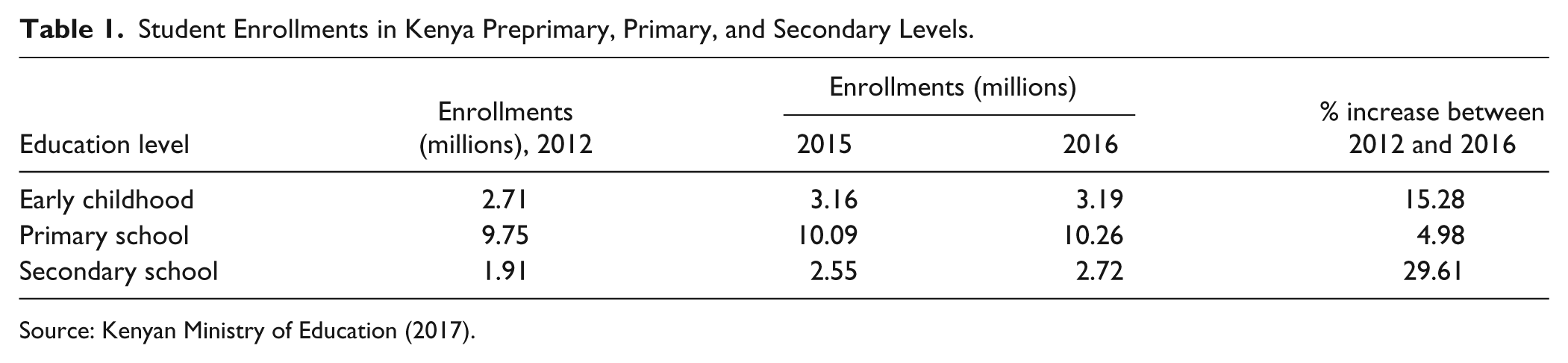
Source: Kenyan Ministry of Education (2017).
Numbers of Trained and Untrained Teachers in Kenya by Education Level for 2015 and 2016.
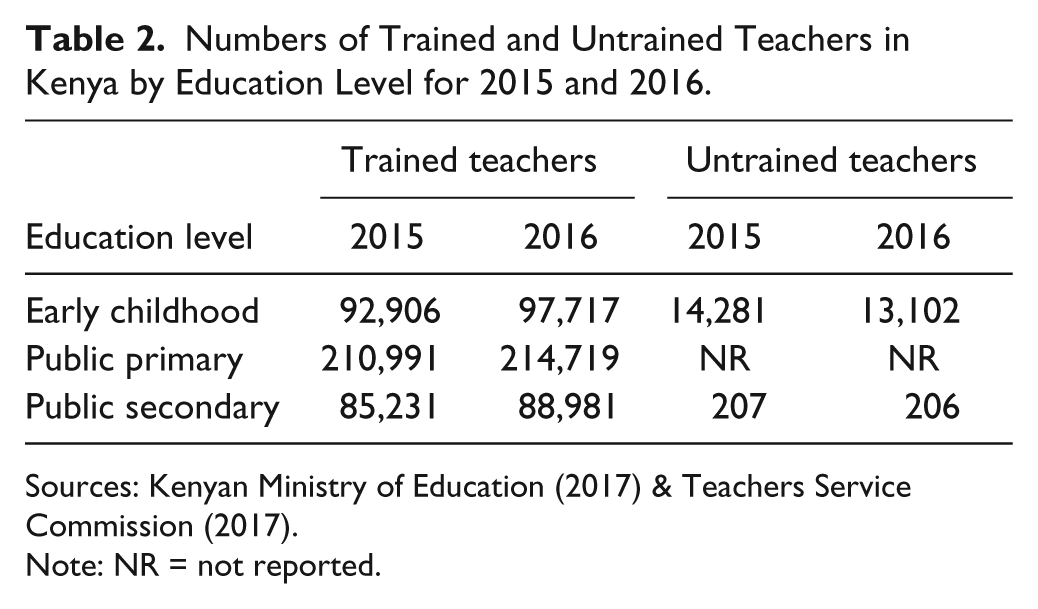
Note: NR = not reported.
However, low enrollments for students with disabilities persist (Nyeris & Koross, 2015). Scholars have attributed this discrepancy in school enrollments between students with and without disabilities to various reasons, including lack of policy implementation in schools (Gathumbi, Ayot, Kimemia, & Ondigi, 2015), low funding from the government, limited training for special education personnel, and underdeveloped assessment procedures (Chomba, Mukuria, Kariuki, Tumuti, & Bunyasi, 2014). The low enrollments also mean that fewer students with disabilities graduate from secondary schools. In 2015, according to the MOE, 2,118 students with disabilities graduated from secondary school, a minimal increase from 2,097 students in 2014 (Kajilwa, 2016).
Special Education in Kenya
In the 1940s, religious institutions such as churches provided care and special education to people with disabilities (e.g., visual, physical, intellectual). Two decades later, in 1986, the Kenya Institute of Special Education (KISE) was established as an organization under the MOE, with the aim of providing teacher training and instructional materials for students identified with disabilities (KISE, 2016). In 1989, various organizations merged to form the United Disabled Persons of Kenya. These organizations were the Disabled Person’s Organization, the Kenyan Union of the Blind, the Kenya National Association of the Deaf, and the Kenya Association of the Physically Handicapped. In 1997, as a result of lobbying from a group of people with disabilities, the Kenyan government created a task force to investigate existing polices on disability and the Persons with Disabilities Act (Persons with Disabilities Act No. 14, 2003) was consequently enacted in 2003 (Opini, 2010). This action launched the National Council for Persons with Disabilities, mandated to develop policies and ensure that people with disabilities received improved opportunities in various sectors (e.g., education, employment, and recreation; Opini, 2010).
Understanding Disability in Kenya
Kenya has participated in international treaties and has shown commitment to provide equal opportunities to people with disabilities. For instance, Kenya is a signatory of the Salamanca Declaration (UNESCO, 1994), which affirms that every child has unique characteristics, interests, abilities, and learning needs. In addition, in 1989 Kenya ratified the Convention on the Rights of the Child (UN, 1989), which requires countries to provide free education to students identified with disabilities to ensure that they achieve their potential. Beyond these two treaties, Kenya is a signatory of the Education for All (EFA; UNESCO, 2000) goals in Dakar and made a commitment to improve access to education for marginalized populations (e.g., people with disabilities). Also, to demonstrate a commitment toward inclusive practices, Kenya is a signatory of the Convention on the Rights of Persons with Disabilities (UN, 2006). Participation in these treaties shows a commitment from the Kenyan government toward including people with disabilities, protecting their rights, ensuring access to appropriate education services, and valuing their abilities. Furthermore, the new constitution, adopted in 2010 (Republic of Kenya, 2010) included a requirement of nondiscrimination based on disability, another step toward safeguarding the rights of people with disabilities (Murray, 2015). Preceding the new constitution, in 2008 the Kenyan government launched Kenya Vision 2030, a development initiative developed in collaboration with multiple stakeholders (e.g., the Kenyan government, local citizens, local and international experts) with a vision to enhance the quality of life for its citizenry. Education and training are core components of Vision 2030, in particular the development of programs for students with disabilities (Republic of Kenya, 2007).
Special Needs Education Policy Framework
In 2009, the MOE in conjunction with multiple partners developed the SNE policy framework (Republic of Kenya, 2009) to ensure that students with disabilities receive equal access to special education services and further boost the country’s goal of achieving EFA. The SNE policy framework is the guiding document for providing special education services in Kenya. Some of the objectives of the SNE policy framework include assessment and intervention, advocacy and awareness creation, capacity building and development, research and documentation, and use of specialized facilities and technology (Republic of Kenya, 2009).
After World War II, special education was provided to four categories of students with disabilities: hearing impaired, mentally handicapped, physically handicapped, and visually impaired (Republic of Kenya, 2009). Following the enactment of the FPE (2003), additional special education categories were added to the existing four categories (i.e., autism, cerebral palsy, Down syndrome, multiply handicapped children, and gifted and talented; Republic of Kenya, 2009). The development of the SNE policy framework expanded special education to 22 categories (Republic of Kenya, 2009). These categories include students who are orphaned, those internally displaced from their homes of origin, and students from nomadic communities. While the intention to protect potential oversight to the unique needs of students facing unfortunate life circumstances may be well intentioned, a rationale is warranted but not provided in the SNE framework for the inclusion of these latter categories (e.g., orphaned, internally displaced from their homes of origin, from nomadic communities) in the SNE policy framework, whose focus is on students with special needs. This oversight warrants clarification as it could lead to misidentification of students for special needs based on life events or lifestyles not synonymous with disabilities.
Moreover, although the SNE framework lists the different special education categories, it is unclear whether students are actually identified and placed in the categories (e.g., emotional and behavioral disorders or learning disabilities) outlined in the SNE framework. Presently, students with mild learning difficulties are integrated in general education classrooms; students with physical disabilities, intellectual disabilities, and visual and hearing impairments largely receive instruction in special schools or special units in the general education schools, although there are few cases of integration into general education schools (Elder, Damiani, & Oswago, 2016).
Special Units and Special Schools
Special units are classes in public schools where students with disabilities receive instruction separately from their peers without disabilities. The special units serve students with varying disabilities (e.g., intellectual and physical disabilities; Elder, 2015; Elder et al., 2016). In 2012, there were 1,341 special units in the country serving 81,649 students with disabilities, meaning that only a few public schools have these special units or special classes (Republic of Kenya, 2009). According to the Office of the High Commissioner on Human Rights (2011), in Kenya, there are 114 special schools in the country serving 24,000 students. These schools are for students with specific disabilities (e.g., cerebral palsy, Down syndrome, hearing impairments, visual impairments, physical or intellectual disabilities) and are located in various part of the country.
The schools provide students with education and related services, including assessments, evaluations, occupational therapy, auditory training, and life skills. Depending on students’ needs, in some of the special schools, students spend a period of time receiving special education services before transitioning back to the general education school. Also, the provision of education and related services varies among the schools depending on the available instructional resources, parental awareness, and parental involvement in their children’s education (Kamau, 2017).
Challenges and Current Reforms
The FPE initiative led to increased school enrollments as students previously unable to attend school due to financial constraints could enroll in school. However, Kenya experiences additional challenges and barriers that curtail access to educational opportunities for all students, especially students with disabilities. These challenges include inadequate teacher training, underdeveloped identification and assessment processes, limited monitoring and evaluation of special education policies, and limited funding (Chomba et al., 2014; Elder et al., 2016).
Teacher Training
The government of Kenya acknowledges that teachers are vital in the education process and critical in achieving the Kenya Vision 2030, an initiative that emphasizes that education is core in contributing to the development of human and social capital and, in the long run, key for sustainable development (Republic of Kenya, 2012). To this end, according to the Kenya Bureau of Statistics (2017), the MOE planned to increase expenditure by 13.5% in 2017, with 60% of the funds allocated to the development and training of teachers. Table 2 shows increases in the number of trained teachers in 2016 across the three levels (i.e., early childhood, primary, and secondary).
Teacher training falls under the following categories: (a) early childhood development and education (ECDE), (b) primary teacher education, (c) diploma education, and (d) graduate teacher education. Graduates of the teaching programs receive teaching certificates, degrees, or diplomas. Annually, at the end of a 2-year program, on average 10,000 graduates receive certificates in teacher training and 12,000 graduates receive diplomas (Republic of Kenya, 2012).
Training in ECDE is provided in ECDE centers and District Centers for Early Childhood Education (DICECE). The centers are responsible for training preschool teachers and related services personnel, as well as supervision and inspection of preschool programs (Gakuru, Riak, Ogula, Mugo, & Njenga, 1987). DICECE training centers have expanded especially after the World Bank project in ECDE showed growth over the years (i.e., from 1990 to 2000) with an increase in the number of trained teachers. This increase is attributed to the MOE’s collaboration with a number of stakeholders including nongovernmental organizations, faith-based organizations, and the Kenya Institute of Education (Mbugua, 2009). The Kenya Institute of Education (KIE) is a governmental department responsible for developing curriculum materials and providing in-service teacher training. However, data show that a large percentage of the teachers in early childhood classrooms are untrained (KIE, 2005).
Public and private universities provide 4-year graduate teacher courses throughout the country with courses offered at the graduate level to prepare special education teachers. KISE offers certificate and 2-year diploma level special education courses for teachers that range from Braille courses to Kenyan Sign language. To increase accessibility and enrollment, KISE provides some of its teacher education programs through distance education. Annually, 240 trainees graduate at the certificate level and 1,800 trainees graduate at the diploma level (Republic of Kenya, 2012). These are fairly small numbers of trained teachers in special education, posing a major obstacle toward ensuring all students receive high-quality educational opportunities.
Identification and Assessment
Effective assessments are critical for evaluating students’ present levels of performance and making appropriate decisions on effective instructional practices. In Kenya, underidentification of students with disabilities is largely compounded by underdeveloped assessment and referral procedures (Bruce & Venkatesh, 2014). Assessment and referral for special education services are processed through Educational and Assessment Resource Centers (EARCs). The EARCs play a major role in facilitating access to education for students through appropriate placement. However, these EARCs are underfunded and are not easily accessible to all schools in the country, undermining the identification and assessment process (Flower, 2016; Nyeris & Koross, 2015). Also, scarcity of resources and specialized services for students with disabilities continues to be a pervasive challenge (Chomba et al., 2014; Gathumbi et al., 2015). Subsequently, many students who need special education services remain unidentified and miss out on an appropriate education. For instance, prior to 2003, most students with autism spectrum disorder (ASD) did not receive any special education services (Autism Society of Kenya, 2013). The Autism Society of Kenya was established in 2003 and currently provides special education services to students with ASD (Autism Society of Kenya, 2013).
Context
Cultural perceptions toward disabilities are a hindrance that keeps students with disabilities from receiving access to education or appropriate services and may lead to stigma and marginalization (Bruce & Venkatesh, 2014; Elder, 2015). Moreover, lack of advocacy and participation from parents and the community result in reduced awareness about disabilities, leading to further marginalization especially in the rural areas (Elder et al., 2016).
Although students with disabilities in both rural and urban areas face barriers that limit access to education, compared to students in the urban areas, students with disabilities in the rural areas face increased barriers mainly related to limited infrastructure, increased marginalization for girls, and fewer available resources (e.g., limited water and electricity; Maiwa & Ngeno, 2017). In addition, students in the rural areas are more likely to drop out of school to meet their families’ financial needs (Elder et al., 2016). Estimates from the Kenya National Survey for Persons with Disabilities (2008) showed that 72% of people identified with disabilities live in the rural areas. After the enactment of FPE, classrooms in Kenya were not prepared to meet the demands of huge student enrollments, especially in the rural areas (Elder et al., 2016). Additional challenges include lack of teaching resources, inadequate physical infrastructure, and limited special services for students with disabilities (Gathumbi et al., 2015).
Inclusion
In the SNE policy framework (Republic of Kenya, 2009), inclusion is defined as “a philosophy which focuses on the process of adjusting the home, the school, and the society so that all people, regardless of their differences, can have the opportunity to interact, play, learn, work and experience the feeling of belonging and experiment to develop in accordance with their potentials and difficulties” (p. 5). Inclusive education is defined as “an approach in which learners with disabilities and special needs, regardless of age and disability, are provided with appropriate education within regular schools” (p. 5).
The SNE policy framework (Republic of Kenya, 2009) provided a critical first step toward inclusive education in Kenya and includes requirements for the inclusion of students identified with special education needs in the education system. The SNE policy framework provides all stakeholders with a comprehensive guide for implementing special education policies and procedures. However, especially in public schools, due to large class sizes, high teacher-student ratios and limited teacher training, the reality of inclusion is yet to be realized (Maiwa & Ngeno, 2017; Wafula, Poipoi, Wanyama, & Begi, 2012). To summarize, although there are policies in place to ensure students with disabilities receive an appropriate education, low enrollments for students with disabilities and limited access to appropriate education services persist due to inadequate teacher training, geographic location, limited resources, cultural perceptions, and underdeveloped identification and assessment procedures.
Recommendations
Clearly, there are positive trends and proactive education reforms in place for improving teaching students with disabilities in Kenya. The government acknowledges that students with disabilities historically have been marginalized, and in reality denied basic opportunities to access quality education (Republic of Kenya, 2009). In light of this, the enactment of the SNE policy framework (Republic of Kenya, 2009) was a major step in putting forth a framework that provides stakeholders with a comprehensive guideline of actionable steps. Also, in 2016, the government allocated $8.7 million toward developing a national referral center, improving teacher training, and improving school infrastructure to increase education access for students with disabilities. However, these policies have to be accompanied with a real-time commitment toward ensuring students with disabilities receive a quality education. Commitments will be required in terms of increased accountability measures, monitoring of funding, increased quality teacher training, investing in assistive technology, disseminating positive messages on disability awareness, changing negative cultural perceptions toward students with disabilities, and improving accessibility in schools, work and public spaces. More importantly, proactive practices such as early screening for learning difficulties can facilitate the implementation of intensive instruction, alleviating learning challenges as students progress in their learning (Elder et al., 2016).
In addition, there is an urgent need for clarity in the language employed in the SNE policy framework pertaining to students who are orphaned or come from nomadic communities. Including these students in the SNE policy framework conflates life circumstances or lifestyles with disabilities and demonstrates an unfortunate bias that can lead to misidentification of students for special education services. In a related vein, the extent of the diffusion of the SNE policy framework in classrooms is unclear, making it nearly impossible for stakeholders (e.g., parents, researchers, educators) to gain a clear picture of the special education landscape in Kenya. Limited availability of information and ambiguity regarding the SNE policy implementation leads to inadequate use of scarce resources, and increases the likelihood of large percentages of students missing out on educational opportunities due to lack of reliable data. Accurate information on student enrollments, students’ performance or the criterion for student identification is critical in providing services to students with disabilities in an efficient and effective manner.
More collaborative work among stakeholders is needed to ensure students with disabilities receive a quality education. For instance, curriculum developers may consider evaluating the current curriculum to ensure all students have meaningful access to the curriculum content. Related to this, there is a need for a pedagogical shift that differentiates instruction for students. These changes will require continuous teacher professional development on effective research-based practices. Odongo and Davidson (2016) noted that although teachers in Kenya reported being receptive to inclusion (i.e., teaching students with special education needs in the general education classes), the teachers expressed frustration with being left out of policy development. Involvement of teachers in policy development is imperative in the development of educational policies and may cultivate possible buy-in for policy implementation.
Conclusion
Kenya has made strides in providing special education services to students with disabilities. Over the years there have been changes in legislative mandates that have brought to the forefront the urgency of providing access to education for all students, especially students who have historically been marginalized due to learning difficulties or disabilities. FPE (2003) provided opportunities to many students previously denied educational opportunities due to unaffordable school fees, and this is evident in the increased student enrollments at the ECDE, primary, and secondary levels (Kenya Bureau of Statistics, 2017). In addition, the SNE policy framework (Republic of Kenya, 2009) has pushed the inclusion agenda forward and prioritized the provision of educational services to students with disabilities. Although some success has been obtained from these initiatives, the continued existence of segregated settings where a bulk of students identified with disabilities receive instruction means much work needs to be done to ensure inclusion of students with disabilities in general education settings.
Furthermore, questions remain regarding the quality of FPE, and for students with disabilities, the question of enrollment and outcomes persists (KNCHR, 2014). Last, there is a need for trained special education expertise to adequately meet the needs of students with disabilities. To increase the quality of special education services and implementation of inclusion policies in schools, accountability measures are necessary to ensure policies are implemented. Effective implementation will require intentional collaboration, participation among stakeholders, and involvement of people with disabilities to ensure all the voices are heard in the true spirit of “nothing about us, without us” (Powell, 2014, p. 347).
Footnotes
Declaration of Conflicting Interests
The author declared no potential conflicts of interest with respect to the research, authorship, and/or publication of this article.
Funding
The author received no financial support for the research, authorship, and/or publication of this article.