




Abstract
Schoolwide positive behavioral interventions and supports (PBIS) is a systems-level approach to promote appropriate behavior, increase academic achievement, and improve school climate. The PBIS infrastructure engages families as partners in school systems and extends evidence-based positive behavior support to the home. The article discusses a pilot investigation and describes objectives, associated activities, and implementation guidance to engage families as partners in PBIS.
Keywords
Family engagement refers to distinct ways that families support their children, which are embedded in cultural beliefs and ideologies. Family engagement is active, interactive, and dynamic (Sheridan, Knoche, Kupzyk, Edwards, & Marvin, 2011). Active properties of family engagement are defined based on the specific intervention and tier of support. For example, a parent can communicate with the child’s teacher about classroom behavior. Family engagement is interactive because it includes families working and communicating with stakeholders in the child’s life. Family engagement is dynamic because it changes as families interact with stakeholders and as children develop. Families or educators may initiate activities, but families often wait for schools to initiate contact (Christenson & Reschly, 2010; Davies, 1991). Thus, it is important for schools to create a role for families and clearly communicate that role and its components. Once engaged, the goal is to create partnerships (Christenson & Sheridan, 2001).
Ecological systems theory (Bronfenbrenner, 1977) describes the importance of home and school, and connections between them, for child development. Research suggests that family engagement is positively associated student academic achievement (Fan & Chen, 2001) and negatively associated with behavior problems (Domina, 2005). Furthermore, a series of randomized-controlled trials reveal positive outcomes for students (Dishion et al., 2008; Sheridan et al., 2012; Stormshak et al., 2011).
Theoretical foundations and research findings provide convincing support that family engagement is important for children. However, the ways in which families are frequently engaged (e.g., volunteering at school events) may be limiting the impact of family engagement on child outcomes. Furthermore, common family engagement strategies do not provide equal opportunities for all families to engage (Mapp & Hong, 2010). To amplify the positive impact of family engagement and provide equal opportunities for families, it is important to create a clear and well-defined role for family engagement embedded within existing school systems based on empirically validated practices (Dishion, 2011; Garbacz et al., in press).
Family Engagement in School Systems
Schoolwide positive behavioral interventions and supports (PBIS) is a systems-level framework that uses evidence-based practices to provide proactive behavior support for students (Sugai & Horner, 2002). Randomized-controlled trials of PBIS have found positive effects on student behavior, school climate, and academics (Bradshaw, Mitchell, & Leaf, 2010; Horner et al., 2009). The PBIS framework (Sugai & Horner, 2002) provides a scope and sequence for extending evidence-based positive behavior support to the home and engaging families to support students at school and across the home-school connection. In this approach, family engagement is linked with evidence-based practices, embedded in existing systems, and organized for implementation (Dishion, 2011).
Garbacz et al. (2016) developed a framework to organize family engagement in Tier 1 PBIS that identified intervention components. In their framework, Garbacz et al. proposed engaging families and school staff together as partners in PBIS. PBIS leadership teams engage in systems-level planning and problem solving to address the following intervention components (a) engage families in school implementation of PBIS, (b) extend the evidence-based positive behavior support practices for home implementation, and (c) coordinate and align the school and home systems for home-school implementation. Components of the framework promote parent and teacher knowledge and skill building and facilitate implementation of effective parenting and school staff practices that improve school climate and family-school connections, which in turn improve student outcomes.
Emanating from the Garbacz et al. (2016) framework, hypothesized active properties or core features of family engagement in Tier 1 PBIS include (a) participation in PBIS at school (e.g., participate in meetings, codevelop implementation plans, knowledgeable about school expectations), (b) implementation evidence-based parenting practices at home (e.g., create and supervise a home-based learning environment for homework, use a home PBIS matrix to teach and acknowledge expectations, use a continuum of strategies to respond to inappropriate behavior), and (c) communication with school staff (e.g., inform school staff about child needs, discuss strategies to align home and school support, ask about school behavior and academics; Christenson & Sheridan, 2001; Fette et al., 2009; Horner, 2017).
An exploratory pilot investigation of the Garbacz et al. (2016) framework revealed that school staff implemented and sustained into a second year 44% of the intervention components while maintaining over 90% PBIS implementation fidelity. Furthermore, there were concurrent decreases in parent report of discrete student behaviors (e.g., follows directions, behaves well) and PBIS Leadership Team members reported high acceptability of the family engagement in PBIS framework. Despite the initial utility of the Garbacz et al. framework, the pilot investigation had important limitations, which suggested a need to create core objectives to support implementation of the features of family engagement in PBIS to provide practical implementation guidance to improve implementation.
Six objectives support implementation of the previously mentioned core features of family engagement in PBIS, which address the overall goal to improve children’s social behavior and learning. The six objectives include to (a) create a schoolwide vision for family engagement, (b) identify sources of family engagement evidence, (c) engage families to cocreate PBIS at school, (d) provide families with the knowledge and skills they need to use positive behavior support at home with their children, (e) form and strengthen positive relationships between families and educators, and (f) align PBIS at school with parent use of positive behavior support at home. In the sections that follow, each objective is described with associated activities.
Objective 1: Create a Schoolwide Vision
To create a schoolwide vision for family engagement in PBIS, planning and assessment are important to initiate in advance of initial implementation (e.g., when the action plan is developed a year in advance). The Hexagon Tool (Kiser, Blase, & Van Dyke, 2013) is a useful guide. Using the Hexagon Tool, teams evaluate contextual fit by exploring factors such as resource availability, student needs, and capacity for adoption. The Hexagon Tool offers a valuable approach for considering how family engagement in PBIS aligns with existing approaches.
Assess Readiness
Two dimensions relevant to readiness are faculty attitudes toward family engagement and existing approaches to family engagement. School staff and family attitudes and approaches to family engagement are important considerations to take stock of the system’s capacity for a schoolwide family engagement initiative. For example, if substantial concerns are identified with attitudes about family engagement, it may be useful to address those concerns prior to moving forward with implementing family engagement practices in PBIS. A school’s approach to family engagement refers to elements such as, expectations for family engagement and a mission statement (Christenson & Sheridan, 2001). Readiness can be assessed by distributing surveys (Christenson & Sheridan, 2001) and conducting focus groups with families and school staff. After reviewing readiness data, strengths and needs are identified and consensus for moving forward is reached (Kiser et al., 2013).
Examine and Build Capacity
Resources, personnel, and connections to organizations with a similar mission help build capacity for engaging families as partners in PBIS. Resources, such as funds, can provide support for materials, food for events, assistance with transportation, and staff time. Personnel are important to assist in creating and executing plans. Organizations may have materials, individuals to provide consultation, and may be able to make connections to other schools or districts with similar family engagement priorities.
Identify funds and create connections
When creating connections, the emphasis is on connections that facilitate continuous regeneration of the family engagement practices (OSEP Technical Assistance Center on PBIS, 2015a), support a cyclical process of evaluation and reevaluation, and develop culturally responsive practices. The school district is an important first stop. A school district can provide funds, allocate personnel, and establish a larger vision for family engagement at the district level. In addition, state PBIS organizations can be consulted. State PBIS organizations may have a statewide network of coaches who can provide support, such as trainings, coaching, connections with other school faculty with family engagement priorities, and access to materials. In addition, the state organization may have links to state government, which can help facilitate defining a broader role for family engagement and allocating state funds. University programs can also be a source of support (Spoth, 2007). Some universities have training programs with a focus on ecological systems, prevention, and tiered systems of support. Universities can send materials or provide trainings. In addition, a partnership with the parent-teacher association (PTA) can be forged to (a) build shared ownership over family engagement in PBIS practices, (b) establish a feedback loop with families, and (c) discuss cultural considerations for the school community. PTA meetings are a good opportunity to discuss ideas with families and obtain their feedback (e.g., times to hold events, feedback on materials).
Build knowledge and consensus
It is useful for school faculty, such as PBIS leadership team members, to build their knowledge about family engagement. For example, attending family engagement training sessions at a local or regional education conference or through a webinar could help build team members’ knowledge about family engagement, which they can in turn share with school faculty (Minch, Luecking, & Sanders, 2017). Learning about foundational concepts (e.g., home-school connections) will inform decision making about partnering with families in PBIS (McGlinchey & Goodman, 2008). Similarly, holding an event for all school faculty on family engagement (e.g., conducted by a local or regional PBIS consultant), along with follow-up dialogues and coaching, can encourage conversations about family engagement toward creating a shared vision and building buy-in.
Integrate cultural responsiveness
A final element to building capacity concerns cultural responsiveness. Cultural responsiveness in PBIS aims to enhance educational equity through changing school cultures and systems (Leverson, Smith, McIntosh, Rose, & Pinkelman, 2016). Leverson et al. (2016) indicated that cultural responsiveness in PBIS has five components. The first component prioritizes understanding one’s own identity as well as student, family, school, and community identity. Second, there is an emphasis on engaging all families and community members in partnership, understanding their voice, and integrating their voice in the school and PBIS systems. The third component includes building a supportive environment where all staff are united in a common system of practices with goals to value students and support students to value themselves. In addition, there is an emphasis on reflecting students and their experiences in the school atmosphere. Fourth, situational appropriateness addresses understanding and demonstrating variations in expected behavior across settings, while valuing home and community systems free from judgment. The fifth component includes disaggregating data to determine whether subgroups may be adversely affected.
Engaging families as partners in PBIS systems is well aligned with cultural responsiveness in PBIS. Family engagement in PBIS means that families and school faculty are cocreators and decision makers who build systems and practices that reflect family culture, beliefs, and values. One strategy to build capacity for culturally responsive practices is to collaborate with a cultural broker in the community or school district. Cultural brokers can be identified at the district level and/or through community centers. A cultural broker can assist the PBIS leadership team to take stock of existing practices, partner with families to understand their cultural values and beliefs, modify school PBIS practices, and create family engagement practices that are culturally responsive. It may also be useful for the PBIS leadership team to seek training in culturally responsive practices (Garbacz et al., 2016).
Family engagement through PBIS must reach families for whom common outreach approaches have been inadequate. The goal is to create a shared vision for PBIS family engagement that includes the entire school community (e.g., families, teachers, students). Schools can hold town hall events and focus groups to talk with families about PBIS and obtain feedback (Sandomierski, Minch, Winneker, & Hall, 2017). Similar events held at different times and locations (e.g., community centers), which include child care, food, and transportation, may be most effective in supporting attendance (Kratochwill, McDonald, Levin, Scalia, & Coover, 2009). Other approaches for sharing information include posting on websites and social media. It can be particularly useful for families to communicate directly with other families about PBIS and family engagement activities (Kratochwill et al., 2009). Finally, information should be available in all languages represented in the school and written without technical jargon.
Objective 2: Identify Sources of Evidence
Sources of evidence for family engagement include assessments of the family engagement components, valued outcomes, usability, and acceptability of procedures. To assess family engagement in PBIS, the objectives of family engagement could be included on a self-assessment that includes other school approaches to family engagement in PBIS (Garbacz, McIntosh, Vatland, Minch, & Eagle, 2018). Each school will have different valued outcomes. Outcomes may span student, family, teacher, and home-school outcomes. For students, attendance, home and school behavior, and achievement could be considered. For family members, knowledge of positive behavior support, use of positive behavior support, and family engagement are options. For teachers, attitudes about family engagement, teacher report of family engagement, and teacher invitations for family engagement could be examined. Usability assessments can focus on appropriateness and feasibility (Lane et al., 2009) to guide action planning. Finally, acceptability data can be gathered from the PBIS leadership team and school faculty as well as family members.
Objective 3: Engage Families to Cocreate
When engaging families as partners in PBIS, the emphasis is on cocreating systems and practices and sharing in decision making. Objective 3 is important because the logic of family engagement in PBIS indicates that partnering with families to cocreate plans and strategies is thought to be a mechanism to improve valued outcomes for students. Specific strategies for engaging families to cocreate PBIS can be incorporated in an action plan (OSEP Technical Assistance Center on PBIS, 2015b).
Engage Families as Partners in PBIS Meetings
A first step to engaging families as partners in PBIS meetings is to establish family representation on the PBIS leadership team. To facilitate family engagement, it is important to document roles and responsibilities for family members. Serving on the PBIS leadership team may be a new role for many family members. Providing an orientation to meetings and role expectations is important. PBIS leadership teams can use The Guidebook for Serving on Groups (Linse, Salzer, Skadahl, Van Vooren, & Wians, 2013) as a foundation for their orientations to family members about serving as members on school-family teams. The guidebook for provides an orientation to serving on teams, including roles and responsibilities, group processes, tools for understanding data, and family member roles. In addition to a foundation in serving on groups, it would be helpful for a PBIS leadership team member to serve as coach and point of contact for parents. Providing an orientation and coach will make information and support available to families to promote engaging as full partners in planning and problem solving. Strategies used with families who serve on the PBIS leadership team can be used with other families who participate in shared governance in the PBIS systems.
The PBIS leadership team is the core team engaging in systems-level planning for the family engagement practices. Thus, family engagement will be addressed during PBIS leadership team meetings. To maintain a focus on family engagement while sustaining PBIS practices, three strategies may be useful: (a) dedicate time during each leadership team meeting to family engagement, (b) obtain coaching in family engagement, and (c) allocate time at specific intervals to discuss culture and the extent to which systems and practices are culturally responsive. In addition to creating a place for families on the PBIS leadership team, all families in the school can contribute to creating systems and practices. Grade-level family teams or a family engagement subcommittee could be created, for which the family member on the PBIS leadership team is a core contributor. The subcommittee can be an opportunity for the family member on the PBIS leadership team information to share with the PBIS leadership team.
Review Data Together
School-level outcome data could be collected for review at a midyear check-in and at the end of the school year. Fidelity data could be collected immediately after the school year begins, at a midyear check-in, and at the end of the school year. Fidelity data may be best reviewed alongside the current action plan so that the PBIS leadership team and family members can focus on goals and current priorities. In addition to maintaining a focus on priorities, the leadership team uses data to inform decisions. As with PBIS implementation, family engagement data should document implementation and determine whether valued outcomes are obtainable (OSEP Technical Assistance Center on PBIS, 2015a).
The PBIS leadership team may consider reviewing data with (a) the district leadership team, (b) school staff, (c) families, and (d) the PTA. Sharing data with the district supports an ongoing investment in family engagement at the district. Reviewing data with families communicates honesty, transparency, and facilitates partnerships and shared decisions.
Objective 4: Provide Families with Knowledge and Skills
To extend positive behavior support to the home, there are three levels of engagement (Sanders, 2010): (a) materials (e.g., videos, step-by-step guides) about how to use positive behavior support at home, (b) general workshops that teach families strategies, and (c) specific workshops that teach families about discrete tactics and provide opportunities for practice. Objective 4 is important because the logic of family engagement in PBIS indicates that families need knowledge and skills to implement the evidence-based positive behavior support practices at home, which in turn is thought to improve valued outcomes for students. The following tasks are driven by an action plan and used when preparing for implementation.
Create and Use Materials
In partnership with families and other stakeholders, a home PBIS matrix with the school expectations operationalized for settings in the home (e.g., homework time) is developed (see Figure 1 for an example). A home PBIS matrix can be developed with families at events (e.g., spaghetti dinner at the school) during which PBIS leadership team members are available to support families in developing their matrix (S. Garvey, personal communication, June 29, 2017). In addition, information about PBIS can be described in flyers, brochures, and videos using nontechnical language (Dishion & Stormshak, 2007; Smolkowski et al., 2017). Materials are created in languages used families in the school community and distributed in multiple locations to increase accessibility (e.g., in paper form available at the school, posted on the school website or social media page). When identifying ways to disseminate information, the methods used facilitate a back-and-forth dialogue with families so that questions can be answered and families can provide feedback.
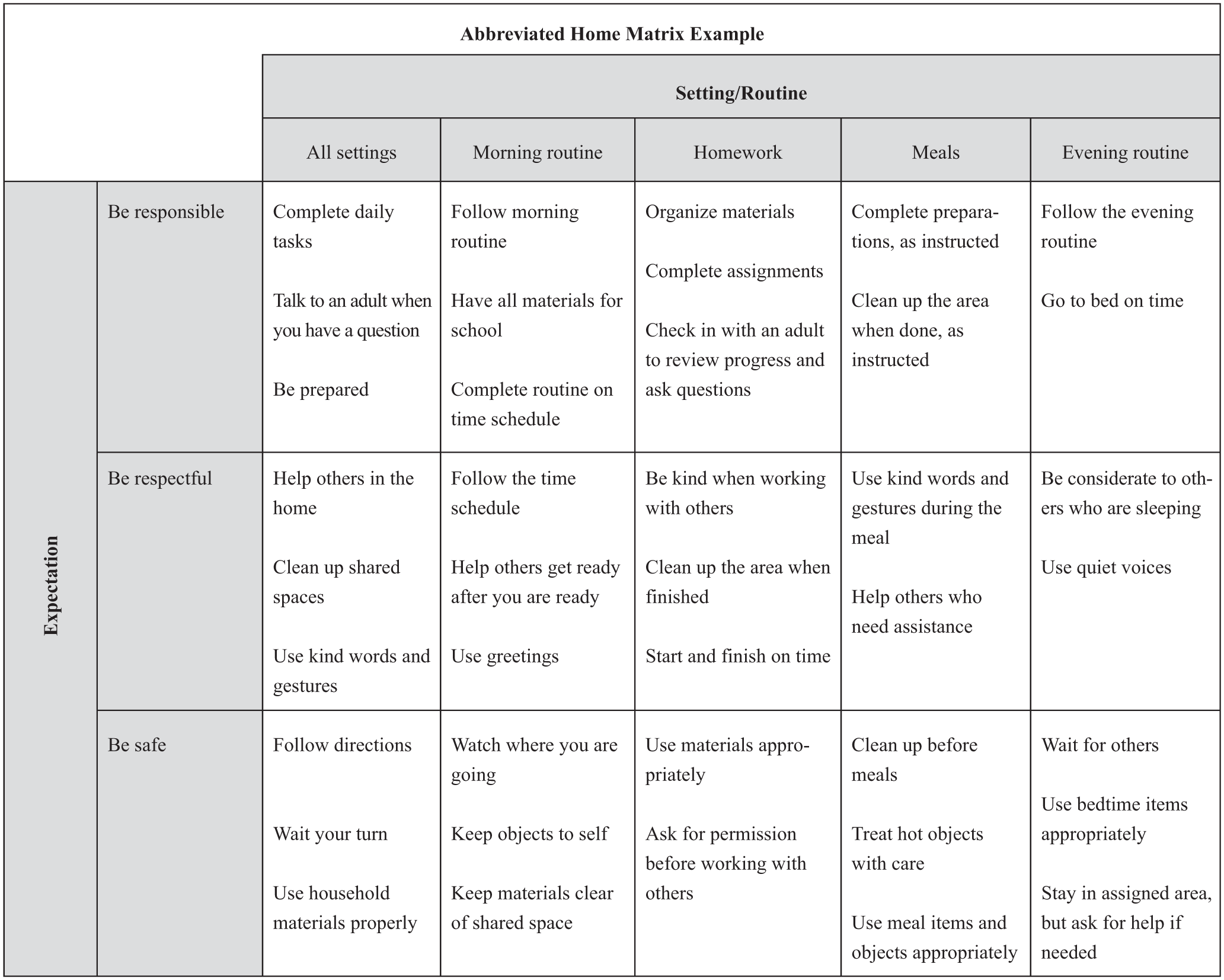
Sample home PBIS matrix.
Hold Workshops
Workshops held at the school or other easily accessible community center can provide information to families about how to use positive behavior support at home. General workshops focus on describing the matrix, posting the matrix, teaching the expectations, and acknowledging children for following expectations in different settings at home. A general workshop could also describe family engagement opportunities at the school (Dishion, 2011). A series of specific workshops are held to go deeper into using positive behavior support at home, such as a using a continuum of strategies to acknowledge appropriate and respond to inappropriate behavior (Simonsen, Fairbanks, Briesch, Myers, & Sugai, 2008). During workshops, strategies described in materials are discussed and practiced (Sanders, 2010).
Workshop content includes evidence-based parenting strategies, such as the Incredible Years (IY) School Age Program (Webster-Stratton, 1984, 2007). The IY School Age Program is a tailored and collaborative approach (Webster-Stratton & Herbert, 1994) to building parent skills in positive behavior support. It focuses on building parenting skills, improving home-school communication, and decreasing children’s behavior concerns (Webster-Stratton & Reid, 2010). The IY program is particularly relevant for PBIS because it is aligned with a positive behavior support framework (Reinke, Herman, & Stormont, 2013) and has been used in different cultural contexts (McGilloway et al., 2012).
Objective 5: Form and Strengthen Positive Relationships
Based on family-school partnership research (Jeynes, 2012; Sheridan et al., 2012), Objective 5 focuses on home-school connections and parent-teacher relationships as mechanisms to improve valued outcomes for students. Thus, it is important to carefully plan communication and partnership-centered practices.
Communicate With Families
Effective communication is the foundation for family engagement (Christenson & Sheridan, 2001). Establishing effective communication systems that facilitate a back-and-forth sharing of information that can originate from any source (i.e., multidirectional) is a key task during preparation. Effective communication can improve implementation of PBIS at home and at school and build cross-setting (i.e., home-school) congruence. Four guiding themes that characterize a school’s approach to communicating with families within PBIS are to (a) develop equitable communication systems that all families can access (Mapp & Hong, 2010), (b) emphasize proactive and positive communication (Moore et al., 2016), (c) convey the importance of partnering and working together (Weiss & Edwards, 1992), and (d) use multidirectional communication methods (Sheridan, Rispoli, & Holmes,, 2013).
Hold Events
Community-wide events can establish and strengthen family-school connections and clarify PBIS procedures, which are thought to promote positive outcomes. First, during an all school meeting, describe family engagement in PBIS priorities. Second, hold events for families that describe family engagement in PBIS. Third, hold workshops for families about home and school implementation. Fourth, hold a community night event that brings together community organizations (e.g., YMCA) that the school faculty and families can partner with to support children. By including community organizations in school events, supports for families are strengthened through the cross-setting connections. In addition, family-to-family connections are made. Families can provide testimonials about PBIS that can increase community building and engagement (Winslow et al., 2016).
At school events (e.g., literacy nights, parent-teacher conferences), it is useful for a subset of PBIS leadership team members and a family member to attend. A PBIS booth could be set up with materials about PBIS. To support events, community organizations can be asked to make a financial contribution. With funds garnered from community organizations, food can be provided at some events. It is important to hold multiple events at different times throughout the year so that families have several opportunities to engage. Finally, it is important to partner with the PTA. With PBIS efforts and PTA activities that are complementary, a unified, supportive, equitable, and engaging vision can be fostered and maintained.
Partner With Families
As described in other sections, the focus of family engagement in PBIS is on partnering with families. This approach moves away from involvement and toward engaged partnerships (Garbacz et al., 2016). A first step is to communicate to families the family-school partnership priority. Families can be included in universal screening of student behavior to proactively engage families and promote later problem solving (Moore et al., 2016). Family members serve on the PBIS leadership team and other committees and workgroups, the PTA and PBIS leadership team consistently work together, and communication systems are implemented that support a feedback loop between families and school staff.
Objective 6: Align With Support at Home
Aligning PBIS at school with positive behavior support at home promotes congruence across children’s primary settings (Crosnoe, 2015). Congruent environments are important for children and can maximize outcomes for home and school PBIS. Thus, PBIS family engagement is more than what happens at school and home, it is also about the home-school connection.
Create and Distribute Materials
Creating and disseminating materials is necessary to align PBIS across home and school. When creating materials, it is helpful to use similar colors, logos, and styling across home and school materials. That way, families and students experience home and school settings as congruent in their focus on positivity, safety, and predictability. Posters about PBIS are created and placed at the school entryway and prepared for school events. Similar materials for families can be available at all events and in electronic form.
Collect Data
Data are needed to evaluate use of practices at home and school and their alignment. In addition to school approaches to family engagement, data on the use of positive behavior support practices at home, family perceived usability, and valued home outcomes should be assessed (Garbacz et al., in press). After data are collected, they are summarized, cross-setting comparisons are made and shared with school staff and families (Sandomierski et al., 2017), and data-based decisions are built into the action plan.
Implementation
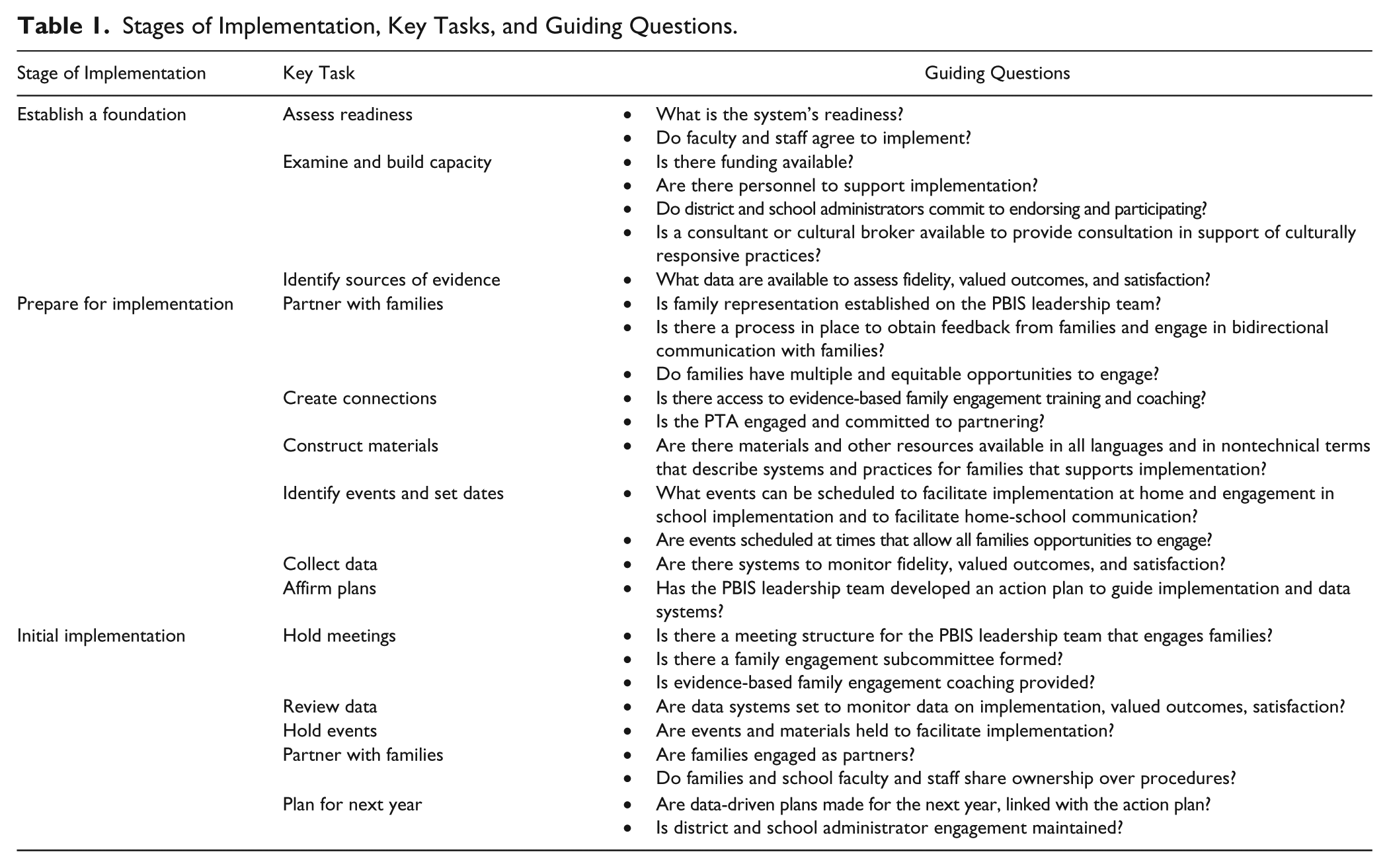
To facilitate implementation, the family engagement objectives and activities in PBIS are grounded in stages of implementation (Fixsen, Naoom, Blase, Friedman, & Wallace, 2005), linked with the PBIS implementation blueprint (OSEP Technical Assistance Center on PBIS, 2015a), and informed by family-centered recommendations (Dishion, 2011; Stormshak et al., 2016). Table 1 aligns stages of implementation with key tasks and guiding questions. Similar to implementation of PBIS, the goal for initial implementation of family engagement systems and practices is to document implementation, obtain feedback from coaches, review data on valued outcomes, and examine usability data (OSEP Technical Assistance Center on PBIS, 2015a).
Stages of Implementation, Key Tasks, and Guiding Questions.
In the late spring or summer prior to initial implementation, plans are affirmed and final preparations are made for initial implementation. This task includes (a) reviewing data collected in spring, (b) discussing any changes to resources, personnel, and scheduling of events, (c) identifying challenges to implementation and developing plans to address challenges, and (d) identifying facilitators to implementation and developing plans to leverage those facilitators to promote implementation and maximize engagement. The year of initial implementation is challenging (Fixsen et al., 2005), but also a time of progress and opportunity. With data on implementation, outcomes, and acceptability, the PBIS leadership team is poised to create a new action plan for implementation the next year. After the PBIS leadership team has internal discussions, it is useful to meet with administrators, school faculty, and families to share progress, discuss plans, and affirm a continued investment in family engagement.
Footnotes
Declaration of Conflicting Interests
The author declared no potential conflicts of interest with respect to the research, authorship, and/or publication of this article.
Funding
The author received no financial support for the research, authorship, and/or publication of this article.