




Abstract
Classrooms are increasingly more diverse, and student success can be enhanced through family engagement, especially for culturally and linguistically diverse (CLD) students with disabilities. Too often teachers are stymied by how to engage CLD families of children with disabilities. Common practices of parent involvement are ineffective and fail to appreciate families as members of the educational team. Family engagement seeks to establish and maintain authentic family-school partnerships based on mutual respect and shared agency for student academic and social success. This column provides specific family engagement strategies that teachers and schools can implement in an effort to provide reciprocal collaboration.
Keywords
Family-school collaboration is a vital aspect of student learning and achievement. Federal legislation requires that school districts seek out parent engagement. The Every Student Succeeds Act (2015) provides funding to support family engagement projects, and the Individuals with Disabilities Education Improvement Act (2004) requires the inclusion of families in the special education processes (e.g., eligibility determination, individualized education planning). Recurrent and shared collaboration between families and schools has the potential to improve family engagement and has been associated with improved grades (Shumow & Schmidt, 2014), achievement (Henderson & Mapp, 2002), enhanced social-emotional learning (Wang & Sheikh-Khalil, 2014), a decrease in office referrals (Sheldon & Epstein, 2002), and more consistent school attendance (Epstein & Sheldon, 2002).
Unfortunately, schools routinely conceive family-school collaboration through a single lens, leading to assumptions about families that are not effective in improving student learning (Ferrara, 2009). Some families report feeling underappreciated or unwelcome in the school environment and often indicate they are confused by the school structure or expectations (Hill & Torres, 2010). Frequently, families are encouraged to be involved in school, but this involvement often revolves around sanitized opportunities of attendance at school activities such as parent-teacher conferences, activities nights, or reading to their child (Baker, Wise, Kelley, & Skiba, 2016; Ferrara, 2009). However, actively and intentionally engaging families is essential for students’ academic and behavioral growth because students learn in a variety of settings that are interconnected (Bronfenbrenner, 1986). Unlike traditional views of family involvement, where the school environment and the home environment are separate systems, family engagement seeks to partner collaboratively with families, and this engagement in student learning, in turn, contributes to student success (Latunde, 2017; Stefanski, Valli, & Jacobson, 2016).
Families share a unique and essential perspective of their children by participating in their child’s learning and development. Therefore, asking families for their perspectives about learning at home and child proclivities for learning can provide valuable information for teachers. This column describes a variety of ways that schools can facilitate home-school collaboration with families that are culturally and linguistically diverse (CLD) to improve student outcomes and enhance family engagement.
Creating an Embracing Environment
Creating a welcoming school climate and environment that promotes a culture of home-school collaboration is critical (Brown, 2009; Obiakor and McCollin, 2011) and fosters the understanding of cultural and linguistic differences among students with diverse backgrounds (Ferguson, Ramos, Rudo, & Wood, 2008). There are four approaches schools can use to create an embracing environment that honors all cultures: interpret, invite, interact, and intend.
Interpret
In order to improve communication and comfort levels for families that come into the school, simple acts of interpretation can be essential (Padak & Rasinski, 2010). Posting welcome signs and having signage in languages that represent the demographics of the student population shows respect for the cultures of families within the school. Creating a welcoming environment that values diversity can assist families in feeling more connected to the school environment (Padak & Rasinski, 2010). Also, the use of interpreter services for families who speak a language other than English may make families feel more at ease during parent conferences or conversations with school personnel. The school should announce that interpreter services will be provided at special education meetings, school-based conferences, and other school events. It is important for interpreters to be briefed on the school personnel’s goals to promote family-school communication, to look at the family members that are being addressed and to be open to and make school personnel aware of the family’s input, questions, and concerns
Invite
Schools can extend invitations for families to share their cultural perceptions and beliefs about their children’s academic abilities, interests, and encourage families to engage in the school and classrooms. Lohmann, Hovey, and Gauvreau (2018) recommend inviting CLD families into classrooms so they can teach students about their culture and share family traditions. Although extending invitations into the classroom are important, the school could also ask families for ideas about school activities to further engage families. Engaging families in school activities facilitates a home-school partnership that benefits all involved and encourages diverse families to feel connected and safe to share their culture, traditions, and language.
Interact
When teachers purposely interact with families and seek out families’ input (e.g., creating a survey or interview families for them to share their requests or desires) about pertinent information relevant to families’ needs, teachers ensure that CLD families of children with disabilities can access information and resources. For example, families of children with disabilities are more prone to stress and may benefit from support services to alleviate stress-related challenges (Hsiao, 2018). Therefore, schools can provide resources of family support available at school as well as outside of school (e.g., community organizations and local associations that serve students with disabilities, family support groups for families from a diverse culture and/or of a child with disabilities). Additional information such as health screenings, tips for transitioning through the various school levels, and how to apply for postsecondary resources (e.g., college, trade schools, adult living supports) could be topics that some families are unaware of but would be beneficial for engaging families in their children’s success.
Intend
School personnel can strive to be more intentional in active listening by creating family-school engagement that embraces CLD families as resourceful and valuable. Active listening includes affirming family members’ contributions, addressing their concerns, needs, and challenges. In addition, school personnel can ensure that they make eye contact when speaking with parents. Also, school personnel may acknowledge invisible but inherent power differentials that exist between families and schools. School personnel can reiterate with families that they are valuable partners by openly communicating with families that they value their contributions, and strive to implement ideas from family members to further improve family-school engagement.
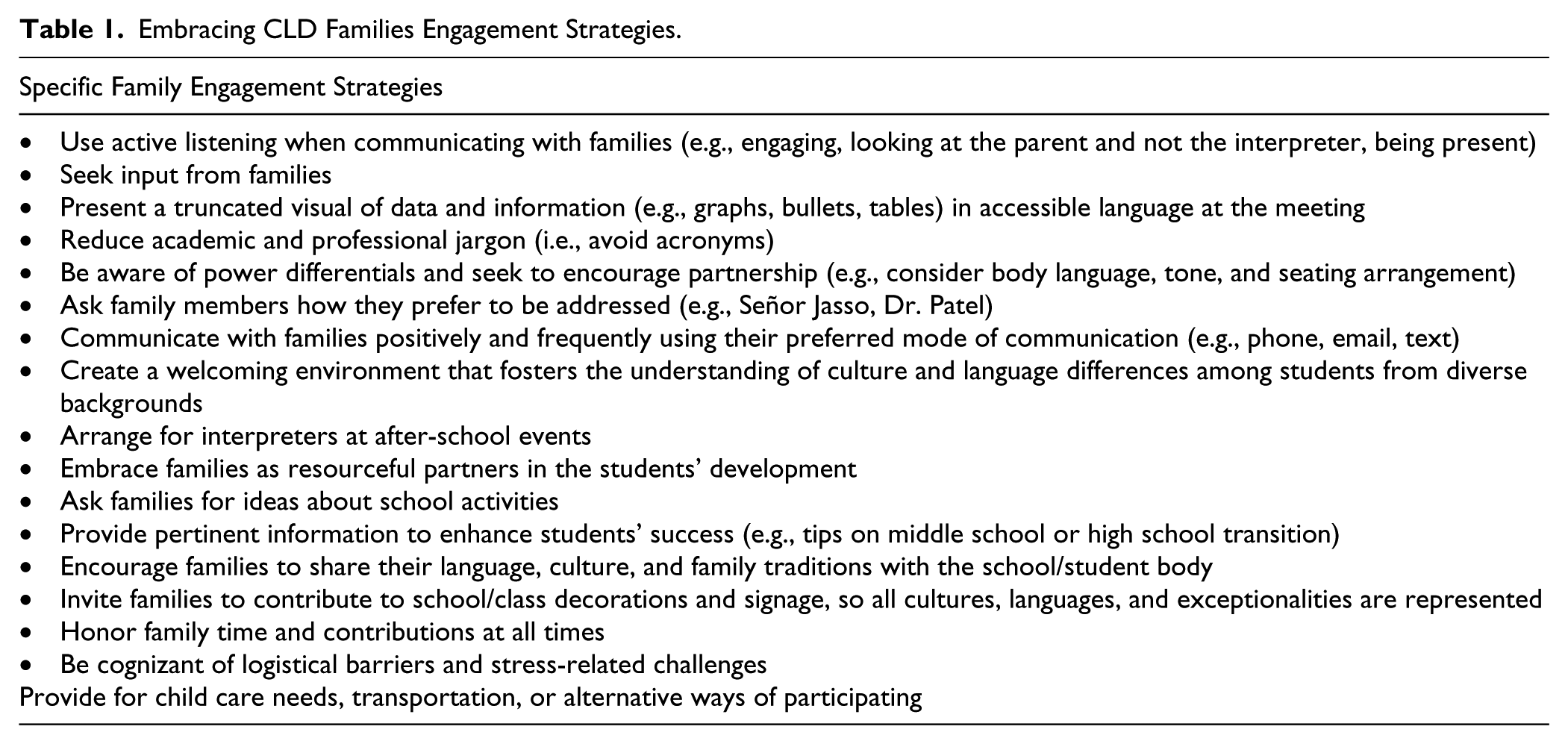
Moreover, school personnel may consider using accessible language to promote meaningful and smooth participation from families (Francis, Blue-Banning, Haines, Turnbull, & Gross, 2016). For instance, school personnel can ensure that their language is free from professional jargon. In addition, school personnel can provide families with numerous opportunities to ask clarifying questions, give examples when explaining complex information (e.g., parental legal rights), and share printed information accompanied by visuals, bulleted phrases, or tables, in the family’s preferred language. Table 1 presents additional ways to embrace CLD families of students with disabilities and improve the family-school connections.
Embracing CLD Families Engagement Strategies.
Engaging with Academic Strategies
Schools can engage families in their child’s learning by providing opportunities to extend learning into the home. One way is through the use of interactive toolkits. Toolkits can be low-cost and easy to create kits with printed materials or existing materials from the teacher’s classroom and are easily adapted for a variety of content areas and grade levels. The toolkits consist of a variety of interactive activities that are aligned with classroom instruction. Toolkits have the potential to increase the families’ engagement in their students’ learning (Floyd & Vernon-Dotson, 2009) and increase students’ opportunities to respond and engage with the content material. To introduce the toolkits to families consider offering a family engagement night for opportunities to learn about the home supports. Interactive toolkits typically include
the content learning standard(s) written in family-friendly language
a list of materials included in the kit
a list of materials that families will need for the interactive activity (e.g., measuring cups, items for counting, items for reading such as newspapers, cereal boxes)
a simple cue card with the directions or the learning strategy being emphasized in class (Floyd & Vernon-Dotson, 2009; Muir, 2016).
Teachers might consider (a) creating a short video that models the strategy or (b) including an infographic of step-by-step instructions in the kit to facilitate family understanding and engagement.
Math
An interactive math toolkit supports the National Council for Teachers of Mathematics (NCTM) recommendation to provide students practice with manipulatives, images, graphs, and visual representatives to enhance students’ understanding of mathematics (Gojak, 2013) and provides activities that allow families to extend their child’s learning. Visual representations used in conjunction with problem solving are an effective approach to teach students with disabilities (Krawec, Huang, Montague, Kressler, & Melia de Alba, 2012). An interactive math kit could include several activities that build on numeracy problems to solve, sample manipulatives, and a cue card translated into the home language and or have simple images of the steps easily shared with home. A sample toolkit on numeracy skills can serve as a foundation for family investigations and might include ten-frames, hundreds charts with missing numbers, or a series of numbers, and even calculator activities (Muir, 2016). For example, a family-friendly learning activity is the broken calculator game. In this activity, a family members pose three numbers to the child and tells him or her to pretend that specific buttons on a calculator are broken and he or she needs to demonstrate how to get to the target number without the use of the identified broken buttons. A family member says, “The calculator has a broken two button and a broken five button. Show me math facts that make 22, 25, 52 without using the numbers 2 and 5” (see https://mathforlove.com/lesson/broken-calculators). Then the child uses paper and pencil to demonstrate an understanding of numbers by solving the broken calculator problem without using the broken buttons.
An interactive math toolkit could alternatively include activities that mimic real-word problems. For example, students might (a) determine the amount of flooring they might need in their home and the cost to complete a given project, (b) practice proportions of recipes by increasing or decreasing the number of servings in a recipe, or (c) determine the amount of interest earned or paid over time. These real-world examples provide opportunities for families to engage in student learning and demonstrate to families the procedural and conceptual knowledge they have to support their child’s learning. Resources such as Illuminations (https://illuminations.nctm.org/), the Math Learning Center (https://www.mathlearningcenter.org/resources/apps), and the National Library of Virtual Manipulatives (http://nlvm.usu.edu/en/nav/vlibrary.html) are websites that families can explore with their child and provide authentic engagement activities, manipulatives, and lessons for additional mathematical practice. For families that have limited access to technology, teachers might send home a list of sample activities or assist families in creating their manipulatives (e.g., egg carton with two cups cut off serves as a 10-frame, bundles of straws and rubber bands serve as bundles of 10 for place value, buttons for counters, paper fraction kits, paper algebra tiles).
Reading
Reading in the home has the potential to increase vocabulary exposure and support comprehension of children (Faires, Nichols, & Rickelman, 2000; Irish & Parsons, 2016). One way to increase family engagement is to create and share interactive reading toolkits. An example of a teacher-made reading toolkit might include a copy of a short story or text, a retelling activity, a word sort, game, or language activity that reinforces reading or vocabulary development. For example, a reading toolkit might include a story of how plants grow, a plant word sort, and sequence of plant growth cut and paste activity. Including texts based on students’ interest and instructional levels and rich in culture might promote students’ engagement in reading. To promote shared reading at home, teachers can encourage families to read to students daily in English and/or their native language as this may promote students’ language development. Family members can engage their children in dialogic reading.
Dialogic reading is an evidence-based strategy that elicits students’ understanding of texts through open-ended questioning (Irish & Parsons, 2016). For example, children play a role as a storyteller and parents listen and prompt children’s comprehension of the text with questions. Teachers might share the CROWD strategy as depicted in Figure 1 (Irish & Parsons, 2016). The CROWD strategy includes a progressive set of questions that support reading comprehension and an effective way to engage families and children in reading together with meaning and focus (What Works Clearinghouse, 2007).

The CROWD strategy cue card for families to engage in dialogic reading with their child.
For example, after reading a passage on meiosis in the science text, the family member asks the child to “describe the phases of meiosis,” which is an open-ended question and supports the child thinking about what he or she reads. Dialogic reading and the CROWD strategy can be used with a variety of texts such as expository, informational, and narrative texts and across grade levels. Translating the cue card into home languages and adding images can also be beneficial for CLD families. The CROWD strategy, as well as other strategies included in Table 2, can encourage families to engage in reading materials that are culturally and linguistically responsive.
Academic Engagement Strategies.
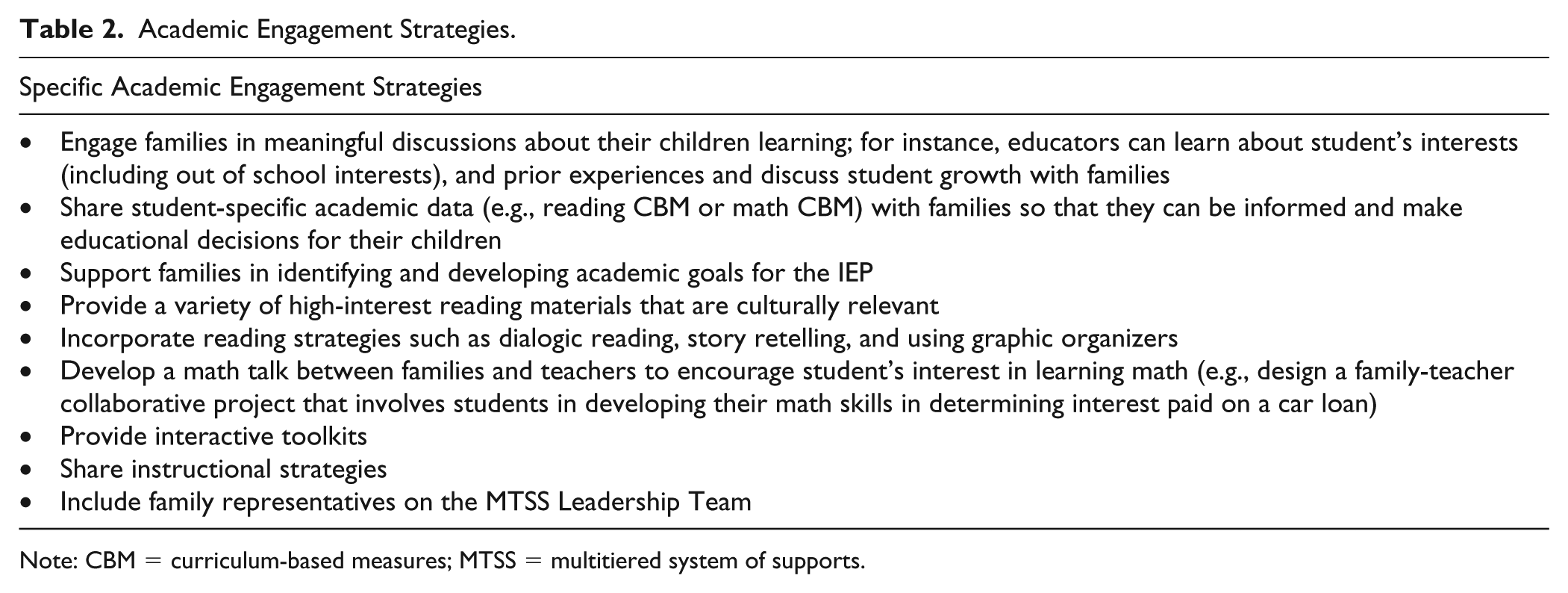
Note: CBM = curriculum-based measures; MTSS = multitiered system of supports.
Engaging with Behavior Strategies
Students who are CLD with disabilities are more susceptible to high rates of disciplinary exclusions such as suspensions and expulsions (Brobbey, 2018; Vincent, Randall, Cartledge, Tobin, & Swain-Bradway, 2011; Whitford & Addis, 2017) and are at greater risk for exclusion from the general education classroom and school failure due to academic frustration (Brobbey, 2018). For CLD families of students with disabilities, there might be a disconnection between the school culture and the home or community culture, meaning that there might be differing views about school-based behavior management methods that are not consistent with home approaches (Hill, 2010). For this reason, school personnel are encouraged to understand any differences between school and family expectations. Understanding these differences can facilitate the development of culturally responsive environments that promote equitable practices in the school.
More schools are using schoolwide positive behavior interventions and supports (PBIS) to teach (e.g., emphasize positive reinforcement and provide specific praise/feedback in behavior management) and promote consistent schoolwide behavior practices. Enlisting CLD family input in the development of behavior matrices is another strategy that can support CLD family engagement. A behavior matrix is an instructional grid that juxtaposes three to five expected behaviors (e.g., respectful, responsible, and safe) with contextual environments such as those within a home including mealtime, bedtime routines, and other areas within the home (Simonsen, Sugai, & Negron, 2008). Additional examples of matrices are available at https://www.pbis.org/. For example, a home behavior matrix for the mealtime might include respectful/eat with mouth closed, say please/thank you, responsible/clean up the kitchen after eating, safe/forks are for eating food, knives are for cutting food. This home-school collaboration behavior matrix is reflective of a similar matrix teachers use in the classroom, for instance, respectful/inside voice, responsible/bring your supplies, safe/keep hands and feet to yourself. Families create a matrix that reflects the behaviors expected in their home to build that home-school connection. Teachers can facilitate a conversation with families by sharing the school behavior matrices and a blank copy of the tool for families to use as they wish at home.
Extending social skills activities into the home is another strategy that can facilitate family engagement. It is important to note that social skill materials should be culturally and linguistically relevant to the students and families (Cartledge & Kourea, 2008). Teachers might share a synopsis of the social skill with a simple cue card that family members can use to provide feedback to the student as the student practices the skill (Weist, Garbacz, Lane, & Kincaid, 2017). For example, if conflict resolution is the school-based lesson then send home a copy of an “I-statements” cue card (e.g., “I feel _____, when you ____, because _____”) and a few scenarios for practice. Another strategy that can benefit family engagement in cultivating positive behavior is Check In-Check Out (CICO; Horner, Sugai, & Anderson, 2010), a behavior monitoring tool that helps students self-monitor behavior as well as communicate with teachers on students’ progress toward a set goal. A CICO checklist is a tool (e.g., paper or electronic) used to facilitate dialog, based on data, between a student and an invested adult who discusses behavior topics and monitors progress toward the set goal with the student. Possible topics include being prepared for class or using appropriate language in school. Families can use CICO at home as a way to extend communication about students’ behavior between home and school. Additional strategies for improving home-school communication with families are delineated in Table 3.
Behavior Engagement Strategies.

Note: PBIS = positive behavior interventions and supports.
Conclusion
Although federal legislation requires schools to engage families actively and is especially important within the special education process, helping families to feel welcome and valuable in their children’s learning is beneficial for everyone. For families, it can mean an improved understanding of academic goals, enhanced socioemotional development for their children, and ameliorated trust in the school system and school personnel. In the classroom, family engagement can mean improved student engagement and motivation to learn that can lead to fewer classroom behavior management concerns and more positive student outcomes. For school personnel, the benefits can reach schoolwide in the way of overall improvement in discipline, school attendance, test scores, and graduation rates for students and an overall sense of belonging for families.
It is imperative that families and schools share the same goals for children. Breaking down barriers to family engagement can communicate to families that they are valued members of the school community. In order to accomplish this goal, schools must be willing to acknowledge that CLD families exist and that CLD families and families of students with disabilities bring a wealth of knowledge, resources, and may have different needs than families of students without disabilities. Moreover, schools might consider nontraditional methods of drawing families into these collaborative relationships. For instance, when schools embrace the cultural uniqueness of CLD families of children with disabilities, solicit family contributions, and encourage active participation in school, then families become engaged educational partners in their child’s learning. The described strategies can help develop trusting family-school partnerships. By encouraging, facilitating, and welcoming family engagement and participation in school activities and the students’ learning processes, school personnel can get to know and affirm diverse families to ensure that they serve all families for the mutual benefit of the family and school community.
Footnotes
Declaration of Conflicting Interest
The author(s) declared no potential conflicts of interest with respect to the research, authorship, and/or publication of this article.
Funding
The author(s) received no financial support for the research, authorship, and/or publication of this article.