




Abstract
Many secondary students with specific learning disabilities (SLD) struggle with mathematics problem solving. When students with SLD are taught to use effective problem-solving strategies, their ability to solve mathematics word problems improves. The purpose of this article is to provide a guide for secondary teachers to implement self-regulated strategy development (SRSD) to teach mathematics problem-solving strategies to secondary students with SLD. The specific problem-solving strategy described in this article is SOLVE, which stands for Study the problem, Organize the facts, Line up a plan, Verify your plan with action, and Evaluate your results. Both SRSD and SOLVE are described, and an example of one teacher’s application of SRSD is shared. When taught concurrently, SRSD and SOLVE can be useful tools to help students with disabilities overcome the challenges of problem-solving in mathematics.
Desiree and Mickey are middle school students who receive special education services for a learning disability (LD) in mathematics. Desiree struggles with the application of mathematical knowledge to solve word problems. Although Desiree has strengths in mathematics calculation, she is often unable to determine an appropriate plan to use when solving mathematics word problems. Mickey struggles with both mathematics basic skills and applications. In mathematics problem solving, he often requires increased opportunities to practice answering a specific type of problem before he can use the skill independently. When given a problem that requires multiple steps, Mickey mixes up the order of the steps or is unable to remember all the steps. The students’ special education teacher, Mrs. Henry, provides explicit instruction in a small group setting; however, her students continue to struggle with word problem solving. After reflecting on her students’ performance, Mrs. Henry decides to use a different instructional approach for teaching problem solving in the upcoming lessons on ratios and proportions (see Note 1).
The problems that Desiree and Mickey face with mathematics are common for many students with LD at the middle and high school level. For example, National Assessment of Educational Progress (NAEP) results from 2015 indicated that 92% of 8th grade students and 94% of 12th grade students with disabilities performed below proficient level in mathematics (U.S. Department of Education, 2015).
Students with LD in particular struggle with mathematics problem solving (Geary, 2011; Hunt & Vasquez, 2013; Jitendra & Star, 2011). Characteristics of students with LD that contribute to these difficulties include deficits in working memory, poor understanding of foundational mathematics skills, and difficulty organizing steps to solve a problem (Geary, 2011). Common Core State Standards (CCSS) for mathematical practice, which describe areas of expertise that mathematics teachers should seek to develop for all students, emphasize problem-solving skills. For example, mathematically proficient students are able to explain the meaning of the problem, analyze the problem, make conclusions about the meaning of the solution, and plan for a solution. Once students identify possible solutions, they should be able to check their answers using a different method and determine whether the answer makes sense (National Governors Association Center for Best Practices & Council of Chief State School Officers, 2010). Cognitive and metacognitive strategies typically used by mathematically proficient students often are not readily available for students with LD. However, research has demonstrated that students with LD can increase their ability to solve mathematical word problems when they are taught to use effective problem-solving strategies (Hwang & Riccomini, 2016; Myers, Wang, Brownell, & Gagnon, 2015). Providing students with effective instruction and strategies is one means to enable students with LD to meet standards for problem solving.
This article provides a description of how a mathematics word problem-solving strategy can be taught using the self-regulated strategy development (SRSD) model of instruction to teach to middle school students with LD. First a description of the word problem-solving strategy is provided followed by a description of the SRSD framework for instruction. Then an example of how the word problem-solving strategy and SRSD was applied in a middle school resource classroom to teach students to solve word problems with ratios and proportions is provided.
The SOLVE Strategy: A Mnemonic
Research supports the use of general problem-solving strategies and explicit instruction to enhance mathematics proficiency for students with LD (Gersten et al., 2009). Further evidence suggests the use of mnemonics helps students learn and retain information (Scruggs, Mastropieri, Berkeley, & Marshak, 2010). The SOLVE strategy is a general mathematics problem-solving strategy that incorporates explicit instruction and the use of mnemonics. The acronym SOLVE points to the following steps:
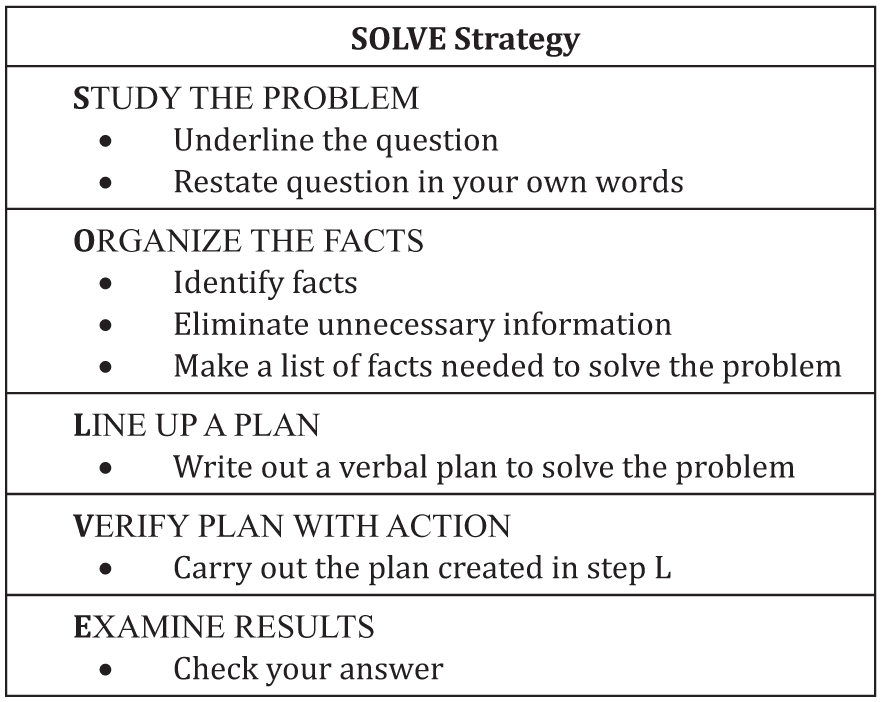
SOLVE Mnemonic (National Training Network, n.d.).
The SOLVE strategy has the potential to improve students’ mathematics problem-solving skills. Freeman-Green, O’Brien, Wood, and Hitt (2015) demonstrated the effectiveness of the SOLVE strategy in mathematics for teaching eighth grade students with LD to solve grade level mathematics word problems. After SOLVE strategy instruction, students increased accuracy on a measure of word problem solving to 70% or higher and maintained skills at 2 and 6 weeks after the intervention.
Self-Regulated Strategy Development
Although cognitive strategies are essential to students’ performance in mathematics problem solving, systematic strategy instruction through a validated framework is also important. The teaching of strategies has been described as the simplest part of strategy instruction; however, without the use of an effective framework for instruction and appropriate time and practice, strategy instruction may not lead to improvements in academic performance (Reid, Lienemann, & Hagaman, 2014). SRSD is an instructional framework that has been used effectively for students with LD or students who are at risk for failure or difficulties in the areas of writing (Graham, Harris, & McKeown, 2013), reading (Hagaman, Casey, & Reid, 2016; Mason, 2013), and mathematics (Case, Harris, & Graham, 1992; Cassel & Reid, 1996; Cuenca-Carlino, Freeman-Green, Stephenson, & Hauth, 2016). The SRSD framework involves explicit instruction, cognitive strategy instruction, self-regulation instruction, and mnemonics to assist students in remembering steps in a process. The cognitive strategy instruction is specific to the academic skill that is the focus of instruction. For example, if the focus of instruction is mathematics problem solving, then self-regulation strategies with a cognitive strategy specific to mathematics problem solving, such as SOLVE, is taught within the six stages of SRSD. Self-regulated strategy development lessons contain six stages of instruction (see Table 1; Harris, Graham, Mason, & Friedlander, 2008). The stages of SRSD are a general format for teaching and may be modified to meet the needs of students. For example, if students’ performance indicates that a specific stage should be revisited, then the teacher should revisit that stage. Likewise, if students are proficient at a particular stage, then the stage would not need to be repeated. Some students may require all stages, plus reteaching of specific stages, while other students may only need the teaching of each stage with no reteaching (Harris et al., 2008).
SRSD Framework.
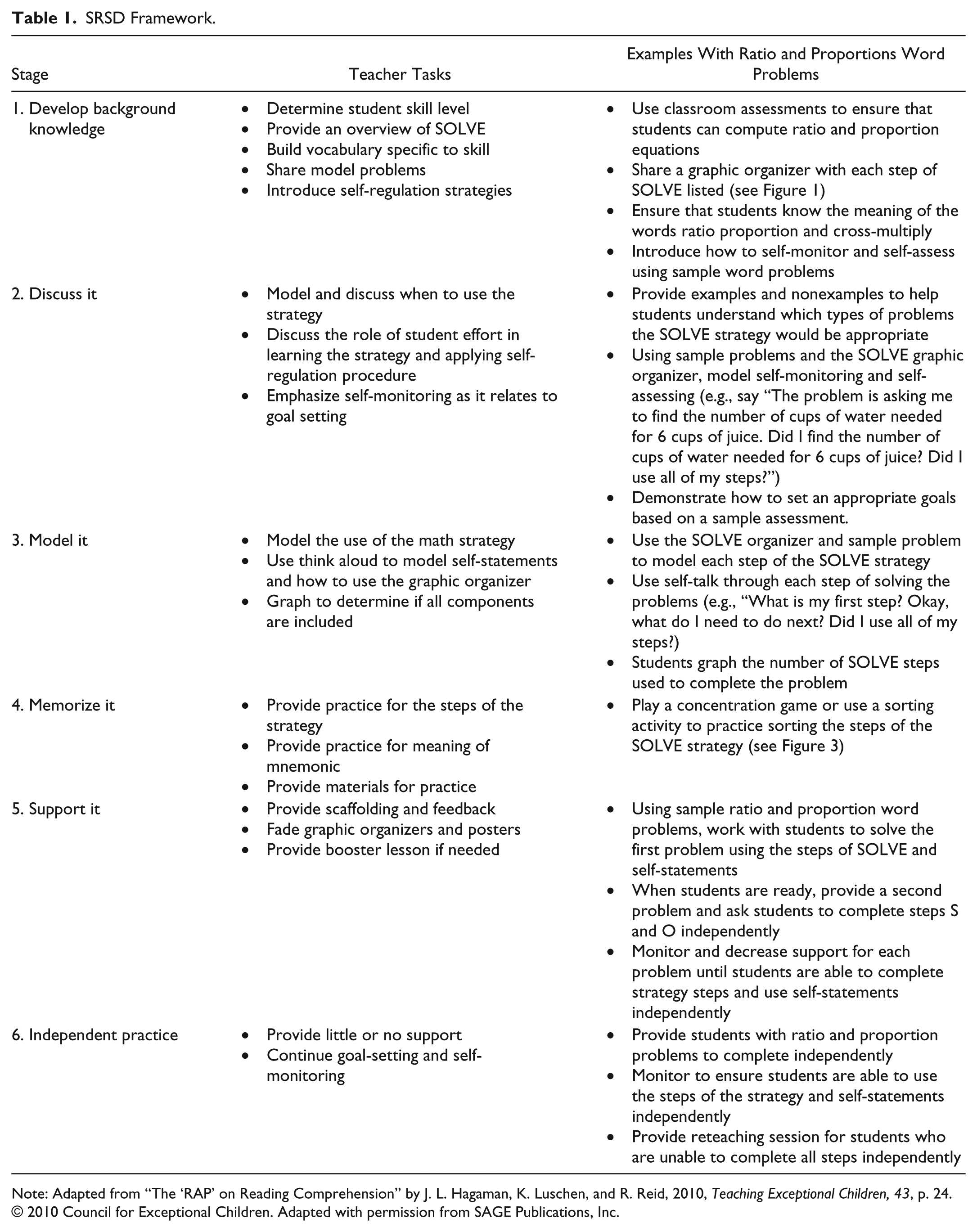
Note: Adapted from “The ‘RAP’ on Reading Comprehension” by J. L. Hagaman, K. Luschen, and R. Reid, 2010, Teaching Exceptional Children, 43, p. 24. © 2010 Council for Exceptional Children. Adapted with permission from SAGE Publications, Inc.
Research supports the use of SRSD for mathematics problem solving for students with LD at the upper elementary and middle school levels. Case et al. (1992) implemented SRSD to teach fifth- and sixth-grade students with LD to solve addition and subtraction word problems. Case et al. (1992) found that students were highly accurate in solving addition and subtraction word problems after SRSD instruction, and maintained those skills at 8 weeks and 10 weeks following the intervention. In other research Cassel and Reid (1996) investigated the use of SRSD to teach fourth-grade students with mild disabilities (LD and intellectual disabilities) to solve addition and subtraction word problems. SRSD was effective in increasing the number of word problems students solved to at or above 80% accuracy on postinstructional assessments. Students also maintained skills 6 and 8 weeks after the intervention. More recently, Cuenca-Carlino et al. (2016) examined the effects of SRSD to teach middle school students with LD or at risk for mathematical difficulties to solve multistep equations. Students were able to solve multistep equations with 90% or higher accuracy after instruction, and three of the four participants in the single-case study maintained skills 4 weeks after the intervention.
Ratio and Rate Word Problems
Mrs. Henry’s students completed a mathematics unit on ratios and proportions. Based on classroom assessments, Desiree and Mickey struggled to solve word problems that included ratios and proportions. Mrs. Henry decided to use the SOLVE strategy and the SRSD framework of instruction to address Desiree and Mickey’s difficulties. Table 1 includes examples of how Mrs. Henry applied the following steps to teach her student to solve mathematics word problems with ratios and proportions.
Stage 1: Develop Background Knowledge
In this stage, the teacher ensures that students have the background knowledge and prerequisite skills needed to apply the SOLVE strategy. The teacher may use previous classroom performance or an assessment to determine students’ prerequisite skills. If students lack the prerequisite skills to apply the SOLVE strategy, prior to teaching the strategy, the teacher provides instruction of the skills until students are able to apply the required skill. Then the teacher provides an overview of the SOLVE strategy and an introduction to self-regulation strategies to be taught explicitly throughout the SRSD stages (Harris et al., 2008; Mason, Reid, & Hagaman, 2012). For example, the teacher may explain to students that SOLVE may be used with many types of word problems. A chart or graphic organizer that contains the steps of SOLVE may be previewed, such as the graphic organizer in Figure 2. Each step of SOLVE is described, as well as how each step would be applied to solve word problems. For example, in step S, students identify the question in the problem, underline the question, and write the question in their own words. In step O, students identify facts, eliminate unnecessary information, and make a list of facts needed to solve the problem.
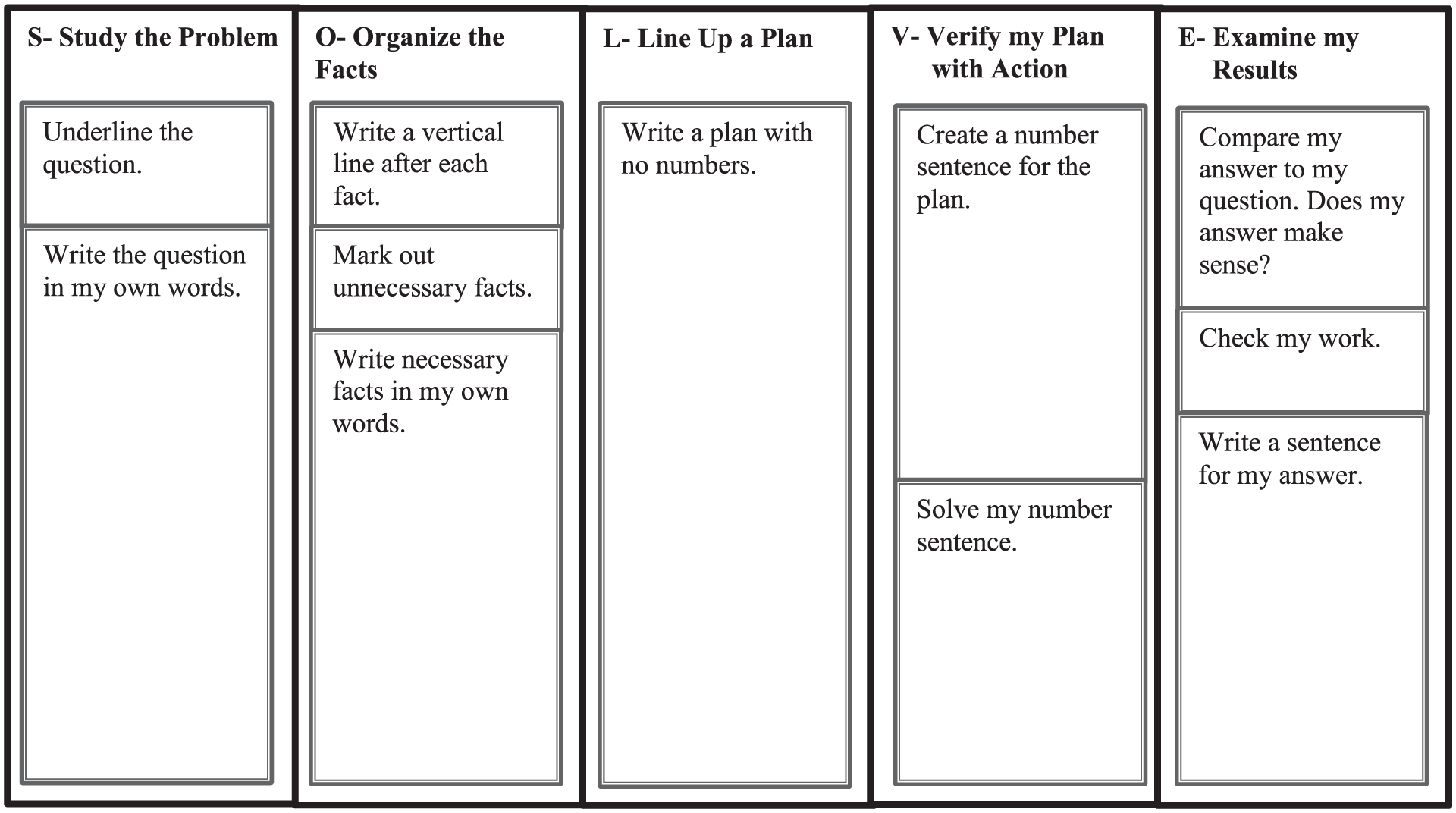
SOLVE Graphic Organizer.
Stage 2: Discuss It
During this stage, the teacher focuses on helping students understand the importance and appropriate uses of the task-specific strategy (e.g., SOLVE) and self-regulation strategies (e.g., self-monitoring, self-assessment, goal setting). For example, the teacher may use sample mathematics problems and guide students to determine for which types of problems the SOLVE strategy would be appropriate (i.e., appropriate for word problems, inappropriate for calculation). To introduce self-monitoring and self-assessment, a completed sample quiz may be provided while the teacher models how to determine if each step of SOLVE was completed, as well as how to graph the number of steps completed. The teacher discusses an attainable and measurable goal based on the sample assessment. Because an essential component of SRSD is the role that students take in using the self-regulation techniques and use of the task-specific strategy, the teacher provides students with information regarding their present levels of performance. Students use the information to set their own goals for learning and performance. The teacher may also ask students to sign a contract to show that they commit to participation in the lessons and effort to learn and apply the strategies.
Stage 3: Model It
In this stage, the teacher models the use of the strategy and self-regulation techniques. While solving a word problem, the teacher uses think-alouds to help students understand the thought processes behind using the strategy (Harris et al., 2008; Mason et al., 2012). A critical component of the modeling process is the use of self-instruction and self-statements to determine what the required task is, focus attention, plan, remember strategy steps, self-evaluate, and self-reinforce (Harris et al., 2008). Through thinking aloud, the use of self-instruction and self-statements are modeled (see Table 2). The teacher explains to students that self-statements are words that can be said aloud, or in thoughts, to help complete a task. Some possible self-statements that the teacher could use when modeling are “What is my first step? Ok, what do I need to do next? I can solve the problem if I focus and use my strategy. Did I use all of my steps? Great! I used all of my steps and solved the problem.” During modeling of solving a word problem using the SOLVE strategy, the teacher may use the SOLVE organizer (see Figure 2) to assist in completing each step of the SOLVE strategy. For example, while reading the steps under S on the organizer, the teacher models how to underline the question in a mathematics word problem and rewrite the question in their own words on the organizer. Then under the O column, the teacher models how to write a vertical line after each fact in the problem and mark out unnecessary facts in the problem. The teacher writes necessary facts in the appropriate box on the organizer. The teacher continues using the organizer for each component of SOLVE, checking off steps that are completed on the problem (e.g., underline the questions, write a vertical line after each fact), and completing written tasks on the organizer (e.g., write the question in my own words, write a plan with no numbers).
Sample Self-Statements.

In addition to the modeling of strategy use, self-assessment and self-graphing are also modeled at this stage. Once the teacher has modeled the use of the strategy, the class discusses the self-statements that that the teacher used during modeling, and how the self-statements helped facilitate success in solving the problem. Students can also begin developing a list of self-statements for future (Harris et al., 2008)
Stage 4: Memorize It
The goal of this stage is for students to memorize their self-statements, as well as strategy steps (Harris et al., 2008; Mason et al., 2012). For example, from the self-statement sheets they created, students should be able to tell a statement that they could use before, during, and after solving a problem. For the SOLVE strategy, students should be able to explain what each letter stands for, as well as the procedures that take place at each step. For example, “S” stands for “Study the Problem,” which means that students underline the question and write the question in their own words. Although the strategy steps are introduced and practiced during each lesson, this stage provides an opportunity for students to spend time committing the strategy and self-statements to memory. The teacher may give students a quiz to determine which strategy parts and self-statements that they needed to spend more time memorizing. Students may participate in activities such as playing a concentration card game with the letters and substeps of SOLVE, completing a sorting activity to practice sorting the steps with their corresponding letters (see Figure 3), or creating a song using the steps of SOLVE.
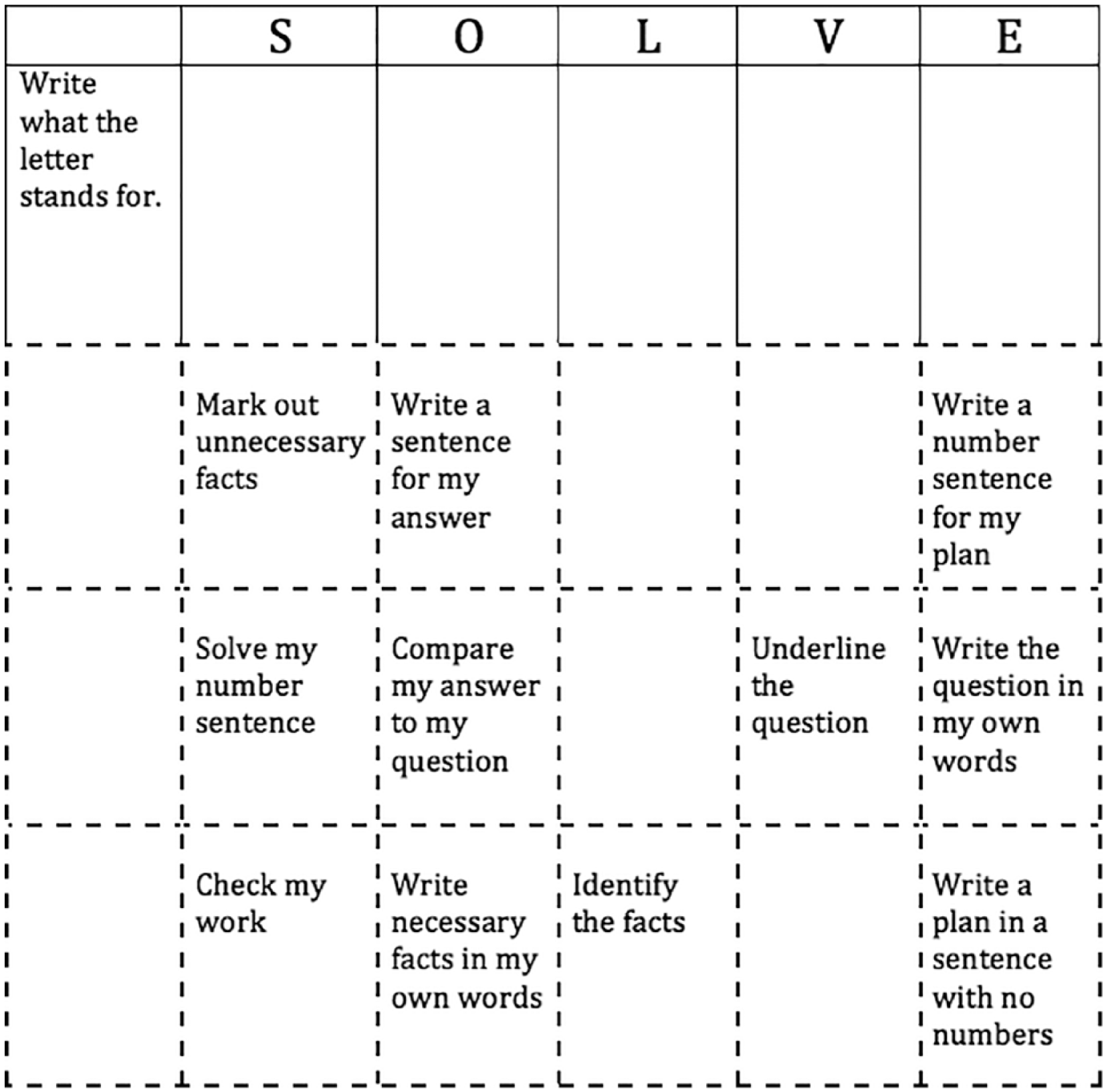
SOLVE Cut-and-Sort.
Stage 5: Support It
During this stage, the teacher supports students in their use of the strategy through modeling, guided practice, and scaffolding. Students may use resources, such as graphic organizers and self-statement sheets; however, as students can use the strategy independently, the resources are removed (Mason et al., 2012). Likewise, as students become more proficient at using the strategy, teacher support will be decreased and eventually removed. This stage may require differing amounts of time for students, as students should master using the strategy before moving on to the final stage.
Stage 6: Independent Practice
Once students have demonstrated that they can use the strategy independently in Stage 5, they are ready to practice problems independently. In this stage, students practice solving problems using the strategy and using self-statements. It is critical that students are monitored while they work for both solving the problems correctly, and use of all strategy components. If students do not solve problems correctly or use strategy components correctly, the teacher may reteach lesson components as needed (Harris et al., 2008; Mason et al., 2012).
Conclusion
Given the emphasis in the CCSS on mathematics problem-solving skills, it is essential that students with LD are able to identify and use appropriate strategies to solve word problems. The process described here provides teachers a description of a general word problem solving strategy within the SRSD framework to teach the strategy to their students. SRSD is effective in helping students develop self-regulation skills and allows them to learn the steps of a specific mnemonic strategy (Harris et al., 2008). The SOLVE strategy included herein is one example of a general problem-solving strategy used with middle school students. The SOLVE strategy has been shown to increase accuracy on mathematical word problems for students with disabilities (Freeman-Green et al., 2015). While problem solving in mathematics is often difficult for students with LD, effective strategy instruction in SOLVE within the SRSD framework may help students with disabilities become more proficient learners.
However, teachers may identify other strategies appropriate for the needs of their students or other mathematics skills that may be taught using the SRSD framework. While a specific example of the application of SRSD and SOLVE in relation to ratios and proportions was provided in Table 1, teachers may use both SRSD and SOLVE for a variety of mathematics problem types. The SRSD framework has been used to effectively teach students strategies for a range of skills (e.g., multistep equations; Cuenca-Carlino et al., 2016), and teachers will find other applications of SOLVE for a variety of problem types including equations, algebra, and geometry (National Training Network, n.d.) to meet the needs of their students.
Footnotes
Declaration of Conflicting Interests
The authors declared no potential conflicts of interest with respect to the research, authorship, and/or publication of this article.
Funding
The authors received no financial support for the research, authorship, and/or publication of this article.
