




Abstract
Previous research examining frontloading academic vocabulary establishes it as an effective instructional activity for students who are English learners. This article extends and builds from those earlier findings, showing the relevance and importance of explicit vocabulary instruction for all students identified with specialized learning needs, especially for students who are English learners with disabilities. Drawing from research-based practices as well as practitioner training to provide ideas of how to frontload academic terms using techniques that incorporate visuals and technology in an integrated classroom setting.
Abel is a 16-year-old student who immigrated to a racially and ethnically diverse city in the United States from a rural community in Guatemala. Before leaving his hometown, he worked on a farm and took care of livestock. His first language is Mam, a Mayan language with half a million speakers in Guatemala, and Spanish is his second language, which he spoke at school (that he attended sporadically) and to conduct transactions in trips to a nearby city. When Abel arrived in the United States 2 years prior; he had a difficult time paying attention in class, was confused at times, and could not complete many of his assignments. After a referral, he was tested and diagnosed with a traumatic brain injury and an intellectual disability, potentially due to a severe fall he had as a child. Abel is also a student with limited or interrupted formal education (SLIFE) and struggles to read in Spanish at grade level. He is developing proficiency in English to complete academic coursework so he can graduate from high school. To receive a standard high-school diploma, he needs to complete grade-level coursework and pass five state-mandated assessments in math, science, history, and English (See Note 1).
This year, Abel is in integrated classes, so his success in those classes and their assessments will determine if he graduates with a standard diploma or an applied studies diploma, which is an option as part of his individualized education program (IEP). To secure better employment and opportunities, Abel needs a high-school diploma. His current job as a dishwasher at a local restaurant pays him a poverty-level wage. In addition to needing a new job, Abel also needs to learn how to read in English for his own personal safety and as a young tax-paying resident of the community. He wants to go to college one day and study natural sciences. What does Abel need to successfully complete coursework and pass assessments required by the state? How can teachers support his specialized learning needs in an integrated setting? This article describes ways of frontloading academic vocabulary as an instructional activity and how teachers can support Abel’s reading development, language acquisition, and his goal of graduating with a highschool diploma.
Students who are English learners are faced with the daunting task of not only acquiring proficiency in a new language, but also developing mastery in academic language and content needed for course and graduation requirements. While there are other terms, such as dual language, multilingual learners, and English language learners, that refer to these students, the term “students who are English learners” is used in this article because it is codified in federal and state policies and refers to students who are not only learning language but also culture through instructional practices in English. Typically students who are English learners are not afforded equitable supports in the first language, but they are required to demonstrate mastery of content through standardized assessments in English. Managing these demands creates significant challenges for students and teachers, as they navigate school accountability systems that depend heavily on state-mandated standardized assessments. The high-stakes testing culture in the United States creates an environment where some students are viewed as a liability due to the possibility of poor testing, leading them to be pushed out of public schools and classrooms (Reyes & Villarreal, 2016). This is even more apparent when students who are English learners underperform on standardized assessments, often resulting in an eligibility and screening referral for special education services (Abedi, 2014).
Research on assessment and curriculum finds evidence of cultural and linguistic bias, where multilingualism and the distinctive learning processes of students who are English learners are not considered when designing these tests and not in the norming sample (Abedi, 2014). Moreover, the sample set used to determine an average for these assessments often does not include students who are English learners in their norming groups, when these measures are used to measure these students’ content learning (Abedi, 2014). This creates challenges for these students who are at an even greater disadvantage when it comes to developing and demonstrating the skills needed to perform on tasks and assessments, and more importantly, to comprehend and think critically about content.
Interestingly, the needs of students who are English learners with disabilities are similar in some ways, such as the need for differentiated instruction. However, they also have multiple differences. They need to learn morphology, phonology, syntax, semantics, pragmatics, and academic vocabulary (Mitchell, 2012). However, a student with a disability, such as Abel, may also need to learn language function and convention, but instructional supports provided may look different based on a student’s learning needs. While those needs may differ depending on the context and resources available, there are instructional activities that have the potential to address the language-learning needs of students who are English learners as well as the specialized supports required of students with disabilities. Both groups of learners require explicit vocabulary instruction. For this reason, practitioners need useful, research-based strategies to address the academic vocabulary development of students with intersecting language and disability needs in an increasingly regimented and competitive academic environment. Students, such as Abel, require specialized supports through different channels to maximize learning opportunities.
Teachers can support diverse learning needs by using instructional tools for different learning modalities. One of these involves providing opportunities to increase vocabulary retention. There are different ways of supporting the retention of academic vocabulary that is used in expressive and receptive forms. This includes providing students with the vernacular language needed to engage in discourse and aural comprehension by frontloading vocabulary. Sometimes referred to as pre-teaching or previewing new academic terms, frontloading is a before-reading instructional activity that supports comprehension of an upcoming text.
Research shows frontloading supports comprehension and critical thinking skills of students who are English learners (Baker et al., 2014). While this term is mainly used by English for Speakers of Other Languages (ESOL) teachers, its equivalent in special education is often called previewing vocabulary. This article provides evidence-based instructional strategies of how to frontload new vocabulary. These activities will involve the use of visual supports and draw from different approaches that include technology-aided, as well as culturally and linguistically additive methodologies (Valenzuela, 2010).
Increasing Need for Explicit Instruction
The need for explicit vocabulary instruction is apparent for struggling learners, namely students who often do not see the connection between their background knowledge and academic texts. For students who are English learners, this is even more challenging as most curriculum promotes English-only instruction and maintains a limited perspective of bilingualism (Mitchell, 2012; Reyes & Villarreal, 2016). This is particularly true for individuals like Abel who are SLIFE due to limited exposure to an academic setting and lack of first language supports. Exclusionary practices and policies of implementing culturally and linguistically subtractive curricula can create tensions between what the learner is expected to know and how that content is received. While there is a need for policies and procedures that address these deficits, frontloading vocabulary gives teachers an opportunity to prepare students for the textual content and support the process of attempting to make it relatable to their lived experiences.
Even though standardized assessments are a poor measure of ability, students who are English learners and students with disabilities perform significantly lower than their typical peers on reading measures (Abedi, 2014). Comprehensive data show students who are English learners and students with disabilities perform lower on most reading and content-specific assessments (Connor, Alberto, Compton, & O’Connor, 2014). Due to lower reading scores, these students may be less likely to graduate from high school and become independent, informed citizens. For instance, Abel needs to learn how to read in English to be safe and knowledgeable, but also to graduate with a highschool diploma. Connor et al. (2014), considering students at-risk of or with reading difficulties, reported that, Children who do not read well are more likely to be retained a grade in school, drop out of high school, become teen parents, or enter the juvenile justice system. Thus, preventing reading difficulties early in children’s school careers has potential long-term benefits to the individual as well as society. (p. viii)
The ability to grasp vocabulary and read for understanding leads to greater academic and social outcomes. For that reason, practitioners need techniques to support the reading development of students who are English learners and students with disabilities, so they can access opportunities and have better outcomes.
Benefits of Frontloading Vocabulary
Decades of studies describe how the development of prereading skills, such as strengthening memory dexterities, can be supported by using frontloading vocabulary strategies (Baker et al., 2014). Evidence suggests that these activities can help students acquire stronger working memory and short-term memory skills, which are correlated with better reading abilities. In a related study, Lesaux, Kieffer, Faller, and Kelley (2010) analyzed the results of an 18-week program used with 476 sixth-grade students, of whom 346 were students who are English learners. The researchers found frontloading vocabulary through the use of a text-based academic language program that included anchor texts improved the performance of both students like Abel and his native English-speaking peers to equal degree. This program, referred to as Academic Language Instruction for All Students, consisted of 45-minute lessons for 4 days a week using high-interest texts that were representative of students’ ethnic and cultural diversity. A battery of standardized and researcher-developed vocabulary and reading comprehension assessments were administered as pre- and post-tests. Results indicated that there were positive statistically significant effects of the frontloading vocabulary intervention on word mastery, morphology, and word meaning. Frontloading vocabulary is often regarded as an instructional strategy for students developing English proficiency, but it may also be beneficial for native English-speaking students as this study indicates.
In another study that focused on academic vocabulary and conducted by Lesaux, Kieffer, Kelley, and Harris (2014), an intervention with 2,082 sixth-grade students resulted in significant effects for students who are English learners and students with below grade-level vocabulary knowledge. This intervention provided a 20-week classroom-based program designed to improve vocabulary knowledge, morphology, and reading comprehension by frontloading four vocabulary words while incrementally building word knowledge before adding eight to nine academic words a week. An anchor text or text-based approach was used and words were selected by readings to create units. Looking at other modalities, the use of multimedia-enhanced read-aloud vocabulary instruction has also resulted in positive effects for students similar to Abel on measures of vocabulary knowledge (Silverman & Hines, 2009). These researchers used multimedia and computer-assisted instruction to support science content area topics focused on vocabulary building, which resulted in significant outcomes. Both studies provide us with viable options for schools and show us ways of using different interventions to support the learning needs of students who are English learners.
Studies focused on vocabulary and content acquisition of science and social studies have also resulted with positive effects for students who are English learners and struggling readers (August, Branum-Martin, Cardenas-Hagan, & Francis, 2009). An intervention designed to develop science content knowledge and academic vocabulary, with middle-school students who are English learners and native English-speaking peers, was successful for the treatment group based on pretest and posttest measures (August et al., 2009). As part of a 5-year professional development intervention named “Quality Science and English Teaching” funded by the National Science Foundation, students were provided with activities and strategies to strengthen their reading and writing skills in science. A key component of this program included multiple modalities for communication, such as verbal, written, graphic, and even physical, to pre-teach and reinforce important vocabulary using visual to support retention and practicing cross-curricular words.
In addition, lessons included students’ culture by including science terms in Spanish and Creole, the former a language with cognates or words in two languages that share a similar meaning, spelling, and pronunciation in Spanish and English. This is especially common with Latin-derived languages. Based on the findings, this study showed significant gains based on the pretest and posttest measures in science achievement for students who are English learners and native English-speaking students. While still a developing area of research, there is substantial research that shows the benefits of frontloading vocabulary with students who are English learners and their native English-speaking peers. While the following techniques support all students in an integrated setting, they particularly aid learners with intersecting language and disability needs such as Abel.
Ways of Frontloading Vocabulary
To frontload vocabulary with a student who is an English learner with a disability, practitioners should capitalize on their funds of knowledge and the skills they possess. This requires an additive approach, where practitioners first view a student’s cultural and linguistic diversity as an asset (Valenzuela, 2010). Using a strengths-based approach, diverse resources can be integrated into the same curricula and learning objectives as their typical peers.
Anchor Texts
Frontloading vocabulary should always be anchored to a text and specific learning goals that include the four language domains: speaking, listening, reading, and writing. With curricula and language-learning goals, Mitchell (2012) discussed how capitalizing on students’ language skills and cross-cultural abilities by creating a space that includes their diverse needs and perspectives is often the first hurdle. Before approaching these strategies, it is important to have clear content and language objectives so these frontloading activities are used to enhance a lesson and are adapted to be appropriate for students. For example, Abel’s English teacher is covering a unit that aligns with the standards to assess theme, figurative language, foreshadowing, character and plot development, symbolism, and poetic prose using Sandra Cisneros’ book The House on Mango Street as an anchor text. With this novel, the teacher is able to connect and compare this reading to other poetic prose and explicitly teach the assessed content by using the text. For students such as Abel and other struggling readers, an anchor text becomes a tool that shows a relationship between an abstract concept (or standard) and a story that can be visualized. Anchor texts also help students recall the content covered because they can reference the story. There are multiple opportunities with anchor texts, where teachers can use fiction or nonfiction in language arts or other content areas to promote a unified curriculum.
Cognates
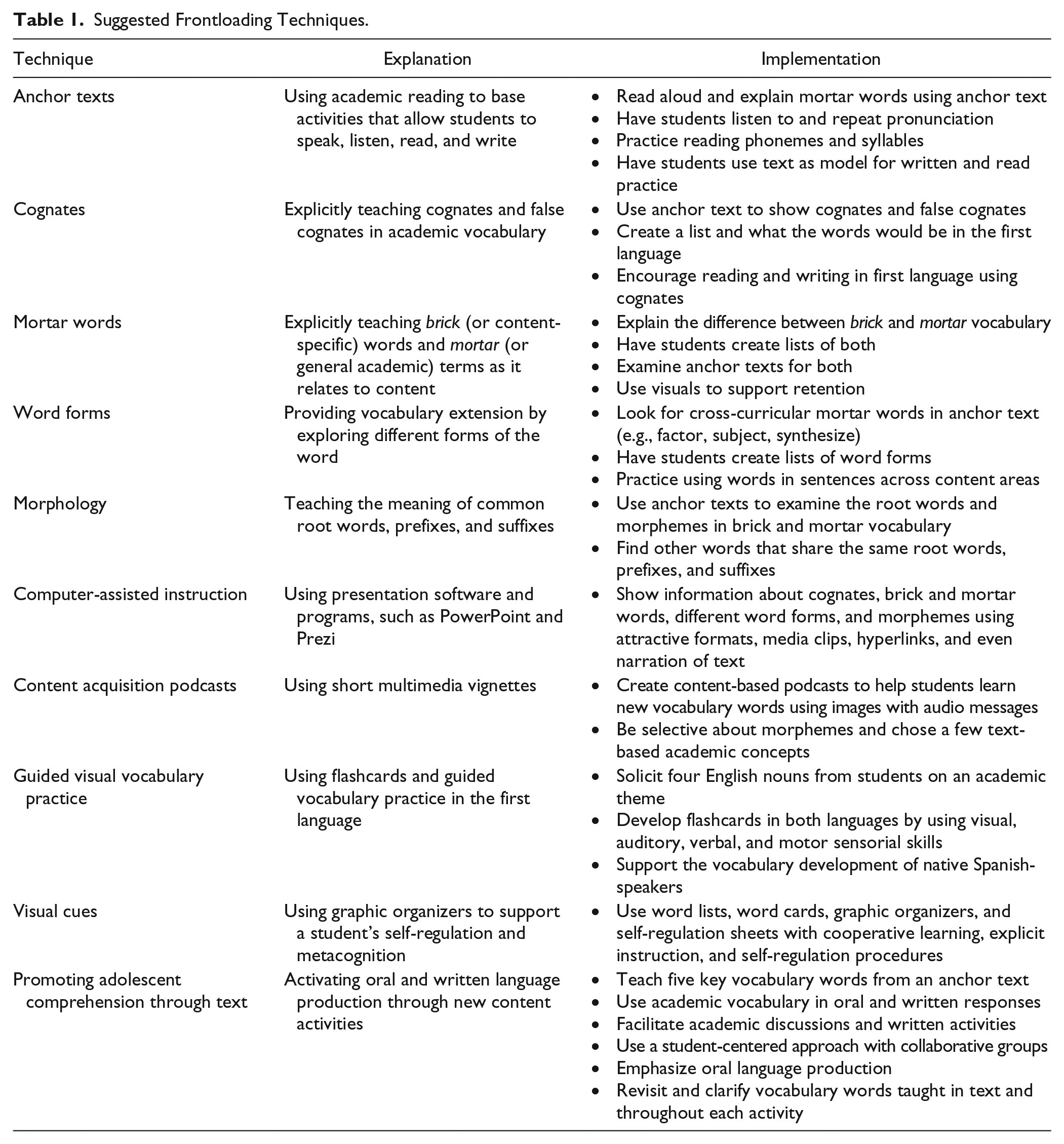
Practitioners can also build on students’ strengths using cognates, words in two languages that share the same meaning and are spelled and pronounced similarly (Haager & Osipova, 2017). This is particularly beneficial for students who are English learners who speak a Latin-derived language, such as Spanish, because academic vocabulary in math and science are derived from Latin and Greek roots. Haager and Osipova (2017) emphasized frontloading cognates and false cognates, which are words that appear to be similar but have different meanings. For example, the word “analizar” means “to analyze” in Spanish and is a cognate. These words should be explicitly taught by presenting the word, its definition, and pronunciation. It is important to explicitly introduce and practice each new vocabulary word, its syllables, its pronunciation, and how it is used in different sentences, as well as provide visuals to associate with them. In this case, Abel’s English teacher is able to use the anchor text from class to help students develop cognate awareness and give them strategies for using them in their first language. Skills developed in the first language transfer to English or the target language, creating a bridge for students who are English learners. After introducing cognates by playing a matching game using select vocabulary words from an anchor text, his teacher provides direct instruction on the three different types of cognates (cognates, false cognates, and multiple-meaning word) by explaining and categorizing the vocabulary words. She also models a step-by-step process for how to approach a new cognate and uses a graphic organizer. Students are asked to survey their anchor text for Spanish cognates and use the graphic organizer. Frontloading techniques such as developing cognate awareness help students capitalize on skills they already possess. Table 1 provides an explanation of this technique and 10 others by providing a brief description of what it involves and its implementation.
Suggested Frontloading Techniques.
Mortar Words
In addition, knowing what a word means and being able to use it orally and in written form expands a student’s vocabulary of mortar words, which are connecting words needed to build on and used in different content areas (Zwiers, 2008). Mortar words are general academic terms and the brick words are content-specific, the latter is technical and specific to a discipline (Zwiers, 2008). While it is important for students to know the brick terms, there tends to be overemphasis on big vocabulary in schools. The need for more instruction on mortar vocabulary is vital for students to understand cross-curricular and technical vocabulary.
Word Forms
A teacher can also extend a text-based lesson that includes a mortar word and explicitly teach it as a cognate to students as well as how to use different forms of the word (e.g., analyst and analysis) in various contexts (e.g., an analysis of different neighborhoods and what does a sports analyst do) using real-life examples. The word analyze is cross-curricular and found in different content areas, so teaching cognates and false cognates strengthens students’ language skills and supports an additive perspective of their first language abilities (Valenzuela, 2010). The combination of teaching different tiers of vocabulary, such as brick and mortar words, as well as cognates and false cognates will enhance access to vocabulary for tasks, tests, and texts in schools and support working memory skills.
Morphology
Frontloading morphology also supports a student who is an English learner’s vocabulary and reading development. It would require explicitly teaching morphology, such as the meaning of common root words, prefixes, and suffixes (Haager & Osipova, 2017). By frontloading morphology, students who are English learners are better equipped to face unfamiliar text and capitalize on their funds of knowledge. It also builds on the familiar knowledge bases that students who are English learners can manipulate to enhance learning in different content areas (González, 2005). Knowing the roots and different morphemes also supports students such as Abel’s language transfer and acquisition of English (Brandes & McMaster, 2017). This happens with languages that share similar orthographies as well as those who do not. As students acquire English proficiency, there is less word association from concept to first language and greater conceptual links (Wang, 2017).
Computer-Assisted Instruction
Associating words and morphemes, which are meaningful units of language that are used in various contexts, with visuals and sounds can be enhanced with technology. Research suggests the need for computer-assisted instruction to increase morphological awareness and vocabulary knowledge of students who are English learners with reading disabilities (Ya-yu, Anderson, & Bunch-Crump, 2016). With accessible presentation software, such as PowerPoint and Prezi, information about morphemes can be presented using attractive formats, using media clips, hyperlinks, and even narration of text (Ya-yu et al., 2016). Computer-assisted instruction and other techniques that use technology help student develop working memory skills and academic vocabulary by using a relevant and current medium.
Computer Acquisition Podcasts
Other evidence-based instructional tools that use common software and the Internet to support concept learning are content acquisition podcasts (CAPs), which are short multimedia vignettes for students with disabilities (Kennedy, Aronin, O’Neal, Newton, & Thomas, 2014). These content-based podcasts help students learn new vocabulary words using images with audio messages and are developed using cognitive load theory (Kennedy et al., 2014). The premise behind this theory is that learning enhances when a few key areas in a text are targeted. CAPs support instructional activities that teach morphemes and other semantic clues using technology (Kennedy et al., 2014). Similar to other frontloading activities, being selective about the morphemes and choosing a few text-based academic concepts is key. This enhances word learning and processes in phonological, orthographic, and meaning-making, which are fundamental to learning to read and write text (Wang, 2017). For this reason, students who are English learners need to develop morphological awareness to have better academic, civic, and post-secondary outcomes. CAPs and other techniques that provide visual cues support working memory skills and also are easily adaptable based on student needs and background.
Visual Cues and Guided Visual Vocabulary Practice
Visual cues can also support these processes and are important tools to frontload vocabulary. Tolbert, Lazarus, and Killu (2017) provide insight on how to use flashcards and guided vocabulary practice in a student’s first language using a method called Guided Visual Vocabulary Practice (GVVP). This approach was developed to support the vocabulary development of native Spanish-speaking students with learning disabilities who require visual aids to support retention and develop their working memory (Tolbert et al., 2017). Through student-created flashcards, GVVP is intended to help practice and strengthen recall skills using repetitive iterations of the same words with flashcards in both languages and by using different sensorial skills, such as visual, auditory, verbal, and motor (Tolbert et al., 2017). By soliciting four English nouns from students on a teacher-related theme, GVVP places agency on students such as Abel and his peers by allowing them to be partners of the curriculum planning (Tolbert et al., 2017). This frontloading technique requires practitioners to have a background knowledge in Spanish to teach nouns and syllables in Spanish, unlike the previous techniques.
However, other visual cues, such as graphic organizers, can be used to support a student’s self-regulation and metacognition, which are fundamental components of vocabulary development and reading comprehension (Campbell & Cuba, 2015). This would incorporate developing graphic organizers based on what students need to gauge and build on prior knowledge to develop academic vocabulary. To develop visual cues that support other strategies, Jozwik and Douglas (2017) suggested using a multicomponent academic vocabulary intervention that incorporates ESOL and self-regulation strategies, with strategies that include cooperative learning, explicit instruction, and self-regulation procedures (Jozwik & Douglas, 2017). With this approach, students were able to set goals, self-record, and self-evaluate performance using the tools provided. As a result, students were able to strengthen their use of expressive language to read and define academic vocabulary words (Jozwik & Douglas, 2017). These visual cues helped students who are English learners with disabilities maximize learning in an integrated setting by placing the onus on them.
Promoting Adolescent Comprehension Through Text
Frontloading vocabulary can also be supported through activities that gauge prior knowledge and build background using oral and written language. Promoting adolescent comprehension through text (PACT) is a method designed to provide students who are English learners and students with disabilities with opportunities to learn and apply new content through activities that activate oral and written language production (Wanzek, Swanson, Vaughn, Roberts, & Fall, 2016). After explicitly teaching five key vocabulary words from an anchor text, students used academic vocabulary in oral and written responses and participated in structured academic discussions, as well as written activities with peers (Wanzek et al., 2016). The vital component was the student-centered approach with collaborative groups and oral language production. The PACT instructional practices were used in middle- and high-school general education settings, specific to social studies instruction, where teachers were intentional about helping students find a purpose for learning the content (Wanzek et al., 2016). During each activity, teachers returned to the vocabulary words taught in text and throughout each activity, creating multiple opportunities for exposure and clarification. Supporting oral and written language through these activities is beneficial for both students who are English learners and students with disabilities in an integrated classroom setting.
Beyond standardized testing and test-driven data, having an informed citizen is a pivotal component of contributing to a more democratic society. Reading is needed to make sense of information about the democratic process, such as understanding a voting ballot, reading the news, and contacting legislative representatives about a policy that impacts them and their community. That being said, there is a need for more informed, participatory residents, especially in underserved communities. By strengthening a student’s reading skills, they are more likely to engage in the democratic process and stay informed of issues that impact their community.
Given current educational policies and practices, students with intersecting language and disability needs such as Abel require extra tools and supports to capitalize on their abilities and maximize their language learning. It is through frontloading academic vocabulary and an additive approach that teachers can reposition these students to receive a linguistically responsive education that supports their continued success. Techniques that support explicit vocabulary instruction aid reading development and can help struggling learners make connections between their background knowledge and academic texts. Through these techniques, practitioners can capitalize on the abilities of culturally and linguistically diverse learners and support all students.
Footnotes
Declaration of Conflicting Interests
The author declared no potential conflicts of interest with respect to the research, authorship, and/or publication of this article.
Funding
The author received no financial support for the research, authorship, and/or publication of this article.
