



Abstract
Mexico has general education and disability laws that guarantee special education services to children and adolescents with disabilities as part of their basic human rights. As youth with psychosocial disabilities, such as depression and anxiety, are not recognized within the special education system as a separate category, in practice, they are excluded from educational supports in public schools. Despite laws that state that special education services must be available in all settings, including juvenile prisons, adolescents with psychosocial disabilities lack access to educational programs and properly trained personnel. This article describes Mexico’s special education legal provisions, noting that adolescents with psychosocial disabilities do not receive the same educational services mandated for students in general education.
Keywords
Equity of access and inclusion in education are the two most important components of special education in Mexico (Agrawal et al., 2019; Russo & Lozano, 2015; Shepherd et al., 2002). Inclusion, according to Russo and Lozano (2015), is the main focus of special education in Mexico. Inclusive education is defined as using specific methods, techniques, and resources with the aim of integrating individuals with disabilities in the general education learning environment. Thus, general education and special education laws allow students with disabilities to be included in general education alongside their typical peers as is feasible using specialized methods, techniques, and materials. In cases where students with disabilities need additional support beyond what is available in the inclusive setting, the law calls for alternative programming (Agrawal et al., 2019; Russo & Lozano, 2015). The federal education law, which guides all levels of education in Mexico, stresses the concept of permanence. The concept of permanence in the context of education in Mexico means that students with disabilities must be provided not only access to the general education classroom and curriculum but also permanent educational support needed to advance to the next level of education. The ultimate goal of Mexico’s education law in the concept of permanence is that students with disabilities successfully complete basic education. In principle and at all levels of education, the law states that special education must be provided to allow individuals with disabilities to develop their capacities to their maximum ability and integrate educationally and socially, eventually entering the labor force (Shepherd et al., 2002). However inclusive the language in current Mexican education laws might be, adolescents with psychosocial disabilities such as depression, anxiety, and other mental health conditions appear to be excluded from accessing special education services.
The purpose of this article is twofold. The first goal is to describe Mexico’s general and special education laws noting that despite their focus on granting access to all students and stressing the importance of inclusion of students with disabilities in general education, the laws exclude students with psychosocial disabilities by not recognizing them as a distinct population of students within the disabilities categorical system. The second goal is to underscore that adolescents who come into conflict with the law are treated as delinquents and not as students, thereby losing access to the general education curriculum available in public schools. This article discusses the importance of recognizing adolescents with psychosocial disabilities as a distinct population within education law, and recommends merging education and juvenile justice institutions in their practice, given the growing problem of juvenile delinquency in Mexico, particularly in urban areas.
Provisions in General and Special Education Laws
Mexican education and special education laws guarantee individuals with disabilities full rights to education (Russo & Lozano, 2015). Table 1 provides the names of six laws, the focus of each, and special education provisions in schools. The first 3 laws in Table 1 ensure that students with disabilities are considered part of the general education system and evaluation.
Protections and Services in Education & Juvenile Justice Laws for Students With Disabilities.
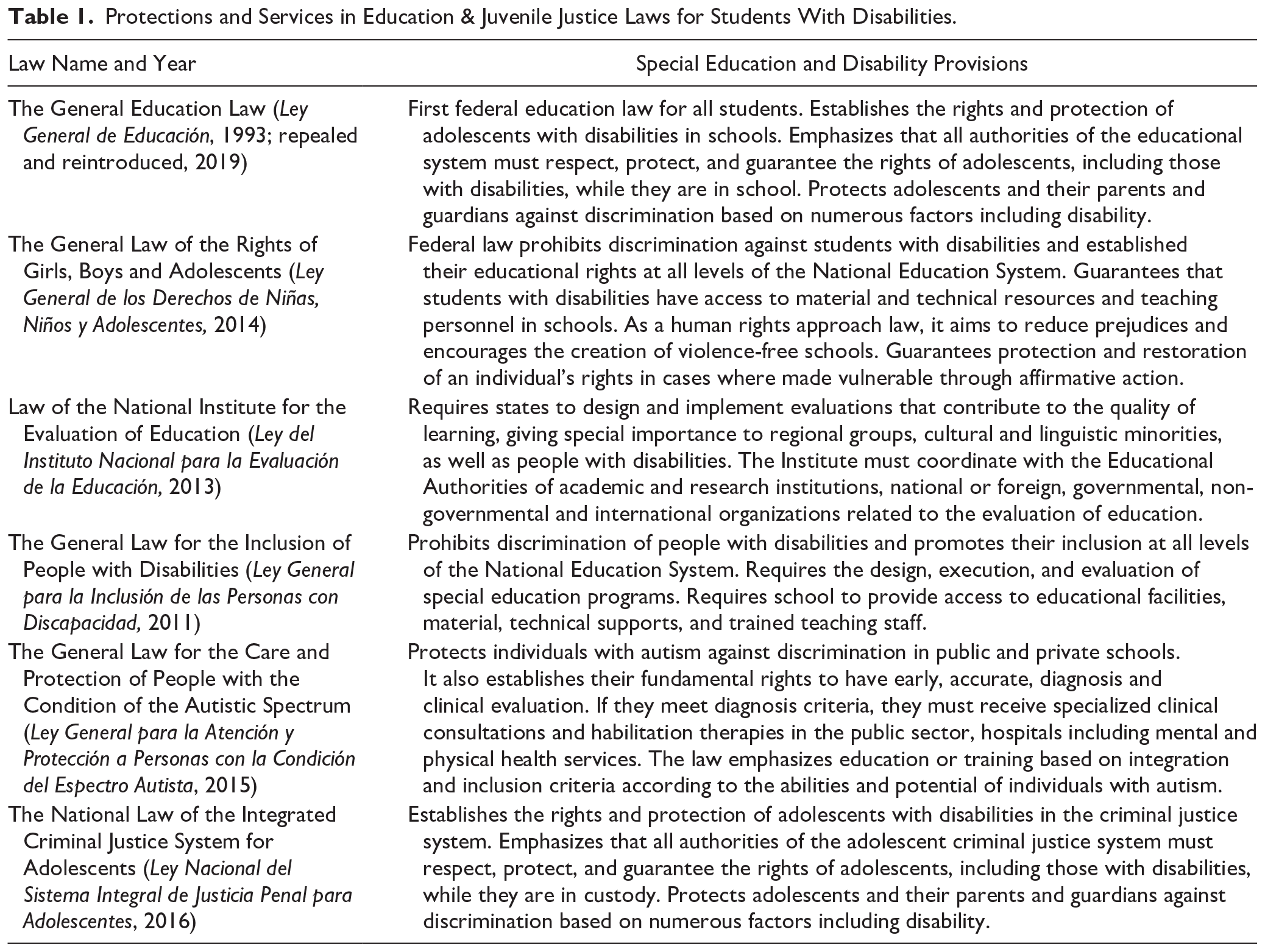
The General Education Law (Ley General de Educación, 1993; repealed and reintroduced in 2019) was the first federal law that required Mexican states to educate all students with disabilities (Agrawal et al., 2019; García-Cedillo et al., 2014). The General Education Law is founded on humanistic and democratic principles that promote the appreciation and respect for the dignity of all people. This law prioritizes the interests of girls, boys, and adolescents, guaranteeing the development of programs and public policies to promote the active participation of educators as well as parents and guardians of children with disabilities. The overarching goal of the General Education Law is to promote both the improvement of human coexistence and egalitarian values, and to avoid any type of privilege associated with race, religion, groups, or sex. The General Education Law’s aspirational goal of promoting social equality comes from the principle of inclusive education enshrined in Mexican education law which promotes the education of students with disabilities alongside their typical peers and using the same general education curriculum (Agrawal et al., 2019).
Related to individuals with disabilities, Article 16 of the General Education Law prohibits prejudice, stereotypes, discrimination, and violence against any person with a disability or in a position of social vulnerability. Article 41 establishes that special education has the purpose of identifying, preventing, and eliminating barriers which limit learning among people with disabilities or learning difficulties. The Ministry of Public Education (Secretaría de Educación Pública) is tasked with administering special education programs and supporting special education systems provided by states. The educational authorities under the direction of the Ministry of Public Education must establish a system of early diagnosis and specialized care and guarantee the training of all educators to identify and eliminate barriers to learning.
Article 65 of the General Education Law states that inclusive education must facilitate learning among students with visual impairments by offering Braille and sign language to individuals with hearing impairments and make reasonable adjustments to instruction to facilitate participation and learning in the general education classroom to students who need such services. Notably, the General Education Law makes specific mention of visual, hearing, and learning impairments as disabilities that make students vulnerable and in need of educational support.
The General Law of the Rights of Girls, Boys, and Adolescents (GLRGBA; Ley General de los Derechos de Niñas, Niños y Adolescentes, 2014; 2019) establishes that the right to a quality education is a basic human right. This law guarantees the right to access education for adolescents with disabilities at all levels of the National Education System. The law also prohibits discrimination and guarantees that students with disabilities have access to educational material and technical resources, as well as teaching personnel in educational facilities. The GLRGBA directs states to guarantee protection and support to individuals in vulnerable situations and to restore all rights if those rights have been infringed. In cases where vulnerabilities and needs exist, the law requires that schools address the student’s needs and if needed to adopt policies to promote substantive equality among girls, boys, and adolescents.
Article 53 of the GLRGBA establishes that girls, boys, and adolescents with disabilities have the same substantive rights as their typical counterparts without disabilities. Article 54 indicates that the right to education, participation in sports, recreational and cultural activities in any institution cannot be denied to girls, boys, or adolescents with disabilities. Article 57 stipulates that these children have the right to a quality education that contributes to their understanding of their rights and the development of their potential. Therefore, Article 57 calls for the implementation of all necessary adaptations to guarantee that children are provided their rightful place in the educational system and to establish supports to vulnerable populations suffering a major educational lag regardless of why they are behind in school.
Articles 82 and 83 indicate that girls, boys, and adolescents, including those with disabilities, are guaranteed to have the same legal rights and access to clear and comprehensible information related to the judicial and administrative processes in the cases in which they are involved. In addition, the GLRGBA stipulates that students with disabilities are entitled to free early education programs, health services, rehabilitation programs, and vocational training. The federal and local governments are responsible for providing the parents and families of eligible students with the educational support necessary to help their children with disabilities achieve respectable lives (Cobo-Téllez, 2019; Russo & Lozano, 2015). The GLRGBA provides more educational specificity and extends protections and services beyond learning to include physical, mental, and vocational realms.
The Law of the National Institute for the Evaluation of Education (Ley del Instituto Nacional para la Evaluación de la Educación, 2013; 2017) requires the evaluation of the curriculum to ensure that the educational curriculum and its implementation contribute to the quality of learning, giving special importance to regional groups, cultural and linguistic minorities, as well as people with disabilities (García-Cedillo et al., 2014; Russo & Lozano, 2015). According to Schmelkes del Valle (2018), because of this law, the Institute is obligated to provide specialized training to strengthen teacher preparation. The Institute is also in charge of reviewing and evaluating instructional lesson plans to ensure that they reflect current knowledge. Notably, the Institute is also tasked to improve parental involvement and conduct educational research. The Institute must also ensure that the educational services provided are equitable to all individuals or groups in vulnerable situations (Board of Directors of the Instituto Nacional para la Evaluación de la Educación [INEE], 2018).
Disability Laws
The General Law for the Inclusion of People with Disabilities (GLIPD; Ley General para la Inclusión de las Personas con Discapacidad, 2011; 2018) defines disability as the presence of a deficiency or limitation in a person, which by interacting with the barriers imposed by the social environment, can prevent the full and effective inclusion of individuals with disabilities in society and on equal terms with others who do not have disabilities. Children and adolescents with disabilities are those who, for congenital or acquired reasons, have one or more physical, mental, intellectual, or sensory deficiencies, whether permanent or temporary. Individuals with disabilities, like other girls, boys, and adolescents without disabilities, have the right to be included in the community. The intent of the GLIPD is to guarantee the educational rights and the right to inclusion at all levels of the National Educational System. As such, the GLIPD provides rules and regulations that avoid discrimination and ensure accessibility in educational facilities (Sandoval et al., 2017). In addition, the law requires the provision of educational material and training supports to ensure that schools have trained teaching staff. In contrast to inclusive education, special education in Mexico is viewed as a response to individuals with permanent or transitory disabilities who need support for their conditions. Such attention is offered to individuals with an inclusive social and gender equity perspective (García-Cedillo et al., 2014).
The General Law for the Care and Protection of People with the Condition of the Autistic Spectrum (Ley General para la Atención y Protección a Personas con la Condición del Espectro Autista, 2015) is unique in its specificity for individuals with autism. Article 10 of this law establishes full human rights for individuals with autism spectrum disorder (ASD) and calls for inclusive education for individuals with ASD. Article 11 requires educators at the federal, municipal, and local level to guarantee individuals with ASD full rights under the law. The law indicates that the education such individuals receive shall meet the criteria of inclusion and integration taking into account the capacities and potential of each individual through pedagogical evaluations with the goal of strengthening self-determination in life. The Intersecretarial Commission of Executive Power (Comisión Intersecretarial del Poder Ejecutivo Federal) was created to serve as a mechanism to coordinate and monitor between governmental education entities at all the levels that provide programs for individuals with ASD. According to the General Law for the Care and Protection of People with the Condition of the Autistic Spectrum law, people with ASD must receive support so that they ultimately can be gainfully employed, free of discrimination, and receive just compensation.
Problems With Implementation of Special Education
As a group, the five general education and special education laws provide protection against discrimination and require schools to include students with disabilities in public education. According to Russo and Lozano (2015), teachers are expected to make broad profiles of students to determine who is struggling and who might need external interventions. The Ministry of Public Education oversees the implementation of alternative programming (Shepherd et al., 2002). Alternative programs include several different types of special education schools, centers, or specialized service units. General Education Support Service Units (Unidad de Servicios de Apoyo a la Educación Regular, or USAER) are the special educators within regular schools who provide resources to general education teachers to help students who are struggling academically with the basic curriculum (Russo & Lozano, 2015; Shepherd et al., 2002). These specialized units offer tutoring support to students as well as advice for parents and guardians of children without disabilities. Integrated Service Units (unidades de servicios integrados) provide educational support in the form of remedial education to elementary level students who were retained at grade level. Peripheral Groups (grupos periféricos) serve students from second to sixth grades in rural and urban areas where special education services are lacking. Special Education Schools (escuelas de educación especial) provide services to children and adolescents with cognitive impairments, neuromotor disabilities, as well as visual and hearing disabilities. Special Education Labor Training Centers (centros de capacitación para el trabajo en educación especial) offer services to students from 14 to 20 years of age with cognitive disabilities, including courses that train them in various vocational trades, so that they can enter the labor market.
Shepherd et al. (2002) noted that about 10% of the school-age population have disabilities. Currently, there are 1,924 schools and centers that offer educational support to students with a range of disabilities (i.e., autism, cerebral palsy, cognitive impairments, hearing impairments, learning disabilities, physical disabilities, visual disabilities; Shepherd et al., 2002). It is important to point out that students with psychosocial disabilities are not included in the list of disabilities protected under Mexican education laws. Although students with learning disabilities (LD) are served under the special education system, they are not considered a distinct category of disabiity under special education law (Agrawal et al., 2019). Meanwhile, the General Education Law includes students classified as gifted and talented as part of the population of students served under the special education system. In sum, the General Education Law explicitly considers the category of gifts and talents as a distinct special education category while the category of LD is not considered a distinct special education category. The question must be asked why the law is silent about adolescents with psychosocial disabilities.
The term psychosocial disability is used in Mexico to describe individuals with behavioral disorders. By definition, a psychosocial disability is a temporary or permanent mental dysfunction that impedes daily functioning. The term includes disorders such as depression, bipolar disorders, anxiety, psychosis, schizophrenia, schizoaffective disorder, dementia, epilepsy, substance abuse, and suicide attempts (CONADIS, 2016; OMS, 2010). The needs and rights of students with psychosocial disabilities are mentioned in the international Convention on the Rights of Persons with Disabilities (2006) but they appear to have been omitted from Mexican general or special education laws. That is to say, as evidenced by their absence in the list of disabilities protected under general education or special education laws, the Mexican educational system does not recognize the population of students with psychosocial disabilities as a distinct group of students who require special services.
Adolescents in Correctional Confinement
The penitentiary system in Mexico is organized based on human rights, education, vocational development, health, and recreation. The purpose of correctional confinement is to rehabilitate and return the individual to society. Article 18 of the Political Constitution of the United Mexican States (La Constitución Política de los Estados Unidos Mexicanos, 1917; 2020) contains information specific to incarceration. A 2005 amendment to Article 18 promotes a comprehensive system of juvenile justice rehabilitation in which minors older than 12 or younger than 18 years of age are guaranteed not only basic human rights but also specific rights, which consider the fact that they are still in the process of developing socially and cognitively (Solís, 2014).
Article 16 of the National Law of the Integrated Criminal Justice System for Adolescents (Ley Nacional del Sistema Integral de Justicia Penal para Adolescentes, 2016) establishes that adolescents will not be subjected to discrimination based on ethnic or national origin, gender, age, disability, social condition, health status, religion, sexual preference, gender identity, and marital status. This law protects adolescents as well as their parents or guardians. Finally, the law fosters positive social ties between the youth and caretakers with the goal that they lead to the full development of the adolescent’s personality and capacities. Article 30 establishes a shift from punitive sanctions for crimes and promotes the use of socio-educational approaches to sanctions so as to promote the full development of the adolescent. As such, the shift from punishment to rehabilitation provides the possibility that correctional facilities might consider attending to the social and educational aspects and needs of incarcerated adolescents. Article 44 states that in the event that the adolescent has a disability, he or she can request a reasonable adjustment to the process to guarantee their effective and full participation in the education process. For example, an adolescent with a disability who cannot read or write must have adequate legal defense and assistance, and an appropriate interpreter will be appointed to guarantee effective communication. The National Law of the Integrated Criminal Justice System for Adolescents requires the authorities of the criminal justice system to guarantee that all adolescents in custody are cared for in consideration of their characteristics, specific conditions, and special needs.
Discussion
National statistics in Mexico show that 3,661 adolescents ages 12 to 18 were deprived of liberty in 2018 (Instituto Nacional de Estadistica, Geografia, e Informatica [INEGI], 2018). Following a wave of reforms prompted by a revision to Article 18 of Mexico’s Constitution in 2005, the name for centers associated with the juvenile justice system in Mexico were changed from the former Guardianship for Minors (Tutelares para Menores) to the current Communities for Adolescents (Comunidades para Adolescentes). There are 54 Communities for Adolescents responsible for the care of youth ages 12 to 18, who are in custody for treatment due to having committed a crime. Six of those Communities for Adolescents are in Mexico City. The change in name signals a shift from controlling and protecting adolescents with challenging behavior to one which views adolescents in custody as having not only responsibilities but also entitlements under the law (CNDH, 2019; Solís, 2014).
Russo and Lozano (2015) pointed out that Mexican special education law does not currently include due-process rights for students who are confined in correctional facilities. Therefore, if children with disabilities are not provided appropriate educational programs when they are in correctional prison, parents may not be able to compel federal or local governments to create special education services designed for their children. Without the implementation of procedural rights, parents do not have a clear path to defend the rights of their children as guaranteed by Mexican law. While the current language of the general education law mandates that the federal, state, and municipal governments identify youth with disabilities in custody to create educational and rehabilitative supports, this has not been implemented in practice.
According to the law, special education services must be available for all students with disabilities. Federal and regional authorities are required to create facilities for special education services and facilitate the training of educational personnel to serve students with disabilities. However, there do not appear to be special education services in place at existing Communities for Adolescents. As such, the absence of special education services in exisiting Communities for Adolescents makes them out of compliance with the law.
Although adolescents with psychosocial disabilities are recognized within the juvenile justice system, these correctional settings, despite the change in name, are not currently designed or funded to provide treatment or education to this complex population of youth. The fact that psychosocial disabilities are not recognized within the larger educational system as a separate category of disability the same way the law recognizes youth with ASD, youth with depression and anxiety are left without protection against discrimination or access to educational services. Thus, Mexican education law excludes students with psychosocial disabilities by virtue of not recognizing and identifying them as members of a distinct category requiring special services.
Meanwhile, the number of adolescents involved in criminal activities in Mexico is growing. According to statistics provided by the Undersecretary of the Penitentiary System (Subsecretaria del Sistema Penitenciario) the number of minors in conflict with the law in the country’s capital grew by 17.51% from August to November 2018. Approximately 20% of adolescents who commit crimes are sent to outpatient treatment centers under the custody of their families. The great majority of adolescents (about 80%) are sent to a correctional facility (INEGI, 2018).
General education laws exclude adolescents with psychosocial disabilities. It appears that the only law that helps this population of youth is the National Law of the Integrated Criminal Justice System for Adolescents. Being recognized only as delinquents and held in custody, adolescents’ educational rights are secondary, given that the juvenile justice system still follows punitive approaches and favors public safety over the educational rights of adolescents in custody. Currently, juvenile correctional facilities are part of the penal system, separate from the educational system. To meet the aspirational goals of the laws which aim to educate and rehabilitate adolescents in correctional confinement, the penal system and educational system would need to work together to support and rehabilitate adolescents so that they could return to society. This collaboration would require a change in the laws to mandate such convergence of the two institutions.
Recommendations
Currently, the problem is that Communities for Adolescents continue to use harsh and punitive measures, which prioritize punishment instead of education to rehabilitate adolescents. A lack of resources, infrastructure, and specialized personnel prevents those policies for properly educating incarcerated students from being effectively enacted (Arnaz, 2005; United Nations Children’s Fund [UNICEF], 2015; Vasconcelos, 2013). Adolescents in correctional confinement need to have access to rehabilitative and educational opportunities that promote their full development as productive, responsible citizens. Proper educational services will increase the likelihood that they will not engage in crimes in the future, adhere to the legal requirements to protect their human rights, and help realize the principles envisioned in educational and juvenile justice laws for adolescents in Mexico.
Collaboration between the educational and judicial institutions is important. Such collaboration would not only maximize the use of limited financial resources, but it would also promote the exchange of pedagogical expertise. It is unlikely that in the immediate future institutions for adolescents in conflict with the law would be able to allocate funding necessary to train a cadre of educators trained in special education to comply with the law which requires that adolescents with disabilities who are incarcerated receive educational services (Russo & Lozano, 2015). It is recommended that special education teachers already practicing in public schools outside of the juvenile justice system could provide support within Communities for Adolescents that do not have special educators.
Finally, and most important for the field of disabilities, adolescents with psychosocial disabilities should be considered first and foremost as students rather than criminals. While the newly passed Article 18 of the Mexican Constitution highlights the importance of education as a rehabilitative tool, in practice, the Communities for Adolescents, where youth in conflict with the law are imprisoned, continue to follow the practice of treating the adolescents as criminals. Recognizing the population of youth with psychosocial disabilities as a distinct category within special education will likely lead to more focused research about how to improve educational services for incarcerated adolescents with disabilities.
Conclusion
Mexico’s juvenile justice system is in its early phase of developing and improving. However, its success is limited (Azzolini Bincaz, 2019). In practice, the juvenile justice system’s treatment of adolescents who commit crimes is not always guided by the human rights perspective established in the Constitution of Mexico, or any other educational law. Policies promoting the inclusion of individuals with disabilities in daily activities is a necessary first step to improving their lives. However, manding that individuals with disabilities assume roles in adulthood similar to their peers without disabilities requires more than encouraging inclusion; it requires overt action that ensures practices are in effect in educational settings both within and outside of the juvenile justice system.
Footnotes
Declaration of Conflicting Interests
The author(s) declared no potential conflicts of interest with respect to the research, authorship, and/or publication of this article.
Funding
The author(s) received no financial support for the research, authorship, and/or publication of this article.