




Abstract
John Wills Lloyd is a professor emeritus at the University of Virginia and co-editor of Exceptional Children. He earned his PhD from the University of Oregon and spent most of his career at the University of Virginia. Dr. Lloyd has been an integral part of many professional organizations, including the Council for Exceptional Children’s Division for Learning Disabilities, where he served as president and later as the executive director, and the Division for Research. Dr. Lloyd’s work has focused on the identification of effective instructional practices, best-practice in single-case design research methodology, and facilitating a deeper understanding of learning disabilities. He has produced numerous scholarly articles, foundational textbooks, and web-based materials that continue to inform readers about effective practice in special education.
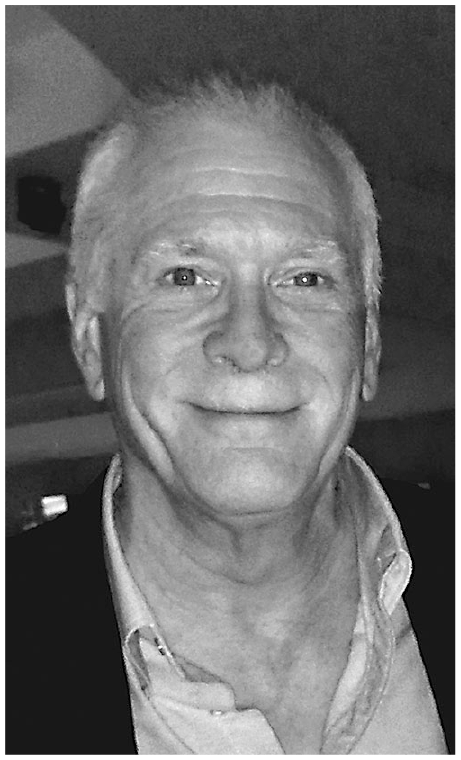
There are some great origin stories (being bitten by a radioactive spider, participating in an experimental study, or finding a magical object), but John Lloyd’s special education origin story is one that would make many in the field a little green with envy. His story falls more into the “right time, right place, and the right sense to take advantage of it all” trope.
It should come as no surprise to any former student or prospective author of Exceptional Children (EC) that John’s undergraduate degree was in English and his father was a newspaper editor. Two of John’s defining characteristics are curiosity and precision. So, although he was an undergraduate student at California State University, Los Angeles, exploring and mastering the nuances of the English language, he found himself in a classroom in a school with a group of teachers who were doing many of the right things. His desire to understand teaching, learning, and human behavior began then and there. His curiosity would lead him to a lifelong pursuit of codifying excellence in teaching and research. But, it is probably better to hear about all of this from John.
How did you find your way into special education?
I had the good fortune of working with blind kids when I was in eighth grade. My job was to teach them to swim, and (as the joke goes) I said, “Watch me . . . ” Of course, I realized immediately that a different approach was needed. It was my first “aha” in terms of thinking about more and less effective ways to teach and was my preliminary connection to special education and individualizing instruction. The real connection, though, came when Pat (Lloyd) and I were undergraduates at Cal State L.A. in the mid 1960s, and we began to do volunteer work with a group of teachers who were hired by the L.A. County School District to host demonstration classrooms on the Cal State campus for the purpose of teacher training and professional development. Each classroom had a wall of one-way mirrors; one classroom was even connected to an auditorium so that large groups (like 100) of prospective teachers could watch and learn. Our job was to support students identified as educationally handicapped, California’s generic term for high-incidence disabilities in the ‘60s. My volunteer work led to a job as a teacher’s aide first in a private school and then back at the Cal State site.
The group of educators I worked with during that time was the first of many to have a deep influence on my thinking and work. First, there was Alice Thompson, the director of the Cal State program. Dr. T, as we called her, was a professor of psychology. To this day, I am sure that I still use some of her sayings and expressions. There was also a teacher named Phil Lean, who gave me Ullmann and Krasner’s (1966) Case Studies in Behavior Modification, an edited volume of published articles by G. Patterson, I. Lovaas, W. Becker, and the like. A gang of the assistant teachers (J. Barcal, E. Petrokowskie, et al.) actually sacrificed some of their salaries to help me work there. Then, there was Teddee Blumberg, the head teacher of the elementary classroom I worked in. Teddee taught me Orton Gillingham, and it was in this context, this Orton classroom, that she turned me on to Zig Engelmann. Teddee was an alert and informed consumer. So, in 1969, when she got a copy of DISTAR Reading I, we explored it together. As we looked through DISTAR, we would say things like: “Oh, they do this!” “That is interesting!” and “Orton Gillingham doesn’t have anything about blending like that.” Teddee also loaned me her copy of Engelmann’s (1969) Preventing Failure in the Primary Grades. The influence of these initial encounters was quite profound on my career.
It was also during that time that I co-taught a class with Alan Lifson, who was a devotee of Frank Hewitt. Alan and I ran a classroom that had point sheets on the desk and activities for the kids to do—very much influenced by Hewitt’s “Engineered Classroom.” I had also discovered the Journal of Applied Behavior Analysis (JABA), which was the new kid on the block so to speak. JABA was great because I could read it and immediately see applications—“Hey, I can use praise to reinforce attending to task!” Each of these early experiences were formative in shaping my thinking. In short, I was surrounded by a bunch of people who were active consumers of the literature of the time. The motto among these professionals was “If it ain’t working, get it out of here,” which reminds me of Marc Gold’s famous guidance from about the same era, “Try another way.”
Both of these sayings laid the groundwork for my belief in the use of data to inform instructional decision making. As we all do, I wanted to find things that made kids’ lives better, but I wanted the procedures to be substantiated by evidence. Why should I trust my or someone else’s opinion? I was looking for something more than personal views.
Thus, thanks to those early mentors, I learned to look for alternative solutions undergirded by the belief that (a) students can learn and (b) teachers have the power to make that happen. Teachers just need the right tools for the task at hand.
That is quite a rich training ground in special education as an undergraduate English major. When did you begin your formal training in special education?
So, I was working and taking classes at Cal State, but the classes I was taking largely reflected a diagnostic-prescriptive approach to special education—give this test, identify these problems, remediate these underlying problems, and the kid will read. When I completed my undergrad in English, I started into a special education master’s program. But, after a semester, I was not buying that diagnostic-prescriptive perspective. I thought teachers needed JABA, so I bailed on the master’s program at Cal State after my introduction to learning disabilities course. But, I kept reading the literature, and there were these names that kept coming up like Barbara Bateman, who was conceptually integrating things well, and Hill Walker and Wes Becker, who were running intervention studies. All of these people were at the same place. And Zig Engelmann (the DISTAR person) was there, too! Therefore, in 1973, I applied to the University of Oregon for my master’s. Foolishly, Oregon let me in.
The first night of my first class, I was sitting in the back of this huge lecture hall and in walks our professor, Barbara Bateman, who introduced herself as a first-year law student, which, of course, she was. Barbara was just starting her law degree at the U. of O. In the first 3 hours of class, Dr. Bateman pulled together everything I had been reading about. A few weeks afterwards, Barb said to me, “You should not be doing the master’s program, you should be doing the doctoral program.” Hill Walker, who was head of the doctoral program, told me I had everything I needed to apply to the program except for one test. “Take the Miller’s Analogies test, and we can get you in.” I took the test on a Wednesday and was admitted to the doctoral program shortly thereafter. I would start the doctoral program that following fall. Because of this, my master’s program was crafted to prepare me for the doctoral program. I did a ton of reading, and I conducted my first real review of the literature—on handwriting, which, by the way, changed my thoughts on handwriting.
It sounds like your master’s experience set the stage for developing your appreciation of science as a guide for decision-making. In what ways did the science influence your perspective on handwriting back then?
Well, due to my Gillingham and Stillman influence from my teaching days, I had been a big believer that long-hand was essential to address issues related to reversals. Specifically, long-hand should be taught first and as primary. The theory was that it would prevent reversals and shorten the learning process for kids with learning disabilities (LDs). But, I found that was not particularly accurate. Now that was based on 1973 to 1974 literature, and I still think long-hand instruction is a good thing, but I found a whole lot of evidence supporting the need to teach printing.
In addition to findings related to handwriting, the nifty thing about that review was that I learned a lot, thanks to Barbara Ring who oversaw the project, about research methods. I took notes on 5 × 8 cards. As I developed my coding system (e.g., data-based vs. author-opinion, elementary vs. secondary), I realized most items were binary. I used a hole punch to indicate the codes. I could then place a pencil or knitting needle through all my stacked cards to sort the cards by feature. This whole experience got me to start to think about things much more empirically and less theoretically.
My master’s thesis was a single-case, reversal design with extensive direction by Hill Walker examining the relation between child attention and teacher behavior. The teacher I worked with was great. He said, “Sure. I can just not praise that kid and praise this one.” I wrote that paper up the Friday after Thanksgiving in 1974. That was my second shot at publishing. My first paper was one I did for Bateman’s class on my perspectives on instruction—influenced, of course, by Barbara and Alice Thompson. Barb said, “You ought to send this in to the Journal of Learning Disabilities (JLD).” Which I did, and they published it (Lloyd, 1975)! Given this early and positive experience with publishing, I was very excited to submit a data-based manuscript based on my master’s thesis. Despite my enthusiasm, it was rejected. Interestingly, though, it was one of the first single-case design submissions to JLD. As a result of my submission, the editor ended up soliciting Tom Lovitt to write a couple of papers on single-case design for the journal.
In higher education, one’s academic family tree can be very revealing in terms of influence of ideas. Can you talk about your academic family tree and some of the academic neighborhoods you grew up in?
Barbara Bateman was my doctoral advisor, but she told me she would advise me in absentia as she was now a second-year law student. Bateman was Sam Kirk’s student at the University of Illinois. Some of the others who were members of Kirk’s “gang” in that era were Jim Chalfant, Corrine Cass, Margaret Schefelin. All of these people were influencing special education at the time of my training and had a direct influence on me.
Like many candidates, I raced through my doctoral training program. I arrived for my master’s in 1973 and defended my dissertation about Thanksgiving of 1976. I have regretted that hasty pace sometimes because establishing a working relationship with Doug Carnine, who had just joined the faculty and was definitely the “research guy,” would have been great for me. You may have seen a video with Engelmann talking about how he would be sitting around with Doug talking about instruction and every now and then Doug would stop and make a little note on his paper. Then, a few weeks later Doug would say, “We ran a study on that instructional question you posed a couple of weeks ago, and here is what we found. . . . ” Being around that kind of research would have been wonderful. I got a whiff of it.
Engelmann had an enormous effect on my career. He showed me the power of logical analysis and, especially, not examples (i.e., what is not an elephant, not an example of “above”). And he (and Doug Carnine) showed me the incredible power of conducting experiments to evaluate microteaching procedures.
In terms of early academic influencers, though, there were many. People in my doctoral training neighborhood were Chris Slentz (now at Western Washington University) and Ann Todd (still at University of Oregon). They helped me collect data for my dissertation. Then, at Northern Illinois University (NIU), where I started working immediately following dissertation data-collection but prior to defending my dissertation, I had the good fortune of collaborating with Mike Epstein (Emeritus, University of Nebraska, Lincoln), Doug Cullinan (North Carolina State University), Diane Dietz, and especially (though there were many others), Alan Repp. All of them contributed in important ways to my thinking and work (see Figure 1).
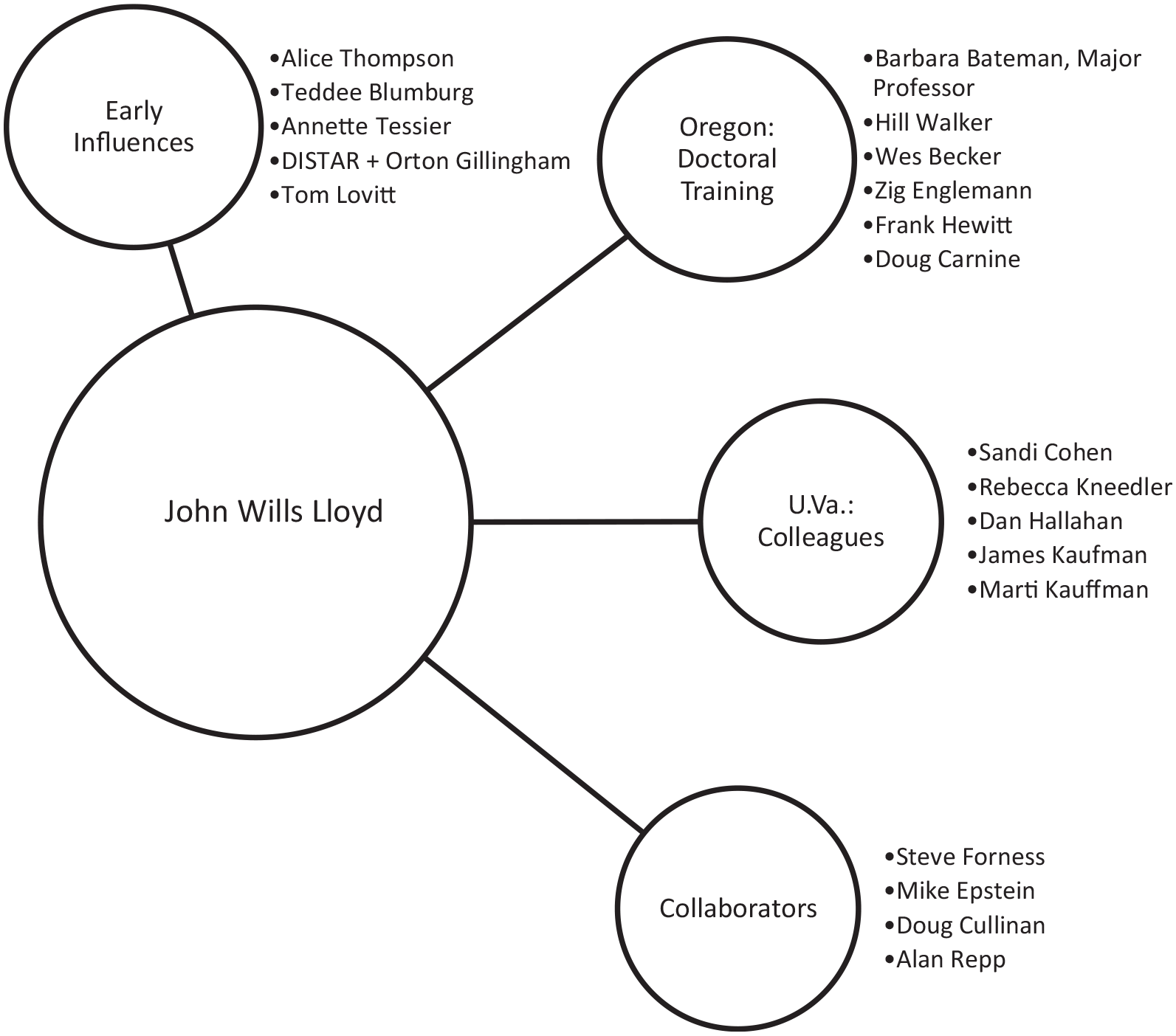
Influences.
As an aside and anecdote for doctoral students: For my dissertation, I got nothing in terms of results. It is important to realize that the dissertation is not and will not (unless you let it) be your defining research study. For mine, I ran a two-between and three-within analysis of variance (ANOVA) design. One condition was a sound-it-out correction routine for reading errors and the other between condition was a different routine, repeat the correct word. I had a whole stack of nonsense words. There was also a reinforcement component, because I did not want to create a behavioral chain that included reading the word incorrectly, having a correction prompt, repeating the correct word, and then receiving a reward. So, I created different reinforcement schedules within the groups. As I said, I got nothing. Null results. Not one publication from it!
What would you say are the themes or instructional guideposts that have run through your professional career? Things like precision teaching? Direct Instruction?
I would say those are good but there are several splinter ones as well. When I first started my career, I thought I was going to be a reading guy. I thought I would do a lot of studies on reading, but when I got hired at the University of Virginia (U.Va.) as a part of the Learning Disabilities Research Institute, my focus shifted. As a historical side-plot, during that time, the Department of Education funded five institutes that each focused on a different aspect related to learning disabilities. It was an interesting compilation of people and ideas; it was a fascinating time. The institutes came about because the feds were unhappy with the results coming from the LD demonstration projects that had been funded. There had been 30 or so of those projects, and they ran the gamut from early Janet Learner–type studies to Epstein and Cullinan’s one on precision teaching and direct instruction where I had worked while at NIU. The funds that had been used to support the demonstration projects were repurposed to support the establishment of the LD institutes. So, it was interesting for me to be leaving an institute which housed one of these demonstration projects, Epstein’s and Cullinan’s at NIU, to work at U.Va., a university that had just received funding for an LD institute.
The focus of the U.Va. institute was on attention. Because of my Direct Instruction and precision teaching background, Dan Hallahan and Jim Kauffman decided that I should run the classrooms. Although the focus of the research was attention, if you look at the training materials for those classrooms, you can see a bunch of Zig Engelmann’s influence. Dan Hallahan came at instruction from a cognitive–behavioral modification perspective—focusing on self-talk and internal narration—while I approached it from a more instructional-design perspective. To teach the cognitive–behavioral routine, students needed demonstrations of each of the steps of the self-monitoring process. As one can see in the training manual, there are multiple exemplars and practice opportunities to promote learning. Also, for the project classrooms, I created my own precision-teaching-like data charts. At the large meetings of all the institutes, Stan Deno and I would end up in a corner discussing how we would measure treatment effects and address issues related to data collection. As I said, it was a great time to be immersed in these issues and engaged with this larger research community.
When I think about the influence of your work, I think about how you have either codified practice recommendations or gathered people together for the purpose of identifying what works. Can you say more about that?
Much of that work started in the 1990s when Doug Carnine and I were a part of the Division for Research. People were saying that research can’t prove anything (or, “you can prove anything with research”), so we decided to have the Division for Research take the lead on identifying what trustworthy research had yielded in terms of a better understanding of teaching and learning. We put on a several-year campaign with the Council for Exceptional Children (CEC) where we asked divisions to send their chairs of research or knowledge utilization committees to us to determine what we did, in fact, know. Of course, Steve Forness and Ken Kavale were doing their “mega-analysis” (Forness’ term for meta-analysis) work at the time. I invited Steve to do the DR Showcase at CEC in ’93 or ’94. It was a packed room and the title of his presentation was something like “Can 1,000 studies be wrong?” It was great to bring this type of awareness of research to the field. Steve slayed it!
Relatedly, I do feel like, as editor of EC, I am in a unique position to “bump ideas along.” As such, being the editor of EC feels like an extension of this earlier work I did with DR. I am very honored to have that opportunity.
The history of special education can sometimes feel like “one step forward, two steps back.” What are some current trends that are moving special education back and what is the antidote for moving forward?
What I see pushes special education back stems from a misinterpretation of the law. Particularly, the notion of the “supremacy of place”—that place is more important than individualized, educational program—is really hurting us. The second one is accommodations—all we have to do is accommodate these kids, and they will be fine. These two concepts go hand-in-hand. For example, providing a picture schedule can be helpful but it is not instruction; providing a paraeducator to be with a student so that the student can be in the general education setting can be wasteful. Students who have difficulty learning are the students who need the very best instruction we can muster.
The antidote to these missteps is preparing teachers to understand this is what your job is. This is what good instruction looks like and feels like. To do that, I believe a clear-eyed look at instruction is paramount. To take that clear-eyed view, one has to make the leap of faith that we can measure outcomes in micro and macro ways so that we can check our egos at the door and try instructional practices, make instructional changes, and see what happens as a result.
As astute readers know, I am currently campaigning in support of open scholarship. Open scholarship (“open science”) is an effort to advance the trustworthiness of contemporary research. Colleagues and I (Adelson et al., 2019) are encouraging authors, editors, publishers, and others to make their research more transparent. This is, to me, simply an extension of the perspective I gained from my colleagues of 50 years ago, when we sought to find practices that would advance the outcomes of the students with whom we were working.
Conclusion
Over the course of his career, John has remained true to his roots. His persistence to knowing more, getting better, and getting it right has influenced many doctoral students, colleagues, and the field of special education. Thanks to John, many of us approach what appear to be the irretractable problems of education with an open mind and willingness to ask, “Well, what can we learn from trustworthy data on this one?”
Footnotes
Declaration of Conflicting Interests
The author(s) declared no potential conflicts of interest with respect to the research, authorship, and/or publication of this article.
Funding
The author(s) received no financial support for the research, authorship, and/or publication of this article.
