




Abstract
Five days after the U.S. Supreme Court handed down its ruling in Endrew F. v. Douglas County School District, the U.S. Court of Appeals for the Ninth Circuit issued a decision in M.C. v. Antelope Valley Union High School District. This important decision involved a student who was being served under the Individuals with Disabilities Education Act (IDEA). The student was blind and required a high level of support in all academic areas. The case addressed important issues regarding parental participation throughout the Individualized Education Program (IEP) process and the school district’s obligation to implement the IEP. This column (a) examines this decision by providing the facts of the case, including the decisions at the due process hearing level, U.S. district court, and U.S. Court of Appeals; (b) explores the ruling by the court of appeals decision; and (c) discusses implications of this decision for special education administrators and teachers.
When school-based personnel and a student’s parents or legal guardians develop and agree on an Individualized Education Program (IEP), the document becomes the blueprint of that student’s free, appropriate public education (FAPE). A student’s IEP team members must meet many procedural and substantive requirements and obligations regarding FAPE.
Five days after the U.S. Supreme Court announced its ruling in Endrew F. v. Douglas County School District (Endrew F., 2017), the U.S. Court of Appeals for the Ninth Circuit issued a ruling in M.C. v. Antelope Valley Union High School District (Antelope Valley, 2017). The case addressed the importance of school district personnel adhering to the procedural requirements of the Individuals with Disabilities Education Act (IDEA) and its obligation to implement a student’s IEP. The ruling also highlighted how school district personnel may inadvertently violate these mandates. This column (a) examines this important decision by providing the facts of the case, including the decisions at the due process hearing and the federal district court; (b) explores the ruling by the court of appeals; and (c) discusses implications of this decision for special education administrators and teachers. Also addressed is a caveat to generalizations regarding court decisions. School district procedural, substantive, and implementation requirements are also examined.
Interpreting Court Decisions
A unique aspect of special education litigation is that the vast majority of cases involving issues regarding the IDEA (2006) are first heard at the due process hearing level. After the party requesting the hearing has completed the due process hearing route, often referred to as exhausting the administrative process, they may bring a case in either state or federal court. There are three levels of federal courts. The first level is the U.S. District Courts. Each state has between one and four district courts. The second level is the U.S. Court of Appeals. The third level is the highest court in the land, the U.S. Supreme Court. A decision by a higher court controls the rulings of lower courts in the same jurisdiction. The lower court, therefore, cannot make a decision contrary to decisions by the higher court in its jurisdiction. Thus, a U.S. district court in a particular circuit will follow the precedent set by the U.S. Court of Appeals within that circuit. As the highest court in the United States, a ruling by the U.S. Supreme Court controls the disposition of similar decisions of all lower courts throughout the nation.
The ruling in Antelope Valley came out of one of the largest circuits in the country: the U.S. Court of Appeals for the Ninth Circuit. U.S. Court of Appeals rulings are important because this level of court decision is only exceeded in importance by rulings of the U.S. Supreme Court, which create precedent, or controlling authority, throughout the country. Rulings by the courts of appeals create precedent for lower federal courts in the states in the particular circuit court’s jurisdiction. The following eight states are in the jurisdiction of the Ninth Circuit Court, and the 15 district courts in these states must follow the precedent created by the Antelope Valley case: Alaska, Arizona, California, Hawaii, Idaho, Nevada, Oregon, and Washington. In addition to controlling authority, the ruling in Antelope Valley will likely have what is called persuasive authority—meaning it is a strong and logical decision, which may persuade courts in other jurisdictions to rule similarly. Moreover, the Ninth Circuit Court’s ruling was certainly in line with decisions made in other circuit courts regarding the procedural requirements of the IDEA. For this reason, the ruling in Antelope Valley is an important and influential one.
Procedural, Substantive, and Implementation Requirements
When developing a student’s IEP, school personnel must meet the FAPE-related requirements of the IDEA by adhering to procedural requirements (e.g., convening an IEP team with required members, involving a student’s parents in the special education process, meeting special education timeline procedures in developing a child’s IEP) and substantive obligations (e.g., conducting a thorough and relevant assessment, developing ambitious and measurable annual goals, measuring and reporting on a student’s progress toward his or her goals) (Yell et al., 2020b).
The procedural requirements for identifying a student as having an eligible disability and subsequently developing the student’s program of special education and related services are explicitly laid out in the IDEA (Berney & Gilsbach, 2017). The IDEA’s primary procedures include requirements regarding child find, evaluation, parental involvement, and IEP development (Yell et al., 2020b). The substantive requirements essentially involve the content of the IEP and focus on the adequacy of a student’s IEP in terms of its likely or actual results (Zirkel, 2017). These substantive obligations were clarified in Endrew F. (2017), when the Supreme Court ruled that the IDEA required an educational program reasonably calculated to enable students to make progress appropriate in light of their circumstances.
When school personnel fail to implement an IEP as written, it is likely they have committed a violation of a student’s right to a FAPE under the IDEA. Zirkel (2017) referred to a school’s failure to implement IEPs as the third dimension of possible FAPE violations. The Ninth Circuit Court’s ruling in Antelope Valley addressed the school district’s failure to implement an IEP.
The Facts of the Case
This case involved a child referred to as M.C. in the court’s decision, who was blind and had required a high level of support in all academic areas. Because of his disabilities, M.C. was found to be eligible for special education services under the IDEA. A team was convened and wrote an IEP for M.C. The child’s mother, referred to as M.N. in the court’s decision, participated in the meeting and although she signed the IEP, she did not agree that the IEP provided FAPE to her child.
The original IEP provided that M.C. was to receive the services from a teacher of the visually impaired (TVI) for 240 min per month. About a week after the IEP team met, school personnel realized the IEP contained an error; it was supposed to offer 240 min of TVI services per week rather than 240 min per month. School officials did not notify M.C.’s mother of the error. Rather, a month after the IEP meeting, the school personnel unilaterally changed the IEP to reflect the increased number of minutes of the TVI services to 240 min per week. This amendment was not even accurate, because the school actually provided 300 min of TVI services per week. After the IEP had been unilaterally changed by school personnel (i.e., changed by school personnel without consent of the parents), the district did not send the new IEP to M.C.’s mother or notify her of the change.
If a student served under the IDEA is to receive assistive technology (AT) services or devices, the student’s IEP must indicate the amount and frequency of these services or devices. On M.C.’s original IEP, a box for AT services had been checked “no.” Therefore, according to the IEP, M.C. would not receive any AT services or devices. After the IEP had been signed, school personnel unilaterally changed the “no” (i.e., AT services would not be provided) to a “yes” (i.e., AT services would be provided). The school district, however, failed to specify what AT services or devices that M.C. required.
M.C.’s mother filed for a due process hearing in which she alleged that the school district had committed procedural and substantive violations, including a failure to (a) document services provided by the TVI, (b) specify the AT services and devices provided by the district, (c) develop measurable goals in the areas of life skills, and (d) provide adequate orientation/mobility services and social skills instruction.
The due process hearing was conducted by an administrative law judge (ALJ) who denied all allegations and ruled in favor of the school district. On appeal to the U.S. District Court for the Central District of California, the ALJ’s decision was affirmed. The case was then appealed to the U.S. Court of Appeals for the Ninth Circuit.
The Ruling of the U.S. Court of Appeals
The Ninth Circuit Court overturned the rulings of the ALJ and district court. The circuit court conducted a de novo review (i.e., the court decides the case without deference to the previous court’s or hearing officer’s decision, often because the previous decisions were inadequate). The circuit judges conducted the de novo review because they found that the ALJ’s ruling, upon which the federal district court’s decision was based, was neither “thorough nor careful” (Antelope Valley, 2017, p. 1195). In other words, the three judges on the circuit court gave little deference or credence to these decisions, primarily because the ALJ “didn’t address all the issues and disregarded some of the evidence presented at the hearing” (Antelope Valley, 2017, p. 1195). The district court had found the ALJ’s analysis not entirely convincing but nonetheless affirmed the decision. The circuit court found that the “district court erred in deferring to the ALJ’s decision” (Antelope Valley, 2017, p. 1195), thus giving no deference to the district court’s ruling.
Procedural Violations
The primary area of discussion by the court in Antelope Valley concerned the importance of the procedural protections of the IDEA, which, the judges wrote, “are a central feature of the IDEA process, not a mere afterthought” (Antelope Valley, 2017, p. 1195). The court quoted the U.S. Supreme Court in Board of Education v. Rowley (Rowley, 1982) that “Congress placed every bit as much emphasis upon compliance with procedures giving parents and guardians a large measure of participation at every stage of the administrative process” (p. 205). In Antelope Valley (2017), the circuit court found that procedural errors committed by a school district during the IEP process were quite likely to “cause the loss of educational benefits” (p. 1195). The three-judge panel cited its previous decision in Amanda J. v. Clark County School District (Amanda J., 2001): “Procedural violations that interfere with parental participation in the IEP formulation process undermine the very essence of the IDEA” (p. 892) and are “essential to ensuring that every eligible child receives a FAPE” (p. 891). Because M.C.’s IEP had been unilaterally revised by school personnel, which had denied M.C.’s mother of her opportunity to participate in the drafting of the IEP, the school district had committed a serious procedural violation. This finding, which was in conformity with many other court findings on procedural violations, may have been serious enough to result in a finding of denial of FAPE; however, the court went beyond this violation and found that the school district has committed another serious procedural violation. The Ninth Circuit Court also examined the problem that occurs when parents are not able to participate throughout the IEP process.
The circuit court found that “parents must be able to participate in both formulation and enforcement of the IEP” (Antelope Valley, 2017, p. 1199, emphasis added). Because the Antelope Valley Union High School District failed to note that M.C. would be provided AT services and unilaterally changed the IEP to provide those services without specifying those services or notifying M.C.’s mother, the school district had “rendered the IEP useless as a blueprint for enforcement” (Antelope Valley, 2017, p. 1199). A student’s parents must, the court held, be involved in more than drafting or formulating their child’s IEP. As the Ninth Circuit Court noted, “Parental participation does not end when the parent signs the IEP. Parents must be able to use the IEP to monitor and enforce the services that their child is to receive” (Antelope Valley, 2017, p. 1199). However, because of the Antelope Valley School District’s actions, M.C.’s mother was unable to participate in enforcing the IEP because she was not aware of the services being offered.
The circuit court’s panel of judges wrote that the school district’s actions in unilaterally changing M.C.’s IEP were a per se (i.e., automatic) violation of the IDEA because it undermines its function of giving notice of the services the school district has agreed to provide and measuring the student’s progress toward the goals outlined in the IEP. Moreover, any such unilateral amendment is a per se procedural violation of the IDEA because it vitiates the parents’ right to participate at every step of the IEP drafting process. (Antelope Valley, 2017, p. 1197)
Furthermore, the court found that “an IEP, like a contract, may not be changed unilaterally. It embodies a binding commitment and provides notice to both parties as to what services will be provided to the student during the period covered by the IEP” (Antelope Valley, 2017, p. 1197).
The judges on the Ninth Circuit Court also chastised the school district for actions committed by the school officials and their attorneys. School officials did not notify M.C.’s mother that they had changed the number of minutes of TVI services provided to M.C. To make matters worse, school officials never notified M.C.’s mother of this change to the IEP nor did they send her a copy of the amended IEP. In fact, M.C.’s mother did not become aware of this change to the IEP until the due process hearing! Furthermore, according to the court, the attorneys apparently tried to hide this change to the IEP, which they clearly knew was illegal. According to the circuit court opinion: We must express our dissatisfaction with the District’s conduct with respect to this issue. The District discovered what it believed was a mistake in the IEP just a week after it was signed, yet failed to bring this problem to M.N.’s attention until weeks later, on the first day of the due process hearing. Even then, its lawyers didn’t identify the purported amendment but rather buried it in a document production, leaving it to plaintiffs’ counsel to stumble upon it. Had the District raised the issue immediately upon discovering the suspected error, it’s entirely possible that M.N. would have found the amount of TVI services to be satisfactory. Plaintiffs might have avoided hiring a lawyer and taking the case to a due process hearing—saving attorneys’ fees on both sides and perhaps disruption to M.C.’s education. We find no justification in the record for the District’s failure to be forthright on this point and the District has offered none in its brief or when questioned about it at oral argument. (Antelope Valley, 2017, p. 1197)
An additional problem occurred when M.C.’s mother requested a due process hearing: School officials failed to respond to the complaint within the required 10-day limit. In fact, they ignored the complaint altogether. The circuit court noted that this violation may not have denied FAPE, but it still violated the IDEA. Moreover, the court held the following: When a school district fails to file a timely response, the ALJ must not go forward with the hearing. Rather, it must order a response and shift the cost of the delay to the school district, regardless of who is ultimately the prevailing party. We remand for a determination of the prejudice M.N. suffered as a result of the District’s failure to respond and the award of appropriate compensation. (Antelope Valley, 2017, p. 1200)
Substantive Violations
The attorneys for M.C. argued that he had been denied a FAPE because of substantive violations such as failing to (a) provide M.C. with the required minutes of TVI services, (b) develop measurable goals in all areas of need, and (c) offer adequate orientation and mobility services. The district court found that the parent’s attorneys failed to meet their burden of proof in showing that the school district had failed to provide M.C. with meaningful educational benefits as required by the U.S. Supreme Court in the Rowley (1982) decision. The Ninth Circuit Court, however, observed that the new Supreme Court decision in Endrew F. provided a more precise standard for evaluating whether a school district had complied with the substantive requirements of the IDEA: “To meet its substantive obligation under the IDEA, a school must offer an IEP reasonably calculated to enable a child to make progress appropriate in light of the child’s circumstances” (Endrew F., 2017, p. 998).
When addressing the issue of substantive violations, the Ninth Circuit Court made a very compelling point. Both the hearing officer and district court judge had placed the burden of proving their allegations on the parent. This is appropriate because the Supreme Court, in Schaffer v. Weast (2005), held that normally the party alleging a violation of the IDEA bears the burden of proving that the services received did not provide FAPE. The circuit court noted that because of the procedural errors committed by the Antelope Valley Union High School District personnel, however, M.C.’s mother did not even know what services were being provided, so she had no way to assess the reasonableness of the services being provided. According to the Ninth Circuit Court, “In such circumstances, the burden shifts to the school district to show that the services the student actually received were substantively reasonable” (Antelope Valley, 2017, p. 1200).
The Disposition of the Ninth Circuit’s Case
The Ninth Circuit Court ruled that the Antelope Valley School Union High District’s procedural errors violated the IDEA and denied M.C. a FAPE. Furthermore, the procedural violations deprived M.C.’s mother of her right to participate in the IEP process, thus making it impossible for her to enforce the IEP and evaluate whether the services her son received were adequate. The circuit court remanded the case to the district court for proceedings consistent with its opinion. In addition, the circuit court did not rule on the substantive issues; rather, it directed the district court to consider the new substantive standard in Endrew F. (2017). Although the circuit court did not issue any settlement, it directed the district court to do so, including a settlement of attorneys’ fees and an order to draft a “proper IEP and receive compensatory education to place [M.C.] in the same position [he] would have occupied but for the school district’s violations of the IDEA” (Antelope Valley; 2017, p. 1201).
The school district appealed to the U.S. Supreme Court by filing a petition for a writ of certiorari (i.e., requests that the Court rule on the case). The Supreme Court declined to review the case, so the circuit court’s decision to remand the case back to the district court stood. At the district court level, the attorneys for the parents and the school district reached a settlement that was not made public.
Implications of M.C. v. Antelope Valley (2017)
The Ninth Circuit Court’s decision in Antelope Valley has critical implications for special education administrators and teachers. The following sections point out the essential guidance provided in this decision.
1.
2.
It is also important that all services are described in parent-friendly language and that at the end of the meeting, all participants know how, where, and when services will be provided. When IEP teams fail to accurately list and provide special education and related services, the team impedes parents’ rights to participate in the process. Parents have the right to verify that their child is receiving the full amount of services required and to monitor those services. For example, in the Antelope Valley case, the school district failed to describe the AT services, when and how often they would be provided. The school district compounded the error by unilaterally changing M.C.’s services; however, the original error was failing to include the services altogether.
Table 1 depicts important components of the IEP to which the team must attend during the drafting of the document. Readers should note that because of the differences in state laws, it is vital that any additional state requirements be addressed.
IEP component checklist.
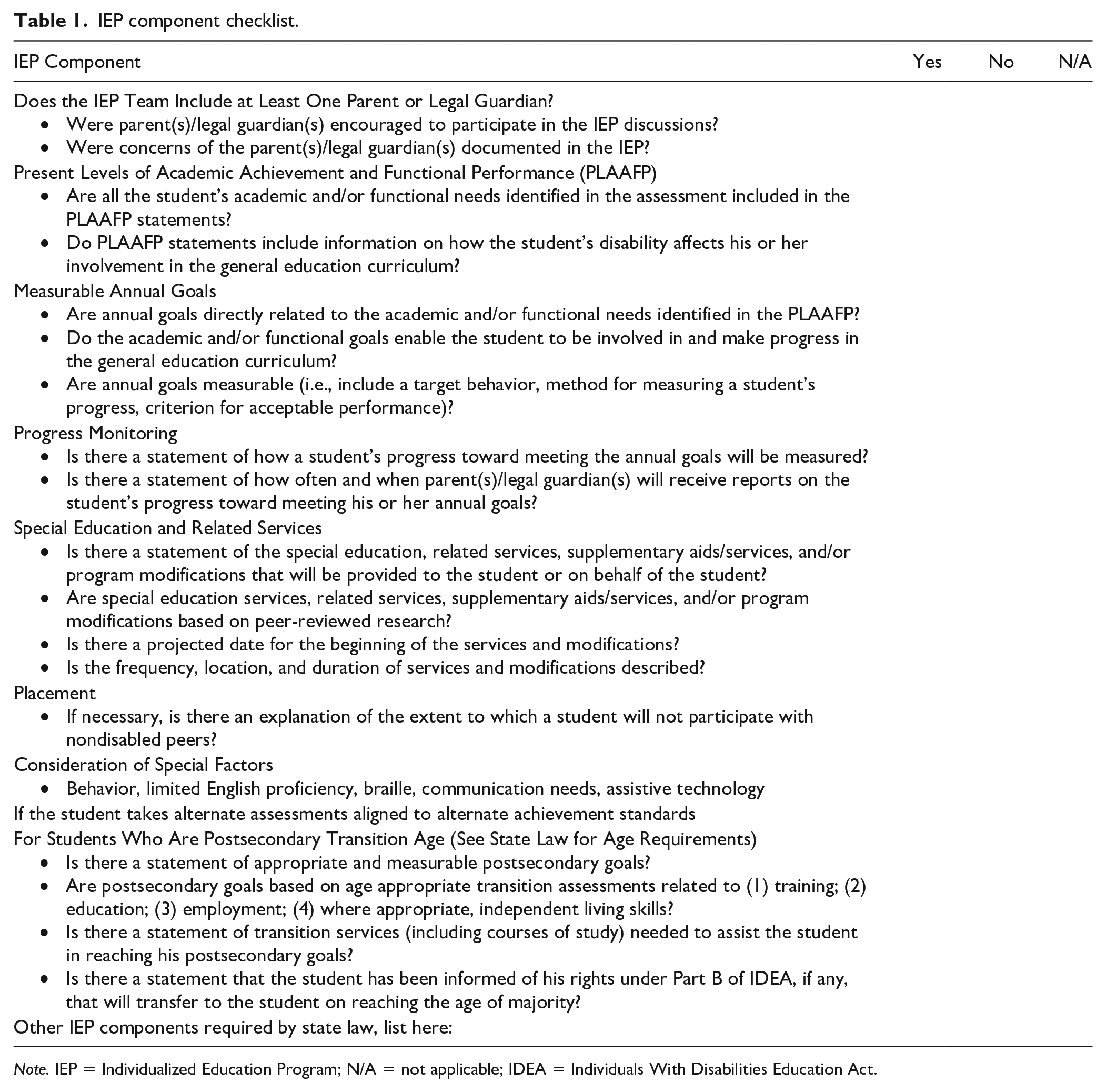
Note. IEP = Individualized Education Program; N/A = not applicable; IDEA = Individuals With Disabilities Education Act.
3.
A student’s IEP can be developed in a procedurally correct manner and have excellent and ambitious content, but if it is not actually implemented as written, it could be a denial of FAPE and thus violate the IDEA (Yell et al., 2020a). Only three circuit courts have addressed failing to implement an IEP as a FAPE violation, and the U.S. Supreme Court has never addressed this issue. Zirkel (2017) noted that litigation regarding a school district’s failure to implement students’ IEPs is becoming more frequent, even in cases when the IEP met procedural and substantive requirements. Nonetheless, the limited amount of litigation has indicated that it takes a material or substantial failure to implement a student’s IEP before the failure to implement raises to a possible FAPE violation. Examples of these material or substantive mistakes have included (a) not implementing a student’s behavior intervention plan; (b) failing to provide special education, related, or supplementary services that were included in a student’s IEP; (c) providing fewer hours of services that were included in a student’s IEP; and (d) delaying the implementation of an IEP (Yell et al., 2016).
It is likely that the U.S. Court of Appeals for the various circuits, and possibly the U.S. Supreme Court, will eventually hear a FAPE case regarding failure to implement a student’s IEP. Moreover, Congress may address this issue in reauthorization. In the meantime, school districts would be well advised to adhere to the Ninth Circuit Court’s assertion that an IEP is similar to a contract because it embodies a binding commitment. As a binding commitment, the IEP should be implemented as agreed upon by school personnel and a student’s parents.
One way that school administrators and teachers may ensure that the components of the IEP are implemented by a student’s teachers is to provide easy-to-follow implementation checklists for all involved, including general education teachers, special education teachers, and related service providers. Figures 1 and 2 provide examples of how the components of an IEP could be included in such a checklist. It is a good idea for implementation checklists to be signed by all personnel who work with a student, including the school principal.
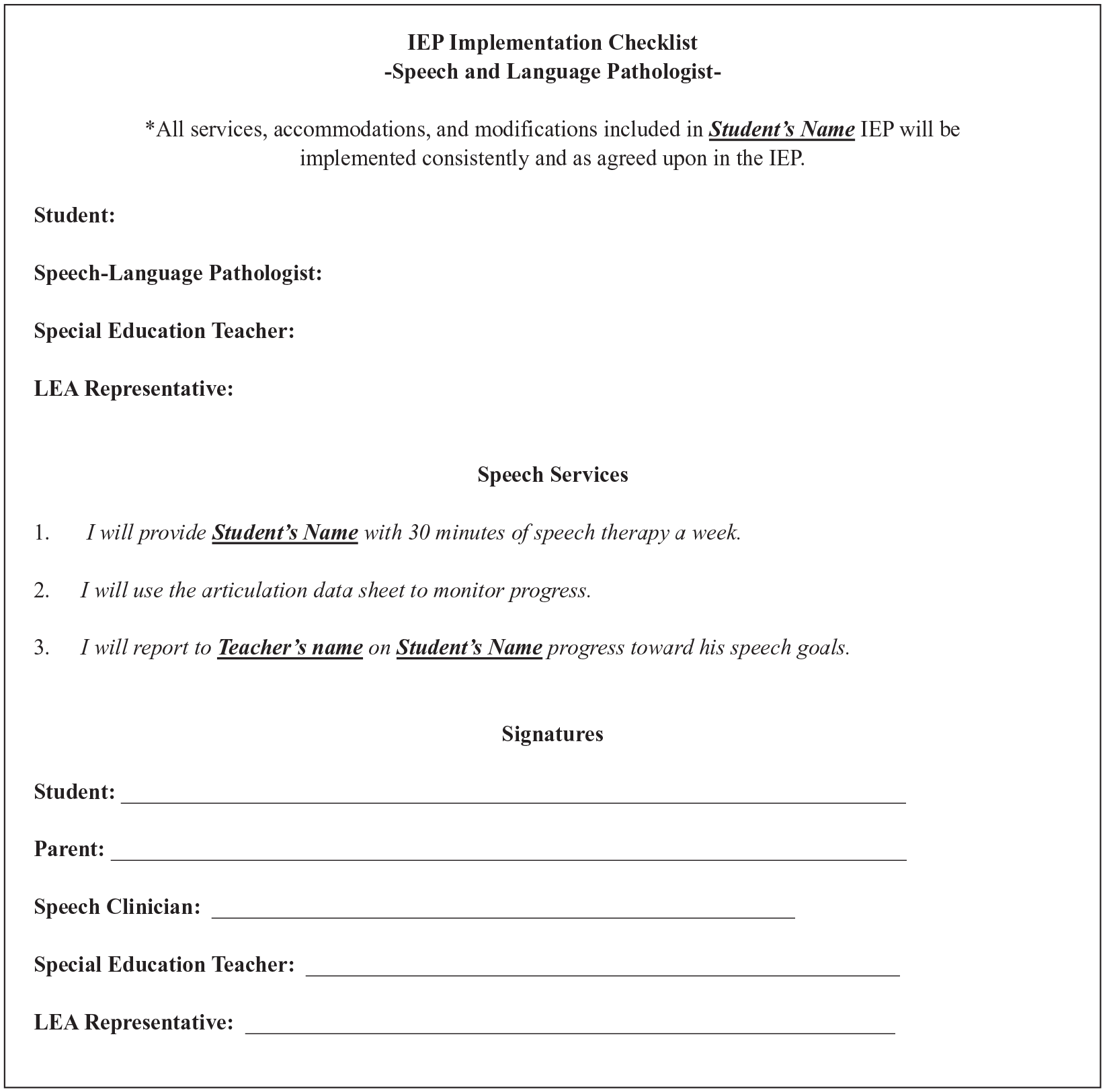
IEP implementation checklist—Speech and language pathologist.
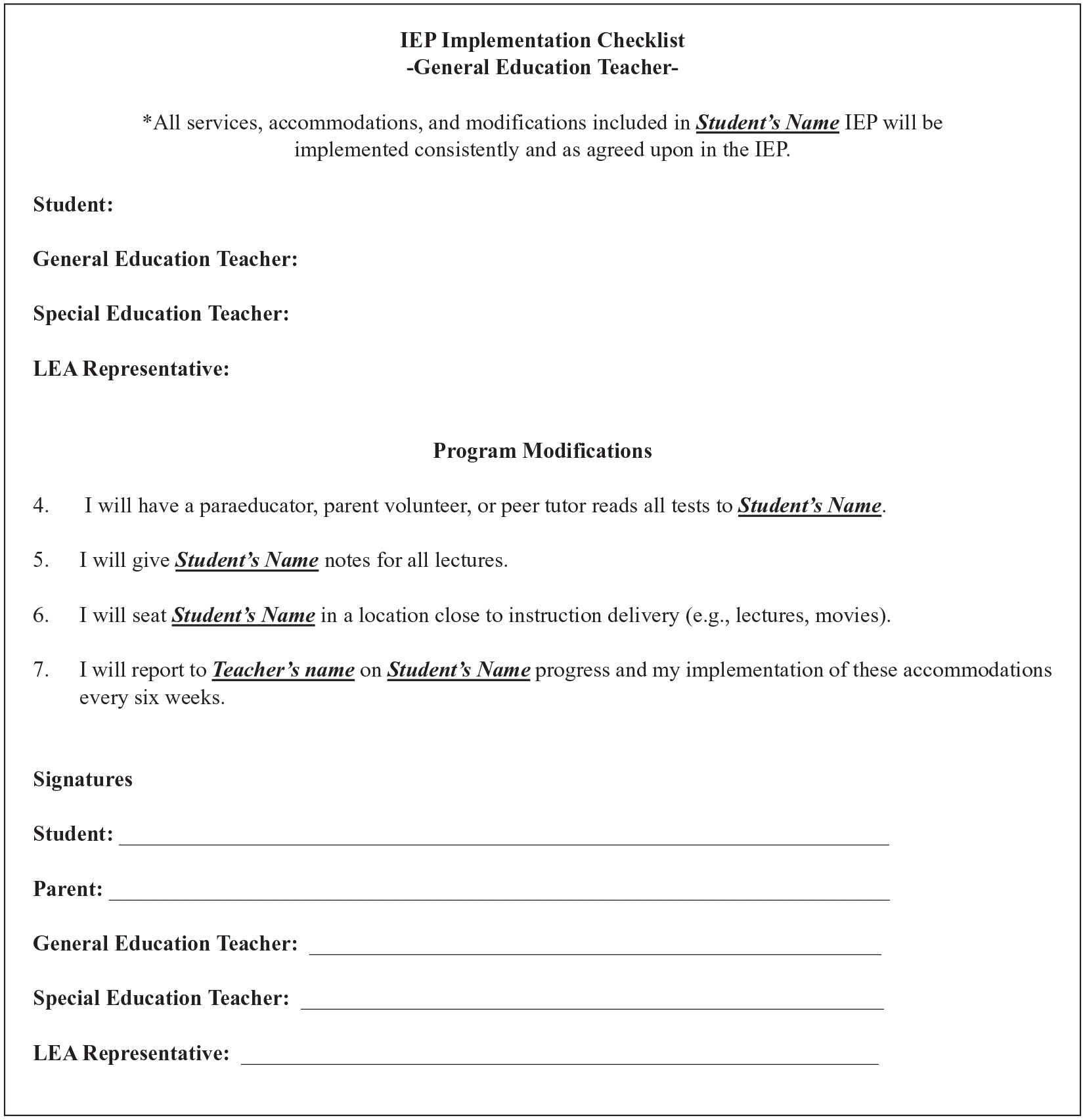
IEP implementation checklist—General education teacher.
4. The IEP is at the center of many, perhaps most, IDEA disputes, especially those over reimbursement for private school placements. The IEP is the primary evidence of the appropriateness of the child’s educational program—its development, implementation and efficacy. (p. 91)
If a significant service in the IEP is not implemented as agreed upon, it is likely that FAPE has been denied. Thus, if the school district representative or members of the IEP team find that that the IEP is not being executed properly, the problem must be addressed by informing the student’s parents of the error and correcting the error as soon as possible. As mentioned previously, the IEP should be corrected by reconvening the IEP team, or by acquiring parent consent to amend the IEP without a meeting. If necessary, compensatory education services should be offered. When such problems occur, it is important that school personnel address the problem quickly.
As the ruling in the Antelope Valley case clearly announced, a student’s parent has the right to enforce IEP implementation. A member of the IEP team, perhaps the representative of the local education agency, school district, or someone they designate, should be the person responsible for ensuring that all services included in the IEP are implemented as written. This is especially important for the services or program modifications required in the general education classroom when a teacher or teachers did not participate in IEP development but are nevertheless responsible for implementation.
It is also critical that the IEP team ensure that the IEP is implemented with fidelity. That means all services should be delivered as agreed upon in the IEP, which includes the frequency, duration, and location of the services.
Summary
Clearly, the Antelope Valley School District made errors in M.C.’s special education programming. This case involved serious procedural errors made in a student’s IEP and addressed important issues regarding parental participation throughout the IEP process. The case has crucial implications for special educators for avoiding procedural errors, and including parents throughout the IEP process, from drafting, to implementing, and enforcing the IEP.
Footnotes
Declaration of Conflicting Interests
The author(s) declared no potential conflicts of interest with respect to the research, authorship, and/or publication of this article.
Funding
The author(s) received no financial support for the research, authorship, and/or publication of this article.
