



Abstract
Students with emotional and behavioral disorders (EBD) generally have behavior support plans that are based on a functional behavioral assessment. This article provides educators practical guidelines for conducting a multiple stimulus without replacement (MSWO) preference assessment to rank order preferred activities that will align with the function of behavior for use in behavioral interventions. The use of highly preferred reinforcers to reduce student problem behaviors can enhance educational outcomes for the student.
Keywords
Students with emotional and behavioral disorders (EBD) are likely to have positive behavior intervention plans in place to support desired behaviors and reduce problem behaviors. Identifying preferred reinforcers is essential in developing social and academic programming for students with EBD (Weaver et al., 2017). A multiple stimulus without replacement (MSWO) preference assessment is one of several preference assessment procedures that has been identified by research to determine the strength of potential reinforcers. The MSWO procedure can be used to accurately predict reinforcer strength when conducted with students with EBD in an educational setting (Damon et al., 2008; King, 2016; King & Kostewicz, 2014; Paramore & Higbee, 2005; Weaver et al., 2017). King (2016) determined that the use of the MSWO procedure identified more reinforcers and sometimes stronger reinforcers than those identified during a vocal nomination survey for students at risk of EBD. Furthermore, identifying the strength of potential reinforcers can increase the effectiveness of behavior interventions (King, 2016; Paramore & Higbee, 2005; Vollmer & Iwata, 1992).
Devon is a seventh grader receiving special education services under the eligibility of EBD. A functional behavioral assessment (FBA) was recently completed and it was hypothesized that the function of Devon’s elopement behaviors is escape. He is receiving specially designed instruction in a specialized program that focuses on social intervention, but he spends the majority of his day in a general education environment. Kate, the special education teacher, is working with a team of professionals to develop a behavior intervention plan. The team would like to increase the time Devon remains in the general education classroom and they know they need to choose a reinforcer that will align with the escape function of his behavior. One suggestion is to use the iPad as a reinforcer while another suggestion is to allow Devon a walk in the hall. Kate decides to complete a preference assessment to identify the item for which Devon would prefer to work (see Note 1).
Steps for Conducting the Preference Assessment
Completing a systematic preference assessment does not have to be intimidating. It is an important component when designing a positive behavior intervention plan that is often omitted, although research shows a preference assessment to be a fundamental component of support plans (DeLeon & Iwata, 1996). Without consideration of the students’ preferences, reinforcers selected as part of the support plan may not increase the desired or replacement behaviors.
Step 1: Gather an Array of Items and Activities
Gathering items or activities should be based on the outcomes from the FBA. Although five to seven items are typically selected for the preference assessment, up to 16 items can be used (Cannella-Malone et al., 2013). If the hypothesized function of a student’s behavior is access to tangibles, then the items in the array would be tangible items (e.g., toys, games, fidgets, school supplies). If the function of the behavior is hypothesized to be adult attention, the activities would be those that gain the student access to adult attention (e.g., lunch with the teacher, play a game with a preferred adult). If the hypothesized function of behavior is escape, then the activities would be those that allow the student to escape nonpreferred activities (e.g., break on a device, walk in the hall). In this scenario, because Devon’s behavior is hypothesized to be escape maintained, Kate selects items that might serve as more appropriate means of escaping nonpreferred tasks. When completing a preference assessment with students with EBD, it is not necessary to use real objects during the assessment, as one would when assessing a student with an intellectual or developmental disability. If it is known that students present with average cognition, photo cards or pictorial representations can be used to conduct the preference assessment rather than using actual objects or items.
Step 2: Prepare a Data Collection Sheet
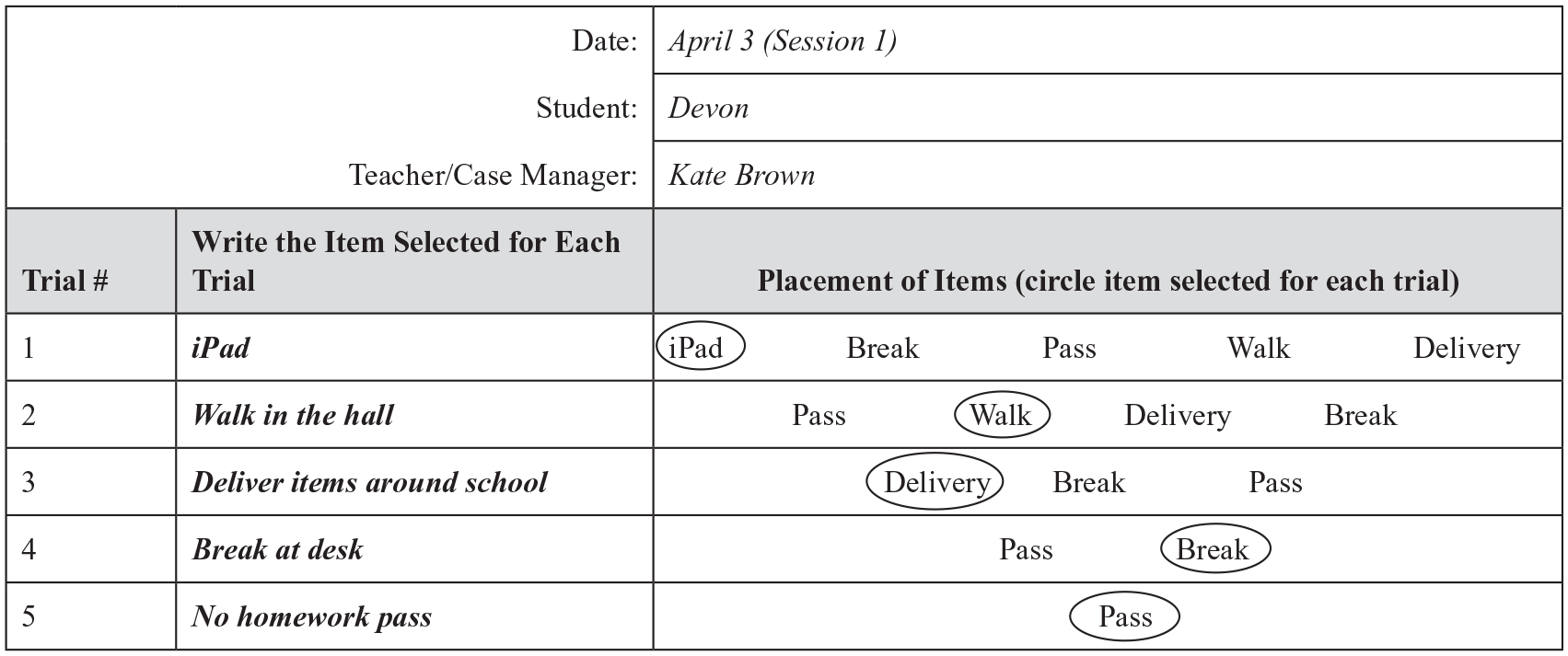
A data collection sheet is needed to track student responses. The data sheet should indicate student name, date, teacher or case manager, list of items, trials by number, and location of selected item. The data sheet should have a way to indicate the item selected in each trial to determine whether the student’s responses are location specific and to follow systematic procedures. In the sample data sheet in Figure 1, Kate circled the item Devon selected on each trial.
Sample completed data collection sheet for one assessment session.
Step 3: Conduct the Assessment
Kate begins the assessment sitting across from Devon and provides an explanation of the assessment. She tells Devon, In this activity I am going to show you choices of items/activities that you could earn. All you have to do is choose the one you like best. It will help me to understand the things that you like and create the best plan I can to help you.
After she places the item/activity cards in a straight line in front of Devon, she gives instructions saying, “Pick one” or “Point to the one you want” and waits a predetermined amount of time (e.g., 5 s). After Devon makes a selection, she asks for the card to be returned or placed in a pile.
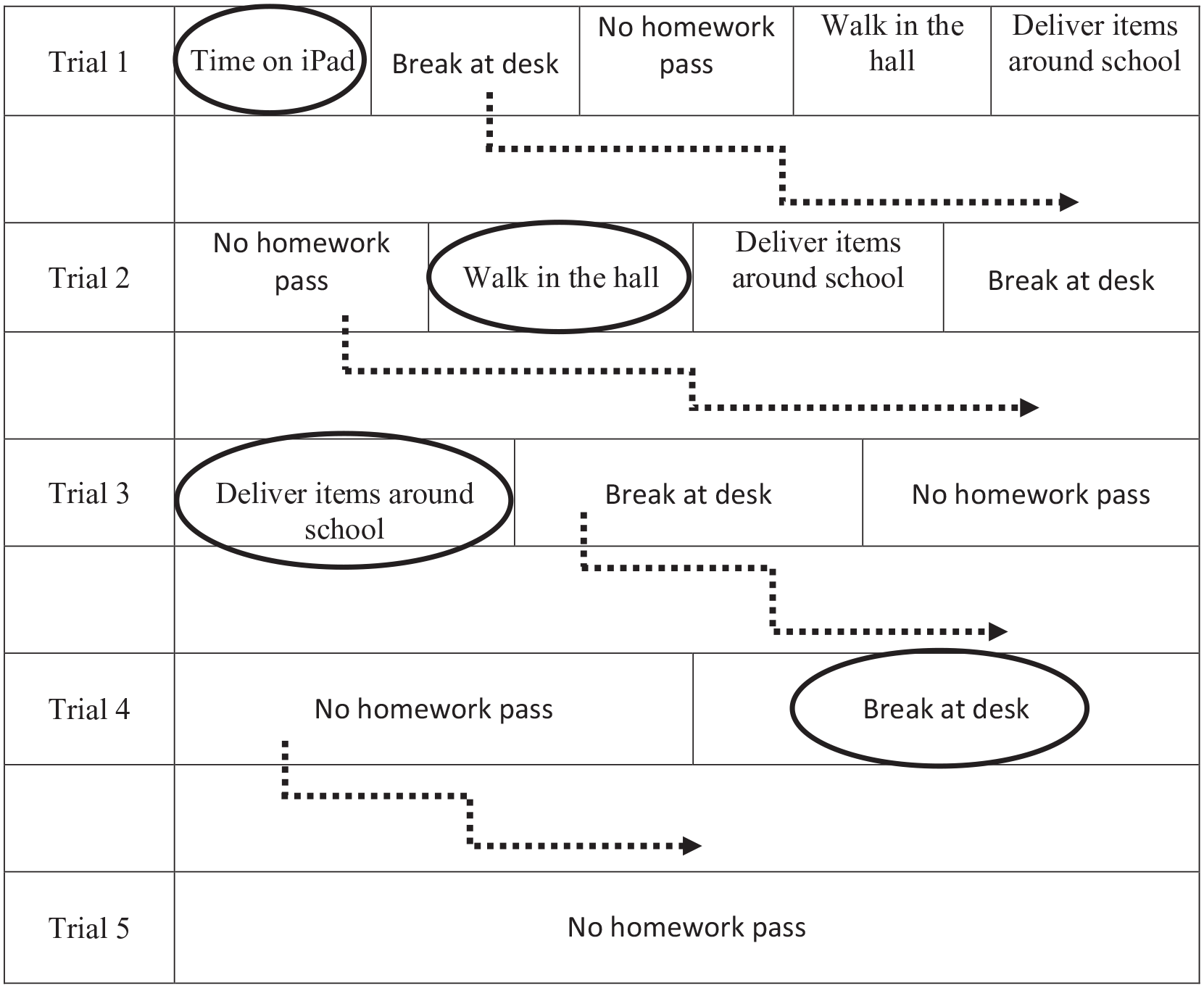
By giving the instruction “point to,” the teacher is less likely to have a power struggle over the return of the card. Either way, this card is not placed back into the array. Next, take the card from the leftmost side and place it on the right, shifting all cards to the left so that they are centered (see Figure 2).
Example of shifting photo cards after each trial (circled items indicate item selected and removed for next trial).
Step 4: Repeat Step 3
Kate repeats the instruction, waits the predetermined time for a selection, allows student choice, and shifts items/activities until each activity is selected or the student stops responding (i.e., the student does not make a choice from the remaining items). After each trial, Kate removes the item chosen so that she has one fewer items for each subsequent trial.
Each trial requires moving the leftmost item not selected to the right and then centering all items (see Figure 2). Because photo or picture cards are used, it is not necessary to provide time for the student to consume the edible or play with the item as one does when using concrete objects or items.
Step 5: Repeat Session
Accurate data will come from multiple sessions across days. Three to four sessions over a variety of times of day should be completed by following Steps 3 and 4, using the item/activity cards selected in Step 1, and using the data sheet prepared in Step 2.
Step 6: Determine the Results
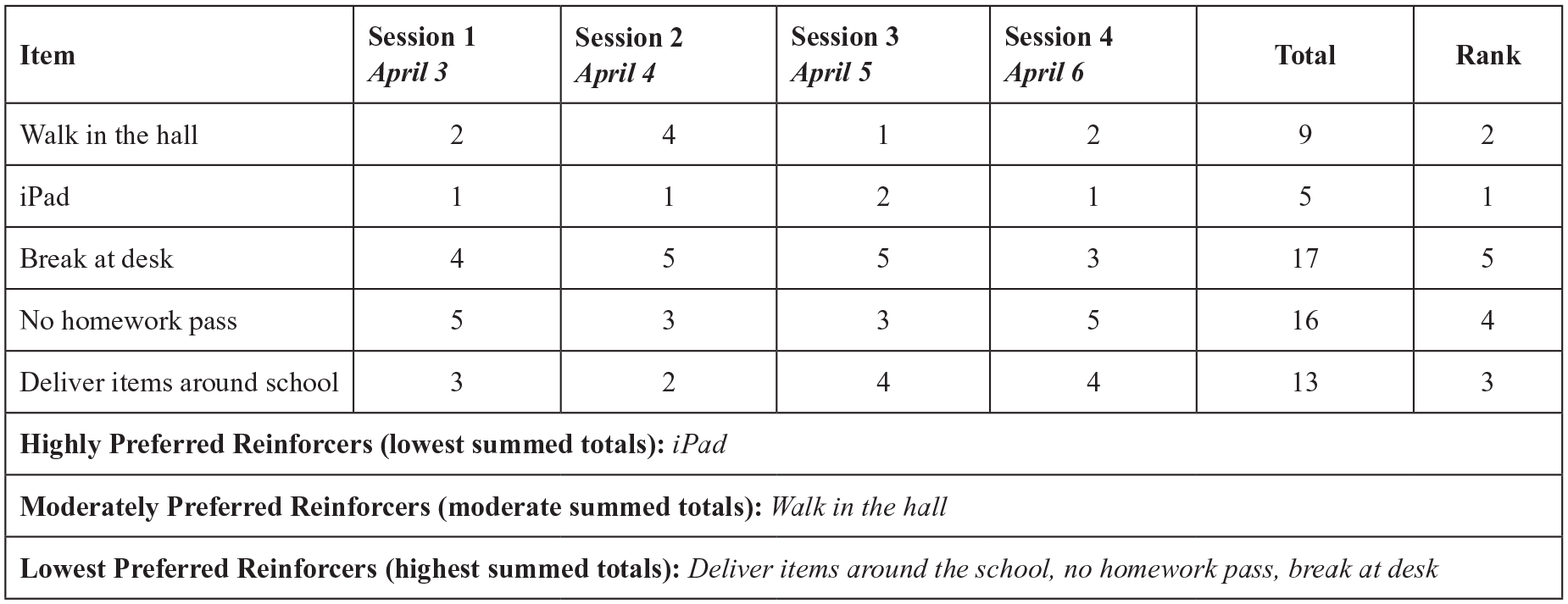
Score each item in the array given the trial number that the item was selected across each session for a summed score total. For example, if a walk in the hall was selected on the second, fourth, first, and second trials across four sessions (2 + 4 + 1 + 2), it would total nine. If the next item, a break using an iPad was selected on the first, first, second, and first (1 + 1 + 2 + 1) trials across four sessions, it would total five. These calculations would be completed for each item in the array. Once a total is determined for each item, then the items/activities can be rank ordered, the lowest number indicating the highest preference. Items that are not selected are automatically scored with the highest possible trial number. The rank is the order of preference. Figure 3 shows that Devon has a high preference for iPad use (total score: 5; rank: 1), a moderate preference for a walk in the hall (total score: 9; rank: 2), and lower preference for deliver items around the school (total score: 13; rank: 3), no homework pass (total score: 16; rank: 4), and break at desk (total score: 17; rank: 5).
Example of results scoring.
Using the Results
The results of the preference assessment should be used in combination with a positive behavior intervention plan. The hierarchy of preferences gained from the assessment provides the teacher with a list of preferences that are likely to serve as reinforcers to use to increase desired or replacement behaviors. Highly preferred items and activities can be reserved for top priority behaviors, whereas moderately preferred items and activities can serve as reinforcers for mid-priority behaviors. Teachers will also identify those items and activities that might not serve as reinforcers if they are not chosen during the assessment process. Items that are never chosen or are ranked at the bottom are highly unlikely to serve as reinforcers; thus, they would not be used as part of the student’s behavior support plan.
Items and activities may be presented to students in the form of a choice menu, with all preferred items, only the top ranked items, or only two items (depending upon student needs) displayed on the choice menu. The student would be asked to make a choice of reinforcer prior to engaging in a task (i.e., “What do you want to work for?”) and would then work to receive the chosen item/activity upon completion of the task. Earning reinforcers should be systematically outlined in the behavior intervention plan with a clear schedule of reinforcement (e.g., how much work needs to be completed to earn the reinforcer).
Teachers may want to consider reevaluation of preferences on a regular basis. Preference assessments should be periodically recompleted to confirm that preferences have not changed and to ensure that items are still preferred with the same value as in the prior assessment (i.e., have the same or similar ranking). Frequency of assessment will vary based on student needs. If teacher data show that the behavior change has flattened or changed direction, that is an indication of a need to reassess preferences. Students with highly variable behavior or frequent environmental changes may also require more frequent preference assessments.
Conclusion
Identifying the strength of potential reinforcers is a useful process that adds to the integrity of a behavior intervention plan. The use of a strong reinforcer can aid in decreasing problem behavior and increasing desired behaviors. The MSWO preference assessment is one way to determine the strength of a set of potential reinforcers. Teachers of students with EBD can successfully conduct an MSWO preference assessment by following the procedures outlined. King (2016) found that teachers who used an MSWO preference assessment identified reinforcers to apply to a token economy for use with students. In addition, by identifying the strongest reinforcers, teachers have a more practical way to provide reinforcers that are needed in high quantity. Teachers will be able to use assessment results to improve their behavior intervention plans and facilitate student success.
Based on the MSWO preference assessment, Kate determines that Devon’s highest preferred reinforcer is access to the iPad. She designs a plan where Devon earns 1 min of time on the iPad for every 5 min he remains in class. If he remains in class for 50 min, Devon can take the last 10 min of an hour-long class to use the iPad in the hall. Kate documents an increase in Devon’s time in class when this procedure is used.
Footnotes
Declaration of Conflicting Interests
The author(s) declared no potential conflicts of interest with respect to the research, authorship, and/or publication of this article.
Funding
The author(s) received no financial support for the research, authorship, and/or publication of this article.
