




Abstract
The American School Counselor Association (ASCA) requires that school counselors engage with and advocate for students with emotional and behavioral disorders (EBD), in addition to requiring competency in counseling culturally and linguistically diverse (CLD) students. However, few publications have called for increased attention to the intersectional needs of this population. This column provides a brief rationale for focusing on students with EBD who are also CLD and recommends a trauma-informed approach to supporting them through fostering a safe school-wide environment, building faculty and staff cultural competence, increasing collaborative communication with students and families, and recommending counseling services in individualized education program meetings.
Keywords
Emotional disturbance, used and referred to in the Individuals with Disabilities Education Improvement Act (IDEA), is a condition showing one or more of the following characteristics over a long period of time and to a marked degree that adversely affects a child’s educational performance: (a) an inability to learn that cannot be explained by intellectual, sensory, or health factors; (b) an inability to build or maintain satisfactory interpersonal relationships with peers and teachers; (c) inappropriate types of behavior or feelings under normal circumstances; (d) a general pervasive mood of unhappiness or depression; or (e) a tendency to develop physical symptoms or fears associated with personal or school problems (IDEA, 2004).
Indicators of emotional and behavior disorder (EBD) overlap with symptoms of traumatic stress in children, and students displaying anxiety, low self-esteem, hyperactivity, aggression, withdrawal from relationships, and learning difficulties (i.e., symptoms of traumatic stress) are often identified with an EBD (Aydin et al., 2012; D’Andrea & Daniels, 2007). In addition, students with a history of trauma outside of school may display behavioral challenges that may lead to school disengagement, punitive disciplinary action such as suspension, drop out, or other educational issues (Aydin, 2011). Thus, traumatic stress indicators can be similar to those for EBD, and both affect educational outcomes for students.
Traumatic stress in children is so prevalent it is considered a public health crisis (Anda et al., 2010). The National Survey of Children’s Health (Sacks & Murphey, 2018) study on adverse childhood experiences (ACE) showed that 45% of children nationwide have experienced at least one ACE, suggesting 45% of students could potentially display symptoms of traumatic stress. Other studies have demonstrated some groups of culturally and linguistically diverse (CLD) students experience trauma at alarmingly high rates disproportionate to the national average (i.e., 61% of Black non-Hispanic children experience at least one ACE, 51% of Hispanic children experience at least one ACE) and are disproportionately identified as EBD (Carter, 2015; Harlow, 2019; Kafer, 2016). Therefore, it stands to reason that a large proportion of students experiencing traumatic stress who are identified with EBD would likely be from CLD backgrounds.
Although not all CLD families are immigrants to the United States, assimilating to a new culture brings a variety of experiences that may exacerbate existing traumatic stress or create new traumatic experiences. As a result, students with EBD who are also CLD may additionally experience low self-esteem, relationship issues, increased levels of stress, and powerlessness that further influence their educational success (Aydin et al., 2012; D’Andrea & Daniels, 2007). Given the high rates of traumatic experience and EBD identification among students who are CLD, and their increasing population in the U.S. education system, addressing these students’ needs is vital to supporting their education and emotional success (Carter, 2015; Kafer, 2016).
Overview of Trauma-Informed Approach
In managing these prevalent trauma-related social and emotional difficulties, a trauma-informed approach is recommended to holistically address the educational, emotional, social, and behavioral difficulties of students who are CLD (Geltner & Leibforth, 2008; Hott et al., 2015; Milsom et al., 2007). The Substance Abuse and Mental Health Services Administration (SAMHSA) provides a general framework for professionals working to create trauma-informed systems, such as education. A school that is trauma-informed realizes the widespread impact of trauma and understands potential paths for recovery; recognizes the signs and symptoms of trauma in [students], families, staff, and others involved with the system; and responds by fully integrating knowledge about trauma into policies, procedure, and practices, and seeks to actively resist re-traumatization. (SAMHSA, 2014, p. 7)
A truly trauma-informed approach acknowledges personal trauma in addition to the sociopolitical complexity of trauma, which recognizes the role of gender, race, class, and other cultural variables in the establishment of systems of care (Berger & Quiros, 2014). Thus, cultural awareness and competence are integral pieces of effective implementation of trauma-informed approaches.
There are similarities between a trauma-informed approach and recommended practices in special education, between which there is considerable overlap. The shared values include (a) creating emotionally safe environments; (b) building a trusting relationship between practitioners and students/their families; and (c) empowering all members, including professionals, students, and families (SAMHSA, 2014; Turnbull et al., 2011). Implementing a trauma-informed approach for students with EBD who are also CLD can be straightforward because many of the principles have existing counterparts in special education. This column presents trauma-informed strategies focusing on students with EBD who are also CLD due to the higher instances of traumatic experience compounded upon indicators of EBD in this intersectional population. However, these suggestions for school counselors can apply to all students with EBD. School counselors are uniquely positioned to implement trauma-informed practices given their specialized knowledge, skills, and training in the areas of traumatic stress. The American School Counselor Association (ASCA) provides guidelines on school counselor’s cultural competencies and maintains that culture influences all aspects of education (ASCA, 2005, 2015). School counselors should combine cultural competence with their understanding of trauma-related emotional and behavioral disorders in their work with students with EBD who are also CLD.
Before the Meeting
Trauma-Informed Counseling Services
School counselors can recommend that students attend individual or group counseling, depending on the student’s needs. Within both modalities, counselors can promote effective management of a student’s emotional and behavioral difficulties; strategies include practicing emotional regulation via written or audio recorded journaling, mindfulness techniques such as guided imagery and deep breathing; positive self-talk (Callicott & Park, 2003); rhythmic self-soothing methods such as walking, using fidget toys, or drumming; and attuning to the student’s needs through active listening, patience, and apologizing for missteps.
When a student who is CLD displays indicators of EBD, it is helpful to adopt a strengths-based mindset and conceptualize the student’s behaviors as a function of what has happened to them rather than what is wrong with them. Understanding the role of traumatic stress and ACE in emotional and behavioral disorders before the Individualized Educational Program (IEP) meeting can establish a strengths-based, trauma-informed foundation for providing educational and emotional recommendations to best meet the student’s needs.
School-Wide Safe Environments
Increasing school-wide awareness and understanding of diversity reduces instances of prejudice and discrimination, thus building a safer overall educational environment for all students with and without disabilities (Yuan & Jiang, 2019). In accordance with SAMHSA (2014) guidelines in creating a safe learning environment, the following recommendations for school counselors are presented for building an inclusive, safe, and trusting school climate:
Celebrate diversity of students in respectful ways through school-sponsored holiday events and service-learning projects including students from all backgrounds working to benefit a community organization that supports multiculturalism and equity.
Create after-school mentoring programs fostering relationships between students with and without disabilities from diverse cultures.
Hold support groups for students to address challenges, experiences, and successes they have had in school as members of diverse populations.
Collaborative Communication
Communication with students and their families should extend beyond structured IEP meetings (Mueller & Vick, 2019). Some parents may prefer meeting with counselors and educators one-on-one before the official meeting, which can be less overwhelming than a full-sized meeting with multiple unknown professionals. Before the initial meeting, counselors can communicate the logistics of the IEP process and expectations for each party, promoting a feeling of safety, trust, and collaboration (SAMHSA, 2014; Zhang & Bennett, 2003). Establishing regular communication outside structured meetings can provide consistency and a sense of safety between educators and families. These interactions also provide information regarding a family’s preferred communication style and give opportunities to engage in cultural reciprocity which creates a fuller understanding of the student’s/family’s background, needs, and unique challenges (Luke, 2014). As counselors engage with students and families, it is crucial they come from a place of acceptance and awareness of their own cultural biases that could affect their work with diverse populations (ASCA, 2015). Table 1 outlines culturally sensitive and trauma-informed guidelines and questions that a school counselor can use to build supportive relationships with students and families.
Guiding Questions to Build Supportive Relationships.

Note. IEP = Individualized Educational Program.
During the Meeting
School counselors possess unique skills that benefit the students, families, and educational personnel attending IEP meetings (e.g., providing advising and facilitative support in groups). If in attendance, school counselors should familiarize themselves with each individual student case and understand their role and expectations in relation to other professionals. They can also share specific strategies with other professionals attending IEP meeting.
Integrating Cultural Variables
School counselors can advocate for a strengths-based, holistic approach to a student’s education plan, which includes understanding how cultural factors may play a role in the student’s self-concept, social growth, the family’s understanding of a disability, and overall cultural goals and expectations for students with disabilities (SAMHSA, 2014). Openly and collaboratively discussing these pieces of a student’s identity allows the student (and their family) to have a voice in the IEP process. It also validates their cultural experiences rather than dismissing or omitting them. Counselors can model transparency, openness, and willingness to learn from and respect cultural differences to build rapport between groups and enhance student and family buy-in to the IEP process.
During IEP meetings, school counselors should understand cultural communication barriers and give adequate time for students/families to process information, ask questions, and give suggestions. Differences in language that reflect cultural values and biases can reinforce power hierarchies between educators and parents/students in which educators’ voices are championed while parents/students are unheard or rejected, even unintentionally (Cheatham & Lim-Mullins, 2018). Parents may also feel coerced into complying with this hierarchy and adopting educator’s requests and viewpoints rather than acting as equal partners (Cheatham & Lim-Mullins, 2018). School counselors can act as liaisons between these groups, championing parents’ strengths and input, openly acknowledging their own biases, and showing a willingness to work toward a compromise to meet the student’s needs (Hott et al., 2015; Zhang & Bennett, 2003).
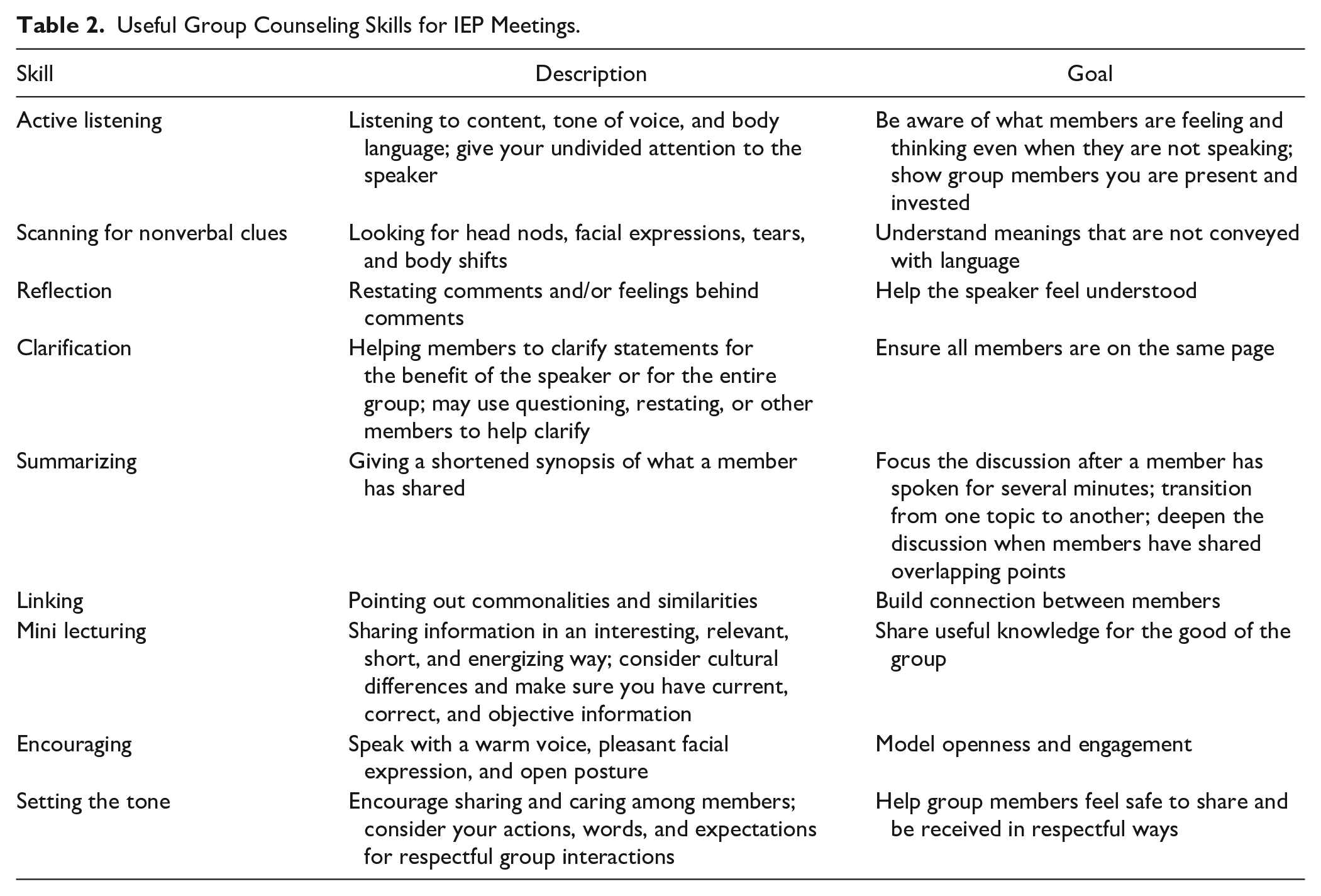
Some educational or social/emotional goals may not be appropriate for certain cultures, so counselors can invite families to participate in the process and incorporate strategies that may already be effective within their family and/or culture. This attention to the unique needs and experiences of the student/family fosters a collaborative relationship of shared power, rather than a rigid hierarchy with educational authorities at the top. See Table 2 for specific group counseling skills to aid school counselors toward effective group management during an IEP meeting.
Useful Group Counseling Skills for IEP Meetings.
After the Meeting
Continuation and Follow-Up
School counselors should continue establishing safe trauma-informed spaces on a school-wide basis and offering individual and group counseling services. School counselors should also regularly follow-up with students and families regarding issues discussed during the IEP meeting to address any questions or concerns they have. Rather than assume the family’s desired frequency of contact, check in with their preferences on how often they want to be contacted and what type of information they need.
Continuation of Self-Reflection on Cultural Perceptions and Biases
In addition to actively bringing cultural discussions into the IEP meetings, counselors should continue to reflect and examine their personal cultural perspectives to address any biases that can affect the outcomes of IEP meetings. The process of self-examination is ongoing and dynamic and should extend beyond limited interactions with families that are CLD.
Conclusion
Due to the high rates of traumatic stress in students who are CLD, and the overlap of traumatic stress symptoms with EBD identifiers, a trauma-informed approach to working with this intersectional population is recommended. This column provides concrete strategies for school counselors interacting with student with EBD who are also CLD. Because of the overlapping nature of SAMHSA’s trauma-informed guidelines, many of the suggested strategies address multiple trauma-informed principles, and this article is a unique contribution to the field in its focus on the role of school counselors in supporting and advocating for students with EBD who are culturally and linguistically diverse.
Footnotes
Declaration of Conflicting Interests
The author(s) declared no potential conflicts of interest with respect to the research, authorship, and/or publication of this article.
Funding
The author(s) received no financial support for the research, authorship, and/or publication of this article.
