




Abstract
Augmentative and alternative communication (AAC) refers to a wide variety of communication devices, systems, tools, and strategies that support or replace spoken language. Augmentative and alternative communication users represent a range of ages, abilities, and communication needs. Support for AAC often begins in the public school setting. Although the Individuals with Disabilities Education Act (IDEA) mandates public schools to provide adequate assistive technology for communication and training to support implementation, researchers estimate that fewer than 40% of students with communication impairments using AAC are proficient communicators. Barriers to implementation include a lack of training opportunities, limited preparation time, unfamiliarity with AAC systems, and difficulty finding evidence-based strategies for AAC. To address these, we present evidence-based strategies that speech-language pathologists (SLPs) and special education teachers may use in collaboration to support students using AAC and practical tips for implementation. Strategies described include aided language modeling, core vocabulary, and communication partner support behaviors. Planning considerations for collaboration are discussed.
Keywords
Augmentative and alternative communication (AAC) refers to a wide variety of communication devices, systems, tools, and strategies that support or replace spoken language. In the United States, recent estimates indicate more than 2 million people rely on AAC to access their daily activities (American Speech-Language-Hearing Association [ASHA], 2023). This estimate includes public education, where nearly 19% of students with disabilities qualify under the eligibility of speech/language impairment (National Center for Education Statistics, n.d.). Augmentative and alternative communication falls under the broader umbrella of assistive technology and is an evidence-based practice (Steinbrenner et al., 2020) and an important component of service delivery for children and youth with communication challenges in our schools today (Crowe et al., 2022).
Augmentative and alternative communication can be aided or unaided. Unaided AAC modalities include unspoken methods (such as gestures and facial expressions), manual signs, and American Sign Language (ASL). These methods require users to have adequate motor control and communication partners who can accurately interpret what the individual is communicating. On the other hand, aided AAC modalities require some type of external support, such as a communication board or book with symbols, computers, handheld devices like a phone, or speech-generating devices (ASHA, 2023). Augmentative and alternative communication can be light tech, such as communication books, picture exchange systems, and vocabulary boards, or high tech, such as a speech-generating device on a dedicated machine, mobile applications for phones or tablets, or computer software programs. Aided, unaided, light-tech, and high-tech AAC options can be used alone or in combination to give a student multiple options for communicating within different contexts (Light & McNaughton, 2012). Choosing an AAC system for a student is a complex task that requires school teams to consider a student’s physical and cognitive needs, personal preferences, and academic profile (Dietz et al., 2012; Lund et al., 2017; Lynch et al., 2019).
IDEA mandates that public schools provide appropriate services and assistive technology to students with disabilities. Assistive technology is “any item, piece of equipment, or product system, whether acquired commercially off the shelf, modified, or customized, that is used to increase, maintain, or improve the functional capabilities of a child with a disability” (Individuals with Disabilities Education Act, 2004, §1401). Assistive technology includes technology used to enhance communication, such as AAC systems. These systems must be provided for students with disabilities based on academic needs (IDEA, 2004). The school team, including the general education teacher, special education teacher, speech-language pathologist (SLP), and other professionals working with a student, is tasked with completing a functional assessment to determine whether AAC is appropriate based on a student’s individualized needs to access the curriculum (Binger et al., 2012).
Augmentative and alternative communication is considered educationally necessary when a student requires it to access the curriculum and participate in public education (ASHA, 2023). In addition, this mandate includes providing appropriate training and technical support for school-based professionals to ensure that students have the support necessary to make adequate progress, develop language and communication skills, and engage in academic learning (Johnston et al., 2012). This may include training or technical assistance for a child with a disability to use the AAC device and training or technical assistance for educators providing services to students with disabilities (IDEA, 2004). Inadequate training and support, limited time for preparation, unfamiliarity with AAC systems, and challenges locating AAC strategies and resources are common problems reported by special education teachers working with AAC users (Andzik et al., 2019). These inadequacies negatively affect educators’ ability to provide effective AAC service delivery (Andzik et al., 2019; Baxter et al., 2012; Da Fonte et al., 2022). As a result, special education teachers estimate that less than 40% of their AAC users are proficient communicators (Andzik et al., 2018).
There are several factors that educators should consider when strategizing to support AAC users, who represent a range of ages, abilities, and communication needs. First, effective AAC intervention should address the imbalance between how language is modeled and how students are expected to communicate expressively (Light & Binger, 1998). Children who use AAC are often given language input auditorily but are expected to use a visual language system to communicate expressively. This mismatch between input teaching and output expectation is commonly referred to as “input-output asymmetry” and is illustrated in Figure 1 (O’Neill et al., 2018). If students are expected to communicate using AAC, classroom activities must include frequent modeling of AAC symbols consistent with a student’s selected system. Next, AAC intervention should focus on modeling a wide variety of vocabulary and grammatical structures that are useful, relevant, and motivating to students (Sennott et al., 2016). This intervention requires access to AAC systems that always contain a robust vocabulary and grammar system in the classroom, allowing for flexible use of language and customization based on the student’s interests and preferences (Franco et al., 2018). Finally, AAC intervention should include functional communication training for various purposes. Many teachers and SLPs focus primarily on requesting; however, students also need instruction for other communicative functions using AAC, such as rejecting, commenting, directing, and social language (Light & McNaughton, 2014; Logan et al., 2022; Tager-Flusberg et al., 2005).
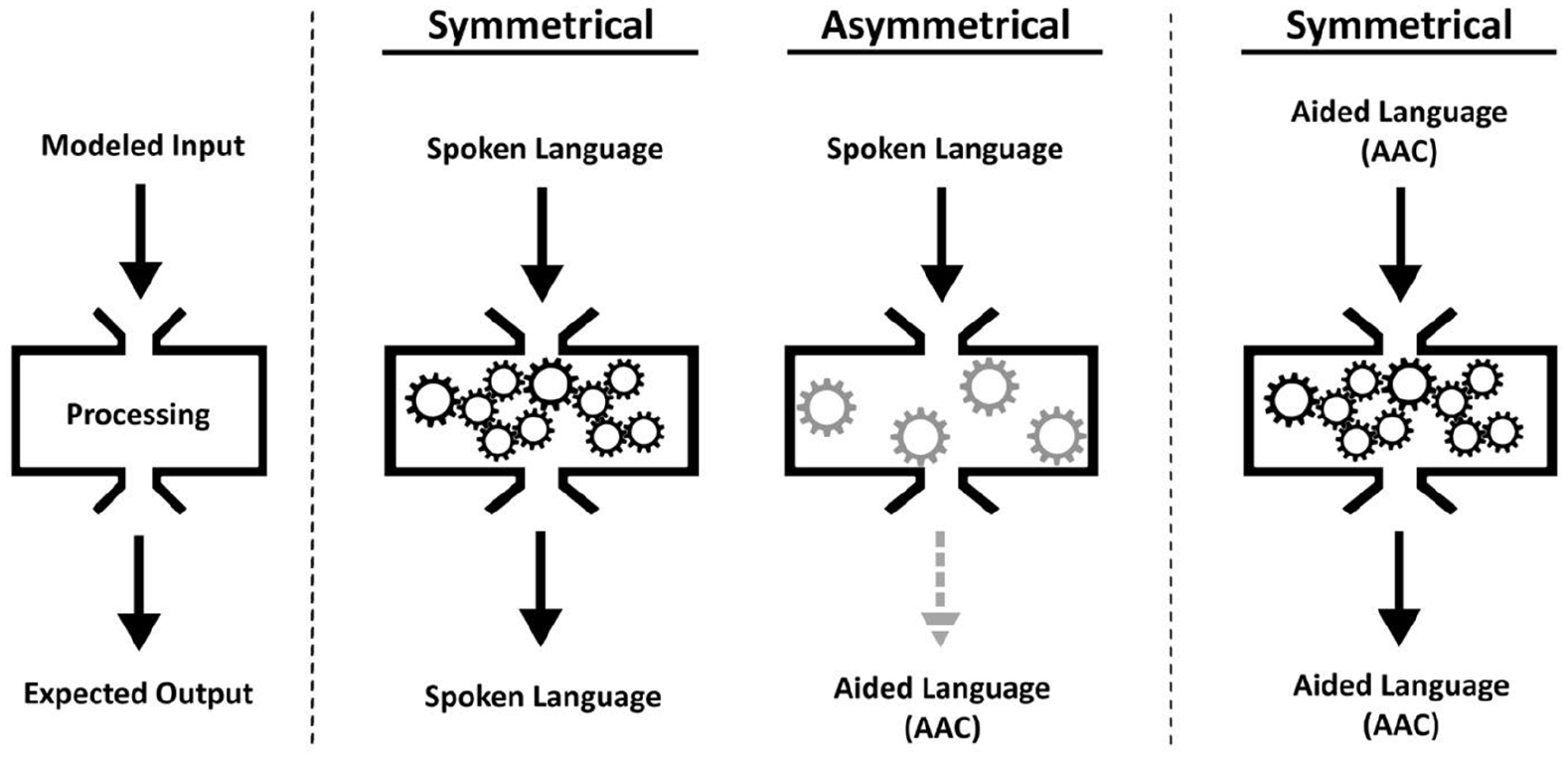
Input/Output Asymmetry.
Given the aforementioned considerations, teachers and SLPs may be unsure where to begin when designing curriculum and activities with AAC users in mind. To address this need, professionals should use evidence-based practices that support AAC. Evidence-based practice has been defined as “. . . the integration of best and current research evidence with clinical/educational expertise and relevant stakeholder perspectives, in order to facilitate decisions about assessment and intervention that are deemed effective and efficient for a given direct stakeholder” (Schlosser & Raghavendra, 2004, p. 3). Based on this definition, educators should consider three cornerstones of evidence-based practice when making decisions about how to support AAC in the classroom: research evidence, clinical/educational expertise, and relevant stakeholder perspectives. Identifying clinical/educational expertise and stakeholder perspectives will vary based on the needs and experiences of individual students and school teams and is beyond the scope of this article. The purpose of this article is to address the first cornerstone of evidence-based practice: the research evidence. There are several strategies that are used throughout the scientific research to support AAC users (see Table 1). These include aided language modeling, core vocabulary, and communication partner support behaviors. After describing each strategy, practical tips and examples of how these strategies may be used in collaborative planning efforts to assist AAC users are discussed.
Evidence-Based Strategies for Augmentative and Alternative Communication (AAC) Implementation.

Maira, a second-grade special education teacher working in an inclusive classroom, has several students with communication needs who require varying levels of support. One student, Timothy, is a bright learner with limited verbal language skills and requires support to communicate. Another, Anne, is on the autism spectrum and can communicate independently at times but uses AAC to expand her vocabulary, as well as when she is under stress and cannot access verbal language. Even though she has engaging activities that her students appear to enjoy, she’s having difficulty knowing if her students are understanding the content because they aren’t communicating with her clearly. She’s also starting to notice some challenging behaviors in class when students are frustrated that she doesn’t understand them. Maira isn’t sure what to do and how she can manage all these different forms of communication. She doesn’t have time to plan different activities for each student. She decides to consult with her school SLP, Rachel, to get ideas.
Aided Language Modeling
Aided language modeling is a well-established, best-practice strategy to improve language expression and comprehension for AAC users (Sennott et al., 2016). Augmentative and alternative communication interventions, including aided language modeling, are highly effective across various ages, disabilities, and language skills (O’Neill et al., 2018). In aided language modeling, communication partners point to or activate aided AAC symbols while speaking with AAC users (Binger & Light, 2007). Within an interaction, a communication partner may use the AAC symbols to model their own utterance or to model language that the AAC users may use to respond to a communicative overture. Depending on the student’s needs and language abilities with AAC, the communication partner can model the entire utterance (with grammatical markers) or only model keywords using core vocabulary (O’Neill et al., 2018). For example, when discussing colors of the rainbow in a science lesson, communication partners can model “The rainbow is red, blue, yellow, etc.,” or simply model using core vocabulary words, such as “I see red.” Aided language modeling may be used with any AAC system, from core vocabulary boards to speech-generating devices. Unlike a prompt, the AAC users are not expected to immediately imitate modeled AAC symbols to allow the child to observe and map the locations of icons on the system (Biggs et al., 2018). This concept of “modeling without expectation” is a key component to this strategy. Aided language modeling works well when used in a child’s naturalistic environment, making it an ideal strategy for educators to use within the context of curricular activities (Sennott et al., 2016).
In a systematic review of empirical studies on aided language modeling interventions, Biggs et al. (2018) found them to be effective in enhancing expressive communication, including improvements in social language, semantics, and grammar. They also found that children using this approach communicated more frequently, employing new vocabulary and more complex grammar structures. Moreover, these positive outcomes were consistent across various communicative functions such as asking questions, making comments, and engaging with peers. Furthermore, aided language modeling can be implemented by a wide range of communication partners, including teachers, paraprofessionals, and family members. Teaching these natural communication partners to utilize aided language modeling within the classroom environment has been found to have favorable effects on improving communication outcomes for AAC users (O’Neill et al., 2018).
The following specific tips will inform teachers and other education professionals seeking to enhance their instruction using aided language modeling:
Maira, Rachel, and the classroom paraprofessionals discuss aided language modeling, a technique where an adult models the words and grammar he/she is saying using the student’s AAC systems. Because her students use different systems, Maira works with Rachel to find posters with the home pages of her students’ devices and put them up by the whiteboard, so she can model words while she teaches whole-group lessons. They also find paper versions of her students’ devices, which they laminate and keep in the room for small-group/individual lessons, as well as if a student leaves their system at home. Finally, Rachel and Maira make lanyards for themselves and each of the staff that have picture symbols from the students’ communication devices for common words, such as “go,” “stop,” “help,” “more,” and “bathroom.” After this set up, Maira is ready. She chooses a few words that she can find easily on her students’ AAC systems—“go,” “help,” and “more.” During class, Rachel shows Maira how she can point to these words in conversations with her students. For example, during a group lesson, one student, Timothy, stands up and walks toward the water fountain with his water bottle. Rachel says, “It looks like you need to
Core Vocabulary
Within the field of AAC, core vocabulary is typically defined as the words that are frequently occurring and commonly used by many individuals (Beukelman & Mirenda, 2013; Fallon et al., 2001). Core vocabulary represents a relatively small set of frequently used words in conversation and written text. These words consistently make up approximately 80% of words collected in spoken and written language samples across many studies. The remaining 20% of words are referred to as fringe vocabulary. Core vocabulary consists of primarily pronouns, verbs, auxiliary verbs, prepositions, adjectives, and determiners (see Figure 2). Fringe vocabulary, on the other hand, primarily consists of nouns and is topic specific. For example, in a lesson about the scientific method, verbs such as “go,” “do,” “have,” “can”; pronouns such as “I” and “it”; and prepositions such as “up,” “in,” and “on” would be core vocabulary that may be used to describe scientific concepts. Nouns such as “hypothesis,” “observations,” and “conclusions” are fringe vocabulary (Banajee et al., 2003; Beukelman et al., 1989).
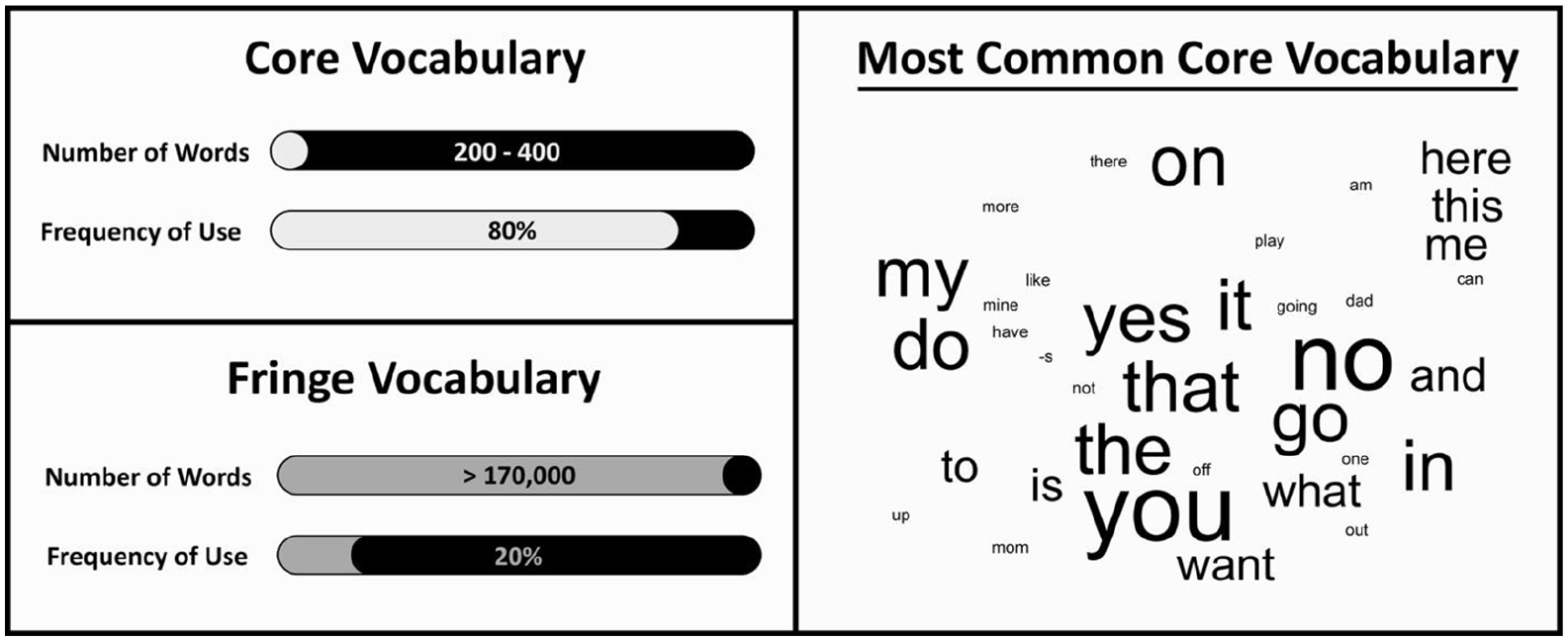
Core and Fringe Vocabulary.
Unlike spoken language, AAC vocabularies are limited and often contain preselected vocabulary, rather than vocabulary chosen by the AAC user (Carlson, 1981; van Tilborg & Deckers, 2016). Vocabulary selection should be guided by the need to convey essential, functional messages, as well as the eventual development of robust language skills (Beukelman & Mirenda, 2013). Core vocabulary offers a valuable starting point for educators because they are the most frequently occurring words in English and can be used in many different contexts. This flexibility allows for more opportunities to facilitate interaction for a variety of communicative functions. However, it should be noted that there continues to be a need to choose and model fringe vocabulary. Fringe vocabulary is less frequently occurring and topic specific; however, fringe vocabulary is often motivating for students and can be combined with core vocabulary to create functional, meaningful messages (Stuart et al., 1997).
Teachers and other education professionals looking to improve their instructional techniques through core vocabulary can benefit from the following specific suggestions:
Next, Maira and Rachel discuss the difference between “core” vocabulary and “fringe” vocabulary. Using research that Rachel found about the most common words used in English, Maira identifies five core vocabulary words that she and the staff use with the students every day: “go,” “more,” “help,” “out,” and “in.” For each student, she also identifies five fringe words that are important to them. For example, Timothy enjoys drawing characters from the show “Thomas the Train.” The team makes sure to find where the words “draw,” “Thomas,” and “train” are on his AAC device so they can model those for him too. When teaching, Maira makes sure to model the words she targeted on her core vocabulary posters on the wall next to her whiteboard and on the students’ AAC systems in small-group activities. As she feels like she has mastered modeling these words, she and her staff choose new core and fringe words to focus on to expand what they can model for their students.
Communication Partner Support Behaviors
Natural communication partners, such as teachers, paraprofessionals, and support staff, have many opportunities to interact with AAC users. However, working effectively with AAC users requires careful planning and support to promote the generalization of communication skills to multiple academic contexts (Stoner et al., 2010). Partners can use several evidence-based supportive behaviors to facilitate communication with AAC users. These include time delay, responsivity, and environmental adaptation.
Time Delay
Time delay occurs when a communication partner provides extended wait time after a conversational turn, allowing AAC users the time and opportunity to process language input, and allow time for a response (Light & Binger, 1998). Depending on the student’s cultural norms, time delay could also be paired with extended eye contact and an expectant facial expression as a cue that the AAC user is expected to respond to the partner’s communicative overture. To maintain a “flow” to conversation that is typical of spoken language, communication partners often do not provide ample response time for AAC users (Binger et al., 2008). Educators need to be cognizant of the need for AAC users to have ample time to process language and respond to communication bids using their systems.
Responsivity
Responsivity involves communication partners interpreting the meaning behind the behaviors of AAC users and responding in alignment with that interpreted meaning (Ogletree & Pierce, 2010). The idea of responding to early communicative bids of AAC users is based on approaches that consider language acquisition a transactional process (McClean & Snyder-McClean, 1978; Tamis-LeMonda et al., 2001). For example, when infants move, make noise, or change facial expressions, caregivers react to these behaviors as signals of discomfort, pleasure, or need. By interpreting these early signals as communication, caregivers influence infants to vary their signals, and communicative intent becomes clearer (Bruner, 1975; Tamis-LeMonda et al., 2001). When applied to AAC users, responsivity involves interpreting early communicative behaviors such as facial expressions, movements, and eye gaze as communicative bids and modeling language that AAC users may use to make their communication more salient using AAC. As language develops, partners may also consider expanding AAC users’ messages to model grammatically or semantically complete utterances (Dodd & Gorey, 2014). In this way, AAC users can develop language through motivating interactions and meaningful activities in the classroom (Prizant & Wetherby, 1998; Prizant et al., 2000).
Environmental Adaptation
Augmentative and alternative communication users require numerous opportunities for language modeling and practice with AAC. Educators can facilitate these multiple interactions by examining the educational environment and adapting it to increase opportunities for communication between AAC users and communication partners (Kaiser et al., 2000). Environmental adaptations may include incorporating motivating activities into the class schedule, such as through “baiting” the environment with materials that will elicit comment or communication or placing commonly used classroom materials in areas requiring students to communicate to access them. Other forms of environmental adaptation may include creating picture schedules and choice boards and adapting stories with picture supports from a student’s AAC system (Dodd & Gorey, 2014). Creating a language-rich environment encourages AAC users and educators to interact in a naturalistic setting, providing opportunities for AAC modeling and the development of communication skills (Gevarter & Zamora, 2018).
To promote the use of communication support partner behaviors, the following tips are recommended:
Maira and her classroom paraprofessionals work together to add core vocabulary icons from the students’ AAC systems at the bottom of each page of the picture books they are reading in class so they can model core using AAC. In the book “Cloudy with a Chance of Meatballs,” they tape the icons for “They eat breakfast” at the bottom of the first page. After they finish, they put the book on the table to put away later. Timothy comes over and looks toward it. One paraprofessional, Anne, says to him, “I see you looking at ‘Cloudy with a Chance of Meatballs.’ Maybe you want to read it with me,” and models on his device, “I want book.” Anne looks at Timothy and counts silently to 8 to see what he’ll do. He looks briefly at her and then walks to another part of the room. “Bye, buddy!” she says. She was a supportive communication partner during that interaction—she gave Timothy plenty of time to respond if he wanted to, attributed meaning to his eye gaze, and provided him with something he could say using his AAC device.
Planning Considerations for SLPs and Special Educators
The strategies outlined in the previous part are well-established evidence-based techniques that SLPs and special educators can implement with all AAC users and all AAC systems. However, to maximize generalization across professionals and contexts, targeted planning and training is necessary. Although inconsistent in practice, educational team members across several research studies emphasize the importance of collaboration in promoting success for AAC users (Andzik et al., 2019; Kent-Walsh et al., 2008; Soto et al., 2001a, 2001b). When done effectively, collaboration with an emphasis on problem-solving and providing support across a variety of educational contexts can have positive effects on student socialization, the use of AAC in a variety of contexts, and peer acceptance of AAC (Stoner et al., 2010).
It may be overwhelming to attempt to implement these strategies throughout the entire day. Therefore, it would be beneficial to begin by planning 1–2 classroom activities incorporating these techniques and expand to other contexts as comfort with AAC and the strategies increases. For activity ideas or other lesson planning resources, professionals may utilize web-based resources for AAC implementation (see Table 2). A sample planning session (see Table 3) between the SLP and special education teacher should include the following discussion topics:
List of Web-Based Resources for Augmentative and Alternative Communication (AAC) Implementation.

Augmentative and Alternative Communication (AAC) Activity Planning Worksheet.

Augmentative and Alternative Communication (AAC) Activity Planning Example.

Note. Adapted from Hill, 2009, and Soto et al., 2001b.
Data Collection and Monitoring Considerations
When planning AAC implementation in the classroom, school teams should also consider the data collection to ensure that the strategies and activities are beneficial for AAC users in the classroom (Hill, 2009). The data collected will be individualized based on student needs and their current skill level with AAC as determined by the school team’s functional assessment (Binger et al., 2012). Hill (2009) describes three transitional stages of language skills for school teams to consider when taking data for monitoring purposes with AAC users:
There are many skills related to AAC that school teams may monitor in their data-collection efforts. The aforementioned list is only a starting point. It is crucial that school teams consider this in the planning stages of AAC implementation. The planning worksheet presented in Table 3 has a section for school teams to define what success is for each AAC user when planning classroom activities. This definition will vary between students. By defining this during the planning stages, teams have a strategy for progress monitoring for themselves and their students.
Maira and Rachel put all their skills together to plan a science lesson for the students. They use the AAC Activity Planning Worksheet (see Table 3) to plan one lesson to target the communication needs of all Maira’s students, including the AAC users. Together, they decide to use a science activity about matter. Maira maps out what she’s planning to do for the lesson—a brief description of the types of matter, a video, and an experiment making “Goop.” She also helps choose some fringe words that are important to the students because she knows them best. Rachel helps Maira come up with definitions of the words using core vocabulary and puts up core vocabulary posters and word walls to target the science vocabulary. Finally, together they decide what success with AAC looks like for each student for the lesson. They decide to use core—vocabulary and aided language modeling during the lesson. Altogether, the planning stage took about 20 minutes—now they are ready for the lesson! Collaboration made all the difference in empowering Maira to feel ready and supported to implement AAC. It will take time and repeated activities to be 100% comfortable with the strategies—but now Maira can feel confident that she is supporting all students, regardless of how they communicate.
Conclusion
Although historically considered a “last resort” intervention for students with communication needs, children across a broad range of disabilities may use AAC at some point to augment their communication skills (Romski & Sevcik, 2005). Adults with developmental disabilities recommend that educational professionals learn more about AAC to better support all students who may need extra support communicating (Donaldson et al., 2021). This is further supported by a federal mandate stating that assistive technology (and, subsequently, AAC) should be provided for students who need it to access the curriculum, as well as adequate training for staff supporting the AAC user as needed (IDEA, 2004).
Students with developmental disabilities using AAC require specialized support to become effective and efficient communicators. Speech-language pathologists and special educators each have unique knowledge about curriculum, communication development, and student needs and characteristics that can be leveraged for an effective collaborative partnership to support these students. The AAC strategies presented herein represent evidence-based techniques that SLPs and special education teachers can use with all AAC users and all AAC systems in their collaborative efforts to support communication development in the classroom. With adequate planning, these techniques are immediately actionable and can be used across educational contexts to facilitate communication opportunities for AAC users.
Footnotes
Authors’ Note
This vignette is a fictional retelling of a compilation of the author’s experiences in classroom-based instructional contexts, for the purpose of illustrating the application of the evidence-based practices described in this article.
Declaration of Conflicting Interests
The author(s) declared no potential conflicts of interest with respect to the research, authorship, and/or publication of this article.
Funding
The author(s) received no financial support for the research, authorship, and/or publication of this article.