



Abstract
Background
Adherence to exercise remains a challenge in rotator cuff-related shoulder pain (RCRSP).
Objective
This study compared an individualized exercise sequence with a content-matched random sequence on pain, disability, and adherence in adults with chronic RCRSP.
Methods
In a single-center randomized controlled trial, 55 participants with chronic RCRSP were assigned to an individualized, algorithm-based sequencing protocol or to a random sequence of the same 13 home-based exercises (24 sessions over four weeks). The primary outcome was the Shoulder Pain and Disability Index (SPADI) total score at eight weeks. Secondary outcomes included pain intensity, the Korean version of the Disabilities of the Arm, Shoulder and Hand questionnaire (K-DASH), and range of motion. Adherence, defined as completed cycles, was a key measure.
Results
Forty-eight participants (87.3%) completed the eight-week follow-up. Group baseline characteristics were similar. Intervention fidelity was confirmed, with distinct sequencing patterns between groups (p < 0.05). Adherence was higher in the individualized group (media4.0 cycles) than in the random sequencing group (median 1.0 cycle; p < 0.001). This difference corresponded to greater improvement in the primary outcome and all secondary outcomes across follow-ups (all post hoc p < 0.001). Linear mixed-effects models also showed a steeper rate of functional improvement (K-DASH and range of motion) in the individualized group.
Conclusion
Individualized sequencing was associated with superior adherence and improved outcomes. Interpretation requires caution: the large treatment effect was likely mediated by adherence, and the low compliance in the random sequencing group may not reflect usual practice.
Introduction
Shoulder pain is one of the most common and disabling musculoskeletal complaints across the lifespan. Population-based systematic reviews indicate that shoulder pain is common, although prevalence estimates vary substantially across studies because of differences in case definitions, recall periods, and sampled populations. Shoulder pain also contributes substantially to primary care utilization and may persist for months to years in a sizable proportion of patients. 1 Subacromial and rotator cuff-related shoulder pain (RCRSP) represents a major proportion of these presentations and contributes meaningfully to activity limitation and reduced quality of life. These epidemiologic patterns highlight the need for scalable, effective, and patient-centered rehabilitation strategies.
Contemporary clinical practice guidelines recommend therapeutic exercise as first-line care for RCRSP2,3; however, the optimal type, dose, and progression remain debated, and the comparative advantages of “specific” versus “general” exercise paradigms are uncertain.4–7 Large pragmatic trials and recent systematic reviews indicate that, when exposure and contact are controlled, differences between delivery formats appear to be modest.8,9 In the GRASP factorial trial,10–12 for instance, progressive, individually tailored exercise was not superior to a single best-practice advice session over 12 months. Similarly, emerging evidence and ongoing non-inferiority trials suggest that diverse models of care—including group-based, individually supervised, home-based, and even telerehabilitation programs—produce broadly comparable outcomes in subacromial pain.13–15 This uncertainty places greater emphasis on treatment fidelity and, critically, patient adherence—factors that often determine the extent of benefit in long-term conditions.16–19
Recent feasibility work has focused explicitly on supporting adherence. The Ad-Shoulder feasibility study prespecified progression criteria spanning recruitment, follow-up, objective activity monitoring, adherence (≥ 80% of participants completing ≥ 80% of prescribed home exercise), therapist fidelity, and safety. 20 The study demonstrated excellent therapist fidelity and safety, with acceptable follow-up and objective monitoring, but recruitment and adherence targets were not met. These findings reinforce adherence as a pivotal construct and emphasize the need for refined implementation strategies before proceeding to a definitive trial. 19
Building on this line of inquiry, the present randomized study examined a distinct behavioral mechanism to enhance adherence: the moment-to-moment experience of pain and task difficulty during exercise.21–24 We compared an assessment-based, individualized sequencing protocol with a random-sequence comparator in adults with chronic RCRSP. The individualized algorithm ordered 13 unit exercises (derived from widely used American Academy of Orthopedic Surgeons [AAOS] components) 25 by integrating patient-specific Shoulder Pain and Disability Index (SPADI)26–28 item mapping to range-of-motion (ROM) and muscle subsets to generate Rank_muscle and Rank_rom scores; exercises predicted to be less pain-provoking and lower in difficulty were placed earlier, with progression governed by these objective rankings. The control group performed the same unit exercises in a random sequence, isolating ordering and individualization as the active component while keeping exposure, contact, and total dose constant. Both groups received harmonized warm-up and cool-down routines, standardized education, and mid-course re-prescription at two weeks, alongside home-based frequency targets and symptom diaries to capture exposure.
Our mechanistic premise was that exercise sequencing itself acts as an independent active component. Specifically, we hypothesized a sequential mechanistic pathway: an individualized sequence that places well-tolerated exercises first reduces early nociceptive provocation during a session. This early pain mitigation preserves the patient's pain self-efficacy and promotes adherence, which ultimately leads to improved clinical outcomes—particularly SPADI—compared with a dose-matched but non-individualized comparator. This premise aligns with emerging work on “exercise-into-pain” and pain-tolerant loading strategies in RCRSP, as well as prospective trials evaluating allow-versus-avoid pain prescriptions, while recognizing that the optimal pain monitoring approach remains undefined. 29 Furthermore, we quantified process measures such as adherence, rescue analgesic use, and protocol fidelity. These were pre-specified as exploratory implementation outcomes to evaluate the hypothesized mechanisms, rather than formal primary endpoints or statistically modeled mediators.
Finally, although a small crossover trial reported short-term benefits of specific exercise sequencing (axioscapular versus rotator cuff order) in subacromial impingement, no pragmatic randomized controlled trial has examined algorithmic, assessment-based sequencing within a home-anchored program while controlling exercise content and dose. Our trial addresses a practical and testable question: does individualized sequencing, derived from the impairment profile of each patient, improve adherence and outcomes compared with a random sequence of the same exercises?
Materials and methods
The study protocol was approved by the Institutional Review Board of Korea University (IRB No. 2025AN0102; approval date 10 March 2025). Written informed consent was obtained from all participants before any study-specific procedures. The trial was conducted in accordance with the Declaration of Helsinki and institutional data protection policies.
To standardize symptom management and minimize risk, the protocol allowed rescue analgesia with acetaminophen 500 mg as needed, up to six tablets per day (maximum 3000 mg per day), with all use documented in participant diaries. Prespecified stop rules for clinically significant pain exacerbation or adverse events required modification, temporary suspension, or discontinuation of sessions, along with prompt medical evaluation. Adverse and serious adverse events were assessed at each contact and reported to the IRB as required by institutional policy.
Participants
Eligible participants were adults older than 19 years with chronic shoulder pain lasting at least six months, localized to the scapular or lateral deltoid region. Participants reported pain during overhead activity, had positive clinical findings (clustering of localized tenderness, specific active ROM limitations, and a positive Neer sign), and had musculoskeletal ultrasound confirmation of rotator cuff involvement. Key exclusion criteria included traumatic injury or prior surgery involving the symptomatic upper limb or thorax; neurological signs affecting the index limb; fibromyalgia; systemic inflammatory disease; active neoplastic disease; hyperthyroidism or hypothyroidism; unstable affective disorder; and unwillingness or inability to comply with prescribed exercises or study assessments. Thyroid disorders were excluded because abnormal thyroid hormone levels can significantly alter tendon metabolism and collagen synthesis, potentially confounding the physiological response to exercise therapy. Screening consisted of a physician-led medical history and physical examination with corroborative musculoskeletal ultrasound.
Allocation and blinding
Participants were randomly assigned (1:1) to the individualized sequencing or random sequencing protocol using a computer-generated list (random.org), with stratification by sex and age to reduce baseline imbalance. Allocation was concealed using sealed, opaque, sequentially numbered envelopes prepared by an independent staff member. Procedures involved allocation concealment at the participant level and partial disclosure regarding the specific sequencing algorithm. Outcome assessors and data analysts remained blinded to group assignment until database lock.
Intervention (exercise protocols)
Participants completed 24 sessions over four weeks (six sessions per week; 60 minutes per session) in a standardized format consisting of a five-minute warm-up, a 45-min main set, and a 10-min cool-down. Warm-up and cool-down comprised stretching exercises adapted from AAOS resources (pendulum; cross-arm stretch; passive internal and external rotation; sleeper stretch). The main set was selected from a library of 13 unit exercises targeting rotator cuff and periscapular musculature (Figure. 1), delivered according to the arm-specific sequencing described below. Participants received standardized instruction, completed the same total content and contact time regardless of allocation, performed home-based sessions as prescribed, recorded exposure and symptoms in a diary. Participants were also asked to avoid new shoulder-directed treatments during the four-week intervention unless medically required.
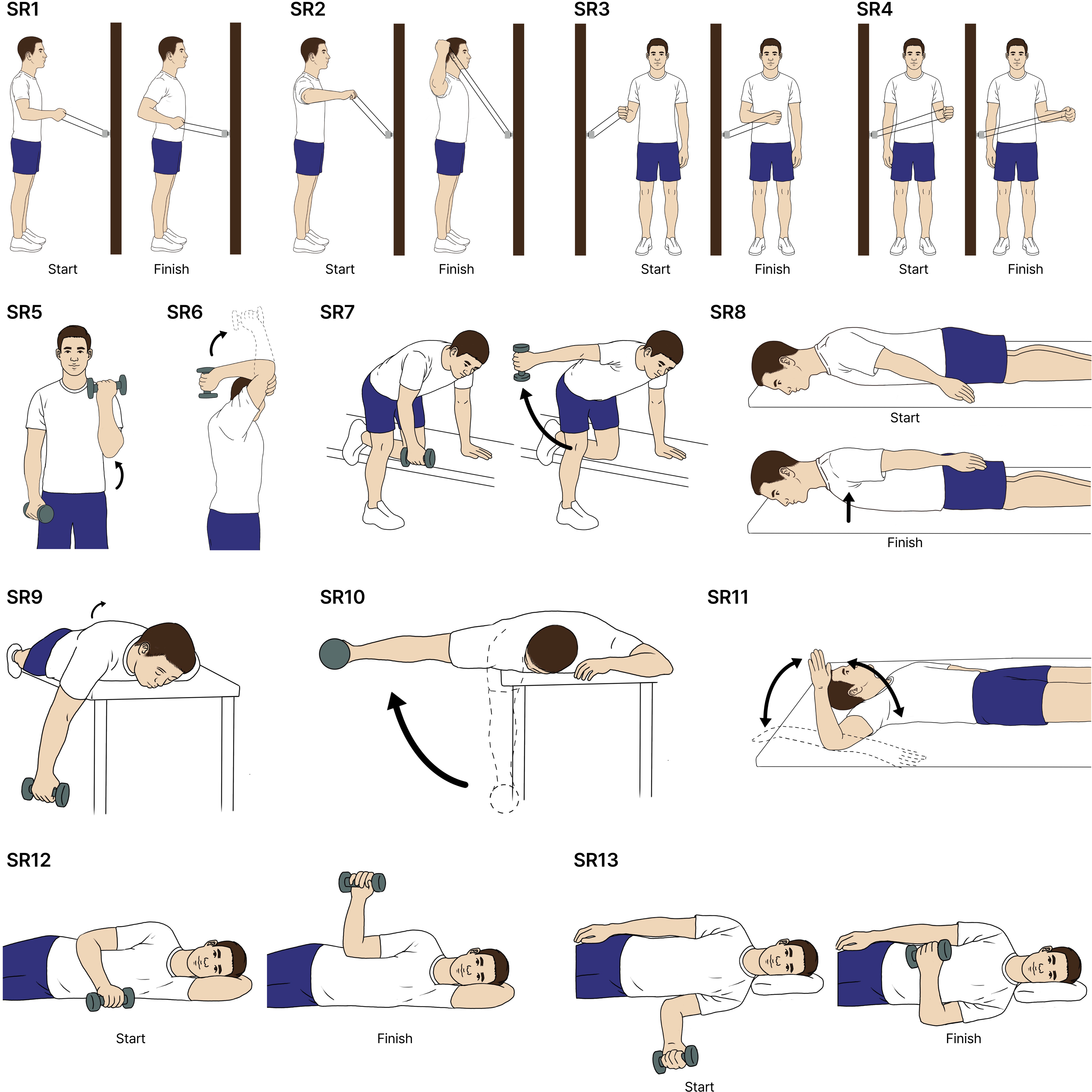
Overview of the 13 unit exercises included in the rehabilitation protocol. The intervention comprised 13 specific exercises targeting the rotator cuff and periscapular musculature, adapted from the American Academy of Orthopaedic Surgeons (AAOS) conditioning program. 26 All participants in both the individualized and random sequencing groups performed these identical exercises, differing only in the daily execution order. Labels (SR1–SR13) correspond to the exercise identifiers used in the sequencing analysis presented in Figure 3.
In the individualized sequencing arm, at baseline, SPADI item responses were mapped to ROM planes (flexion, extension, abduction, adduction, internal rotation, external rotation) to generate ROM-specific subset scores, and to muscle subsets relevant to RCRSP to generate muscle-specific scores. Each of the 13 unit exercises had been pre-classified by its ROM and muscle contributors. For each participant, a predicted discomfort score for every unit exercise was calculated as the weighted sum of the relevant muscle- and ROM-specific subset scores (see Supplementary Material 1 for the conceptual mapping matrix and logic). The final session order was based on the ranking of the mean subset scores, with exercises expected to provoke less pain and require less effort scheduled earlier to reduce nociceptive salience during initial sessions and support adherence.
In the random sequencing arm, participants completed the same 13 unit exercises delivered in an order drawn at random from a pre-generated permutation table of all possible 13-exercise sequences. Warm-up and cool-down procedures, total content, contact time, participant education, and safety procedures were identical to those in the individualized arm.
Rescue analgesia and diary-based monitoring of exposure and symptoms were applied in both arms per protocol. Treating clinicians followed a manualized script for exercise setup and cueing. Adherence was quantified as the proportion of prescribed sessions completed and time on task, with concomitant care and rescue analgesic use extracted from diaries to support process evaluation and sensitivity analyses. Session safety and stop rules were applied uniformly across both arms.
Outcomes
The primary outcome was the SPADI total score (0–100, with higher scores reflecting greater pain and disability; Korean version) measured at baseline, two weeks, four weeks (end of intervention), and eight weeks (follow-up). 30 The primary treatment effect was prespecified as the average post-baseline group difference across two, four, and eight weeks, estimated through a group × time interaction contrast with baseline SPADI as an adjustment factor. Secondary outcomes were pain intensity on a 0–100 mm visual analog scale (VAS) and active ROM measured with a manual goniometer across six planes (flexion, extension, abduction, adduction, internal rotation, external rotation) in line with AAOS standards. 25 Exploratory outcomes included the Korean version of the Disabilities of the Arm, Shoulder and Hand questionnaire (K-DASH); manual muscle testing and hand grip strength; musculoskeletal ultrasound features (tear size, direction, pattern); plain radiographic indices (acromial index and muscle atrophy metrics); depressive symptoms measured with the Beck Depression Inventory; and health-related quality of life assessed with the Short Form-36 survey. 26 Outcome assessment schedules matched SPADI time points. All evaluations were conducted by trained assessors who remained blinded to group assignment and followed standardized procedures. Adherence and process measures (conceptualized as exploratory implementation outcomes to support the mechanistic hypothesis) included session-level adherence (proportion of the 24 prescribed sessions completed), within-session adherence (proportion of the scheduled unit-exercise set completed per session), and time on task, with all data recorded in participant diaries and therapist logs. Rescue acetaminophen use (dose and timing) was documented to aid interpretation of outcomes and support sensitivity analyses.
Sample size
The primary outcome was the SPADI total score. Using a minimal clinically important difference of 13.3 SPADI points31–33 and a residual standard deviation of 15.8 (derived from prior ANCOVA models adjusting for baseline scores),10,13 we estimated that 22 participants per group (N = 44 completers) would provide 80% power to detect this difference at a two-sided alpha level of 0.05.
To accommodate potential attrition, we applied an anticipated dropout rate of approximately 20%, consistent with rates reported in exercise-based musculoskeletal trials.34,35 This yielded a target enrollment of 28 participants per group (N = 56 total). The planned sample size was judged adequate to maintain sufficient power for the final per-protocol analysis even with expected attrition.
Statistical analysis
All analyses were performed using SPSS (version 26.0; IBM Corp.). A two-sided significance level of p < 0.05 was applied to all tests. Data normality for continuous variables was assessed with the Shapiro–Wilk test. Most primary and secondary outcome variables (SPADI, VAS, K-DASH, ROM, Exercise Adherence Rating Scale [EARS]) and demographic variables (age, height, weight) did not meet the assumption of normal distribution.36,37 Primary and secondary outcome analyses were conducted on a per-protocol basis for the 48 participants (87.3%) who completed the eight-week follow-up. Baseline characteristics for the individualized and random groups were compared using the Mann–Whitney U test for continuous variables and the chi-square (χ2) test or Fisher's exact test for categorical variables. Treatment effects on primary and secondary outcomes across post-baseline time points (two, four, and eight weeks) were evaluated with linear mixed-effects models (LMMs). Each model included group (individualized vs. random), time (two, four, and eight weeks), and the group × time interaction as fixed effects. Baseline scores for each outcome were included as time-invariant covariates to adjust for baseline differences. Participant ID was included as a random intercept to account for repeated measures within subjects.
The significance of the group × time interaction was assessed through a likelihood ratio test (LRT) comparing the full model with a reduced model without the interaction term. When a significant interaction was identified (K-DASH and ROM) or when group differences at individual time points were required (SPADI and VAS), post hoc analyses were performed with Bonferroni correction for multiple comparisons. A p-value < 0.05 was considered statistically significant.
The primary estimand was the baseline-adjusted average between-group difference across all post-baseline assessments (weeks 2, 4, and 8). The group × time interaction was evaluated as a secondary test of whether the treatment effect varied across post-baseline time points. Accordingly, time-specific between-group contrasts were interpreted as descriptive post-baseline contrasts, with particular caution when the interaction term was not statistically significant.
Results
Participant flow and baseline characteristics
A total of 125 patients were screened for eligibility. Of these, 70 patients were excluded for not meeting inclusion or exclusion criteria, and 55 participants were randomized (27 to the individualized sequencing group and 28 to the random sequencing group). All participants received the allocated intervention. During the study period, seven participants were lost to follow-up or stopped the intervention (Figure 2), leaving 48 participants (87.3%) who completed the eight-week follow-up assessment.
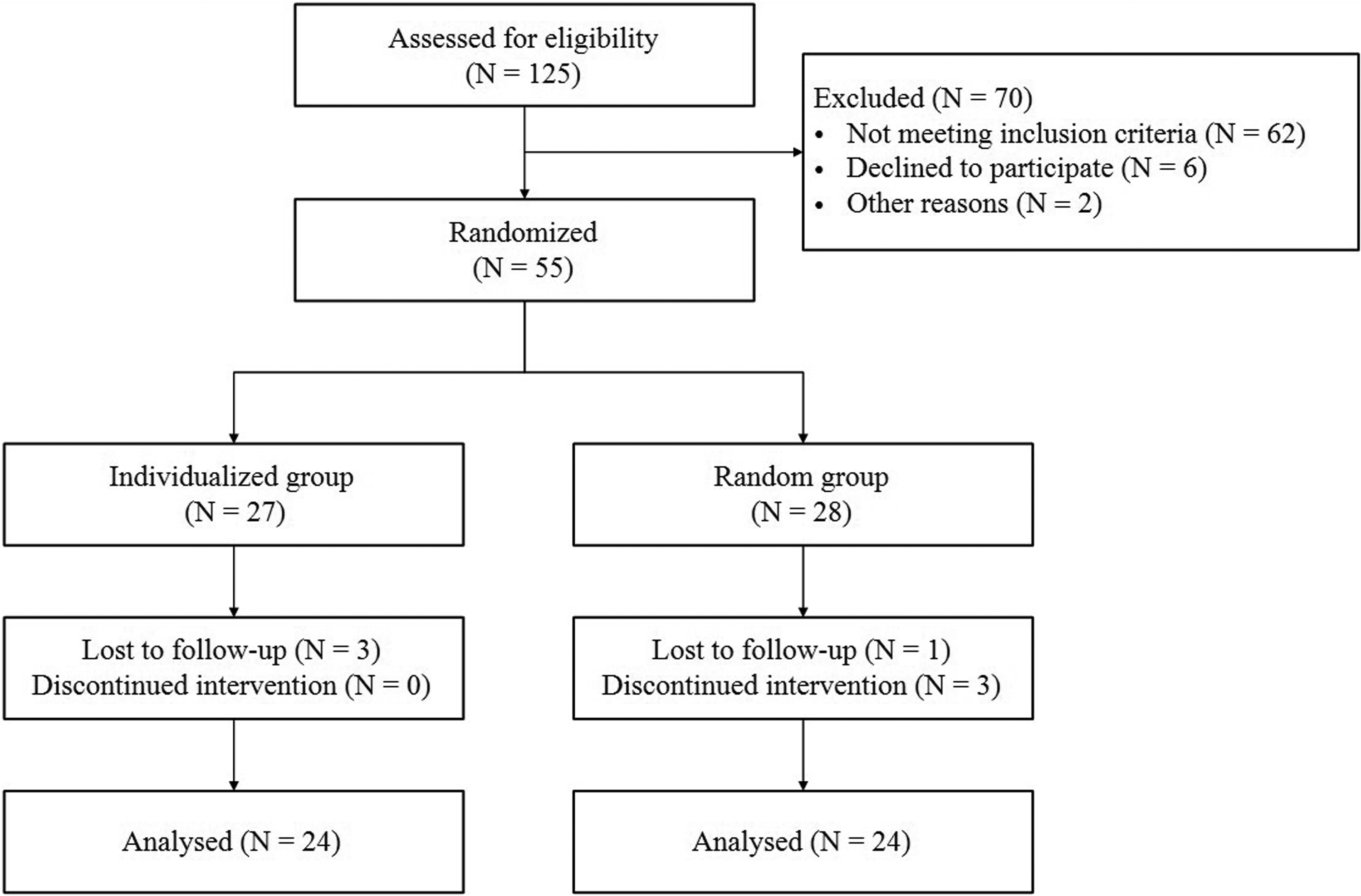
CONSORT flow diagram.
Baseline demographic and clinical characteristics for the 48 participants included in the final analysis are presented in Table 1. No significant differences were observed between groups in baseline values of the primary or secondary outcomes (all p > 0.05), indicating that the analyzed cohorts were well matched at baseline.
Baseline demographic and clinical characteristics of participants.
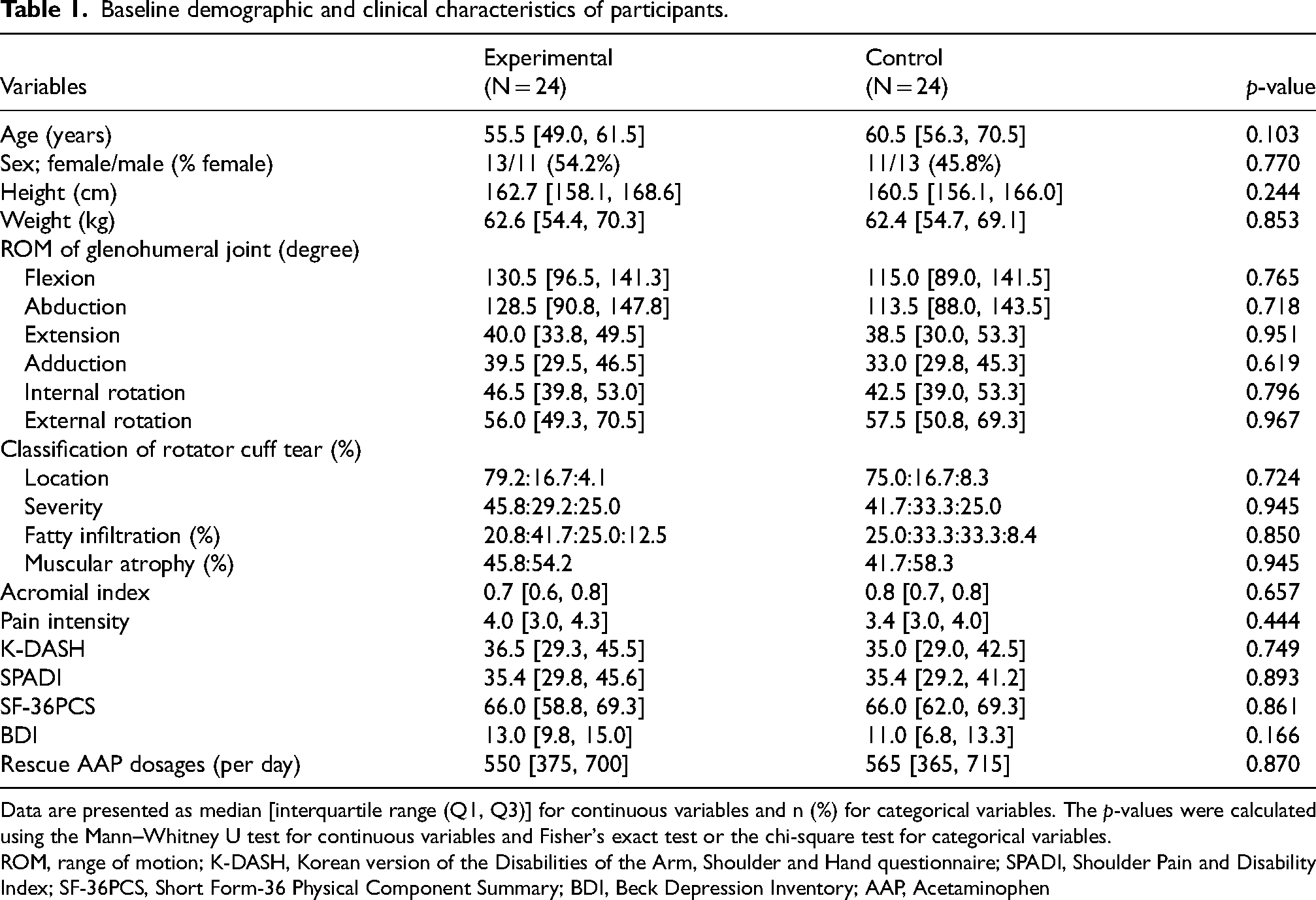
Data are presented as median [interquartile range (Q1, Q3)] for continuous variables and n (%) for categorical variables. The p-values were calculated using the Mann–Whitney U test for continuous variables and Fisher's exact test or the chi-square test for categorical variables.
ROM, range of motion; K-DASH, Korean version of the Disabilities of the Arm, Shoulder and Hand questionnaire; SPADI, Shoulder Pain and Disability Index; SF-36PCS, Short Form-36 Physical Component Summary; BDI, Beck Depression Inventory; AAP, Acetaminophen
Intervention contrast and manipulation check
To verify that the intervention was delivered as intended, the actual execution order of the 13 unit exercises was analyzed (Figure 3). In the individualized group, the SPADI-based algorithm placed exercises SR4, SR8, SR5, and SR9 significantly earlier in the sequence (lower order numbers) compared with the control group (all Holm-adjusted p < 0.05). In contrast, exercises SR7, SR6, and SR10 were positioned significantly later (higher order numbers; all Holm-adjusted p < 0.05). These findings confirm that the sequencing protocols were distinct across the two groups as planned.
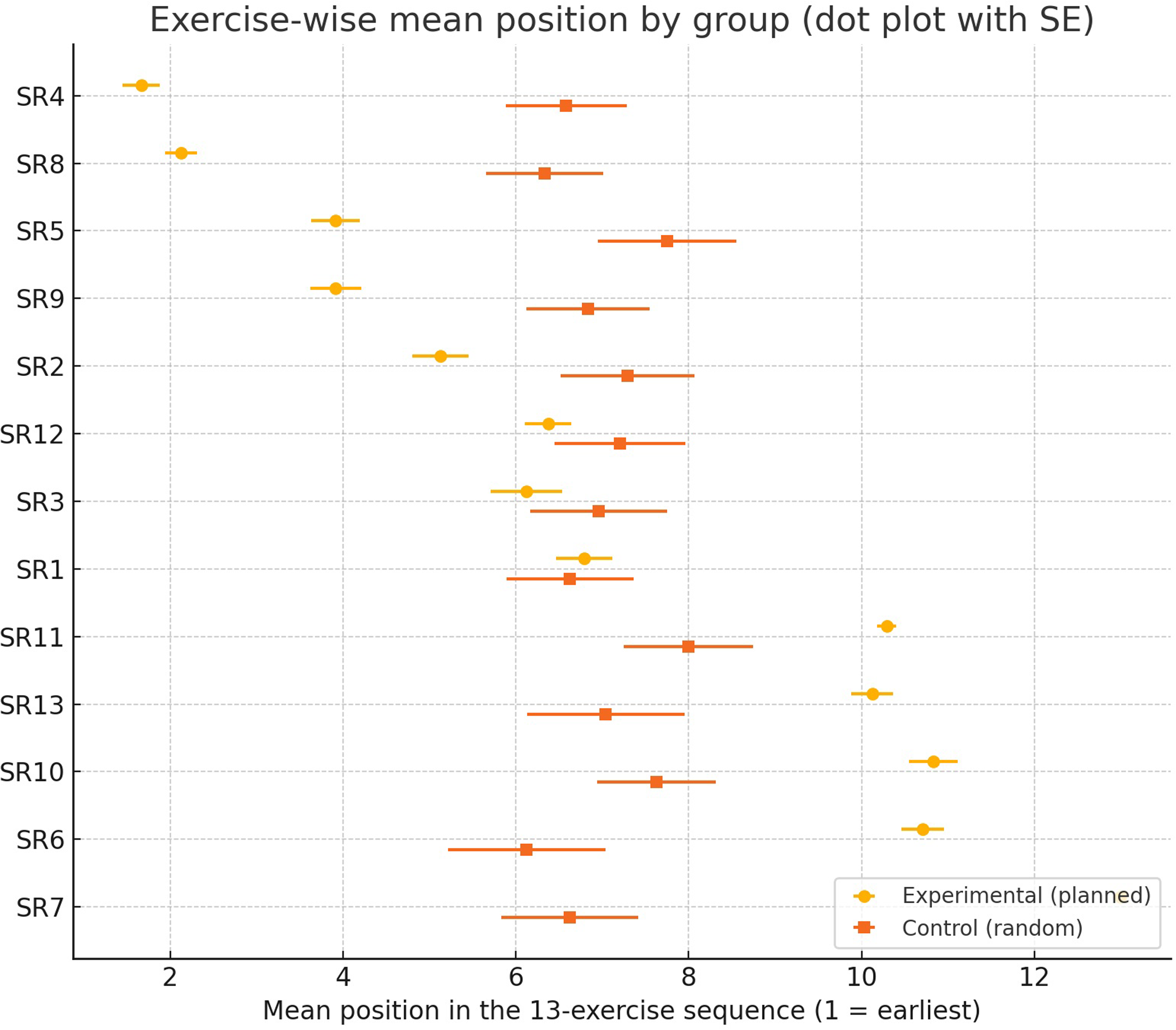
Mean exercise position within the 13-exercise sequence for the individualized (experimental) and random sequencing (control) groups. Each dot represents the mean position (± SE). Lower values indicate placement earlier in the session. Exercises are arranged by the between-group difference (Δpos = control − experimental). The individualized group placed lower-load exercises significantly earlier and higher-load exercises significantly later compared to the control group (Mann–Whitney U test, Holm-adjusted p < 0.05). SE, standard error.
Compliance was significantly higher in the individualized group (Figure 4). Participants in this group completed more exercise cycles during the four-week intervention period than those in the control group (median 4.0 vs. 1.0; Mann–Whitney U = 570.0, p < 0.001). The EARS total score at four weeks was also higher in the individualized group (median 21 vs. 14; Mann–Whitney U = 544.0, p < 0.001).
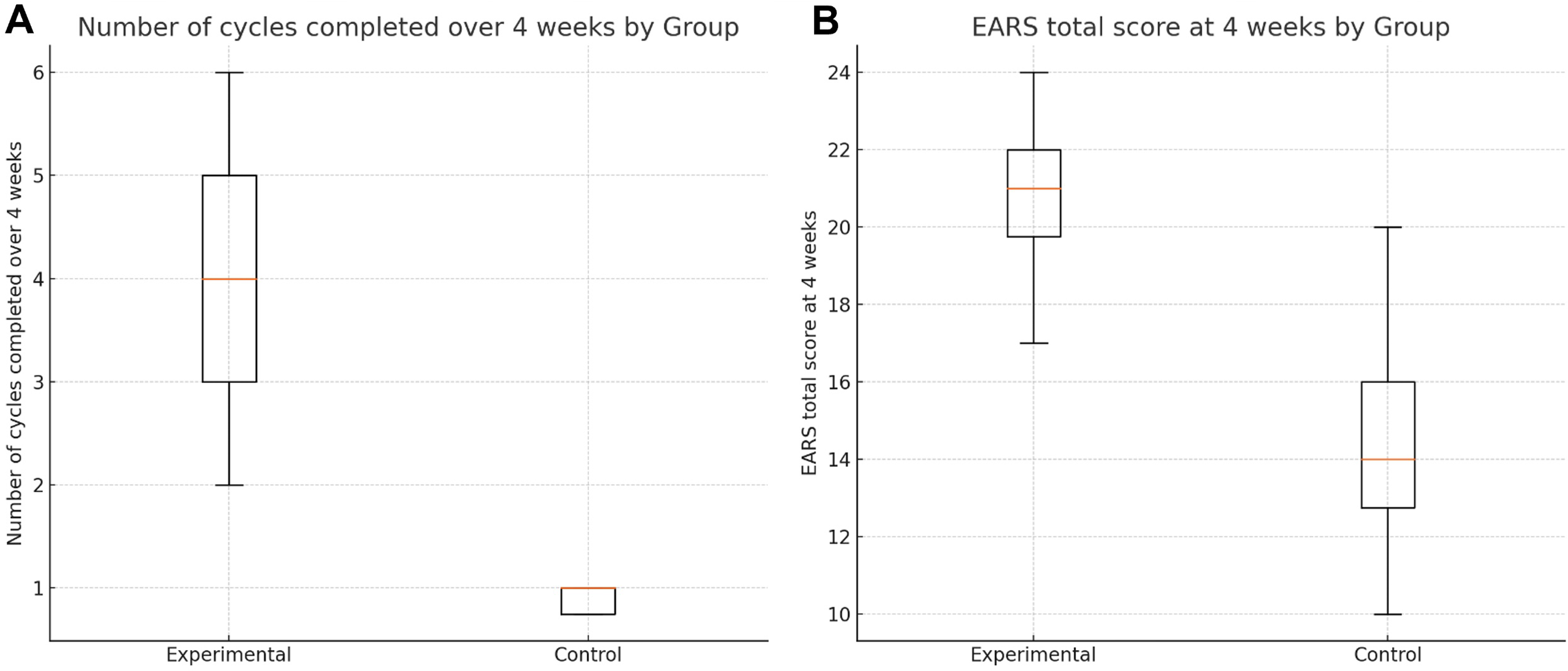
Exercise compliance outcomes during the four-week intervention. (A) Number of exercise cycles completed. (B) Exercise Adherence Rating Scale (EARS) total scores. Boxes represent the median and IQR; whiskers denote 1.5 × IQR; dots represent individual participants. The individualized (experimental) group demonstrated significantly higher adherence compared to the random (control) group in both completed cycles (Median 4 vs. 1; p < 0.001) and EARS scores (Median 21 vs. 14; p < 0.001). CI, confidence interval; EARS, Exercise Adherence Rating Scale; IQR, interquartile range.
Primary outcome
An LMM was used to evaluate trajectories of the SPADI total score with adjustment for baseline values. The overall group × time interaction was not statistically significant (LRT χ2(2) = 2.73, p = 0.255), indicating no evidence that the magnitude of the between-group difference varied over follow-up. However, post hoc estimates from the LMM demonstrated that the adjusted mean difference (MD) between groups (experimental minus control) was statistically significant and clinically meaningful at all post-baseline time points (Figure 5(a)): two weeks (adjusted MD, −7.98; 95% confidence interval [CI], −9.22 to −6.73; p < 0.001), four weeks (adjusted MD, −8.63; 95% CI, −9.88 to −7.39; p < 0.001), and eight weeks (adjusted MD, −8.28; 95% CI, −9.53 to −7.04; p < 0.001). The individualized group nevertheless maintained lower adjusted SPADI scores than the random-sequence group at each post-baseline assessment. A similar pattern was observed for VAS, with an early between-group separation that remained broadly parallel over time rather than diverging trajectories.

Trajectories of clinical outcomes at baseline, two, four, and eight weeks for the individualized (experimental) and random sequencing (control) groups. (A) SPADI total scores. (B) VAS pain scores. (C) K-DASH scores. (D) Total shoulder ROM. Box plots represent the median (horizontal line), interquartile range (box), and 1.5 × interquartile range (whiskers). Boxes represent the median and interquartile range; whiskers denote 1.5 × interquartile range. Linear mixed-effects models revealed significant group differences favoring the individualized group at all post-baseline time points for all outcomes (p < 0.001).ROM, range of motion; K-DASH, Korean version of the Disabilities of the Arm, Shoulder and Hand questionnaire; SPADI, Shoulder Pain and Disability Index; VAS, visual analog scale.
Secondary outcomes
Secondary outcomes showed a consistent pattern of greater improvement in the individualized group (Figure 5(b) to (d)). For the VAS pain score, the LMM did not identify a significant group × time interaction (LRT χ2(2) = 2.85, p = 0.241). However, post hoc analysis demonstrated significantly larger reductions in pain in the individualized group at every time point: two weeks (adjusted MD, −6.7; 95% CI, −8.2 to −5.3; p < 0.001), four weeks (adjusted MD, −9.1; 95% CI, −10.6 to −7.6; p < 0.001), and eight weeks (adjusted MD, −8.6; 95% CI, −10.1 to −7.1; p < 0.001).
In contrast, LMM analysis for K-DASH scores yielded a significant group × time interaction (LRT χ2(2) = 17.74, p < 0.001), indicating a faster rate of functional improvement in the individualized group. Post hoc comparisons were significant at all time points: two weeks (adjusted MD, −7.67; 95% CI, −9.43 to −5.90; p < 0.001), four weeks (adjusted MD, −10.69; 95% CI, −12.46 to −8.93; p < 0.001), and eight weeks (adjusted MD, −10.48; 95% CI, −12.25 to −8.72; p < 0.001). For total ROM, the LMM also identified a significant group × time interaction (LRT χ2(2) = 10.85, p = 0.004), reflecting a steeper mobility gain in the individualized group. Post hoc analyses again showed significant differences at all time points: two weeks (adjusted MD, +22.95; 95% CI, +17.75 to +28.15; p < 0.001), four weeks (adjusted MD, +27.08; 95% CI, +21.88 to +32.28; p < 0.001), and eight weeks (adjusted MD, +26.70; 95% CI, +21.50 to +31.90; p < 0.001). There was no statistically significant difference in the cumulative use of rescue acetaminophen between the individualized and control groups, and inclusion of analgesic use as a covariate did not alter the primary outcome estimates.
Adverse events
No serious adverse events related to the intervention were reported. Clinically significant exacerbation was operationally defined as an increase in resting shoulder pain of >30 mm on the VAS persisting for more than 48 h following a session. No such exacerbations were reported in either group during the study period.
Discussion
This trial should be interpreted as a mechanistic comparison between two sequencing strategies rather than as a comparative-effectiveness trial against usual clinical care. Because the comparator used a fully random exercise order, the observed between-group difference may reflect both a beneficial effect of individualized sequencing and a detrimental effect of arbitrary sequencing on adherence. Accordingly, our findings suggest that patient-informed sequencing may be preferable to random ordering, but they do not establish superiority over standard therapist-guided progression.
This study shows that in the rehabilitation of individuals with RCRSP, a sequence of individualized exercises based on SPADI profiling produced statistically significant and clinically meaningful improvements in pain (SPADI and VAS) and function (K-DASH and ROM) compared with a control group performing the same exercises in a random order. These findings indicate that a substantial difference in treatment adherence is associated with better outcomes relative to a random-sequence comparator; the individualized group completed a median of 4.0 exercise cycles, whereas the control group completed only 1.0 (p < 0.001).
Furthermore, the LMM analysis revealed a nuanced pattern in the recovery trajectory. For pain and disability outcomes (SPADI and VAS), the group × time interaction was not significant, indicating that the treatment advantage was established early and then maintained, rather than reflecting progressively diverging slopes over time. In contrast, for more complex functional and mobility outcomes (K-DASH and ROM), the group × time interaction was significant (p < 0.01). This pattern suggests that the individualized sequencing group not only attained positive outcomes but also continued to improve at a faster rate, resulting in increasingly divergent recovery trajectories.
Treatment adherence appears to be the key factor explaining these findings. The experimental group not only completed substantially more exercise cycles than the control group (median 4.0 vs. 1.0; p < 0.001) but also reported higher adherence on the EARS (p < 0.001). Although formal statistical mediation analysis was not performed, the stark contrast in completed cycles strongly suggests that treatment adherence acted as the primary mechanistic pathway ex-plaining the clinical outcome differences between groups. In practical terms, tailoring the sequence to SPADI-identified deficits seems to have effectively motivated greater participation. This finding aligns with the concept of ‘psychological momentum’, 38 where early successful task completion fosters continued engagement. By minimizing early nociceptive experiences, the individualized sequence likely preserved pain self-efficacy—a factor recently identified as a critical mediator of adherence in musculoskeletal rehabilitation.39,40 These results differ from those of Mulligan et al., 41 who reported no meaningful differences when comparing fixed exercise sequences. Their study suggested that variation between standardized sequences may have limited impact; in contrast, the present findings indicate that the act of individualizing the sequence itself—rather than merely the exercise selection—may function as an independent variable influencing outcomes. This distinction also separates our results from large pragmatic trials such as GRASP, 10 which found structured exercise to offer no advantage over simple advice. The Ad-Shoulder study 20 proposed that such null findings may stem from low adherence; the current individualized sequencing strategy presents a potential method for improving this critical component. This patient-centered approach to load management aligns with principles used successfully in rehabilitation for other musculoskeletal conditions.9,42–44
The findings of this study support the hypothesis that individualized approaches may outperform rigid, uniform protocols. For example, Silbernagel et al. 45 used a pain monitoring model for Achilles tendinopathy that allowed individuals to continue sporting activity. That group achieved recovery comparable to a six-week rest group, with no reported adverse effects. The present study applies a similar individualized paradigm but uses functional disability (SPADI) rather than pain to set the initial treatment sequence.
Nevertheless, the low adherence observed in the control group complicates interpretation. The large effect size may not reflect the benefit of the individualized approach alone but instead a combination of its advantages and the adverse consequences of the random sequence. This randomization may have exposed some individuals to stimulating or demanding exercises prematurely, producing discomfort or frustration and thereby reducing adherence. Consequently, this control condition may not reflect standard usual care46,47 and may have operated as a demotivating context or even nocebo-type intervention.48–51
Strengths and limitations
This study has several design strengths. First, it employed a randomized controlled trial design (Level 1b evidence) to isolate the effect of treatment sequence variables. Methodological strengths include the randomization process and the use of LMMs, a robust approach for analyzing longitudinal data that accounts for individual variability and repeated measures. Second, the study isolated exercise sequencing - rather than exercise selection - as the design feature under investigation by comparing an algorithm-based, patient-informed sequence with a mechanistic random-sequence comparator. However, because this comparator does not reflect standard clinical progression, the findings should not be interpreted as direct evidence that individualized sequencing is superior to usual care. Third, unlike previous studies that relied on no-treatment or usual-care controls, this study provided a matched exercise program delivered in random order, allowing for a more rigorous evaluation of the net effect attributable to individualized sequencing. Finally, by incorporating both subjective (EARS) and objective (completed exercise cycles) adherence metrics, the study offers a well-supported explanation for differences in clinical outcomes.
Despite these strengths, some limitations warrant consideration. First, the nature of the intervention prevented therapist blinding, increasing the potential for performance bias.52,53 Therapist awareness of group assignment may have unconsciously influenced the amount or quality of attention provided, introducing a possible confounding variable.54–56 The absence of formal fidelity verification further limits interpretation. Second, the main analysis included 48 participants (87.3%) who completed the eight-week follow-up; seven participants (12.7%) did not complete the intervention (Figure 2), with slightly higher attrition in the control group (14.3% vs. 11.1%). Individuals who discontinued the intervention may have experienced different outcomes, potentially inflating effect estimates. Third, as noted earlier, the markedly lower adherence in the control group complicates interpretation. The large effect size may reflect both the benefits of the individualized approach and detrimental effects—such as reduced motivation—introduced by the random sequence. Finally, the single-center setting limits generalizability and calls for caution when applying these findings to other populations and clinical contexts.
Clinical implications and future research
Despite these limitations, the findings carry important clinical implications. How exercises are sequenced may be as relevant as the specific exercises prescribed. Rather than relying solely on standardized protocols, clinicians may consider sequencing exercises according to the functional tasks most challenging for each individual, as identified through an initial assessment such as the SPADI. Even when the exercise content remains identical, restructuring the sequence in this patient-centered manner may improve adherence and, in turn, enhance clinical outcomes.
Future research should include large, confirmatory, multicenter trials to validate these preliminary results. To address limitations noted in the present study, further work must also incorporate more rigorous blinding strategies57–59 —for example, separating the clinician generating the individualized sequence from the therapist delivering the intervention—to better isolate the specific effect of the sequencing algorithm from non-specific influences such as therapeutic attention. While the total physical dose and cumulative mechanical load of the 13 exercises were strictly equivalent between groups, the intentional manipulation of intra-session fatigue and loading order was the hypothesized mechanism for reducing early nociceptive provocation and improving adherence.
Conclusions
This study shows that, even when exercise content is identical, delivering it in an individualized sequence derived from initial assessment with the SPADI is associated with greater improvements in pain, disability, and shoulder ROM over eight weeks compared with a random sequence. The findings provide preliminary evidence that individualized sequencing is linked to increased adherence and enhanced clinical outcomes. Although the magnitude of this effect requires cautious interpretation—given the potential for performance bias and the limitations of the control condition—the observed association between individualized sequencing and improved adherence represents an important hypothesis-generating result. Large, confirmatory multicenter trials are needed to validate these findings and inform broader clinical implementation.
Supplemental Material
sj-docx-1-bmr-10.1177_10538127261445293 - Supplemental material for Enhancing adherence and outcomes in rotator cuff-related shoulder pain: A randomized trial of individualized exercise sequencing
Supplemental material, sj-docx-1-bmr-10.1177_10538127261445293 for Enhancing adherence and outcomes in rotator cuff-related shoulder pain: A randomized trial of individualized exercise sequencing by Beom Chang Baek and Nackhwan Kim in Journal of Back and Musculoskeletal Rehabilitation
Footnotes
Abbreviations
The following abbreviations are used in this manuscript:
Acknowledgements
This research was supported by the Institute of Information & Communications Technology Planning & Evaluation (IITP) grant funded by the Korean government (Ministry of Science and ICT) (No. 2022000218, Development of XR twin-based training content technology for rehabilitation).

Ethical considerations and informed consent statements
The study was conducted in accordance with the Declaration of Helsinki and approved by the Institutional Review Board of Korea University Guro Hospital (IRB No. 2025AN0102; approval date 10 March 2025). Informed consent was obtained from all subjects involved in this study.
Author contribution
Conceptualization, N.K.; methodology, BCB. and N.K.; validation, N.K.; formal analysis, BCB. and N.K.; data curation, BCB. and N.K.; writing—original draft preparation, BCB.; writing—review and editing, N.K.; supervision, N.K.; funding acquisition, N.K. All authors have read and agreed to the published version of the manuscript.
Funding
The authors disclosed receipt of the following financial support for the research, authorship, and/or publication of this article: This work was supported by the Institute for Information and Communications Technology Promotion, (grant number 2022000218).
Declaration of conflicting interests
The authors declared no potential conflicts of interest with respect to the research, authorship, and/or publication of this article.
Data availability statement
Data supporting the findings of this study are available upon request from the corresponding author.
Supplemental material
Supplemental material for this article is available online.
References
Supplementary Material
Please find the following supplemental material available below.
For Open Access articles published under a Creative Commons License, all supplemental material carries the same license as the article it is associated with.
For non-Open Access articles published, all supplemental material carries a non-exclusive license, and permission requests for re-use of supplemental material or any part of supplemental material shall be sent directly to the copyright owner as specified in the copyright notice associated with the article.
