



Abstract
Background
Interventions for unilateral neglect have involved various approaches, notably the integration of robotics into clinical practice.
Objective
This study examined the effects of Robotic Mirroring Training (RMTr) and Mirror Therapy with Robot (MTh-R) on unilateral neglect, activities of daily living (ADL), and depression, and compared the effectiveness of the two interventions.
Methods
This study was a randomized controlled trial. Twenty-four patients with subacute stroke were randomly assigned to either the RMTr group (n = 12) or the MTh-R group (n = 12). Both groups received 30-min sessions, three times per week for five weeks, using the same robotic glove (SY-HRE12, SYREBO): the mirroring function for the RMTr group and pre-programmed passive movements for the MTh-R group. Unilateral neglect was assessed using the Behavioral Inattention Test–Conventional (BIT-C) and the Korean Catherine Bergego Scale (K-CBS). ADLs were measured with the Korean version of the Modified Barthel Index (K-MBI), and depression was assessed using the Korean Short Form Geriatric Depression Scale (SGDS-K). Pre- and post-intervention scores and between-group differences were analyzed.
Results
Both groups showed significant improvements in BIT-C and K-CBS scores (p < 0.01). The RMTr group demonstrated statistically significant improvements in K-MBI (p < 0.01) and SGDS-K (p < 0.01), while the MTh-R group showed significant improvements in K-MBI (p < 0.05) and SGDS-K (p < 0.01). These results indicate reduced unilateral neglect, enhanced ADL performance, and decreased depression in both groups. Significant between-group differences were observed in BIT-C (p < 0.01), K-CBS, and SGDS-K (p < 0.05), confirming the greater overall effectiveness of the interventions.
Conclusions
While both interventions were effective, RMTr demonstrated greater efficacy in reducing unilateral neglect and depression.
Keywords
Introduction
Unilateral neglect is a post-stroke cognitive impairment. Characterized by difficulty recognizing stimuli and space on one side (Bosma et al., 2023; Punt & Riddoch, 2006), it manifests as deficits in various sensory perceptions, including visual, tactile, auditory, proprioceptive, and kinesthetic senses, and these deficits affect neglected sectors (Cardinali et al., 2009). The neglected sectors can be subdivided into personal space, peripersonal space, and extrapersonal space (Jeong, 2017). Unilateral neglect persists longer in patients with right hemisphere lesions than among those with left hemisphere lesions (Wee & Hopman, 2008) and neglecting the body along with low participation in rehabilitation during the acute and subacute stages, when neuroplasticity is active, may limit the recovery of physical functions (Doron & Rand, 2019; Nijboer et al., 2014). The motor and mobility abilities of patients with unilateral neglect are significantly lower than the abilities of those without neglect, resulting in reduced independence in ADLs (Embrechts et al., 2024).
Unilateral neglect negatively correlates with independence in ADLs; the more severe the neglect, the lower the ADL independence, with self-care and mobility showing the strongest correlation (De-Rosende-Celeiro et al., 2021; Nijboer et al., 2013). Turgut et al. (2018) reported that interventions providing visual and verbal cues effectively reduced unilateral neglect and improved ADL performance. Unilateral neglect also positively correlates with depression and anxiety, indicating that greater neglect severity leads to increased depression and anxiety (Sobrinho et al., 2018). Kim and Kim (2015) reported that neuro-feedback intervention reduced unilateral neglect and concurrently decreased depression levels among patients.
In clinical practice, interventions for unilateral neglect are categorized into visual–perceptual interventions, body–awareness interventions, cognitive interventions, movement-based interventions, non-invasive brain stimulation, and electrical stimulation interventions (Longley et al., 2021). Limb activation, categorized as a body–awareness intervention, involves stimulating somatosensation and motor neural circuits through movements of the neglected side, thereby directing the patient's attention toward the neglected side. Limb activation is divided into active limb activation, in which the patient voluntarily moves the neglected limb, and passive limb activation, in which external forces from therapists or devices move the limb (Frassinetti et al., 2001; Robertson & North, 1992).
Robertson and North (1992) first reported the effectiveness of active limb activation in reducing unilateral neglect, and Frassinetti et al. (2001) reported that passive and active limb activation in neglected space had similar effects on improving unilateral neglect. Passive limb activation can partially activate somatosensation and enhance body schema even if somatosensation of the left side is impaired (Reinhart et al., 2012). Eskes et al. (2003) compared active limb activation with passive limb activation using Functional Electrical Stimulation (FES) and confirmed that both interventions reduced unilateral neglect. Choi et al. (2016) argued that limb activation using upper-limb robots with monitor-based input interfaces showed no significant differences in unilateral neglect improvement compared to traditional interventions. In a randomized controlled pilot study, Park (2021) reported that limb activation using an upper-limb robot with a monitor interface displaying animated fixed forearm finger movements was more effective at reducing unilateral neglect than traditional interventions.
Mirror therapy, initially developed for reducing phantom limb pain in amputees, is an intervention that prompts the patient to imagine movement in the affected limb by reflecting movements of the unaffected limb in a mirror (Ramachandran & Rogers-Ramachandran, 1996). Mirror therapy utilizes visual illusions created by a mirror to stimulate mirror neurons, enhancing neuroplasticity in the damaged hemisphere. It can be applied irrespective of paralysis severity, making it suitable for post-stroke hemiplegia rehabilitation (Altschuler et al., 1999; Garry et al., 2005). Dohle et al. (2009) reported that mirror therapy was effective at reducing unilateral neglect, and Deconinck et al. (2015) suggested activation of the premotor cortex as the underlying mechanism for neglect reduction. In a randomized controlled trial, Pandian et al. (2014) confirmed the effectiveness of mirror therapy at reducing unilateral neglect by comparing it with sham mirror therapy. In another randomized controlled trial, Sim and Kwon (2022) reported that bilateral mirror therapy was more effective than unilateral mirror therapy at reducing unilateral neglect. Nam et al. (2017) implemented a combined intervention of mirror therapy and an upper-limb robot for unilateral neglect, reporting that improvements in proprioception had a statistically significant effect on reducing unilateral neglect.
With advancements in engineering technology, various forms of robotics are being utilized in stroke rehabilitation clinical settings. Rehabilitation robots can be categorized based on their structure into exoskeletons, which resemble the human skeleton and assist with precise joint movements, and end-effectors, which guide movement by holding the distal parts of limbs, such as the hands or feet. They can also be classified by their assistive function as active, passive, active-assistive, resistive, or interactive (Bazan et al., 2022; Molteni et al., 2018). Robotic interventions offer advantages such as precise movement control and adjustable stimulus intensity and repetition frequency (Lo, 2012). They also enable simultaneous active movement guidance and passive movement stimulation for patients with flaccid or spastic paralysis in the subacute stage (Basteris et al., 2014; Bumbea et al., 2018). Additionally, robotic interventions have been shown to have positive emotional effects, including reduction of depression and enhancement of self-efficacy, in addition to motor function improvements (Chen et al., 2023; Taravati et al., 2022). In particular, robots employed for unilateral neglect interventions have been used as computerized input interfaces for upper limb movements, intended to either induce active limb activation or provide passive limb activation stimuli (Basteris et al., 2014).
Recent studies have introduced wearable robotic gloves utilizing exoskeleton technology, which enable independent finger movements, unlike traditional upper-limb robots that measure limb movements and visualize them on screens or provide resistance. In stroke rehabilitation scenarios, robotic gloves have primarily been studied as interventions or assistive devices for the affected upper limb (Chu & Patterson, 2018; Liu et al., 2022). Schrader et al. (2022) reported significant improvements in upper limb function among stroke patients who received bilateral mirror therapy using robotic gloves. However, previous studies applying robotic gloves specifically for unilateral neglect interventions could not be identified.
One recent introduction is Robotic Mirroring Training (RMTr). It utilizes robotic glove synchronization technology to mirror movements of the unaffected hand onto the affected hand, allowing direct observation of affected hand movements (Kim et al., 2022; Sharma et al., 2024). RMTr provides multisensory combined stimuli, activating the motor cortex and thereby promoting neuroplasticity (Kim et al., 2022). Combined sensory–motor stimuli can increase the activation of mirror neurons and the primary motor cortex (M1), while multisensory stimulation enhances body ownership and a sense of agency (Costantini & Haggard, 2007; Mukamel, 2012). Enhanced body ownership of the neglected side and activation of M1 through multisensory stimulation can reconstruct body image, thereby reducing unilateral neglect (O'Shea et al., 2017; Preston & Newport, 2011).
Kim et al. (2022) reported that interventions using robotic gloves, enabling the affected hand to simultaneously mimic and observe movements of the unaffected hand, effectively activate M1 in stroke patients. RMTr, involving wearable robotic gloves, provides synchronized movements of both unaffected and affected hands, allowing consistent experiences of multisensory stimuli such as proprioception from passive movements of the affected hand, observable visual feedback, and operational sounds of the robotic glove. The mirroring function of the robotic glove provides identical observable movements of both hands, thereby addressing the known limitation of traditional mirror therapy in which sensory–motor discrepancies between proprioception and vision may reduce therapeutic effects (Selles et al., 2014). However, no prior studies have applied RMTr utilizing robotic glove synchronization technology specifically for unilateral neglect interventions.
Therefore, the purpose of this study was to apply RMTr, using robotic glove mirroring technology, and Mirror Therapy with Robot (MTh-R), combining mirror therapy with robotic glove passive movements, subacute stroke patients with unilateral neglect, and compare the effects of each intervention on unilateral neglect. Additionally, this study was intended to examine the effects of changes in unilateral neglect on ADL performance and depression levels among subacute stroke patients. Furthermore, this study aimed to introduce a new robotic intervention for unilateral neglect that has fewer spatial constraints and is more affordable for use in clinical settings.
Methods
Participants
To determine the target sample size for this study, we used the G*Power 3.1 program. On the basis of a two-tailed t-test, an effect size of 0.8 (Large), a significance level of 0.05, and a power of 0.80, we determined that 52 participants (26 per group) were required in total. However, due to constraints posed by the clinical environment, the study duration, and difficulties in recruiting participants who met the selection criteria (e.g., diagnosis of unilateral neglect, normal general cognitive function), a final sample of 24 participants was recruited. There were no dropouts during the study. To be included, participants had to satisfy the following criteria: first-time stroke diagnosis by Magnetic Resonance Imaging (MRI) or Computed Tomography (CT), left hemiplegia resulting from a right hemisphere lesion within 2–6 months post-stroke onset, a Korean-Mini Mental Status Examination (K-MMSE) score of 24 or above, and meeting criteria for suspected unilateral neglect on the Motor-free Visual Perception Test (MVPT). Participants voluntarily consented to participate. Exclusion criteria were quadriplegia or amputation/contracture of upper limb joints, neurological diseases other than stroke, visual impairment, communication difficulties due to aphasia or hearing impairment, psychiatric disorders, and current participation in other studies. This study was approved by the Institutional Review Board (IRB) of [Blinded for review] (approval number: [Blinded]).
Study Design and Procedure
This study was designed as a randomized controlled trial to investigate the effects of RMTr and MTh-R on reducing unilateral neglect among stroke patients and to compare the effectiveness of these two interventions. Twenty-four patients were allocated to either the RMTr group (n = 12) or the MTh-R group (n = 12) using block randomization via an Excel-generated random number table. To ensure allocation concealment, a research assistant who did not participate in the intervention was assigned. The research assistant informed the researcher of group assignments. This study was single-blinded, as participants were unaware of their group assignments. The interventions were conducted in a quiet, separate room at the hospital with environmental distractions minimized to facilitate participant focus. Additionally, the study interventions were provided as supplementary sessions after the completion of their standard rehabilitation therapy scheduled by the hospital. Both RMTr and MTh-R groups used identical intervention equipment to prevent participants from knowing their group assignments. Both groups received interventions for 30 min per session, three times a week, totaling 15 sessions over five weeks, including pre- and post-intervention assessments. During their hospital stay, patients received the same conventional occupational and physical therapy as prescribed by the hospital, which was thoroughly managed by the coordinator of each therapy room. Subsequently, both groups received supplementary robotic glove interventions. Primary outcome measures evaluating reductions in unilateral neglect pre- and post-intervention included the Behavioral Inattention Test-Conventional (BIT-C) and Korean Catherine Bergego Scale (K-CBS). Secondary outcome measures assessing changes associated with neglect reduction included the Korean Version of Modified Barthel Index (K-MBI) for ADL performance and the Korean Short Form Geriatric Depression Scale (SGDS-K) for depression levels (Figure 1).
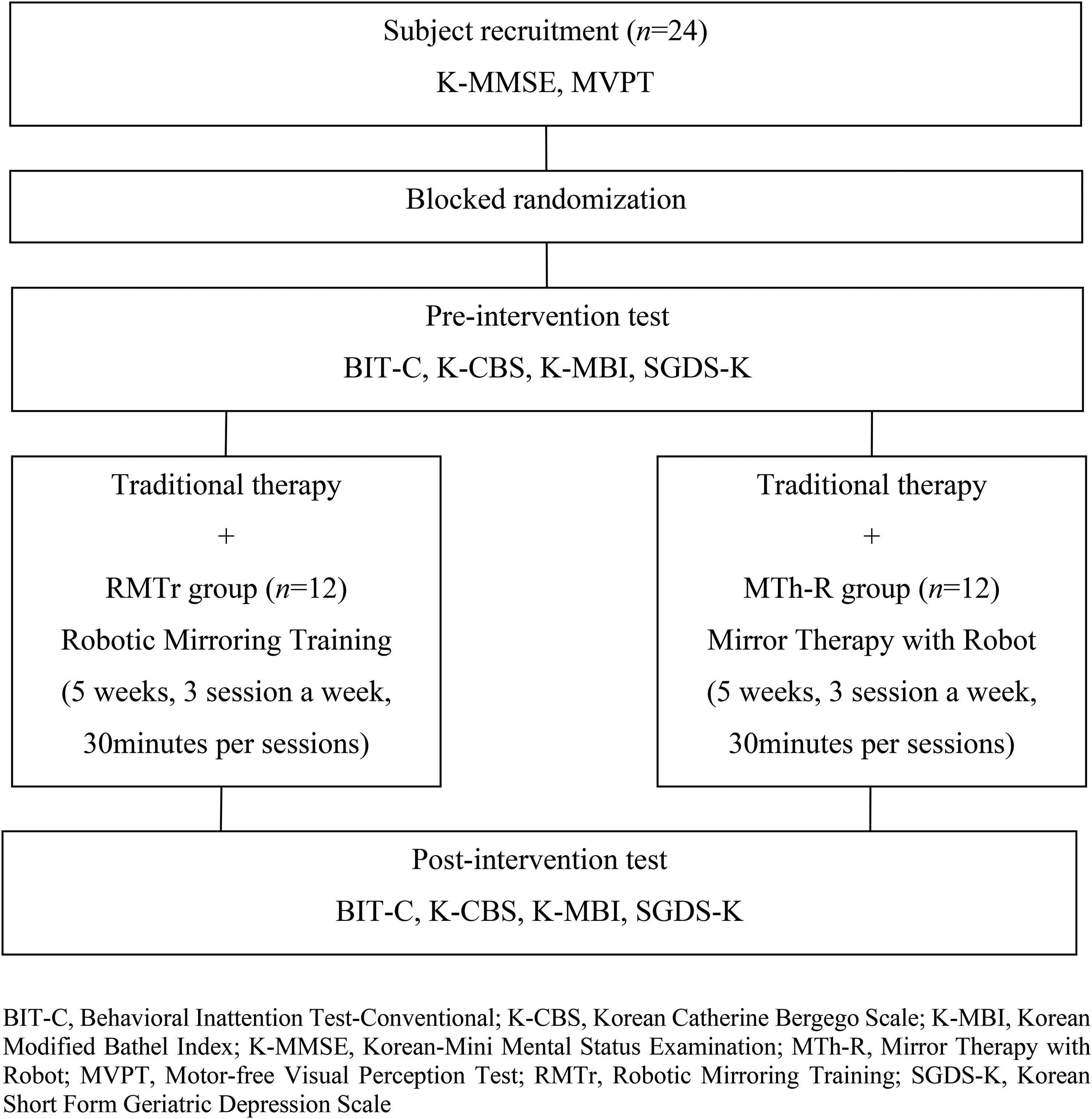
Study Flow Diagram. BIT-C, Behavioral Inattention Test-Conventional; K-CBS, Korean Catherine Bergego Scale; K-MBI, Korean Modified Bathel Index; K-MMSE, Korean-Mini Mental Status Examination; MTh-R, Mirror Therapy with Robot; MVPT, Motor-free Visual Perception Test; RMTr, Robotic Mirroring Training; SGDS-K, Korean Short Form Geriatric Depression Scale
Interventions
Robotic Mirroring Training (RMTr)
The RMTr group used a wearable robotic glove (SY-HRE12, SYREBO), featuring a pneumatic-driven exoskeleton assisting finger flexion and extension on the affected hand. Participants wore a soft fabric glove embedded with motion sensors on the unaffected hand, enabling the affected hand to mirror its movements exactly. To maintain blinding, a transparent triangular acrylic box (450 mm × 350 mm) identical to that used by the MTh-R group, but without the mirror, was utilized. Participants sat in a chair with feet flat on the floor, placed both arms comfortably on a table, and positioned the affected hand inside the transparent acrylic box. The intervention program, modified from mirror therapy protocols by Lee et al. (2012) and Schrader et al. (2022), consisted of (a) making a fist and opening it, (b) touching the thumb to each finger sequentially, and (c) counting numbers while extending or flexing fingers. Each step was performed for 10 min. Participants observed the affected fingers performing identical movements to the unaffected fingers through the transparent acrylic box. An occupational therapist continuously monitored participants’ performance and instructed subsequent movements. Participants practiced each movement for one minute before the intervention; glove donning and practice times were not included in the total intervention duration (Figure 2).
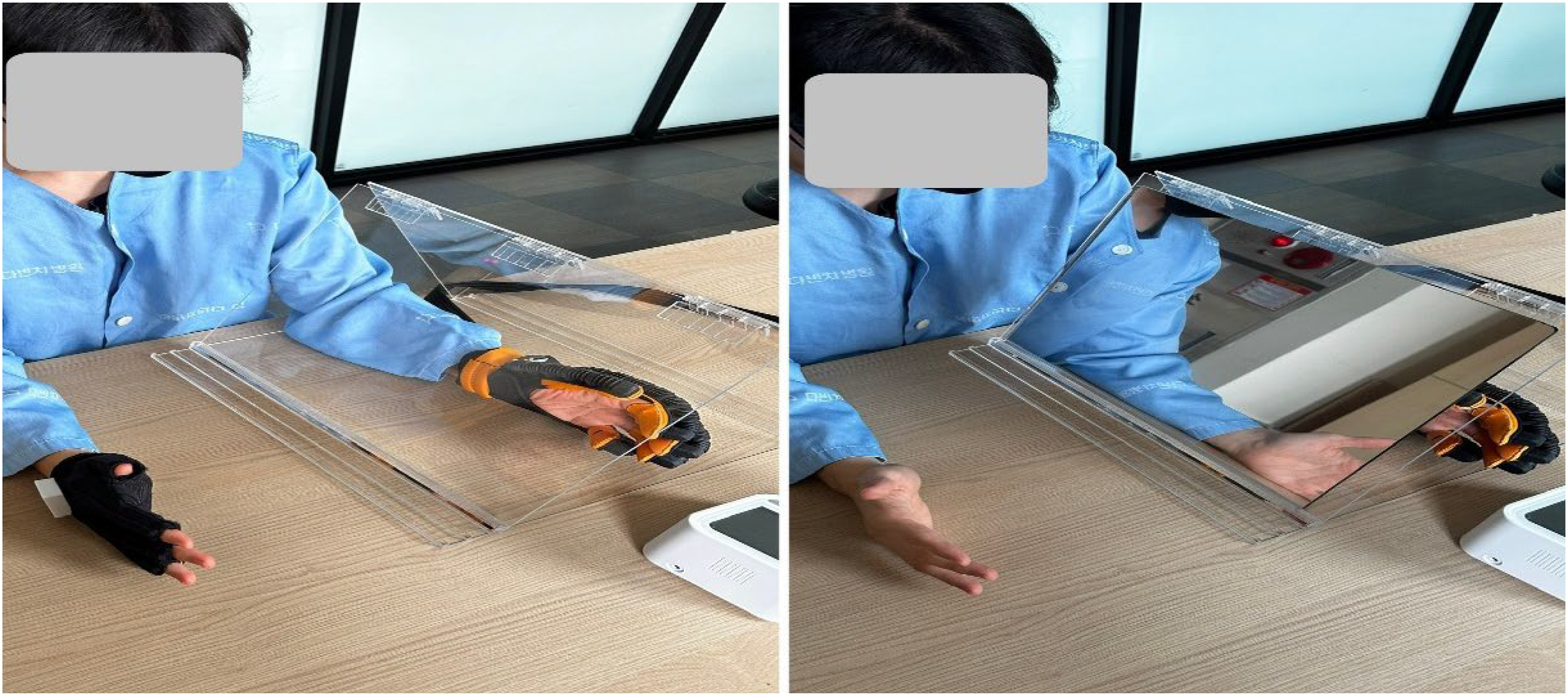
Robotic Mirroring Training (RMTr; Left) and Mirror Therapy with Robot (MTh-R; Right).
Mirror Therapy with Robot (MTh-R)
The MTh-R group also wore the same robotic glove (SY-HRE12, SYREBO) on the affected hand and used a transparent triangular acrylic box (450 mm × 350 mm) equipped with a 400 mm × 300 mm mirror. Participants sat in the same posture as the RMTr group, placing the affected hand behind the mirror inside the triangular acrylic box to prevent visibility. The mirror was positioned approximately 10 cm left of the midline, and its angle was adjusted according to each participant's seated height for easy viewing of the reflected hand. The MTh-R group's program consisted of identical movements to those of the RMTr group, pre-programmed for passive execution by the robotic glove for 10 min each. The occupational therapist instructed participants to concentrate on the matching movements of the hidden affected hand with those of the unaffected hand as closely as possible. Participants observed the movements of the unaffected hand through the mirror. Similar to the RMTr group, each movement was practiced for one minute before the intervention; glove donning and practice time were excluded from the total intervention duration (Figure 2).
Outcome Measures
Participants were assessed for unilateral neglect using the MVPT (Bouska & Kwatny, 1983), and cognitive function was evaluated using the K-MMSE (Kang et al., 1997). To evaluate the severity of unilateral neglect pre- and post-intervention, the BIT-C (Wilson et al., 1987) and K-CBS (Lee et al., 2015) were used. The BIT-C is a paper-and-pencil battery test consisting of six items, combining quantified individual assessments. The K-CBS is a checklist measuring unilateral neglect behaviors during ADL, comprising 10 items assessed through direct observation of patients. Additionally, the K-MBI (Jung et al., 2007) was used to evaluate ADL performance, and the SGDS-K (Cho et al., 1999) was used to assess depression levels following reductions in unilateral neglect.
Statistical Analyses
Statistical analyses for this study were conducted using SPSS version 29.0. Normality tests were conducted using the Shapiro–Wilk test; nonparametric tests were used due to the non-normal distribution of the data. Participants’ general characteristics, including sex and stroke type, were analyzed using chi-squared tests, while age, time since stroke onset (days), and scores on the K-MMSE and MVPT were compared using the Mann–Whitney U test. Chi-squared and Mann–Whitney U tests assessed pre-intervention homogeneity between groups. Wilcoxon signed-rank tests compared pre- and post-intervention results within groups, and Mann–Whitney U tests compared changes between groups post-intervention. The statistical significance level (α) was set at p < 0.05. Effect sizes for nonparametric tests (Mann–Whitney U test and Wilcoxon signed-rank test) were calculated using Rosenthal's r
Results
General Characteristics of Participants and Verification of Functional Homogeneity
The study participants included 14 men and 10 women, with a mean age of 67.50 ± 5.86 years. Stroke types were equally distributed, with 12 patients having suffered an ischemic stroke and 12 having suffered a hemorrhagic stroke. Additional general characteristics are summarized in Table 1. Analysis of participants’ general characteristics, screening test scores, pre-intervention unilateral neglect assessments (BIT-C, K-CBS), ADL performance (K-MBI), and depression levels (SGDS-K) showed no statistically significant differences between the two groups (p > 0.05). Homogeneity between the two groups was confirmed regarding general characteristics, cognitive levels, pre-intervention unilateral neglect severity, ADL performance, and depression levels (Table 1).
General Characteristics and Homogeneity of Participants.
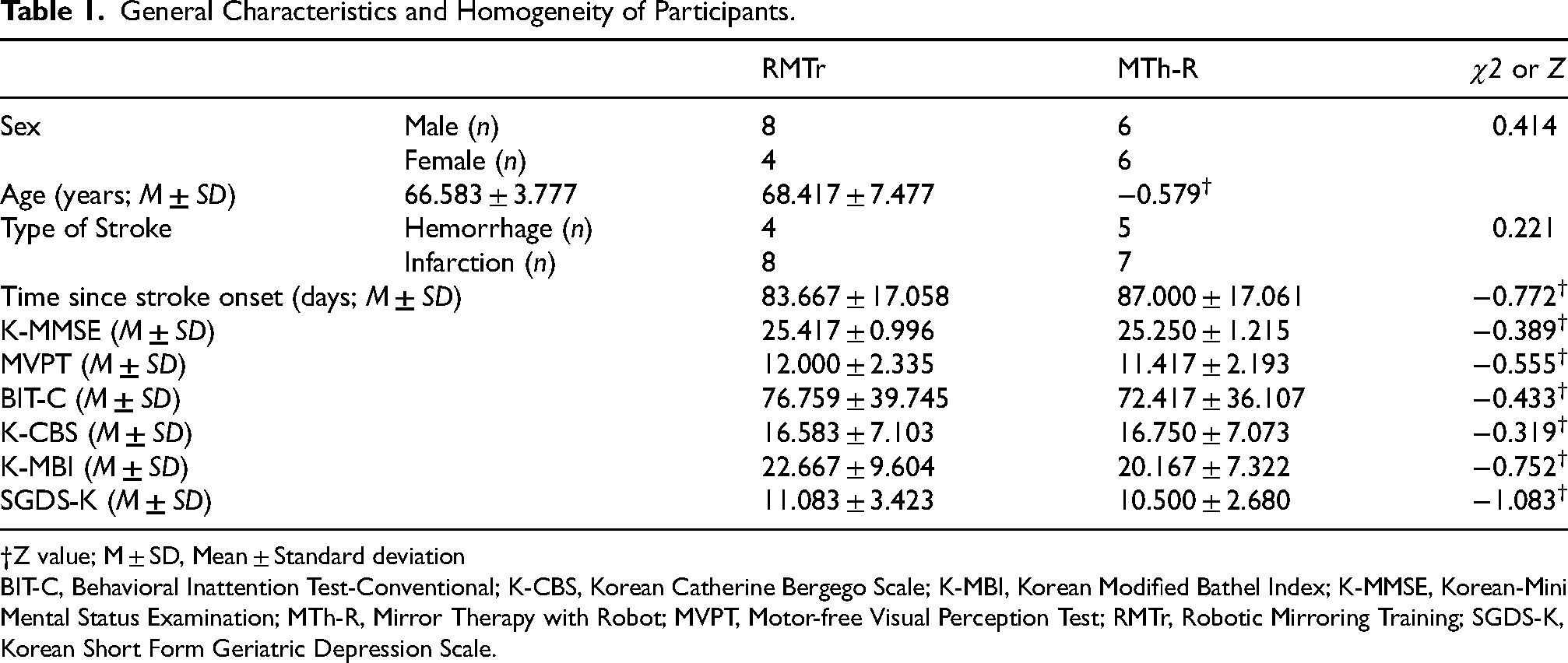
†Z value; M ± SD, Mean ± Standard deviation
BIT-C, Behavioral Inattention Test-Conventional; K-CBS, Korean Catherine Bergego Scale; K-MBI, Korean Modified Bathel Index; K-MMSE, Korean-Mini Mental Status Examination; MTh-R, Mirror Therapy with Robot; MVPT, Motor-free Visual Perception Test; RMTr, Robotic Mirroring Training; SGDS-K, Korean Short Form Geriatric Depression Scale.
Within-group Comparisons of Pre- and Post-Intervention Scores
Regarding primary outcome measures, within-group comparisons showed statistically significant improvements with large effect sizes (r > 0.5) in BIT-C total scores (Z = −3.061, p < 0.01, r = 0.884) and K-CBS scores (Z = −3.076, p < 0.01, r = 0.888) in the RMTr group, and BIT-C total scores (Z = −3.065, p < 0.01, r = 0.885) and K-CBS scores (Z = −3.066, p < 0.01, r = 0.885) in the MTh-R group. As secondary outcome measures related to reduced unilateral neglect, statistically significant improvements accompanied by large effects, were observed in pre- and post-intervention scores for K-MBI (Z = −3.071, p < 0.01, r = 0.886) and SGDS-K (Z = −3.074, p < 0.01, r = 0.887) in the RMTr group, and for K-MBI (Z = −2.533, p < 0.05, r = 0.731) and SGDS-K (Z = −3.069, p < 0.01, r = 0.884) in the MTh-R group. This indicated that both groups had statistically significant reductions with large effect sizes in unilateral neglect and corresponding improvements in ADL performance and decreases in depression levels (Table 2).
Within-Group Comparisons of Pre- and Post-Intervention Scores and Between-Group Comparisons of Changes.

*p < 0.05; **p < 0.01; r, Rosenthal's r; M ± SD, Mean ± Standard deviation
BIT-C, Behavioral Inattention Test-Conventional; K-CBS, Korean Catherine Bergego Scale; K-MBI, Korean Modified Bathel Index; MTh-R, Mirror Therapy with Robot; RMTr, Robotic Mirroring Training; SGDS-K, Korean Short Form Geriatric Depression Scale
Between-group Comparisons of Changes
In between-group comparisons of primary outcome measures, statistically significant differences with large effect sizes were observed in changes in BIT-C total scores (Z = −2.791, p < 0.01, r = 0.570) and K-CBS scores (Z = −2.504, p < 0.05, r = 0.511), indicating significantly greater improvement in unilateral neglect in the RMTr group compared to the MTh-R group. For secondary outcome measures, between-group comparisons showed no statistically significant difference in changes in K-MBI scores(Z = −1.632, p > 0.05, r = 0.333) although the effect size was moderate(r > 0.3), while changes in SGDS-K scores (Z = −2.015, p < 0.05, r = 0.411) indicated significantly greater reductions in depression in the RMTr group, the effect size was consistent with moderate. This suggests that both groups showed moderate effect sizes, whereas the RMTr group had statistically greater reductions in depression than the MTh-R group. However, the difference in changes in ADL performance between groups was not statistically significant. (Table 2).
Discussion
This study was intended to investigate the effects of RMTr using a robotic glove and MTh-R combining mirror therapy and robotics on reducing unilateral neglect in stroke patients, and to compare these interventions for their effectiveness. Additionally, this study sought to examine the secondary effects of unilateral neglect reduction on ADL performance and depression levels. A comparison of score changes between the groups revealed that the RMTr group demonstrated statistically significantly more favorable changes with large effect size in the BIT-C, K-CBS, and SGDS-K by moderate effect size than the MTh-R group, confirming that RMTr was more effective in reducing unilateral neglect and depression. In within-group comparisons, both RMTr and MTh-R groups showed statistically significant changes and large effect size in BIT-C, K-CBS, K-MBI, and SGDS-K scores, indicating reductions in unilateral neglect and corresponding improvements in ADL performance and decreases in depression levels.
In between-group comparisons of unilateral neglect reduction, statistically significant differences with large effect size were observed in BIT-C and K-CBS scores. The differences in effectiveness between groups can be explained by the therapeutic attributes of the interventions. RMTr provides integrated multisensory stimuli—including visual, proprioceptive, and tactile inputs—that can maximize the activation of mirror neurons and M1 (Costantini & Haggard, 2007; Kim et al., 2022). RMTr allows patients to actively control movements of the unaffected limb, while the robotic glove passively replicates these exact movements in the affected limb. The patient's motor intention to control movements of the affected limb and the observation of these movements may have enhanced participation and engagement levels. Furthermore, consistent visual feedback combined with somatosensation could have more significantly activated M1, and the limb activation effect from passive movements of the affected hand likely contributed positively to improvements in unilateral neglect (Blank et al., 2014; Kim et al., 2022; Luukkainen-Markkula et al., 2009). MTh-R is an intervention based on mirror therapy principles, in which the robotic glove performs pre-programmed passive movements behind the mirror, independently of the patient's intention. In this intervention, patients focus on the unseen affected hand, striving to synchronize its movements with those of the unaffected hand observed in the mirror. The visual illusion of perceiving the reflection of the unaffected limb as the affected limb may stimulate mirror neurons in the damaged hemisphere, promoting neuroplasticity. Additionally, the passive limb activation effect on the affected hand could activate the motor cortex, potentially leading to improvements in unilateral neglect (Deconinck et al., 2015; Frassinetti et al., 2001; Pandian et al., 2014). However, because MTh-R relies on visual illusion, rather than the congruent multisensory stimulation of RMTr, limitations in attention to the body and sensory integration may have resulted in a lower level of engagement compared to RMTr. These factors likely contributed to the differences in effectiveness between the two groups. The difference in effectiveness at improving unilateral neglect was also evident in the K-CBS scores, which assess neglect symptoms during ADL through observation. Such results could be explained by the possibility that RMTr enhanced body ownership, thereby improving patients’ body schema. This may have particularly affected self-care-related items within the K-CBS. Patients with unilateral neglect commonly have significant proprioceptive deficits compared to other senses, and impaired body schema due to these deficits can lead to difficulties in ADL (Baas et al., 2011; Fisher et al., 2020). Mora et al. (2023) analyzed correlations between body schema and ADL independence, reporting a negative correlation, which indicated that unilateral neglect patients with impaired body schema scored lower on the Barthel Index (BI).
The K-MBI was used to examine changes in ADL performance as a secondary outcome associated with reduced unilateral neglect. Between-group comparisons showed the effect size was moderate although the changes in K-MBI scores were not statistically significant. Both interventions in this study likely facilitated improvements in unilateral neglect, which in turn positively influenced ADL. However, as an ordinal scale that quantifies patient ADL performance and the amount of assistance required through observer assessment, the K-MBI may have limitations in its sensitivity to detect behavioral changes resulting specifically from improvements in perceptual abilities (Salatino et al., 2023). Furthermore, as this study observed short-term reductions in unilateral neglect, the five-week study period may have been too short to observe a translation of these gains into improved ADL performance. ADL are complex, high-difficulty tasks that require not only a reduction in unilateral neglect but also comprehensive improvements in overall physical functioning, including gait (Jeong, 2017; Kwakkel & Kollen, 2013). However, within-group pre- and post-intervention comparisons for each group showed statistically significant improvements. This suggests that improvements in the primary outcome of unilateral neglect may have increased participants’ engagement in ADL. De-Rosende-Celeiro et al. (2021) reported that reductions in unilateral neglect increased ADL participation and decreased the amount of required assistance. Furthermore, as participants were subacute stroke patients undergoing active neuroplasticity, the possibility that conventional rehabilitation therapies, provided under identical conditions, improved their physical functions and thus affected their ADL performance cannot be ruled out (Zhang et al., 2015).
The SGDS-K was used to assess decreases in depression levels associated with reductions in unilateral neglect. Between-group comparisons of changes in depression scores showed statistically significant differences. This result can likely be attributed to active participation and positive experiences. Subacute stroke patients with unilateral neglect often have increased dependence on ADL due to functional deficits and reduced motivation for rehabilitation during the early stage of active neuroplasticity, which can hinder their participation in rehabilitation therapy (Butsing et al., 2024; Chaturvedi et al., 2020). However, RMTr allows active participation with motor intention, providing patients with positive experiences of movement in the paretic hand. These factors may have contributed to reduced levels of depression (Pushko, 2021; Sharma et al., 2021). Moreover, both groups showed statistically significant within-group improvements in pre- and post-intervention depression scores. This suggests that increased ADL participation resulting from unilateral neglect reduction likely influenced depression levels (De-Rosende-Celeiro et al., 2021).
This study has several limitations. First, the small sample size limits the generalization of effectiveness differences between interventions based on comparisons of changes. Second, since participants were subacute stroke patients undergoing a period of active neuroplasticity, spontaneous recovery may have influenced the study outcomes. Third, although the study controlled for the duration and methods of conventional rehabilitation treatments among hospitalized patients, differences in treatment quality, which could not be controlled, may have affected the results. Fourth, as physical function evaluations beyond unilateral neglect severity, ADL performance, and depression levels were not conducted, variations in participants’ physical functions may have influenced K-CBS and K-MBI results. Fifth, this study's short intervention duration of five weeks allowed for the confirmation of only short-term effects. Lastly, as follow-up assessments were not performed after intervention completion, the sustainability of reduced unilateral neglect could not be verified. Therefore, future studies are recommended to recruit a sufficient number of participants to generalize intervention effects and to establish selection criteria that include physical function assessments. Additionally, extending the intervention period and including follow-up assessments are necessary to fully evaluate secondary effects resulting from reduced unilateral neglect and to confirm the sustainability of the outcomes.
Conclusions
This study applied RMTr and MTh-R as interventions for unilateral neglect over five weeks in their respective groups. As a result, both groups showed significant reductions in unilateral neglect, improved performance in ADLs, and decreased levels of depression. Between-group comparisons of changes revealed statistically significant differences, indicating greater reductions in unilateral neglect and depression levels in the RMTr group than in the MTH-R group. This study demonstrated the clinical applicability of RMTr as a novel intervention for stroke patients with unilateral neglect. Its clinical significance consists in its presentation of an intervention that utilizes wearable robotics, which offers fewer spatial constraints and greater cost-effectiveness than traditional upper-limb robots used for unilateral neglect. Therefore, it can be suggested as an adjunctive intervention that is more readily applicable in clinical environments. Future research is expected to actively explore novel robotic technologies and continue to identify possibilities for effective interventions targeting unilateral neglect.
Footnotes
Acknowledgements
This paper was written by revising and supplementing the master's thesis of the first author.
Ethical Considerations
This study was approved by the Institutional Review Board (IRB) of Cheongju University (approval number: 1041107-202404-HR-011-01). All participants provided written informed consent prior to participation. Participant data were anonymized.
Consent to Participate
This study was approved by the Institutional Review Board (IRB) of Cheongju University (approval number: 1041107-202404-HR-011-01). All participants provided written informed consent prior to participation in the study.
Funding
The authors received no financial support for the research, authorship, and/or publication of this article.
Declaration of Conflicting Interests
The authors declared no potential conflicts of interest with respect to the research, authorship, and/or publication of this article.
