



Abstract
Introduction
Speaking valves (SVs) restore phonation and may support airway protection in people with a tracheostomy, yet tolerance varies widely in neurological rehabilitation. We aimed to identify clinical factors associated with SV use and duration in a neurological rehabilitation setting.
Methods
We retrospectively analyzed 117 adults with neurological conditions and tracheostomy admitted to a rehabilitation center. Two internally validated multivariable models were developed: logistic regression for SV use (yes/no) and a quasi-Poisson regression for target daytime SV duration (hours/day), using routinely available bedside clinical variables.
Results
Of 117 patients, 64 (54.7%) used an SV during hospitalization. In the multivariable logistic model, higher level of consciousness (eMCS vs VS/MCS; OR 6.26, 95% CI 1.53–23.14), a positive blue dye test (OR 0.05, 95% CI 0.01–0.30), and endotracheal suction requirement (vs spontaneous cough; OR 0.07, 95% CI 0.003–0.879) were independently associated with SV use. Model performance was strong (AUC 0.856; accuracy 79.5%). Among SV users, longer daytime duration for SV use was associated with younger age, greater inspiratory and expiratory muscle strength, higher consciousness level, mild dysphagia, spontaneous cough, and neuromuscular or spinal cord injury diagnoses. In contrast, moderate-to-abundant secretions were associated with fewer hours.
Conclusion
In a single-center neurological rehabilitation cohort, SV adoption and sustained tolerance were associated with bedside indicators of neurological responsiveness, secretion management, swallowing safety, and respiratory muscle strength. Findings should be interpreted as predictive associations and warrant external validation in contemporary multicenter cohorts.
Introduction
Tracheostomy is a widely employed surgical procedure to maintain a patent airway in patients with prolonged respiratory failure, severe neuromuscular conditions, or upper airway complications (Mussa et al., 2021; Vigna et al., 2025). Originally intended to ensure airway stability and support prolonged ventilation, this intervention plays a key role in the management of critically ill, subacute, and chronic patients—particularly in neurological rehabilitation settings, including clinics treating acquired brain injuries (ABI), neuromuscular disorders (NMD), and spinal cord injuries (SCI) (Abe et al., 2018; Muller et al., 2019). However, tracheostomy can disrupt normal swallowing and phonation mechanisms, increasing the risk of aspiration and procedure-related complications. These effects can adversely impact the patient's functional outcomes and quality of life (O’Connor et al., 2019; Skoretz et al., 2020).
The epidemiology of tracheostomy shows considerable variability in incidence, patient demographics, and outcomes, particularly among adults. In the United States, the annual tracheostomy rate declined from 37.5 per 100,000 adults in 2002 to 28.4 in 2017, while the proportion of patients with respiratory failure receiving tracheostomies dropped from 10.4% to 7.4% (Abril et al., 2021). These findings underscore ongoing changes in clinical practice and the increasing complexity of patient profiles. Tracheostomy indications, based on underlying condition and overall patient status, result in a heterogeneous patient population with diverse rehabilitation needs (Abe et al., 2018; Speed & Harding, 2013). Given this variability, identifying clinical predictors of successful interventions, such as prolonged use of the speaking valve (SV), may help optimize treatment strategies. Early SV use during mechanical ventilation (MV) has been associated with faster voice recovery without increasing complications (Freeman-Sanderson et al., 2016; Sutt et al., 2022) underscoring the importance of individualized care.
The SVs are unidirectional devices designed to redirect exhaled airflow through the larynx, facilitating phonation and restoring subglottic pressure, which is crucial for safe swallowing and effective secretion management (Lian et al., 2022). In adult tracheostomized populations, SV use has been associated with improvements in communication and may contribute to swallowing–airway coordination and secretion management, although clinical effects on aspiration and decannulation outcomes remain heterogeneous across studies and care pathways (Martin et al., 2021; O’Connor et al., 2021; Sutt et al., 2022).
Despite these benefits, patient tolerance to prolonged SV use varies significantly, influenced by age, level of consciousness, respiratory muscle strength, and severity of comorbidities (Brooks et al., 2020; Speed & Harding, 2013). Recent studies in general people with a tracheostomy have identified specific predictors of successful SV tolerance—including adequate upper airway patency (Li et al., 2021), manageable secretions, and the absence of physiological instability during trials. In particular, oxygen desaturation (e.g., SpO2 < 90%) has been reported among adverse events leading to trial interruption, supporting the use of SpO2 thresholds primarily as pragmatic safety criteria rather than definitive predictors of tolerance (Wang et al., 2024). However, it remains unclear whether these predictors are equally applicable to patients with neurological impairment, who often present with distinct physiological challenges. Understanding these factors is essential for optimizing rehabilitation strategies and tailoring interventions to individual patient needs.
Importantly, most existing studies have evaluated SV implementation as a single binary decision or short-term feasibility outcome, whereas “tolerance” is clinically meaningful only when operationalized as sustained use over time (i.e., accumulated minutes/hours). Accelerated SV placement has been shown to increase tolerated trial duration and decannulation opportunities compared with standard timing, supporting cumulative tolerance as a clinically relevant endpoint rather than a simple yes/no outcome (Martin et al., 2021). Nevertheless, evidence remains limited in neurological rehabilitation populations, where airway protection, secretion load, cough effectiveness, and swallowing safety are central determinants of upper-airway rehabilitation trajectories (Dziewas et al., 2025). Recent syntheses also emphasize substantial heterogeneity in candidate predictors and variability in clinical pathways, highlighting the need for pragmatic “bedside-ready” predictors that can support risk stratification in real-world neurorehabilitation practice (Calderone et al., 2025).
Recent evidence reinforces that decision-making in tracheostomized neurological patients should rely on structured, multidisciplinary pathways that prioritize airway safety, secretion burden, and cough effectiveness. In particular, an updated neurorehabilitation framework proposes a standardized diagnostic and therapeutic approach based on the A2BC criteria—airway protection/anatomy, bronchial secretion management, and cough function—and integrates fast-track and standard-track algorithms to guide progression in upper-airway rehabilitation and cannula weaning. These core bedside domains remain central to clinical practice and provide a contemporary rationale for evaluating SV use and sustained tolerance using routinely available clinical predictors (Dziewas et al., 2025). In this context, this study aimed to expand current knowledge by identifying clinical variables associated with the use and duration of SVs in subacute and chronic patients with a tracheostomy undergoing neurological rehabilitation.
Methodology
This retrospective study used a fully de-identified database of adult patients with a tracheostomy admitted to Clínica Los Coihues
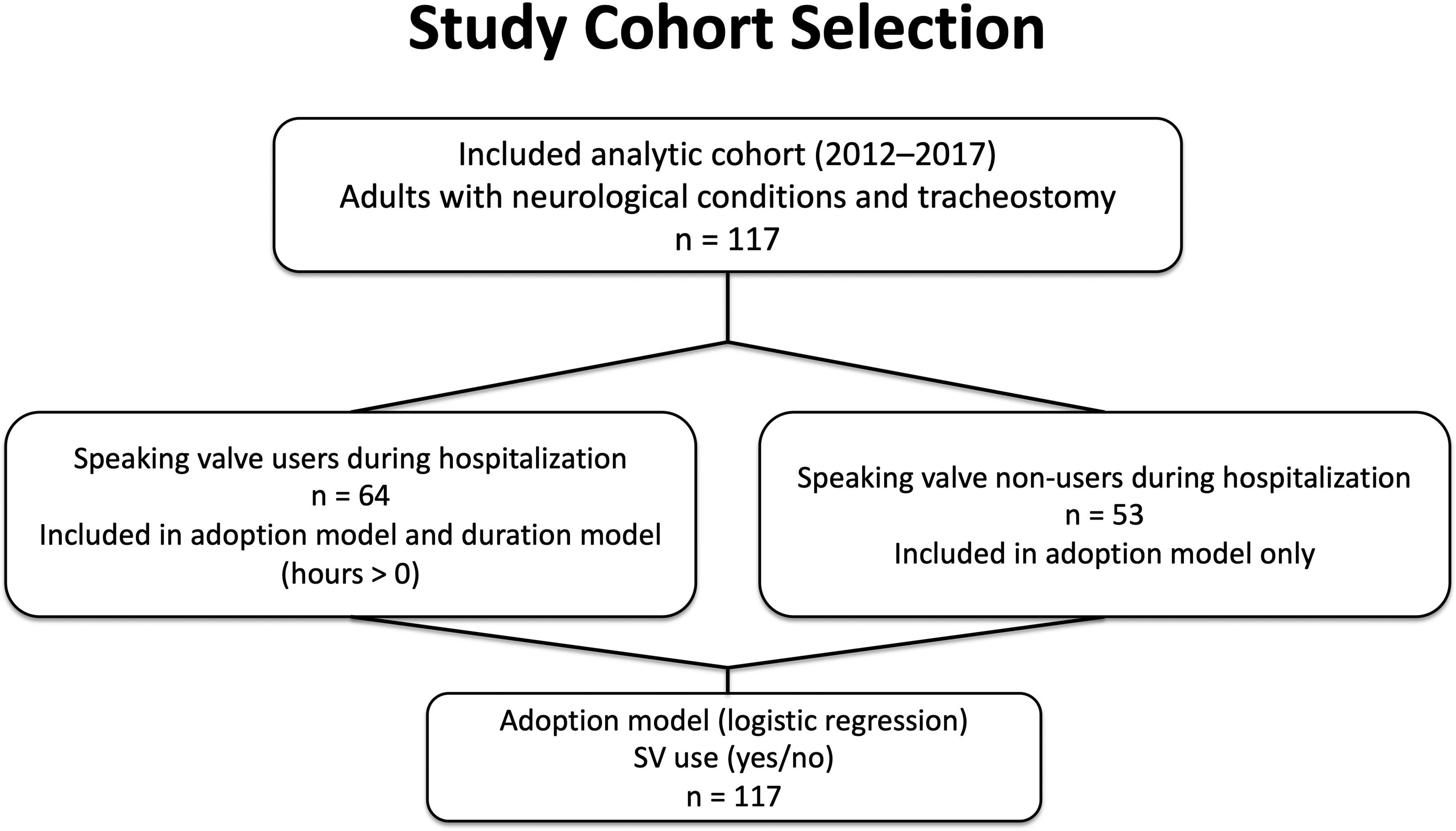
Study Cohort selection and analytic samples. Flow diagram of the included analytic cohort (2012–2017) and subgroup allocation for the speaking valve (SV) adoption model (Logistic regression; n = 117) and the sustained tolerance model (Duration among SV users only; n = 64).
The primary outcome variables were SV use during hospitalization (yes/no) and the target daytime SV duration (hours/day). SV duration was defined as the last clinically prescribed daily SV use, recorded in the fully de-identified dataset and reflecting real-world tolerance, in hours. Clinical and demographic predictors included level of consciousness, assessed using the Coma Recovery Scale-Revised and categorized into a vegetative state (VS), minimally conscious state (MCS), or emerged from MCS (eMCS), following the CRS-R criteria (Kalmar & Giacino, 2005) and neurological diagnosis, classified into two groups: SCI or NMD, and ABI. Given the heterogeneous case mix typical of neurological rehabilitation, diagnoses were grouped a priori into clinically coherent categories (SCI/NMD vs. ABI) to improve interpretability and model stability. Maximal expiratory pressure (MEP) and cuff leak pressure (in cmH2O) (Villarroel et al., 2012) were also included as respiratory variables. Swallowing status was evaluated using the Dysphagia Outcome Severity Scale (DOSS) (O’Neil et al., 1999) and the Blue Dye Test (BDT) (Belafsky et al., 2003), the latter indicating aspiration risk. Age and sex were considered as demographic variables. Secretion quantity was recorded as scant vs. moderate/abundant, and secretion management was categorized as effective spontaneous coughing versus the need for endotracheal suctioning. Maximal inspiratory pressure (MIP) and MEP were evaluated using a PCE-P05 (PCE Holding GmbH, Hamburg, Germany) digital manometer (Torres-Castro et al., 2019) and measured in centimeters of water (cmH2O). Additional variables considered were the number of comorbidities and the clinical indication for tracheostomy.
Statistical Analysis
Descriptive statistics were used to summarize the data: continuous variables were reported as means with standard deviations or medians with interquartile ranges, depending on their distribution. In contrast, categorical variables were presented as frequencies and percentages. Group comparisons (SV users vs. non-users) used Student's t-test or Mann–Whitney U test for continuous variables and chi-square or Fisher's exact test for categorical variables.
Variables entered in the multivariable models had complete data; therefore, primary analyses were performed as complete cases with no imputation required.
To stabilize estimates given sparse categories, we applied the following prespecified coding rules: level of consciousness (VS/MCS vs eMCS); neurological diagnosis (SCI/NMD vs ABI); dysphagia recoded as DOSS severe = 1–2, moderate = 3–5, mild = 6–7; secretion quantity (scant vs moderate/abundant); secretion management (effective spontaneous cough vs endotracheal suction); and BDT (positive vs negative). All recoding decisions were prespecified on clinical grounds (no data-driven binning or stepwise selection). Because patients frequently present with multiple diagnoses and comorbidities in neurorehabilitation, we conceptualized the models as predictive (risk stratification) rather than causal and interpreted estimates as adjusted associations.
Two multivariable models were developed. First, a logistic regression model was constructed to identify predictors of SV use (yes/no). Predictors were specified a priori based on clinical plausibility and bedside availability, and included neurological responsiveness (consciousness level), swallowing safety (DOSS and BDT), secretion burden/management, neurological diagnosis, and respiratory variables (MIP, MEP, cuff leak pressure). The model was intentionally kept parsimonious by prespecifying a core set of four clinically relevant bedside predictors; no stepwise or data-driven variable selection was applied.
Second, a generalized linear model (GLM) with a quasi-Poisson distribution and log link was applied to predict clinically prescribed daily SV duration (hours/day) among patients who used the SV. For the duration analysis, the model was fitted only among patients with any SV use (hours > 0), excluding non-users coded as zero hours to avoid zero inflation and to separate initiation (adoption) from sustained use (tolerance); age, MIP, and MEP were modeled as continuous covariates, with all other predictors entered in the categorical forms specified above. This approach was chosen to address two clinically distinct outcomes: SV adoption (use vs non-use) and tolerance conditional on adoption (prescribed daily hours among users).
The discriminatory performance of the logistic model was assessed using the area under the receiver operating characteristic curve (AUC), along with sensitivity, specificity, and classification accuracy. Both models underwent internal validation via bootstrap resampling (2,000 replications). Bootstrap internal validation was used to reduce optimism and to support the stability of model estimates. For the SV adoption model, we additionally obtained bootstrap resampling-based confidence intervals for odds ratios and quantified model optimism by reporting the optimism-corrected AUC.
Multivariable analyses used complete cases with no imputation; observations with missing data on any model variable were excluded from the corresponding model.
Descriptive and inferential statistics were conducted in software JASP (Version 0.18.3) and R version 4.4.2 (R Foundation for Statistical Computing, Vienna, Austria), with supplementary preprocessing and modeling support in Python (Python Software Foundation, Wilmington, DE, USA). A two-tailed p-value of < 0.05 was considered statistically significant.
Results
One hundred seventeen persons with a tracheostomy were included, of whom 64 (54.7%) used an SV during their hospital stay. SV users were significantly younger than non-users (median 47.5 vs. 53.0 years, p = 0.048). They showed higher MIP and MEP (p < 0.001 and p = 0.049, respectively). The likelihood of SV use varied significantly by level of consciousness and differential neurological diagnosis, with higher usage observed in patients with SCI or NMD and lower use in those with ABI. Regarding airway management, SV use was more frequent in those with scant secretions, no need for endotracheal suction, and a negative BDT (p < 0.001 for all). Notably, patients with severe dysphagia or positive BDT were less likely to use the SV (Table 1).
Demographic and Clinical Characteristics of Patients According to Speaking Valve Use.

Quantitative data are expressed as median (IQR), and categorical variables as frequencies (percentages). Chi-square or Mann–Whitney U tests were used, as appropriate. SV User refers to patients who used a speaking valve during hospitalization. SV, Speaking Valve;
TBI, Traumatic Brain Injury; NMD, Neuromuscular Disease; SCI, Spinal Cord Injury; eMCS, Emerged from Minimally Conscious State; MCS, Minimally Conscious State;
OSA, Obstructive Sleep Apnea; VS, Vegetative State; SAHS, Sleep Apnea-Hypopnea Syndrome; PMV, Prolonged Mechanical Ventilation; PET, Prolonged Endotracheal Tube; ABI, Acquired Brain Injury; ETS, Endotracheal Suction; DOSS, Dysphagia Outcome and Severity Scale; MIP, Maximal Inspiratory Pressure; MEP, Maximal Expiratory Pressure.
Factors Associated with Speaking Valve Use (Yes/No)
The final multivariable logistic regression model was specified with a prespecified set of candidate bedside predictors; however, to ensure parsimony and stability of estimates in this retrospective cohort, the final model comprised four predictors: level of consciousness, BDT result, secretion management strategy, and dysphagia severity (Table 2).
Multivariable Logistic Regression Model for Speaking Valve Use (Yes/No).
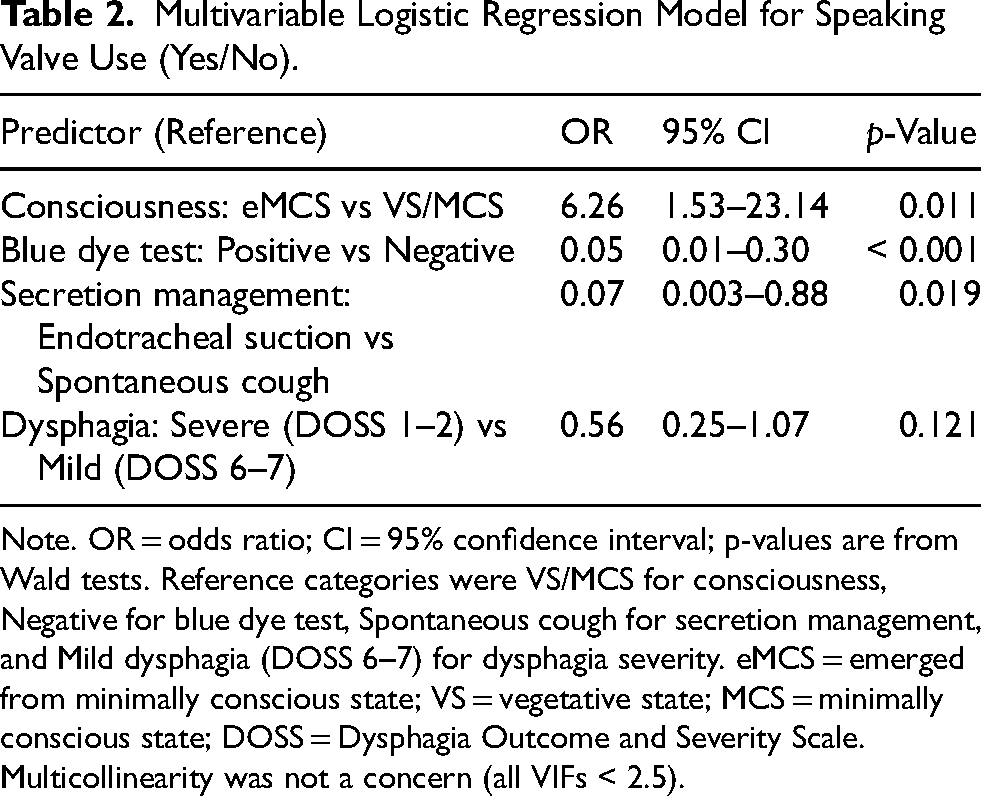
Note. OR = odds ratio; CI = 95% confidence interval; p-values are from Wald tests. Reference categories were VS/MCS for consciousness, Negative for blue dye test, Spontaneous cough for secretion management, and Mild dysphagia (DOSS 6–7) for dysphagia severity. eMCS = emerged from minimally conscious state; VS = vegetative state; MCS = minimally conscious state; DOSS = Dysphagia Outcome and Severity Scale. Multicollinearity was not a concern (all VIFs < 2.5).
The model demonstrated strong predictive performance (AUC = 0.856; McFadden's R2 = 0.366), with a classification accuracy of 79.5%, sensitivity of 68.8%, and specificity of 92.5%. Internal validation using 2,000 bootstrap replications confirmed the stability and reliability of the model coefficients. Bootstrap analyses showed negligible optimism in discrimination, supporting robust model performance after internal validation.
Compared to patients in VS/MCS, those in eMCS had higher odds of SV use (OR = 6.26, 95% CI 1.53–23.14), with a wide confidence interval. A positive BDT result, indicating aspiration risk, was strongly associated with a reduced likelihood of SV use (OR = 0.05, 95% CI: 0.01–0.30). Endotracheal suction (vs. effective spontaneous cough) was associated with markedly lower odds of SV use (OR = 0.07, 95% CI: 0.003–0.879). Dysphagia (severe [1–2] vs. mild [6–7]) showed a protective direction (OR = 0.56; 95% CI: 0.25–1.07), and bootstrap resampling-based confidence intervals remained compatible with the null; accordingly, we interpret it as a non-confirmed clinical signal rather than a definitive independent predictor.
All prespecified predictors were included in the model, and no evidence of multicollinearity was detected (all VIFs < 2.5). Standardized coefficients facilitated comparisons of effect magnitudes, with level of consciousness and BDT result emerging as the most influential predictors.
Age, sex, MIP/MEP, cuff leak pressure, and neurological diagnosis were examined as candidate covariates; however, the final parsimonious model focused on the four bedside predictors that provided the most stable and clinically interpretable discrimination in this cohort.
Factors Associated with Speaking Valve Use Duration (Quasi-Poisson Model)
A quasi-Poisson regression model was used among patients who utilized the SV to identify predictors of target daytime SV duration, accounting for overdispersion. Several variables were significantly associated with longer SV duration (Table 3). A negative binomial sensitivity analysis yielded concordant results, supporting the robustness of inference for duration predictors.
Predictors of Targeted Daytime Speaking Valve Use.
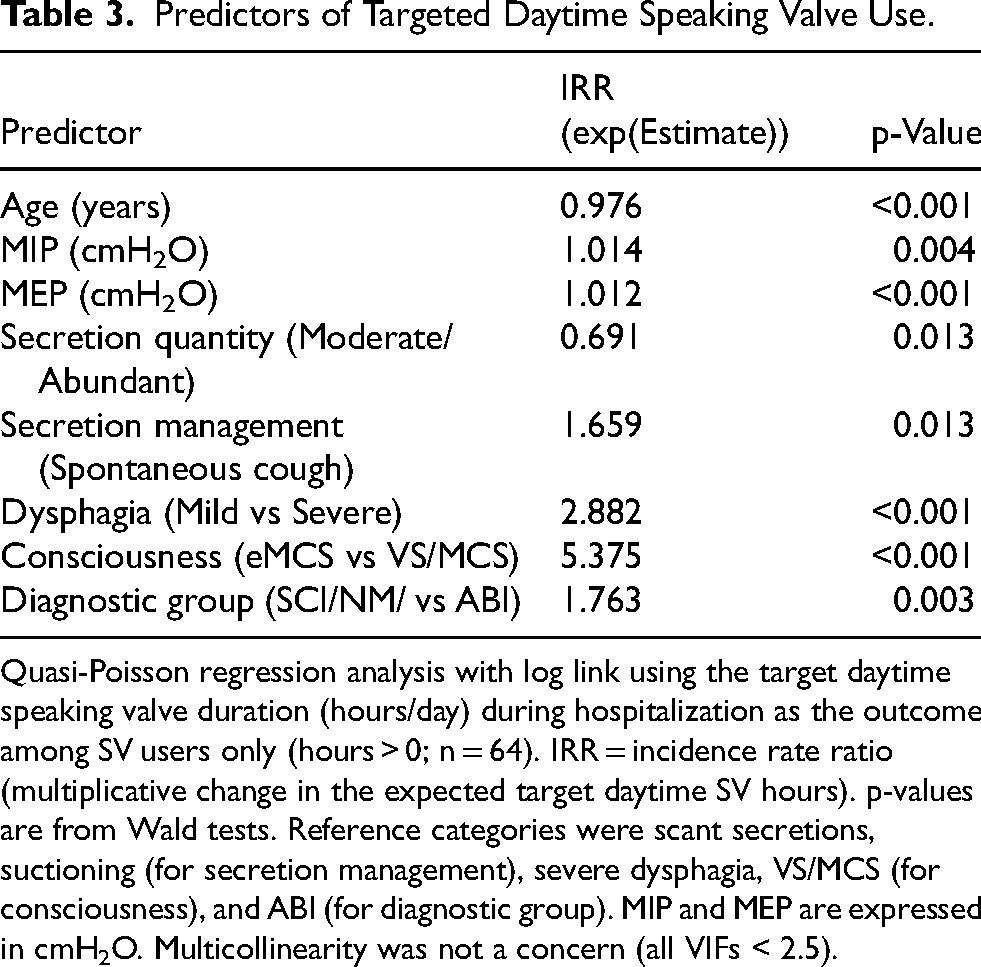
Quasi-Poisson regression analysis with log link using the target daytime speaking valve duration (hours/day) during hospitalization as the outcome among SV users only (hours > 0; n = 64). IRR = incidence rate ratio (multiplicative change in the expected target daytime SV hours). p-values are from Wald tests. Reference categories were scant secretions, suctioning (for secretion management), severe dysphagia, VS/MCS (for consciousness), and ABI (for diagnostic group). MIP and MEP are expressed in cmH2O. Multicollinearity was not a concern (all VIFs < 2.5).
Age was inversely associated with SV use duration (β = –0.025, IRR = 0.976, p < 0.001), suggesting that younger patients used the SV for more hours. Greater MIP (β = 0.014, IRR = 1.014, p = 0.004) and MEP (β = 0.012, IRR = 1.012, p < 0.001) were significantly associated with more extended SV use. Moderate-to-abundant secretions were associated with significantly fewer SV hours than scant secretions (β = –0.369, IRR = 0.691, p = 0.013). In contrast, spontaneous coughing, as an indicator of effective secretion management, was significantly associated with more extended SV use than suctioning (β = 0.506, IRR = 1.659, p = 0.013). Mild dysphagia (vs. severe) was significantly associated with increased SV use (β = 1.058, IRR = 2.882, p < 0.001). Patients in a higher consciousness level (eMCS vs. VS/MCS) used the valve significantly longer (β = 1.682, IRR = 5.375, p < 0.001), and those with NMD or SCI used it longer than patients with ABI (β = 0.567, IRR = 1.763, p = 0.003).
Variables such as sex, number of comorbidities, and BDT were considered but were excluded from the final model due to lack of statistical significance.
Discussion
This study identified multiple clinical and demographic factors associated with the use and duration of the SV in people with a tracheostomy with neurological conditions undergoing rehabilitation. Because this cohort reflects the heterogeneous case-mix and comorbidity burden typical of routine neurorehabilitation care, these findings should be interpreted as predictive associations useful for bedside stratification rather than causal determinants of SV outcomes. Given the single-center design and moderate sample size, the generalizability of the estimated associations is limited, and findings should be viewed as reflecting real-world practice in a comparable neurorehabilitation setting rather than broadly generalizable effects. Although the dataset was collected more than a decade ago, the main predictors identified here reflect bedside physiologic and functional domains (airway protection, secretion burden/clearance, swallowing safety, and neurological responsiveness) that continue to be central in contemporary tracheostomy-neurorehabilitation pathways (Calderone et al., 2025; Dziewas et al., 2025). Recent international surveys and systematic reviews have highlighted the heterogeneity of clinical practices in SV use and the need for standardized, evidence-based criteria to guide implementation (Duan et al., 2024; Gentile et al., 2024; Miles & Wallace, 2025).
Importantly, recent evidence suggests that system-level and team-based approaches can meaningfully improve access to SV trials and reduce time to speech-related milestones. Dedicated interprofessional tracheostomy teams have been associated with increased SV use and shorter time to speech and decannulation in inpatient settings, supporting the ongoing clinical relevance of identifying practical bedside predictors that facilitate SV adoption (Mah et al., 2017; Ninan et al., 2023).
Clinically, considering SV use as adoption and targeted daytime duration as sustained tolerance moves decision-making beyond a yes/no view. This framing is supported by evidence: accelerated SV placement led to substantially longer tolerated trials and more decannulations than standard timing, underscoring the clinical salience of tolerance duration as an endpoint (Martin et al., 2021; Otto-Yáñez et al., 2025; O’Connor et al., 2021). Accordingly, multivariable models can be used to estimate the probability of adoption and the expected duration of use for a given clinical profile to inform planning and counseling; however, such models are predictive, not causal, and should be interpreted under TRIPOD guidance (Moons et al., 2015).
In line with current neurorehabilitation frameworks, our findings can be interpreted as clinically pragmatic “readiness signals” rather than definitive mechanistic determinants. Contemporary diagnostic and therapeutic approaches emphasize airway protection, secretion load, and cough effectiveness as prerequisites for progressing toward upper-airway restoration and weaning steps (Dziewas et al., 2025). In this context, our findings support that SV adoption and sustained tolerance are primarily conditioned by bedside indicators reflecting these same domains—namely, neurological responsiveness, secretion management strategy, and swallowing safety (Dziewas et al., 2025).
The most robust predictors of SV use were level of consciousness, dysphagia severity, secretion management strategy, and BDT result. Compared to patients in a vegetative or MCS, those in a higher level of consciousness (eMCS) had over six-fold increased odds of valve use (OR = 6.26, 95% CI: 1.53–23.14), which is consistent with the clinical expectation that volitional responsiveness facilitates phonation and airway protection; however, this association does not establish necessity or causality (Eichar et al., 2024; Freeman-Sanderson et al., 2016). Wide confidence intervals may reflect sparse data within consciousness strata and small-sample bias in logistic regression, leading to imprecise estimates and odds ratios biased toward more extreme values (Van Smeden et al., 2016).
Restoring expiratory airflow through the upper airway with a SV re-establishes subglottic pressure and upper-airway airflow patterns that are relevant for phonation and may support swallowing–breathing coordination and secretion clearance; however, mechanistic pathways and neuroplastic effects remain speculative and require dedicated physiological studies (Rose & Messer, 2024). Additionally, the BDT indicating aspiration risk was a strong negative predictor of initial SV use, aligning with previous reports that high secretion burden and aspiration risk reduce SV tolerance (Wang et al., 2024). However, aspiration risk did not significantly affect duration once the SV was initiated, suggesting it acts primarily as a barrier to initial adoption rather than ongoing tolerance. For adoption (use vs. non-use), “clinical gatekeepers” such as higher neurological status, an effective cough, effective swallowing, and manageable secretions primarily function as safety prerequisites that enable a cautious trial rather than proving mechanistic necessity for initiation; in acquired brain injury cohorts, higher neurological status together with effective cough/swallowing consistently predicts favorable airway-related outcomes (e.g., decannulation), reinforcing their role as functional safeguards rather than causal drivers of adoption (Gallice et al., 2024).
In parallel, bedside aspiration screening with a BDT approach can inform risk stratification but demonstrates wide sensitivity (38–95%) with generally high specificity (79–100%); therefore, a negative test should not be interpreted as proof of safety, and BDT is best used cautiously within a broader assessment pathway (Béchet et al., 2016). Finally, scoping evidence also highlights cough strength and secretion control as key predictors supporting their use as gatekeeping criteria for attempting SV use under monitored conditions (Calderone et al., 2025). In our cohort, although SV users exhibited higher MIP/MEP in unadjusted comparisons, these measures did not independently predict initial adoption; instead, they were consistently associated with longer duration of use among those who employed the SV. This pattern aligns with the literature, in which tolerance is operationalized as accumulated minutes/hours, and strategies that facilitate the trial increase minutes tolerated without safety events (median 65 vs. 15 min after three sessions), reinforcing that “duration” is a functional outcome distinct from adoption/initiation (Martin et al., 2021).
Physiologically, the valve restores expiratory airflow through the upper airway and subglottic pressures, optimizes swallowing biomechanics, and may reduce the risk of aspiration—mechanisms that plausibly depend on respiratory strength and coordination to sustain prolonged use rather than to determine its initiation (O’Connor et al., 2021).
Respiratory muscle strength primarily influenced sustained tolerance. In the duration model, MIP and MEP remained independent predictors of longer valve use, supporting their functional relevance in maintaining airway patency and facilitating effective phonation. Hess (2005) highlights the necessity of sufficient subglottic pressure for successful speech production in people with a tracheostomy, indirectly supporting the clinical relevance of respiratory muscle strength in this context (Hess, 2005). These findings align with previous evidence from decannulation research. Diaz-Ballve et al. (2019) demonstrated that MEP and consciousness level were central determinants for safe decannulation across care complexity levels. Although decannulation and SV use differ in clinical intent, both rely on preserved respiratory strength and cognitive function, reinforcing the translational relevance of these variables (Diaz-Ballve et al., 2019).
The quantity and management of secretions significantly influenced the duration of SV use. Patients with moderate-to-abundant secretions used the SV for considerably fewer hours than those with scant secretions, and spontaneous coughing was associated with longer duration, highlighting the importance of autonomous secretion clearance (Brooks et al., 2020; Wang et al., 2024).
Dysphagia severity was also associated with duration, with mild dysphagia (vs. severe) significantly related to more extended SV use. The clinical relevance of swallowing function in SV tolerance is supported by Freeman-Sanderson et al. (2016). Additionally, higher levels of consciousness (eMCS vs. VS/MCS) were significantly associated with prolonged SV (Freeman-Sanderson et al., 2016). Neurological diagnosis also influenced duration, with patients with NMD or SCI showing greater SV tolerance compared to those with ABI, as reported by Wang et al. (2024), who also emphasize the impact of dysphagia severity and secretion burden on SV use (Wang et al., 2024).
Together, these findings describe a multifactorial clinical profile associated with prolonged SV tolerance (Martin et al., 2021) and emphasize the role of airway protection (Lian et al., 2022), respiratory capacity (Ge et al., 2024), and neurological status in determining suitability (Gallice et al., 2024). Model diagnostics supported adequate performance, and the quasi-Poisson specification was used to account for overdispersion in SV duration among users. Multicollinearity was not a concern in either model (all variance inflation factors < 5), supporting model stability. Future studies may consider using a negative binomial model in broader cohorts.
Age was inversely associated with SV use duration, plausibly reflecting the age-related decline in inspiratory and expiratory muscle strength (lower MIP/MEP) that limits the physiological reserve required for prolonged phonatory effort (Lista-Paz et al., 2023). In the duration model, BDT was not independently associated with SV use duration after multivariable adjustment, whereas spontaneous cough remained associated with longer duration. This differentiation may be clinically useful: aspiration screening appears more relevant for initial “go/no-go” decisions, while sustained tolerance seems to depend more on modifiable performance domains such as cough effectiveness, secretion management, and respiratory muscle capacity—targets that can be addressed through structured rehabilitation strategies (Calderone et al., 2025; Dai et al., 2024; Dziewas et al., 2025; Ge et al., 2024; Muñoz-Garach et al., 2023).
Variables such as sex and number of comorbidities were evaluated but excluded from the final duration model due to lack of statistical significance; BDT did not remain after adjustment, whereas effective spontaneous cough did, in line with evidence that cough effectiveness and secretion management are key airway-protection mechanisms in decannulation pathways (Gallice et al., 2024; Ge et al., 2024).
The final logistic model comprised four predictors—level of consciousness, BDT result, secretion management, and dysphagia—and showed good discrimination after internal validation. Rather than focusing solely on statistical significance, our approach emphasized interpretability, predictive value, and clinical applicability (Collins et al., 2015; Steyerberg et al., 2010). Regrouping consciousness levels and applying internal validation ensured model robustness without compromising clinical relevance. These findings support the development of targeted strategies to identify candidates most likely to benefit from SV use, in line with contemporary recommendations for predictive modeling (Moons et al., 2015; Steyerberg et al., 2010).
This model integrates clinically accessible and physiologically relevant predictors to identify patients most likely to benefit from early and sustained SV use. Variables such as mild dysphagia, increased respiratory muscle strength, and effective secretion management are potentially modifiable through targeted rehabilitation, highlighting their importance as therapeutic targets to improve SV tolerance and optimize communication outcomes. Objective assessment methods, such as the cuff leak pressure assessment (Villarroel et al., 2012), correlate expiratory pressures with SV tolerance (Johnson et al., 2009) and strategies that enhance subglottic pressure generation (Hess, 2005). Early SV use has also been associated with improved mobility and physical performance, possibly due to enhanced respiratory-swallow coordination (Ceron et al., 2020).
Furthermore, despite the growing literature on tracheostomy outcomes, recent syntheses highlight substantial heterogeneity in candidate predictors (including cough effectiveness, secretion management, and ventilatory factors) and emphasize that a fully integrated and standardized framework remains a challenge in clinical practice. In this context, our real-world findings provide pragmatic insights into clinically observable variables associated with SV use in neurological rehabilitation settings (Calderone et al., 2025).
Despite its strengths, this study has several limitations. First, it was conducted at a single center, potentially limiting generalizability due to specific institutional protocols and patient characteristics. Second, the retrospective design means clinical decisions on SV use were independent of the study framework, reflecting real-world practice rather than standardized protocols. However, this design captures routine clinical decision-making in heterogeneous subacute/chronic neurorehabilitation populations, where practice variability is expected (Dziewas et al., 2025). Third, some predictors—such as secretion quantity and tracheostomy indication—relied on clinical judgment, potentially introducing interrater variability.
Additionally, the de-identified dataset included limited demographic information (age and sex only) and did not provide anthropometric measures (e.g., weight, height, BMI), which may have restricted further adjustment for patient characteristics. Detailed functional outcomes (e.g., NIHSS, FIM, language scales) were not available, which may have refined prediction and captured broader functional benefits associated with SV use (Ceron et al., 2020). The absence of longitudinal follow-up restricts understanding of long-term effects on communication, decannulation, and quality of life. While standardized tools (DOSS, BDT) were employed, aspects such as cough effectiveness lack universally accepted criteria, thereby affecting reproducibility. Objective assessment methods, such as manometry-guided pathways proposed by Johnson et al. (2009), may help reduce variability (Johnson et al., 2009). As with all retrospective single-center studies, residual confounding cannot be entirely excluded despite multivariable adjustment, and the observed associations should not be interpreted as causal effects. To mitigate model optimism and improve robustness, we applied prespecified clinical regrouping and bootstrap internal validation; nevertheless, external validation in diverse settings remains necessary before clinical use as a decision-support tool (Moons et al., 2015). Finally, although care pathways have evolved, contemporary neurorehabilitation frameworks and multidisciplinary tracheostomy models continue to prioritize the same bedside readiness constructs evaluated here (neurological status, secretion burden, cough effectiveness, and swallowing safety), supporting the current interpretability of our predictors as enduring decision domains (Dziewas et al., 2025; Ninan et al., 2023).
Future research should aim to externally validate these findings in larger multicenter cohorts and explore the potential for predictive clinical scoring tools. Prospective trials could assess whether targeted prehabilitation—focused on improving respiratory strength, secretion management, and swallowing—enhances SV tolerance and accelerates communication recovery in neurologically impaired patients.
Conclusion
In this single-center retrospective cohort of tracheostomized patients with neurological conditions undergoing rehabilitation, SV adoption and sustained tolerance (hours/day) were associated with readily available bedside indicators of neurological responsiveness, swallowing safety, secretion burden/clearance strategy, and respiratory muscle strength. Higher consciousness level, aspiration screening results, secretion management needs, and dysphagia severity were independently associated with SV use, whereas longer sustained tolerance among users was mainly related to respiratory muscle strength, cough effectiveness, secretion burden, and age. These findings should be interpreted as predictive associations rather than causal effects and may support individualized planning and early identification of candidates for supervised SV trials in comparable neurological rehabilitation settings. Given the single-center design and moderate sample size, these findings should not be considered broadly generalizable. External validation in contemporary multicenter cohorts is required before clinical implementation as a decision tool.
Footnotes
ORCID iDs

Ethical Considerations
Ethical approval was obtained from the Bioethics Committee of the Eastern Metropolitan Health Service, Santiago, Chile (approval number: 06-09-2017. This study involved the analysis of anonymized clinical records collected as part of standard clinical care.
Consent to Participate
Not applicable. This study used retrospective anonymized data collected as part of standard clinical care.
Consent for Publication
Not applicable. This study does not include personally identifying data, images, or videos.
Funding
The authors received no financial support for the research, authorship, and/or publication of this article.
Declaration of Conflicting Interests
The authors declared no potential conflicts of interest with respect to the research, authorship, and/or publication of this article.
Data Availability Statement
Data supporting the findings of this study are available from the corresponding author upon reasonable request.