




Abstract
Previous research has demonstrated that informant disagreement is common with the use of rating scales to assess problem behavior in school-age populations. However, much less is known about this phenomenon in preschool populations. This is important because the accurate assessment of problem behavior in preschool is complex due to the rapid developmental shifts during this period. As such, the purpose of this study was to assess the prevalence of students at risk of behavior problems and to see whether these problems varied as a function of informant and ecological characteristics. Using the Behavior Assessment System for Children–Second Edition, we analyzed parent and teacher ratings for 320 preschool children. Results indicated that parent and teacher ratings were very similar, with males being rated as more at risk of having attention problems and social skill deficits in comparison with females. No differences were noted in at-risk status by ethnic group membership. Conversely, significant and consistent parent and teacher ratings were noted by socioeconomic status (e.g., parent education level). Implications are discussed for the prevention of problem behavior in preschool.
School professionals are faced with the task of assessing and providing interventions for children with emotional and behavioral disorders effectively. However, the assessment of problem behaviors in preschool children is challenging because of the difficulty in defining what constitutes a significant problem. Although the diagnostic criteria and classification methodologies for behavioral disorders are clearly defined by federal laws (Individuals with Disabilities Education Improvement Act [IDEIA]) and professional consensus (American Psychiatric Association [APA], 2000), there are several issues that make the diagnosis of problem behavior difficult in this age group. In particular, during the prekindergarten years, child development is characterized by rapid shifts, and it is often difficult to differentiate between age-appropriate behaviors and those that are not. In addition, the potential to overdiagnose extreme behaviors as abnormal in preschool children has been of great concern because the diagnostic criteria that delineate atypical behavior from normal development are not as well defined in this population in comparison with older children (Wakschlag, Tolan, & Leventhal, 2010).
As a result of the aforementioned difficulties, best practices in behavioral assessment dictate that school professionals should gather information from multiple perspectives (Kerr, Lunkenheimer, & Olson, 2007). Consequently, one of the most common methods for identifying behavior problems in preschool children has been the use of teacher- and parent-reports. To gather these perspectives, school-based professionals generally use standardized checklists such as the Behavior Assessment System for Children (BASC-2; Reynolds & Kamphaus, 2004) that have defined criteria for identifying children at risk of problem behavior. Although it is consistent with best practices to use multiple informants to assess problems across multiple contexts, cross-informant agreements are generally low. In their highly influential meta-analysis of cross-informant agreement on behavior problems among 6- to 11-year-old children, Achenbach, McConaughy, and Howell (1987) found that the average correlation between parent and teacher reports ranged from .27 to .60.
Discrepancies between informants’ reports of children’s behavior are robustly observed in clinical child research and have important implications for interpreting the outcomes of controlled treatment trials. In particular, Biederman, Faraone, Milberger, and Doyle (1993) found that agreement between teachers and parents on items reflecting attention-deficit hyperactivity disorder (ADHD) symptoms, measured by questions derived from the Diagnostic Interview for Children and Adolescents was r = 22. Mitsis, McKay, Schulz, Newcorn, and Halperin (2000) investigated parent and teacher agreement on Diagnostic and Statistical Manual of Mental Disorders (4th ed., DSM-IV; APA, 1994) ADHD criteria in a clinically referred sample. Dimensionally, they found correlations of r = .30 for inattention, r = .39 for hyperactivity/impulsivity, and r = . 42 for the combined type. Categorically, they found informant agreement of k = 20. Agreement regarding subtypes was even lower. Antrop, Roeyers, Oosterlaan, and Van Oost (2002) examined agreement between parents and teachers on ADHD symptoms. They found low agreement rates on symptoms of inattention and hyperactivity (r = .13 and .09, respectively). The observed low levels of agreement between parent and teacher ratings of ADHD symptoms may be attributed to different perceptions of the problem behavior by parents and teachers, medication effects, or the situation specificity of children’s behavior.
Examining parent and teacher ratings of aggression, rule breaking, inattention, and hyperactivity, in a population-based study of Dutch children, Rettew et al. (2011) found that setting-specific, particularly home-specific, problems were frequent. In this instance, children were assigned to groups according to the presence of clinically relevant problems at home only, at school only, or in both settings. Results indicated that compared with the school-specific group, the home-specific group contained a significantly higher percentage of females who were rated high in inattention/hyperactivity and a significantly lower percentage of girls with regard to rule breaking. Wolraich and colleagues (2005) examined the impact of interrater reliability on the diagnosis of ADHD. They found that poor interrater agreement decreased diagnostic rates for all three types of ADHD in this clinical sample: inattentive (15%-5%), hyperactive/impulsive (11%-3%), and combined (23%-7%). Parent and teacher agreement was low concerning ADHD symptoms and performance. Voelker, Shore, Hakim-Larson, and Bruner (1997) analyzed parent and teacher ratings of adaptive skills of children with multiple disabilities in a rehabilitation day treatment setting. Correlational analyses indicated a robust relation between Vineland forms; however, mean score comparisons indicated that teachers systematically rated the children as more skilled in both the global and the specific domains of adaptive behavior than did caretakers. This provides evidence that externalizing problems may be setting specific.
In this vein, researchers have attempted to determine whether differences in informant reports are a result of informants observing children’s behavior in different settings. Conducting a laboratory observation, De Los Reyes, Henry, Tolan, and Wakschlag (2009) found that parent–teacher discrepancies in reports of preschoolers’ disruptive behavior predicted laboratory observations of the interactions in which these same preschoolers exhibited disruptive behavior. Specifically, (a) parent-reports (and not teacher-reports) predicted observed disruptive behavior within parent–child interactions, (b) teacher-reports (and not parent-reports) predicted observed disruptive behavior within interactions between the child and a nonparental adult (clinical examiner), and (c) when combined, parent and teacher reports predicted disruptive behavior that was observed across adult–child interactions.
These low correlations pose difficulties because intervention specialists rely heavily on parent and teacher assessments during this developmental period to identify children at risk of behavior problems and in need of early intervention (McDonnell, Brownell, & Wolery, 2001; Qi & Kaiser, 2003). Coupled with the lack of consensus regarding what constitutes behavior problems in preschool, more research is necessary to understand the prevalence of behavior problems in this age group.
Influences on Rater Effects
Differences in informant ratings of behavior problems are affected by several issues. In particular, discrepancies may reflect actual observed differences in behavior (e.g., disruptive behaviors exhibited at home but not school) or divergence in raters’ worldviews and tolerance for specific behaviors (Lambert et al., 1999; Lambert, Puig, Lyubansky, Rowan, & Winfrey, 2001; Puig et al., 1999). Throughout the research literature on informant discrepancies, two demographic constructs have been consistently shown to be related to cross-informant disagreements: gender and socioeconomic status (SES).
Gender
Gender differences in the manifestation of behavior problems are well documented (Dixon, 2002). Males typically demonstrate more externalizing behaviors (e.g., conduct disorders), whereas females demonstrate more internalizing behaviors (e.g., depression). However, research that has examined this phenomenon in preschool has produced conflicting results. Some research has documented that the origins and developmental processes of behavior problems are similar for males and females (Dixon, 2002), whereas others have documented males as demonstrating more externalizing issues than females (Broidy et al., 2003), with other researchers finding that females exhibit more externalizing problem behavior according to teachers (Soles, Bloom, Heath, & Karagiannakis, 2008).
SES
There is substantial evidence that children from low socioeconomic backgrounds are rated by teachers as demonstrating more problematic behavior than their more affluent peers (Thomas-Presswood & Presswood, 2008). However, the magnitude of the relationship between SES and behavior problems is inconsistent (Bradley & Corwyn, 2002). In particular, several studies that have examined cross-rater agreement have not found a distinction in behavior problems between high and lower socioeconomic groups (Skiba, Poloni-Staudinger, Simmons, Feggins-Azziz, & Chung, 2005). Consequently, there is a strong possibility that the relationship between SES and the perceptions of children’s problematic behaviors can be explained by informant characteristics (De Los Reyes & Kazdin, 2005).
One method to assess for SES is via parental education level. Parental educational level is an important predictor of children’s educational and behavioral outcomes (Davis-Kean, 2005; Dubow, Boxer, & Huesmann, 2009). It is known that education is an indicator of SES. Different studies have shown high to moderate correlations between education and occupation-based SES. In particular, more education equates with higher earnings, and the payoff is most notable at the highest educational levels. This is illustrated by the fact that, over the course of a lifetime, high school graduates can expect, on average, to earn US$1.2 million; those with a bachelor’s degree, US$2.1 million; and people with a master’s degree, US$2.5 million. Persons with doctoral degrees earn an average of US$3.4 million during their working life, whereas those with professional degrees do best at US$4.4 million (College Board, 2005; Day & Newburger, 2002).
Need for the Present Study
Informant discrepancies can have a significant impact on the assessment, classification, and treatment of behavior problems in children. This is especially salient in preschool children because of the difficulty in distinguishing between behavior that is considered normative and behavior that warrants a clinical diagnosis. As such, the purpose of this study was to examine the relationship between parent and teacher reports of behavior problems using a national sample of preschool children. Specifically, we sought answers to the following questions:
What is the predominance of problems behavior for children at risk of displaying behavior problem in preschool?
Does the risk for exhibiting behavior problems differ significantly by gender and parent education?
Does the probability of problem behaviors differ based on teacher- and parent-reports?
Method
Data Source
Participants were drawn from the BASC-2 (Reynolds & Kamphaus, 2004) standardization sample. The BASC-2 is one of the most commonly used rating scales by school psychologists to assess aspects of behavior and personality (Merrell, 2008). This standardized multidimensional rating system uses child self-reports, teacher ratings, and parent ratings for the development of summary judgments regarding a child’s behavior. It was developed to assist in differential diagnosis for a range of disorders included in Diagnostic and Statistical Manual of Mental Disorders (4th ed., text rev.; DSM-IV-TR; APA, 2000), as well as for treatment planning. Although the BASC-2 includes rating scales that can be completed by children, teachers, and parents, only the teacher and parent reports were used in the present study because a child self-report version of the BASC-2 is not available for preschool-age children. In addition, although the BASC-2 contains a normative and clinical sample, the researchers used the normative sample for this particular study. The normative sample was chosen because the preschool sample of the BASC-2 does not contain a clinical sample that differentiates between clinical conditions or disability categories.
The BASC-2 Teacher Rating Scale (TRS) and Parent Report Scale (PRS) use clinical and adaptive scales to assess a wide range of distinctive dimensions of personality and behavior. These scales consist of 160 items that provide information on the student’s problem and adaptive behavior at home and in the community. These dimensions were designed to help in the diagnostic decision-making process of disorders denoted in the DSM-IV-TR, as well as school-based categories denoted by the IDEIA. The PRS and TRS items are used to form numerous subscales, broad domain composites, clinical scales, and adaptive scales (for review, see Reynolds & Kamphaus, 2004).
Measures
Preschool problem behavior
Select scales from the BASC-2, PRS and TRS (Reynolds & Kamphaus, 2004), were used to assess problem behaviors in young children. On the preschool (ages 2-5 years) version of the PRS and TRS, each item is rated on a 4-point frequency scale (0 = never, 1 = sometimes, 2 = often, and 3 = almost always). These scales are reported in T-scores, with a mean of 50 and a standard deviation of 10. For the clinical scales, on which elevated scores represent more problematic behaviors, T-scores between 60 and 69 are considered at risk and scores greater than 70 are considered clinically significant. For the adaptive scales, lower scores represent deficits, with T-scores between 31 and 40 falling in the at-risk range and scores less than 30 considered clinically significant.
For this study, the following clinical and adaptive scales were included: (a) Aggression—the tendency to act in a hostile manner (either verbal or physical) that is threatening to others; (b) Hyperactivity—the tendency to be overly active, rush through work or activities, and to act without thinking; (c) Social Skills—the interpersonal aspects of social adaptation such as complimenting others, offering assistance, and the skills necessary for integrating successfully with peers and adults in home, school, and community settings; (d) Attention—the tendency to be easily distracted and unable to concentrate more than momentarily; and (e) Adaptability—the ability to adjust to changes in routine and teacher assignment, to share toys/possessions with other children, to shift from one task to another, and to adapt readily to changes in the environment.
These scales provide information on the extent to which parents and teachers perceive children as exhibiting overactivity; physical aggression; difficulty with maintaining focus and attention; difficulty adapting to changes in routine and new situations; and interpersonal difficulties. For the BASC-2 TRS preschool version, the individual scales had a median alpha coefficient of .84. For the PRS, the median alpha coefficients of the individual subscales ranged from .80 to .83. See Reynolds and Kamphaus (2004) for further psychometric information.
To identify preschool children who exhibited problematic behaviors at home or school, a cutoff score for “at-risk” behavior problems for each scale was created consistent with interpretative guidelines in the BASC-2 manual (e.g., “at-risk” problems that require intervention or warrant a clinical diagnosis; Reynolds & Kamphaus, 2004). Children were identified as exhibiting at-risk behavior problems if they earned a T-score greater than or equal to 60 on any clinical scale or a T-score less than or equal to 40 on any adaptive scale based on parent or teacher ratings (dummy coded 1). Students who earned a T-score of 59 or less on any clinical scale or greater than 41 on an adaptive scale were identified as being within normal limits (WNL; dummy coded as 0) for that particular scale.
Participants
The participants for this study were drawn from the national standardization sample of the BASC-2. The sample consisted of 320 preschool children, ages 2 to 5 years (M = 3.68), their parents (n = 320), and their teachers (n = 320) from various regions of the United States. Of the participating children, 46% were female. In regard to racial background 58.4% (n = 187) of the sample was European American, 15.3% African American (n = 49), 20% Hispanic (n = 64), and 6.3% were described as Other (n = 20). The racial/ethnic backgrounds of participating parents and teachers were unavailable. Information on the educational background of participating parents indicated that 14% of parents who participated in the study had less than a high school education, 33% of parents had a high school education or General Equivalency Diploma (GED), 36% had attended college or technical school but did not graduate, and 17% had completed 4 or more years of postsecondary education (i.e., college/technical school). Sample size and demographic information are presented in Table 1.
Sample Size (N = 320) and Demographic Information
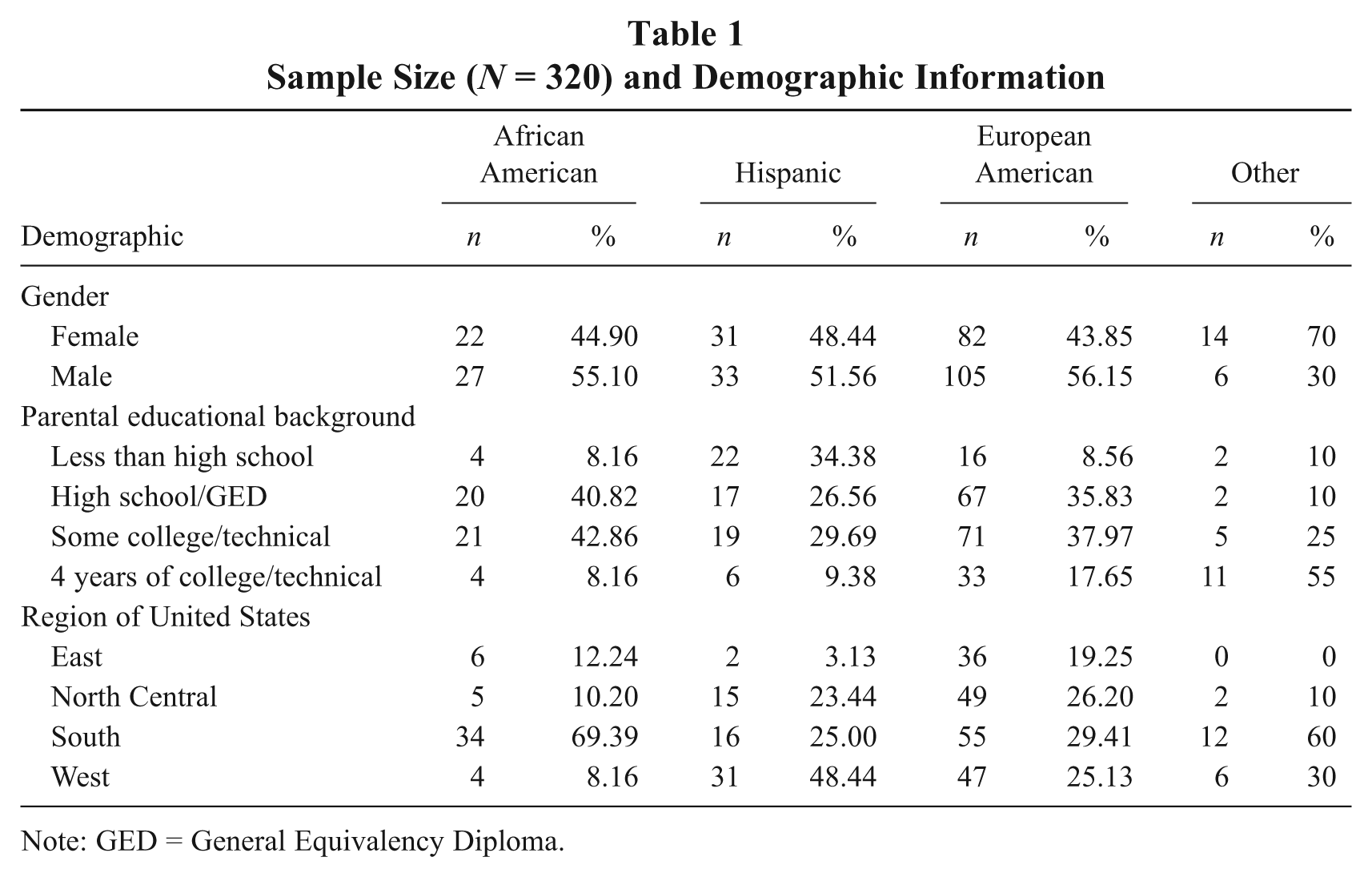
Note: GED = General Equivalency Diploma.
Results
Prominence of Preschool Problem Behaviors
As shown in Table 2, the two most common behavior problems for preschool children identified by both parents and teachers were attention problems and social skill deficits, and the least common behavior problem identified by teachers was hyperactivity. In regard to prevalence, two consistent themes emerged. The first theme was that males were rated by parents and teachers to be more at risk of problem behavior in each of the categories. The only exception was for hyperactivity, in which parents rated males and females the same (6.67%). Furthermore, it was also demonstrated that, based on parental education background, parents and teachers both rated children as demonstrating more problem behavior when the parent education level was high school/GED and some college/technical. The exception to this was for social skills, in which parents with less than a high school education rated their children as having less social skills than the aforementioned groups. Conversely, parents and teachers both indicated that children of parents with less than a high school education and those with parents with 4 years of college/technical education were rated lower in perceived problem behavior.
Prevalence of At-Risk Problem Behavior
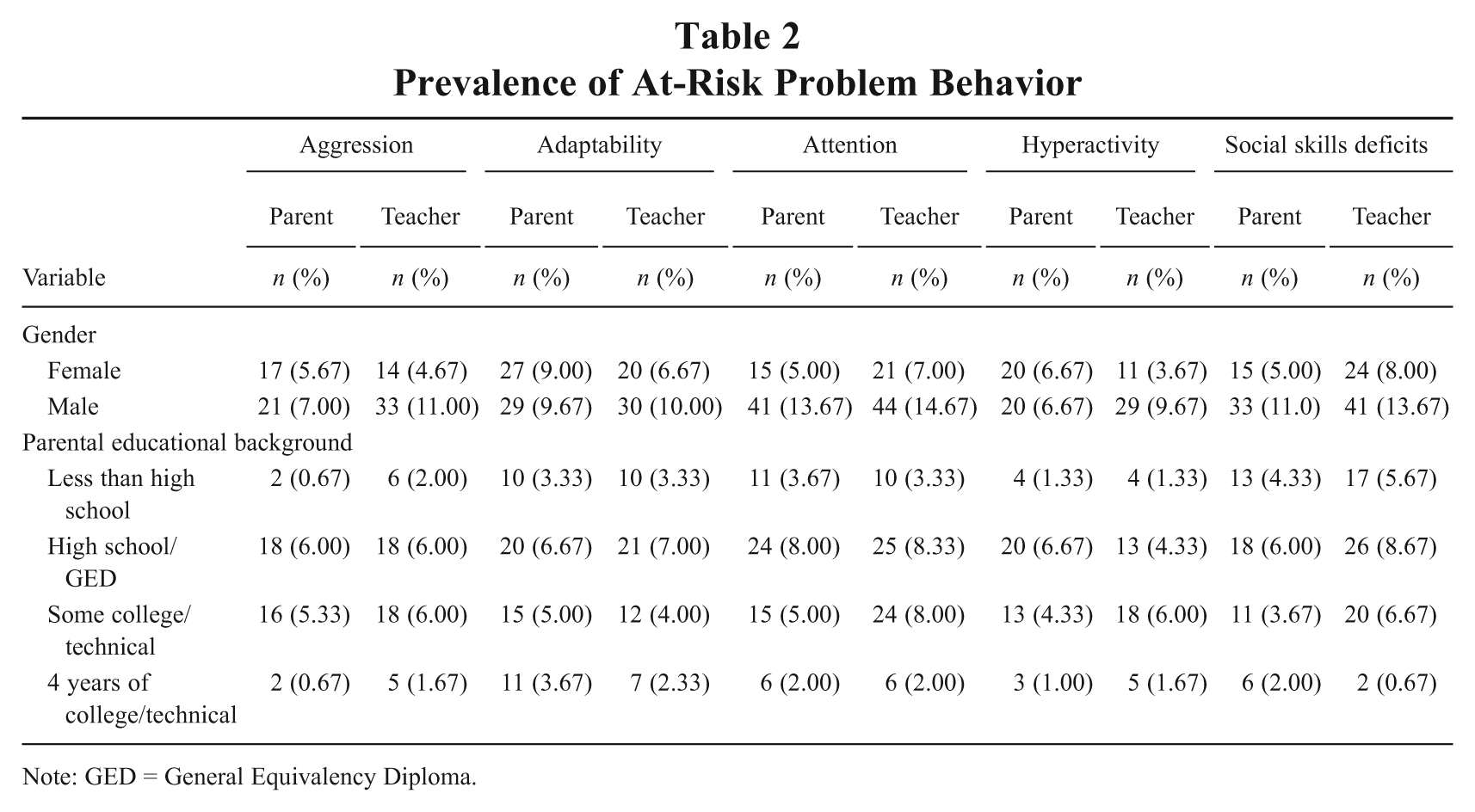
Note: GED = General Equivalency Diploma.
From a categorical perspective, both parents (13.67%) and teachers (14.67%) rated attention problems as the most frequent issue for males. In regard to females, teachers indicated that social skills (8.0%) was the most frequent problem behavior, whereas parents indicated that adaptability (9.0%) was the most common problem issue demonstrated by preschool females.
Does Prevalence Differ Significantly by Gender and Parent Education?
Chi-square analyses were conducted to examine whether the prevalence of children’s risk for exhibiting behavior problems differed by gender and parent educational level.
Parent ratings
Gender differences and differences with respect to parent education level were found for some but not all behavior problems. Parents were more likely to perceive boys as being at risk of attention problems in comparison with girls, χ2(1) = 9.22, p = .002. Parents with differing educational levels rated their children’s risk for exhibiting aggression, χ2(3) = 7.58, p = .055, and deficits in social skills, χ2(3) = 17.64, p = .001, differently. An examination of standardized cell residuals suggests that parents with a high school education/GED were more likely to perceive their children as exhibiting at-risk levels of aggression and social skills than all other groups of parents. Gender differences and differences related to parental educational background with respect to children’s risk for exhibiting symptoms of hyperactivity and adaptability were not found.
Teacher ratings
Similar to parent ratings, a significant chi-square was found for parent education level and children’s social skills, indicating that teachers were more likely to perceive children whose parents had less than a high school education as demonstrating greater risk for exhibiting social skills deficits, χ2(3) = 7.58, p = .055, than the children of more educated parents. Significant chi-squares for gender and aggression, χ2(1) = 5.21, p = .022, gender and attention, χ2(1) = 5.40, p = .020, and gender and hyperactivity, χ2(1) = 5.71, p = .017, were also found, indicating that teachers were more likely to perceive boys as exhibiting risk for aggression, hyperactivity, and attention problems than girls.
What is the Probability of Problem Behaviors Based on Gender and Parent Education?
In addition to assessing the predominance of preschool problem behaviors, we were also interested in examining whether sociodemographic variables and rater effects predicted children’s risk for exhibiting behavior problems. Ordinary least squares (OLS) logistic regression is often used when researchers are interested in predicting binary outcomes (e.g., risk vs. no risk). The OLS logistic regression assumes that all observations are independent; however, as both parents and teachers rated each child’s risk for exhibiting behavior problems, our data do not meet this assumption. Therefore, we used generalized linear mixed model (GLMM) to account for the dependency in our data (Agresti & Finlay, 2009; Littell, Milliken, Stroup, Wolfinger, & Schabenberger, 2006; McCulloch, 2003).
We used a series of GLMM logistic regression analyses for each problem behavior to examine whether preschool children’s risk for problem behaviors differed based on teacher and parent perceptions (e.g., rater effects) and sociodemographic variables (e.g., child age, child gender, and parent educational level) using SAS PROC GLIMMIX (Littell et al., 2006). To determine whether parent and teacher views of children’s behavior problems were influenced by gender and parental education level, the following interaction terms were added to the models: rater by gender and rater by parental educational level. The statistically significant results of this analysis are presented in Table 3.
ORs of Significant Effects for Preschool Behavior Problems
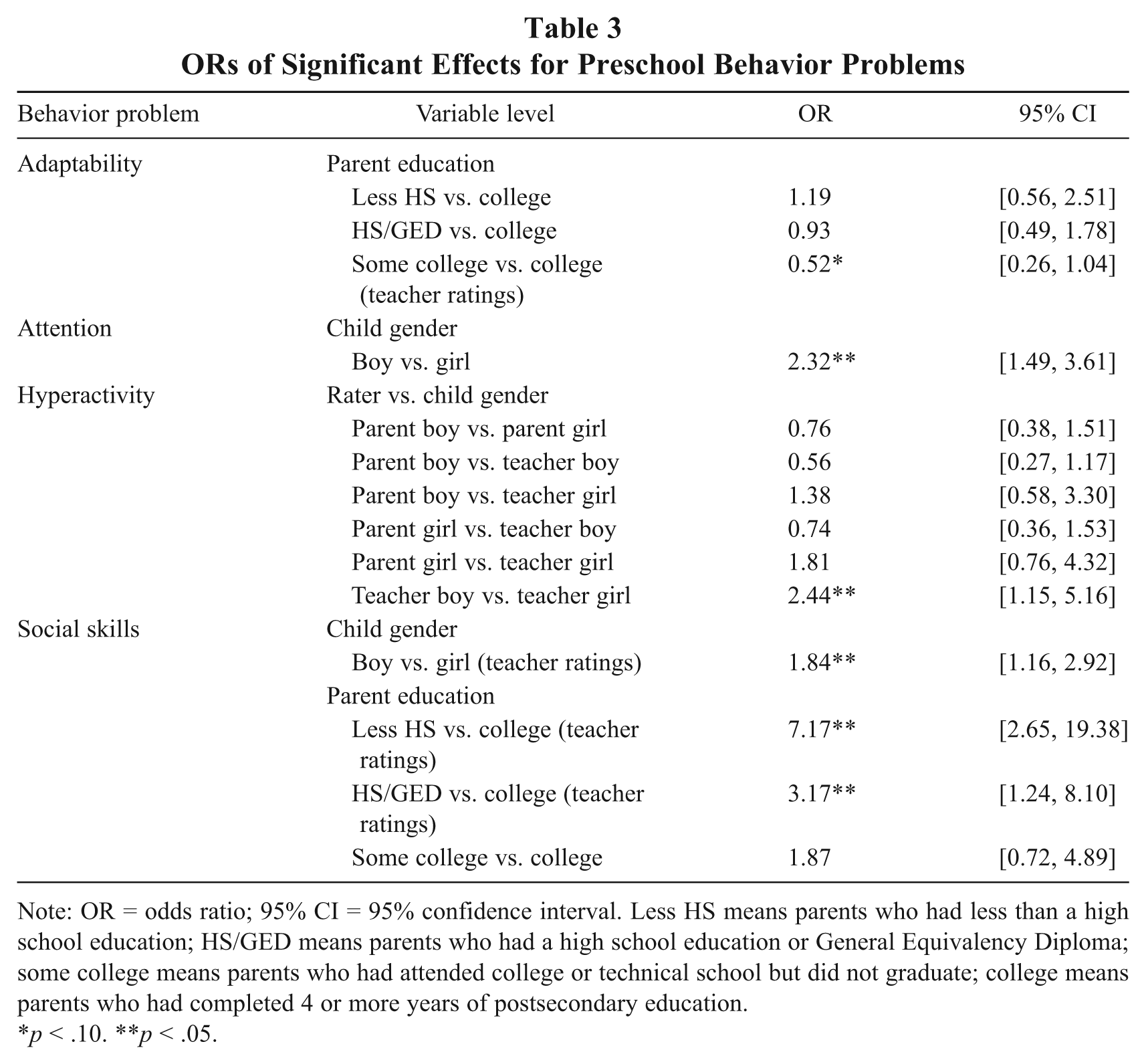
Note: OR = odds ratio; 95% CI = 95% confidence interval. Less HS means parents who had less than a high school education; HS/GED means parents who had a high school education or General Equivalency Diploma; some college means parents who had attended college or technical school but did not graduate; college means parents who had completed 4 or more years of postsecondary education.
p < .10. **p < .05.
Our results revealed that across analyses, age was not predictive of children’s risk for exhibiting behavior problems. Child gender and parent educational level did not significantly predict children’s risk for exhibiting aggressive behaviors. We also did not find evidence that parent and teachers ratings of children’s risk for aggression differed. However, we did find that children’s risk for exhibiting impairments in adaptability was related to parents’ educational level. In comparison, according to teachers, children whose parents had a postsecondary degree and children whose parents had some postsecondary education (not completed) were less likely to be perceived as exhibiting an impairment in adaptability (odds ratio [OR] = 0.53).
With respect to children’s risk for exhibiting attention problems, we found that on average boys were twice as likely to be rated by parents and teachers as evidencing attention problems relative to girls (F = 14.04, p <.001; OR = 2.32). Gender differences were also found for children’s risk for hyperactivity; however, our results suggest that parent and teacher perceptions of boys’ and girls’ risk for exhibiting hyperactivity differed (F = 5.09, p = .02). We found that whereas parent ratings of risk for hyperactivity did not differ by gender (OR = 0.76, p = .44), teachers were more likely to rate boys as exhibiting symptoms of hyperactivity than girls (OR = 2.44, p = .02). Children’s risk for displaying deficits in social skills was also significantly associated with child gender (F = 6.76, p = .01). We found that in comparison with girls, boys were more likely to be rated by teachers as exhibiting social skill deficits (OR = 1.84). In addition to child gender, we also found that parents’ education level significantly predicted children’s risk for exhibiting social skill deficits (F = 8.01, p < .000). Moreover, according to teachers, children whose parents had less than a high school education were seven times as likely to be perceived as having deficits in social skills relative to children whose parents completed 4 or more years of postsecondary education (OR = 7.18). Similarly, children with parents who never attended college (i.e., high school diploma) were three times as likely as children whose parents completed 4 or more years of postsecondary education to exhibit deficits in social skills (OR = 3.18). However, children whose parents had some postsecondary education (either completed or not) did not show statistically significant differences in social skills in comparison with children whose parents graduated from college.
Discussion
The purpose of this study was to assess the predominance of behavior problems for preschool students and to see whether these problems varied as a function of informant characteristics. Discrepancies among informants’ ratings of child behavior problems have important implications for diagnosis, assessment, and treatment. Typically, parents and teachers complete measures (e.g., behavior rating scales) to assess children’s problem behavior. However, the methods for identifying preschool children can be problematic because of the differing views of normative development in this population. Thus, we sought to increase the understanding of teacher and parent views of preschool behavior problems in a national sample.
Gender Differences in Behavior
Consistent with previous research (i.e., Campbell, 2002; Lavigne et al., 1996), the two most common behavior problems identified by parents and teachers were attention problems and social skill deficits. Parents and teachers were more likely to rate males as being more at risk of attention problems in comparison with females. In addition to rating males as more at risk of attention problems, teachers also perceived males as being more aggressive and hyperactive than females. This finding is similar to that of previous research that has demonstrated gender differences in early childhood behavior. In particular, males are generally rated as having more externalizing behaviors than females (Graves & Howes, 2011). In addition, during preschool, females tend to be more cooperative and develop relationships characterized by emotional and physical closeness, whereas boys tend to have more conflict with their teachers and peers (Hamre & Pianta, 2001; Saft & Pianta, 2001). As a consequence of this finding that boys represent a risk group with respect to early school adjustment, interventions that target male aggressive and hyperactive behavior should be a focus during this developmental period.
Differences in Ratings Based on Parent Education Level
With respect to parent education level, parents with less than a high school education were more likely to perceive their children as exhibiting at-risk levels of aggression and social skills than all other parents (e.g., parent with a high school/GED education and beyond). In addition, teachers were more likely to perceive children of less educated parents (e.g., less than a high school diploma) as having more social skill deficits than children of more educated parents. These parental education level differences in behavior ratings were also manifested in the prediction of being at risk of problem behavior. Specifically, children of parents who held a postsecondary degree and children of parents whose parents had some postsecondary education were less perceived as having adaptability deficits by teachers. Moreover, children of parents with less than a high school diploma were perceived as having deficits in social skills in comparison with their peers who had more highly educated parents. With the present gender- and socioeconomic (e.g., parent education)-based discrepancies in teacher and parent ratings of behavior, preschool practitioners need to be aware of these mediating factors. Although these discrepancies may reflect true differences in children’s behavior, they may also be indicative of the informant’s current circumstances that serve as the bases for their ratings of behavior (Kraemer et al., 2003). In particular, the qualitative work of Lareau (2000) has highlighted the existence of class differences in the logic of parenting practices. This line of research has found that upper- and middle-class parents engage in concerted cultivation, in which their parenting is directed at growth and development of their children’s talent. In comparison, parents of lower SES engage in the accomplishment of natural growth, in which parents presume that educational skills are best taught by educational professionals (Lareau, 2003). Although both of these parenting approaches have individual strengths and weaknesses, middle-income parents’ concerted cultivation in the area of school preparation may better prepare their children for making the behavioral adjustment to preschool. Consequently, preschool practitioners should be aware of these cultural differences based on parental educational background when designing interventions for this population. Research has demonstrated that by using socially relevant and culturally sensitive interventions there can be an improvement in social-emotional outcomes (Serpell, Hayling, Stevenson, & Kern, 2009).
Parent and Teacher Differences in Ratings
Although there were many similarities between parents and teachers, meaningful differences existed as well. This finding is important because it provides further evidence that differences between informants are meaningful and support the utility of maintaining the unique perspective of each rater in analytic and measurement strategies. Considering the stringent requirements for the documentation of problematic behavior in the school context (i.e., Individuals with Disabilities Education Act) and clinical settings (i.e., DSM-IV), the lack of agreement between parent and teacher ratings of problem behavior clearly poses a question concerning current assessment practice requirements for problem behavior. The lack of agreement may have implications for precise definitions of symptomatology in preschool. However, as research has demonstrated that these discrepancies are meaningful, then policy makers may need to rethink their requirements for problem behavior documentation. This phenomenon presents a major diagnostic dilemma for the preschool practitioners, and there is surprisingly little clinical guidance about how to understand and reconcile these differences in evaluation or intervention decisions (De Los Reyes, 2011; Kraemer et al., 2003). These informant discrepancies should be viewed not simply as measurement issues but as important opportunities for preschool stakeholders to try and understand why children behave differently in home and school environments. Consequently, individuals are urged to consider and to investigate these factors when weighing evidence from multiple factors in the course of conducting comprehensive assessments, interventions, and treatment planning.
Mixed-method studies using a multitude of strategies (i.e., randomized controlled trials and laboratory observations) have documented that informant discrepancies yield quantifiable and meaningful information. In particular, discrepancies in informants’ reports actually predict poor child and adolescent outcomes in ways that the individual informant’s reports do not (Achenbach, 2011; Dirks, Boyle, & Georgiades, 2011). These finding are important because intervention-based assessment for preschool children who are at heightened risk of behavior disorders has been a focus of increased attention among researchers (Barnett et al., 2006). Benefits of intervention-based assessment include the early identification of behavior problems, framing student difficulties from a risk rather than deficit model, and the reduction of identification biases in the special education process (Gresham, 2005; Newell & Kratochwill, 2006). For these interventions to be effective, accurate reports of context and why informants differ are vital. As such, researchers and policy makers must continue to study why informants differ in their ratings and how these ratings affect the intervention development process.
Limitations and Need for Future Research
There are general limitations to this study. It is possible that some parents may have underreported behavior problems in their children for fear of their child becoming labeled as behaviorally difficult by teachers. This concern may be particularly prominent for parents who do not want their children labeled for fear that they will be placed in special education classrooms. A replication of this study with other frequently used behavior rating scales (i.e., Conners Rating Scale; Social Skills Improvement System) used by professionals in preschool settings should be done to determine whether these results are consistent across instruments.
Conclusion
The results of this study provide additional information toward understanding behavior problems in preschool populations. The overall findings indicate that the perceptions of problem behavior among parents and teachers of preschool children appear to differ in important ways related to the SES of the child (i.e., parent education level). As such, the use of behavior rating scales by preschool professionals such as the BASC-2 that rely on parent and teacher reports may yield different results for children at lower SES levels. These differences may signal different underlying treatment needs, which school-based professionals should be aware of for children with lower SES. Consequently, gathering information from multiple sources can provide a more complete picture of the behavioral functioning and therapeutic needs of children from all socioeconomic backgrounds.
Footnotes
Authors’ Note:
Scott L. Graves Jr., Department of Counseling, Psychology, and Special Education, Duquesne University; Jamilia Blake, Department of Educational Psychology, Texas A&M University; Eun Sook Kim, Department of Educational Measurement & Research, University of Southern Florida.