




Abstract
Early language and reading experiences are known to predict later reading success. Interactive shared reading activities particularly benefit children’s emergent literacy development. Converging research has begun to show that certain educational television programs can significantly influence early literacy skill acquisition. There is a need, however, to combine interactive shared reading with the educational television production techniques known to purposefully facilitate emergent literacy. This research begins to address that need by pilot testing a research-based animated book reading intervention developed specifically to promote the vocabulary, alphabet knowledge, print concept, and rhyme knowledge of preschoolers in child care between the ages of 3 and 5 years. Employing a quasi-experimental pre- and posttest research design, results indicate that children in the experimental group made greater gains on standardized emergent literacy measures compared with children in a control group. Early findings suggest that the animated book reading intervention may be a feasible and effective way for child care educators to teach early reading skills.
Keywords
Introduction
For more than three decades, researchers, practitioners, and policy makers have focused on the need to ensure that children acquire a solid literacy foundation during their preschool years (Connor, Morrison, & Slominski, 2006; Diamond, Justice, Siegler, & Snyder, 2013; Girolametto, Weitzman, & Lefebvre, 2007; Goldstein, 2011; Jamieson, 2009; Janus & Doku, 2007; Lonigan, Farver, Phillips, & Clancy-Menchetti, 2011; MacDonald & Figueredo, 2010; Topping, Dekhinet, & Zeedyk, 2013; Whitehurst & Lonigan, 1998). Failure to acquire sound language and literacy knowledge in early childhood can lead to deleterious outcomes for children’s long-term academic success (National Early Literacy Panel, 2008; National Institute of Child Health and Human Development, 2000; Torgesen, 1997). Students without adequate reading skills at the end of first grade have an 88% likelihood of remaining below grade level after 3 additional years of instruction (Juel, 1988) and are likely to encounter difficulty with all curricular aspects. Children not at grade-level literacy by third grade experience reduced curricular access, require long-term support, and continue to lag behind in literacy and curricular achievement (Sloat, Beswick, & Willms, 2007; Stanovich, 1986).
Literacy development before first grade is in many ways a high-stakes endeavor, and yet many children arrive at school without the literacy foundation and learning skills they need to meet school’s academic challenges. Economic conditions and children growing up in poverty account for a large percentage of high-risk literacy learners, but so do factors associated with single-parent households, an often limited access to resources in rural areas, and increasing numbers of children whose first language is not English. These risk factors are further compounded by the added demands of information and communication technology skills and the pressures educators and students face to acquire and employ strong media literacy capabilities. All of these factors continue to place demands on the need for innovative preventive early intervention strategies aimed at reaching and teaching all children the literacy skills foundational to reading and writing success.
Building on what we now know about both what children need to learn during their early years, and how that learning is best facilitated, a growing body of research over roughly two decades has begun to investigate the effects of instructional programs delivered through the Internet and television media. Converging evidence shows that innovative instructional uses of electronic storybooks (Korat & Shamir, 2007), for example, and television programs like Between the Lions (Frith, 2000) and Super WHY (Santomero & Alpert, 2007) are yielding positive effects on children’s cognitive skills and academic outcomes, including literacy (Kirkorian, Wartella, & Anderson, 2008; Linebarger, 2011; Linebarger & Walker, 2005; Neuman, Newman, & Dwyer, 2010; Pasnik, Strother, Schindel, Penuel, & Llorente, 2007; Piotrowski, 2014). Using innovative technology in child care center environments may be particularly beneficial in settings in which care providers are unfamiliar with effective emergent literacy teaching and learning practices.
Not all programs or technology devices promoted as “educational” are the same, however, nor do they all yield the same positive results. The educational television programming literature highlights the need for specific design features and technical specifications if intended learning outcomes are to be met. For example, programs integrating and closely connecting storylines with defined learning content yield greater effects in both the short term and the long term (Fisch, 2000; Piotrowski, 2014). Content is particularly important because individual programs must be clear and explicit, reflect age-appropriate curricula, and target a small, specific number of learning goals in individual programs (Kirkorian et al., 2008).
Preschoolers and Emergent Literacy
The significance of emergent literacy acquisition during the preschool years has been researched and documented extensively for almost four decades (e.g., Lonigan et al., 2011). We now understand well the significance of emergent literacy knowledge to children’s early development and to later reading and academic success (Bauchmüller, Gørtz, & Rasmussen, 2014; Justice, 2006). Emergent literacy characterizes those behaviors and interactions with language and print young children exhibit prior to engaging in conventional reading and writing processes (Connor et al., 2006). These reading precursors are many, such as print directionality, reading from left to right, and reading from front to back. Early decoding aspects such as letter naming, phonological awareness, and word and sentence awareness along with other elements such as story narrative characterize children’s emergent, growing awareness of how print works, and what print conveys.
Acquiring emergent literacy skills begins early and develops over time as children grow, but what they learn depends on their environment and their amount of exposure to language and literacy (Senechal, 2006; Sukhram & Hsu, 2012; Theriot et al., 2003; Topping et al., 2013). Although parents are children’s first and most important influence on early literacy development (Sukhram & Hsu, 2012), many children also spend substantial time in child care settings from at-home parental or family member care contexts, to nonparental care and center-based care contexts. Research shows that the linguistic quality of both home and child care environments influence children’s social, behavioral, and cognitive development, and in particular literacy (Justice, 2006). Early language learning continues to influence reading and writing ability through both the primary grades (Diamond et al., 2013; Sylva, Melhuish, Sammons, Siraj-Blatchford, & Taggart, 2008) and beyond (Bauchmüller et al., 2014). Providing high-quality literacy learning environments requires early childhood educators to be highly knowledgeable about what constitutes early literacy skill knowledge and to teach children that knowledge through a well-planned, transactional, activity-based curriculum centering on early literacy skill acquisition (Connor et al., 2006; Lonigan et al., 2011; Perlman & Fletcher, 2008). Research indicates, however, that child care centers vary widely in the literacy environments and instruction they offer with some delivering a strong focus on literacy learning (Pelatti, Piasta, Justice, & O’Connel, 2014), and others providing limited or infrequent to no literacy instruction (Connor et al., 2006; Dickinson, McCabe, & Anastasopoulos, 2002; Perlman & Fletcher, 2008).
Interactive Reading
Research clearly indicates that being read to at an early age leads to positive language and literacy outcomes in both emergent literacy knowledge and later reading fluency and comprehension (Mol & Bus, 2011). Shared, interactive picture-book reading is now a commonly used and effective approach for teaching important foundational emergent literacy skills wherein children are urged to be active listeners and participatory readers during a story’s rendering (Flynn, 2011; Pelatti et al., 2014; Whitehurst & Lonigan, 1998). Shared book reading strategies were initially identified in the 1980s (Whitehurst & Lonigan, 1998) to delineate how purposeful teaching and learning opportunities can naturally emerge as adults dialogue with children while reading to promote a range of cognitive, linguistic, textual, and structural emergent literacy skills. Through these engaging, participatory book readings, learning is facilitated as adults muse aloud and ask questions covering a range of story and book structures and elements.
Educational Television
The increase in children’s televised programs touted as “educational” and the growth in research on their effects means it is no longer a question of whether these programs should be used for educative purposes. Rather, the issue now is how such programs should be used, and what content and production features are needed to make them truly educational (vom Orde, 2012; D. K. Wainwright & Linebarger, 2006). Through our review of the research, we identified several program design features that more effectively facilitate young children’s learning, which we took into account when developing our own book reading intervention. Reflecting clearly the cognitive processes children employ while viewing and learning from educational television programs was central in designing our own program.
Fisch’s (2000) capacity model delineates this learning process according to the parallel cognitive demands of first extracting and in turn comprehending a program’s content. The model incorporates the dual and corresponding components of narrative, or a program’s storyline moderated through characters and event sequencing, and educational content, or a program’s underlying learning concepts. Content is embedded within and delivered through the narrative storyline, both aspects of which children attend to simultaneously by engaging the same set of cognitive responses while viewing (e.g., activating prior knowledge, making inferences) for comprehending both program story narrative and learning content. Children rely on working memory to engage these dual processes, but working memory resources are finite, and learning and comprehension are limited in instances in which educational content is too far removed and tangential rather than integral to program narrative. According to Fisch, effective programs ensure storylines and content are complementary and closely integrated to facilitate greater comprehension and learning. Fisch’s model is all the more important given current research demonstrating that young viewers’ working memory and learning are further challenged because they must first attend to learning a program’s format and production features before they can in turn focus on content (Piotrowski, 2014).
Purpose of the Study
The issues above—the importance of preschoolers’ emergent literacy skill acquisition, the advantages of interactive reading, and the capacity of appropriately designed educational television to teach important developmental knowledge and skills—coalesced to frame the purpose and approach for developing our book reading intervention. Educational television programming has the potential to improve preschoolers’ emergent literacy skill acquisition; however, accomplishing this goal requires high-quality, easily implemented programming targeting literacy knowledge foundational to conventional reading and later academic success. In the current study, we sought to contribute to the work on identifying highly effective early childhood television programming by developing and evaluating an animated book reading intervention that would yield significant effects on preschoolers’ emergent literacy skill attainment.
The study is best characterized as an early pilot study and was purposely kept small so that refinements could be made, particularly if results were not significant, prior to moving to large-scale program development and testing. This study was designed to investigate a relationship between our book reading intervention on the vocabulary, alphabet, print concept, and rhyme knowledge of 3- to 5-year-old children in a child care center setting. Employing a quasi-experimental design, the following research questions were addressed in the study:
Method
Our book reading intervention was pilot tested following a quasi-experimental pretest and posttest nonequivalent group design with group assignment to control and condition occurring at the classroom level. A 2 × 2 mixed-model factorial design was employed for data analysis. The two independent variables were group (intervention, control) and time (pre- and posttest). The between-groups variable was group and the within-groups variable was time. Four primary outcome variables were selected for study inclusion: vocabulary, alphabet knowledge, print concept awareness, and rhyme. The rationale and selection processes for all of these design features are elaborated next including a description of our book reading intervention and its development.
Site Selection and Participant Recruitment
A disadvantage of group assignment at the classroom level is that classrooms can differ from one another in meaningful ways. To reduce the likelihood of this problem, we established several measures and criteria for guiding child care center selection. First, only centers located in demographically similar neighborhoods were recruited for study participation. Second, centers needed to be licensed by the government department responsible for administering and enforcing all child care center programs, policies, and services. As such, centers were required to follow a curricular framework for early learning and child care, and comply with regulations including center design, health and safety protocols, and specified child-worker ratios. Directors were asked to report on aspects of their program and environment by completing a questionnaire designed to ensure that centers followed provincial operating regulations.
These criteria ensured a minimum level of consistency in center selection and baseline data collection, which is desired when employing a quasi-experimental research design. With these criteria in mind, six centers were approached for study participation, with four agreeing to participate. All classrooms compared equally on a range of characteristics, as discussed below, that allowed for classroom assignment to condition to occur through center administrator self-selection based singularly on whether a child care site had a television and DVD player, both necessary equipment requirements for implementing our book reading intervention. The study sample was comprised of 51 preschool students (M age = 49.34 months, SD = 6.99). Forty-three percent of children were male. There were no significant differences in condition by age, t(49) = 0.51, p = .62, or gender, χ2(1) = 1.19, p = .274. Of the total sample, 28 (55%) served as an experimental group and 23 (45%) served as the control group. Once the child sample for the study was determined, we employed two additional procedures for further ensuring center consistency. Family demographic information was gathered via parent report using a brief questionnaire regarding child sex and birth date, family income, and parental education, as well as a number of media characteristics in the home such as whether children had access to cable television, a computer, and high-speed Internet, along with the number of books in the home. Response rates were high, with 96% control group and 86% experimental group surveys returned. Comparative analyses indicated no significant differences between groups, as results reported in Table 1 demonstrate.
Demographic and Media Environment Descriptives.

Note. χ2 = chi-square results; t = independent-samples t-test results; p > .05 in all cases. ELLCO Pre-K = Early Language and Literacy Classroom Observation: Pre-K assessment.
Reports the number of classrooms and their scores in each of the control and experimental groups for each ELLCO measure.
Finally, and to further ensure classrooms were similar at baseline, classroom quality and literacy environment were measured using the standardized Early Language and Literacy Classroom Observation Pre-K assessment (ELLCO Pre-K; Smith, Brady, & Anastasopoulos, 2008a). The ELLCO Pre-K is an observational tool designed for use with 3- to 5-year-olds in center-based classrooms so researchers and educators trained on the tool’s administration can systematically document language and literacy practices and materials for evaluating the extent to which classrooms optimally support children’s early language and literacy development. Observations are organized across multiple domains with scores tabulated for two subscales, General Classroom Environment and Language and Literacy. The General Classroom Environment subscale captures elements of both classroom structure (organization, contents, management, and personnel) and the curriculum (curricular approaches, opportunities for child choice and initiative, and recognizing diversity in the classroom). Classrooms in our research scored either “basic” or “inadequate” on this subscale with a score of basic indicating that “some evidence” of the scale indicators were observed, whereas a score of inadequate indicated that “limited” evidence of the scales’ indicators had been observed.
The Language and Literacy subscale, in contrast, captures components of language environment (discourse climate, opportunities for extended conversations, and efforts to build vocabulary and phonological awareness), along with books and book reading (organization of book area, characteristics of books, books for learning, approaches to book reading, and quality of book reading), as well as print and early writing (environment, early writing support, and environmental print). Participating classrooms scored “inadequate” or “near basic” on this subscale. An inadequate score indicates “limited” evidence of the measure, with a near basic score indicating that “some” evidence of the language environment measure was present. The technical properties of the ELLCO Pre-K are sound, with evidence of strong interrater reliability in classroom settings of 88% (Smith, Brady, & Anastasopoulos, 2008b). To ensure consistency in the tool’s application across settings, one rater, following training, carried out all ELLCO assessments in this study based on a 4-hr observation in each of the four study classrooms. Chi-square tests revealed that scores between classrooms were not significantly different on the General Classroom Environment subscale, t(2) = −0.29, p = .80. Similarly, on the Language and Literacy subscale, chi-square tests revealed that scores were not significantly different across classrooms, t(2) = −1.10, p = .39.
The Intervention
Design influences
Given our decision to use a screen-based approach for delivering our book reading intervention, wide reading was necessary across two research literatures, including literature pertaining to emergent literacy and interactive shared storybook reading, as well as the effective use of television’s formal features for teaching and learning. Our intent was to bring together and integrate the essential elements of effective educative television programming with the wealth of research describing both what children need to learn at the emergent reading stage of development and how such knowledge is most effectively taught and learned. Specifically, the emergent literacy research informed the developmental profiles of our study outcomes—vocabulary, alphabet knowledge, print concept awareness, and rhyme—along with identifying effective interactive reading strategies for scaffolding instruction for a wide range of learners, whereas the educational television production literature informed our knowledge of effective methods for imitating shared reading sessions on screen. Examples of production features identified and used in our program include various sound effects, on-screen print, color, music, visuals, and animation effects. Finally, lesson sequencing was developed using the evidence-based, empirically validated Read It Again-PreK! curricular supplement (RIA; Justice & McGinty, 2009; Justice et al., 2010) following an extensive literacy curriculum review. RIA’s focus on emergent literacy development for 3- to 5-year-olds and the sequentially developed lessons designed to ensure children acquired a foundation of simpler literacy concepts before moving to learn more challenging concepts aligned well with our intervention intent.
For our book reading intervention, we adapted 20 RIA lessons into 15-min interactive book reading DVD lessons delivered by child care center providers over a 5-week period, for a total of 5 hr of instructional video viewing. Although studies varied in identifying the timing and duration of screen-based interventions, significant gains were evident after only four viewing hours over periods of 3 to 8 weeks (e.g., Linebarger, Kosanic, Greenwood, & Doku, 2004; Linebarger, McMenamin, & Wainwright, 2008; Linebarger & Taylor-Piotrowski, 2009). We determined that 5 hr of viewing over a 5-week period was appropriate for a pilot test of the intervention’s effects on emergent literacy development.
Animated book reading design
In each book reading lesson, a commercially available children’s storybook is read aloud by a dynamic host character conceptualized by the authors (see Figure 1) using interactive reading strategies occurring before, during, and after the reading for inviting and encouraging viewer engagement and participation in the story. Books used in our lessons were identified in the RIA curriculum for targeting specific literacy skill development. For instance, The Night Before Kindergarten (Wing, 2001) introduces rhyme given the book’s rhyming prose writing style, and Chicka Chicka Boom Boom (Martin & Archambault, 1989) reinforces letter naming knowledge because of its humorous storyline about 26 mischievous letters. Each reading lesson targets and emphasizes a few rather than a broad range of skills given the research indicating that this approach is more likely to yield positive learning effects (Pasnik et al., 2007). Books are read in their entirety without altering their original version.

Figure of host character.
Each skill taught within a lesson, however, is scaffolded to address a range of learner needs so all readers can move toward greater skill and independence. For instance, all lessons focus on a “letter of the day” that children are to watch for during each book reading with direct instruction and learning reinforcement occurring periodically when the letter appears. Letter naming knowledge is a simpler concept already familiar to some that other preschoolers have yet to learn. While those with more advanced language and literacy skill can still benefit from letter naming instruction, more challenging skills like letter sound production, word recognition, or rhyme identification are also included to scaffold and differentiate possible learning outcomes in each lesson.
A consistent, familiar program format is used as the same friendly and inviting host character (Holler, Görtz, Egerer, & Schwarz, 2012) interactively leads children through each episode (D. L. Wainwright, 2007). We illustrate the intervention’s design and format by describing elements of lesson 10 in which The Night Before Kindergarten (Wing, 2001) is reread to reinforce rhyming knowledge as a targeted intervention and study outcome. This video follows the opening format used in all programs as an animated rendering of a bookcase full of colorful books and the lesson number appears on-screen set to a musical jingle. The smiling host moves on-screen while waving to viewers and comes to rest next to the bookcase to draw a book from a shelf. The host, the voice for which is that of a skilled adult female reader, begins:
Today we are going to read The Night Before Kindergarten again, but before we start reading today, I want to review rhyming words. Do you remember what rhyming words are? [2-s pause] Rhyming words sound the same at the end.
A new screen appears with the host surrounded by three words and corresponding images, a red color patch with the word Red written beneath, the word Bed and corresponding image, and a loaf of bread next to the word Bread. Each image is animated in turn by zooming in and moving it to the screen’s foreground as each word is said aloud. The host then goes on to explain that “these words all end in the sound ‘ed,’” and, following a slight pause, asks viewers to “listen carefully” as the words and images are again spoken and animated. This same exercise is repeated using the words and images for swing, ring, and king. On this occasion the host asks, “Do these words rhyme?” followed by a 5-s response pause before continuing with, “You got it. These words rhyme because they all end in the sound ‘ing.’”
A short musical interlude signals a transition to the next activity, in which the host asks children to “Listen for rhyming words as we read together today.” As the music resumes, a green envelope floats from the top of the screen and comes to rest next to the host. The host moves to open the envelope while asking viewers, “I wonder what our special letter will be?” The letter p moves out of the envelope to center screen where the host then muses aloud with, “Hmmm, what is this letter?” following a pause allowing time for a response. The host then names the letter as three words and corresponding images beginning with p appear, with each then animated and read aloud. In all, this program’s introduction takes 2 min and 35 s, including transitioning to readying for reading the book as the host states, “It is time to start reading our book. Are you ready? [pause] “Let’s go!”
The above exemplifies a number of patterns and techniques used consistently in all videos, as recommended in the research (Holler et al., 2012; D. L. Wainwright, 2007). The host speaks directly to children, invites them into the learning environment, encourages reading along with the book, prompts responses to literacy-related questions, pauses to allow time for replies, and facilitates making connections with program learning concepts. Short musical jingles and other sound effects are used consistently to signal transitions between activities and maintain viewer attention, along with using animation and highlighting techniques to engage children in learning by directing their attention to key literacy concepts on the screen. Each lesson includes a letter of the day that children are encouraged to watch for during a book’s reading. When the letter appears on a page, the same chiming sound effect and text highlighting are used to signal its appearance. As The Night Before Kindergarten (Wing, 2001) is read, for instance, the letter “p” is periodically highlighted as the host guides and reinforces learning with, “You found our special letter p. Can you remember what sound the special letter p makes?” Following a 3-s pause phonemic awareness is taught with, “The letter p makes the sound, /p/, as in ‘prepared,’” at which point the word is highlighted in red with the first p in green font.
Learning is constantly reinforced both implicitly and explicitly throughout each book’s rendering with learning concepts introduced at a book’s beginning, reinforced periodically as the story is read, and summarized after the story’s narrative is complete. When a story reading is set to begin, the book appears in its original colorful form and the title is read aloud accompanied with color highlighting and animation, or increased text size, for drawing attention to each word. Prediction skills are reinforced as children are asked to consider how the title and cover illustrations might provide clues about the storyline. Animation techniques are visually highlighted in the way in which book pages are turned from left to right, and further reinforced with a clearly audible sound effect of a turning book page. Each line of story text is highlighted in red to reinforce reading direction, and so children can follow along with the text. Corresponding pictures accompanying the text animatedly move on a page to facilitate text-to-image and storyline development connections.
The central learning concept associated with each book is of course also addressed throughout a reading. At the end of page 2 of The Night Before Kindergarten (Wing, 2001), for example, the host character moves onto the page, stops next to the text, and begins, “I heard some rhyming words on this page, did you?” A white screen overlays the storybook to feature the host character along with the two rhyming words from the book, galore and door. The host points to each word as it is highlighted and spoken aloud: “These are the words galore and door. Do these words rhyme? Listen carefully.” The words are again repeated, and children are provided another opportunity to hear the sound that causes the words to rhyme. The lesson continues with two new, nonrhyming words with accompanying questions about whether they rhyme along with an explanation of why they do not. Readings and lessons continue to the book’s end, at which point the host character recaps with accompanying page images what the story was about. The book’s key learning concept, in this case rhyming words, is also reviewed, as is the letter of the day, by animating, highlighting, and reading aloud the relevant words and sounds. The smiling host character signs off with, “I have to go now. See you next time,” and waves goodbye to viewers.
The questioning and pauses in the story’s rendering provide many opportunities for child and educator involvement in the reading. Along with the queries and prompts from the host narrator are ample opportunities for center educators to reinforce, differentiate, scaffold, and extend lesson content. For educators to do so, however, requires substantive knowledge of the emergent literacy and reading development continuum, understandings that child care providers may not possess. As such, the animated book reading intervention was designed so that facilitated instruction by an adult reader, though beneficial, was not essential. To test whether the intervention program would be a successful instructional resource on its own, we asked pilot-study child care center providers to refrain from talking about or reinforcing the learning in any way for the study’s duration.
Measures
Researcher-developed program implementation and activity logs were provided to each study classroom for capturing fidelity to the preestablished intervention schedule whereby program videos were to be played 4 times per week over 5 weeks. Each day a video was shared with children, teachers were asked to record the date, the unique reference number associated with each lesson as it appeared on the screen at the end of each video, and additional commentary regarding student attention and participation.
Following a wide review of the standardized emergent literacy screening assessments available, measures were selected from the early Literacy Individual Growth and Development Indicator (IGDI; Early Childhood Research Institute on Measuring Growth and Development, 2000a) and the Phonological Awareness Literacy Screening Pre-K (PALS-PreK; Invernizzi, Sullivan, Meier, & Swank, 2004). Both measures were chosen because they target the literacy learning skills of children between the ages of 3 and 5, directly assess core book reading intervention learning objectives, are efficient and economically easy to administer, exhibit evidence of validity and reliability in controlled testing environments, and are sensitive to literacy growth and change over relatively short periods of time.
The Picture Naming IGDI (Early Childhood Research Institute on Measuring Growth and Development, 2000b) was selected to capture indications of the intervention’s effects on children’s expressive vocabulary development. The measure is administered by presenting images of objects commonly found in preschoolers’ natural home (cake, apple), school (book, glue), and community environments (rabbit, train) to children and asking them to name as many images as fast as possible over a 1-min period. The Rhyming IGDI (Early Childhood Research Institute on Measuring Growth and Development, 2000c) was chosen to determine children’s ability to detect rhyme, which is an important emergent indicator of phonological awareness. This assessment is administered by presenting children with stimulus cards showing a target image at the top and a set of three images at the bottom. Children are then required to identify the bottom row image that rhymes with the target image, and to complete as many cards as possible over a timed 2-min period.
Two subtests from the PALS-PreK (Invernizzi et al., 2004) were administered to measure children’s alphabet knowledge and their print concepts awareness. Letter naming knowledge was assessed using the Uppercase Alphabet Recognition subtest in which children were asked to name the 26 uppercase letters of the alphabet presented in random order. The Print and Word Awareness subtest assesses children’s knowledge of 10 specific print concepts (e.g., differences between pictures, letters, and words; print directionality of top to bottom and left to right; and meaning of print). This task reflects a natural book reading event in which the assessor reads a short storybook to children while periodically asking questions during the reading. For instance, prior to beginning the reading an assessor asks the child to “Show me the name or the title of the book” and in turn to point to each word in a book’s title. Questions posed during the shared book reading session include queries like “Where do I start reading on this page?” with children given time to respond by identifying the left-to-right directionality of reading print.
Data Collection Procedures
No center staff, including program directors, knew of the study’s specific research questions to ensure that teaching emphasis and practices did not change in response to the study’s focus on positively influencing children’s emergent literacy development. Once program administrators consented to participate, the ELLCO Pre-K Tool (Smith et al., 2008a) was conducted for each participating classroom, and program administrators completed the child care center quality questionnaire. Subsequently, children for whom consent was received were pretested using the standardized measures described above. Once pretesting was complete, children assigned to the experimental condition began viewing the video program in their classrooms, whereas children in the control group maintained their usual daily schedule and program. Children in the experimental viewing group watched four videos per week in a predetermined order, for a period of 5 weeks. Teachers were asked not to discuss or extend any elements of the on-screen book readings so that any study findings could be attributed to the intervention. Upon termination of the intervention period, children in both groups were assessed again using the same battery of tests administered at pretest as described above. Following the data collection period, early childhood centers with children in the control group were given the opportunity to use the book reading intervention in their classrooms if they wished.
Analysis
In addressing this study’s aim of determining whether teachers could implement a 5-week video intervention according to a set schedule and lesson sequencing, we examined teachers’ program implementation and activity logs for fidelity to the intervention. It was clearly evident that, in all instances, teachers were able to implement the intervention according to the predetermined schedule and book sequencing format specified. Because the videos were to be viewed just 4 days per week as opposed to every day of the week, teachers had one day to use as a buffer. All teachers reported that the extra day helped them to stay on schedule, and as such, fidelity to intervention implementation was 100%.
To establish whether the video program would positively and significantly influence children’s emergent literacy skills, a series of repeated-measure ANOVAs was carried out using raw scores to determine whether there was an interaction between two factors (time and group) on each of the four dependent variables (vocabulary, alphabet knowledge, print concept awareness, and rhyme). Raw scores were used for the analysis given that we were examining child outcomes for change over time in a sample of participants who were approximately the same age. We did not control for age given the quasi-experimental and nonequivalent group design of our study, and because all children were close to the median age of 49.35 months. If participants’ ages had varied more significantly, then standardization would have been necessary for interpreting the results. In our case, however, standardization would not have contributed in any meaningful way to interpretation (Shadish, Cook, & Campbell, 2001). Furthermore, analytical procedures addressing children nested in classrooms were not employed given our purpose of conducting a pilot study for examining trends in the data, though subsequent studies will use such analyses, including hierarchical linear modeling. Because young children naturally mature in their learning over time, it was necessary to examine Group × Time effects to determine whether results were significant.
Results
The interaction of Group × Time was significant in all cases (p < .05), with children in the experimental group outperforming their control group peers on each measure, as demonstrated in Table 2.
Pretest and Posttest Means and Standard Deviation for Effects of Treatment × Time.
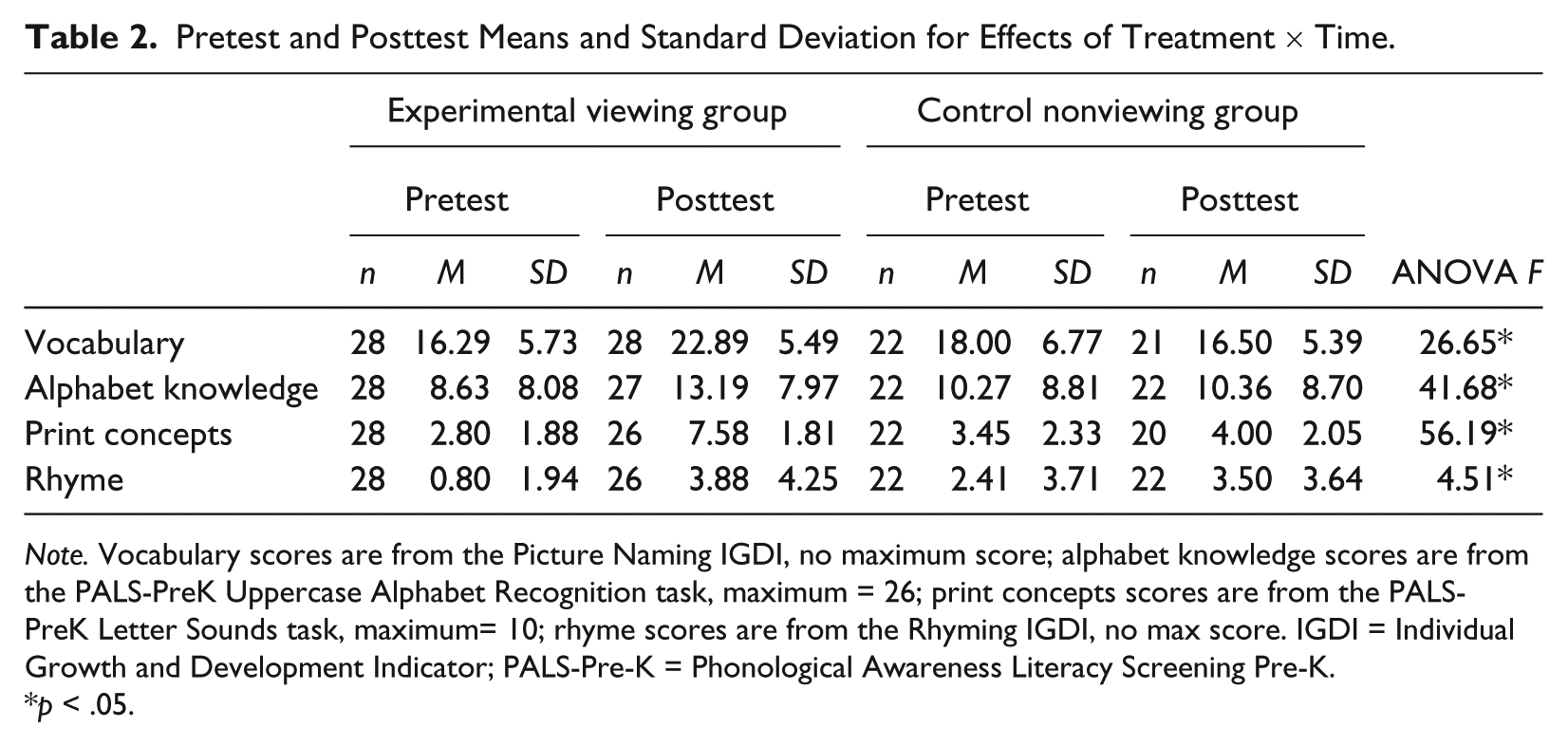
Note. Vocabulary scores are from the Picture Naming IGDI, no maximum score; alphabet knowledge scores are from the PALS-PreK Uppercase Alphabet Recognition task, maximum = 26; print concepts scores are from the PALS-PreK Letter Sounds task, maximum= 10; rhyme scores are from the Rhyming IGDI, no max score. IGDI = Individual Growth and Development Indicator; PALS-Pre-K = Phonological Awareness Literacy Screening Pre-K.
p < .05.
Vocabulary
There was a statistically significant interaction between group and time on Picture Naming, F(1, 48) = 26.66, p < .0005, d = 1.17, and children in the experimental group exceeded their control group peers at posttest. Overall, experimental group scores increased 40.52% from pre- to posttest, whereas control group scores declined slightly by 8.33%.
Alphabet Knowledge
There was a statistically significant interaction between group and time on Uppercase Letter Naming, F(1, 47) = 41.68, p < .0005, d = 0.34, with children in the experimental group outperforming their control group peers at posttest. Examination at posttest showed that experimental group scores had increased by 52.84% from pretest, whereas control group scores increased just 0.88%.
Print Concepts
There was a statistically significant interaction between group and time on the Print and Word Awareness task, F(1, 44) = 56.20, p < .0005, d = 1.85. The experimental group outperformed their control group peers at posttest. Overall, experimental group scores increased 170.71% from pretest, whereas control group scores increased just 15.94%.
Rhyme
There was a statistically significant interaction between group and time on Rhyme, F(1, 46) = 4.51, p < .039, d = 0.36. Children in the experimental group exceeded their control group peers at posttest. Posttest scores revealed that the experimental group increased 379.00% from pretest, whereas control group scores increased just 45.23%.
Discussion
The primary purpose of this pilot study was to examine the effects of a 5-week, 20-lesson animated book reading intervention designed to teach vocabulary, alphabet knowledge, print concepts, and rhyme lessons in a sequential, developmentally appropriate manner to children 3 to 5 years of age while enrolled in child care. In some respects, these results are encouraging. The intervention resulted in experimental group gains on all standardized measures of the four emergent literacy concepts targeted in the intervention, while, comparatively, control group scores remained relatively unchanged. Control group mean scores were higher on all four of the emergent literacy measures at pretest compared with experimental group mean scores, and yet, following the intervention, children in the experimental group exhibited higher mean scores on all measures than children in the control group at posttest.
One potential threat to the internal validity of the study concerns the confounding variables that may have been present in both experimental and control group contexts during the intervention period. We cannot know for certain whether or to what extent history and maturation effects may have influenced participants in both groups, and participant selection may conceivably be considered a factor. However, parent demographic and media access in the home questionnaires, along with extensive observational data collected in all child care settings, indicated there were no significant differences between groups. Furthermore, weekly center activity log checks during the intervention clearly indicated high fidelity with the experimental group to the intervention’s defined viewing schedule and lesson sequencing. Furthermore, given the positive findings on all four literacy measures in addition to the steps taken above, pilot results indicate that our book reading intervention influenced important emergent literacy knowledge acquisition among a sample of preschoolers.
Although on one level findings are encouraging for validating our animated book reading intervention, we also recognize the need to temper results given the pilot-study nature of the research, the small participant sample, and the study’s quasi-experimental design. In addition, we do not know the learning conditions of control classrooms during the research period or whether or to what extent the same literacy outcomes may have been addressed. With current study findings indicating that our reading intervention holds potential for teaching key emergent literacy skills, future studies can address a number of design elements including documenting control classroom learning conditions.
A growing body of literature now points to the value of educational television programming to support young children’s development across multiple domains (Fisch & Truglio, 2001; Pasnik & Llorente, 2012; Paulsen, 2013), and in particular emergent literacy (Linebarger, Moses, Garrity Liebeskind, & McMenamin, 2013; Piotrowski, 2014; vom Orde, 2012). Media is an effective tool for learning, but it must be used purposefully and appropriately commensurate with age and preschoolers’ developmental stages (Wartella, Blackwell, Lauricella, & Robb, 2012), like the use of effective reading instruction strategies (Neuman et al., 2010). It can be challenging, however, for early educators to assess whether and to what extent an educational program constitutes a positive and productive learning opportunity for children (Dickinson et al., 2002). Our book reading intervention’s design includes a number of features that can heighten its appeal for early childhood educators given the program’s clearly defined parameters, goals, and purposes. It specifically targets the language development instruction of 3- to 5-year-olds as a precursor to and preparation for more formal school entry at the kindergarten level, unlike most programs targeting broader age ranges. It similarly focuses exclusively on an age- and developmentally appropriate instructional approach to emergent literacy skill teaching and learning. Lessons are both carefully planned and sequenced from one program to the next, and individual lessons are also purposely scaffolded for differentiated instruction (activating prior knowledge, summarizing, predicting) to support varied learning needs (Fisch, 2004). At the same time, programs are relatively short, requiring on average only 15 min, require no training for educators to implement, and no need for educators to mediate lesson instruction unless they opt to do so. As noted above, child care educators in this study indicated that the program implementation schedule was easy and feasible to follow, and no challenges in using technology to show the program were noted. There is, however, ample opportunity for co-instruction either to reinforce or augment content learning if there is a preference to do so.
Limitations and Future Directions
Given our aim of pilot testing a new educational intervention, certain design limitations warrant discussion, three of which we consider here in the context of future research. One limitation pertains to the study’s size in terms of child sample size, a limited number of child care sites, and a limited number of emergent literacy measures administered. Reasons for limiting the pilot study in size and scope were twofold. As we could not locate any book reading intervention models comparable with the one we sought to design, substantial time and resources were expended researching reading intervention’s design criteria, including the animation production literature, effective programming literature, and the emergent literacy literature, along with identifying a suitable curricular framework and selecting intervention assessment measures. At the same time, once all of the foundational research had been conducted, findings documented, and decisions made, there was then the need to develop, record, informally test, and refine all 20 of the animated book reading sessions for readying the intervention’s pilot testing. In keeping with pilot-study purposes and designs, the study was kept small to ascertain intervention effectiveness before moving to large-scale implementation.
A second limitation concerns assigning children to the experimental and control conditions by classroom. This approach is typical of experimental design studies situated in school- and classroom-based contexts given the pragmatic and ethical limitations of conducting true randomized studies. To limit threats to validity, however, demographic and media use data gathered preintervention along with statistical analyses and regular treatment integrity checks were employed to ensure that groups were similar at baseline and throughout the research (Codding, Livanis, Pace, & Vaca, 2008; Shadish et al., 2001). Given initial pilot-study findings, subsequent studies will include larger sample sizes and more child care centers, and assess more emergent literacy measures following a pre- and posttest design. Group allocation to condition will be randomized as well, and additional statistical models including multilevel modeling will be employed to ascertain patterns at the child, classroom, and school levels, and, over time, longitudinally.
Finally, a third limitation is the additive value that qualitative data could contribute to the research. Interviews with child care educators in addition to their written logs would allow for a richer and more complex rendering of their experiences with and perspectives on our book reading intervention. At a minimum, social validity measures administered to child care center administrators and teachers following a study’s completion would shed light on the value and relevancy of the intervention’s design, utility, and effects. Likewise, observational data of children reacting to the videos would provide a more comprehensive depiction of their experiences with the lessons beyond anecdotal comments from educators. Subsequent mixed-method studies will employ qualitative measures to capture children’s impressions of the animated reading lessons for program refinement so viewer appeal and attentiveness remain high.
Conclusion
The purpose of this study was to pilot test the effects of an animated book reading intervention on the emergent literacy acquisition of children between 3 and 5 years of age. The reading intervention’s design was guided by a critical, comprehensive review and analysis of the emergent literacy and interactive book reading literatures along with the educational television and effective animated program design literatures. The intervention, a series of twenty 15-min animated book reading DVD video lessons, was implemented in a center-based child care setting using a quasi-experimental pre- and posttest design. Findings indicate that children in the experimental viewing condition demonstrated gains on standardized measures of vocabulary, alphabet knowledge, print concepts, and rhyme after participating in the book reading intervention over 5 weeks. Such findings can make important contributions to efforts to find effective, widely applicable, and cost-effective tools for teaching children the emergent literacy skills they need before formal schooling begins. The evidence is clear that children lagging behind at school entry are challenged to catch up, and that with each successive year of struggle, children fall farther behind. Going forward, further research will better determine the program’s efficacy with larger populations and greater numbers of child care contexts, collect social validity and observational data for gauging reactions to and interactions with the animated reading lessons, and further assess program influence on greater numbers of emergent literacy outcome measures.
Footnotes
Declaration of Conflicting Interests
The author(s) declared no potential conflicts of interest with respect to the research, authorship, and/or publication of this article.
Funding
The author(s) disclosed receipt of the following financial support for the research, authorship, and/or publication of this article: This research was supported by a Social Sciences and Humanities Council (SSHRC) Doctoral Award, two Mitacs Accelerate Internship Awards and the New Brunswick Innovation Foundation.