




Abstract
The purpose of this study was to examine the quality of the practices that Greek teachers use to support the inclusion of children with disabilities in general preschools. Fifty-two preschool units for children between 4 and 6 years of age participated in this study. Data were collected through systematic observation with the use of the Inclusive Classroom Profile (ICP). Given that the ICP was devised and field tested in the United Kingdom, its applicability to Greece was subsequently explored. Results from descriptive statistics revealed the existence of mainly poor-quality practices. Analysis of the reliability of the scale showed high interrater agreement, while exploration of its structural validity showed that quality was detected as a unidimensional construct consisting of nine items. This article discusses the issue of preschool inclusion quality in Greece, while it contributes to the emergent research on the ICP in relation to its validation in different cultures.
Introduction
A number of stated policies have prioritized inclusion as a desirable model of provision for children with disabilities, placing special emphasis on the benefits of inclusion for the early childhood years (S. E. Brown & Guralnick, 2012). In addition, advances in the field have demonstrated a series of evidence-based interventions for ensuring that children with disabilities become involved in, and take advantage of, the wide array of opportunities offered in general settings (e.g., W. H. Brown, Odom, & McConnell, 2008; Buysse, 2011; Horn & Banerjee, 2009; Sandall, Hemmeter, Smith, & McLean, 2005; Trivette, Dunst, Hamby, & O’Herin, 2010). Examples of such interventions include adaptations of the environment and curriculum, embedded learning practices, and instructional scaffolding strategies to provide more intense learning support. In addition, professional development, resources, partnerships, and the creation of more responsive communities of practice have been reported as important factors for facilitating inclusion (Division for Early Childhood [DEC], 2014). With the accumulation of research evidence on the implementation of inclusive practices has come increased interest among the research, policy, and professional communities in the assessment and monitoring of the quality of inclusive classroom environments with an aim to promoting high-quality inclusion (Soukakou, 2012).
Defining and Measuring the Quality of Inclusion
Even though the quality of provision is a priority issue on the inclusive education agenda, no consensus has yet been reached about what constitutes quality and how it can be measured within the school context (Spiker, Hebbeler, & Barton, 2011). At the preschool education level, the DEC of the Council for Exceptional Children and the National Association for the Education of Young Children (NAEYC) have indicated that high-quality provision is based on three pillars crucial to inclusion: access, participation, and supports (Division for Early Childhood/National Association for the Education of Young Children [DEC/NAEYC], 2009). More specifically, (a) “access” is concerned with removing physical and structural barriers through providing multiple ways to promote learning and development, (b) “participation” is about designing and implementing individualized instructional approaches that enhance active engagement in play and learning activities as well as encourage a sense of belonging in the peer group, and (c) “supports” relate to system-level services that are necessary to support all individuals involved in the process of inclusion (e.g., professional development opportunities for staff). This framework underlines the importance of integrating specialized practices with those already established in general preschool programs to support all children, including children with disabilities, to realize their full potential. Support should aim to foster children’s participation, social relationships, and learning progress (Odom, Buysse, & Soukakou, 2011).
Given that high-quality inclusive preschool programs should support each individual child’s objectives and participation in a range of educational and social processes, global measurements of quality may not be adequate enough to capture quality for all children, including those with disabilities (Gallagher & Lambert, 2006; Spiker et al., 2011). Despite their value in research, such measurements of preschool environments (e.g., Early Childhood Environment Rating Scale–Revised [ECERS-R]; Harms, Clifford, & Cryer, 2005) were not created primarily for the evaluation of quality in classrooms serving children with disabilities alongside their peers without disabilities.
Thus, in recent years, an effort has been made to create measures that would capture practices and processes that are directly or indirectly associated with appropriate classroom provision for preschoolers with disabilities. For instance, the Quality of Inclusive Experiences Measure (QuIEM; Wolery, Pauca, Brashers, & Grant, 2000) was developed to provide a comprehensive assessment of quality inclusion for individual children with disabilities attending general preschool classrooms. The QuIEM evaluates quality along seven dimensions: (a) program goals and purposes, (b) staff support and perceptions, (c) accessibility and adequacy of the physical environment, (d) individualization, (e) children’s participation and engagement, (f) adult–child contacts and relationships, and (g) child–child contacts and interactions. For the completion of the QuIEM in each classroom, data for each child with a disability need to be collected via observation, interview, document review, and questionnaire over a period of several days. However, no evidence exists in relation to the psychometric characteristics of the QuIEM.
More recently, the SpeciaLink Early Childhood Inclusion Quality Scale was devised in Canada by Irwin (2005, 2009). This instrument is comprised of two subscales to yield scores for the inclusion capacity of preschool programs. Specifically, the SpeciaLink Inclusion Practices Profile consists of 11 items and evaluates the quality of specific inclusive practices addressing areas such as individual program plans, physical environment and special needs, and transition to school. The SpeciaLink Inclusion Principles Profile consists of 6 items and rates the commitment of the program’s staff to the philosophy of inclusion (e.g., same hours/days of attendance available to all children, maximum feasible parent participation at the parent’s comfort level). Initial evidence of the scale’s validity documented that the two subsequent measurements taken together assess “quality” as a multidimensional construct (see Lero, 2010).
Given that the above-mentioned instrument covers aspects of quality primarily “at a programmatic level” (Soukakou, 2012), another scale titled the Inclusive Classroom Profile (ICP; Soucacou, 2007) was designed specifically to assess the quality of practices used by teachers to promote the inclusion of children with disabilities within daily classroom processes. According to Soukakou, the targeted practices in the ICP are based on a set of principles developed out of an extensive review of the literature regarding what constitutes high-quality preschool inclusion (Buysse, 2012; National Professional Development Center on Inclusion [NPDCI], 2011; Odom et al., 2004). A synthesis of this literature reveals that high-quality preschool inclusion involves (a) the implementation of practices and supports within the common program in the general classroom, (b) child participation in the whole spectrum of learning opportunities and social interactions with his or her peers, (c) the provision of a system of interconnected practices, (d) sustained and reciprocal adult–child interactions, (e) the use of specialized instructional strategies, and (f) the individualization of classroom practices according to children’s individual needs and goals (for an extensive analysis of these principles, see Soukakou, 2012). The ICP was constructed on the basis of the above principles and includes items that reflect inclusive practices which “deliberately adapt the classroom’s environment, activities, and instruction in ways that encourage access and active participation in the group, through supports that might differ from child to child” (p. 481). A validation study of the ICP conducted in the United Kingdom showed that the scale measures “quality” as a unidimensional construct consisting of 10 items (Soucacou, 2007). This implies that only one latent factor was underlying the ICP (see “Method” section for a detailed description of the scale).
The current study was built on the emerging research support for the ICP measure with the intention of piloting it in a Greek sample. In particular, one of the main aims of the study was to investigate the applicability of the ICP to a different cultural and socio-educational environment by examining the reliability and validity of the data collected using the Greek version of the scale. However, before embarking into any further analysis, it is important to describe the context in which preschool inclusion takes place in Greece.
The Greek Context: Policy and Research
The foundation for the current early childhood inclusion policy was first introduced into the Greek educational system in 2000. Following the passing of law 3699/2008 pertaining to special education, emphasis was placed on the provision of equal opportunities for all children with disabilities to participate in the mainstream curriculum. In addition, new educational reforms were introduced focusing on differentiated instruction as a strategy for the purposeful planning of practices that promote participation, development, and learning for all children.
While stated policies seem to promote more inclusive initiatives, segregated special education provision in the mainstream sector (i.e., resource room settings/pull-out programs) continues to be the most prevalent type of learning context for children with disabilities (Pedagogical Institute, 2004). In particular, according to the latest biennial information bulletin of the European Agency for Development in Special Needs Education, the student population in 2012 was 1,131,901 in Greece, including 801,101 students in primary education (i.e., Grades 1-6) and 330,800 students in secondary education (i.e., junior secondary [Grades 7-9] and senior high school [Grades 10-13]). The country data issued in 2012 illustrated that 36,011 (3.18%) students attending state primary and secondary educational settings were identified with disabilities. Based on additional information in relation to the model of special education provision offered to students with disabilities, 73.17% (n = 26,350) were enrolled in resource room settings/pull-out programs operating in general schools and 21.83% (n = 7,861) attended special school settings; the remaining 5% of pupils (n = 1,800) were educated in general classrooms that followed an in-class support model with general and special education teachers applying coteaching practices (European Agency for Development in Special Needs Education, 2012).
Although descriptive data exist for children with disabilities in primary and secondary schools in Greece, to date there have been no official population estimates of how many children with disabilities below 6 years of age (i.e., age that children enter primary school) receive early care and educational support services. This happens because there are no official regulations and/or requirements for data collection for infants, toddlers, and preschool-aged children. Even in cases where some data exist, these are not reliable. The lack of reliable data is related to the fact that existing diagnostic sources are not homogeneous or culturally sensitive in respect to definitions of disability and/or special educational needs. Different sources use different data collection methods, making any comparisons inapplicable and not reliable (Kottaridi, Kappi, & Adam, 2000; Vlachou-Balafouti & Zoniou-Sideri, 2000). The situation becomes even more complicated considering that participation in a preprimary educational program in Greece is compulsory only for children aged 5 to 6. From this perspective, there is poor access to information (if any) concerning the family and center-based programs or early intervention services available in the community for younger children. This lack of reliable statistical estimates places many children with disabilities at an increased risk of neither being identified nor receiving needed services (World Health Organization & UNICEF, 2012). As a result, efforts toward monitoring and improving the quality of services for children with disabilities are significantly hindered.
As far as research on the quality of early childhood provision in Greece is concerned, it has mainly focused on the quality of general early childhood programs. The studies that used structured, research-based instruments to measure quality have reported low-quality care and education for children in general (see, for example, Petrogiannis, 2010; Rentzou, 2010). With respect to the preschool provision for children with disabilities, a research study that involved 55 state-run day-care centers found that the majority of infants, toddlers, and preschoolers with disabilities were grossly underserved (Polyzoi & Polyxronopoulou, 2000). The researchers observed a lack of support services, while the staff had no training on issues related to special education and early intervention. In a more recent study (Barbas, Birbili, Stagiopoulos, & Tzivinikou, 2006), it was found that children with disabilities experienced significant difficulties in their interactions with peers during joint class activities. However, their degree of involvement in learning activities was influenced largely by their teachers’ attitudes toward inclusive education as well as the type, nature, and quality of the strategies teachers used. Barbas and colleagues (2006) highlighted a lack of empirical evidence and an urgent need for further research in the area of preschool inclusion.
The lack of official data as well as the lack of research initiatives aimed at assessing, with valid tools, the quality of educational responses offered to children with disabilities in general preschool settings provided the rationale of the present study. Thus, the present study used the ICP (Soucacou, 2007) to address the following research questions:
Method
Participants
Preschool settings
Fifty-two classrooms, from 52 general preschool settings drawn from certain educational districts located in Northern (1 district; 10 classrooms), Western (2 districts; 10 classrooms), and Central (5 districts; 32 classrooms) parts of Greece, participated in this study. The participating settings were selected randomly from a list of preschool settings provided by the Educational Board Directories in each district identified as meeting the following criteria: (a) being public, (b) serving children aged 4 to 6 years, and (c) having at least one child on their register with identified disabilities. This sample represented a response rate of 61% of the 85 contacted settings, which was considered sufficient for applying a structured observation technique.
The selected sample mirrored the full spectrum of “inclusive” provision in Greece, namely 22 (42.3%) of the participating classrooms operated pull-out programs, 17 (32.7%) had adopted an in-class support model, whereas in the remaining 13 (25.0%) cases no additional support was offered to children with disabilities. The vast majority of the participating preschool classrooms (n = 42, 80.8%) had between 11 and 20 pupils (with and without disabilities). In each class, the number of children with disabilities ranged from 1 to 5 (M = 1.79, SD = 1.13).
Teachers
Of the 96 teachers working in the participating classrooms, 58 were early childhood education teachers (60.4%) and 38 were early childhood special education teachers (39.6%). All but one teacher in each group held a bachelor’s degree in general preschool education. Furthermore, based on the teacher qualifications framework for special educators (the Special Education of Persons with Disability and Special Educational Needs Act of 2008 [PL 3699], § 199-20), almost all early childhood special education teachers (n = 34, 89.5%), in addition to the bachelor’s degree in general preschool education, had completed substantial training (long-term courses) in special education (i.e., a 2-year postgraduate training program or 400-hr university-based seminars or master’s programs). Table 1 presents demographic characteristics for teachers.
Teachers’ Demographic Characteristics.
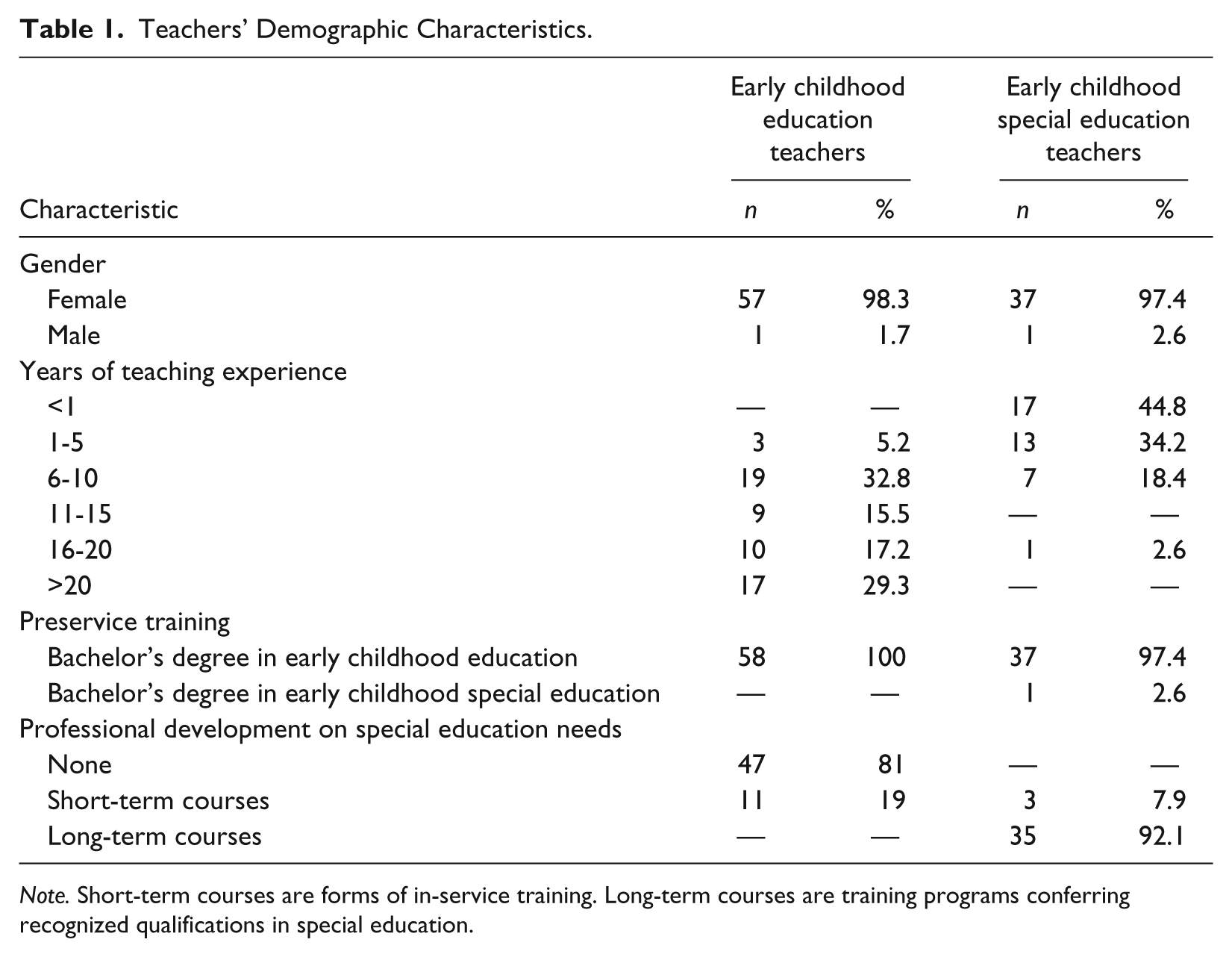
Note. Short-term courses are forms of in-service training. Long-term courses are training programs conferring recognized qualifications in special education.
Children with disabilities
Of a total of 93 children with disabilities aged between 52 and 92 months (M = 72.68, SD = 9.81), approximately 70% (n = 65) were boys. It is worthwhile to note that in the case of the participating children who were above the age of 6, a decision was taken to stay an extra year in the preschool program because they were considered unready to enter the primary school (Special Education of Persons with Disability and Special Educational Needs Act of 2008 [PL 3699], §199-8). Nearly all children (n = 87, 93.5%) had a diagnosis provided by the official Diagnostic and Evaluation Centers (i.e., the Medical-Pedagogical Center or the Center of Diagnosis, Differential-Diagnosis, and Support under the auspices of the Special Education of Persons with Disability and Special Educational Needs Act of 2008 [PL 3699], § 199-4). The remaining 6.5% (i.e., 6 children) were identified based on informal teacher assessments. As regards the children’s type of disability, the most prevalent diagnostic category was that of autistic spectrum disorder (n = 38, 40.9%), followed by developmental delay (n = 26, 27.9%), intellectual disability (n = 15, 16.1%), neurological problems (n = 13, 14%), and hearing impairment (n = 1, 1.1%). While this categorization system seems to overlap, we have adopted the exact terminology used in the children’s official statements.
Measurement: The ICP
The ICP (Soucacou, 2007) is in alignment with the recent joint DEC/NAEYC (2009) definition of high-quality preschool inclusion, in terms of access and participation. In particular, ICP assesses the extent to which teachers support and adapt their practices to promote access and active participation of all children, including children with disabilities, in everyday classroom activities.
Instrument format
ICP is a structured observation rating scale consisting of 11 items: (a) adaptations of space and materials/equipment, (b) adult involvement in peer interactions, (c) adult’s guidance of children’s play (free-play), (d) conflict resolution, (e) membership, (f) adult–child social communicative interactions, (g) support for social communication, (h) adaptation of group activities, (i) transitions between activities, (j) feedback, and (k) planning and monitoring of children’s individual needs and goals. The 11 items reflect specific practices that have been found to promote the inclusion of children with disabilities (Buysse, 2012; NPDCI, 2011; Odom et al., 2004). In fact, all of the items of the ICP are based on research evidence concerning the effectiveness of specialized instructional strategies for meeting the individual needs of children in the general education classroom.
From a technical perspective, each item includes a set of indicators that take the form of qualitative descriptions of classroom practices to be rated (Soukakou, 2012). These indicators mirror dimensions of quality that are interrelated. For instance, the “Adaptation of space and materials/equipment” item includes indicators that measure two interrelated dimensions of quality: the level of accessibility of space and materials and how adults use them to support peer interactions. An extensive description of the content of each of the 11 ICP items is provided in Soukakou (2012).
Instrument scoring
The ICP items are rated on a 7-point Likert-type scale with descriptors for 1 (inadequate), 3 (minimal), 5 (good), and 7 (excellent). Specifically, the lowest degree of quality (1) reflects practices that are considered harmful or highly inappropriate whereas the highest degree (7) reflects practices that are thought to promote inclusion while nurturing individualization. The ratings are based on information gathered at the indicator level through direct observation, teacher interview as well as document review (when identified on the scale), and might be assessed with Yes, No, or Not Applicable (NA; see Soukakou, 2012, for a full explanation of items and indicators rating in ICP).
Instrument reliability and validity
The ICP was field tested in a previous study conducted by Soucacou (2007) in a sample of 45 pre-K inclusive classrooms in the United Kingdom. The results of the English study showed that the internal consistency of the scale was .79 (Cronbach’s α). Soucacou also conducted interrater agreement checks in a separate set of classrooms (n = 10) with two independent observers; agreement, as measured through Cohen’s kappa (κ), was found to be in an acceptable range from .45 to .93, with a mean of 0.71. Exploratory and confirmatory factor analyses of the English data yielded one underlying dimension with 10 items (note: the “Conflict resolution” item was excluded from the structure of the scale; for these two analyses, see Soukakou, 2012). The confirmatory factor analysis revealed that the one-factor model verified the assumptions and showed good values for model fit (i.e., χ2 = 35.164, df = 35, p = 460, minimun discrepancy function C divided by degrees of freedom [CMIN/df] = 1.005, root mean square error of approximation [RMSEA] = 0.010, non-normed fit index [NNFI] = 0.998, and confirmatory fit index [CFI] = 0.998; Soukakou, 2012). Specific information about the technical adequacy of the Greek version of the ICP used in the present study is documented in the “Results” section.
Instrument translation
For the purposes of the present study, the ICP was translated into Greek. To facilitate linguistic equivalence, back translation procedures were applied to the test instrument and to the items themselves. The Greek translation was reviewed by two associate professors with expertise in the fields of inclusion, early childhood education, and measurement. In accordance with the suggestions of the reviewers, the Greek translation was piloted and tested in two general preschool classrooms where children with disabilities were also present. This procedure revealed modifications that were necessary for a few quality indicators of specific items in the ICP. Such modifications were as follows: clarification/explanation of terms such as some or several; replacement of examples of particular practices to adapt to the characteristics of a typical Greek preschool classroom (i.e., in the example “adult models for child how to use sand,” sand was replaced with blocks because sand tables are not available); and changes in scoring criteria. The third modification concerned an indicator assessing the extent to which “adults share responsibilities involved in preparing daily activities”; the option to score this case as NA was added. This is because underscoring this practice in cases where only one adult is present might have not resulted in valid measurements. With the consent of the author of the scale, these changes were included in the final version of the Greek scale.
Procedures
Access to the selected 52 schools was approved by the Greek Ministry of Education (Ref. no 4/2011). Prior to the actual observations, the first author received formal reliability training by the author of the ICP (Soucacou, 2007). The training program included two full-day sessions in Chapel Hill, North Carolina. During the first day, the researcher was trained in the scale’s purpose and aims, structure, and guidelines. This theoretical instruction was accompanied with a practice visit to a local preschool setting over a period of 3 hr, followed by a discussion about the administration and scoring of the scale. The second day involved a practice visit (3 hr observation) in a different preschool context, where the two researchers used the scale in an individual manner. Next, a debriefing workshop took place for the two observers to compare their ratings and clarify issues relevant to the scale’s scoring instructions.
Following these procedures, visits to the 52 Greek preschool settings were scheduled at a time convenient to the teachers over an 8-month period from October 2011 until June 2012. Each ICP assessment involved approximately 3 hr of observation. Before the observation began, the assessor asked the lead teacher to identify the children with diagnosed disabilities. Next, the observer took a few minutes to orient herself to the classroom and secure a position in the classroom from where she could clearly observe activities and interactions between children under observation and all teachers who were present in the class. As the focus of the ICP was on inclusive practices, the interactions between teachers and all children with and without disabilities were also observed to rate specific quality indicators as guided throughout the scale. The observation sessions were distributed carefully, given that some items on the scale required observation of events and activities that occurred only at specific times of the day (i.e., items 3, 8, and 9 covering free-play activities, teacher-directed group activities, and transitions, respectively).
At this stage, it needs to be mentioned that in 5 of the 52 participating preschool settings (i.e., 9.6% of the entire sample) a secondary data collector, a colleague with experience in naturalistic observation in educational environments, accompanied the primary data collector, with the aim of establishing interobserver agreement of the ICP. To ensure that both individuals administered the measurement simultaneously and independently with consistency across settings, training was also provided to the second rater by the research team. The training package involved two full-day sessions on the content, administration, and scoring of the ICP and two practice visits to Greek preschool classrooms. The sessions were designed, delivered, and distributed according to the guidelines offered by the author of the ICP and experienced by the first author (see above for a detailed description on the training in using the ICP). Interrater reliability scores are provided in the “Results” section.
Results
Descriptive Statistics on ICP’s Items and Total Composite Score
Descriptive statistics analysis was conducted to determine the quality of the practices that preschool teachers used to support the inclusion of children with disabilities in Greek mainstream preschool settings. The mean scores and standard deviations for the 11 ICP items and the total composite score are located in Table 2.
Means and Standard Deviation for ICP 11 Items and Total Composite Score.
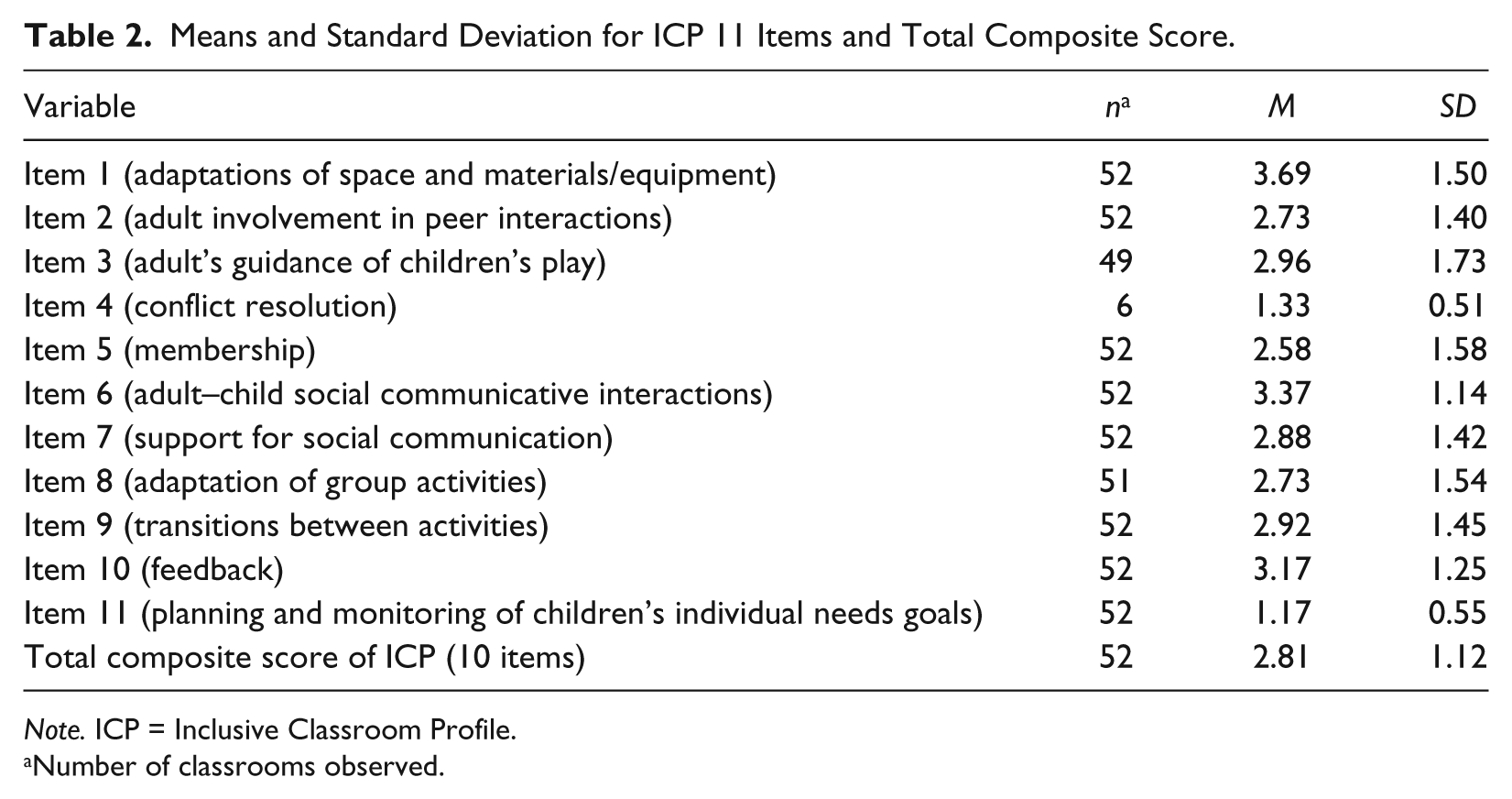
Note. ICP = Inclusive Classroom Profile.
Number of classrooms observed.
When examining the results at the item level, the following observations were made. All but one item were observed in full across the sample of this study with the “Conflict resolution” item being scored as NA in 88.5% (n = 46) settings. This item was eliminated from further analysis because of the large percentage of missing data, which indicated that conflict episodes among children with and without disabilities were not recorded during the observations.
The scores showed that the “Adaptations of space and materials/equipment” (M = 3.69, SD = 1.50), the “Adult-child social communicative interactions” (M = 3.37, SD = 1.13), and the “Feedback” (M = 3.17, SD = 1.24) were the “best-evaluated” items, but were still around the midrange of the 7-point Likert-type scale. Six of the remaining items accumulated low mean scores, ranging from 2.58 (“membership”) to 2.96 (“adult’s guidance of children’s play”). The “Planning and monitoring of children’s individual needs and goals” item had the lowest mean of 1.17 points (SD = 0.55). An additional examination on the distribution of this item showed that it was positively skewed, with a skewness value of 3.759. It also appeared to be kurtotic, with a kurtosis value of 15.319. Sensitivity analyses were conducted with and without this item, and with its log transformation, but results were robust to the alternative specifications. Thus, this item was retained in its original form in the analysis. The way this item was rated indicates that in the vast majority of cases (n = 50, 96.2%), teachers used practices of inadequate quality to plan for and implement the goals of children with disabilities in daily activities, and to monitor their progress in collaboration with parents.
A composite mean across the 10 items, without the “Conflict resolution” item, was calculated for each participating classroom. The total composite score had a mean of 2.81 and a standard deviation of 1.12, falling in the inadequate category (i.e., below 3). In particular, the test of the percentage of classrooms assessed as providing practices/services of “inadequate quality” (1 ≤ 3), “minimal quality” (3 < 5), and “high quality” (≥5), produced notable results. In 61.5% of the cases (n = 32), teachers were found to use practices of inadequate quality (1.00-2.80). In approximately one third (n = 18; 34.6%) of the classrooms, teachers were observed to make some efforts to encourage children with disabilities to access and participate in classroom activities and peer interactions, but these practices were of minimal quality (3.00-4.60). Inclusive provisions of a high quality (5.10-5.40) were recorded only in two sites.
Reliability and Validity Assessment of the Greek Version of ICP Interrater Reliability
The interrater reliability of the ICP was calculated initially across all 122 indicators in the scale using the percentage of point-by-point interobserver agreement. The interobserver point-by-point agreement was calculated by taking the total agreement between two observers, dividing by the total agreements plus disagreements, and multiplying by 100. Mean interrater agreement across assessors was 92.5% with a range of 87.3% to 98.1%. The interobserver reliability of the scale’s items was also calculated via Cohen’s kappa coefficient (κ). The mean weighted kappa for all items across classrooms was .87. The weighted kappa scores for all items across classrooms ranged from .71 to 1.00, with the “Support for social communication” (.71) and the “Planning and monitoring of children’s individual needs and goals” (.71) items falling in the .60 to .75 “good” range (Robson, 2002). Overall, the ICP was found to be reliable at the indicator and item levels.
Structural Validity
Pearson’s correlations among the individual items (i.e., 10 items) and the total ICP scores were computed to examine the contribution of each item to the scale. As shown in Table 3, the intercorrelations among the scale’s items ranged from r = .05 to r = .82, with a median of r = .66. Most of the items were significantly correlated with each other, presenting coefficients higher than .50. Also, correlations were computed among all items and their respective total scores measured by taking the scale’s composite score, excluding the item with which it was correlated, and dividing by the number of the remaining items. The analysis addressed significantly high associations between 9 of the 10 items and the ICP total scores, with an upper bound of r = .88 (“Adaptations of space and materials/equipment”) and a lower bound of r = .72 (“Adult’s guidance of children’s free-play”). Of importance were the findings with regard to the “Planning and monitoring of children’s individual needs and goals” item. Particularly, this item was found either not to correlate or to modestly correlate with specific items and its total score.
Intercorrelations Among Items and the ICP Total Score.
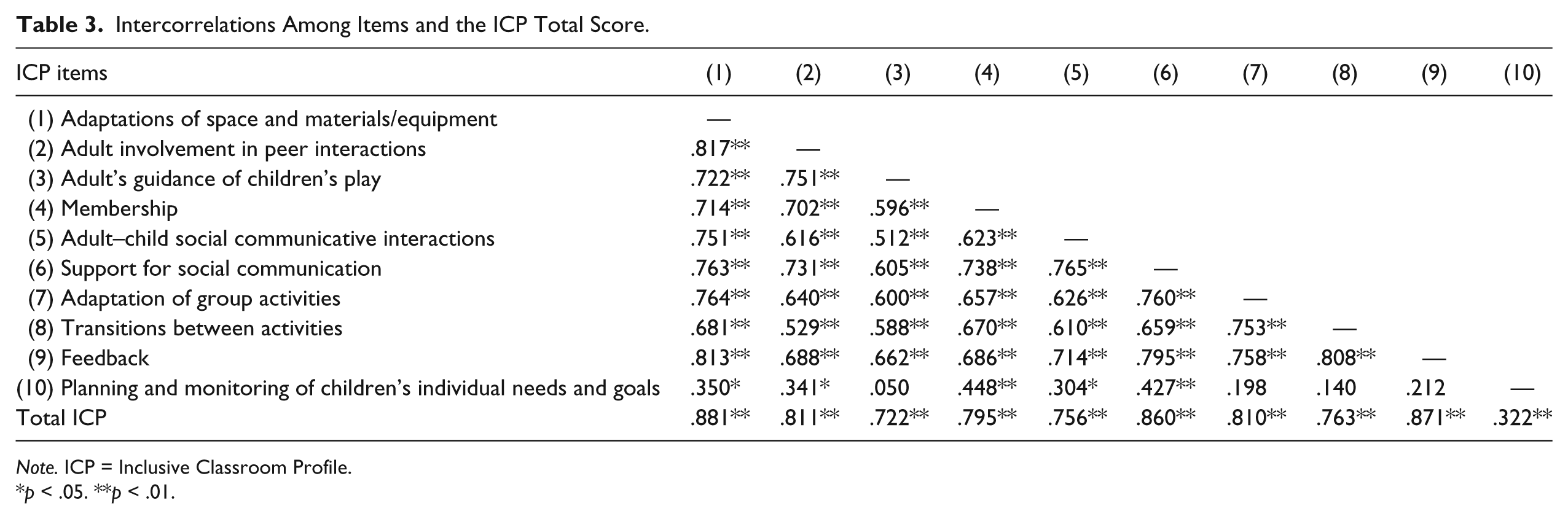
Note. ICP = Inclusive Classroom Profile.
p < .05. **p < .01.
An exploratory factor analysis was used to model the structure of associations among the 10 items of the ICP for the purpose of identifying the latent construct “preschool inclusion quality” in the Greek sample (Preacher & MacCallum, 2003). The severe violations of the normal distribution found for the “Planning and monitoring of children’s individual needs and goals” item (see Table 2 for details about the item’s distribution) led us to choose an iterated principal factors method as this method of extraction in exploratory factor analysis is less affected by non-normality (Briggs & MacCallum, 2003; de Winter & Dodou, 2012; Fabrigar, Wegener, MacCallum, & Strahan, 1999). In particular, we applied the principal axis factoring (with iterations) solution.
As far as the rotation method was concerned, the selection was based on the existing theory about inclusion in education, according to which a preschool inclusive classroom represents an amalgam of practices (factors) that are interrelated (Odom et al., 2004). In this line of reasoning, it was assumed that the factors structuring the construct of quality in preschool inclusive programs were correlated and so an oblique rotation was selected (Field, 2009). For this analysis, a direct oblimin rotation (delta = 0) was used. It is worth mentioning that because of the small sample size of the study (52 cases), we focused on salient factor loadings—that is, loadings that were statistically significant (p < .01). In particular, following the recommendations offered by Stevens (2009), saliency was set at >.722.
The factorability of the 10 items of the ICP scale was examined. Kaiser–Meyer–Olkin measure of sampling adequacy was .89, which is satisfactory, and Bartlett’s test of sphericity was significant, χ2(45) = 407.266, p < .001 (see Field, 2009, for a discussion on these measures). Finally, the communalities were all above .60, showing that each item shared common variance with other items.
Given these overall indicators, an initial factor analysis was run to obtain eigenvalues for each factor in the data with all 10 items. Two factors had eigenvalues over Kaiser’s criterion of 1.0 and in combination explained 77.55% of the variance. As can be seen from Table 4, the first factor was defined by 9 of the 10 items with factor loadings ranging from .752 to .908. As for the “Planning and monitoring of children’s individual needs and goals” item, it was found to load separately (.903) under “Factor 2.” However, because three to five measured variables are needed to represent a common factor for providing accurate results (Fabrigar et al., 1999), this item was decided to be ignored from the original structure (10-item) of the ICP scale.
Factor Loadings Based on a PAF Analysis With Direct Oblimin Rotation for 10 and 9 Items of the ICP Scale.
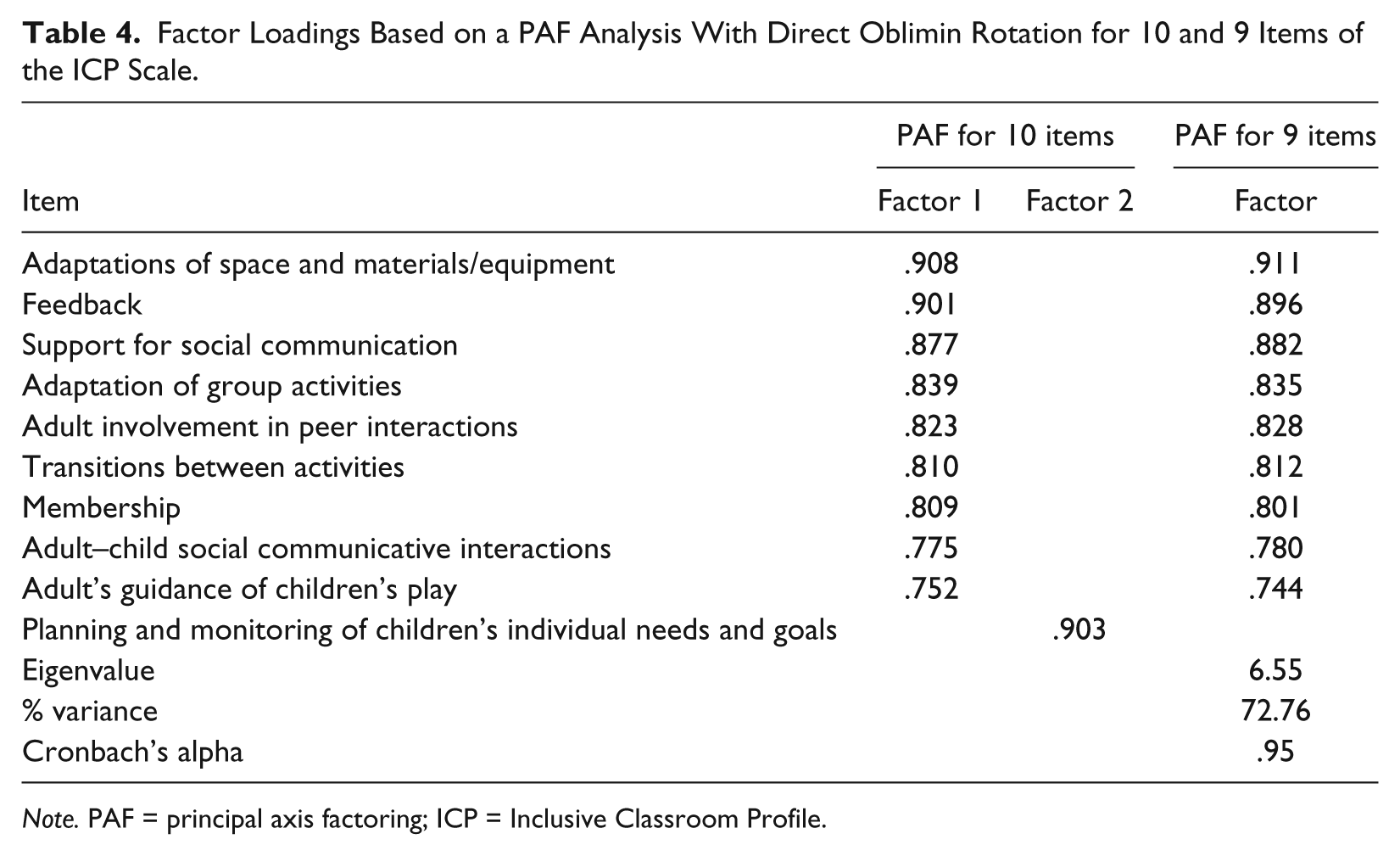
Note. PAF = principal axis factoring; ICP = Inclusive Classroom Profile.
As a result, a factor analysis was conducted, this time, with the nine items of the scale. A single dominant factor comprising nine items was extracted. This factor had an eigenvalue of 6.55 and explained 72.76% of the common variance. Table 4 presents the factor structure and loadings of the nine-item scale.
Internal Consistency
Cronbach’s alpha analysis was conducted to test whether the nine items of the ICP “fit together” (Viswanathan, 2005). The results showed that the scale had a high internal consistency estimate (α = .95).
Discussion
The present study was an attempt to investigate the quality of inclusive education that was available to children with disabilities in a sample of 52 Greek general preschool settings. The investigation of preschool inclusion quality was built upon the emergent work carried out on the ICP (Soucacou, 2007), a scale which was developed and field tested in the United Kingdom, in an effort to define functionally and assess different parameters regarding the quality of inclusive preschool programs. As a result, the applicability of the ICP in Greece was examined further by assessing the interrater reliability, structural validity, and internal consistency of the Greek version of the scale.
According to the results of the study, the provision offered to students with disabilities, who attended general preschool programs, was mainly of poor quality. In one third of the observed settings, the ways in which practices were implemented by teachers minimally facilitated access and participation in everyday classroom activities and/or routines for children with disabilities. Good or excellent practices were almost absent in the observed preschool settings. The low to minimal quality practices found in this study can be explained by reflecting on results from other national studies that have explored the quality of early childhood provision in general (see, for example, Petrogiannis, 2010; Rentzou, 2010). These studies indicated that infants, toddlers, and preschool-aged children participate in center-based settings that function in a rather poor manner. That being the case, the general care and education system in Greece is, to a greater extent, not only unable to respond sensitively and appropriately to the potential needs of children without disabilities but even less able to accommodate the needs of children with disabilities.
In addition, such ineffective practices suggest that the legal framework (the Special Education of Persons with Disability and Special Educational Needs Act of 2008 [PL 3699]) for promoting inclusion and equal opportunities for all students was not really followed up with the corresponding regulations and actions at school and/or classroom levels. The gap between stated and enacted policies might be linked to the fact that within the current policy-making of inclusion, the concepts of “human rights” and “equal opportunities” in education are articulated as abstract principles. Due to their abstraction from actual social contexts, statements of rights and opportunities (a) fail to take into consideration the implications of competing discourses for policy outcomes; (b) are limited in their impact, and in particular are constrained within the bounds of an ethical critique of exclusion which offers no strategies for bringing about change; and (c) are presented as “given” rather than as “secured” through particular measures, and thus they reduce social justice to technical and bureaucratic issues of basically functional arrangements. In this way, inclusion policies are in danger of remaining at the level of rhetoric (Armstrong, Armstrong, & Barton, 2000).
The gap between stated policies and enacted practices in relation to inclusive education seems to exist in other countries too, but to a lesser extent. For instance, in England, a more diverse range of ratings (2.51-4.54) were found even though none of the ICP items accumulated high-quality mean scores (Soucacou, 2007). Somewhat better results were found in a small-scale study conducted in the United States (Muccio, Kidd, White, & Burns, 2014) in which all the ICP items averaged equally or above the criterion score of 4 across the participating preschool programs (i.e., nine settings). There were no classrooms with poor or excellent ICP ratings. However, it is important to note that, despite the generally common cross-national findings relating to the non-existence of preschool inclusive centers of excellent quality, the Greek overall mean score (M = 2.81) was still substantially lower than those in the U.K. (M = 3.37) and U.S. (M = 4.67) studies. The extent of the differences suggests real-life challenges, especially at a time of financial crisis, when children with disabilities in Greece tend to be exposed to educational practices of a lower quality when compared with their peers with disabilities from the United Kingdom and United States.
Apart from examining the quality of provision offered to children with disabilities in Greek general preschool classrooms, this study aimed to examine the applicability of the ICP in the Greek educational context. In terms of its structural validity, the ICP was found to measure quality as a substantively unidimensional construct. However, the one-factor model extracted was comprised of 9 and not of the initially hypothesized 10 items of quality (see information on the instrument’s structural validity as identified in the U.K. study in the “Method” section). The 9 items detected by the exploratory factor analysis were as follows: adaptations of space and materials/equipment, feedback, support for social communication, adaptations of group activities, adult involvement in peer interactions, membership, transitions between activities, adult–child social communicative interactions, and adult’s guidance of children’s play (free-play). Overall, the 9-item scale identified in this study had high internal consistency.
The “Planning and monitoring of children’s individual needs and goals” item was discarded from the factor structure of the ICP because of loading complexity; it loaded separately on a subsequent factor. This finding is in contrast to the results of the study conducted in England (Soucacou, 2007), where this item was found to contribute to the one-factor model of the construct quality. The factor structure explored in the present study, which needs to be assessed in larger and more diverse samples, can be attributed to (a) how the learning progress of children with disabilities is monitored within the Greek general education system and (b) the content of the item per se.
Specifically, a major problem of policy design and implementation in the area of inclusion in Greece is its traditional, dominant, and persistent focus on an individualistic approach to disability (Strogilos, 2012; Vlachou, 2004). Despite ample evidence that this approach is detrimental and counterproductive to efforts toward inclusion (Armstrong et al., 2000), it continues to dominate social conditions, relations, and practices. For instance, dominant policy practices in Greece tend to assume that the success of inclusion is largely dependent on the disabled pupil’s individual characteristics and, by extension, on his or her ability to assimilate into a largely undifferentiated classroom environment (Zoniou-Sideri & Vlachou, 2006). Consequently, modifications of the syllabus and teaching methods are not carried out, while educational assessment places heavy emphasis on a child’s skill acquisition in which issues of academic performance and compliance with the overall demands of the program are foregrounded (Mavrommatis, 1997; Mavrommatis, Zouganeli, Kafka, & Stergiou, 2007). In this context, teachers may have difficulty understanding the necessity and the function of developing individual education plans (IEPs) as a “vehicle” for the individualization of classroom practices to respond to the goals and objectives of children with disabilities and to promote their development.
From a statistical perspective, the differential functioning of the “Planning and monitoring of children’s individual needs and goals” item in this study needs to be considered in relation to its content. In this version of the ICP rating scale, this item measured concurrently three interrelated but distinct practices of preschool inclusion, namely (a) planning and implementing children’s IEPs as part of the general program, (b) monitoring children’s progress according to their IEPs, and (c) establishing relationships with parents. Revisions of this item were recently piloted in a U.S. sample to keep the focus on “planning and monitoring children’s learning needs” separate from indicators related to “family-school partnerships” (E. Soukakou, personal communication, March 11, 2014).
A final important finding of this study was that the “Conflict resolution” item was not included in the factor structure of the ICP because it was observed in few settings. Although this result is consistent with the findings of Soucacou (2007), evidence from semi-structured interviews conducted with the general and special early childhood teachers in an attempt to cross-validate and corroborate the observational records showed that, in the majority of cases, children with disabilities were considered to be at risk of social withdrawal isolation and/or getting involved in asymmetrical processes (i.e., assuming subordinate roles or being catered for or protected by others) within their peer culture (Fyssa & Vlachou, 2013). This evidence, which is consistent with previous research (Janson, 2001; Meyer, 2001; Odom et al., 2006), signifies that conflict, as presented by the ICP model, is only one aspect of the complex nature of social rejection that children with disabilities might experience by their peers. Therefore, future research in the area should shed more light by examining and analyzing more thoroughly children’s behavior patterns in social tasks in the classroom.
Limitations and Future Research
There are a number of limitations to this study. The sample of the present study was drawn from certain provincial regions of Greece that cannot be seen as nationally representative even though the study represented the majority of the inclusive preschools in these areas. Thus, we were unable to detect differences in relation to the quality of the educational provision that is available to children with disabilities in general preschools in diverse geographical areas such as mountainous areas/villages or islands (Vlachou-Balafouti & Zoniou-Sideri, 2000). It is also important to note that the sample of the study included only state preschools for children between the ages of 4 and 6. Therefore, these findings may not apply to preschool inclusive classrooms in the private sector or day-care centers that present different regulatory environments (Doliopoulou, 2006).
Another limitation relates to the restricted psychometric characterization of the reliability of the ICP measure in the present study. Specifically, the reliability of two data collectors was assessed only in 9.6% (n = 5) of the 52 participating classrooms, which is of very low standard. In general, this study should be considered preliminary, and future studies should consider establishing interrater agreement and testing-retesting the scale in a larger number of schools (Robson, 2002). Also, confirmatory studies should be conducted to test the validity of the one-factor model with the 9 items in other contexts. Notwithstanding these limitations, our results indicated that all 9 items loaded strongly on the defined factor and had moderate to high communalities without cross-loadings, which provide an initial support to our solution (Costello & Osborne, 2005).
Given that the discussion about the quality of preschool inclusion gains momentum, more emphasis should be placed on the assessment of the ICP’s reliability and validity. This study has important implications for research and practice as it is the first of its kind that has sought to assess the quality of preschool inclusive programs in Greece by documenting the applicability of the ICP in a different cultural, socio-educational, and linguistic environment. In so doing, this study has succeeded in establishing the scale’s validation in a sample of classrooms which differentiated in terms of the special provision (i.e., pull-out program, in-class support, and no additional support) that could be offered to children with disabilities in inclusive preschool contexts. In addition to conducting confirmatory factor analysis, future studies should examine the relationships of the full ICP (or its individual items) to child outcomes for children with disabilities and to global program quality measures (such as the ECERS-R which has been validated in Greece; Botsoglou & Kakana, 2013) in determining the scale’s predictive and convergent/divergent validity. If this evidence is combined with qualitative research on the beliefs of the professionals (e.g., teachers, administrators, educational counselors) and the parents of children with and without disabilities about the quality of the enacted practices, a framework might be developed in guiding the inclusion agenda.
Conclusion
In conclusion, the participating general and special early childhood education teachers were observed to use practices of low quality that promoted only to some extent access and participation in classroom activities for children with disabilities. As far as the applicability of the ICP measurement in the Greek educational context was concerned, the results indicated that “preschool inclusion quality” was detected as a unidimensional construct consisting of nine items with high factor loadings and internal consistency. While these statistical indicators provide evidence of a robust instrument, they cannot be generalized to the whole of Greece or to other cultural and educational environments. Therefore, additional studies are necessary to demonstrate national and cross-national validity of the ICP. This research activity will help in the development of the ICP as a culturally sensitive tool, so that researchers would be able to share a common understanding for studying preschool inclusion quality and to compare their findings. Finally, the existence of such a culturally sensitive tool could have multiple benefits for professionals involved in early childhood inclusion practice, including the use of data to plan and deliver classroom-based interventions aimed at enhancing children’s learning outcomes.
Footnotes
Acknowledgements
We are grateful to the teachers and pupils who participated in this study, as well as to Elena Soukakou for giving us the permission to use the Inclusive Classroom Profile (ICP) scale. We are also thankful to Dimitra Papadimitriou for her insightful comments throughout the preparation of this manuscript.
Declaration of Conflicting Interests
The author(s) declared no potential conflicts of interest with respect to the research, authorship, and/or publication of this article.
Funding
The author(s) disclosed receipt of the following financial support for the research, authorship, and/or publication of this article: This research was supported by scholarship awarded to Aristea Fyssa, cofinanced by the European Union (European Social Fund—ESF) and Greek national funds through the Operational Program “Education and Lifelong Learning” of the National Strategic Reference Framework (NSRF)—Research Funding Program: Heracleitus II (Grant MIS 339852) investing in knowledge society through the European Social Fund.