




Abstract
Recent research findings have led to the conception that values pedagogy connotes a philosophy of learning and principle of curriculum organization with potential to enhance all dimensions of the learning environment. Enhancement includes student responsibility to themselves and others and positive impact on learning outcomes. Allied research demonstrates that a particularly potent feature of such pedagogy is to be found in service learning. The article appraises the research relevant to such claims, including among empirical findings from the Australian Values Education Program.
Introduction
The foundational thought behind the Australian Government’s National Framework for Values Education in Australian Schools (Department of Education, Science and Training [DEST], 2005) was in the idea that values education, incorporating civics and citizenship education, both relies on and enhances good practice pedagogy. This can be taken to mean two things. First, values education must rest on best practice pedagogy. That is, it cannot merely be an “add-on” or break the conventions of good teaching identified in educational research. Second, and quid pro quo, well-crafted values education has its own enhancing effect on best practice pedagogy. That is, it both builds on and strengthens the criteria that characterize such pedagogy as identified, for example, in Fred Newmann’s pedagogical dynamics for effective quality teaching (Newmann & Associates, 1996). This leads to the consideration that values education in all its forms can no longer be considered to be merely a moral option, and therefore debatable and subject to partisan dispute, as has been its history. Increasingly, the evidence is that it is a pedagogical imperative. Hence, the language of values pedagogy (Lovat, Dally, Clement, & Toomey, 2011) connotes a holistic approach to learning that, evidence suggests, is particularly effective.
Research findings from projects that operated as part of the Australian Values Education Program (Department of Education, Employment and Workplace Relations [DEEWR], 2008, 2010; DEST, 2006; Lovat et al., 2009) confirm that values pedagogy connotes a philosophy of learning and principle of curriculum organization with potential to shape the entire schooling experience. This includes the planning, managing, and organizing of the curriculum; the teaching and learning environment and approaches; and the ambience of internal and external relationships between and among all stakeholders. A particularly potent feature of such pedagogy is to be found in the curriculum intervention that includes teaching and learning opportunities incorporating the wider community and placing students in a relationship of service with and to that community. Going by various names, this pedagogical feature is invariably described as “service learning.” It is to this curriculum intervention and its especially contributory role in broader values pedagogy that this article is now directed. The article will proceed in two steps to do the following. First, it will review the literature, premised largely on neuroscience and related fields, to expound on the role played by social intelligence and the development of empathic character in enhancing learning generally and, furthermore, the demonstrated contribution of service learning to this process. Second, it will mine the data from the research and practice projects emanating from the Australian Values Education Program to provide further empirical evidence that supports the contentions and findings from the literature.
Service Learning and Sociality
In relation to its particular role in values pedagogy, service learning can be seen to accord with neuroscientific notions concerned with sociality as a feature of human development, social intelligence as an artifact of cognition, and the nurturing of empathic character as essential to effective teaching and learning. As Immordino-Yang and Damasio (2007) have demonstrated, sociality enjoys an interactive nexus relationship with the brain functions known as cognition and affect. That is, there can be no cognitive and emotional development without corresponding social development, because development is a product of the interplay between genetic inheritance and the physical and social environment (Diamond, 2009). As Goleman (2006) has shown, social intelligence is not a separate entity from other forms of intelligence. It functions conjointly with other forms to constitute the very entity we describe as “intelligence.” Without it, intelligence is impaired. Similarly, Carnegie Corporation (1996) postulated that the nurturing of empathic character is a foundational characteristic of effective learning. In its absence, learning is reduced in its effect. It is pertinent, therefore, to the purpose of this article to explore those elements of values pedagogy that center on nurturing empathic character and affective self-management, and so developing sociality and social intelligence. As suggested, this element of the pedagogy goes often by the name of service learning.
Service learning has taken many forms but is characterized by a pedagogy that combines community service with reflection on action (Billig, 2000b; Furco, 2008). Five recent meta-analyses (Celio, Durlak, & Dymnicki, 2011; Conway, Amel, & Gerwien, 2009; Novak, Markey, & Allen, 2007; Warren, 2012; Yorio & Feifei, 2012) provide supporting evidence to long-held convictions that service learning has beneficial effects for a diverse range of outcomes for students. These effects include their personal, moral, social, and civic development, as well as their motivation for schoolwork evidenced by improvement in academic achievement. Service learning has been implemented across a broad spectrum of educational settings from kindergarten to a variety of adult educational settings. Regardless of the level, research has consistently revealed the above variety of beneficial outcomes for participants.
High-quality service learning provides for those essential social conditions whereby values are formed in the context of civic awareness and citizenry (Shumer, Lam, & Laabs, 2012). Studies have shown that such pedagogy has a positive impact on student behavior and moral awareness, resulting in improved attitudes toward their social responsibilities and civic engagement (Halfacre, Chessin, & Chambless, 2006; Hart, Matsuba, & Atkins, 2008). Berkowitz, Battistich, and Bier (2008) regarded service learning as creating optimal conditions for such development. This is supported by studies that indicate that service learning provides a positive context for the formation of social, personal, and civic responsibility; communicative competence and meaningful relationships with adults; as well as growth in the kind of awareness that extends to empathic understanding, altruism, giving, and caring (e.g., Billig, 2000b; Conrad & Hedin, 1991; Stewart, 2007). Furthermore, involvement in service learning broadens students’ career aspirations and opportunities, stimulates future involvement in service activities and civic leadership, and enhances the maturation process from adolescence into adulthood (Billig, 2000a; Warchal & Ruiz, 2004; Wilczenski & Coomey, 2007). Service learning provides opportunities to interact with others in a wider social context, and there is broad testimony to its capacity to deepen civic responsibility among its participants (e.g., Billig, 2002; Carson & Domangue, 2013; Furco & Root, 2010). In fact, Metz and Youniss (2003, 2005) found this to be the case even when students who were less inclined toward service learning were nonetheless mandated to engage in it as part of course requirements. Moreover, rather than being detrimental for further voluntary service, the stipulation to serve actually proved to be motivating.
More recent meta-analyses have added weight to observations that service learning contributes to the development of sociality and civic responsibility in students (Table 1). Three meta-analyses (Celio et al., 2011; Conway et al., 2009; Yorio & Feifei, 2012), regardless of their different categorizations, identified the positive effects of service learning on social and civic engagement. For Conway et al., (2009), the strongest effect concerned justice-oriented citizenship. Celio et al., (2011) found that service learning produced beneficial effects in the civic engagement and development of social skills among its participants, and Yorio and Feifei (2012) reported that service learning aided students’ understanding of social issues.
Personal, Social, and Citizenship Outcomes of Service Learning (Compiled From Sources Included).
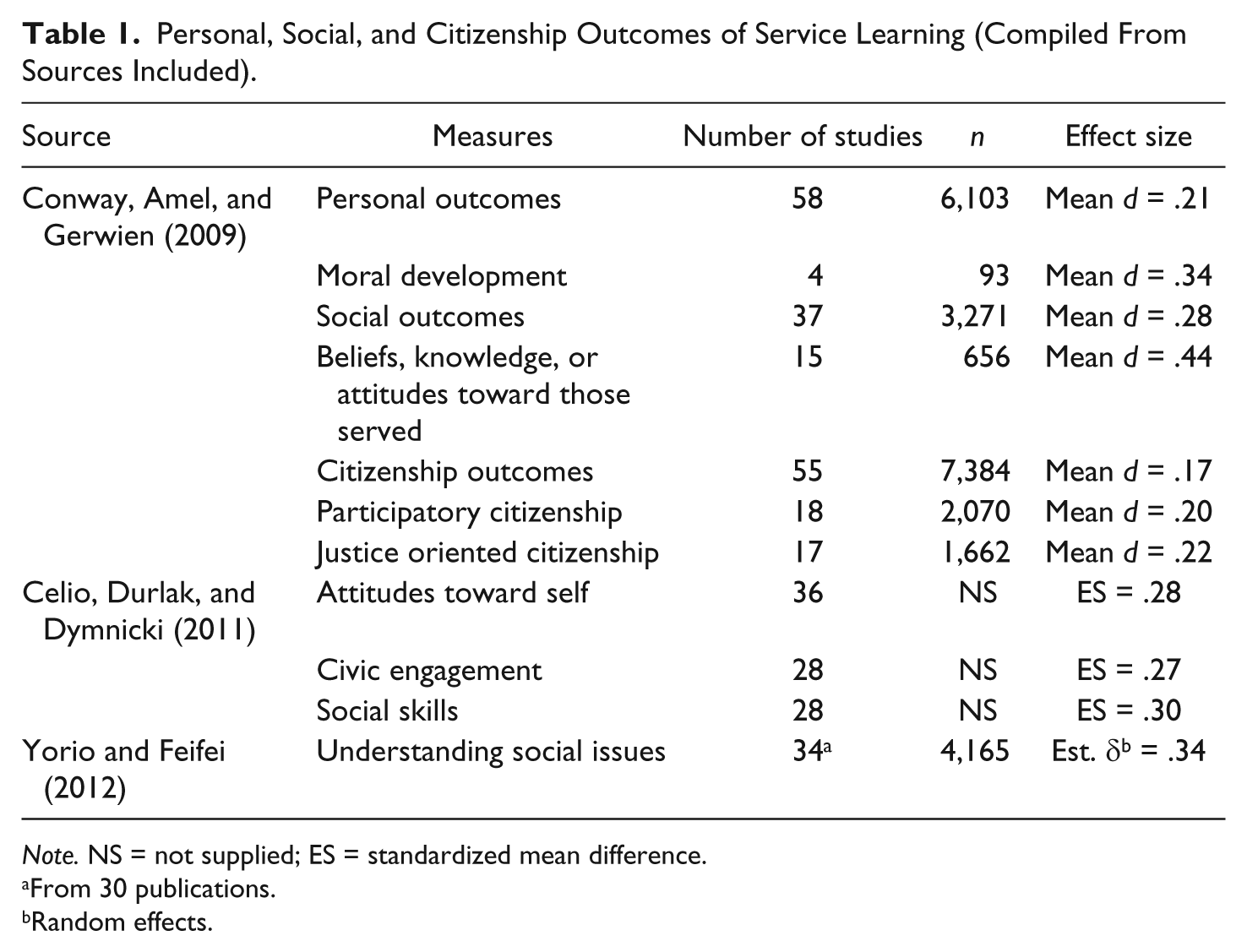
Note. NS = not supplied; ES = standardized mean difference.
From 30 publications.
Random effects.
The capacity of service learning to break down cultural barriers and form positive relationships with people beyond one’s usual social reach is attested to in multiple studies. It has been shown to underpin the effective integration of intercultural learning into mainstream education (Flannery & Ward, 1999; Goddard & Gribble, 2006) and to promote intercultural sensitivity and competence (e.g., Borden, 2007; Pisano & Rust, 2007; Wilczenski & Coomey, 2007). In like manner, service learning provides a context for attitudinal change toward people with disabilities, especially where there is interaction between special needs and “mainstream” students (e.g., Brill, 1994; Dymond, Renzaglia, & Chun, 2008). It has also proven effective in instilling a deeper appreciation of the elderly and those more senior to the participants (e.g., Gutheil, Chernesky, & Sherratt, 2006).
Evidence suggests that sociality and civic development are accompanied by personal growth. Observed benefits include improvement in school climate and a reduction in health risks and/or at-risk behaviors, including those related to school and learning behavior (e.g., Allen, Philliber, Herrling, & Kuperminc, 1997; Denner, Coyle, Robin, & Banspach, 2005; O’Donnell et al., 2002). The meta-analysis of Celio et al. (2011) produced a positive effect in relation to attitudes toward self (Table 1). Likewise, Conway et al. (2009) calculated a beneficial effect for personal outcomes, particularly in relation to moral development.
On the basis of the evidence, it would seem that the capacity of service learning to induct its participants into responsible citizenship would be sufficient justification alone for its inclusion in the school curriculum. Moreover, the meta-analyses listed above bolster evidence for the claim that service learning also progresses academic achievement, further increasing its credentials as comprising an important component of a broad values pedagogy (Lovat et al., 2011). All five meta-analyses report beneficial effects for academic outcomes or cognitive development, and in those studies that report social and citizenship outcomes (Celio et al., 2011; Conway et al., 2009; Yorio & Feifei, 2012), the effect sizes for academic and/or cognitive outcomes are the highest (Table 2). In fact, Celio et al. (2011) found the effect size of academic achievement to be significantly higher than the four other outcomes, namely, attitudes toward self, attitudes toward school and learning, civic engagement, and social skills. Also, they calculated a positive effect emanating from service learning on student motivation. Interestingly, although Yorio and Feifei (2012) found that there was no statistical significance regarding the voluntary nature of service learning for personal insight and understanding social issues, the contrary proved to be the case for cognitive development (Table 2). Yorio and Feifei’s results indicated intrinsic motivation to be a key factor in effective cognitive engagement in service learning.
Effect Sizes of Academic/Cognitive Outcomes With Selected Sub-Measures (Compiled From Sources Included).

Note. NS = not supplied; ES = standardized mean difference; GPA = Grade Point Average.
Of 380 outcomes.
From 19 publications.
Random effects.
Reflection is widely regarded as a core element in effective service learning. Many studies point to intentional reflection as a distinguishing and essential feature that promotes the personal, moral, and intellectual development of students (e.g., Billig, 2000b; Conrad & Hedin, 1991; Eyler, 2002). The reflective dimension in service learning is associated with the development of empathic understanding (Gibson, 2009) and has the capacity to develop critical and transformative thinking in participants (e.g., Cooper, Cripps, & Reisman, 2013; Kahne & Westheimer, 1996). Reflection is a key element in the identification of service learning as a species of Deweyan-inspired experiential learning (Gibson, 2009; Giles & Eyler, 1994) and is touted by Eyler (2011) as the most consistent predictor of outcomes. Despite the existence of studies that provide inconclusive evidence regarding the efficacy of reflection in service learning as being instrumental in values formation (e.g., Hart, Atkins, & Donnelly, 2006; Waldstein & Reiher, 2001), recent meta-analysis provides evidence of its positive contribution on reflection. For instance, Celio et al. (2011) reported that 49 of their 64 selected studies of service learning had at least one recommended program feature. Of these 49 studies, 75% used reflection and, of the 21 that reported only one program feature, 20 had incorporated reflective practice. This group of 21 registered a mean that was significantly higher than those 13 studies that had used none of the recommended practices (Table 3).
Effect Sizes of Use of Reflective Practice (Compiled From Sources Included).

Note. NS = not supplied; ES = standardized mean difference.
Q tests for differences between no reflection and reflection cohorts were significant at p < .05 for random and fixed effects.
Q tests not significant at p <. 05 for both fixed and random effects.
Q test significant for fixed effects at p < .05.
Twenty of the 21 studies used reflection as the single program feature.
From 30 publications.
Random effects.
Written reflection and discussion reflection statistically different at p = .01.
From 13 publications.
From 19 publications.
Conway et al. (2009) provided a more detailed analysis of the effect of reflection in service learning. In this meta-analysis, the mean effect sizes (ES) of studies incorporating structured reflection are compared with those that do not incorporate it across the categories of personal outcomes, social outcomes, and citizenship outcomes (Table 3). In the category of personal outcomes, the ES difference between those studies reporting the use of structured reflection and those that did not was statistically significant for both fixed and random effects. For social outcomes, there was no statistical difference between the two modes, whereas, for citizenship outcomes, the differences between reflective practices and non-reflective practices showed statistical significance for the fixed effects Q test but not the random effects test. As with Celio et al. (2011), Conway et al. did not distinguish between the mode of reflection employed, so there is no indication of whether there might be a mode by outcomes interaction. Such an interaction was postulated by Waldstein and Reiher (2001) based on the work of Dunlap (1998) in the absence of statistical evidence for any effect of reflection in their analysis of the outcomes of service learning. Nevertheless, the meta-analysis provided by Conway et al. provides evidence that the effect of reflection varies across categories, with personal outcomes being the most susceptible to the influence of reflection.
The meta-analysis of Yorio and Feifei (2012) invited the suggestion of a mode of reflection by category interaction. They compared the mode of structured reflection, that is, discussion reflection or written reflection across the learning outcomes of understanding of social issues, personal insight, and cognitive development. All six effect sizes were statistically significant. This means that reflection, whether written or by discussion, had an effect on student learning across all three learning outcomes (Table 3). In a comparison of the two modes of reflection, namely, discussion and written, discussion reflection proved more efficacious in relation to the understanding of social issues, but not in relation to personal insight or cognitive development. A similar differential effect is reported by Hart et al. (2008) in relation to political efficacy. Class discussion about the service activity produced a negative predictor of beta -.13, on political efficacy, whereas written reflection produced a positive predictor of beta .20. No effects were found for other measures. It would seem from the analysis of Yorio and Feifei and the work of Hart et al. (2008) that a differential effect between mode of reflection and outcome may well exist at least for some outcomes, and that mode of reflection may have to be varied to achieve maximum effect across different outcomes. Moreover, these results point to the necessity of recognizing that quality learning involves an alternating pattern of engagement between experience and internal reflective activity (Immordino-Yang, Christodoulou, & Singh, 2012). This balance of experiencing service and having the structured opportunity to reflect on and discuss the experience would seem to be integral to service learning having the holistic effects identified above, including those pertaining to academic achievement. This balance was at the heart of those projects in the Australian Values Education Program that utilized service-learning interventions.
Service Learning in the Australian Values Education Program
The Australian Values Education Program was an innovation of the national government of Australia. It began with a pilot study in 2003 (DEST, 2003), followed by the development of a National Framework for Values Education in 2005 (DEST, 2005) and a range of research and practice projects from 2005 to 2010, the most crucial of which were the two stages of the Values Education Good Practice Schools Project (VEGPSP; DEEWR, 2008; DEST, 2006) and the Project to Test and Measure the Impact of Values Education on Student Effects and School Ambience (Lovat et al., 2009).
Within the two stages of VEGPSP, 316 schools organized into 51 clusters across the country, involving approximately 100,000 students, 5,000 teachers, and 50 University academics, engaged in a variety of approaches to values education, all based on the central premise that values education and best practice pedagogy are inextricably interrelated. Findings from the above projects demonstrated that a sound values education can be a powerful ally in the development of best practice pedagogy, with positive effects being demonstrated across the range of measures, including in terms of social engagement, social responsibility, and academic development. Service learning was a constant feature of these projects.
In the first large project titled, Values Education Good Practice Schools Project–Stage 1 (VEGPSP-1; DEST, 2006), comprising 26 “cluster projects” among the 166 schools that participated, several of the cluster projects focused explicitly on activities pertaining to service-learning pedagogy. One of the clusters liaised with the Red Cross and a local nursing home as their service sites and, following best practice guidelines, backed up the service with intense reflectivity, discussion, and dialogue. Pre-service reflection with Year 9 (14 years of age) students on the tasks at hand resulted in the kinds of responses that one might expect of early adolescents, being largely dismissive of the potential for the intervention to entail a meaningful experience for them. In contrast, toward the end of the project, the same group was showing clearly that the service had impacted on their consciousness. Reflective responses included the following:
Understanding because you need to know how people feel and what they think;
Don’t take life for granted because it is too short;
I now value my youth and have more respect for the elderly and the way they live;
There are values in everything. I just didn’t realise it before;
From all of the people in the respite centre, I saw how they respected me and they tolerated [me]. They were so patient it was unbelievable. I really respect them and I tried to do my best because it was so important to them. (DEST, 2006, p. 161)
In the follow-up project (Values Education Good Practice Schools Project–Stage 2 [VEGPSP-2]), comprising 29 cluster projects around the 151 participant schools, reflection on service as a means of achieving the goals of values pedagogy had matured. The report (DEEWR, 2008) identified, for a range of cluster projects, the holistic goals that were achieved via service-learning interventions. For one cluster that took a global education focus on children’s working conditions in third world countries, reflection on action resulted in enhanced empathic character demonstrated in student campaigns to alert consumers to manufactured goods that were the product of child labor. In another cluster, engagement with disadvantaged groups in their own community led to organized activities to address loneliness and deprivation, again portraying growth in empathic character, an essential learning outcome related directly to the goals of enhanced civic awareness and citizenship involvement. The report proffers,
Service learning is a pedagogy that aids the development of young people as they learn to engage in the worlds of others and then participate in civic service. It is a form of experiential learning which is integrally related to values education, and helps young people to empathise, engage and take their place as civic-minded, responsible, caring and empowered citizens in our community. (DEEWR, 2008, p. 34)
The link demonstrated above in international research between growth in student agency, civic consciousness, and citizenship involvement, and greater academic attention and enhancement was noted quite early on in the development of the Australian program. Without these links being especially explicit, as early as VEGPSP-1, teacher testimony was including comments like the following:
Everyone in the classroom exchange, teachers and students alike, became more conscious of trying to be respectful, trying to do their best, and trying to give others a fair go. We also found that by creating an environment where these values were constantly shaping classroom activity, student learning was improving, teachers and students were happier, and school was calmer. (DEST, 2006, p. 120)
By the time VEGPSP-2 had matured, these links were being made more often and were more prominent in the participants’ minds. In the latter report, we read,
Teachers assert that increased student agency makes schooling more meaningful, enjoyable and relevant to students’ lives. Student agency refers to empowering students through curriculum approaches that: engage them; are respectful of and seek their opinions; give them opportunities to feel connected; promote positive and caring relationships; promote wellbeing and focus on the whole student; relate to real-life experiences; are safe and supportive. (DEEWR, 2008, p. 40)
In this statement, we begin to sense an awareness of and confidence in the vital links between holistic and effective student agency and the wider goals of learning inherent to the school, including its foundational charter around academic learning. Herein, we see, demonstrated evidentially, the postulation made at the outset, namely, that values education can no longer be seen as a mere moral imperative but, moreover, as a pedagogical one. Hence, we have posited the notion of values pedagogy as a way of capturing the pedagogy driving such an approach. Furthermore, this pedagogy appears to be especially effective in impelling academic learning when a form of service learning lies at its center. In light of neuroscientific evidence concerning the nexus of cognition, affect, and sociality, this can hardly be surprising (Immordino-Yang & Damasio, 2007). In VEGPSP-2, we read,
The Stage 2 cluster experiences accord with research findings in the field of social-emotional learning and its relation to building academic success. Zins et al. (2004) conclude that safe, caring and orderly environments are conducive to learning; that caring relations between teachers and students foster a desire to learn and a connection to school; and that socially engaging teaching strategies focus students on their learning tasks. (DEEWR, 2008, p. 41)
In the Project to Test and Measure the Impact of Values Education on Student Effects and School Ambience (Lovat et al., 2009), a multiple methods approach in the form of a sequential explanatory design (Creswell, Plano Clark, Gutmann, & Hanson, 2003) was taken to test all of the claims arising from VEGPSP concerning student effects. Quantitative data were collected over two time periods and analyzed, with qualitative data being collected during the second phase and analyzed separately to help explain and elaborate on the quantitative results. The qualitative data helped to refine and explain the statistical results by incorporating more detailed information from the perspectives of the research participants. Student, staff, and parent pre and post surveys were administered to obtain quantitative and qualitative data about the effects of the program on student behavior, student engagement, and classroom and school ambience. The results of the analysis of the teacher surveys revealed statistically significant improvements on these three measures.
The qualitative data also supported the above findings, with many comments from both students and teachers indicating that improved interactions between students had led to more harmonious and productive learning environments in which students were demonstrating greater kindness to each other and taking more care and pride in their work. The teachers observed that giving students more control over routine tasks added to their sense of competence, and this appeared to lead to more independent learning and increased intrinsic motivation. The teachers reported that students were putting greater effort into their work and “striving for quality,” “striving to achieve their best,” and even “striving for perfection”:
Thus, there was substantial quantitative and qualitative evidence suggesting that there were observable and measurable improvements in students’ academic diligence, including increased attentiveness, a greater capacity to work independently as well as more cooperatively, greater care and effort being invested in schoolwork and students assuming more responsibility for their own learning. (Lovat et al., 2009, p. 6)
To the specific role of service learning in achieving this holistic change in behavior and readiness for learning, we offer the words of one of the university advisors who had been involved in a cluster engaged in such activities:
Uniformly, teachers report that doing something with and for the community increases the students’ engagement in their learning. This resonates with an interesting but relatively new proposition in education: when students have opportunities to give to their community, to something beyond themselves, it changes their attitude to the learning tasks. (DEEWR, 2008, p. 41)
Conclusion
It seems we live in times wherein many of the assumptions around good practice pedagogy are being reassessed and sharpened in their focus. Under the weight of a combination of forces, many of the older paradigms of learning are being seen to be wanting. These forces include new neuroscientific evidence that renders many of the dominant 20th-century developmental theories and allied pedagogical practices inadequate to the task of learning in the 21st century. They include research around effective pedagogy that has shown how much more holistic an enterprise it is than can be conveyed merely by concern for content and technique. Allied to this is the force that is the main subject of this article, namely, volumes of research and empirical evidence from across the globe that point to the inextricability of values as being at the heart of good practice pedagogy and, within that, the especially potent force that service learning can impel around all of the goals of education, including those pertaining to personal and social development as well as to academic achievement.
Footnotes
Declaration of Conflicting Interests
The author(s) declared no potential conflicts of interest with respect to the research, authorship, and/or publication of this article.
Funding
The author(s) received no financial support for the research, authorship, and/or publication of this article.