



Abstract
Background
More women are going outdoors and menstrual hygiene is a concern for these women, we do not know how collegiate outdoor programs are addressing this topic, if at all. It is possible that feminine hygiene may not be adequately discussed in these settings. Because of this, the overall health and outdoor experiences of female participants are potentially at risk.
Purpose
The purpose of this study was to gain a better understanding of current practices and potential barriers surrounding feminine hygiene and menstruation dialogs in college outdoor recreation programs in Texas.
Methodology/Approach
An open-ended online survey was distributed to 36 schools with outdoor recreation programs in Texas. Responses were independently analyzed and coded for emergent themes.
Findings/Conclusions
Thirty-eight percent of schools did not address feminine hygiene and menstruation in pretrip communications. Predominant themes consisted of an emphasis on health and hygiene, dependence on female leaders, a need for more knowledge and resources, and a desire for normalization.
Implications
Most professionals expressed that resources to expand their knowledge on these topics can help to better prepare participants. Current practices surrounding these topics may be insufficient and able to improve. Further research is needed to evaluate the efficacy of the curriculum and the preference of participants.
Introduction
A report by the Outdoor Industry Association found that newcomers to outdoor recreation were “more likely to be female, younger, living in an urban area and slightly more ethnically diverse than existing participants” (Outdoor Industry Association, 2021, p. 5). As more women are making their way outdoors, the need arises to recognize the ways in which the outdoor recreation industry has privileged the male perspective and not considered barriers for women that potentially hinder them from fully enjoying their outdoor recreation experiences. Although there has been an increase in online resources and advice from experienced female recreators, Botta and Fitzgerald (2020) argued that little has changed in the 25 years since women reported that trip leaders were uneducated about managing menstrual cycles in the wilderness (Lynch, 1996).
To date, it appears that in outdoor recreation there is a lack of a common curriculum and comfort when discussing feminine hygiene and menstruation. In a notable guidebook for introductory backpacking, Allen and Mike's Really Cool Backpackin’ Book, the term menstruation is not used and rather referred to as “that special time of the month” (O'Bannon, 2001, p. 93). The book offers no specific guidance for menstrual hygiene while offering eight possible positions to consider while pooping in the woods. To reduce barriers for historically marginalized participants, in this case women, outdoor recreation leaders must provide adequate information related to the topic of menstrual hygiene to ensure the inclusivity and safety of female participants.
It should be recognized that menstruation is not just a female issue. There are individuals who do not identify with the traditional binary genders who also menstruate. Additionally, actively being on their period while recreating is not the sole hygiene-related concern for these individuals. With this in mind, feminine hygiene refers to actions or steps taken to ensure one's cleanliness and health. Hygiene is important to upkeep for anyone and there are certain health risks that can result in not maintaining hygiene that are specific to women. These hygiene practices should be considered both in and outside menstruation. While we acknowledge the greater discussion surrounding gender identity and menstruation in outdoor settings, due to the introductory nature of this study we have decided to focus on the outdoor experience as it pertains to individuals who identify as female.
University-sponsored programs provide one place where women are introduced to outdoor recreation. While we know that more women are going outdoors (Outdoor Industry Association, 2021) and menstrual hygiene is a concern for these women (Botta & Fitzgerald, 2020; Boulware, 2004; Lynch, 1996; Twombly & Schussman, 1995), we do not know how collegiate outdoor programs are addressing this topic, if at all. It is possible that menstrual hygiene may not be adequately discussed in college outdoor recreation settings, and as such, the overall health and outdoor experiences of female participants are potentially at risk. According to a report by Cal Poly Humboldt, Texas has 36 collegiate outdoor recreation programs, which is the largest number in the nation (Marchand et al., 2022, p. 10). Therefore, the purpose of this study was to gain a better understanding of current practices and potential barriers surrounding feminine hygiene and menstruation dialogs in college outdoor recreation programs in Texas.
Literature Review
Outdoor recreation and wilderness settings have traditionally been male-dominated spaces that have hidden attitudes, values, assumptions, and structures that may influence the participation of women (Allen-Craig et al., 2020; Botta & Fitzgerald, 2020; Gray et al., 2020; Little, 2002; Warren et al., 2019). There is evidence of a general fear surrounding participation in outdoor activities because not all women believe they have the qualities to participate in activities that traditionally require strength, risk-taking, and rationality (Culp, 1998; Swarts, 2020). Schwartz and Corkery (2011), found that intimidation of not having experience or the ability to perform certain activities was a major barrier to participation in outdoor activities for female college students. Beyond social and psychological barriers, female recreators must overcome biological factors that are not experienced by their male counterparts. From visible disparities such as small body stature and lighter body weight to unseen disparities like menstruation and subsequent symptoms, women have additional considerations when participating in outdoor activities (Swarts, 2020).
Period management and changes in the frequency and duration of the menstruation cycle were found to have a major impact on female long-distance backpackers (Botta & Fitzgerald, 2020; Boulware, 2004; Twombly & Schussman, 1995). Boulware (2004), found that 87% of females on the Appalachian Trail had menstrual changes, 22% of which experienced amenorrhea, the absence of menstruation. Women have been reported to take measures to alter their menstruation cycle using methods such as birth control or an IUD, or by altering the timing of activities to avoid starting their period while in the backcountry (Botta & Fitzgerald, 2020; Lynch, 1996). Maintaining hygiene while menstruating was also a major concern for preventing further feminine health conditions (Botta & Fitzgerald, 2020; Lynch, 1996). Lynch (1996) recorded that to avoid dealing with the hassle of a lack of privacy or inconvenient timing, some women would reduce the frequency in which they changed their menstrual products which can lead to serious infections like toxic shock syndrome, and other medical issues.
When surveying female through hikers on the John Muir Trail, issues surrounding menstruation and feminine hygiene were reported at higher rates than issues regarding toxic masculinity (Botta & Fitzgerald, 2020). These findings indicate that there is a growing need for recreation professionals, when addressing social and societal differences among genders, to discuss health and hygiene issues related to menstruation. When these topics are addressed when discussing gender in the outdoors, it reduces disadvantages for female participants. Over 25 years ago, Lynch (1996) argued that all individuals who are involved in outdoor recreation should be educated on issues and solutions regarding menstruation in the backcountry, but sadly today this may still not always be the case in many college campuses’ outdoor program trip meetings or informational materials.
Method
Design
Data for this study were obtained through an online qualitative survey which asked open-ended questions. This approach was chosen to elicit data from a geographically large sample without being intrusive on a topic that may be sensitive to some respondents. The authors intended for the survey to illuminate practices surrounding the discussion of feminine hygiene and menstruation between campus outdoor recreation programs in the state of Texas. This project was approved by the Institutional Review Board at Texas State University. The authors declare there are no conflicts of interest.
Participants
A purposeful sampling technique (Creswell & Creswell, 2018) was utilized to select participants for this study. To compile a list of all colleges or universities in the state of Texas that had a campus outdoor recreation program, an email database of schools from a regional professional group was used as a starting point. Researchers also searched the internet to find schools that were not on the list. Schools were included if the campus recreation department had an outdoor recreation program that conducted at least one program for students during the school year. Thirty-six schools, including large and small and both public and private universities, were included in our initial solicitation for participation. Contact information for assistant directors and program coordinators was obtained from public information found on school websites and directories.
Procedures
After compiling a list of contact information for assistant directors and coordinators from schools that fit the inclusion criteria, an invitation to complete the survey was emailed to 43 individuals at 36 schools and two reminder emails were sent after the initial email. Assistant directors and coordinators were invited to forward the survey to their student trip leaders to gain a better understanding and perspective from all leaders who interact with trip participants.
Materials
Data for this study were collected from a 10-minute, 20-question, anonymous survey that was distributed through email. After answering demographic questions about themselves and their program, respondents were asked questions surrounding the discussion of feminine hygiene and menstruation in their program, overall comfort addressing these topics measured on a Likert scale, and any resources they felt would be helpful surrounding this topic. Female identifying respondents were additionally asked questions regarding their previous experiences surrounding the discussion of feminine hygiene and menstruation in outdoor settings. Sample questions included:
Is the topic of feminine hygiene and menstruation included in pretrip communications/meetings? Explain how the topic of feminine hygiene and menstruation is communicated to trip participants. What barriers or reasons prevent you from discussing feminine hygiene and menstruation? As a female, briefly describe how menstruation was or was not addressed when you began recreating in the outdoors. What information or resources would you find helpful when addressing feminine hygiene and menstruation?
Analytic Strategy
Responses to the survey were independently coded by the two lead authors. Researchers began with the first round of coding using in vivo coding and then did a second round of coding using pattern coding as described in Miles et al. (2014). In the first round of coding, the researchers initially identified common phrases like how and what schools address the topic of feminine hygiene and menstruation, personal comfort and justifications when addressing these issues to participants and peers, and resources to aid in these types of conversations. Phrases and themes were then independently analyzed by both lead authors in the second round of coding and in vivo codes were raised to themes. Consistency was found among all major categories.
Findings
We had a response rate of 36% consisting of 23 individual responses from 13 different schools with outdoor recreation programs in Texas. The majority of respondents were male and held an assistant director or supervisory role. Responses from student staff were only received from two programs. Further demographic information can be found in Table 1. Potential nonresponse bias could be due to the timing of this survey. The initial email for participation was sent during the summer, which is considered an off-season for campus recreation. Additionally, it is possible that recipients of our email invitation who find the topic of menstruation uncomfortable or know that their schools are not adequately equipped to discuss it may have chosen not to respond to the survey.
Demographic Information of Respondents.

In this study, when asked if topics about feminine hygiene and menstruation were included in pretrip communications and meetings. Respondents from seven schools selected yes, five selected no, and one school had conflicting answers between the assistant director and the four other staff, as shown in Table 2.
Schools Addressing Feminine Hygiene and Menstruation.

Respondents who marked “yes” when asked if they addressed feminine hygiene and menstruation were then asked how and what specific topics were communicated to trip participants. Among all respondents, maintaining health and hygiene was the predominant topic along with disposal and storage of used products. Only half of the schools addressed additional topics beyond those two. All answers are represented in Table 3.
Feminine Hygiene Topics Covered in Pretrip Communications.
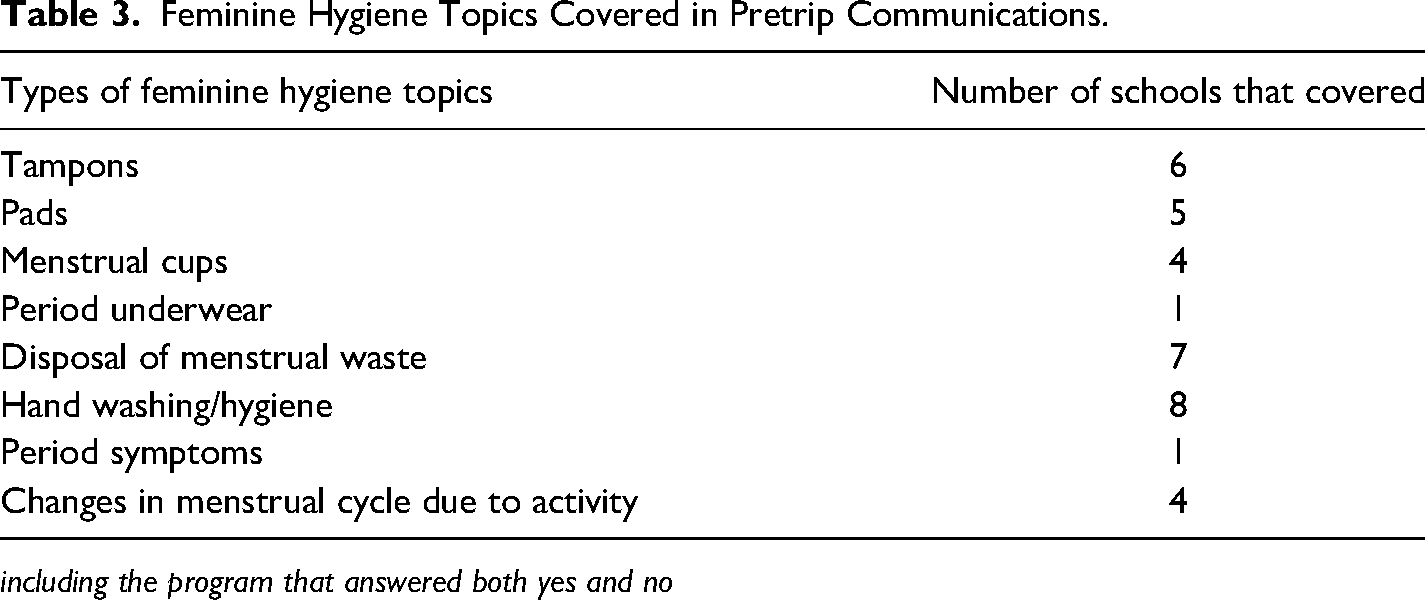
including the program that answered both yes and no
After analyzing the qualitative data, four major themes were identified: emphasis on pre-trip discussions surrounding health and hygiene, female leaders carrying the responsibility of communication, a desire for normalization, and the need for more knowledge and resources.
All respondents were asked to rank their comfort level when talking about feminine hygiene and menstruation with participants and other trip leaders from extremely comfortable to extremely uncomfortable. The majority of both male and female-identifying respondents indicated that they were comfortable as shown in Table 4. Of the nine respondents who indicated that their program did not address feminine hygiene and menstruation, only three felt some level of discomfort.
Level of Comfort Talking About Feminine Hygiene and Menstruation.
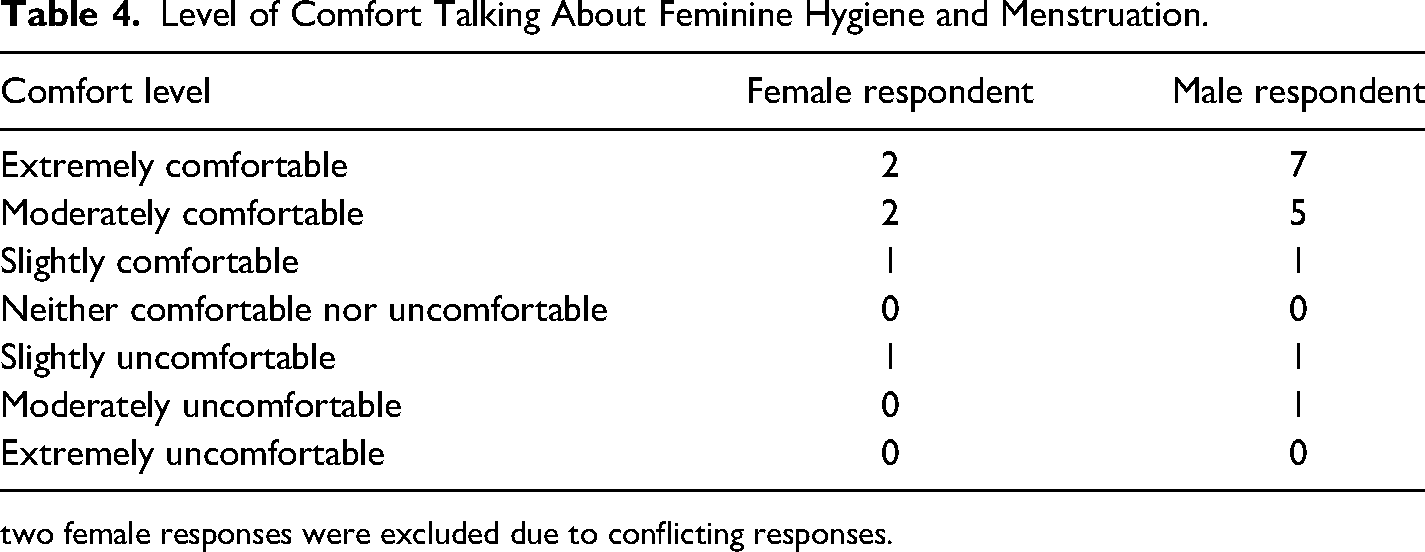
two female responses were excluded due to conflicting responses.
Emphasis on Health and Hygiene
Discussion on hygiene, handwashing, and staying clean was seen as essential to the health and comfort of female participants. One respondent indicated that they “talk about the importance of staying clean through baby wipe bags, as well as the multiple different methods (tampons, pads, cups) that can be used in the woods.” Along with emphasizing the importance of handwashing and maintaining personal hygiene, a popular response for how this topic was communicated included placing feminine hygiene products on the packing list and discussing how to dispose of used products. Respondents said things like, “We discuss the need to bring desired feminine hygiene products and any other supplies that may be needed.” Another respondent said, “Additionally on the ‘pack list’ that every participant is sent home with, we always include ‘feminine products’ explicitly in the toiletries/hygiene section, as a reminder.”
As leaders in the outdoors, respondents also placed an emphasis on the proper disposal of used products. Responses included educating participants on Leave No Trace principles and making sure participants knew what facilities were available at the trip sites. Although responses included talking about disposal, no responses discussed specific disposal methods. Only two respondents, both of whom were female, provided more detail about how an individual would manage feminine hygiene and the “additional needs of a female in the woods,” one of them said, We advise all menstruators to bring supplies they typically use to manage their menstruation plus wipes, even if they do not expect to menstruate, because surprises happen. We also assure them that in case of emergencies or surprises, they can find a variety of feminine products available in every first aid kit.
Female Leaders
When asked how programs discuss the topic of feminine hygiene and menstruation in pretrip communications/meetings, seven schools reported that female trip leaders would lead these discussions in large group settings with all participants. Two of the schools identified that these topics were discussed with only female participants present. One male leader suggested that students may feel more comfortable talking with female trip leaders about menstrual health. The leader said, “Normally our female trip leaders will answer any questions on this topic after the pretrip meeting closes. We have never felt the push to include it in our meetings.” Female trip leaders suggested that they felt a sense of responsibility as a female to make sure their participants felt completely comfortable, one respondent said, As the individual most often in charge of participants, it is my duty to make sure [the participants] are as prepared as they can be for their trip. Therefore, when it comes to the topic of women's health and menstruation in the outdoors, I prefer to be as transparent and supportive as possible …. As a female who recreates in the outdoors, I know firsthand that menstruation can be challenging.
Male respondents said they are comfortable discussing the topic but some do not feel competent enough to be the primary communicator. One male trip leader said, I feel that this is an important topic for trips and should be discussed in pre-trip meetings to the participants. I would like [to] give helpful information concerning these products, however I do not have the experience regarding this topic. I would feel tentative if asked to address these topics at this point in time.
Another male respondent suggested that simply being male prevents him from being able to discuss these topics in their entirety. He said, I have given this talk numerous times to students in the field, I have also trained student staff leaders to have this discussion as well. I think for me to feel extremely comfortable, I would have to be a woman. I believe not every participant will want to hear this information from a male.
Male respondents additionally noted that some of their knowledge on the topic has been learned from or prompted by female trip leaders. One respondent said, “Menstruation/feminine hygiene topics do not make me uncomfortable, and I have learned from female trip leaders what some best practices are that I am comfortable talking about to participants.”
Desire for Normalization
Regardless of whether their school addressed feminine hygiene and menstruation, both male and female respondents expressed their desire for these topics to be normalized. One female respondent said, “it is communicated as something to not be ashamed of, and spoken to both men and women in order for everyone to have a clear understanding of the additional needs of a female in the woods.” Another respondent suggested that talking openly about menstruation may help trip participants become more educated and also remove the shame that some people may feel. She said, “we have these discussions openly with the group, as menstruating is nothing to hide or carry shame about, and it is often informative/educational to those who may not know much on the topic.” Another trip leader echoed these sentiments and said, I think the most important aspect of advocating for those that menstruate, is normalizing the topic. Through several of my open discussions on women's health, I have often shared useful and insightful information with women who were less knowledgeable and have even enlightened some men on the topic. As there seems to be a gap in men's general knowledge of women's health, I believe the more we learn about it, the more we can normalize menstruation as a society.
A few respondents noted that the culture of comfort with the topic must start with the leaders. One respondent said, It is a natural part of life and it needs to be spoken to. It's also a huge inconvenience when in the outdoors and if you don’t normalize it as a leader, it makes it harder for participants to do the same.
Although openly discussing the topic of feminine hygiene and menstruation was the more popular response, there were some respondents who felt it was not necessary to discuss in group settings, such as a pretrip meeting and is only a relevant conversation if necessary at the moment. These responses came from both male and female respondents. One respondent suggested that menstrual health should not be discussed with everyone, but it should be, “discussed on a case-by-case basis.” Another respondent said, “It is not a topic that is pertinent for everyone.” One leader suggested that their program takes a different approach to menstrual hygiene and considers it a more private issue. He said, “We have always considered it a personal issue for the person(s) involved and only address it if the situation calls for it.” He preferred that females would individually bring it up to trip leaders “instead of feeling obligated to discuss it with everyone since some students feel it should be a private matter or makes them uncomfortable.” Though two schools suggested that they preferred to approach menstrual hygiene as a private topic, the majority of respondents suggested that normalization would be the best way to prepare women to participate in outdoor recreation activities.
Need for More Knowledge and Resources
Several respondents, regardless of whether their school talked about it or not, expressed the desire to learn more about the topics of feminine hygiene and menstruation. A lack of menstrual hygiene education and knowledge was cited by four trip leaders, all of which were male, as a barrier to discussing these topics in pretrip communications. One leader said, “…I would feel hesitant to discuss these topics with my participants because I have not heard it discussed during my experiences in outdoor recreation. I feel I do not have adequate information to give to participants when discussing this topic.” Additionally, other leaders have not discussed feminine hygiene or menstruation because they have not recognized it as a need for participants. One respondent said, “we are definitely open to discussing these topics, but they have not been suggested as topics before.” Another respondent suggested that they don’t mention it in any of their material in the pretrip meeting or in pretrip communications. The respondent said, “…it is not included in our pre-trip meeting outline for staff to cover, additionally it is not in any prior email communication to participants for our day trips.”
Female participants were asked additional questions about their personal experiences as participants on trips. Four out of five female respondents noted that feminine hygiene and menstruation was not addressed when they were a participant in a trip program. One female respondent shared an experience in which the leaders’ lack of knowledge affected her friend's overall outdoor experience, she said, “the first time I went backpacking, my friend [Sam] got her period and had no products to help. She ended up free-bleeding for four days in [the canyon]. I wish the male guides who led my trip discussed it beforehand.” Conversely, one respondent stood out because of a female mentor who did not avoid the subject, she said, During my early years in outdoor rec, I had a fantastic mentor who openly discussed how to be prepared for each adventure, as an individual who menstruated. She openly had emergency feminine products to share and would shamelessly discuss women's health topics in order to educate others and normalize the topic.
When asked what information or resources would be helpful when addressing feminine hygiene and menstruation, responses included wanting brief but informative physical resources such as a “short little packet on how to stay clean/what to do when you get your period on a trip/how to be prepared.” Another respondent suggested that a standardized curriculum would be helpful and they would appreciate information on, “what resources trip leaders should offer to participants, i.e., what kinds of products, what best practices are, how periods can be affected by strenuous physical activity.” Others wanted information from individuals who have abundant experience handling menstruation in the outdoors. One person suggested that knowing how large outdoor organizations address this topic would be helpful, saying, “information from institutions that spend a lot of time outdoors like NOLS, Outward Bound etc.” Overall, the need for better planning, normalization of the topic, information regarding best products and practices, and shared experiences was indicated by respondents as helpful resources.
Discussion
The purpose of this pilot study was to gain a better understanding of current practices and potential barriers surrounding feminine hygiene and menstruation dialogs in college outdoor recreation programs in Texas. We found that 38% of college outdoor recreation programs sampled are not addressing feminine hygiene and menstruation in pretrip communications. Of the schools that do discuss these topics, handwashing and hygiene were the predominant topics, which is appropriate based on the need for hygiene to prevent feminine health concerns (Botta & Fitzgerald, 2020; Lynch, 1996). Six schools suggested the main way feminine hygiene and menstruation were communicated to participants was through the inclusion of feminine hygiene products on the trip packing list, but of those schools only three provided any instruction. While this does address feminine hygiene and menstruation, it may not fully answer participant needs. With these findings, difficulties in period management, changes in the frequency of menstrual cycles, fear and intimidation due to lack of experience or knowledge being known barriers, and major impacts on the female experience in the wilderness, a packing list may not fully address the needs of participants. (Botta & Fitzgerald, 2020; Boulware, 2004; Culp, 1998; Schwartz & Corkery, 2011; Swarts, 2020; Twombly & Schussman, 1995). Two participants, who were female outdoor leaders, suggested that the presence of discussions on feminine hygiene and menstruation has an impact on the female trip experience. In order for leaders to make the wilderness more inclusive and remove barriers for female participants, more discussions surrounding these topics need to occur.
Every school that indicated they addressed feminine hygiene and menstruation topics relied on female trip leaders, coordinators, and assistant directors to lead these discussions. Male respondents noted that they do not entirely feel equipped to lead these discussions simply because they do not menstruate. Some believed their lack of experience would hinder their ability to fully communicate proper methods when handling menstruation on a trip. The outdoor industry is predominantly male and it is the job of outdoor leaders, to create spaces and programming that meet the needs and values of all participants (Allen-Craig et al., 2020; Schwartz & Corkery, 2011; Warren et al., 2019). However, relying on only females to lead these conversations may not be sufficient. Not every female indicated that they felt comfortable leading these discussions with participants and fellow trip leaders, which further emphasizes the need for outdoor leaders to normalize discussions surrounding these topics. This is consistent with Allen-Craig et al.’s (2020) findings that to reduce the gender bias often found in outdoor settings and create a supportive environment for all participants, leaders need to examine outdoor curriculum and be able to discuss all aspects of it, regardless of traditional gender roles. If these topics are not being addressed, an individual who has never recreated outside may have difficulty identifying their hygiene and menstrual needs. Guidance from leaders in pretrip communications is essential to ensure participants who menstruate feel prepared and supported during their experience and some schools indicated that they are not communicating this information before trips.
Normalizing the topic of feminine hygiene and menstruation allows leaders and participants to openly discuss these topics. Several respondents noted that normalizing the topic through open discussion is a form of advocacy for those who menstruate. A common sentiment found in this study was that normalization needs to begin with leaders, regardless of gender, being role models and being comfortable having these conversations. As Warren et al. (2019, p. 149) addressed, the more outdoor leaders normalize all aspects of women, including feminine hygiene and menstruation, in outdoor spaces, the more “women's contributions to adventure become evident.” Normalizing conversations surrounding topics that are typically considered gendered, such as menstruation or toxic masculinity, is not only beneficial to the individuals that they directly impact, but for everyone involved. These discussions provide opportunities for individuals of all genders to be more aware of issues outside of their experiences and to further understand their own identities, potential biases, and how these may impact themselves and others (Allen-Craig et al., 2020). Gray et al. (2020) suggest that to make outdoor spaces more inclusive, individuals that identify as male should take responsibility to educate themselves, raise awareness, and engage in conversations to gain perspective on issues that are specific to the female experience.
Consistent with Botta and Fitzgerald (2020), our study found that college outdoor recreation programs have room to improve their pretrip communications regarding feminine hygiene and menstruation. Even with seven schools (of 13) indicating that they address these topics in some form of pretrip communication, over a third of the schools that responded to the survey suggested that they are not communicating information surrounding menstrual health on trips, which could negatively impact a large percentage of their participants. Differing responses were received from one university, where an assistant director indicated “yes” while the remainder of the respondents from that school indicated “no,” menstrual hygiene was not being covered in pretrip communications. This conflict may be explained in a few different ways, (a) it is possible that the assistant director does not know what is being communicated in pretrip communications, (b) it is possible the assistant director expects it to be discussed in pretrip communications and it is not, (c) it is possible that the trip leaders and participants missed the information in pretrip communications, or (d) it is possible that the assistant director has a response bias and responded with what they hope/desire to happen in their program instead of what is actually happening. If some form of response bias is at play in this response, it could be impacting the responses from other institutions where only supervisory staff responded and it is possible that the number of schools covering menstrual hygiene is even less than our findings suggest.
The conflicting responses further emphasize the recommendation by Schwartz and Corkery (2011) that outdoor leaders need to assess and create “best practices” that can be shared across the profession to ensure that the needs and barriers of females are appropriately being addressed. This lack of a commonly accepted curriculum may contribute to trip leaders’ feelings of uncertainty about what is appropriate to talk about in multigender groups. While many respondents said they spoke of these topics and did so somewhat comfortably, almost everyone expressed the want for more information concerning products to recommend to participants, what specific topics to cover, and how to plan.
Limitations and Future Research
Continued discussions and research surrounding if and how feminine hygiene and menstruation are addressed in college outdoor programs are warranted. Building on these findings, several limitations should be considered when interpreting the findings of this study. This survey utilized a small, geographically limited, sample size, from Texas. For future studies, further research should be conducted to explore if the trends and practices found in this single-state sample are consistent in other parts of the United States and internationally. Allen-Craig et al. (2020) found cultural context had an influence on experiences and perceptions surrounding gender-related issues. With this in mind, it is unclear how cultural contexts like politics, religion, and southern culture might have impacted the conversations about menstrual hygiene in pretrip communications. Efforts were taken to reduce author bias; however, it should be noted that all authors currently work for one of the universities sampled, and the majority of authors have worked for that university's campus recreation program.
Possible response biases may have impacted these findings. The majority of respondents held a full-time position in a supervisory role. The sample had only a handful of student trip leaders' perspectives due to the timing of the study being during the summer months. Student trip leaders may provide a different knowledge of actual practices. Further, program leaders may have responded according to what they thought should have been discussed, and in actuality, the topic was not being discussed. Including a larger sample of respondents who are actual trip leaders may provide a clearer picture of the status of this topic in pre-trip communications.
Certainly gaining the perspective of female trip participants is needed. The voice of these women may provide a more realistic understanding of what and how this information is delivered and even about what female participants want and expect from their trip leaders. Further, menstruation is not strictly a female issue, as individuals who identify outside of traditional binary genders also need to understand management in the outdoors. The data found in this study provides a framework for future research regarding conversations around gender identity, menstruation, and feminine hygiene in outdoor programs. In future research, however, it would be appropriate to survey not only females but rather all individuals who menstruate. Understanding the experience of all individuals who menstruate can provide helpful information on how to proceed making these discussions, and the outdoors themselves, more inclusive.
Conclusion
Ultimately, even though some schools are addressing these topics it is unclear the depth and effectiveness of these discussions, and there are still many new female participants who are not being provided this information unless they request it. The majority of females indicated a desire for conversations about menstrual hygiene to be normalized in outdoor recreation settings. This movement toward normalization and destigmatization of feminine hygiene and menstruation is important if we wish to remove barriers to participation for women in outdoor recreation. The results of this study emphasize that there has been little development on the topics of feminine hygiene and menstruation in the outdoors since Lynch (1996). The percentage of female recreators growing each year and the findings of this study indicate that the current practice surrounding menstrual hygiene education is insufficient to adequately support female outdoor recreators at college and university programs in the state of Texas.
Footnotes
Declaration of Conflicting Interests
The author(s) declared no potential conflicts of interest with respect to the research, authorship, and/or publication of this article.
Funding
The author(s) received no financial support for the research, authorship, and/or publication of this article.
