



Abstract
Introduction
Different international guidelines indicate the need for improving educational procedures. This study aims to contribute to the professional development training program of higher education professors from a Physical Education Teacher Education degree in México.
Methodology
This qualitative study used a participatory action research design through four cycles: (a) diagnosis; (b) elaboration of the action plan; (c) implementation and evaluation; and (d) feedback. The participants were the professor, six experts, and 17 students. Data were collected from semi-structured interviews with students and the professor, the analysis of the class syllabus, and nonparticipatory observations.
Findings
The importance of carrying out a diagnostic cycle allowed us to identify the specific needs of the class. Similarly, the model of development and evaluation of academic competencies (M-DECA) allowed the professor to develop specific pedagogical and disciplinary competencies from the training program.
Conclusion
A continuous professional development training program for university professors in pedagogical and disciplinary strategies generates better learning results. The inclusion of innovative content in the class syllabus was also crucial.
Introduction
The implementation of different types of activities within the structure of physical education (PE) could be an important way to provide opportunities for students to engage in physical activity (Kirk, 2006). However, it is important to mention that one of the paradigms that PE has faced over several decades, is the use of traditional pedagogical approaches or models that have built what is described as the status quo (Casey, 2014).
According to Kirk (2010), the status quo in PE can be defined as the implementation of a traditional pedagogical approach where teachers are solely responsible for the creation of the curriculum, the environment, and the content for the class. On the other hand, the student's role is to follow the instructions of the teacher without questioning in any way his or her decision. Researchers have called this as a teacher-centered approach where there is an established pedagogical hierarchy in the classroom environment (Nuñez Enriquez & Oliver, 2021). This traditional form which has been consistently reproduced over the last decades has affected how PE is perceived by students. A traditional approach has been one of the reasons leading to the demotivation of students to engage in physical activity, either in PE or after school hours (Luguetti et al., 2018; Marttinen et al., 2020; Nuñez Enriquez & Oliver, 2021; Oliver & Oesterreich, 2013). Kirk (2010) suggests that if this traditional or teacher-centered approach continues to be implemented, he envisions three possible scenarios: (a) more of the same; (b) extinction; and (c) in-depth reform. More of the same could lead us to the extinction of what we now know as PE. For Kirk in-depth reform means that higher education programs should be based on the specific needs of the region and contexts. Thus, promoting a different pedagogical strategy that helps individuals to engage in physical activity for a longer period of time.
The implementation of outdoor has been a tool to encourage individuals to engage in nontraditional physical activity. This approach has been shown to have multiple benefits in the individuals involved. Among these benefits are stress reduction, social skills development, and resilience (Roberts et al., 2019). According to Granero and Baena (2007), the natural environment represents the biggest space to be used for teaching PE due to the different pedagogical resources that the facilitator can implement. Cornell et al. (2001) also mention that the natural environment has other factors such as a psychological stimulation that can contribute to the student’s learning. A great example is in the United Kingdom where Williams and Wainwright (2015a, 2015b) have proposed a pedagogical model that includes the natural environment.
Outdoor education is grounded in the theory of experiential education proposed by John Dewey (1938) who argued that it is important for individuals to have a direct experience of learning. Although, Kolb (1984) using Dewey's theory added four stages that complete what he defines as an experiential learning cycle: (a) a concrete experience; (b) to be reflexive; (c) generate an abstract conceptualization; and (d) to prove these conceptualizations. As such, the learning cycle creates the opportunity for individuals to process the different types of experiences to complete a learning process.
In outdoor education, the focus is on skill development in outdoor activities. These should always occur in the natural environment where the risk is not fabricated and therefore it cannot be controlled (Steffen & Stiehl, 2010). There are several learning areas that can be integrated with the natural environment (Brown & Dyson, 2006). Recently, scholars have considered PE to be a subject that can gain from being taught within the natural environment (Hovey et al., 2020; Potter & Dyment, 2016). One reason is that outdoor education focuses on components of discipline to study an active research agenda, reference disciplines, principles and practices, education and professionalism, and has the potential to be considered a stand-alone discipline, including within the higher education levels (Dyment & Potter, 2015; Liles et al., 1996; Potter & Dyment, 2016).
Outdoor education can also include adventure education (AE; Priest & Gass, 2005). It is important to identify differences between AE and outdoor education since they are similar to each other but also have significant differences. Unlike outdoor education, AE focuses on personal and group development which can occur in the natural environment, but the work and natural area are adapted to develop the AE. This means that the risks taken during learning can be fabricated or modified to motivate the participants to confront a specific issue created by the teacher (Steffen & Stiehl, 2010). Therefore, AE can be considered as a teaching method based on experiential learning.
AE can be defined as a set of activities characterized by the use of the natural environment as a pedagogical resource that can include nature and outdoor activities which can create an ideal learning space (Gilbertson et al., 2006). This approach challenges individuals and groups to practice with various degrees of risk to solve different tasks while providing a safe environment where students can reflect and share their feelings and ideas (Galloway, 2006; Gilbertson et al., 2006). McKenzie (2000) identifies the principal characteristics of AE programs as containing: physical environment, activities, processing, the group, instructors, and the participant.
Sutherland and Legge (2016) suggest that involving AE as an instructional model within physical education and teacher education (PETE) curriculum and instruction is imminent. The authors consider AE as a model that allows them to understand the sociocultural contexts of their students which then helps them create successful learning opportunities. Thus, AE might be another way to create a nontraditional approach that could be incorporated within the PETE curriculum.
Another characteristic of the AE approach is that it is flexible and can allow the combination of other approaches and models, methodologies, or educational strategies such as the flipped classroom approach, cooperative learning and gamification, and student-centered pedagogies (González-Rivas, Zueck-Enríquez et al., 2021; Lamoneda et al., 2020; Oliver & Oesterreich, 2013; Rodríguez-Martínez et al., 2021). In addition, the AE model is the manifestation of procedures and methodological steps that allow teachers to contemplate different variables and aspects that allow listening and responding to students over time. According to Baena-Extremera (2011), AE is divided into two phases incorporating nine activities; the first stage is built by problem-based learning, followed by stage two which is learning by practice. According to Baena-Extremera, these aspects help to build a learning environment through listening and responding to participants in adventure activities, as well as modifying the equipment and facilities to meet the needs of all students. Another example of the AE model is presented through a professional development and training program specific to PE professionals. This approach develops pedagogical and specific technical competencies (or skills), develops teamwork skills, and promotes leadership among students (González-Rivas, Zueck-Enríquez et al., 2021; Leather & Nicholls, 2016; Marinho et al., 2017). AE creates opportunities for students to engage in different curricular approaches including participating in outdoor activities, supporting an innovative learning process which can develop professional competencies (or skills), and is a possible solution to overcome various challenges such as deconstructing a traditional learning environment in PE (Enright & O'Sullivan, 2010; González-Rivas, Zueck-Enríquez et al., 2021).
For this reason, it is important to contribute to a possible way that builds a different reality for students, while implementing new ways of working according to the context needs through high standards for higher education PE students. According to López et al. (2021), this could be a form for higher education institutions to take a leap of faith for the improvement and use of different pedagogical approaches specific for the context and social needs. Thus, university professors must develop pedagogical and disciplinary competencies, which is undoubtedly a challenge for higher education institutions (Franco et al., 2020; Rodríguez et al., 2020). However, it is a process that must be carried out to improve the educational quality of PETE students (González-Rivas, Zueck et al., 2021).
We argue that for the adequate inclusion of specific AE content and competencies within PETE programs, the training of university professors is indispensable. This must be carried out through a critical and reflective analysis of practice that allows identifying training needs (Fernández-Díaz et al., 2016). The model of development and evaluation of academic competencies (M-DECA) has contributed satisfactorily to various teacher training programs in higher education. This is because it involves teachers in a process of reflection and feedback by analyzing their performance, without neglecting the collaboration of other teachers (Franco et al., 2020; González-Rivas, Zueck et al., 2021; Montes et al., 2020).
Globally, AE has been utilized as a pedagogical method for scholarship and as a part of the PETE curriculum (Baena-Extremera, 2011; Fernández-Río et al., 2016; Sutherland & Legge, 2016). Unfortunately, there is a lack of research being conducted in México in regards to implementing this approach at the university level. There is hope that AE and outdoor education can play a more prominent role going forward as México is currently completing an educational reform that involves preschool, elementary, and secondary education (SEP, 2023). This reform includes four fields of development, the third one involves the use of nature as a pedagogical tool. This would require PE teachers to be competent in the use of pedagogical resources in the natural environment, and therefore, the inclusion of AE in the academic training of future PE teachers is crucial.
In México, there are different universities that offer professional development and training programs in PE and other related areas. An example is the Autonomous University of Chihuahua (UACH) located in a northern state which borders Texas and New Mexico (USA). The UACH offers a PE bachelor's degree, in which the curriculum is divided into eight semesters or 4 years of contact courses. In the fourth semester (or second year), students are required to take the subject “Juego y Educación Física” which translates to physical education and games. The goal of this class is to teach pedagogical and didactic strategies through games which can be implemented within the PE classes at preschool, primary, and secondary school. These are considered mandatory by Mexican authorities (Zueck et al., 2009). In this class, different areas of improvement have been identified with respect to teaching skills and performance from a pedagogical perspective: planning, development of competencies in the students, pedagogical and didactic strategies, and content evaluation (González et al., 2019). However, at the international level, different training programs related to PE are in a similar situation (Elzel et al., 2016; Martínez et al., 2017), as such, the need for educational improvement from teaching scenarios is recurrent in various contexts.
The objective of this study was to provide professional development and training to a higher education professor from the UACH PETE program, through innovative content in recreational outdoor activities, using Baena-Extremera’s (2011) AE model. The research questions that guided this study were: (a) How can we train graduates in PE in the subject of PE and games? and (b) What are the pedagogical experiences of participants in a teacher training program (M-DECA) that integrates AE content?
Methodology
This is part of a much larger inquiry project, which was submitted and approved by the revision committee of the Faculty of Physical Culture Sciences of the Autonomous University of Chihuahua with number 21022017-093. This was a sequential study whereas the first cycle included document analysis, observations, and interviews with students and a professor of a pedagogy class and the second cycle utilized the results from the first cycle to design a professional development training program using the M-DECA. This qualitative study used a participatory action research (PAR) design (Blaikie, 2007; Merriam & Tisdell, 2015). PAR focuses on social aspects in order to interpret a phenomenon that helps to understand the reality in which individuals are involved. The main objective of PAR is to transform their reality and allow the participants to become aware of the changes (Creswell, 2005; Sandín, 2003). One characteristic of PAR is that participants are involved in an open process that leads to knowledge development, reflection, and analysis seeking to solve a problem which demands leadership from the researcher (Carr & Kemmis, 1986; Elden & Chisholm, 1993; Reason & Bradbury, 2001). PAR has been used in past research successfully with the M-DECA procedure as a pedagogical tool (Guzmán & Marín, 2018; Karppinen, 2012; McKenzie, 2000).
This cyclical process was implemented in four steps as proposed by Hernández et al. (2014): (a) diagnosis; (b) elaboration of the action plan; (c) implementation and evaluation; and (d) feedback. To guide this research, each of the cycles had an individual objective that together contributed to the general objective. Performance was selected as the initial unit of analysis, and the class syllabus, semi-structured interviews with students, and the semi-structured interview with the professor were selected as observation units. The implementation of the intervention program was the second unit of analysis. This consisted of two observation units: acquisition of pedagogical competencies (APC) and acquisition of disciplinary skills (ADS) (Figure 1).
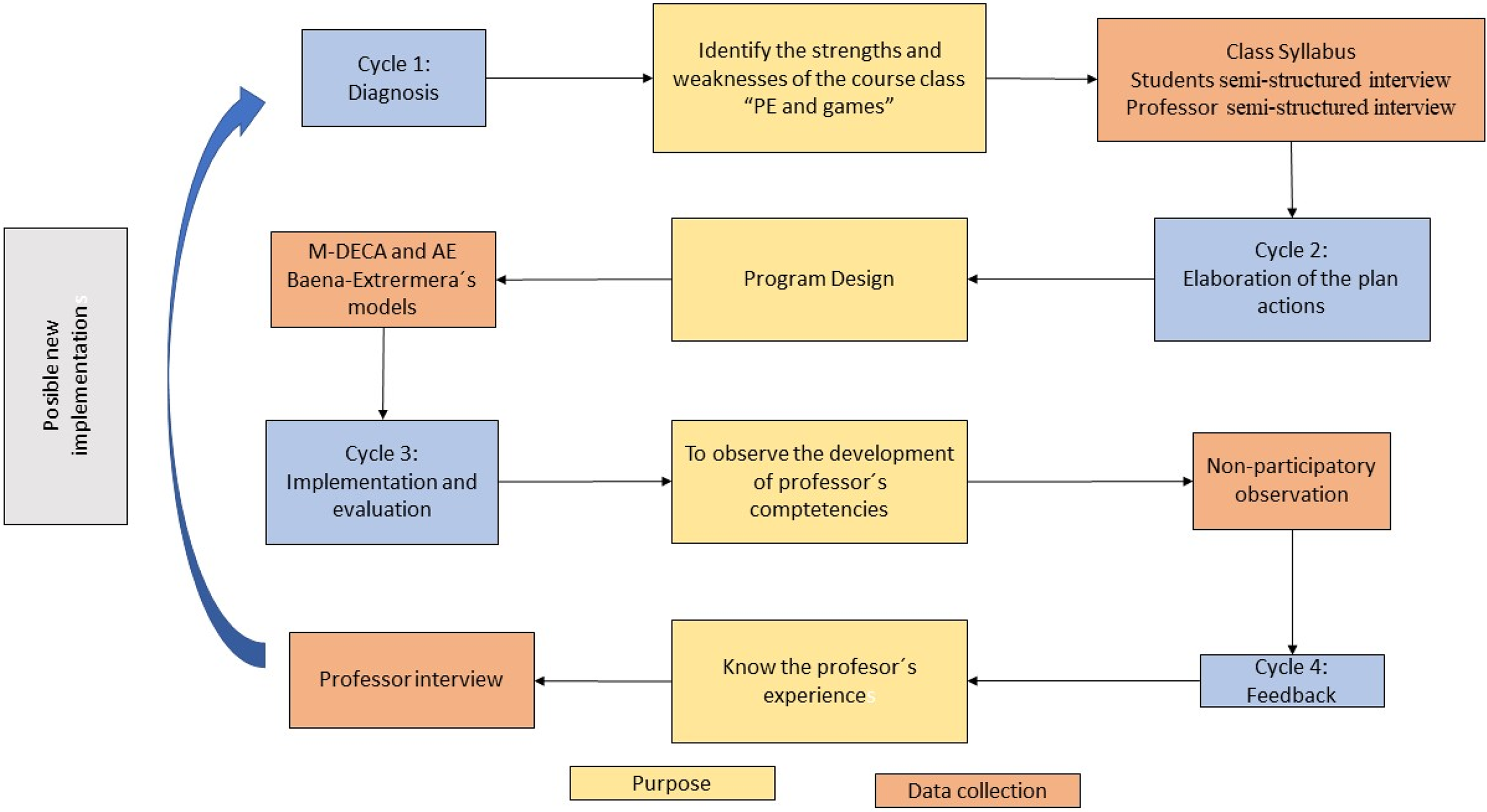
University professor’s training process.
Participants
A total of 28 participants were involved in this study, which included: five PETE professors, six PETE senior professors serving as consultants or “experts” because of their expertise (two in education research, two in recreation, and two in PETE training), and 17 undergraduate students; out these students seven participated in cycle 1 (diagnosis) and 10 participated in cycle 3 (implementation and evaluation). This study is a part of a larger research project and for the purposes of this manuscript, we will present only one faculty member (noted in this manuscript as “professor”) perspective, performance, and engagement of the PE and games class. This class is taught in the second year of the undergraduate degree. The professor identified himself as a male, with 28 years of professional experience in higher education serving as instructor and faculty the last few years. He had taught this specific course for 15 years. He holds a bachelor's degree in PE and a graduate degree in psychomotricity. As part of this professor's class, seven undergraduate students participated. The average age of the undergraduate students was between 19 and 20 years old. We employed a convenience sample and students with the highest academic average and without any class absences were selected. It is important to mention that these students had not yet completed their student-teaching experience and their participation was in cycle 1.
In addition to the undergraduate students and the professor, the study utilized six experts. These experts were carefully selected because of their expertise in different PETE areas, and were asked to participate at different times. In this way, their opinion as consultants contributed to the validation of this research project (Sandelowski, 1998). The following describes the academic experience of each of them:
Data Collection
Semi-structured interviews were conducted with participants. In this process, a series of pre-established questions were developed. This process is flexible, because it allows modification of the wording of the question for a more complete understanding and allows the researcher to add questions in order to obtain more information or follow up on what the participant says (Díaz-Bravo et al., 2013).
For the implementation and evaluation cycle of the professional development program, the researchers employed nonparticipatory observation. Using this type of observation means observing in a holistic way without any direct influence of the researcher (Campos & Martínez, 2012). The researchers utilized a video recording technique because it facilitates observing the object of study in detail, in addition it has the advantage of being able to send a copy to experts and researchers for analysis, which allows the researchers to check for internal reliability (Stigler et al., 1999).
The qualitative data analysis program Atlas Ti (Version 7.5) was used to categorize and organize the data. This software is friendly and facilitates the coding and categorization process, however, the results are the product of the interpretation of the researchers (Silva & Carneiro, 2018). Atlas Ti has been used in various educational research projects (San Martín, 2014).
During the interviews, the PX370 mono digital voice recorder was used. This tool allows for recording audio in MP3 format and has a USB connector (Digital Voice Recorder Mono PX370, 2021).
The Sony camcorder model FDR-AX700 4K HDR was used to capture video. This model has an autofocus function that allows images to be in high definition (Camcorder FDR-AX700 4K HDR, 2021).
Procedure and Data Analysis
This is part of a much larger inquiry project, which was submitted and approved by the revision committee of the Faculty of Physical Culture Sciences of the Autonomous University of Chihuahua with number 21022017-093. However, for the purposes of this project, the scope was shared to the department head as it is required to get authorization to invite participants. After obtaining the authorization of the higher education institution, an open invitation was made to one professor and students of the course titled Physical Education and Games. Once participants accepted the invitation a consent form was given to be part of the project. This project was two-fold that included two cycles; cycle 1 of the project included document analysis, observations, and interviews with students and the professor of the pedagogy class. The second cycle utilized the results from cycle 1 to design a professional development training program using the M-DECA approach.
Two types of interview scripts were designed, one for the students and the other for the professor. Questions were focused on identifying the strengths and weaknesses of the professor's performance. Both interview scripts were monitored and validated by experts one and five.
The class syllabus was analyzed (e.g., the purpose, competencies, and domains) with an emphasis on the topics and references. The purpose of the analysis was to identify the relevance of the contents developed for the class. The seven students were interviewed during the last week of classes in Spring 2018, followed by an interview with the professor once the semester ended. Both types of interviews were approximately 25 min long. Interviews were recorded and transcribed verbatim in RTF format and uploaded to the Atlas Ti software.
A collaborative qualitative analysis process was used (Richards & Hemphill, 2018). Experts one, three, four, and six carried out the coding and categorization process individually based on emerging design (Glaser, 1992). These experts met once to discuss and unify coding and categories, to be used in the final document. Finally, the results of the three primary sources (class syllabus, student’s interviews, and the professor interview) were compared. From this, the researchers obtained a diagnosis and identified the strengths and opportunities for improvement of the subject.
Upon the diagnosis, a professional development training program was designed using the M-DECA. In order to include innovative content in the training, communication was established with experts in pedagogy and didactics of PE and recreation (experts two and six).
The process of topics, pedagogical design, and the training facilitator were validated by experts one, two, four, and six. The training program was divided into five modules with the following objectives for the participating professors. The first one was a reflection and conceptualization of class planning; in the second one, disciplinary contents and design of a didactic sequence with an analyzed topic of particular interest were addressed; in the third one, group feedback of the sequence was sought; in the fourth module, application of the sequence with undergraduate students in PE was tested; and the last module was a process of self-analysis of the professor's performance. The design of this program is shown in detail in the findings section in Table 1.
Design of the Training Program.

Note. Pedagogical competencies: develops its continuous training (DCT), carries out processes of didactic transposition (DT), teaching design (TD), management and progression of competencies (MPC), communication (CN), values the achievement of competencies (VAC). Disciplinary competencies: cognitive (C), functional (F), and values (V).
During the application of the fourth module, permission was asked from the professor and the students of the PE and games course to video record the application of the didactic sequence. This allowed the researchers to combine the techniques of nonparticipatory observation and video recording. The audio from the video recordings was transcribed and the same inductive analysis of the diagnosis (collaborative) cycle was performed, but this time with a focus on the professor's performance. The video recording was analyzed paying special attention to the way in which the professor appropriated the innovative contents of AE in his class. Finally, the transcripts and audiovisual material were analyzed through the Atlas Ti software.
Findings
The findings are presented in a sequence according to each of the cycles established in the methodological design of PAR. The quotes have been translated from Spanish and special attention was made to communicate the original meaning and intent of the participant's quotes.
Cycle 1. Diagnosis
The class content noted in the syllabus of the PE and games class unveiled a trend toward the different types of games such as: traditional, sports-like, scavenger hunt-like games, and pre-Hispanic games. However, the class syllabus was not up to date. It was not based on current scientific evidence (according to the requirements of the academic unit) and included obsolete references in some cases from 1978, 2000, 2010, 2011, and 2014. The learning activities were mainly class presentations and laboratory practices. The competencies were basic, specific, and professionally aligned with the domains and contents of the games. The purpose of the program was as follows: The student will value the game as a pedagogical tool, applying its methodology, typology in the design, using the principles and techniques for the systematic and methodological teaching of the physical or recreational activities in the different educational levels. He will be prepared to integrate with a participatory attitude in inter and multidisciplinary teams.
The students noted that they were satisfied with the content of the class syllabus, mainly due to the knowledge acquisition about the benefits, typology, and methodology for the implementation of games in the educational context. The students were also satisfied with the level of creativity they were able to impart in the class: … yes, it is new to me, it opens my panorama on the benefits of the game…. (Student 2)
… yes, it has helped me to know how to plan a game and what the teacher generates in terms of values and principles, this subject has a lot to do with the planning of physical education …. (Student 4)
… yes, I am satisfied, I have developed my creativity a lot to create new games. Also, I liked to see how important play is in the development of children, the truth is that has surprised me too much… (Student 6)
In the interview with the professor, he said that the class allows students to acquire competencies about the design and application of recreational activities to promote physical activity in schools and community centers. However, he recognized the need for disciplinary updates, also as well as didactic resources and bibliographies. … Yes, because the next semester the students will begin their teaching practices in schools, and this subject helps students to be trained in skills in the recreational activities and promote physical activities with the scholarships. I believe that to improve the learning we need more didactic resources, disciplinary actualization and recreation books….
The class of PE and games contemplates the development of competencies related to recreational activities for the promotion of physical activity in the school context. To the students, the content of the class syllabus contributed to their professional training, and they reported being satisfied. However, the class syllabus needed updating and the professor identified a need for disciplinary actualization through attractive, innovative, and pertinent contents in the teaching performance of PE, specifically at the level of basic education (preschool, primary, and secondary). Therefore, analysis of the first cycle made it clear that the class had relevant curricular contents but needed reinforcement.
Cycle 2. Development of Action Plan
Since the previous cycle identified the importance of disciplinary updating, a focus on recreational activities in the natural environment as innovative content was proposed for the professor and students. A teacher training program was designed based on the M-DECA, with a disciplinary approach focusing on two types of competencies: pedagogical (Guzmán et al., 2014) and disciplinary (Marinho et al., 2017). The following is the structure of the teacher training program, in which the development of low ropes was the learning goal (see Table 1).
Cycle 3: Implementation and Evaluation
The third cycle consisted of the implementation of the training program which was attended by the professor participating in this research. Module one was carried out in the classroom, where the structure and pedagogical planning of the professors were reinforced. Module two, which was a core part of this study, was developed intensively outdoors. The second module combined didactic strategies of cooperative learning and a “Flipped Classroom.” It took the basic structure of AE integration based on the Baena-Extremera (2011) framework which proposes two phases of intervention. In this framework, Phase 1 is experiential and Phase 2 is practice oriented.
Phase 1: Experiential
Activities of Self-Knowledge and its Possibilities
Recreational activities were implemented in order to stimulate individual skills of each of the participants. These first activities were a circuit that included balance challenges. For example, crossing a balance beam 20 cm above the ground and 10 cm wide, in different ways: blindfolded, in pairs and with a ball in your hands, etc. These activities were chosen based on the challenges encountered in other activities.
Knowledge of Others and Possibilities as a Working Group
Cooperative motor activities were carried out in which communication and knowledge of the skill level of others were fundamental to solve a situation. An example of this is as follows: Professors formed a circle and were asked to take the hand of their companion next to them. Without letting go, they were changed places with another professor in the circle essentially creating a large knot. The activity consisted of undoing the knot without letting go of the hand of your colleague.
Knowledge of the Material and Specific Facilities
Prior to the session, and through the WhatsApp® messaging application, a video was sent to the professors explaining the basic knots to mount a low rope, knot of seven, eight, and woodcutter and fisherman knots. Each professor was asked to come to the session with the mastery of one knot to teach to their peers. This is an example of how the “flipped classroom” was used to teach cooperative games. In a face-to-face workshop, the professors put into practice their knots, explaining to their classmates the correct way to tie them. This activity was enriching since they clarified doubts among themselves, developing pedagogical and disciplinary competencies.
Group Reflection and Self-Reflection Activities
To finish the first phase proposed by Baena-Extremera (2011), the professors were asked to reflect on the activities up to that time. The professors were both analytical and critical regarding the pedagogical and didactic possibilities of using knots in recreational activities. They critiqued the interest and applicability for PE undergraduate students.
Phase 2: The Practice of Activities
Challenge Activities and Problems with Modification of the Real Situation, Where the Knowledge Acquired in the Previous Phases is Used
In the first phase, the professors learned to make various types of knots. Building on this knowledge they were introduced to the low ropes. The professors were taught the time each of the knots should be included, as well as how to monitor the tensioning of the rope. The activity consisted of the teachers taking the material (ropes and hooks) in pairs to make their own low ropes, each with a different degree of difficulty.
Challenge Activities and Problems with Small Modifications
The lowest rope with the lowest degree of difficulty was the one that had two horizontal ropes. This was parallel to the ground (approximately 50 cm high). All the professors crossed this first challenge and worked to creatively solve a motor problem.
Analytical Practice of the Real Situation
The next challenge was to cross the conventional low rope across a horizontal rope 50 cm from the ground and another tied to the same two trees, but at a height of 2 m from the ground. Again, each of the participants crossed with the support of their peers.
Group Reflection and Self-Reflection Activities
Finally, a process of reflection was carried out in the group. The goal was to generate questions that stimulated a debate regarding the adoption of the AE programs, professors’ pedagogical and didactic possibilities, and the relevance of low ropes as an educational resource in the training of physical educators.
In module three, the class professor designed a didactic sequence aimed at undergraduate students in which they had to include the design and elaboration of a low rope. These sequences were exposed in the group and were validated by the experts in the M-DECA (three and four). It is important to mention that the professor of the PE and games course designed their sequence including the contents following the AE methodology according to Baena-Extrermra (2011).
The fourth module was the application of the didactic sequence in the real context, that is, with 10 undergraduate PE students. With the prior consent of the professor and the students, the application of the didactic sequence was videotaped for two purposes: first, to provide a copy to the professor to carry out an individual and self-critical analysis of their performance. Second, the researchers of this study could analyze the application of the didactic sequence, as well as the teaching performance and mastery of the contents of AE.
Cycle 4: Feedback
In the fifth module of the training program, after the class professor analyzed the video of his session, he presented the analysis of his practice in a group presentation. In order to perform this activity, he was given an observation guide that included different indicators of teacher performance. The professor identified aspects that must be improved in his teaching practice. He recognized the inclusion of low ropes as a strength and as innovative content that was stimulating for the students. Likewise, he referred to aspects that must be improved in his teaching. Mainly this was the use of didactic strategies that placed the student as the protagonist of his learning process and included challenges to motivate his students. The professor also recognized the need for the development of communication skills: … for me it was a challenge to learn all the knots, in fact, I was practicing a lot, because I had many doubts about how to do it, so I had to rehearse, especially because there were students who did handle all this knots very well … but I think I did well, I have to keep practicing the knots and the tightening of the rope so that I don’t forget… I liked it a lot, the students too, it is something different that I had not contemplated but yes, I will leave it permanently in my program …
… because the good thing was all of the knots, they were new topics in the program and I managed to perceive a great motivation of the group, as well as a spontaneous participation on the part of the students … as for how I can improve my teaching, because attend and give better indications, promote independent work in students, include challenges that motivate in a practical class, I must also let the activities promote the initiative of each one, ask challenging questions that stimulate students, use communication mediators such as tone of voice, the look, the body expression, recognizing the positive contributions of the students, favoring a friendly and motivating class climate ….
The results suggest that the training program favored the self-reflective process of the professor of the PE and games course, the acquisition of specific competencies, strengths and weaknesses of their teaching performance, and the inclusion of recreational activities in the natural environment through the AE model. In this same line, the professor developed disciplinary skills, mainly in relation to knots and in the design of low ropes.
Discussions
The objective of this study was to provide professional development and training to a higher education professor from the UACH PETE program, through innovative content in recreational outdoor activities, using Baena-Extremera’s (2011) AE model. The importance of this study lies in creating an innovative way of practice that could be used by higher education professors. The focus was on integrating relevant content and up-to-date knowledge that facilitates the training of PETE students and in-service teachers. It is important to highlight that just a few studies were found that addressed AE in the context of México, so this study is a precedent for future studies. In order to provide clarity, the discussion is presented as it was established in the methodology.
The Diagnosis
The diagnostic cycle or cycle 1 uncovered the need to improve pedagogical planning from a disciplinary perspective. PETE programs have documented various levels of student dissatisfaction. Opportunities for improvement in various aspects of teaching performance have been identified including didactic strategies as well as content and learning evaluation (Elzel et al., 2016; Martínez et al., 2017). Similar results were found by González-Rivas, Zueck et al. (2021) as there were inconsistencies found in the didactic planning, the development of competencies, and didactic strategies. Specifically in the subject of PE and games, planning and didactic strategies are two aspects that must be strengthened (González et al., 2019). The above results suggest the need to perform analyses and evaluations of teaching performance in universities that train physical educators from pedagogical and disciplinary perspectives. Particularly in the case of the subject of PE and games, results indicate the relevance of the training programs consisting of innovative content.
Development of an Action Plan, Implementation, and Evaluation
The training program based on the M-DECA allowed for the inclusion of AE into a PETE program and stimulated professor reflection about opportunities for improvement in his teaching performance. The collaborative work that was applied throughout the intervention stimulated the development of pedagogical and disciplinary change. Hence, the professor's teaching practice benefited from approaches that improved planning and didactic strategies.
The results from our current research align with Canquiz et al. (2019) because in their study, the M-DECA contributed to the acquisition of different skills or competencies. In another study by Franco et al. (2020), the model favored the development of pedagogical teaching competencies in the context of inclusion with university students with disabilities. Montes et al. (2020), found that the M-DECA allowed teachers to identify opportunities for improvement in their practice, leading to educational improvement with transdisciplinary pedagogical approaches. Professor training programs must be based on the self-critical reflection of practice and always include the professor, which makes it possible to improve educational processes (Soto et al., 2017), and the M-DECA makes these approaches possible. Our results indicate that using the M-DECA as a model allows the acquisition of pedagogical and disciplinary competencies in training programs in various contexts of higher education and can be applied in versatile ways.
During module two of the professor training program, using the AE model, the professor developed cognitive, social, and technical skills for the development of recreational activities in the natural environment. These results align with those of Caballero et al. (2020), Ee and Ong, 2014, González-Rivas, Zueck-Enríquez et al. (2021), and Marinho et al. (2017). Karaarslan and Teksöz (2019) found that physical activity programs in the natural environment facilitate the development of systematic thinking skills, and suggested the benefits are not only physical but that they are relevant in the educational context as well. The studies noted above were all qualitative studies, which suggests that this methodology is suitable for the identification of competencies developed during the application of activities in the natural environment. These results were consistent with the current study.
AE programs can also help in the development of leadership competencies (Kourtesopoulou & Kriemadis, 2020), which are considered an essential characteristic for physical educators. According to Houshyar et al. (2020), there are different styles of leadership in PE teachers highlighting the importance of coaching styles and creating other opportunities, which are consistent with AE programs. As such, it is important to be thoughtful and inclusive in the way activities are presented since AE programs have a hidden curriculum that can discriminate against women (Warren et al., 2019). Most of the studies above concur that physical activities in the natural environment stimulate the development of personal and professional skills. For this reason, AE programs could be a relevant aspect that should be included within the training of PETE students and in-service teachers.
Feedback
In the last cycle, the class professor reflected on his performance finding strengths and areas for improvement. This process was enriching and aimed to enhance the training of PE teachers. Specifically, in the implementation of outdoor content, because Legge (2022) agrees with the value of reflection and self-criticism, it implies that individuals must be in a constant process of improving and updating content and teaching methods.
The training program was carried out according to the areas of opportunity identified in the diagnostic cycle and was designed to address the needs of the class professor that were uncovered. For this purpose, the initial cycle was important for the design and greater use of the training program, and findings align with González-Rivas, Zueck et al. (2021) and Henríquez et al. (2020). These results indicate the need to carry out in-depth research to identify real areas of opportunity for improvement of PETE professors, leaving aside practices of design and application of courses that are not of interest nor adding to the teaching performance. At the beginning of the intervention, the professor was completely unaware of the AE models. Following the steps mentioned in the M-DECA, the professor managed to develop his pedagogical and specific competencies. Additionally, in the last module, he reflected on his own teaching performance. In this sense, the combination of M-DECA and AE worked in harmony.
Conclusions
The study was part of an educational innovation project in the context of higher education with the purpose to improve the educational quality of the institution. This was based on a diagnosis that allowed us to identify the strengths and weaknesses of one professor's performance. In this process, a training program was designed and implemented to fully assess the impact of the intervention by analyzing the benefits and opportunities for improvement of the training approach.
The methodology used in the training program met expectations and can be adapted to various contents. The M-DECA allowed us to seamlessly combine disciplinary, practical, and specific contents. There were moments of self-analysis and reflection on the part of the class professor and cooperative work was encouraged. Therefore, based on the findings of this study, in professor training interventions it is considered fundamental to start from a critical and reflective self-analysis of teaching practice. This allows the professor to be aware of their strengths, but also of their professional weaknesses in order to finally develop the necessary competencies to improve their teaching. Likewise, it is considered that, due to global and specific social phenomena of each context, the advance in technological resources and learning styles of the new generations makes continuous teacher training at any educational level indispensable.
Based on our findings, future research should: (a) evaluate the teaching performance through a mixed-methods approach by surveying satisfaction of students through questionnaires paired with interviews with professors and managers, as well as nonparticipatory observation of the sessions and (b) conduct research with a case study methodology to identify teaching performance in other subjects of the educational institution. Finally, this study finds its strengths in the application of the M-DECA in teacher training, in the application of innovative content in the analytical program of the subject of PE and games, and contributing significantly to the educational quality of physical educators, in northern México.
Footnotes
Declaration of Conflicting Interests
The authors declared no potential conflicts of interest with respect to the research, authorship, and/or publication of this article.
Funding
The authors received no financial support for the research, authorship, and/or publication of this article.