



Abstract
Keywords
In the United States, interest in higher education has declined amid growing concerns about escalating tuition costs and increasing student debt. Additionally, employability becomes a core concern in an increasingly competitive labor market, as employers seek graduates who demonstrate transferable skills and workplace readiness (Iqbal et al., 2026). As a result, institutions are being compelled to enhance the real-world relevance of their programs by strengthening experiential learning components and developing students’ practical skill sets. A key challenge underlying this trend is the persistent industry–academia gap. Iqbal et al. (2026) identified the results of this gap as the lack of development in soft skills, adaptability, and real-word application; “graduates often lack industry-relevant skills due to outdated curricula and weak faculty-industry linkages” (p. 2). This, in turn, results in employers and prospective students questioning the value of higher education and its relevance in workplace preparation.
The adoption of an experiential learning approach has been shown to strengthen career readiness and support meaningful post-college work (Blake, 2023; Brenan, 2023). Higher education can regain public trust by closing the industry-education gap and equipping students with employable skills and preparing them for meaningful careers, thereby reinforcing its perceived value (Colby, 2020; Wildavsky, 2023). According to Billett (2009), achieving these outcomes calls for innovation in educational practices, which has fueled increasing interest in and emphasis on work-integrated learning in higher education. Ferns et al. (2025) state that embedding work-integrated learning within curriculum design is essential for achieving such outcomes that bridge theory and practice, enhance professional skills, foster transformative learning, and prepare students to adapt effectively to evolving societal and professional landscapes. Nevertheless, the industry-academia gap exists and is especially concerning as today's careers increasingly demand collaborative project work, where success depends on integrating academic knowledge with teamwork, problem-solving, and applied experience.
Experiential learning operationalized through student engagement (comprising of behavioral, emotional, and cognitive dimensions) has been shown to positively influence both academic and professional outcomes (Iqbal et al., 2026). However, its success relies on reliable measurement instruments that can assess how well educational quality translates into practical skills and labor market readiness (Iqbal et al., 2026). Rose (2026) highlights that while experiential learning frameworks have proven pedagogical value, systematic evaluation tools are lacking. A reliable instrument is essential to ensure educational quality, comparability, and continual improvement of this much-needed learning method.
Theoretical Framework
Experiential learning is defined as a “process through which a learner constructs knowledge, skills and value from direct experience” (as cited in Southcott, 2004, p. 1). It involves individuals who actively engage with their environment, reflect critically, and apply learned insights to practical, real-world situations (Association of Experiential Education, n.d.). Recent research continues to reinforce the value of experiential learning and its close ties to work-integrated learning, an educational approach that intentionally combines academic theory with professional practice to prepare students for the workplace (Rose, 2026). According to Rose (2026), this approach “requires the intentional support of student learning through structured practice models that purposefully integrate theoretical and practical components” (p. 8). Students engage differently when they perceive a project as a genuine real-world problem that an external client is attempting to solve, thereby enhancing their motivation and professional identity (Rose, 2026).
These pedagogical frameworks are essential for career preparedness, but the development of a reliable instrument to evaluate experiential learning is essential for maintaining educational quality and achieving consistent improvement. Such an instrument not only enables the assessment of learning outcomes but also ensures that experiential components are meaningfully integrated into the curriculum and aligned with academic goals. Furthermore, given that experiential learning is not a one-size-fits-all model, consistency in measurement across contexts is crucial. Establishing benchmarks across programs, institutions, and industries allows for comparability and continuous improvement in educational effectiveness. Iqbal et al. (2026) further validated the importance of experiential learning and underscored the need for robust measurement tools to assess how effectively educational quality translates into practical skills and labor market readiness.
Although experiential programs are appropriate at all levels of education and discipline (Southcott, 2004), compared to the other theories of learning, such as constructivism, experiential learning needs further theorization (Quay, 2003). In this study, we present the Collaborative Engagement Experiential-Based Learning (CEEBL) framework, which extends Kolb and Kolb's (2005) influential experiential learning model by integrating multiple dimensions of students’ collaborative engagement (Sedaghatjou & Rodney, 2018), and we report on the validation of the CEEBL Instrument (Freyn et al., 2021, 2024). While Kolb's (2014) experiential learning cycle focuses on how learners process experiences through stages of concrete experience, reflective observation, abstract conceptualization, and active experimentation, CEEBL broadens this view by emphasizing the role of behavioral, affective, and cognitive engagement throughout the learning process.
As Freyn et al. (2021, 2024) explain, experiential learning involves more than simply evaluating experiences; it reflects students’ active participation, emotional involvement, and cognitive processing as they engage in learning tasks. Building on this, Freyn et al. (2021, 2024) describe how CEEBL integrates these components into a comprehensive model with three domains.
Behavioral Engagement reflects students’ involvement in concrete and active experiences, such as group work, collaboration, participation in discussions, and engagement with hands-on tasks. In the context of the current study, this domain was captured through items related to teamwork, peer collaboration, and active contributions during learning activities.
Affective Engagement centers on students’ emotional responses to the learning process, including enjoyment, satisfaction, personal interest, and positive attitudes toward learning, especially as a team member. This dimension was represented in the instrument by items addressing students’ enjoyment of the learning experience, perceived relevance of course content, and their motivation to engage in learning tasks.
Cognitive Engagement involves higher-order mental processes, such as the application of knowledge, problem-solving, critical thinking, and integration of learning into new contexts. Items representing this domain were designed to capture students’ perceived development of skills, application of theoretical knowledge to practice, and preparedness for future tasks.
Background and the Three Dimensions of CEEBL in Literature
The design of the CEEBL Instrument is conceptually aligned with the three-dimensional model of student engagement; behavioral, affective, and cognitive, a widely accepted framework grounded in the foundational work of Fredricks et al. (2004), who argue that engagement is a multidimensional construct encompassing observable actions, emotional responses, and mental investment in learning activities.
Behavioral Engagement. Behavioral engagement refers to learners’ active participation in academic and social aspects of learning. In collaborative experiential learning contexts, this includes group task participation, peer discussions, and contributions to problem-solving. Gunuc and Kuzu (2014) demonstrated that behavioral engagement in class settings can be reliably measured and is essential for fostering persistence and academic effort. Likewise, Greene et al. (2004) highlighted how persistence and self-regulated learning behaviors are core indicators of behavioral involvement in meaningful academic work. In addition, researchers like Barlow et al. (2020) emphasize the need for specific metrics to capture engagement in active learning, such as peer interaction, notetaking, and verbal participation, reinforcing the idea that observable behaviors are key indicators of engagement in collaborative team-based work settings. The Student School Engagement Survey (Inman et al., 2020) confirmed behavioral engagement as distinct and measurable through actions demonstrating willingness to overcome challenge and collaborate, validating the inclusion of behaviorally anchored CEEBL items.
Affective Engagement. Affective engagement addresses learners’ emotional connection to learning tasks and their affinity group experience. Such as interest, enjoyment, and a sense of belonging and value. For instance, Alias et al. (2018) emphasized affective learning as central in higher education, particularly in engineering, where student emotional attachment and values shape meaningful engagement. Wang et al. (2011) also validated emotional engagement as comprising belonging and valuing school, which directly supports items assessing peer-connectedness, emotional safety, and shared purpose in group work. These emotional responses are foundational to sustained engagement and motivation. The importance of affective engagement is underscored in systems thinking literature, where belief in the value of collaboration and confidence in the learning process is considered affective drivers of systems learning outcomes (Camelia et al., 2018). Fredricks et al. (2004) also posited that affective engagement, manifested through enthusiasm, curiosity, and emotional investment, reinforces behavioral and cognitive engagement. McCoach et al. (2013) further stress the necessity of capturing undeveloped emotional and attitudinal variables in affective domain measurement, as these significantly influence how students approach group tasks and experiential problem-solving.
Cognitive Engagement. Greene et al. (2004) explicitly linked cognitive engagement to meaningful strategy use, self-regulation, and perceptions of instrumentality. Veiga (2016) identified cognitive engagement as one of four robust engagement dimensions, reinforcing the need to measure higher-order thinking and cognitive perseverance. Therefore, those elements support items addressing metacognitive reflection, goal setting, and sustained intellectual effort in collaborative tasks. The Interactive, Constructive, Active, and Passive (ICAP) model (Chi & Wylie, 2014), which underpins the Student Course Cognitive Engagement Instrument (SCCEI) instrument (Barlow et al., 2020), categorizes cognitive activity into passive, active, constructive, and interactive levels, each reflecting deepening forms of cognitive engagement. Gunuc and Kuzu (2014) and Greene et al. (2004) provide empirical support that cognitive engagement is positively associated with metacognition, self-regulation, and critical thinking essential for students engaging in experiential learning scenarios where problems are complex and open-ended. However, in the CEEBL framework, cognitive engagement focuses on the psychological investment and strategic effort students exert to comprehend complex concepts and complete challenging tasks. In collaborative experiential settings, items capturing elaboration, synthesis of ideas, and collective meaning-making are aligned with these higher-order cognitive processes.
CEEBL Instrument: Instrument Development
Because no existing survey was found to fully measure these three dimensions within the context of the CEEBL framework, the instrument used in this study was developed through a combination of literature review, expert consultation, and iterative item refinement. A review of the current experiential learning literature identified several validated pedagogical instruments that provided valuable guidance for item development (Inman et al., 2020; Veiga, 2016; Wang et al., 2011). These sources noted the multidimensional nature of engagement, including students’ emotional involvement, active participation and motivation, intellectual investment along with collaboration in academic settings. Therefore, the behavioral, affective, and cognitive dimensions of the CEEBL Instrument are both theoretically and empirically justified by an extensive body of literature. These dimensions reflect the multifaceted nature of collaborative engagement in experiential learning and align with validated engagement models and instruments across STEM, education, and social contexts. By structuring the CEEBL around this framework, the Instrument not only captures the complexity of student interaction within experiential contexts but also provides a reliable tool to assess and enhance educational practices in collaborative learning environments.
Method
Study Design
The study employed a survey development and validation design. Initial items were drafted based on the noted literature and subsequently reviewed by subject matter experts, including faculty from both education and business disciplines (as an example of professional programs). Each item was evaluated for clarity, relevance, and domain alignment, following face validity guidelines such as ensuring that questions were meaningful, easy to understand, non-judgmental, and appropriate for respondents (Connell et al., 2018). Based on expert feedback, several items were refined or reworded to enhance clarity and ensure full coverage of the theoretical domains or deleted.
Material: Instrument Development
The instrument developed was the CEEBL Instrument. The survey items were designed to capture the three engagement domains (behavioral, affective, and cognitive) embedded within the CEEBL framework. Items reflected constructs such as teamwork, problem-solving, leadership, professional preparedness, and application of real-world knowledge. The Instrument initially contained 20 items. Items in italic were later removed based on pilot testing and psychometric analysis. One item was negatively worded (Items 6) and reverse coded during analysis. The full item pool is presented in Table 1.
The CEEBL Survey Questions.
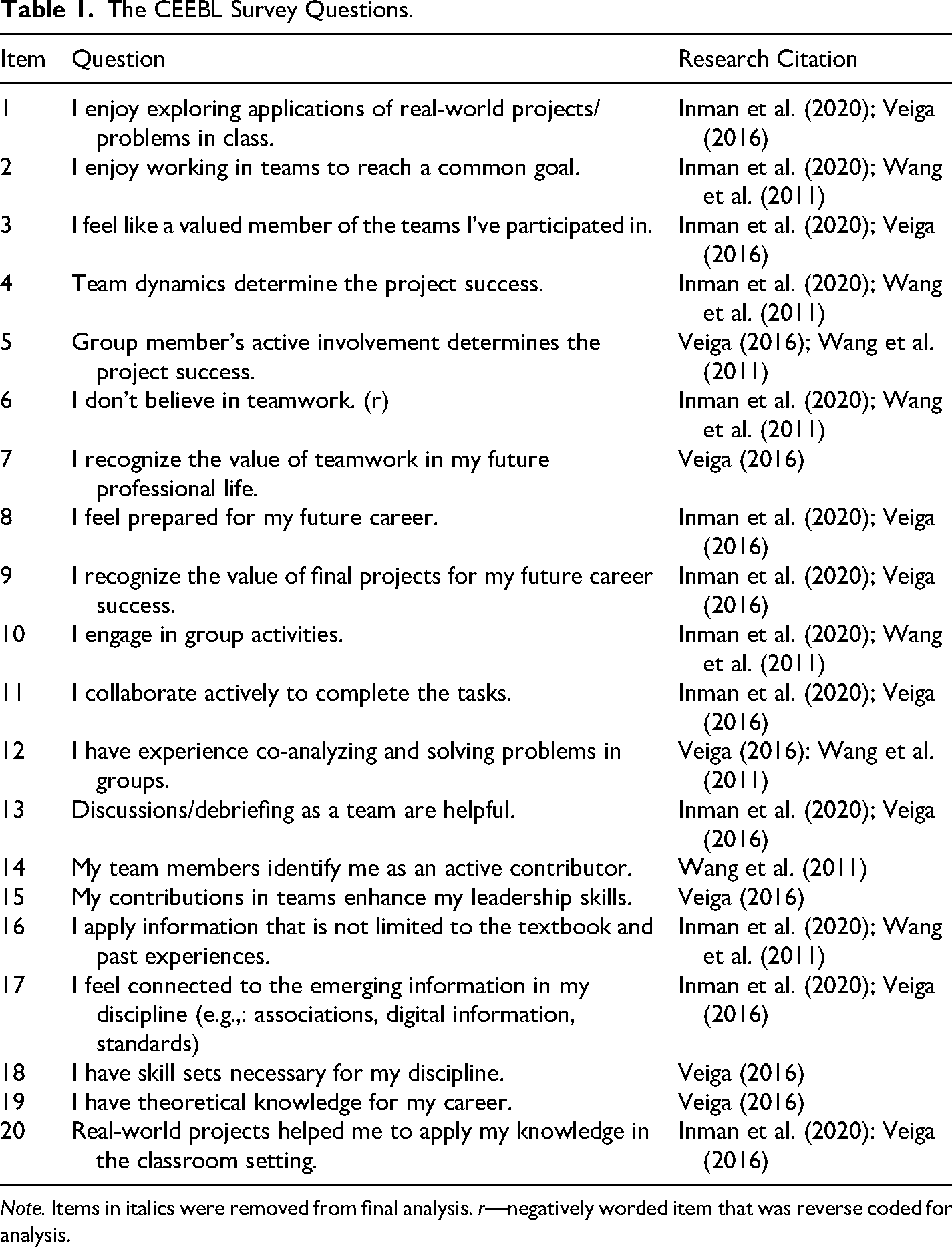
Note. Items in italics were removed from final analysis. r—negatively worded item that was reverse coded for analysis.
Participants
The reliability of factor analysis is influenced in part by the size of the sample, making it important to ensure an adequate number of participants. In other words, larger samples yield more stable and replicable factor structures and improve the precision of estimated loadings (Goretzko et al., 2021). However, the literature presents a range of sometimes conflicting recommendations for determining an appropriate sample size (Comrey & Lee, 1992, 2013; Hair, 2011; Hair et al., 1998; Kass & Tinsley, 1979; Nunnally, 1978; Tabachnick & Fidell, 2007). One commonly cited guideline suggests a minimum sample size of 100 participants, along with a respondent-to-item ratio of at least 5:1 (Hair et al., 1998).
Based on this, a minimum of 100 participants was required (20 × 5 = 100). A total of 165 responses were collected. After cleaning data, the final data set included 109 completed responses, meeting this criterion. Given the modest sample size, Confirmatory Factor Analysis (CFA) was conducted using a Bayesian estimation approach implemented in blavaan. Bayesian methods are less dependent on large-sample assumptions and are well-suited for theory-driven models estimated with limited samples. Model evaluation relied primarily on posterior predictive checks and inspection of posterior distributions and credible intervals, rather than traditional frequentist fit indices (Gelman et al., 2014; Muthén & Asparouhov, 2012).
Participants were primarily undergraduate students enrolled in business programs, with a limited number drawn from teacher education and graduate-level programs, at a small rural university in North America. To reach the required sample size, data were collected in multiple semesters and incomplete survey responses were removed during the data cleaning process.
Procedure
Pilot Testing and Refinement
The revised instrument was then pilot tested with a small sample of students representative of the target population. The purpose of this stage was to evaluate item clarity, wording, comprehension, and response patterns (Freyn et al., 2021, 2024). Feedback from the pilot study informed additional minor revisions. Adjustments were made before the instrument was finalized for full data collection and psychometric validation. The final version included items representing each of the three engagement domains embedded within the CEEBL framework.
Data Preparation and Coding
After the finalized surveys were administered responses were numerically recoded using 7-point Likert-type Instrument ranging from Strongly Agree = 7 to Strongly Disagree = 1. To mitigate potential response bias, one negatively worded item (Item 6) was included and was reverse-coded prior to analysis.
Analytic Strategy
Analyses were conducted using Bayesian methods appropriate for ordinal survey data. Responses were treated as ordinal indicators and analyzed in R (version 4.5.0; R Core Team, 2025) using the blavaan package. Measurement models were estimated using a probit link with Hamiltonian Monte Carlo sampling. A three-factor confirmatory model representing behavioral, affective, and cognitive engagement was specified a priori.
Weakly informative priors were placed on factor loadings and residual variances to stabilize estimation given the modest sample size. Model adequacy was evaluated using posterior predictive checks and Bayesian information criteria, including Widely Applicable Information Criterion (WAIC) and Leave-One-Out cross-validation (LOO).
To examine the robustness of the confirmatory model, a Bayesian SEM (BSEM) sensitivity analysis was planned using small-variance (shrinkage) priors to allow minor cross-loadings. Tests of measurement invariance across subgroups were not conducted due to insufficient subgroup sample sizes (see “Results” section). Internal consistency was evaluated using model-based reliability coefficients (McDonald's ω) derived from the posterior distributions.
Results
The study sample consisted of 109 participants. Most participants were enrolled as undergraduate students, with a small number of graduate students (N = 2) and participants from teacher education programs (N = 5). Subgroup counts by academic level (undergraduate vs. graduate) and program type (business vs. teacher education) are reported in Table 2.
Sample Characteristics by Academic Level and Program Type (N = 109).
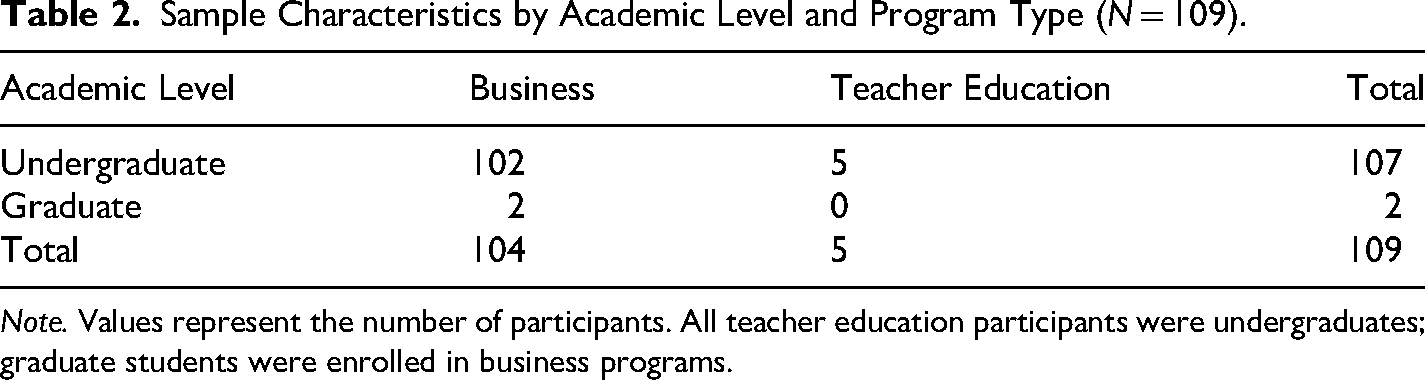
Note. Values represent the number of participants. All teacher education participants were undergraduates; graduate students were enrolled in business programs.
All participants reported their gender. Of the sample, 61 participants (56.0%) identified as female and 48 participants (44.0%) identified as male. No participants identified another gender category. The survey was administered using required-response items, resulting in no item-level missing data. Incomplete survey submissions were removed during data cleaning, and only fully completed responses were retained for analysis. One negatively worded item was removed prior to model estimation due to weak associations with other items and poor alignment with the intended construct. The final model was estimated using the remaining items.
Bayesian CFA
Following data preparation, a Bayesian CFA was estimated for the hypothesized three-factor model representing behavioral, affective, and cognitive engagement, with item responses treated as ordinal indicators. Model estimation converged satisfactorily under Hamiltonian Monte Carlo sampling. All retained items loaded positively on their intended factors, and 95% credible intervals for all factor loadings excluded zero, providing preliminary support for the proposed measurement structure.
Model Fit and Posterior Predictive Checks
Global model fit was evaluated using posterior predictive checks. The posterior predictive p-value (PPP = .013) indicated some degree of global misfit, suggesting that the model does not fully reproduce all aspects of the observed response distributions. Given the ordinal nature of the items and the length of the instrument, this level of misfit is interpreted alongside the strength of the factor loadings and reliability estimates rather than as evidence against the overall factor structure.
To complement posterior predictive checks, Bayesian information criteria, including WAIC and LOO, were examined. Some Pareto-k diagnostics exceeded recommended thresholds, indicating that these indices should be interpreted cautiously and used descriptively rather than for strict model selection.
BSEM Sensitivity Analysis
To examine whether the observed misfit was attributable to overly restrictive CFA assumptions, a BSEM sensitivity analysis was conducted allowing small cross-loadings via shrinkage (small-variance) priors. Allowing approximate cross-loadings did not materially alter conclusions about model adequacy, and posterior estimates of cross-loadings remained close to zero. This pattern suggests that the observed misfit is unlikely to be driven by omitted cross-loadings and may instead reflect local item dependencies or redundancy common in longer ordinal scales.
Measurement Invariance Feasibility
The feasibility of testing measurement invariance across academic level (undergraduate vs. graduate) and program type (business vs. teacher education) was examined. However, the analytic sample included only two graduate students and five participants from teacher education, with the remaining participants drawn from undergraduate business programs. Given this extreme subgroup imbalance, multi-group Bayesian CFA and approximate measurement invariance analyses were not statistically justifiable. Accordingly, measurement invariance was not tested, and no between-group latent mean comparisons were conducted.
Reliability
Internal consistency was evaluated using model-based reliability coefficients (McDonald's ω) derived from the Bayesian CFA posterior distributions. Reliability was excellent for all three factors: Behavioral (ω = 0.99), Affective (ω = 0.92), and Cognitive (ω = 0.88). These results indicate strong internal consistency of the measurement model despite the noted global fit limitations. Average Variance Extracted (AVE) was examined descriptively but is not interpreted as a reliability coefficient.
Narratives of Engagement: The Value of Qualitative Depth in CEEBL Evaluation
While the CEEBL Instrument provides a structured and statistically validated instrument for measuring engagement across behavioral, affective, and cognitive domains, it is important to acknowledge the limitations inherent in relying solely on quantitative survey data. Engagement is not only a measurable outcome but also an evolving, context-sensitive process shaped by interpersonal, emotional, and cognitive factors that cannot be fully captured through structured response formats.
Extensive literature on student's engagement, including foundational work by Fredricks et al. (2004), underscores that engagement is multifaceted and dynamic often expressed in ways that are not easily observable or self-reported. Similarly, McCoach et al. (2013) argue that affective constructs are deeply embedded in social contexts and internal dispositions, necessitating complementary methods of inquiry to reveal their full meaning. In educational settings where experiential and collaborative learning are emphasized; particularly in STEM and professional disciplines; qualitative methods such as structured observations, researcher field notes, group interviews, and participant reflections are crucial. These methods allow researchers and educators to explore students’ interaction patterns, group dynamics, emotional responses, and cognitive strategies. As noted by Barlow et al. (2020), capturing the cognitive processes and collaborative practices characteristic of active learning requires attention to both verbal and non-verbal behaviors, as well as the evolving social context in which learning occurs.
Moreover, affective engagement, such as students’ sense of belonging, perceived value of the learning task, and emotional investment in peer collaboration, often emerges through subtle cues and interpersonal exchanges. These are best understood through interpretive analysis of open-ended narratives, dialogue, and observed conduct within groups. The use of interviews and classroom ethnography allows researchers to explore discrepancies between what students report and what they actually do or experience.
Accordingly, while the CEEBL Instrument can serve as a summative tool to assess students’ perceptions at the conclusion of a course or learning cycle, its application is most effective when situated within a broader, mixed-methods approach. Triangulating survey results with qualitative data enhances the trustworthiness of findings and offers a richer understanding of how collaborative engagement unfolds in real-world instructional contexts. Such an approach aligns with current best practices in engagement research, which emphasize methodological pluralism to account for the complexity of learning in authentic, team-based environments. Especially in professional education, where skills such as communication, critical reflection, and adaptive thinking are central, exclusive reliance on quantitative tools may obscure critical aspects of the learner experience. Therefore, systematic integration of qualitative data is not simply advisable, it is essential.
In this study, recognizing the limitations of quantitative assessments, additional open-ended questions were incorporated into the instrument, such as: How has this semester affected your teamwork skills, if at all? What were the most important exercises or experiences in the class that prepared you for your future career? Do you have any other comments about the course structure or insights gained?
Student reflections in response to these prompts revealed breadths of collaborative engagement that are not easily captured through quantitative metrics. Qualitative insights emerged that added depth to our findings and reinforced the value of a mixed-method approach to understanding student engagement, which are briefly explained below.
For instance, in the student's response in undergraduate business and teacher education programs that we analyzed we found that experiential learning emerged as a strong motivator and a key factor in shaping students’ professional identity, particularly when tied to real-world relevance. One student explained that “Meeting with actual companies and working with a team to develop a marketing plan were the most beneficial,” while another noted “Making a real business instead of just doing a paper helps us students prepare for what it may be like in the future.”
Also, participants often described collaboration as more than task coordination, emphasizing the importance of trust and mutual accountability within group work, which reflects “behavior engagement.” As one student shared, “I had to really make sure to trust that my group is going to do their part of the assignment and not try to micromanage them” and another added “Group work collaboration and discussions of how we could achieve our goal.”
Similarly, student narratives also frequently reflected growth in their sense of responsibility, revealing how “affective engagement” shaped their learning experiences. For example, one participant noted, “I’ve learned a new level of responsibility that has made a very positive impact on my confidence.” And another emphasized, “This project really helped to stress the importance of communication.”
In addition, many students engaged in reflective thinking, acknowledging the need to adapt and problem-solve as part of their development through collaborative challenges. This self-awareness, which is another indicator of “cognitive engagement,” was reflected by one student who said, “The course helped me figure out my faults in group work and how I can fix them in the future,” and another who shared, “I feel more confident taking risks based on my knowledge.”
Discussion
The CEEBL Framework
The results of this study validate the multidimensional structure of collaborative engagement as a key driver in preparing students for the work-life skills needed post-graduation. Iqbal et al. (2026) points to the value of experiential learning as a key driver stating that many graduates “face employment challenges due to skill mismatches, limited experiential learning, and an overemphasis of theory” (p. 2). Their study of student engagement and its positive influence on employability support the CEEBL Framework. Rose (2026) stresses that when experiential learning is grounded in real-world, problem-based contexts, students exhibit higher levels of motivation, reflection, and professional identity. These findings parallel our results, which confirm that collaboration is a measurable construct integral to successful experiential learning. Rose's conclusion that “students interact differently with the problem when they see it is a real problem which the industry partner is trying to solve” (p. 9) directly aligns with the behavioral and emotional engagement dimensions captured in this instrument.
Similarly, the current study's evidence of strong validity and reliability supports Iqbal et al.'s (2026) assertion that student engagement functions as the mediating link between educational quality and employability. They argue that engagement and learning outcomes translate academic quality into practical capability a finding mirrored here, where the validated instrument operationalizes that engagement construct within experiential learning contexts.
The decline in confidence in higher education underscores the need for frameworks that can both strengthen practice and evaluate impact. While experiential learning is widely recognized as a valuable approach, scholars emphasize that it still requires deeper theorization and structured measurement (Quay, 2003; Southcott, 2004). The CEEBL framework addresses this gap by capturing behavioral, affective, and cognitive dimensions of collaborative engagement, offering a practical tool for assessing how experiential learning supports career readiness.
A Validated Instrument
While Ferns et al. (2025) and Rose (2026) highlight the importance of intentional curriculum design and structured practice, their studies also noted the lack of a standardized instrument to measure how effectively these experiences achieve their intended outcomes. The present research directly addresses this gap. By confirming the psychometric soundness of this instrument, this study provides an evidence-based tool for educators and researchers to systematically evaluate the quality and depth of experiential learning across diverse educational and professional settings. A reliable and valid measure allows educators to evaluate collaborative engagement systematically, align curricula with real-world competencies, and benchmark results across programs and institutions. In doing so, this study contributes both a practical tool and an empirical foundation for improving the design, delivery, and accountability of experiential learning.
The validation process for the instrument involved a series of statistical analyses to examine its factor structure and internal consistency. Using a Bayesian CFA framework appropriate for ordinal survey data, the analysis provided preliminary support for a three-factor structure representing behavioral, affective, and cognitive engagements. This structure is theoretically consistent with the theoretical foundations of the CEEBL framework and reflects conceptually distinct yet related dimensions of student experience. The use of Bayesian CFA aligns with methodological recommendations for Likert-type data and modest sample sizes, allowing for probabilistic interpretation of model parameters (Flora & Curran, 2004; Muthén & Asparouhov, 2012).
Although posterior predictive checks indicated some degree of global model misfit, sensitivity analysis using a BSEM approach that allowed small cross-loadings did not materially alter substantive conclusions. This pattern suggests that the observed misfit is unlikely to be driven by overly restrictive zero cross-loading assumptions. Instead, it may reflect local item dependencies or redundancy, which are common challenges in multi-item engagement instruments. Prior work has emphasized the value of such sensitivity analyses when theory specifies a clear structure but minor deviations from simple structure are plausible (Muthén & Asparouhov, 2012).
From a measurement perspective, internal consistency across all three engagement dimensions was strong, indicating that items within each domain function cohesively to represent their intended constructs. Model-based reliability estimation is particularly appropriate in latent variable frameworks, as it directly incorporates factor structure and measurement error rather than relying on assumptions of tau-equivalence (Muthén & Asparouhov, 2012).
Several limitations should be noted. Measurement invariance across academic level and program type could not be evaluated due to limited and highly unbalanced subgroup sizes. In this context, multi-group CFA or approximate measurement invariance analyses would be statistically unstable and overly influenced by prior assumptions. This decision follows established guidance emphasizing adequate subgroup sizes and cautious interpretation in invariance testing (Feng et al., 2023; Millsap, 2012; Van de Schoot et al., 2013). Future research should examine invariance in larger and more diverse samples and further refine the instrument to address potential item redundancy. Taken together, these findings suggest that the CEEBL instrument offers a promising foundation for measuring multidimensional engagement in experiential learning contexts. Continued validation across settings and populations will be essential to strengthening its utility as both a research and practice-oriented tool.
Implications for Education
The results of this study reinforce the need to adopt innovative pedagogical strategies that incorporate the CEEBL framework to foster critical thinking, collaboration, and work-integrated learning. In addition, the study provides a validated instrument for assessing the effectiveness of this methodology, not only in preparing students for the workplace but also in supporting the continuous improvement of teaching and learning processes. Validation findings indicate that the instrument demonstrates strong psychometric properties, including a clear factor structure, satisfactory item fit, and high internal consistency, confirming its suitability for measuring student engagement, perceived value, and skill-development outcomes.
In addition, the examples provided from the qualitative feedback infers collaborative engagement not as a fixed outcome but as a dynamic, evolving process shaped by actions demonstrating willingness to overcome challenges and collaborate teamwork in affinity groups, emotional growth, cognitive challenge, and contextual relevance. These findings reflect insights that a structured survey alone cannot fully capture. Mixed-method approaches align with best practices in engagement research, particularly in professional programs such as business, teacher education, STEM, engineering, and medicine, where communication, critical reflection, and adaptive thinking are core competencies. Without qualitative data, we risk missing the how and why behind collaborative engagement. The complexity of student experience requires both measurement and interpretation, reinforcing that mixed-method designs are not simply complementary but essential. In this context, the systematic integration of qualitative data is not a recommendation; it is a necessity for capturing the full scope of collaborative engagement.
In summary, this study contributes to the field by operationalizing a critical but previously under-measured dimension of experiential learning, collaborative engagement, and provides a validated, reliable framework through which future research and educational practice can evaluate and improve the quality of work-integrated and experience-based learning environments.
Limitations of the Present Study
Despite the methodological rigor applied in the development and validation of the CEEBL Instrument, several limitations must be acknowledged. These limitations not only contextualize the findings but also point toward productive avenues for future research. The primary limitation of this study lies in its reliance on self-reported data. While self-report instruments are useful for capturing students’ perceptions of their engagement across behavioral, affective, and cognitive dimensions, such data are inherently subjective and may be affected by social desirability, recall bias, or a lack of self-awareness.
It is also important to note that the validation process was based on a modest sample (N = 109). While this number is appropriate for an initial validation study—particularly within a Bayesian analytic framework—it nonetheless limits the precision of parameter estimates and the generalizability of the findings. Replication with larger samples is needed to further evaluate the stability of the factor structure and model fit.
Finally, the CEEBL Instrument was administered at the conclusion of an academic term. While this timing allows for holistic reflection on collaborative experiences, it does not account for variability in engagement over time. Engagement is a dynamic construct, and future studies should explore longitudinal designs that capture fluctuations in engagement at multiple stages of a course or project cycle. This would allow for a more nuanced understanding of how collaborative engagement evolves during experiential learning activities.
Future Research
The present study focused primarily on professional education contexts, with most participants drawn from business programs and limited representation from teacher education disciplines. While these fields share characteristics that make them ideal for experiential and collaborative learning, the generalizability of the CEEBL Instrument to other domains (e.g., the humanities or STEM disciplines) remains tentative, and additional research is warranted.
Future research should expand on the current validation process by testing the CEEBL Instrument with larger and more diverse samples to enhance its generalizability and statistical robustness. Although the present study employed Bayesian CFA, further psychometric work including measurement invariance testing across demographic or academic groups and test–retest reliability would strengthen confidence in the instrument's stability and applicability.
Significance of the Research
This study introduces a tool designed to measure students’ engagement in an experiential learning environment to solve real-world problems in their teams. Serving as a practical evaluative tool, this instrument enables educators and researchers to assess experience-based learning in diverse educational contexts and confirm the achievement of learning outcomes necessary in the workforce.
Footnotes
Acknowledgments
The researchers would like to acknowledge Professor Jean Ellefson, Analytics Professor at Alfred University, for her insightful input in the development of the survey and for providing data from her undergraduate business classes. They are especially grateful to Dr. Samuel Albert for his thoughtful final review of the manuscript. Special thanks to Sienna Cefalu, MBA student, for creating the online version of the survey and meticulously cleaning the data.
Generative Artificial Intelligence (AI), specifically ChatGPT-5.0, was utilized to support grammar and language refinement.

Ethical Approval
Research ethics approval was obtained by Alfred University's Institutional Review Board.
Consent for Human Participants
All procedures involving human participants were reviewed and approved by the Alfred University Institutional Review Board (IRB). Informed consent was obtained from all participants prior to their involvement in the study.
Author Contributions
Mina Sedaghatjou led the conceptualization and design of the study, conducted the literature review, and coordinated the writing of the manuscript. Mina Sedaghatjou and Shelly L. Freyn collaboratively conducted the statistical analysis and interpreted the results. Shelly L. Freyn coordinated data collection and provided critical feedback throughout the writing and revision process. Both authors approved the final version of the manuscript.
Funding
The authors received no financial support for the research, authorship, and/or publication of this article.
Declaration of Conflicting Interests
The authors declared no potential conflicts of interest with respect to the research, authorship, and/or publication of this article.
Availability of Data and Material
The data supporting this study are available upon request and contingent upon approval from the Alfred University Institutional Review Board (IRB).
Code Availability (Only if Used)
Not applicable.