



Abstract
As part of the Creative Well program at a local health board, one of the authors qualitatively investigated how painting can access a means of communication for people living with dementia. In a workshop setting within a gallery environment, participants living with dementia were facilitated on a one-to-one basis the opportunity to paint alongside the researcher. During the workshops, a number of experiences were articulated. These included experiences of illness, crisis, and loss. They were captured through observations, interviews, visual art, and video to contribute to new understandings and models of engagement through art for people living with dementia and their carers. Focusing on theory and practice in arts-based research and the social sciences, this article investigates the potential of painting to unlock experiences such as disenfranchised grief for people living with dementia. The conclusions of this article do not measure how and if participants felt disenfranchised grief but rather provide an alternative to augment the body of knowledge surrounding how people living with dementia can communicate feelings of disenfranchised grief through painting.
Introduction
As part of a larger practice-based PhD study into the communicative capacities of painting for people living with dementia, a number of experiences were articulated and captured in innovative ways that contribute to new understandings and models of engagement through art for people living with dementia and their carers. Among the different experiences explored, were feelings of illness, crisis, and loss through dementia, with anxiety and negative emotions being identified as key themes. This article investigates the potential of painting to unlock experiences of crisis illness and loss, and in particular, disenfranchised grief for people living with dementia. Participant observations, interviews, visual art, and video have been used in order to gain a deeper understanding of this topic.
Within the United Kingdom, dementia presents as a huge health-care challenge with currently 850,000 people living with the disease in the United Kingdom (Alzheimer’s Society, 2017). Without significant research and intervention, this will have doubled in the United Kingdom to 1 million by 2025 and by 2051 will have doubled again (Alzheimer’s Society, 2014). The term dementia is defined as a set of symptoms which cause a progressive decline in the brain and its capabilities, commonly causing problems with memory loss, mental agility, and thinking speed (National Health Service, 2013). Dementia still remains a stigmatized condition due to the decline of mental capacity and thereby the loss in independence. The experience mostly affects people over the age of 65 years, and this connotation with aging also exacerbates this social opinion (Cohen-Mansfield, Golander, & Arnheim, 2000).
Diagnosis of dementia can have significant emotional, social, psychological, and practical impact with people often experiencing a sequence of losses (Alzheimer’s Society, 2018b). Many people living with dementia are aware of the changes that are taking place but may have difficulty in expressing this due to their memory loss, cognitive impairment, and communication difficulties (Irish Hospice Foundation, 2016). Due to this, it is often misconceived that people living with dementia cannot experience or sustain grief due to this progressive decline in their memory and mental capacity. This societal misunderstanding of a person living with dementia’s experience of loss means that grief can often become disenfranchised. This can occur at any point of someone’s journey with dementia and often occurs on a daily basis. The different types of loss faced by somebody can also be simultaneous, accentuating this disenfranchisement (Irish Hospice Foundation, 2016).
Disenfranchised Grief and People Living With Dementia
Thompson and Doka (2017) identify disenfranchised grief as a sociological concept that arises as a result of social expectation. Their work has been influential in locating grief in broader theoretical applications which have been utilized in this study. Disenfranchised grief can be defined under three main headings. These are grief that cannot be openly acknowledged, grief that is not socially sanctioned, or grief that is not publicly mourned (Thompson & Doka, 2017). Examples of disenfranchised grief can have different implications and various resonances in contrasting social circumstances (Thompson & Doka, 2017). Painting and other art-related approaches can enable contexts to be explored for those living with dementia.
Grief That Is Not Openly Acknowledged
Grief that is not openly acknowledged relates to grief which has some level of secrecy or confidentiality aligned with it (Thompson & Doka, 2017). Receiving a dementia diagnosis can result in a feeling of social dislocation. The person often enters a new lower status social group a process that is a function both of the condition itself and responses to it (Katsuno, 2005).
Grief That Is Not Socially Sanctioned
The second element of disenfranchised grief comprises grief that is not socially sanctioned. This can be due to social disapproval or a feeling of cultural rules being broken (Thompson & Doka, 2017). Stigmatization for people living with dementia is prevalent with people often feeling lonely and isolated. The cognitive degenerative nature of dementia means people living with it can experience behavioral or psychological symptoms. This can lead to a worry about the response from others and society, meaning that people living with dementia can often feel like they are being hidden (Kuriakose cited in Batsch & Mittelman, 2012).The stigma associated with dementia can affect the persons’ willingness to pursue a diagnosis, request support, or participate in research once diagnosed (Burgener & Berger, 2008; Milne, 2010; Garand et al., 2009 cited in Swaffer, 2014).
Grief That Is Not Publicly Mourned
For people living with dementia and their carers, it can often be very difficult to publicly grieve the changes that are taking place. People often feel a sense of loss when diagnosed with dementia, and this is accompanied by an uncertainty and obscurity about how the disease will progress and the impact this will have on the individual (Alzheimer’s Society Canada, 2013). It can also be very difficult for people living with dementia to publicly mourn a loss or death of somebody. Self-stigmatization, a process whereby stigma is absorbed by the individual, also plays a role. It encourages people with dementia to remain invisible and withdraw from social contact. (Milne, 2010, p. 228)
Using Art as a Research Tool
There is a substantial body of knowledge about arts-based research. Knowles and Cole (2008) provide an overview of how such research provides possibilities that arise through the use of a mixed-method approach using both arts-based practice and social science methods. There has been less of a focus within existing research in developing conceptual and theoretical frameworks for understanding the processes through which the arts may exert their benefits (Stickley et al., 2017). Research needs not only to address causal relationships but also to investigate a deeper understanding of how arts practices function to promote well-being. The specific subject domains of arts and health do not exist as concrete entities, but are shifting, amorphous, and contested, subject to competing knowledge claims (Broderick, 2011). Wider academic engagement across discipline boundaries are needed to create a creative conversation between the place, sites, and spaces in which arts in health possibilities can critique medicalized models of health care (Stewart cited in Stickley et al., 2017).
This research adopted a practice-led approach with the authors as practicing artists not art therapists. Painting was specifically chosen for this study as “it is an original psychic act which is derived from a person’s own individuality, experiences and ideas” (Kuspit, 2000, p. 3). There is abundant art therapy literature that supports the use of painting to enable the healing and renewal of the imagination and illnesses associated with the loss of soul (Mcniff, 1992). Art activities such as painting which have a kinesthetic element allow for a “rhythm, action, movement and the release of energy” to be undertaken by the creator (Hinz, 2009, p. 42). The use of a paintbrush by participants removes any use of a mediator which in turn increases the sensory quality of the experience and therefore the ability to express experiences (Hinz, 2009).
Art-based research can be defined as the systematic use of the artistic process, the actual making of artistic expressions in all of the different forms of the arts, as a primary way of understanding and examining experience by both researchers and the people that they involve in their studies. (Mcniff, 2008, p. 29) If the arts are about anything, they are about emotion, and emotion has to do with the ways in which we feel. Becoming aware of our capacity to feel is a way of discovering our humanity. Art helps us connect with personal, subjective emotions, and through such a process, it enables us to discover our own interior landscape. Not an unimportant achievement. (p. 12)
Methods
Research Overview
As part of a Creative Well program provided through the North Wales Health Board, we qualitatively investigated how painting can access a means of communication for people living with dementia. In a workshop setting within a gallery environment, one of the authors worked on a one-to-one basis with participants, facilitating the opportunity to paint alongside her while she made her paintings. The intervention was not therapeutic in its aims, but part of a program called Lost in Art, organized by a rural crafts center, which provides enjoyment and friendship for people living with dementia and their carers.
Ethics
Ethical permission for the research was granted through approval from Wrexham Glyndwr University Research Ethics Committee. All participants had early- to mid-stage dementia and had sufficient mental capacity, meaning that they agreed to participate through signing informed consent forms. For the purpose of anonymity, pseudonyms have been used throughout this study.
Participants
Permission to participate in the project and thus access participants was gained via a local arts development officer. Four female and four male participants all living with dementia and their family/main carers were recruited through the Lost in Art scheme. Lost in Art provides weekly art workshops for people living with dementia and their main carers who live in a rural county in North Wales. This meant that a diagnosis of dementia had already been established and all participants lived in a local area. All participants were over the age of 65. As the focus of this research was on the communicative capacities of painting for people living with dementia, other detailed demographic information was not specifically sought at the outset of this study.
Data Collection
Each participant and their carer attended a 1-hr one-to-one creative workshop with one of the authors at their local craft center. Participants and their carers were provided with a selection of different colored acrylic paints, paintbrushes, and canvas boards and were asked to paint whatever they wanted while they sat next to the researcher, who then painted alongside them.
A loose semistructured interview guide was utilized during the workshops to gain a more of an in-depth understanding of the creative painting process for participants. Interviews covered broad themes such as mark making, color, and relation of painting to memory. It was also important to understand that participants had varying levels of verbal communication and care needs, so the conversation and needs were adapted for each session. This was done through simplifying how questions were asked if needed, using reminiscence to help ease participants and redirecting conversation to help lessen or avoid participants anxieties (Beuscher & Grando, 2011).
This person-centered approach where a person’s care is based around their “interests, abilities, history and personality” is highlighted by the Alzheimer’s Society (2018a) through the acknowledgment of it being a mechanism of managing psychological or behavioral difficulties.
Participant observation (Kawulich, 2005) was also used to gain a deeper understanding of the experiences and creative process of all participants. Each workshop was video recorded which allowed reexamination of the participant’s behavior, painterly process, and speech. Observations were also recorded through field notes throughout each hour workshop. Semistructured interview and video recordings were transcribed along with a corresponding step-by-step description of observations made.
Resulting data consisted of paintings from participants, field notes from observations within the workshop, and video recordings within the workshops, which documented semistructured interviews with corresponding written observations.
Analysis
A qualitative thematic analysis approach (Braun & Clarke, 2012) was used to identify themes and patterns from these data for people living with dementia and the capabilities of the engagement with paint to provide a communicative capacity. To ensure a rigorous and transparent approach, data were transcribed and then coded line by line (Neal, 2016) using the qualitative analysis tool NVivo. Semistructured interview data were transcribed along with corresponding written-up observations gained through the video recordings. These were analyzed through NVivo. Final paintings were not analyzed through Nvivo as the focus of the research is on the process of creating the paintings not the final output of the finished work itself.
Emergent inductive themes were developed from these, one of which was the emotions that participants faced during the art workshop. After data had been coded, thematic charts were created to visually simplify, highlight, and visualize relationships between themes (Ritchie & Lewis, 2014). This allowed for a systematic and comprehensive exploration of similarities between different themes and topics and between the different participants involved.
Findings
Four of the eight examples were specifically chosen from the sample for this article, as they most consistently presented relevant considerations. Carers paintings were not analyzed, as the focus of the research was to provide an in-depth focus on the grief associated with dementia.
Each participant’s final painting can be seen in Figures 1 to 4.

James (May 2017).
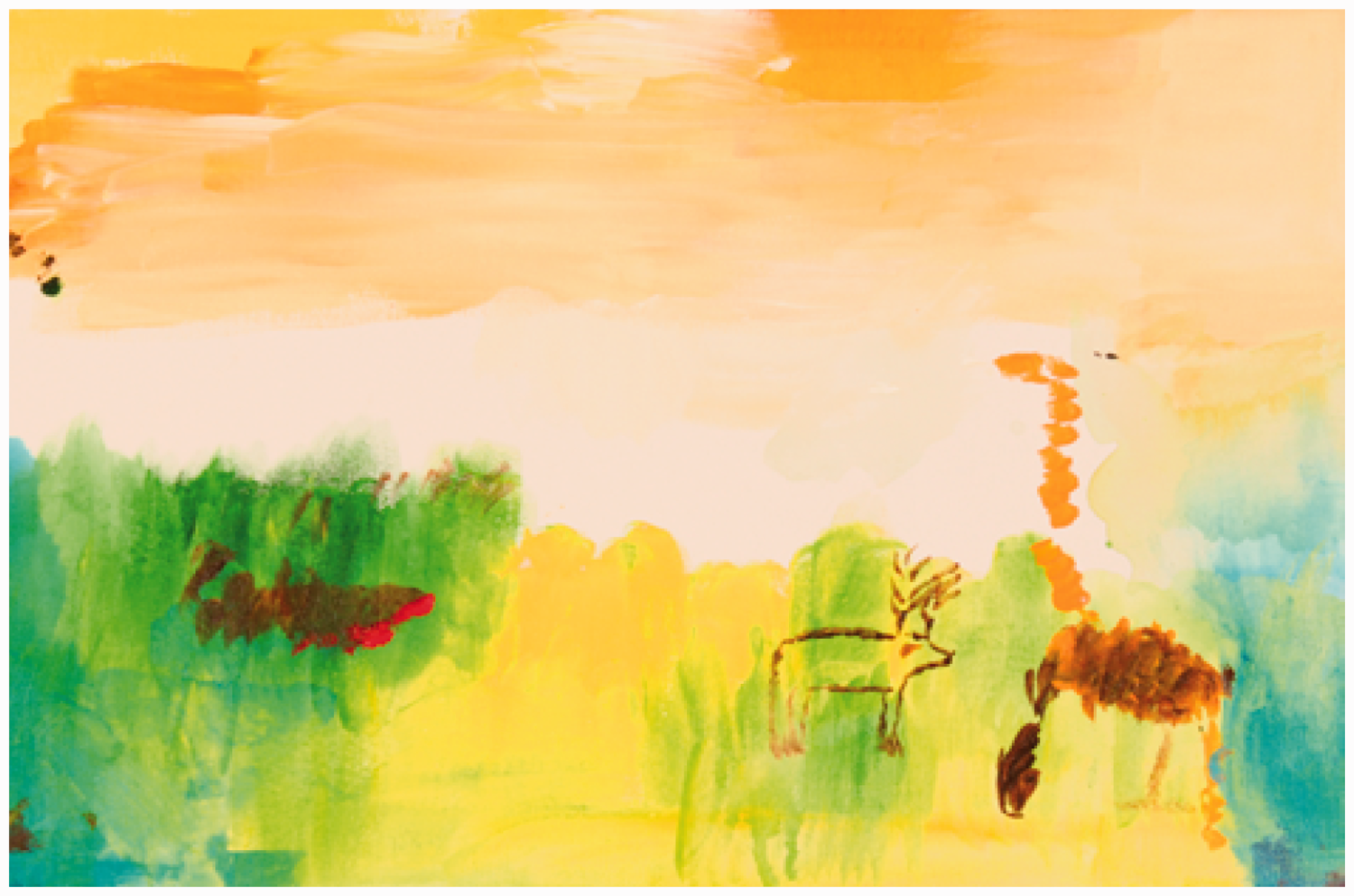
Poppy (May 2017).

Flossy (May 2017).

Rose (May 2017).
Analysis suggests that all four participants either felt some form of grief that is not openly acknowledged, grief that is not socially sanctioned, or grief that is not publicly mourned. This was embodied in exhibited negative emotions of anxiety, frustration, crying, and an awareness of their own difficulties. It is important to note that this analysis did not establish measures of how and if participants felt disenfranchised grief but rather provided alternative perspectives and adds to the body of knowledge into how people living with dementia can communicate feelings of disenfranchised grief through painting.
Grief That Is Not Openly Not Acknowledged Within Context of Dementia
Grief that is not openly acknowledged relates to grief which has some level of secrecy or confidentiality attached to it. Receiving a dementia diagnosis can result in a feeling of social dislocation due to the nature of responses to the condition and the nature of the condition itself (Katsuno, 2005). Findings from the workshops suggested that all four participants felt some level of grief that was not openly acknowledged.
James found it difficult to communicate on entering the room. Once his wife left, he immediately began to cry. When asked if he was ok, James said he could no longer do anything for himself anymore and that he had to rely on his wife for everything. He expressed his frustrations, saying with a sense of loss that he had once been very independent and had a good career. He spoke of how this independence had been taken away from him and that his complete reliance on his wife was something he found upsetting.
Once James was seated, the researcher displayed a range of paintbrushes and asked if he would like one. When engaged in the activity of painting, James’s strong emotions subsided, and it was observed that James was immersed in the process of painting for the majority of the 1-hr workshop. James was making up the imagery of a small man like figure in the corner of his canvas through applying repetitive delicate marks of different colored paint. Midway through the art workshop, James’ wife commented on his painting saying: he recited a poem this morning that he remembered, I don’t know if that’s because of it. He said about a friend of his and somebody did this verse or something and what did you say, and blue legs was it and you know somebody said with black teeth and blue legs. He’s done his with blue legs now.
The evidence here implies that James felt dislocated socially in the workshop setting, but the painting activity enabled these strong feelings to subside. It can be suggested that the painting workshop gave James the opportunity to express the grief associated with the loss of independence.
At the beginning of the session, Poppy’s speech was very fast and rambling and was largely incoherent. For the parts of Poppy’s speech which were coherent, she was talking about how she had been asked to take part in a questionnaire the previous day, and she was concerned that she had not been able to think of the right answers. It was observed that this made her very anxious, something which may be an example of Poppy feeling socially dislocated.
At the beginning of each of their workshops, Flossy appeared anxious and Rose was fed up. Flossy repeatedly asked while exhaling, what she was supposed to be doing. The researcher asked her if she would like to choose a brush and flossy chose a medium-sized one and after a few minutes began to paint. Once Flossy engaged in painting, she became immersed in the process, and it was observed that her anxieties lessened from what they had been at the beginning. Neither Flossy nor Rose initially verbally commented on their emotions, something which may show that they could not openly acknowledge their feelings or felt some level of secrecy toward them.
Initial resistance to working in an unfamiliar workshop setting was combatted by participants being asked to paint alongside the researcher and acting spontaneously when painting. The presence of the artist researcher as witness helped restore confidence and placed them in a more relaxed frame of mind, opening them up to the creativity within them.
Grief That Is Not Socially Sanctioned Within the Context of Dementia
Findings from this study also suggest that the participants experienced the second element of Disenfranchised Grief (Thompson & Doka, 2017). Something which is prevalent for people living with dementia is the feeling of being stigmatized with anxieties relating to their own behavior and the responses of this from others (Kuriakose cited in Batsch & Mittelman, 2012).
All the participants communicated negative emotional feelings at the start of the painting workshop and throughout the session with three of the four participants showing negative expressions toward their painting.
At the beginning of the session, Poppy chose a brush and then stated my pictures are no good. She then went on to say that she was hopeless and that every time I do it, it comes to a blob while tapping her head and appearing frustrated. Flossy also stated I don’t know what I’m ending up with I don’t know what I’m doing and Rose said I’m not a talented painter you see.
The above observations could indicate that the participants were worried what others would think of their paintings, trying to hide symptoms in a new setting and withdrawing into themselves. It is important to note, however, that people without dementia may also be critical of their own abilities.
Poppy and Flossy also both questioned the purpose of the session, with Flossy repeatedly asking questions throughout the workshop such as are you not going to give us anything to paint, is it just out of your head and what do you reckon I’m painting here. This may indicate a lack of confidence and anxiety surrounding their own abilities and purpose within the workshop. When reassured by the researcher or their carer, however, they engaged in the process of painting.
At the end of the session, however, Flossy stated I think it’s magic when referring to her painting, something which can suggest that she felt a certain sense of achievement while Poppy said The only thing you get out of this is a laugh isn’t it, and Rose looked at her painting and said wow wow all of which can indicate that they had enjoyed the workshop. Our lives are improved by having a network of social connections, for example, art groups, clubs, and associations which are of benefit in times of need (Thompson & Doka, 2017).
Grief That Is Not Publicly Mourned in the Context of Dementia
All four participants felt some form of the third element of disenfranchised grief—grief that is not publicly mourned. People living with dementia can feel a sense of loss due to the degenerative and uncertain nature of their condition (Alzheimer’s Society Canada, 2013). All four of the participants verbally acknowledged their own difficulties whether physical or mental, and it was observed that while speaking about these difficulties, participants either appeared sad, anxious, or frustrated by them. As indicated earlier, James cried at the beginning of the session and spoke about his loss of independence, suggesting that he felt saddened by this. While Poppy was painting, she said the stuff is here but it goes in the wrong place all the time with me while tapping her head and looking frustrated. Flossy did not verbally acknowledge any difficulty but appeared confused and said I don’t know what I’m doing. It was observed that Flossy appeared frustrated when saying this and was exhaling, suggesting that she was aware of this difficulty but unable or reluctant to articulate it. Rose also stated that she had experienced a bad night and had been up a lot but that her painting was cheering her up.
Flossy’s anxieties were lessened when painting, as it was observed from her facial expression no longer appeared anxious, and she had stopped asking what she should be doing. She appeared very immersed in this process.
The Immersive Experience of Painting and Dementia
All four of the participants engaged in the process of painting, and it was observed that at some points in the workshop, they all appeared immersed. Although their mood and behavior fluctuated throughout the session, it was noted that their negative emotions were not as profound at the end as they were at the beginning.
Mcniff (2008, p. 32) states: I give examples of how the arts help us improve the way we interact with others by learning how to let go of negative attitudes and excessive needs for control, learning how to foster more open and original ways of perceiving situations and problems, gaining new insights and sensitivities toward others, learning how the slipstream of group expression can carry us to places where we cannot go alone, learning how to create supportive environments that inspire creative thought, and realizing that nothing happens in creative expression unless we show up and start working on a project, even with little sense of where we might ultimately go with it.
Painting encourages a dialogue that can have therapeutic effects for people living with dementia allowing access to an expression of grief through activities that focus on the present. The lives of people living with dementia can be improved through engagement in art activities with their focus on growth, humor, and emotional connection rather than memory (Basting, 2009).
Implications for Practice
An Arts Council Wales (ACW, 2018) survey mapping the arts in health provision across revealed the need to strengthen the evidence base stating that, “if we don’t we risk not being able to confidently demonstrate the impact the arts engagements are having on people’s health and well-being” (p. 91).
The Dementia and Imagination Arts and Humanities Research Council funded project has had significant impact in North Wales through journal papers, booklets, and guides for artists and clinicians working in the field (Dementia and Imagination, 2017). This article builds upon good practice established by this research and demonstrates on a small scale how being immersed in painting can access disenfranchised grief for four people living with dementia, contributing to evidence of the positive benefits of Arts in Health more generally. In October 2017, the ACW signed a 3-year Memorandum of Understanding with Public Health Wales and the Welsh Local Government Association to advance work around Arts and Health and to promote the benefits to the public and policy makers in Wales (NHS Confederation, 2017). The painting intervention in this article has forged friendships with those living with dementia and their carers, created partnerships between local galleries, local authority arts officers, the local health board, and the University who are now working collaboratively to establish funding for further research projects.
Limitations of Study and Potential for Future Research
Within this research study, there are evident limitations. First, all participants who were accessed already attended a 2-hr art workshop every week and had been involved in creative activities. This, therefore, excluded people living with dementia who had no experience of taking part in a creative class. It is possible that this skewed the findings and that another sample of people would not show such an engagement with the painting. The ability to verbally communicate was varied for each participant meaning that data from semistructured interviews were varied and dependent on each participant. However, the methodology used was able to at least partly capture the painting experience for all participants.
The nature of dementia is extremely unpredictable, and somebody’s behavior and cognitive abilities can fluctuate throughout the day. Therefore, it needs to be noted for the purpose of this research that the findings capture the feelings and experiences of the participants at the particular time of the workshop. It cannot be assumed that all participants would experience the same things at a different point in time. It is also important to understand that many people living with dementia are living with a comorbidity (Alzheimer’s Society, 2015). Again, this can complicate behaviors and cognitive abilities for participants and cause a decline in their daily functioning (Scrutton & Brancattie, 2016).
It was noted within this research that all participants’ anxiety decreased throughout the session. Specific instances were recorded where anxiety reduced once the participants started painting, which suggests that there was a relationship between the two. However, there is ambiguity about whether the act of painting led to a lessening in anxiety or whether it was the adjustment of having spent time in a new place. In addition, many people lack confidence in their creative ability, and this is not just an issue for people with dementia. This study provides a very person-centered approach into investigating how people living with dementia experience and communicate through painting. Although this study only involves eight participants (on a certain day at a certain time), it could be repeated with more participants from different contexts to further explore the communicative and experiential qualities of painting.
The work produced at the workshops by the participants and the researcher is to be exhibited in a public space in 2018. Audiences can engage with the artworks to help understand the dementia condition through a carefully curated show with accompanying literature that aims to destigmatize. This professional context for the artwork produced by those with dementia being shown alongside professional artists elevates the status of the artwork. A similar initiative was the successful exhibition Beyond Dementia at the Whitworth Gallery, Manchester 2017 (Whitworth, 2017). This exhibition explored the lived experience of dementia through looking beyond the negatives and highlighting the positives of the condition through engaging those living with dementia in practical workshop activities similar to that led by the researcher here. Museums and galleries are increasingly becoming socially engaged spaces that tackle human challenges with public audiences.
Conclusion
Research shows that people with dementia still maintain a rich inner life (Johnson, 2016). It is also evident, however, from the findings of this project, that participants in the study felt the varying negative emotions. Engagement in the creative process can help develop knowledge and understanding about how these feelings represent the processes of loss and grief and can through facilitating provision of an outlet that can explore how the loss effects an individual through recognition of that loss and grief as it is encountered. It can also help with developing appropriate responses for both those living with dementia and their carers, as they create artworks together. This research contributes to new ways of communicating with people living with dementia. Sharing and exhibiting the artwork can help destigmatize dementia and raise awareness and public understanding of the condition to combat isolation and give validation to the grief experienced by those living with dementia and their carers.
Footnotes
Declaration of Conflicting Interests
The authors declared no potential conflicts of interest with respect to the research, authorship, and/or publication of this article.
Funding
The authors received no financial support for the research, authorship, and/or publication of this article.