




Abstract
OBJECTIVE
To develop a checklist that guides the requirements necessary for public digital platforms in providing AT, based on the WHO-proposed “The WHO-GATE 5P framework” and the Global Report on Assistive Technology.
METHODS
A qualitative descriptive research approach was employed consisting of 4 stages: 1) Construction of the checking tool, 2) Discussion of the checklist by a group of three researchers until a final proposal was reached, 3) Analysis of the checklist by two external researchers with experience in AT research and services, 4) Analysis of the suggestions and formatting of the final version of the checklist. Three of the authors/researchers conducted a documental analysis of the “WHO-GATE 5P framework” and Global Report on Assistive Technology, and two experts in research and AT services, performed the checklist analysis independently.
RESULTS
The final version of the checklist with 25 items was created and made available in English and Portuguese version. Conclusion: This checklist based on the fundamentals of the assistive technology model centred on people, the “WHO-GATE 5P framework” and the Global Report on Assistive Technology provides direction for digital AT service delivery, delivery practices and data science in digital services aimed at addressing the needs of AT consumers, while supporting advancements in the provision of digital AT services.
Keywords
1. Introduction
According to the World Health Organization (WHO) a billion people have some disability in the world, suggesting that one in every seven people in the world has some disability. Furthermore, 80% of these individuals live in developing countries [1].
In this context, the WHO estimates that more than one billion people, primarily comprising the elderly and people with disabilities, need one or more assistive products. Also, it is important to take into consideration that as the world’s population ages and the prevalence of disease increases, the number of people needing assistive products is expected to reach more than two billion by 2050 [2].
According to the United Nations (UN), having a disability increases the cost-of-living expenses by approximately one-third of an individual’s income and limits access to education. Additionally, more than 50% of people with disabilities cannot pay for health services. Despite the significant impact of these issues, the documentation regarding how countries develop policies and responses to address the needs of the disabled are scarce [3].
The Convention on the Rights of Persons with Disabilities recognizes that disability is a continuously evolving concept, shaped by the interaction among people with disabilities and the attitudinal and environmental barriers that hinder their full and effective participation in the society on an equal footing with others [4].
Among environmental factors identified by the International Classification of Functioning (ICF), Assistive Technology (AT) encompasses products and technology designed to enhance the abilities of individuals with disabilities. AT is defined as any product, technology, or equipment in an adapted environment or in a specifically created environment to improve the capabilities of individuals with disabilities [5].
The WHO has furthermore stated:
“Assistive technology is an umbrella term for assistive products and their related systems and services. Assistive technology enables and promotes the inclusion, participation, and engagement of persons with disabilities, ageing populations and people living with chronic conditions in the family, community, and all areas of society, including the political, economic, and social spheres.” [6]
With these concepts, the WHO has released an important global document: the “Global Report on Assistive Technology” [6] and, with the Global Cooperation on Assistive Technology – GATE has introduced “The WHO 5P” model, focusing on people-centered AT [7]. These documents are strongly recommended as guiding resources for facilitating access to assistive technology in a global context [6, 7].
The GATE activities are organized around the “WHO-GATE 5P framework” that comprises interrelated parts and dynamic processes, driven by five components: Products, Provision, Personnel, Policy, and Person (at the center). The first “P” in the model, Products, specifies the identification of high priority AT devices and the manufacturing of good-quality, affordable AT solutions. The second “P” refers to Provision, as a guarantee of quality of services, selection of devices, accessibility, and timely delivery of the assistive technology services. The item Personnel refers to the certification of the personnel who provide direct AT services, enabling them to respond to user preferences through evaluations and proper product selection. Next, Policy highlights the importance of user-centric policies in the field of AT, including demand mapping, implementation, monitoring and providing feedback on access and products. The final “P”, People, proposes that AT users themselves should be at the center of all stages, including design, product development, and service provision in order to best meet their personal needs, goals and environmental demands [7]. The updated 5P diagram was contained in the Global Report on Assistive Technology [6].
The Global Report on Assistive Technology [6] is a unique and robust document that identifies the main barriers faced and measures the gaps in access to AT within the global context, involving different countries, cultures, and socioeconomic aspects. It also provides recommendations aimed at guiding countries and stakeholders to improve access to AT with consideration given to the United Nations Convention on the Rights of Persons with Disabilities and addressing the Sustainable Development Goals (SDGs) [6].
In the Global Report on Assistive Technology, the WHO Assistive Technology Access Team conducted data collection involving the participation of 35 countries, representing nearly 324,000 individuals from different countries around the world. This report analyzed various indicators related to the access to AT, including its use, source, funding, satisfaction, unmet needs, and barriers to access. The findings of the report revealed that most of the countries had established at least one legislative act, a responsible ministry or authority, public budgets, funding mechanisms, as well as regulations, standards or guidelines focused on assistive technology. However, significant gaps were identified in the provision of services and the availability of skilled personnel for assistive technology in many countries, especially in the areas of cognition, communication, and self-care [6].
In terms of human resources, only seven countries (10%) reported adequate and trained personnel at all levels of service delivery to provide, repair and maintain care products for all functional domains; and 20 countries (29%) did not have adequate and trained human personnel for any of the functional domains. Regarding training, 15 countries (21%) had training and education covering service delivery, repair, and maintenance for all functional domains, and ten countries (14%) had no relevant training and education. The report identified several factors that limited access to assistive technology services. These factors included the lack of information, lack of services, and limited physical and geographical access. When it came to access issues, participants reported challenges such as inefficient procurement and delivery processes, a shortage of service providers, and gaps in the capacity of the workforce [6].
Considering the research and evidence related to AT services, a comprehensive review, including 54 countries in the European WHO region, was conducted on the coverage of AT devices. A total of 103 studies were analyzed as part of this research. The review identified several key barriers to device coverage, including: a lack of knowledge and training of healthcare professionals and individuals involved in AT provision; the high turnover of these professionals in services; the lack of personalized care; the lack of relevant research in the area; a limited, fragmented, and uncoordinated device provision system, and delays in delivery. Many users expressed a lack of awareness regarding how to access AT devices [8].
On the other hand, the review identified several facilitators that could improve AT device coverage. These included training programs in health, social and educational areas, proactive approaches by professionals who assess and refer to AT, and the improvement of working conditions for these professionals. In addition, online resources, community-based channels, local initiatives, and peer support groups were seen as good sources for providing information. Additionally, involving users in the trial and assessment of the product, while maintaining records of this process, were seen as beneficial [8].
Another scoping review investigated service delivery processes for individuals with disabilities who have mobility impairments and identified best practices, barriers, and characteristics of health care delivery policies and practices [9]. Results showed data from 21 countries indicating that current service delivery processes do not proactively address the needs of individuals with mobility impairments. AT consumers were found to be negatively impacted by current service delivery practices, including long wait times, lack of specialized clinical expertise, and limited opportunities for consumer education. The review concluded that additional consistent and extensive research is needed in the AT delivery industry to increase evidence-based practices related to complex rehabilitation technology and individuals with disabilities [9].
Brazilian researchers have made significant contributions to the field of assistive technology (AT), focusing on evidence-based approaches, foundational principles, guidelines, and evaluation measures to enhance the quality of access and services in AT [10, 11, 12, 13, 14]. Studies have already presented specific theoretical models and proposals for the acquisition and monitoring of the use of AT devices, such as flowcharts for the organization [10] and acquisition of AT in the educational context [11], a framework for conceptual modeling of outcomes of assistive technology devices (QEMCRDTA) [13], and the extended models for AT access and services such as the Matching Person and Technology MPT [12, 14], and the “5P” model described by the WHO [7]. Thus, it can be concluded that Brazil already has important theoretical guidelines available for accessing AT devices and structuring AT services.
Regarding general assistive technology measurement instruments for use in Brazil, evidence has demonstrated the availability of 8 translated and validated AT instruments for use in Brazil [12, 14, 15, 16, 17]. These instruments include: Quebec user Evaluation of Assistive Technology – QUEST B [15]; Assistive Technology Device predisposition Assessment – ATD PABr [12]; Initial Worksheet for the Matching Person an Technology Process; History of Support Use – HSU Br; Survey of Technology Use – SOTU Br; Predisposition Assessment for Educational Technology Use – ET PA Br, Predisposition Assessment for Health Care Technologies – HCT PA Br [16], and Rapid Assessment Questionnaire in Assistive Technology- rATA [17]. It is worth noting that all these instruments follow theoretical foundations in health and AT and are focused on the demands and needs of AT users and their satisfaction with the use and service provided.
However, a study has identified the research gap regarding digital services in AT and the importance of data science and digital service in AT as a constructive support mechanism in the decision-making process in the AT sector [18]. The study described 6 principles and recommendations for building a digital system in AT based on the case study of the “Atvisor” Platform, which involves Artificial Intelligence, namely: (1) Offering continuous user support and providing a complete user journey in both discovery, evaluation, delivery, and follow-up module; (2) Incorporating shared decision-making and self-assessment; (3) Providing personalized recommendations; (4) Adopting an extended approach capable of sensitizing professionals and users in discovering the relationship between limitations and needs, (5) Designing digital tools that must be part of a broader service framework such as government partnerships, understanding user needs in the field, combining human resources and experience, and (6) Emphasizing the importance of building an online network infrastructure, with continuous and dynamic interactions between assistive technology users, professionals, and providers [18].
Thus, as demonstrated by the scientific evidence in the area of AT, there is an important worldwide demand for AT devices, coupled with gaps in service provision, in the qualified workforce and in the need for adequate and trained human resources. The use of proactive approaches by professionals who assess and refer AT, active user participation in product design, testing and evaluation, availability of digital tools, community channels, local initiatives and peer support groups have been identified as strategies facilitating the provision of AT devices. However, it is worth pointing out that there are no instruments or tools in Brazil that can assist professionals in the creation of AT services, especially in the realm of digital services.
In this sense, the present research proposes to create a checklist, available in English and Portuguese versions, that aims to verify that digital platforms providing AT services and products offered by the public sector have the necessary requirements. The checklist can also help professionals and creators of digital platforms to map out the needs for building such a tool.
This research is the result of the postdoctoral studies of the first author, further consolidating the partnership between the research group XX and the professor and researcher from XX.
2. Methods
This study employed a qualitative descriptive research design that consisted of 4 stages. Phase 1 involved constructing the checklist based on the WHO’s proposal in the Global Report on Assistive Technology [6] and the “WHO-GATE 5P framework” [6, 7]. The second stage entailed extensive discussions of the checklist until a structured and clear version was achieved. In the third stage, the preliminary version of the checklist underwent an independent analysis by other researchers who are co-authors of this study. In phase 4, the final version of the checklist was concluded.
For the preparation of the checklist, three of the authors, who are experts in digital platforms and assistive technology from university research groups in Spain and Brazil, conducted a documental analysis on the Global Report on Assistive Technology [6] and the “WHO-GATE 5P framework” [6, 7]. These documents were chosen because they are the most recent publications by the WHO and for presenting a comprehensive overview of the global landscape pertaining to the need, accessibility, and readiness of countries to support assistive technology. In addition, both documents offer guidelines in the field of assistive technology, emphasizing the importance of people-centered design and promoting collaborative and multisectoral efforts to enhance access to AT. Also, the Global Report on Assistive Technology strongly suggests that decision makers in health, education, social welfare, and other relevant stakeholders, including civil society, embrace these recommendations to ensure quality products, access, and AT assistance for all who need them.
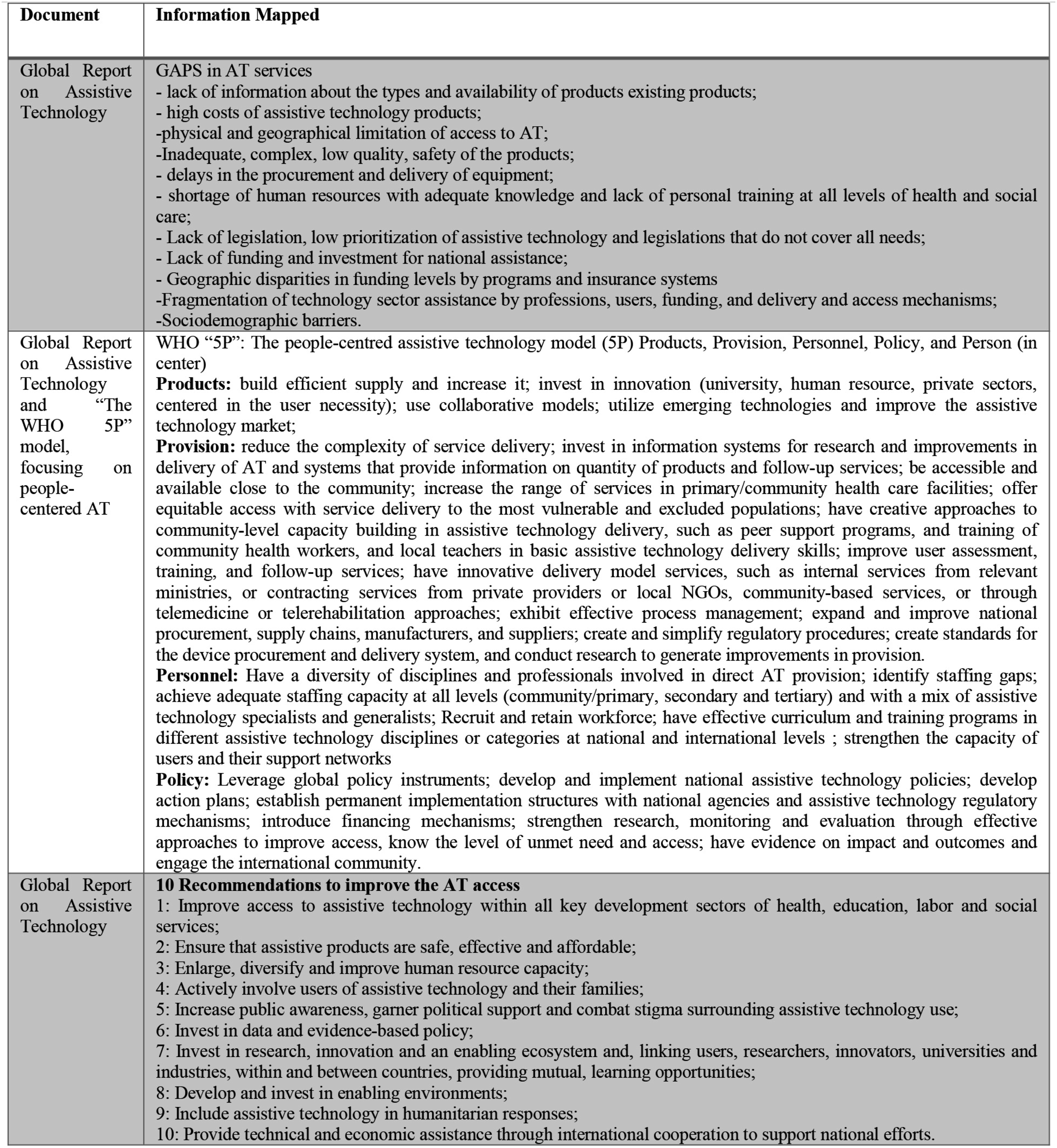
Thus, these three authors reviewed the Global Report on Assistive Technology [6] and the “WHO-GATE 5P framework” [6, 7] and identified the primary gaps, guidelines and recommendations related to AT access and service that could be used as a basis for the elaboration of a checking tool tailored to digital AT platforms. Four two-hour meetings were held for the preparation, discussion, and checklist adjustments until there was a consensus on a structured and clear version of the checklist (Fig. 1).
Excerpt from directions for judges analyzing the checklist tool for the public assistive technology digital platform.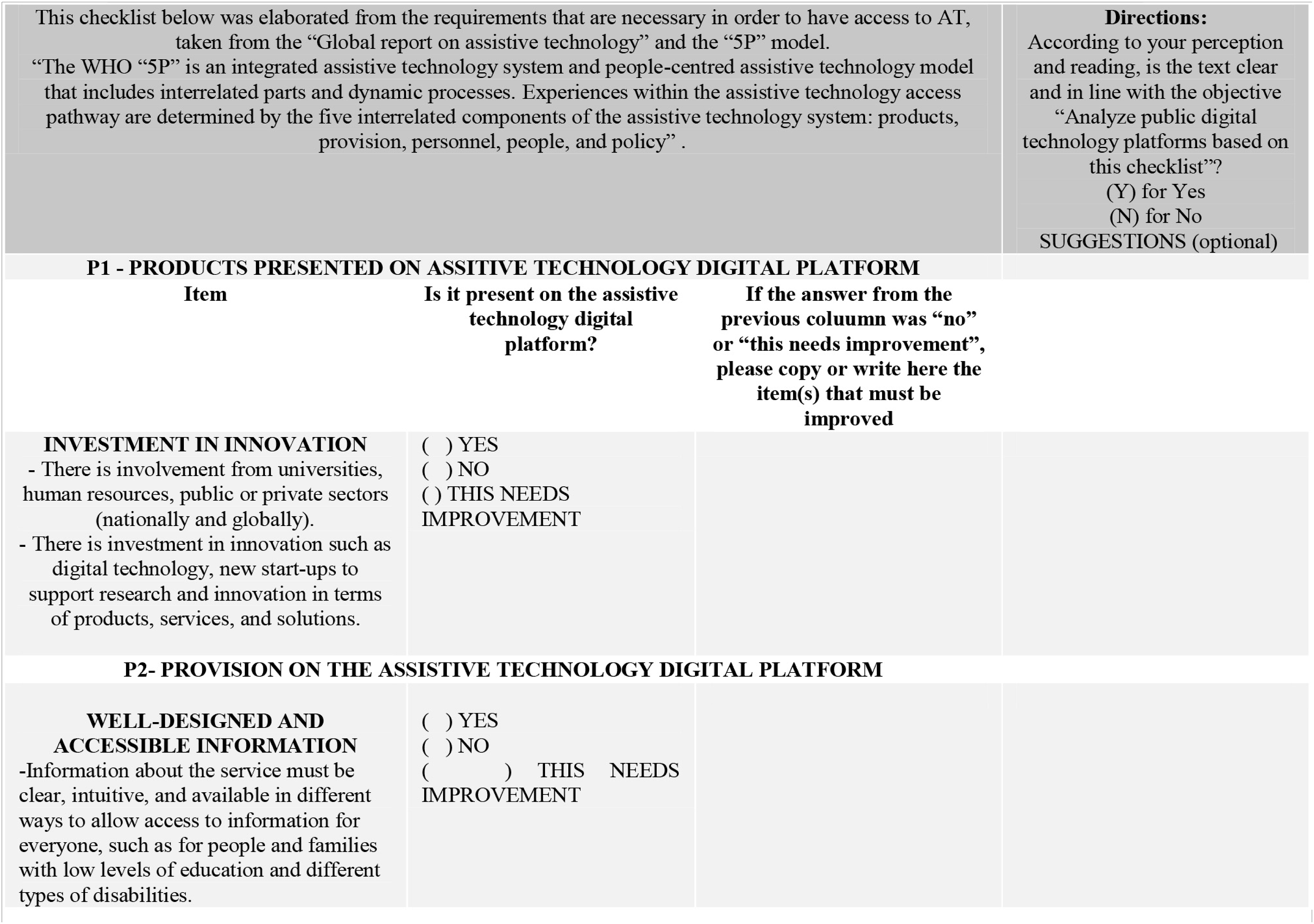
Next, two other researchers, who did not participate in the initial checklist preparation stage and who were members of a research group in Brazil with experience in research and AT services, performed an independent checklist analysis. Their suggestions were then forwarded to the group of the three authors responsible for the preparation of the checklist in stages 1 and 2 (Fig. 2). A subsequent meeting was held to discuss and evaluate whether the suggestions aligned with the content of the Global Report on Assistive Technology and the “WHO-GATE 5P framework” [6, 7] documents. In the end, it was unanimously decided that all the suggestions were relevant and deemed appropriate, leading to their incorporation into the checklist, thus creating a finalized version. The final versions of the checklists in English and Portuguese were reviewed by native teachers of the respective languages.
3. Results
Figures 1 and 2 show the stages (partial dates) of drawing up the checklist.


Below is the final version of the checklist for analyzing the Public Assistive Technology Digital Platform based on the Global Report on Assistive Technology and on the “WHO-GATE 5P framework”.
4. Discussion
The outcome of this research has resulted in the development and availability of a checklist that outlines requirements needed for public digital platforms providing AT services and products. The final version of the checklist comprises 25 items divided into 5 categories, following the fundamentals and recommendations of the Global Report on Assistive Technology and the “WHO-GATE 5P framework” [6, 7] document: Product (with 5 items), Provision (with 8 items), Personnel (with 4 items), Person (with 2 items) and Policy (with 6 items). Each item provides details on what should be considered, including quantifiers with a qualitative approach, offering the options “yes”, “no” and “needs improvement”. In the case that the last option is selected, the checklist includes a column to specify the item(s) that must be improved.
The external checklist authors provided the following suggestions for improvements: in item 1 – clarify the phrase “availability of existing products” and include an item about technical specifications of the products; in item 6 – clarify the phrase “different ways to allow access to information”; in item 9 – make clear what “creative approaches” would be; in item 17 – clarify the item “workforce”, and in item 20 – highlight information about local and regional public policies. In order to maintain the objective of this study, the suggested adjustments were only incorporated into the checklist if the suggestions were aligned with the Global Report on Assistive Technology and the “WHO-GATE 5P framework” documents [6, 7], thus maintaining the reliability of the documents and keeping a clear and simple version of the checklist. Ultimately, all suggestions were incorporated into the final version of the checklist.
Considering the creation and importance of this checklist, the Global Research, Innovation and Education in Assistive Technology [19] had already mentioned in 2017, among the five global priority research topics in AT, the need for research on policies, systems, service delivery models and best practices, and topics on standards and methodologies for assessing needs and unmet needs.
Additionally, the Global Report on Assistive Technology highlighted that not all countries have laws requiring accessible environments and policies on AT. Furthermore, this document emphasized that accessibility and digital services in AT are often inadequate or not effectively applied, even in cases where laws exist. One recommendation is to increase investment in research and innovation that links users, researchers, innovators, universities and industries, within and among countries, at both national and international levels, providing mutual, learning opportunities [6].
In addition, the International Organization for Standardization (ISO) [20] in its Information and Communication Technology (ICT)-User Interface Accessibility Development standard presented a holistic approach to accessibility. This standard offers guidance on implementing accessibility systems at both the organizational and system development levels. This document provided guidelines for building and maintaining ICT systems applicable to all types of organizations. Also, Web Accessibility in Mind [21] provided a comprehensive web accessibility solution from a checklist consisting of 4 guidelines with detailed sub-items, provided as a resource to help implement Web Content Accessibility Guidelines (WCAG). It is important to note that while these guidelines offered by the ISO, referenced in the Global Report on Assistive Technology [6] and WebAIM, are important for building digital accessibility, they are based on technical and generalized content, which could be applied to any digital service.
Thus, it is emphasized that the checklist that was developed from the present research is a differential for its specificity of content and requirements that are crucial for the area of AT, which can contribute to the analysis of specific digital services for AT–a gap already identified in previous research [6, 8, 18, 19]. Furthermore, the checklist developed in this research can be considered a checking tool that investigates the fulfillment of elements that act as barriers to access for digital AT services, such as the availability of information that meets the real needs of AT users, as well as the difficulty faced by users in relation to physical and geographical access to AT services [6, 8].
The checklist also contemplated findings from research about digital AT platforms that highlighted the necessity that digital design tools be part of a broader service, involving government partnerships. This service should understand the needs of users in the field, combining human resources, staff expertise, and additionally the establishment of an online network infrastructure with continuous and dynamic interactions between assistive technology users, professionals, and providers [18].
Thus, this research is relevant in providing a tool based on global AT fundamentals that can be applied by anyone interested in checking the items needed for a public digital platform in AT, aiming to fill the large gaps reported in the provision of services in the area [18]. The checklist can also help professionals and creators of digital platforms to map out the needs for building such a tool. It is worth considering that although this checklist was designed for use on digital platforms, this tool can also provide guidance for developers of other AT services.
As a next step, this checklist will be employed in the analysis of a public digital platform in AT in Brazil. This reinforces the existing call, as echoed by other authors [6, 8, 18, 19], for more research on AT services, specifically the need for further research on digital services.
As a limitation of the study, the authors identify the need for ongoing validation studies and application of the checklist.
5. Conclusion
This study achieved its objective by elaborating and presenting a checklist with items taken from a global guiding document, the Global Report on Assistive Technology and the “WHO-GATE 5P framework”.
This checklist serves as a tool to verify whether digital platforms that provide AT services and products offered by the public sector have the necessary requirements outlined in the fundamentals of the people-centered assistive technology model.
The impact of this checklist, incorporating the fundamentals of the people-centered assistive technology model, lies in providing guidance for digital AT service delivery, delivery practices, and data science in digital services tailored to the needs of AT users. Likewise, it contributes to supporting advancements in the provision of digital AT services.
Author contributions
ANA CRISTINA DE JESUS ALVES: conception, performance of work, interpretation or analysis of data, preparation of the manuscript and revision for important intellectual content.
JAVIER JEREZ ROIG: revision for important intellectual content and supervision.
JOSAN MERCHÁN BAEZA: conception, performance of workpreparation of the manuscript, revision for important intellectual content.
KAUANE SANTOS CARVALHO: analysis of data, preparation of the manuscript and, revision for important intellectual content.
ANNA RAMON ARIBAU: conception, performance of work, revision for important intellectual content, supervision.
Ethical considerations
This study is exempt from Institutional Review Board approval.
Footnotes
Acknowledgments
To the Post-Graduation Program in Rehabilitation Sciences from the University of Brasilia, to the University of Vic-Central University of Catalonia, to the coordinator and researchers of the Research Group Methodology, Methods, Models and Outcomes of Health and Social Sciences (M3O. This research received the financial support from the Federal District Research Support Foundation (FAP-DF). Grant number for the study 11/2021.
Conflict of interest
The authors have no conflicts of interest to report.