




Abstract
There is no greater threat to the relevance of organizational and administrative research, or to effective management, than erosion of confidence in truth and objectivity. The authors warn management and organization researchers against becoming institutionalized into an exaggerated perspective of self-doubt by giving too much credence to discussions of subjectivity and the underdetermination of theory by evidence. The concepts of trustworthiness, integrity, honesty, reliability, competency, fairness, or bias all rest on the concepts of truth and objectivity. The authors urge managers to seek the truth and base decisions on evidence and good theory. In responding to a cluster of recent promising articles on the topic, the authors carefully explicate the notions of truth and objectivity, show how these are attached to the notion of trust, and detail their place in social science and the art of management. The authors demonstrate that it is a mistake to think that one can abandon the notions of truth and objectivity and continue to use normative vocabulary as before.
Introduction
All science is fallible, as scientists are aware, but nothing is gained by affixing “probably” or “from our point of view” to its progressive deliverance. The physicist tells us how it is, subject to possible future correction; and this latter caveat, being invariable, is rightly left tacit. The scientists fingers are permanently crossed, however slightly, be he physicist or anthropologist.
No useful theory can rest on the assumption that everything is unique.
Over the last decade, this journal published a series of articles on whether, and the extent to which, notions of truth and objectivity have a place in organizational and administrative science (Bosch, 2010; Gioia, 2003; Hunt, 2005; Lounsbury, 2003; Meckler & Baillie, 2003a, 2003b; Ryan, 2005). This debate became rather heated in places, and was left unfinished. Now that passions have cooled, it is time to take stock. Understanding the place and usefulness of truth in our discipline has certainly not become any less important. Scientists study the world. They study elements and compounds, organizations, political systems, cultures, economic markets, technologies, work groups, industries, and other entities of the business world. When we get it right, we make true claims about these aspects of the world. In this sense, scientists can be said to seek and to discover the truth. We demonstrate why, at least for those engaged in inquiry, truth is at the very root of what matters most.
The article proceeds as follows. First, we summarize some themes from the articles that started the debate: Meckler and Baillie’s (2003a) critique of Astley (1995) that was criticized by Gioia (2003) and by Lounsbury (2003), and Meckler and Baillie’s (2003b) response to that dissent. Second, we integrate these with some ideas from Shelby Hunt’s (2005) powerful response to that debate. Third, we analyze Phil Ryan’s (2005) critiques and positions as well as those of Reinoud Bosch (2010). Finally, this analysis leads to our positive thesis that many of the core concepts used in management and management research—trust, trustworthiness, integrity, honesty, reliability, competency, fairness, bias, and more—are based in and presuppose the notions of truth and objectivity. That is, without commitment to truth and objectivity, these crucially important factors cannot be coherently used in our theories and practices.
Review of Theory
Astley’s Thesis and Meckler and Baillie’s Middle Ground Response
In two articles (2003a, b), Mark Meckler and James Baillie (from now on, “M&B”) attempted to clarify various theses around the notion of social construction and argued that their resulting conception could support notions of truth and objectivity. They explained the ways in which the social world of conventions and institutions exists objectively (and other ways in which it does not), and showed that claims made regarding this socially created world were evaluable as true or false. They did so in response to widespread skepticism and cynicism about truth and objectivity within the administrative science literature.
M&B’s first article (2003a) was written in response to W. Graham Astley’s influential article (1985), which exemplified a form of social constructivism over administrative sciences that left little room for notions of truth and objectivity in them. M&B diagnosed how one could be led into skepticism about truth and objectivity, by identifying the philosophical assumptions behind such a position. M&B rejected some of these assumptions, such as (a) the conception of language and thought as standing in the way of an objective view of reality, (b) viewing language as a self-contained system with no connection to nonlinguistic reality, (c) the reduction of truth claims to facts about power relations and other forms of social negotiation. In other cases, such as (d) the theory ladenness of perception, or (e) the possibility of incommensurable ways of representing reality, M&B argued that these are compatible with notions of truth and objectivity. They then used some contemporary philosophical ideas from John Searle (1995) and others to present an account of how a form of social constructivism could be applied to the administrative sciences, in a way that supported notions of truth and objectivity.
An aspect of M & B’s methodology that frustrated some readers was their use of prosaic examples, rather than management-specific examples or research to illustrate their theses about truth and objectivity. However, this strikes us as a sensible methodology because it allowed attention to be placed on the philosophical theses with maximum clarity without getting distracted over the fine details of the examples. Having established this “base camp,” M&B applied their theses to more complex and substantive cases involving management or organizations. We use a similar strategy in this article.
Rather than offering a detailed metaphysical theory, M&B began with a series of basic principles about truth and objectivity. Their idea was to show that any form of social constructivism that was incompatible with such principles was mistaken. The first of these is the “equivalence thesis” whereby to say, of any proposition p (or statement, or belief, or utterance, etc.—M&B were deliberately neutral on which of these is primary), that p is true is to say no more than p itself. To say that it is true that the cat sat on the mat (or that the sentence “The cat sat on the mat” is true) is to say that the cat sat on the mat. The question then arises, for any p, in virtue of what is it true? In cases involving either physical or social sciences, the answer, obviously, is that it is due to how the world is. My belief that I taught eight courses in 2010 is made true by my course load. My statement that the current Pope is German is made true by Joseph Ratzinger being the current Pope, and being German. Each claim presents the world as being a certain way and is true if this is how the world is. It is in this minimal sense that M&B endorsed truth as correspondence with reality. They also discussed correspondence on the subsentential level, via the concept of reference. Take an example like “Intel Corporation bought McAfee Inc. for about US$7.7 Billion in the summer of 2010.” This is true if Intel Corporation bought McAfee Inc. for about US$7.7 Billion in the summer of 2010. The term Intel Corporation refers to Intel Corporation; McAfee Inc. refers to McAfee Inc., and the sentence is true if these two entities are in the requisite relationship, whereby the latter was purchased by the former for that sum at that time.
M&B emphasized the normative dimension of truth as being the primary aim of inquiry. That is, inasmuch as one is engaging in inquiry regarding some issue, one aims at ascertaining the truth about the matter at hand. That is what makes it an inquiry at all. We emphasize here that this is compatible with the inquirer having other motives as well, such as pleasure, prestige, or power. Although mixed motives are surely the rule rather than the exception, we insist that the essence of inquiry as the pursuit of truth cannot be eliminated or reduced to these other motives.
M&B followed John Searle (1995) in distinguishing the epistemic and the ontological forms of objectivity and subjectivity. The epistemic form relates to truth. A claim (whether a belief, a statement, etc.) is epistemically objective if its truth value is due to factors that are independent of any individual’s point of view, such as whether they believe it or desire that it be the case. By contrast, a claim is epistemically subjective if it is dependent on our responses in these ways. For example, to say that a bottle of wine is corked, or has increased in price, is to make an epistemically objective claim, whereas to say that it tastes bad, or is overpriced, is to be epistemically subjective.
An object is ontologically objective when it exists independently of anyone thinking about it. Likewise, a property is ontologically objective if its possession by objects holds mind independently. An object or property is ontologically subjective if its existence or instantiation is mind dependent, in that its mode of existence consists in being experienced by a subject. For example, being a pain consists in being felt in this distinctively unpleasant manner (which can only be described using terms like “painful”) by a sentient being.
The physical sciences deal with objects and properties whose existence is independent of all human perception and cognition. They make epistemically objective claims about ontologically objective entities, processes, and properties. The planet Neptune would have existed in exactly the way it does now even if conscious life had never emerged. However, this ontological objectivity is inapplicable to the social world. This is not simply because of the obvious fact that social conventions and institutions are products of human activity. The more fundamental ontological point is that our collective intentionality sustains the conventions and institutions in their existence, and indeed constitutes their very being, as the next paragraph will explain. However, as M&B argued at length, this does not prevent us making true claims regarding the social world. That is, the social sciences make epistemically objective claims about the world, despite the ontologically subjective nature of their subject matter. Thus, a claim that there will be increased work productivity after a training program is epistemically objective in that any suitably informed person can confirm (or disconfirm) increased productivity after training. Productivity either increases or it does not, regardless of the point of view of any particular observer. If the trainer were to claim that productivity increased after training, while other observers deny this, then someone is mistaken. By contrast, claim that the training was boring is epistemically subjective because what it is to be boring is constituted from human attitudes. A world without consciousness is obviously a world without boredom.
Business administration research investigates entities and properties that are observer dependent in the sense that although they exist independently of the mentality of any particular person, their existence is dependent on our collective attitudes and practices. On one hand, my having a credit card in my pocket is a matter of what is in my pocket, rather than what I may believe about it. On the other hand, what makes this item a credit card rests on the collective attitudes and practices constituting our financial institutions. Without all that, it exists only as a small plastic rectangle encoded with meaningless digital data. So, what makes it the case that I have a credit card in my pocket is not exhausted by the contents of my pocket, nor by any set of facts about me considered in isolation from my social environment. Rather, the relevant facts essentially involve the economic institutions and conventions that enable the status of money to be granted to certain material objects. Likewise, having the firm’s strategic plan on my desk is a matter of what is on my desk and not what I believe about it. However, what makes it the firm’s strategic plan is a matter of the collective attitudes and practices of business management within the firm and in the broader institutional environment. Without that context, it is only a pile of inky paper.
These examples of the plastic rectangle being a credit card and a stack of paper being a strategic plan illustrate what Searle (1995) called an institutional fact, a fact that holds as a result of social institutions. He explained this in terms of status functions, our collectively taking an object as having a status to which a function is attached. Society has institutions through which we take plastic rectangles of a certain pedigree, such as being issued by banks, as having the status of money, with all the purchasing functions that this involves. Searle argued that complex intertwined iterations of the schema X counts as Y in (context) C could explain the nature of social reality. This kind of plastic rectangle (X), officially produced, counts as a credit card (Y) in the United States and any other country that acknowledges our financial institutions (C).
Consider a slightly more complex example to illustrate the iterative nature of the schema. Suppose that I make an utterance. From the point of view of physics, this event merely comprises a pattern of sound waves. But in a societal context, this same event (X) counts as an utterance of an English sentence (Y). But that Y sentence can function as a higher level X2. For example, in certain contexts, it might count as making a promise (Y2). But this promise can also be X3 − signing a contract, which may count as buying a factory (Y3). So the brute physical X1 counts as Y2, which becomes X2, which counts as Y2, which becomes X3, etc.
Hunt’s Realism
Now that we have set out the basics of M&B’s position, we turn to Hunt (2005). Much of Hunt’s article was devoted to tracing the development of scientific realism, with special emphasis on quantum mechanics. However, because quantum theory generates unique and extremely difficult epistemological and metaphysical problems that we have no idea what to do about, we will remain silent on them. We can justify this omission because we have given what we regard as a definitive reason why any distinctive problems pertaining to the quantum realm cannot transfer to the social world, namely that the former is ontologically objective and the latter ontologically subjective. We emphasize that this distinction is compatible with our endorsing a physicalist worldview where everything that exists has a description in the vocabulary of physics and is ultimately constituted by the brute entities posited within a completed theory of the physical world as such.
Hunt summarizes his scientific realism by four theses: classical realism, fallibilistic realism, critical realism, and inductive realism. Classical realism takes the world to exist independently of its being perceived. As the previous section indicates, we regard this thesis as true of the world as studied by physical scientists, which exists and has all its intrinsic properties independently of all perception. Social entities have their being more dependently, due to their ontologically subjective nature. Hunt’s other three theses can be endorsed without qualification. Fallibilistic realism merely holds that while the aim of science is to discover truths about the world, these can never be known with certainty. Fallibilism is a necessary counterpart to realism because realism makes a categorical distinction between how the world actually is and how any individual takes it to be, together with the possibility of a divergence between these. This gap between how the world is and how we think it is is needed to allow the possibility of our getting it wrong. That is, fallibilistic realism requires classical realism. Critical realism immediately follows: Given fallibilism, no knowledge claims are immune from scrutiny. Finally, inductive realism holds that the cumulative predictive and explanatory success of science provides strong reasons to believe that the entities, properties, and processes postulated by mature sciences exist and that the laws describe their behavior.
We would add that realism is the only position that explains the success of science, and doesn’t make it an incredible coincidence. We grant that false theories can, for a time, generate true predictions, and give the illusion of explaining some phenomenon. However, this is either due to the theory containing significant elements in common with the true theory, or it is simply a matter of luck, which will run out sooner rather than later.
Hunt’s views on truth are in line with those of M&B. For example, he takes truth to be a property of truth bearers:
Scientific realism, in viewing administrative science as a truth-seeking enterprise, conceptualizes truth not as an entity, but an attribute. It is an attribute of beliefs and linguistic expressions. . . . truth is an attribute of beliefs and linguistic expressions, it is not an entity in the external world. . . . Therefore truth is not an entity that researchers do (or can) study. To treat truth as an entity . . . is to engage in reification. (Hunt, 2005, p. 7-8)
We agree that to present truth as some weird superempirical kind of thing, and then to deny its existence, is to create a straw man. Rather, we ascribe truth and falsity to beliefs, statements, utterances, and propositions. Again, Hunt is right that “truth is not an entity that researchers do (or can) study.” Consider Weick (1993) investigating organizational breakdowns among firefighting teams under great stress during forest fires. It is not that there were two distinct subjects of his examinations, namely, organizational breakdowns and truth. Rather, he studied organizational breakdowns and aimed at the truth about them. Scientists study the world. They study elements and compounds, organizations, economic markets, political systems, cultures, economic markets, technologies, work groups, industries, and other entities of the business world. When we get it right, we make true claims about these aspects of the world. In this nonreifying sense, scientists can be said to seek and to discover the truth.
Hunt illustrates his account of the relations between scientific theorizing and reality in a complex diagram (Hunt, 2005, p. 133) reproduced as Figure 1.
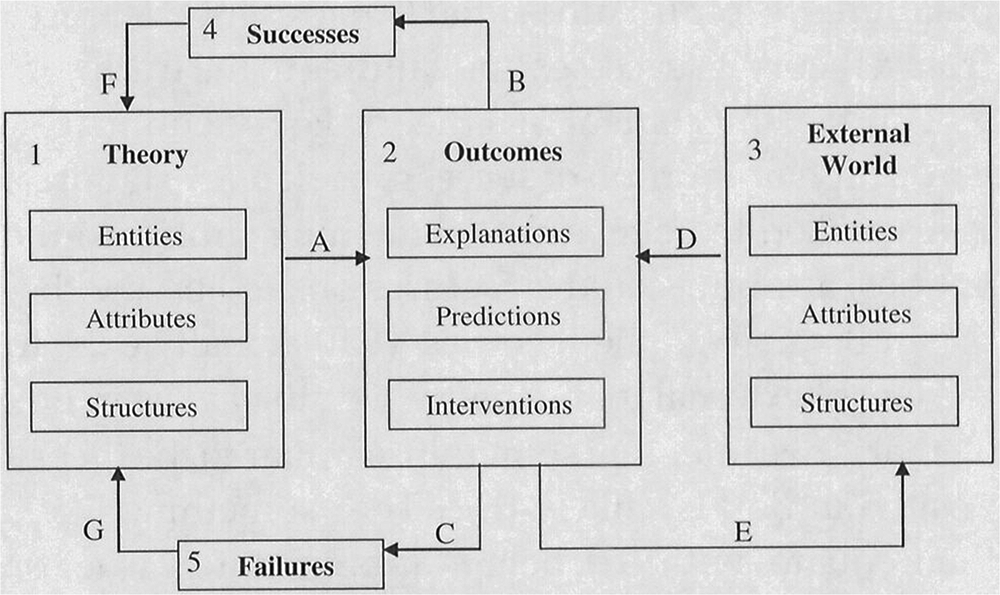
Truth and scientific realism: Successes, failures, and the external world
We will now suggest that while Hunt describes his metaphysical position as classical realism, the thesis that the world exists independently of its being perceived, and that classical realism as so described makes no distinction between the physical and social world, his theory as articulated in this diagram shows that Hunt does in fact endorse distinctions between these realms, of the kind formulated by John Searle, and as described by M&B.
As we can see, the diagram has three boxes, 1, 2, and 3, which represent a scientific theory (comprising hypothesized entities, properties, and structures), the outcomes that emerge from theorizing (explanations, predictions, interventions), and the world (the actual entities, properties, and structures), respectively. Hunt uses transaction cost economics (TCE) to illustrate the relationships between 1, 2, and 3. TCE posits entities such as transaction-specific assets, or market governance, with their numerous attributes, on the basis of which causal law-like structures are proposed such that hierarchies are preferred over markets as asset specificity increases (Williamson, 1975). All this is in Box 1, and TCE claims that the world actually contains these entities, properties, and structures (Box 3). This is a clear example of the correspondence principle. A theory is a structured set of statements and is true if the world is as the theory says—if the things referred to exist and function as the theory describes.
Interactive Kinds and Self-Fulfilling Theory
Turning to Box 2, we have already stated our agreement with Hunt that our confidence in a theory’s truth rests on its record of predictive and explanatory success. But the third outcome, interventions, is important to our extension of Hunt’s realism. He gives the example, “If a new venture has high transactional-specific assets, be wary of potential opportunism of venture partners and protect yourself accordingly” (Hunt, 2005, p. 7). The success or failure of these interventionist strategies will ultimately be measured by their outcomes. However, for us, the key issue is Hunt’s insight as to the two-way interaction between devising and applying theories, and the world theorized about
in turn, the outcomes in Box 2 affect . . . the entities, attributes, and structures in Box 3 (e.g., when managers in firms interpret the outcomes in Box 2 as supporting the truth of TCE, and this belief then guides their future patterns of behavior). (Hunt, 2005, p. 133)
It is at this point that Hunt’s account of realism can be extended to include Searle’s distinction between ontological subjectivity and objectivity. It also ties in with another theme discussed by Meckler and Baillie (2003a), namely, Ian Hacking’s (1999) notion of interactive kinds, and the “looping effect” where the nature of the worldly phenomenon is transformed by the dialectical interaction with the process of theorizing about it.
Interactive kinds are an essential and distinctive feature of institutional kinds, due to their observer dependence and ontological subjectivity. For example, when two companies in the same industry find that they have excess inventory, they may both use the simple strategy of lowering their prices. Someone may correctly theorize that they are both having “a sale” and no changes in organizational behavior would likely occur beyond the scope of the sale. However if those sales were theorized as “a price war,” an interactive kind would be introduced. Companies who are implicated by this theory as participating (whether or not they intended) may alter their behavior specifically because they find that they are engaging in something more than just a sale. In fact, if they were not in price war in the first place, they may begin to behave as if they are in a price war after the theory is applied and the dialectic process gains traction.
Ryan: Belief and Believing
Now that we have built up a realist account of the sciences, including organization theory and the study of management, we turn to some recent criticisms of this approach from Phil Ryan (2005). Ryan rejects the claim that beliefs and statements aim at representing the world and are true when they succeed in doing so:
Nor do beliefs necessarily aim at “accurately representing the world.” I may believe the propositions of Theory X to justify to myself the harsh treatment of those under me. I certainly make no effort to test the truth of this belief, and it is not plausible to say that the goal of the belief is truth. (p. 121)
We argue that this objection rests on an ambiguity in the concept of belief. Two different senses of belief must be distinguished.
Sense 1: Belief as a kind of mental state. The question here is what makes some mental state a belief, rather than a desire, a hope, a fear, and so on.
Sense 2: An agent’s believing something and the motivating reasons for doing so.
Beliefs (Sense 1) are the mental analogue of statements and serve the same function in that they aim at representing how the world is in some respect. There is a well-established distinction among intentional states between (a) representational states that present the world as being a certain way and (b) goal states which concern something sought by the agent. This distinction is often abbreviated as between beliefs and desires, which essentially have different “direction of fit” vis-à-vis the world (Anscombe, 1958). While the cognitive role of beliefs is to represent how the world actually is, a desire is aimed at changing the world. A belief is true if it matches the way the world is. However, a desire involves a perceived absence and is satisfied if the world changes so that what was absent is now present. My belief that I am in Aruba is true if I am there, whereas my desire to be in Aruba assumes that I am not there, and can only be satisfied by my getting there.
It seems to us that Ryan has failed to distinguish these two different senses of belief, or, at least, has mistakenly used an example relating to Sense 2 as a premise to reject Sense 1. In the quotation above, Ryan is discussing psychological motivation—the ways in which having a desire can influence one to adopt a belief. That is, he is talking about Sense 2. However, M&B were talking about Sense 1, on what makes the mental state a belief in the first place, namely that it asserts that the world is a certain way. This is compatible with the agent having this belief for any number of reasons.
We agree that agents rarely have the sole goal of getting to the truth. Even in the realms in which the pursuit of truth is most directly implicated, such as academic research, other motives can be involved such as gaining tenure, promotion, power or prestige. But it does not affect our basic point that a definitive characteristic of beliefs in general—what makes them beliefs—is that they present the world as being a certain way. The same points apply to statements. Someone may utter a statement for any number of reasons. But what makes it a statement (as opposed to a question or a command, for example) is that it is a claim about the world, and its truth or falsity depends on whether the world is the way it states.
Another point is relevant here. Return to Ryan’s (2005) claim that “I may believe the propositions of Theory X to justify to myself the harsh treatment of those under me” (p. 121). While this is correct, it is another way of saying that I may take these propositions to be true, to justify my behavior to myself. Unless the propositions were taken to be true, the motive of calming one’s conscience could not be achieved. But to say that someone takes a proposition to be true is just another way of saying that he or she believes it. In conclusion, Ryan’s claim about the role of particular beliefs in human behavior presupposes M&B’s and Hunt’s position and, a fortiori, cannot be an objection to them.
In sum, even if there are many motives for holding a belief—reasons that are themselves composed of sets of beliefs and desires—the basic function of a belief is to represent the world. This role is primary in two senses. First, it is constitutive of being a belief at all. Second, even when one may hold a belief for a variety of purposes (consciously or otherwise), these intentions can only be satisfied if one regards the belief as true, that is, as representing how things are, independently of one’s act of believing it.
The Overuse of Underdetermination
We now turn to the Duhem–Quine underdetermination thesis (from now on, “D-Q”), which is often used to raise doubts about truth and epistemic objectivity. We will consider two such claims, namely, Ryan’s (2005) argument that D-Q entails that no statement could achieve epistemic objectivity and Bosch’s (2010) argument that D-Q entails that we could never know whether any statement was epistemically objective. We will then end this section of the article by offering a general diagnosis of attempts to use D-Q to show that social or political factors inevitably influence the acceptance of a scientific theory. Because these arguments misrepresent D-Q, we will begin by briefly summarizing it. Our discussion is indebted to Stanford (2009).
Pierre Duhem (1914/1954) argued that hypotheses of physical science cannot be empirically tested in isolation, but only in conjunction with a series of auxiliary assumptions, where these include not only other scientific claims but also assumptions about the correct functioning and use of the equipment. No hypothesis logically entails or is entailed by any specific set of experimental outcomes. It follows that if the expected experimental result does not ensue, we are not logically compelled to reject our hypothesis because the predictive failure could be due to error elsewhere, among the auxiliary assumptions. Duhem concluded that evidence always underdetermines theory: When an experiment does not provide the result that one’s hypothesis predicts, something has to give, but the experiment itself does not determine which beliefs should be dropped.
W. V. Quine (1951) extended Duhem’s thesis beyond the realm of physical science, applying it to all our beliefs. His discussion takes place in the context of an attack on two “dogmas of empiricism” associated with his mentor Rudolf Carnap and his fellow logical positivists, namely, a strict analytic/synthetic distinction and, more importantly for our purposes, reductionism, the thesis that “each synthetic statement has a unique set of possible sensory events that would add to its likely truth, and another set that would add to its likely falsity” (Quine, 1951, p. 40). Quine rejects reductionism in favor of a holistic construal of confirmation where “our statements about the external world face the tribunal of sense-experience not individually but only as a corporate body” (Quine, 1951, p. 41).
Quine aimed to undermine venerable philosophical dualisms such as between (a) analytic and synthetic sentences, (b) a priori and a posteriori knowledge, and (c) necessary and contingent truths. In place of these dichotomies, he held that statements differed only in the degree of their entrenchment and centrality to a belief system. He summarized his position as follows:
The totality of our so-called knowledge or beliefs, from the most casual matters of geography and history to the profoundest laws of atomic physics or even of pure mathematics and logic, is a man-made fabric which impinges on experience only along the edges. Or, to change the figure, total science is like a field of force whose boundary conditions are experience. A conflict with experience at the periphery occasions readjustments in the interior of the field. But the total field is so underdetermined by its boundary conditions, experience, that there is much latitude of choice as to what statements to reevaluate in the light of any single contrary experience. No particular experiences are linked with any particular statements in the interior of the field, except indirectly through considerations of equilibrium affecting the field as a whole. (p. 42)
Two complementary points should be emphasized here. First, no statement is absolutely immune from revision. At least in principle, any can be rejected if the overall integrity of the system requires it. Second, any statement can be held true, in the face of any number of seemingly confounding experiences. In both cases, the proviso is that you must be prepared to make as many adjustments to your “web of belief” as required to maintain the consistency of the system. As with Duhem, Quine holds that when some newly received information clashes with one’s set of prior beliefs, some revision is required to preserve the overall integrity of one’s belief system, but neither considerations from deductive logic, nor the anomalous datum itself, uniquely determine where the adjustment ought to be made.
However (and this is a big however), Quine did not conclude from this that anything goes or that all different ways of drawing conclusions from the evidence are equally reasonable. Rather, he held that the gap is, and ought to be, filled by nondeductive canons of rational belief revision (Quine, 1955; Quine & Ullian, 1978) so that “our actual revisions of the web of belief seek to maximize the theoretical ‘virtues’ of simplicity, familiarity, scope, and fecundity, along with conformity to experience” (Stanford, 2009). Quine elsewhere expands on this, clearly stating that we should seek to resolve conflicts between the web of our beliefs and our sensory experiences in accordance with the virtues of conservatism, modesty simplicity, generality and refutability as we reconcile the web of belief with experience (Quine & Ullian, 1978, chap. 6).
The most important of these principles is conservatism, the “maxim of minimal mutilation.” When faced with an experience or experimental result that clashes with some element of our belief system, we ought to revise our beliefs in a way that results in as little disruption to the system as possible and that would maximize the system’s predictive and explanatory power (Quine & Ullian, 1978). This means, for example, that in the testing of a scientific hypothesis, we would abandon a fundamental law only as a last resort because the law would be so deeply entrenched in our account of the world that rejecting it would create a domino effect that would require revising a vast number of other beliefs. It is far more reasonable to seek damage limitation by shifting the blame on, for example, flaws in the experimental design, or a theoretical assumption of lesser import. Only when these strategies are seen to fail, as shown in an accumulation of unsuccessful experiments, do we bite the bullet and give up the law or the deeply embedded theory.
Imagine, for example, that you were teaching a basic chemistry class for schoolchildren, and the lesson of the day was to measure the temperature at which water boiled. To this end, you divide the class into small groups each equipped with a glass beaker, a heat source, and a thermometer. As expected, each group in turn reports that their sample of water boils at 212°F. However, suppose that one group disagrees, recording only 200°F. Now, it would be logically possible to conclude that water’s true boiling point was 200°F and that all previous experimental findings were mistaken. One shudders at the thought of what adjustments to chemical theory would have to be made to accommodate this result. Quine’s principle of conservatism would recommend checking for less radical ways to explain the anomaly, such as the students not reading the thermometer correctly, the thermometer being broken, or the sample not being pure water.
One important lesson to draw from Quine is to see how people can hold beliefs that are (to the rest of us) bizarre, and yet not fall into logical inconsistency, because they have made the requisite adjustments elsewhere in their belief system. Unfortunately, extreme cases of this are not in short supply, with Holocaust deniers being among the most odious (Smith, 1995). Consider also the “birther” movement, which refuses to believe that President Obama was born in the United States. No matter what evidence is given, evidence that they would accept if it concerned anyone else, it is discounted as either a kind of measurement/methods error or part of a grand conspiracy (or both). At the other end of the political spectrum, consider those who believe that 9-11 was an inside job, orchestrated by the United States government. For a final extreme example, one touching more directly on issues of scientific testing, take “young earth” creationists, who hold that the earth is 6,000 years old. Quine would insist that the mere fact that these belief systems are internally consistent does not entail that they are rationally defensible, on a par with any other belief system.
Another lesson we can learn from Quine is that we are reluctant to give up our core theories and laws, even in the face of evidence to the contrary, due to cognitive fallacies. Daniel Kahneman (2011) offered the example of how military industrial/organizational psychologists searched for future leaders among officers in training. The personnel selection experts repeatedly used techniques and theories that had been around for a very long time despite clear statistical evidence that the theory did not predict leadership among officers at all, and this evidence was freely shared and discussed among everyone involved. This example led to his discovery of the cognitive bias that he called “the illusion of validity.” How often do we succumb to this very same tendency when going through a pile of resumes to sort and select job candidates and believing that we are getting it right? In the face of persistent stereotyping biases when evaluating resumes (Gill, 2004) and the accumulation of unsuccessful forecasting experience, we should probably drop our belief that we can look at 200 resumes and accurately decide which 3 applicants are most likely the best for our departments. And yet we do it again and again. However, the fact that we repeat our mistake does not make the theory any more true or defensible.
In conclusion, although there is no upper limit to the number of logically possible ways to adjust one’s belief system to accommodate a recalcitrant experience, utilizing the principle of conservatism, alongside Quine’s other heuristics, will eliminate the vast majority of them.
Having summarized D-Q, we are now in a position to evaluate arguments that it entails that epistemically objective claims are impossible (Ryan, 2005) or that we can never know if they have been achieved (Bosch, 2010). We turn first to Ryan.
Ryan (2005) used D-Q to deny the possibility of epistemically objective truths, that is, statements whose truth or falsity is independent of one’s beliefs or desires. He considered a case in which a test tube of botulinum is found at the home of an Iraqi scientist, where it had lain for the previous 10 years. Suppose someone claims that “This is proof that the Iraqi regime had WMDs.” Ryan asked whether this claim (which we will call “W”) is objectively true. He pointed out that to accept W, one must accept a number of other claims, background conditions (i.e., auxiliary assumptions) such as
(a) that a test tube of toxin is a WMD, (b) that a test tube in the possession of a scientist is under the de facto control of the regime, (c) that the regime hid its WMDs in private homes for a decade, and so on. (Ryan, 2005, p. 122)
Call this set of statements “BC.”
On this basis, Ryan asserted that “I do not believe that anyone can come up with a statement entirely free of background conditions. But this means that the truth of every assertion we make depends on beliefs” (p. 122). But this final inference confuses the truth of a statement with one’s grounds for accepting it as true. D-Q holds that observations or experiments do not confirm or disconfirm individual statements considered in isolation, but only if specific background conditions are accepted. That is, they confirm the whole package comprising the statement plus the background conditions. However, all that follows for Ryan’s example is that we will accept W only if we accept BC. That is, we will believe that W is true only if we believe that BC are also true. It does not follow that W is true only if BC are true. Nor does it follow that what makes W true is our believing either W or BC. For these reasons, we do not agree with Ryan (2005) that “A statement is objectively true to the extent that its background conditions are plausible, reasonable, self-evident (and so on)” (p. 123). Rather, all that follows is that a statement is plausible, reasonable, self-evident (and so on) to the extent that its background conditions are plausible, reasonable, self-evident (etc.).
Ryan (2005) goes on from the previous quotation to ask “plausible (etc) for whom?” (p. 123) and suggests that in some cases it is the judgments of experts that matter. We agree that when you want to know what to believe on a topic, you should ask the experts and should believe them unless you have a good reason not to, such as that you suspect that they have a conflict of interest. But what makes someone an expert is that they know the relevant facts, and can distinguish truth from falsity. Meckler and Baillie (2003b) made this same point in response to Gioia (2003). What makes something a fact is not that it is endorsed by experts. Rather, it’s the other way round—They are experts because they know how to discover the facts. But the facts are there to be discovered and are there even if not discovered.
We turn now to a recent article in which Bosch (2010) argued that “it is impossible to know whether a theoretical claim is epistemically objective or not” (p. 384). His argument rests on D-Q and the theory ladenness of perception. Because M&B (2003a) argued that theory ladenness posed no threat to epistemic objectivity, and none of their critics have disputed this, we will focus on D-Q.
Bosch’s article presents some exegetical challenges, and we will try to highlight some ambiguities in it. For example, before getting to our main line of response, we should note that Bosch also states his position in a slightly different form from the quotation above, namely that D-Q and theory ladenness “have demonstrated the impossibility of reaching certainty about epistemological objectivity” (p. 385). We will briefly examine this formulation, to bring what we take to be Bosch’s central thesis into sharper focus.
There is a further ambiguity in Bosch’s reference to certainty. If, on one hand, it means the mental state of absolute confidence in a claim, then this is irrelevant to our concerns because certainty is neither necessary nor sufficient for truth or for knowledge. One can feel certain about something that is actually false (and which therefore cannot be known), and one can have doubts about something that is true, and that one actually knows. As discussed above, we agree with Hunt that a fallibilistic attitude is central to scientific inquiry. On the other hand, if Bosch means by “certainty” that the matter in question is confirmed to the degree that there is no possibility of error, then again we follow Hunt in holding that this is an unrealizable and inappropriate ideal. So, in conclusion, if Bosch means merely that it can never be established with certainty whether a theoretical claim is epistemically objective, then we can grant this. However, nothing of substance follows, because every scientific claim is in the same boat.
We now consider Bosch’s central claim, purged of any association with certainty:
According to the Duhem–Quine underdetermination thesis, it is impossible to find out whether any theoretical claim is objective because any test of a theoretical claim requires the making of a number of auxiliary hypotheses regarding the empirical evidence, the testing technique, and relevant control conditions. In effect, it is impossible to know whether or not encountered evidence provides support for a particular theory, as this depends on the auxiliary hypotheses made. (p. 385)
We suspect that Bosch is conflating two separate claims here, namely that D-Q entails that (a) we can never know whether a particular claim is true or that (b) regardless of a claim’s truth, we can never know whether it is epistemically objective. These are separate issues because a claim can be an epistemically objective falsehood (e.g., “Oregon is north of Washington State”) or it can be true but epistemically subjective (“Kittens are cute”). We will argue that Q-D provides no grounds for endorsing either (a) or (b).
Let us begin with the claim that D-Q prevents us from knowing whether any claim is epistemically objective. Notice the absoluteness of this assertion. It is one thing to say that underdetermination makes it difficult to tell if a claim is epistemically objective or subjective. We would grant that in some cases. But it is entirely another to say that it is impossible to know this under any circumstances. Consider our previous examples. (We will give more interesting examples from social science below.) To say that a bottle of wine costs US$39.99, or that it is a Pinot Noir from Oregon, is epistemically objective. To say that it tastes good or that it is not worth the money is epistemically subjective. Surely there are a multitude of cases such as these, in which it is obvious whether a claim is epistemically objective. It is equally clear how we would go about determining whether the objective claims are true. Although there may be some gray areas in which these questions are harder to resolve, the existence of these mundane cases is all we need to challenge Bosch’s claim that it is never possible to tell whether a claim is true, nor whether it is epistemically objective.
It would take a very strong argument to overcome such considerations, but we cannot find it in Bosch’s article. How could he come to such a conclusion? The most likely explanation is as follows. In taking D-Q to entail such extreme skepticism regarding truth or objectivity, Bosch is only attending to part of Quine’s argument. In particular, he stops at the point at which Quine follows Duhem in showing that any experience, together with rules of deductive inference, radically underdetermines our theoretical response. So perhaps Bosch’s point is that it is possible, without falling into inconsistency, to take any claim either as epistemically objective or as subjective. Likewise, he may be saying that it is possible that any claim we take to be true is actually false. However, as we have seen, Quine does not leave the matter there. While granting that there is no formal, algorithmic process telling us the uniquely correct theoretical inference to draw, Quine insists that using nonformal principles of rational inference goes a long way toward filling the gap between evidence and theory (Quine & Ullian, 1978).
We now turn to another line of thought in Bosch’s article, namely that we can never be sure as to whether a theory has been tainted by subjectivity in the form of sociopolitical factors such as interest, bias, or prejudice. He tells us that
the collection of data during social research is affected by the researcher’s philosophical, theoretical, and political commitments; the expectations, interests, and commitments of those studied; the complex interplay between those being studied and the researcher; and the development of conceptual categories and the ordering of empirical material. The subsequent analysis of such categories and material is affected by theoretical frameworks, vocabularies, and conventions, whereas the writing process is influenced by writing conventions. (Bosch, 2010, p. 385)
He cites Alvesson’s (2002) concern that
One can imagine that another researcher, with another ethnic background, gender and political orientation, making some slightly different choices of people to study, presenting the project in a somewhat different way and using a different interview style, with other favoured categories and vocabularies, etc., would produce rather different research results. This could very well be the case even if the basic ingredients of the study—research topic, paradigm, methodology etc. are similar. (p. 9)
Our first point, in response, is that if this sort of thing happens in scientific research—and we grant that it does—then we can state epistemically objective truths about it. Indeed, Bosch and Alvesson surely offered the example in such a spirit. Furthermore, it would be self-defeating to then go on to say that we can never know whether such factors are in play in any particular case. Rather, their presence or absence must be argued through detailed empirical research to determine what biases are at play on a case-by-case basis. Second, it must be possible to achieve reliable conclusions about its actual presence or absence, at least some of the time.
Such cases are easy to come by. For example, if a scientist reports that the effect of nicotine on lung cancer has been drastically exaggerated, does he not lose credibility when we discover that his research has been funded by a tobacco company? Second, as the Oscar-winning documentary Inside Job revealed in excruciating detail,
Prominent academic economists (and sometimes also professors of law and public policy) are paid by companies and interest groups to testify before Congress, to write papers, to give speeches, to participate in conferences, to serve on boards of directors, to write briefs in regulatory proceedings, to defend companies in antitrust cases, and, of course, to lobby. (Ferguson, 2010)
Certainly there are interpretive biases that are more difficult to discern, and researchers, their critical peers, and journal reviewers have varying levels of competence identifying and outing them.
However, we repeat, these considerations do nothing to undermine belief in epistemically objective truths about the social world. Even if one’s research is motivated by base interests that end up exerting influence on the content of the research, this does not preclude the resulting claims from being objectively true. And second, these allegations about the corruption of research must themselves be offered as epistemically objective truths, or else they do not deserve our attention. Alvin Goldman (1999) made this point against Michel Foucault, a prime source of the view that all talk of truth and objectivity is a guise for repressive practices:
Indeed, if one examines debunkings of truth on the grounds that truth claims merely cloak a drive for domination, almost all of these debunkings themselves depend on truth claims! Unless there is truth in Foucault’s story that the human sciences arose, at least in part, out of motives to control, administer, and dominate, why should we pay it any attention? Presumably Foucault did not mean to write historical fiction, or why did he expend effort documenting his allegations? . . . We need true evidence to persuade us of a tight connection between knowledge and power, and Foucault provides evidence. Apparently, he does so because he contends that there is truth in his claim. (Goldman, 1999, p. 35)
Bosch is not alone in thinking that D-Q has implications for the prevalence of a political dimension in the establishment of scientific theories. As Stanford (2009) noted,
In some recently influential discussions of science it has become commonplace for scholars in a wide variety of academic disciplines to make casual appeal to claims of underdetermination . . . to support the idea that something besides evidence must step in to do the further work of determining beliefs and/or changes of belief in scientific contexts: perhaps most prominent among these are adherents of the sociology of scientific knowledge (SSK) movement and some feminist science critics who have argued that it is typically the sociopolitical interests and/or pursuit of power and influence by scientists themselves which play a crucial and even decisive role in determining which beliefs are actually abandoned or retained in response to conflicting evidence. (p. 3)
However, to prove a decisive role for political factors in the development and the acceptance of a scientific theory on the basis of D-Q, these theorists need more than Duhem’s principle that no amount of observational data logically requires us to accept a particular theory. They must also establish the following claims:
Each way of responding to a recalcitrant experience or experiment is equally reasonable, even when we follow the principle of conservatism, of parsimony, and so on.
As a result, the gap between theory and evidence is always filled by social or political factors such as power, prejudice, and so on.
These social or political factors are often influential, outweighing scientific factors in determining whether a theory is accepted as true.
Finally, as we have pointed out, there are critical ambiguities in Bosch’s (2010) position, where he seems at times not to be asserting the actual ubiquity of these sociopolitical forces but merely that we cannot know if they are present: “Reputation, institutional affiliation, rhetorical abilities, network ties, and consistency with traditions and positions taken in the past may well be more important than the amount and plausibility of the empirical evidence” (p. 387). In that case, Bosch must prove the following three claims:
1*. As above and augmented with the following:
2*. As a result, we can never know whether the gap between theory and evidence is filled by social or political factors such as power, prejudice, and so on.
3*. We can never know whether these social or political factors outweigh scientific factors in determining whether a theory is accepted as true.1*.
As before, we see no grounds for accepting either 1-3 or 1-3*, either in Bosch’s article or elsewhere. In conclusion, D-Q provides no grounds for doubting that we can discover objective truths about the world.
Finally, we want to emphasize that we do believe that sociopolitical factors can influence theory and, hence, directly affect the reality that is theorized about. Our endorsement of Hacking’s (1999) looping effect of interactive kinds commits us to this. But, we insist, it would take detailed empirical argument to show that it occurred in any particular case. For a first-rate example of this kind of investigation, see the recent debate between Ferraro, Pfeffer, and Sutton (2005, 2009) and Felin and Foss (2009a, 2009b) on whether the Chicago Board of Exchange’s introduction of the Black–Scholes model did not merely describe and predict options prices but actively altered the market dynamic so that the prices of options soon reflected the Black–Scholes model in a way that they did not prior to its introduction. We intend to discuss this set of articles in a future article.
Trust and Truth
Having hopefully dealt with Ryan’s and Bosch’s concerns over truth and objectivity, and the necessity of their applicability to organizational and administrative research, we turn to the closely related theme of trust. Hunt (2005) drew attention to the connection between scientific realism and trust. In fact, as Hunt would surely agree, trust is indispensable not only to science but also to organizational life and to society as a whole. Onora O’Neill (2002) made this point clearly:
Each of us and every profession and every institution needs trust. We need it because we have to be able to rely on others acting as they say that they will, and because we need others to accept that we will act as we say we will. The sociologist Niklas Luhmann was right that “A complete absence of trust would prevent [one] even getting up in the morning.” (O’Neill, 2002, p. 3-4)
The very idea of trust presupposes the presence of epistemic objectivity. That is, to hold someone trustworthy over some matter is to assume that there are epistemically objective facts over which he or she can be trusted to comprehend and communicate. This brings out the deep connection between the concepts of trust and truth. You are trustworthy, worthy of having trust placed in you, only if you aim at telling the truth and are a reliable judge of what is true and what is not. M&B also stressed the normative aspect of the concept of truth as being the aim of inquiry. We can now add that the trustworthy inquirer aims at truth and is competent in achieving his or her aim.
We fully endorse Hunt’s (2005) claim that “trust exists when one has confidence in another’s reliability and integrity” (p. 9). A trustworthy person has a combination of cognitive and moral virtues. First, he or she has the capacity to acquire the truths relevant to the issues at hand. Second, he or she has the intention to successfully communicate these facts in appropriate contexts and not let self-interested motives interfere with this intention. This moral component of trustworthiness corresponds to honesty. The honest person says only what he or she sincerely believes. To believe that p is to hold that p is true. Hence, when the honest person believes that p, he or she says that p, with the intention of getting the audience to believe that p.
An untrustworthy person has a defect in either the cognitive or moral aspects mentioned above. On one hand, it may be that he or she cannot reliably grasp the relevant facts or cannot effectively communicate them. This can be for a number of reasons. Perhaps he or she lacks the requisite information or training. Perhaps he or she is just not smart enough to comprehend the issues involved. Hopefully our previous discussion makes it clear that making sense of these possibilities requires the notions of truth and epistemic objectivity. On the other hand, it may be that he or she is untrustworthy because he or she is dishonest, that is, a liar. A liar habitually says p while believing not-p, and does so with the aim of getting the audience to believe that p. Again, this depiction of the liar presupposes that there is a fact of the matter over whether p holds or does not hold, independently of the attitudes of the speaker or the audience. As Harry Frankfurt (2005) said,
One who is concerned to report or to conceal the facts assumes that there are indeed facts that are in some way both determinate and knowable. His interest in telling the truth or in lying presupposes that there is a difference between getting things wrong and getting them right, and that it is at least occasionally possible to tell the difference. (p. 61)
A third way of failing to be trustworthy, this time involving both the cognitive or moral aspects, is to be in the grip of bias or prejudice that leads him or her into a highly partial or distorted take on the evidence, maybe without ever knowing that this is going on. But we can only get a grip on what this condition consists in if there are epistemically objective facts that are being ignored or misrepresented. One of the big dangers of sophomoric slogans like “there is no truth, only interpretation” is that it threatens to dissolve crucially important distinctions relating to bias and prejudice. But there is a real difference between the New York Times and Pravda, or between the PBS News Hour and Fox News, and the difference comes down to the extent to which they aim at discovering and communicating the truth—that is, facts that hold independent of their beliefs and desires on the matter—and the extent to which they succeed in doing so.
The lesson of these paragraphs can be generalized. It is a serious mistake to think that one can abandon truth and objectivity and continue to use normative vocabulary as before. Consider the concepts of trustworthiness, integrity, honesty, reliability, competency, fairness, or bias. When you reflect on what these words mean, and the methods used to apply them in real life, you will see that they rest on the concepts of truth and epistemic objectivity. For a telling failure to appreciate this point, see Gioia’s (2003) example of the baseball umpire who says, “They ain’t nothing till I calls them.” Gioia (2003) wrote approvingly that this
is a commentary on the role of interpretation in the construction of reality. It is the interpretation, not the objective fact of whether the pitch was a ball or a strike that constitutes the reality with which the players must deal. (p. 288)
As M&B (2003b) responded, the distinction between a competent and an incompetent umpire—in other words, between a trustworthy and an untrustworthy one—consists of whether one can regularly make accurate judgments over whether the rules of baseball determine a given pitch as a strike. This requires an epistemically objective distinction between getting it right and getting it wrong, in one’s response to facts that hold independently of the individual’s beliefs or desires about it. However, our discussion shows that M&B’s (2003b) response is incomplete. As numerous sporting scandals over the years illustrate, an umpire can be competent in the above sense and yet not be trustworthy because he might be dishonest, seeing the truth about the matter in hand, but not being guided by it in his actions.
These considerations hopefully vindicate, and extend, Hunt’s assertion of the close connection between scientific realism and trust. But what do we say about organizational theorists who reject the concepts of truth, realism, and objectivity? As Hunt (2005) says, “Who could trust the output of research guided by such philosophies?” (p. 10). It is here that Harry Frankfurt’s distinction between lies and bullshit becomes pertinent. Following Frankfurt’s (2005) deservedly famous work, “bullshit” is no longer a mere term of abuse, but a term of art, one that we will now articulate. As we have seen, the liar acknowledges the different between truth and falsity, and also admits its importance. The liar’s concern for truth is shown in his or her efforts to deceive. The bullshitter, by contrast, is indifferent to the truth or falsity of his or her claim. His or her intention is something entirely different, such as to impress, to amuse, or to achieve a position of power over his or her audience. His or her central deceit relates to this intention, rather than to the content or truth value of his or her claims.
When an honest man speaks, he says only what he believes to be true; and for the liar, it is correspondingly indispensable that he considers his statements to be false. For the bullshitter, however, all bets are off: he is neither on the side of the true or on the side of the false. His eye is not on the facts at all, as the eyes of the honest man or the liar are, except insofar as they may be pertinent to his interest in getting away with what he says. He does not care whether the things he says describe reality correctly. He just picks them out, or makes them up, to suit his purpose. (Frankfurt, 2005, p. 56)
Frankfurt identified the close relationship between the rise of bullshit and the advocacy of theoretical principles that entail it.
The contemporary proliferation of bullshit also has deeper sources, in various forms of skepticism which deny that we can have any reliable access to an objective reality and which therefore reject the possibility of knowing how things truly are. These anti-realist doctrines undermine confidence in the value of disinterested efforts to determine what is true and what is false, and even the intelligibility of the notion of objective inquiry. (p. 64)
This is surely correct. However, the relationship between what we might call bullshit theory and bullshit practice is not merely causal. That is, it is not just that the advocacy of theses that undermine confidence in truth and objectivity lead to an increase in bullshit elsewhere. It is rather that such theorists, unless they are to be logically inconsistent (another concept that presupposes the notion of truth), must be committed bullshitters in practice as well as in theory. Clearly, anyone who denies the existence of truth, and its concomitant doctrines of objectivity and realism, cannot see the value of truth. He or she cannot see it as a worthy aim of inquiry. You cannot value something that you think does not exist. In other words, such persons cannot sincerely (and what could that word mean to them?) say that their aim in writing about management theory, or anything else, is to discover and convey the truth about the matters at hand. Rather, their aim must be merely social, to achieve consensus, fame, power, or something like that. They cannot inquire.
Some Concluding Remarks
Any erosion of confidence in truth as we conduct inquiry in our area of social science is problematic for at least three reasons. First, it is a rationally untenable stance. Second, business administration theory needs concepts such as trust, integrity, honesty, reliability, competency, fairness, and so forth—all of which are dependent on the notions of truth and objectivity. Third, management and organization theory, and the schools of business that generate and teach it, must embody these concepts. They must do so with a full recognition that it is not just some optional extra but that the incorporation of these values is central to being a genuine science at all. Growing distance from a scientific stance of “true to the facts” impedes our field in improving business policies and management decisions.
Finally, we would like to trust the research and the findings we read in our journals, and the claims professors and consultants make during lectures and in books. We have pointed out that you are trustworthy, worthy of having trust placed in you, only if you aim at telling the truth.
Footnotes
Acknowledgements
The authors would like to thank the University of Portland for its continued support of cross-disciplinary research, and three reviewers for helping us improve the manuscript. All errors remain the responsibility of the authors.
Declaration of Conflicting Interests
The authors declared no potential conflicts of interest with respect to the research, authorship, and/or publication of this article.
Funding
The authors received no financial support for the research, authorship, and/or publication of this article.