



Abstract
This study argues that the rationality behind strategic decisions, which is characterized as expressive, social, or instrumental rational, has to be aligned with the argumentation field of the decision, which is characterized as subjective, intersubjective, or objective. A multiple case study illustrates this proposition while exploring rationality in the mainly instrumental rational debate on the expansion of Heathrow, the social rational debate on extension of Gurkha rights and the expressive rational debate on the hijab in Britain. Stakeholder arguments that realize good alignment with the related argumentation field have a substantial influence on strategic decisions. Managers and policy makers who do not realize this field fit well have to adapt their decisions, or cannot execute them. The cases illustrate the effects of this alignment strategy, in argumentation that mirrors the rationality of opponents, and in a strategy that reframes the assumed fit between the rationality and the related argumentation field.
Keywords
Introduction
Over the years, management scholars have developed diverse understandings of rationality, including economic rationality, political rationality, organizational rationality, value rationality, and bounded rationality (Churchman, 1962; Hendry, 2000; Lagueux, 2010; March & Simon, 1958; Schipper, 1996; Vaara, 2002; Weber, 1978). All these rationalities can help to legitimize a decision by giving good reasons to act on, but they all have limitations. For instance, economic rationality gives maximizing profits or utility as motive for action, but is criticized for being a too narrow set of reasons, given how humans legitimize their actions in practice (Eisenhardt & Zbaracki, 1992; Townley, 1999, 2002). Value rationality or political rationality add relevant perspectives, but cannot be made operational as easily as economic rationality. Mueller, Mone, and Barker (2007) therefore argue that there is a need for “empirical research which operationalizes the construct of rationality in a more fine-grained manner, including . . . socio-political elements” (p. 857).
The relevance of making the construct of rationality more fine grained follows from the observation that rationality influences decision quality. Elbanna and Child (2007) find a positive relation between rationality, understood as having good reasons to act on, and decision effectiveness in strategic decision making. Fredrickson and Iaquinto (1989) find a positive relation between rationality of a decision-making process and firm performance in stable environments. Furthermore, psychological and rhetorical management research has shown that in ambiguous situations people tend to rely on reasoning to guide choice (Mellers, Schwartz, & Cooke, 1998; Shafir, Simonson, & Tversky, 1993; J. Sillince, Jarzabkowski, & Shaw, 2011).
The need to add nuance to the concept of rationality increases when ambiguities become social and inspire controversies. Stakeholders then challenge the decision makers’ rationality by arguing, for example, that it is not efficiency or lower costs that should motivate their decision, but rather value rational or moral considerations about justice or environmental care (Barraquier, 2011; Clegg, Kornberger, & Rhodes, 2007). In contrast, others could claim that high moral standards are not sufficient to legitimize the decision, because there is not enough political support. Controversial decisions tend to be plagued by dilemmas that stem from these conflicting rationalities (Diesing, 1976; Healy, Kirton, Özbilgin, & Oikelome, 2010; MacIntyre, 1988), leading to different types of legitimacy (Suchman, 1995). The more we understand these rationalities, the better we can make and explain controversial strategic decisions. That is important for organizations, public and private. If they cannot convince their stakeholders, they get problems with executing their decisions as in the case of Brent Spar, where Greenpeace forced Shell to change their decision to sink it down, supported by massive public resistance.
How can we analyze rationality in a more fine-grained way? A promising research strategy for exploring variation and nuance in rationality is looking at what von Werder (1999) calls “argumentation rationality.” In controversial public debates about strategic decisions, the reasons to act on are communicated as arguments. Argumentation rationality thus implies expressing the reasons to act on. These reasons are expressed in a phenomenon (argumentation, debate) that is ubiquitous in everyday life (Weick & Browning, 1986) and relatively easy to observe, especially when the debates are public (Phillips, Sewell, & Jaynes, 2008; Tans, 2006). Following Toulmin (1958), practical argumentation in such debates is contextual, given the field dependence of argumentation. Argumentation fields constitute the rules that make arguments convincing, and these rules differ not only across disciplines in judging the acceptable margin of error for instance but also more general between sciences and humanities (Toulmin, Rieke, & Janik, 1984). I therefore explore argumentation rationality in three public debates located in a different argumentation field. The cases are on strategic decisions about subjective, intersubjective, or objective questions to allow for variation in argumentation rationality. The approach fits the recent “linguistic turn” in organization studies (Alvesson & Kärreman, 2000a, 2000b, 2011) and can be seen as part of discourse analysis (Putnam & Fairhurst, 2001, pp. 103-109) as it is an interpretive study that belongs to a tradition of rhetorical analysis in management studies (J. Sillince et al., 2011; J. A. A. Sillince & Suddaby, 2008).
The study takes up the challenge in Suddaby (2010) to explore rhetoric in an organizational context and answers the question, “How argumentation rationality is field dependent in strategic decision making?” By drawing on the data from three cases, I argue that the force of arguments used by proponents or opponents of a strategic decision is critically dependent on the “fit” between the kind of rationality embodied in their arguments (instrumental, social, or expressive rationality) and the context provided by the argumentation field (characterized as objective, intersubjective, or subjective). If decision makers only realize a weak fit, opposing stakeholders can take strong influence in public debate by contesting the decision makers’ argumentation rationality. The study’s main theoretical contribution is a discursive and field-dependent conceptualization of rationality. It can so explain why economic “rationality discourse” not always dominates (cf. Vaara, 2002; Vaara & Tienari, 2002), and why stakeholders’ argumentation rationality can even constrain coercive powers of decision makers (Townley, 1999), that is, when the argumentation rationality of decision makers is not well aligned with the argumentation field. It so questions a dichotomous conceptualization of political power and rationality (cf. Eisenhardt & Zbaracki, 1992; Elbanna & Child, 2007).
Argumentation Rationality and Argumentation Fields
To clarify the central concepts in this study, decisions are rational “that are based on considerations which [are] reasons worth acting on” (Engelen, 2006, p. 427; see also Elbanna & Child, 2007, p. 433; Elster, 2009, p. 2; Green, 2004, p. 655). Rational is thus having good reasons to act on, and that is a condition for expressing them. That is required when decisions get more impact and become strategic. Being rational then also implies the ability of expressing your reasons. “Argumentation rationality” understood as the ability to express the reasons for your decisions as sound arguments, thus builds on a discursive conception of rationality.
Good reasons differ across contexts and so does argumentation rationality. Toulmin (1958) and Toulmin et al. (1984) have introduced the notion of argumentation fields to conceptualize the context dependence of arguments. They state that the legal field requires types of arguments that do not convince in a context of art criticism or for making a business case: What is legal does not necessarily follow taste, nor has it to be profitable. Therefore, arguments that are considered regular differ between fields. Argumentation fields can be distinguished in their procedures, like required degrees of formality (law court proceedings vs. art criticism), required degrees of precision (physics vs. strategic planning), used modes of resolution (consensus seeking or adversary), and goals of argumentation or what is at stake (like to agree on a diagnosis or argue for a decision with lifelong implications). Argumentation fields thus differ along epistemological and ontological lines. They resemble what Boltanski and Thévenot (2006, p. 131) consider “common worlds”: Different contexts like the market world, the domestic world, or the world of fame in which field-dependent principles of argumentation are grounded. Argumentation fields also resemble what Green, Babb, and Alpaslan (2008, p. 42) or Suddaby and Greenwood (2005, p. 38) characterize as the “institutional logic of a field” and what Schildt, Mantere, and Vaara (2011) call a “space of reasons.”
On a higher level of abstraction, we can also distinguish metafields of argumentation, in line with Habermas’s (1988) interpretation of Toulmin’s argumentation fields. This study considers three of them: the subjective, intersubjective, and objective metafield of argumentation. On lower levels of abstraction, there are more specific fields and subfields. For example, judicial arguments belong to the intersubjective metafield of argumentation. However, judicial arguments are often only applicable in one nation. And there are subfields of legal argumentation that are even more specific and contextual (Hannken-Illjes, 2006). Toulmin (1958, p. 15) therefore stresses that argumentation is always “contextually field dependent” (Verheij, 2005). Argumentation does follow formal, near-universal patterns, but it follows these patterns in such a way that it will always be “local rationalities that determine if a given argument is relevant” (Corvellec, 2007, p. 134). Similar awareness for context can be recognized in pragmatist theory (Austin, 2003; Rorty, 1992). Dewey (1983, p. 353) stresses the need to link reasoning with experience, which implies contextualization, and context is also acknowledged as “situatedness” of discursive practices (e.g., Cornelissen, Oswick, Christensen, & Phillips, 2008, p. 11; Harre & Gillett, 1994, pp. 28-29, 33; Hendry, 2000, p. 968; Phillips et al., 2008, p. 744; Schildt et al., 2011).
Three Types of Argumentation Rationality
The three identified metafields of argumentation relate to three types of argumentation rationality. The field referring to objective features “out there” as studied mainly in the natural sciences fits instrumental or means-end rationality as it is based on causalities. The intersubjective field relates to social rationality based on agreements or shared values, and the field of subjective or personal experience relates to expressive rationality based on emotions and desires. Following Toulmin (1958), these three rationalities should fit with their field to be seen as good or relevant reasons (Nutt, 2002).
First, when our reasoning relates to the field of objects and events “out there” for instance, it implies accepting the elements of that world as a given (Fairclough, 2005, p. 922). It makes no sense to argue that pure water should not freeze at 0°C because of a conflict with social norms or personal preferences: that may be good reasons in another context. The freezing is based on an objective causality, and should be taken as given. Rationality in this field is therefore usually effect or goal oriented (Habermas, 1988, p. 127), and labeled “instrumental rationality” (Elster, 1989; Stewart, 1995; Tomer, 2008). An example from the debate about Heathrow’s extension illustrates critical instrumental reasoning in a metaphorical argument from cause: “By giving this runway the go-ahead Gordon Brown is effectively holding a giant blow torch to the polar ice-caps and saying Melt, Melt!” (The Guardian, January 13, 2009).
Second, arguments can be related to the field of intersubjective matters, which is socially constructed. Obviously, it is possible to deviate from the norms governing social action; otherwise, such norms would be laws of nature (Elster, 1989). However, reasoning within this field can resemble reasoning in the objective field, as social norms or laws are external to our own subjectivity. An example in which the intersubjective field is almost taken as objective is justification based on the law (Diesing, 1976; Mathiowetz, 2007). Inferences based on political support for a particular action plan are also objective to some extent (Eisenhardt & Bourgeois, 1988; Symon, 2005). More subjective within the intersubjective field is reasoning based on moral values and norms (Elster, 1989, 2006; Satow, 1975; Weber, 1978) and reasoning based on culture-dependent aesthetical grounds, like fashion or taste (Abrahamson, 1996; Kilduff & Mehra, 1997). The different forms of intersubjective reasoning are subsumed under the label “social rationality” (Churchman, 1962; Dahms, 1997; Sen, 1993). A motivational argument from the debate about the extension of pension rights and settlement rights for Gurkhas illustrates social rationality by emphasizing the shared moral impulse to reward them: “[The Gurkhas] put their lives on the line for our country and have therefore earned the right to live among us” (The Express, May 22, 2009).
Third, it is possible to direct our reasoning to the field of subjective expression. While in intersubjective reasoning the emphasis is on shared subjectivity, reasoning related to the subjective field is based on the authenticity of the expression and on individual ownership. Expressive arguments might refer to someone’s identity, enthusiasm, or feelings of sympathy or dislike. Following Engelen (2006), this sort of reasoning is “expressive rational” (see also Hargreaves Heap, 2001). A motivational argument from the debate about the permissibility of the hijab illustrates expressive rationality in the second part of the sentence by referring to an individual impulse: “If I took off my hijab it would stop people recognizing my faith, and I want people to know that I’m a Muslim” (Independent Extra, October 17, 2006).
The features of the argumentation field (as oriented to objectivity, intersubjectivity, or subjectivity) therefore explain what kind of argumentation rationality is most convincing, because the fit with the argumentation context affects the force of a particular argumentation (Toulmin, 1958). Therefore, the capacity to distinguish between fields and their appropriate arguments belongs to what Habermas (1988) or Maitlis and Lawrence (2007) call a competent speaker’s “discursive ability” and what Toulmin (1958, p. 8) calls one of the “standards of achievement, which a man, in arguing, can come up to or fall short of, and by which his arguments can be judged.” Hence, if the reasoning for a personal decision, like engaging in a marriage as belongs to the subjective field, is not based on expressive rationality, the force of the argumentation will suffer and the decision will be on less than firm grounds. The same applies to social rational arguments applied outside the intersubjective field, or instrumental rational arguments applied outside the objective field. Figure 1 shows how argumentation fields are best aligned with argumentation rationality.

Best fit between argumentation fields and argumentation rationality
The alignment of argumentation rationality with the field of argumentation is necessary for decision makers to get strongly founded decisions that will convince stakeholders. However, good alignment in stakeholder argumentation also helps them to contest proposed decisions of decision makers who fail to realize this fit. Such a fit is difficult to achieve due to the somewhat floating borders between the subjective and intersubjective field, as they are dependent on how individualistic or collective a culture is. In the same way, there are floating borders between the intersubjective and the objective field, where laws and regulations can get a relative objective character. Even the subjective and objective field can overlap, when physical effects arouse strong emotions as in case of environmental effects.
Given the requirement to aim at a good fit between argumentation rationality and the argumentation field as posed by Toulmin, a first expectation is that argumentation rationality used in a decision-making debate will vary with the argumentation field. Second, decision makers or stakeholders whose reasoning is better aligned to the corresponding field of argumentation will have greater impact on the outcome of a controversial decision-making debate. The article explores argumentation strategies to realize this alignment in three debates each mainly located in one of the three metafields of argumentation.
Research Design
Argumentation analysis helps to study complex and controversial strategic decisions. To do so, Brønn (1998), Mitroff and Mason (1980), and Mitroff, Mason, and Barabba (1982) apply Toulmin’s analytical framework to study microargumentations. Others also focus on the interrelatedness and hierarchy of multiple arguments (Bouwmeester, 2010; von Werder, 1999) to analyze argumentation in debates. Following that second approach helps to trace the different positions defended by decision makers or stakeholders and to explore the clusters of reasons they give. These reasons expose their argumentation rationality.
Case Selection
The three selected cases summarize debates about controversial strategic decisions that are publicly debated in newspapers. The cases are theoretically sampled so that each primarily fits one metafield of argumentation. That is in line with Eisenhardt’s (1989) recommendation of choosing cases where the phenomenon of interest is relatively straightforward to observe (Eisenhardt, 1989; Eisenhardt & Graebner, 2007; Yin, 2003). Toulmin’s ideas of field dependence of argumentation are used while interpreting argumentation processes in the cases (Lin, 1998).
The first debate about the extension of Heathrow airport affects the world “out there” by extending a runway. The debate therefore belongs to the argumentation field oriented to objectivity, and dominance of instrumental rationality is most likely. The second debate is about the extension of settlement rights and pension rights of Gurkhas and belongs to the intersubjective argumentation field, so dominance of social rationality is expected. The third debate is about the permissibility of religious symbolism in modern-day British society (the “hijab debate,” where hijab is the traditional Arab term for modest female dress). The debate belongs to the subjective argumentation field by its focus on expression of religious identity leading to an expected dominance of expressive rationality.
Data and Analysis
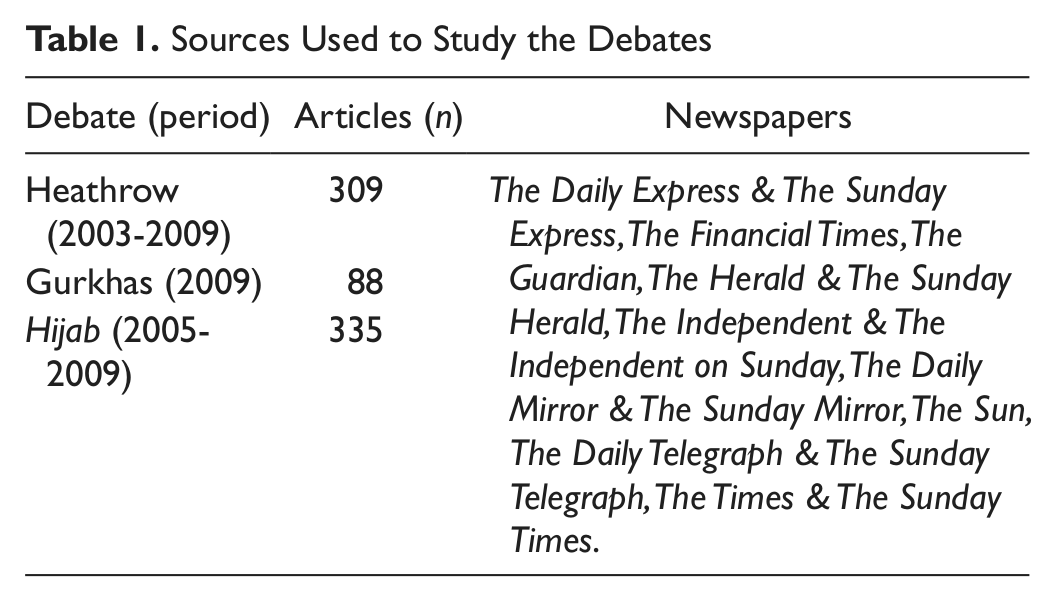
The data sources are newspaper articles in which decision makers and stakeholders debate major decisions. The analysis investigates arguments in the newspaper articles presented by opponents and proponents. Table 1 shows when the articles were published and how many were included in each debate. The articles were collected from the LexisNexis database by searching the indicated newspapers for articles about “Heathrow,” “third runway,” and “new runway,” about “Gurkha” and “pension” and about “Muslim” or “Islam” and “veil.”
Sources Used to Study the Debates
Following Toulmin, I distinguish six elements in an argument: an asserted claim, grounds supporting the claim, warrants that justify the inference between grounds and claim, backings that prove the warrants, qualifiers addressing the modality or likelihood of claim, and rebuttals that (partly) counter the claim by stating conditions or exceptions. Figure 2 illustrates for each case a claim, a main ground, a rebuttal, and an implied warrant.
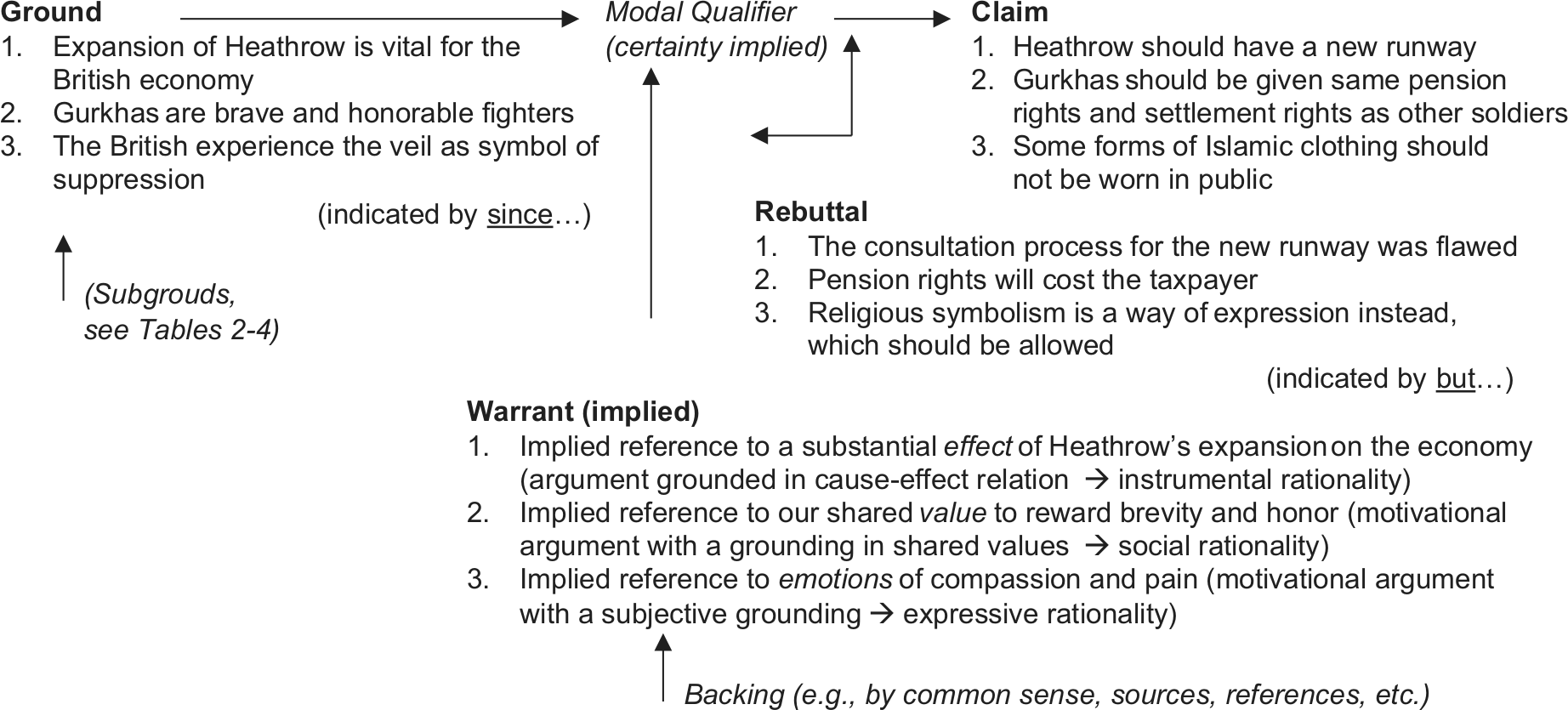
Toulmin model
Four elements, (sub)grounds, warrant, (sub)rebuttal, and claim, are quite relevant when exploring rationality, but modal qualifiers and backings tell little about the kind of rationality: They only influence the force of an argument (likelihood and validity). Moreover, the implied modal qualifiers all suggest great certainty in the cases, without any variation.
The analysis starts at the level of single arguments expressed in text quotes, explores the connectedness of the arguments, and moves up to the entire debate by relating all arguments to the most central claim in the debate as done in Bouwmeester (2010) and von Werder (1999). Together with a research assistant, the author has coded claims, (sub)grounds, and (sub)rebuttals in the three debates. The coding was done with the help of ATLAS.ti 6.2. The coding took several steps (Corbin & Strauss, 1990). First, the grounds and rebuttals in newspaper articles were identified by looking for relevant quotes and summarizing similar formulations under one code for a ground or rebuttal (open coding). Next, all grounds and rebuttals were related to the main claim and to each other as main grounds and subgrounds, main rebuttals and subrebuttals as presented in the Tables 2 to 4 (axial coding). All grounds in these tables follow after
Heathrow Debate
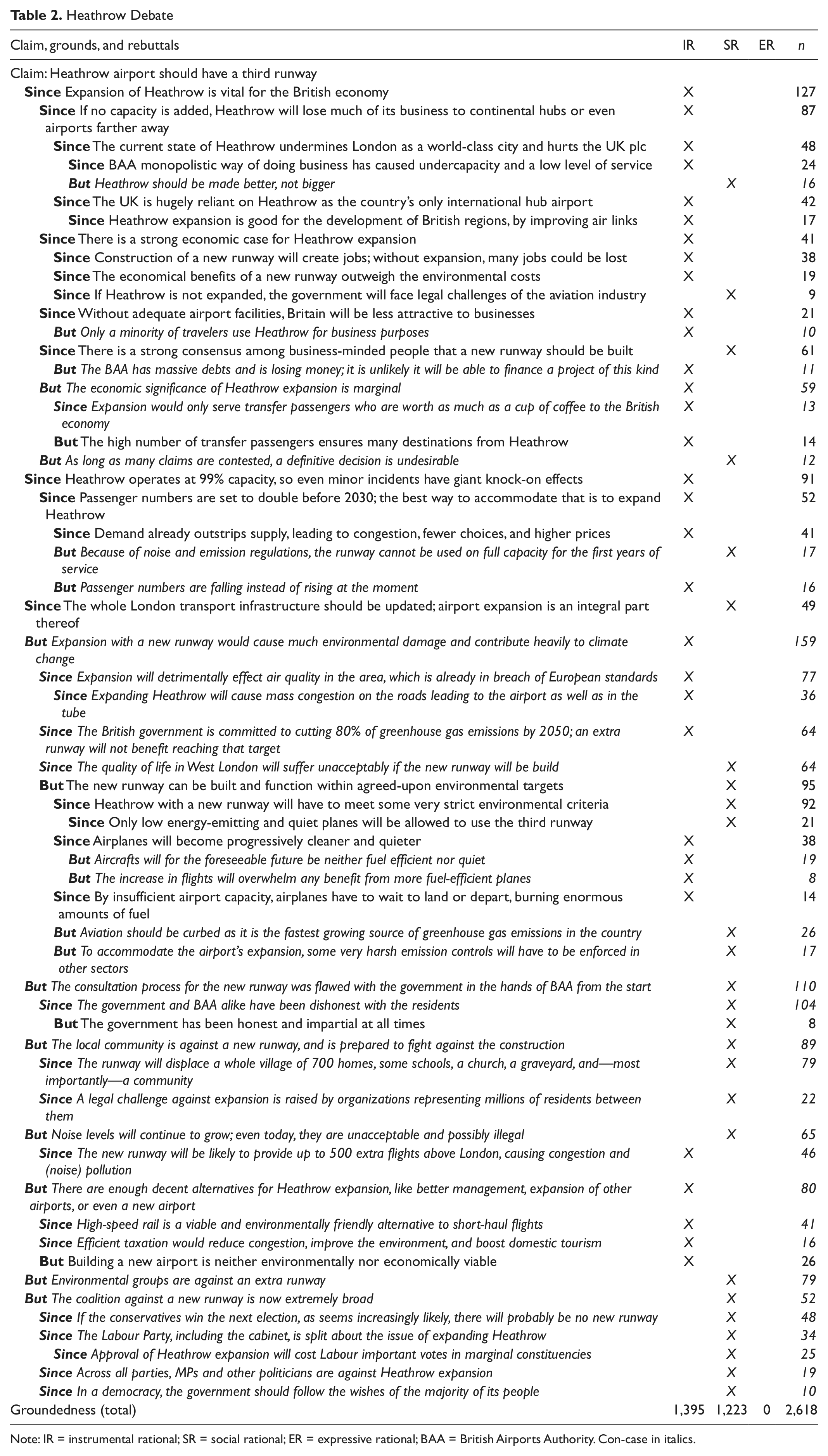
Note: IR = instrumental rational; SR = social rational; ER = expressive rational; BAA = British Airports Authority. Con-case in italics.
Gurkha Debate
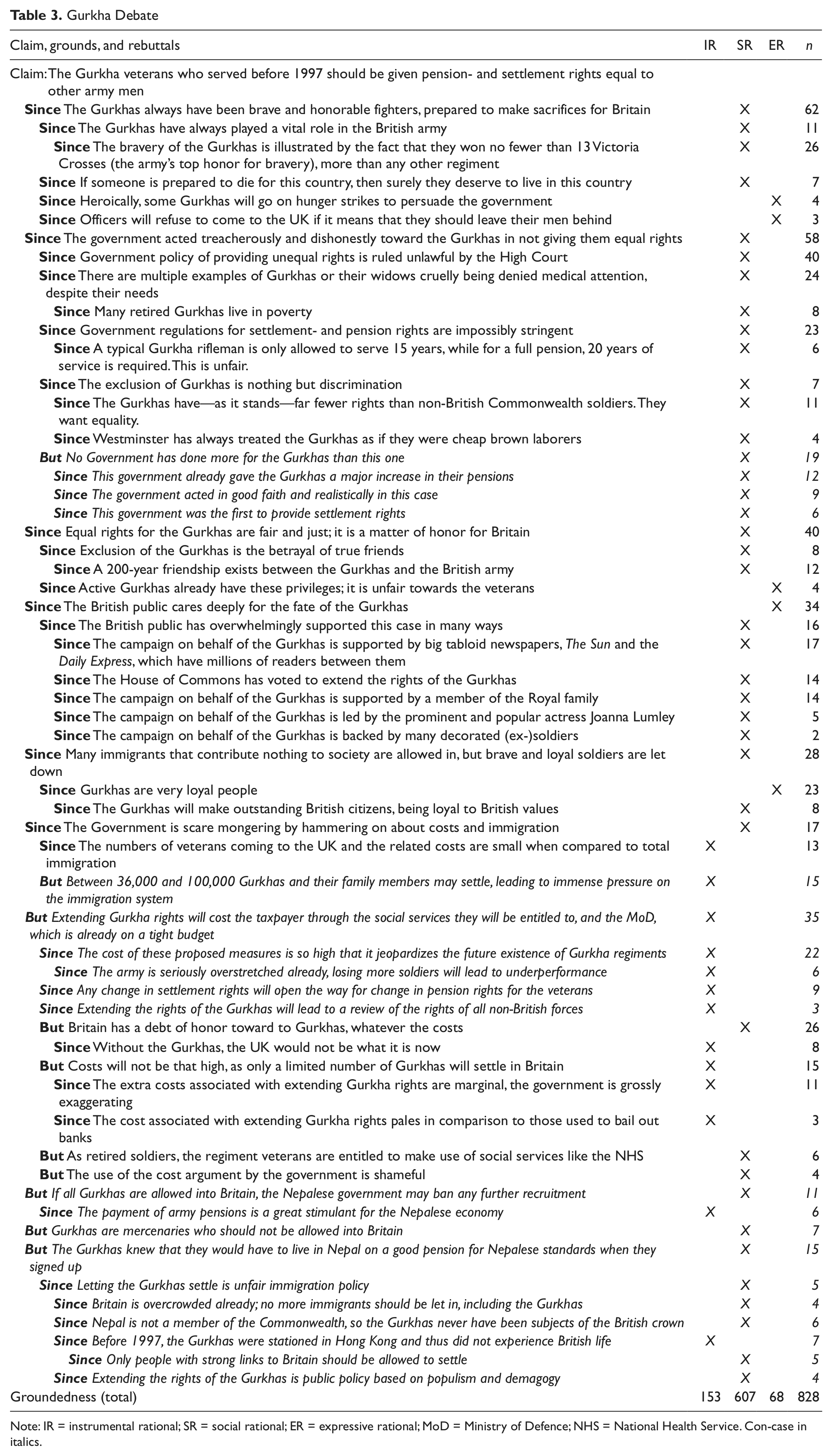
Note: IR = instrumental rational; SR = social rational; ER = expressive rational; MoD = Ministry of Defence; NHS = National Health Service. Con-case in italics.
Hijab Debate
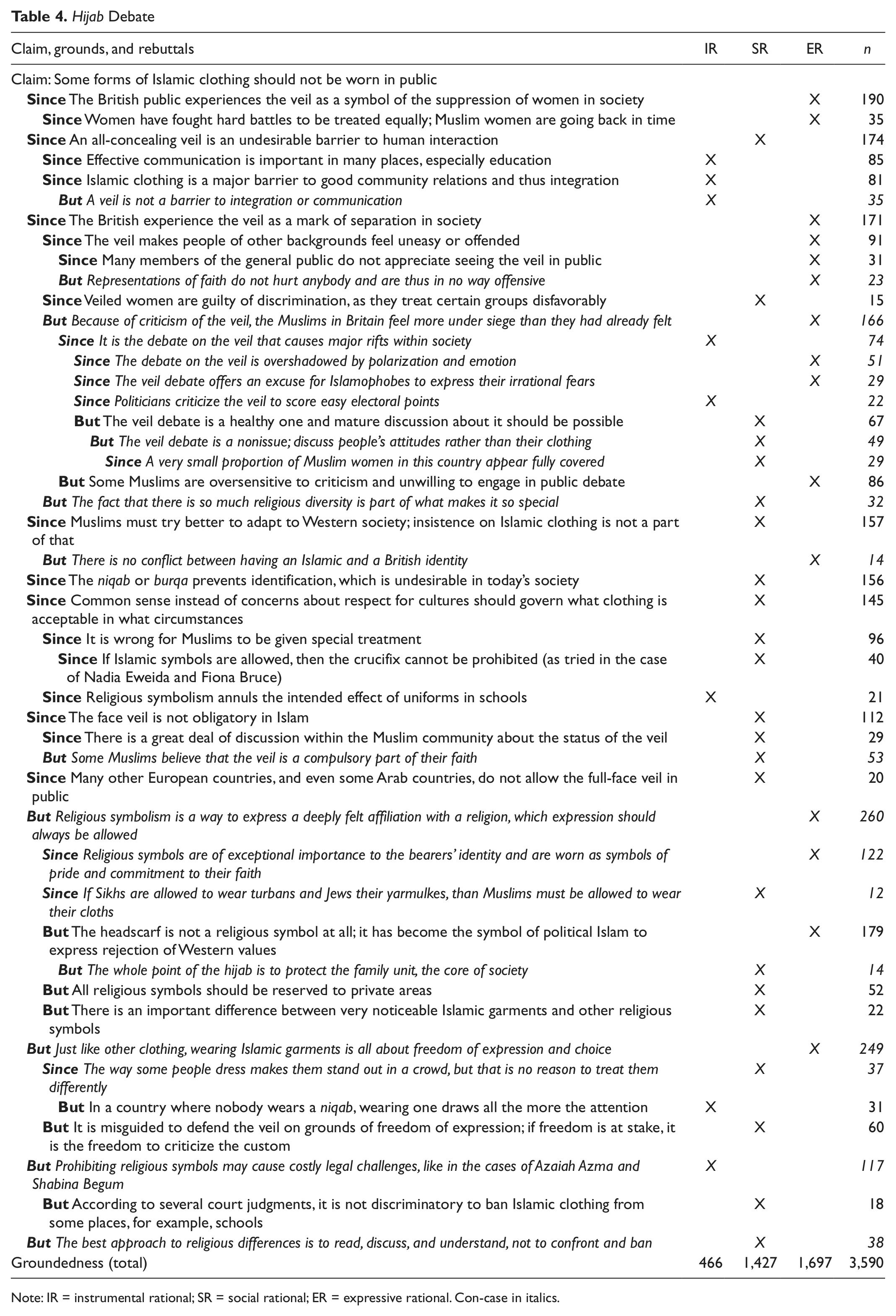
Note: IR = instrumental rational; SR = social rational; ER = expressive rational. Con-case in italics.
The axial coding process continued by identifying implied warrants that connect claim and main grounds, or grounds and subgrounds following Brockriede and Ehninger’s (1960) categorization of warrants. We coded the warrants’ rationality as instrumental when they referred to causal effects or means-end relations often indicated by specific causes (like expansion, measures, or barriers) or effects (like burnt fuel, costs, or drawing attention). We coded the rationality as social in case of motivational arguments that referred to social values that serve as motives instead of instrumental causes, such as valued bravery or an expectation to adapt to Western society. We coded the rationality as expressive when motivational arguments referred to individual emotions as motives, such as feelings of suppression or expression (see Figure 2 for examples of the three different types of arguments, indicated by 1 [cause], 2 [social motive], and 3 [individual motive]). Because rebuttals are counterarguments, their rationality could also be assessed. Then, we coded if the grounds or rebuttals were supportive (pro) or undermining toward the main claim (con) by using italics for the con-case. Finally, we coded for the years in which the debates developed.
Because warrants are somewhat fluid (Tans, 2006), they often imply more than one kind of rationality. For the sake of clarity, we have coded warrants according to the rationality that is dominant. Consider, for instance, a decision that might damage the reputation of a decision maker. If the original formulations in the newspaper articles stress that a bad reputation is unacceptable according to standards of key stakeholders, we coded the warrant social rational (SR). However, if the argument stresses that the decision causes a bad reputation, the warrant was coded instrumental rational (IR). A formulation like “we are unhappy with this reputation” would be coded as expressive rational (ER), by its focus is on personal emotions.
Because of this fluidity of warrants, we independently coded the rationality of the implied warrants of all (sub)grounds and (sub)rebuttals. Given the broad scope of the three rationalities, we could code all warrants. Our initial rationality codes were the same for about 85% of the 162 different grounds and rebuttals in Tables 2 to 4. After discussing the differences, we refined the underlying codes summarizing (sub)grounds and (sub)rebuttals to make the implied warrants less ambiguous, keeping in mind the underlying newspaper quotes. Tables 2 to 4 include as quantitative element, the groundedness of the codes. It is the number of quotes summarized by a code. We included only those grounds and rebuttals in the debates that are grounded in at least two different articles.
Case Descriptions: Three Controversial Decision-Making Debates
Heathrow Extension: A Controversy About Changes With Physical Consequences
History
The debate about Heathrow’s third runway began with the 2003 government white paper The Future of Air Transport, in which the building of a small third runway was proposed, given that targets on the reduction of noise and pollution and better public transport could be met. In January 2009, however, the then current secretary of transport, Geoff Hoon, announced that government would support the plans for a third fully operational runway for Heathrow saying, “Doing nothing will damage our economy and will have no impact whatsoever on climate change” (Guardian Unlimited, January 16, 2009). Over the course of 6 years, the labor government then in power has almost made a complete volte-face by finally fully supporting extension, stressing that the environment would not benefit from staying passive, thus repeating the argumentation of his predecessor:
If Heathrow is allowed to become uncompetitive, the flights and routes it operates will simply move elsewhere . . . All it will do is shift capacity over the Channel. It will make us feel pure, but with no benefit to the rest of the planet. (Transport Secretary Ruth Kelly, The Observer, January 27, 2008)
Stakeholders and decision makers
Decision-making authority is divided between the Department for Transport (DfT) and British Airports Authority (BAA), which owns Heathrow. BAA needs to get official permission by DfT to expand Heathrow, but the investment decision is completely its own. The loudest advocate of expansion was the labor government and the British aviation sector (BAA, British Airways, Virgin Airlines, etc.) that lobbied extensively for the permission to extend. Opposition started with neighbors of the airport and environmentalists, later followed by opposition parties combined with civil interest groups against aviation in general or Heathrow in particular, the local government, and the mayor of London.
Arguments
The discussion in the Heathrow case concentrates mostly on the positive economic and negative environmental effects of expansion. The arguments are summarized in Table 2, with the groundedness of grounds and rebuttals (their frequency of appearance in the newspapers) in the last column. Arguments belonging to the “con-case” are in italics and those of the proponents in normal case. While the rationality behind the “pro-case” is strongly instrumental rational, the “con-case” has more social rational arguments. Overall, there are more arguments counted against extension than in favor of it.
An example of a proargument by British Airways-CEO Walsh: “We remain absolutely convinced that Heathrow is a critical piece of national infrastructure. At a time of difficult economic conditions we need to be building it” (Guardian Unlimited, November 7, 2008). Local opposition is visible in arguments like the following: “Historic buildings aren’t replaceable. Once they’re gone, they’re gone forever. This would destroy a huge amount of heritage. It’s not justifiable” (The Guardian, May 26, 2003). Environmental opposition against Heathrow’s expansion: “Our planet and the people who live on it are in danger. Climate change can be beaten but not by almost doubling the size of the airport” (Financial Times, February 26, 2008).
However, the pro-case and con-case are both challenged. The economic significance of airport expansion is played down by opponents: “Most airline users are outbound leisure travelers. Curbing such travel, through taxation or slot rationing, would benefit domestic tourism” (The Guardian, January 14, 2009). Proponents respond by rebutting that “there is a sound environmental case for a third runway. If aircraft can land more promptly, hundreds of planes a day won’t have to circle overhead for hours” (The Times, June 30, 2008). Over time, the debate not only arrives at the compromise to expand but also acknowledges environmental concerns.
Gurkha Rights: A Controversy About Social Relations
History
Gurkhas, Nepalese army men, have served for more than 200 years in the British army but were never allowed to settle in the United Kingdom and were not given equal pensions to British soldiers. That remained so after restationing of the Gurkha bases from Hong Kong to the United Kingdom due to the transfer of sovereignty over Hong Kong to the Chinese in 1997. It took till 2004 that the government announced allowing the Gurkhas settlement in the United Kingdom after retirement, but only if they would have served after 1997. In 2007, a high-court judge declared this policy to be illegal, as the process to determine pre-1997 applications was deemed arbitrary. The labor government agreed to change the rules, and later that year agreed that the Gurkhas would receive an equal pension to other soldiers in the army. However, there were some important caveats: Only Gurkhas who had served 20 years would be eligible; a common Gurkha rifleman, however, only served 15 years. Nor were settlement rights granted.
Stakeholders and decision makers
The limited rights were a trigger for the rise of a Gurkha-rights movement led by actress Joanne Lumley and supported by large newspapers, and an accompanying large public debate on the issue of Gurkha-rights extension in the first half of 2009, that eventually led the government to grand almost all Gurkha’s equal pension rights and settlement rights compared with other British soldiers. Although decision-making authority belonged to the government, public opinion took strong influence.
Arguments
In the Gurkha case, we see a clear confrontation of instrumental rationality with social rationality. While the rationality behind the “pro-case” (for expanding the rights of the Gurkhas) is strongly social rational, the “con-case” consists of both social rational and instrumental rational argumentation. As can be seen in Table 3, pro-arguments were expressed a lot more than were contra-arguments. Contra-arguments are presented in italics and those of the proponents in normal case. The pro-case wins the debate.
The most important argument for extending the rights of the Gurkhas is social rational. It is based on their alleged bravery and willingness to fight for Britain: “Many of these brave soldiers have given . . . their lives in the service of this country” (readers’ reactions, The Herald, May 2, 2009). Opponents never disputed the alleged bravery of the Gurkhas. In the words of field-marshal Edwin Bramall: “They [the Gurkha’s] are marvelous, the very best and most loyal of fighting men” (The Independent on Sunday, April 26, 2009). But they did point out that
should there be a large influx of . . . ex-Gurkhas and their families, their pensions . . . would be quite inadequate to live on in this country. This would mean either that these pensions would have to be increased or that the government would be having to deal with large numbers of welfare claims. (Tony Gould, The Guardian, May 2, 2009)
However, this instrumental argument failed to impress the proponents of a rights extension, who called it “beneath contempt” (The Express, January 15, 2009) and “disgraceful” (The Express, January 16, 2009). “Whatever it costs, however much we owe them in pensions, however many National Health Service (NHS) beds they take up we want them all here as a debt of honour” (Lumley, The Sun, May 6, 2009). Proponents of an expansion of rights for Gurkhas thus forcefully rejected the relevance of cost-related considerations in favor of classic value-rational justification (Weber, 1978), so reframing the debate. But they also argued that
stories that say letting retired Gurkhas live in the UK will cost billions and be a drain on services like the NHS are simply MoD [Ministry of Defence] scare mongering. The numbers of retired Gurkhas that are likely to come to the UK are small when compared to immigration into this country. (Lumley, The Express, January 22, 2009)
Proponents of an extension were thus both able to discharge the most important cost arguments of their opponents by using the same sort of instrumental rationality and by referring to social rational arguments to which the opponents of a rights extension did not dare challenge them, because they were government officials and army officers who were the first to expand the rights of the Gurkhas in 2004, even before Lumley started the debate. This might explain why the opponents were never able to give a convincing legitimation for the decision not to expand rights further—despite the fact that the authority to decide was fully in their hands. Coercive powers were thus constrained by argumentation rationality.
Wearing a Hijab: A Controversy About Expression and Suppression
History
The debate on the permissibility of the hijab, or any other form of traditional Islamic clothing, nowadays takes place all over Europe. In Britain, the debate was most intensive throughout the years 2006 to 2007. The debate was sparked by comments of Jack Straw, a prominent Labour-MP, who revealed in a column that he asked fully veiled women that would come to his office to take off their robe, as he believed that “the value of a meeting . . . is so that you can—almost literally—see what the other person means, and not just hear what they say.” He went on saying that “wearing the full veil [is] bound to make better relations between the two communities more difficult. It [is] such a visible statement of separation and of difference” (The Lancashire Telegraph, October 6, 2006). Later significant events were a number of court cases, for instance, about women who had been fired from their jobs for wearing some type of hijab, such as a fully veiled teaching assistant, Aishah Azmi, and—in one case—a check-in worker for British Airways, Nadia Eweida, who was prohibited from wearing a small jewelry-cross on her uniform.
Stakeholders and decision makers
Opponents and proponents can be found within many traditional stakeholder groups like political parties and religious organizations, which makes the hijab debate quite fundamental. A problem for the decision makers was the question whether the government or private organizations have sufficient authority to ban a hijab. Opponents of a veil ban forcefully argued that wearing the veil is a completely personal choice, where the government has no business interfering: “We must all be able to think, wear and say what we like, subject only to personal ethics and restrictions truly necessary for the protection of others” (The Guardian, November 20, 2006), thus making a strong expressive rational argument. Moreover, proponents of a veil ban seemed to be unsure whether such a ban was legitimate, legally possible, and effective: “In a secular society . . . the only thing that works is an agreement not to bring flamboyant demonstrations of religious affiliation into everyday life” (The Independent on Sunday, October 22, 2006). So the government’s decision-making authority related to the veil ban was challenged in the debate, as were veil bans by organizations challenged in court cases, so contesting the social rational legitimation.
Arguments
What is peculiar about this debate is the fact that many arguments on both sides became increasingly expressive rational. Only grounds by proponents of a veil ban were mainly social rational. The opponents argued based on expressive rationality, and Proponents responded in their rebuttals based on the same rationality. The arguments in the hijab debate are summarized in Table 4. The arguments of the opponents of a veil ban are presented in italics and those of the proponents in normal case. Proponents of a veil ban dominate the debate in the number of contributions (groundedness of grounds and rebuttals); however, opponents win the debate by the force of their arguments.
As we saw, Jack Straw criticized the hijab, for being “a visible statement of separation,” seemingly implying that women wear the veil to express their contempt for British society. A similar sentiment is expressed in the following quote from writer Yasmin Alibhai-Brown: “It [the wearing of the niqab] breaks our hearts. After all, caged creatures often prefer to stay in their cages even after they have been freed. I don’t call that a choice” (The Independent, October 9, 2006). These expressive arguments become more important in the pro-case during the debate. However, most motivational arguments of proponents arguing for a veil ban refer to norms of how to behave and how to integrate. Only some arguments were instrumental by claiming that face veils make communication and identification less effective, as in the quote of Tony Blair, then prime minister: “It really is a matter of plain common sense that when it is an essential part of someone’s work to communicate directly with people, being able to see their face is important” (The Mirror, December 9, 2006).
Opponents of a veil ban argued mainly based on expressive rationality but mixed with some instrumental and social arguments as in the following quote about effective teaching:
Integration requires people like me to be in the workplace so that people can see that we are not to be feared or mistrusted . . . I teach perfectly well with my veil on. Give it a chance—that’s what I call integration. (Azmi, The Times, October 20, 2006)
A strong statement of expressive argumentation:
I’ve been wearing a hijab for seven years now. I was about 16 when I started wearing a veil and it was my own decision . . . Now, it is part of who I am, it is part of my identity. (A Muslim student, Independent Extra, October 17, 2006)
Thus, while proponents of a veil ban saw the veil as oppressive and as a barrier to integration, opponents instead presented the hijab as a means to express ones (religious) identity and argued that only acceptance of it could lead to integration. By consistently and successfully using an expressive rational argumentation strategy, the opponents of a ban forced proponents to acknowledge that legal action on the veil could not be legitimized. The social rational arguments expressed by those with decision-making authority could not overrule the expressive rational arguments of opponents in the United Kingdom.
Cross-Case Analysis
Field Dependence Matters
Each case discussed above illustrates how argumentation that expresses a rationality appropriate for the corresponding metafield of argumentation carries more force than arguments that do not fit in line with Toulmin’s (1958) argumentation theory. His view is illustrated in Table 5, where the dominant rationality behind the reasoning in the three debates is summarized for each debate in the last column (in bold). This summary in the last column is based on how often all arguments (grounds and rebuttals) were repeated in the newspaper articles (groundedness) in total and then attributed to the three types of rationality (IR, SR, and ER) with the dominant rationality in bold numbers. The table also gives the total of arguments for the pro and con position, showing who dominated the debate by number of arguments.
Types of Reasoning in the Debates
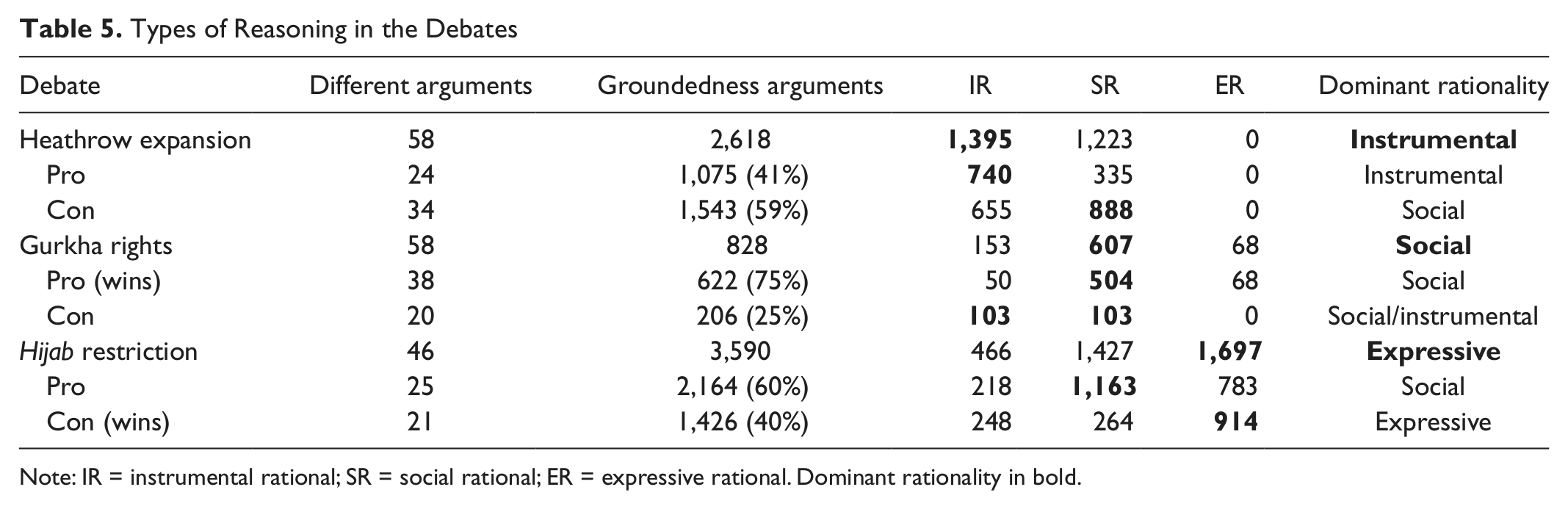
Note: IR = instrumental rational; SR = social rational; ER = expressive rational. Dominant rationality in bold.
In the Heathrow debate, there is no single winner, and stakeholders take some influence by making environmental concerns increasingly the concerns of the proponents. Instrumental reasoning is strong in the debate, on both sides, although opponents identify somewhat more with SR arguments as competing rationality. In the debate on extension of pension rights and settlement rights for Gurkhas, the proponents win, with dominance of social rationality in their arguments. Opponents of a rights extension challenge the social case of the proponents with cost arguments, but are not able to reframe the debate as instrumental. In the hijab debate, the opponents of the veil ban win, using expressive reasoning. Opponents argue that wearing a hijab is a personal “expression” and not a form of “repression.” Decision makers thus lose their authority to decide on this issue based on a social rational legitimation. The dominant rationality is in accordance with the initial allotment of the three debates to argumentation fields with an objective, intersubjective, and subjective orientation, which illustrates the Toulmin thesis also for metafields of argumentation in line with Habermas’s (1988) expectations. Therefore, the number of supporters does not make enough difference to overrule a field fit, as visible in the hijab case. Although supporters of a veil ban express themselves more often, their social rational arguments do still not convince in Britain.
Argumentation Strategies: Mirroring or Reframing
The illustrated relevance of the fit between argumentation rationality and argumentation field invites a more detailed investigation into how opponents and proponents react to each other, which adds a new perspective to Toulmin’s ideas. Argumentation strategies do not only include grounds that fit a field to most effectively support the decision-alternative advocated but also rebuttals to discredit arguments used by other parties in the debate. These rebuttals can mirror the rationality of the grounds they challenge, or try to realize a better fit with the argumentation field, so aiming at reframing a debate. Table 6 shows that in two cases proponents mainly use rebuttals in which the same rationality dominates as in the grounds of their opponents (indicated by an arrow).
Dominant Rationality in Grounds Reflected in Related Rebuttals (see arrows)

Note: IR = instrumental rational; SR = social rational; ER = expressive rational. Bold values are the dominant rationalities.
Is it reasonable to suspect that effective rebuttals will be of the same rationality as the grounds they are intended to rebut? You could benefit from using a kind of rationality that your opponents have acknowledged as suitable for the debate at hand. That explains the phenomenon of mirroring across grounds and rebuttals. For instance, the grounds used by proponents of Heathrow’s expansion are instrumental, while most of their rebuttals are social. Proponents so react to the social rational grounds of their opponents. Also the kind of reasoning dominant in the rebuttals of the proponents of a veil ban (expressive reasoning) mirrors the dominant rationality in the grounds of the stakeholders who oppose this plan. Proponents thus respond to the rationality behind the grounds of their opponents, although they identify with another rationality in their own grounds. That is a first strategy to take field dependency of argumentation into account. Some of the arguments in the Gurkha debate also fit into this strategy. Proponents of a rights extension used instrumental arguments to rebut government figures of costs and potential inflow of Gurkhas as exaggerated:
The total bill for state benefits, housing, tax credits, health and education costs for 12,000 ex-Gurkhas who retired before 1997 and their families is put at £425m—far short of the £1.4bn-plus figures that have been quoted by ministers. (The Guardian, May 6, 2009)
When we thus “go beyond the numbers” and explore in more detail as suggested by Phillips et al. (2008, p. 785) when studying cultural constructs like decision-making debates, we see more differentiation in argumentation strategies. As a second strategy, decision makers emulate strong rebuttals in their own grounds, while reacting to the first strategy executed by opponents. In the Heathrow case, proponents of expansion so incorporated some of the stronger arguments of environmentalist in their legitimation strategy. The instrumental environmental arguments were seen as equally appropriate as their own economic arguments. Environmentalist mirrored the instrumental rationality favored by the proponents in many of their rebuttals, even though they mainly opposed with social rational concerns.
When arguments do not fit an argumentation field they can be rejected as irrelevant or inappropriate, which invites a third strategy to deal with field alignment. In the Heathrow debate, proponents of an airport expansion used a lot of their instrumental rebuttals to counter the weaker “social” case of neighbors of Heathrow, thus supporting their instrumental line of reasoning in their grounds. Likewise, the proponents of an extension of Gurkha rights chose mainly to reject the instrumental arguments of their opponents with social rational rebuttals: “Labor ministers yesterday masterminded one of Britain’s most shameful days by telling thousands of hero Gurkhas they have no right to live here” (The Express, April 25, 2009). They qualified the use of economic arguments as being inappropriate in light of what Gurkhas had done for Britain, thus focusing on social rationality in their argumentation. Opponents of a veil ban used the third strategy to disqualify the discussion about repression (social rationality) initiated by proponents and reframed wearing a hijab as expression (expressive rationality). They argued that people have the right to make their own choices about what they wear. Their focus on expressive rationality is visible in both grounds and rebuttals.
The three strategies all take field dependency into account, the first two stay within the argumentation field and rebut individual arguments or emulate them. The third strategy is potentially most powerful by disqualifying the rationality of opponents’ arguments by changing to a rationality that presupposes another argumentation field as more appropriate, which is most successful in the Gurkha case. This third strategy enforces dissociation from a previously held, favored opinion (Perelman, 1982).
Reframing Over Time: Initial Arguments Versus Effective Legitimation
Two debates develop over several years: the Heathrow and the hijab debate. Here, the reasons used to motivate a particular stance later in the debate do not fully match the reasons used to initially legitimize that stance. The proponents’ choice to support the extension of Heathrow was initially motivated by economic considerations, but as the debate progressed, their instrumental legitimation strategy integrated environmental objectives also as profitable under influence of the argumentation strategy of the environmentalist. They no longer framed them as social obligation, as demonstrated in Table 7. Bold figures emphasize changes over time.
Developments in Rationality of Environmental Arguments
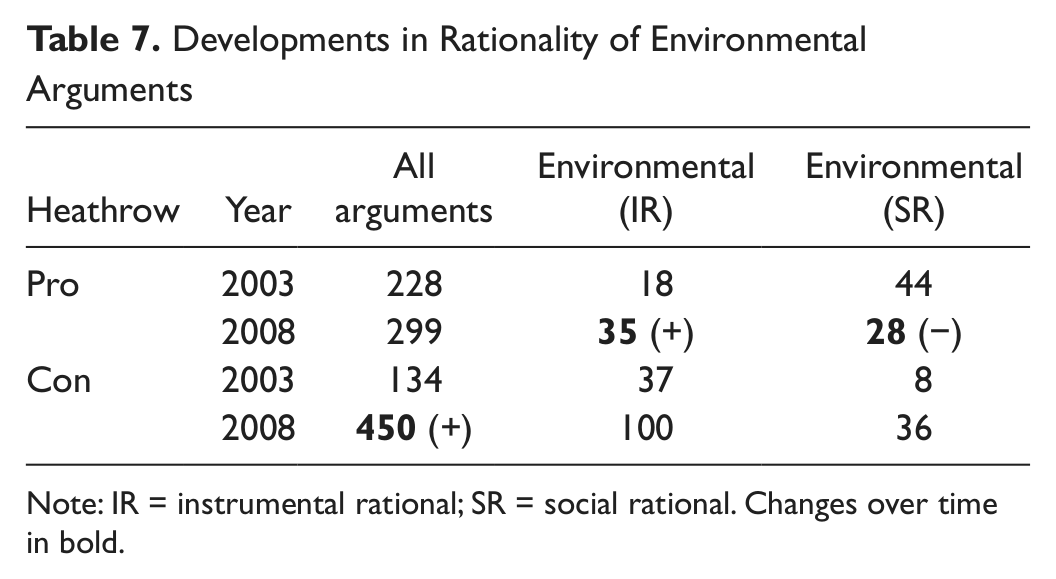
Note: IR = instrumental rational; SR = social rational. Changes over time in bold.
Table 7 shows how proponents of extension use twice as much instrumental arguments in 2008 compared with 2003, and reduce social argumentation on environmental issues. Behind the numbers in 2008 are arguments of proponents that promise more efficient landing and departure, and use of more efficient airplanes.
In the hijab debate, we see on both the pro and con side a shift in emphasis from social rational to more expressive rational arguments (Table 8), although opponents have always emphasized the expressive side most. Proponents of a veil ban acknowledge in the end that the question is mainly subject to expressive rationality. They finally use expressive rational arguments more than social rational arguments in 2008, thus reframing their view under influence of the opponents.
Developments in Rationality Hijab Debate
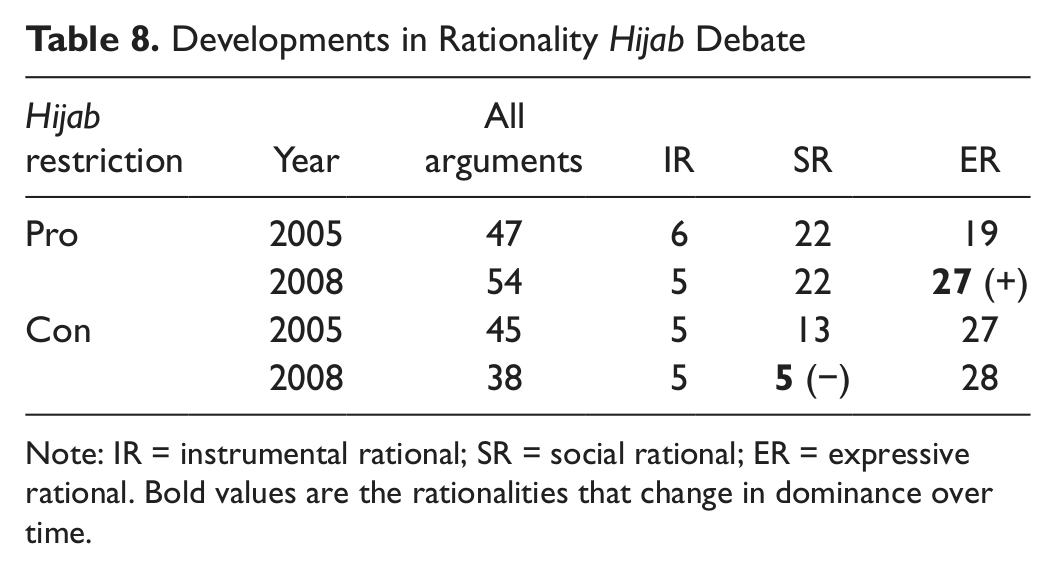
Note: IR = instrumental rational; SR = social rational; ER = expressive rational. Bold values are the rationalities that change in dominance over time.
Opponents of a veil ban have mainly reduced the use of SR arguments over time. Although the choice to wear a hijab is inspired by religious, cultural, and social considerations, expressive argumentation was more effective to stop the veil ban. Expressive rational arguments resonated best with the Western values of decision makers in the United Kingdom. The Heathrow and the hijab debate thus both illustrate that the rationality behind final legitimation in decision-making discourse can differ from the reasons that initially motivated a stance, a phenomenon also discussed in Majone (1989) and Bouwmeester and van Werven (2011). In both cases, we see a move away from social rationality and toward the field of the debate.
Discussion
Organizations, public or private, need to legitimize controversial strategic decisions based on a rationality that convinces stakeholders. If they fail, decision makers risk that they cannot execute their decisions. Establishing a good fit between the argumentation field and the kind of reasoning used gives decision makers more legitimacy. This study therefore draws on Toulmin’s assumption that the expressed argumentation rationality should be aligned with the related argumentation field. Consequently, the underlying rationality, understood as good reasons for action, has to be field dependent as well. This alignment is, as Toulmin (1958, p. 8) claims, a “standard of achievement” and thus a necessary discursive ability (Habermas, 1988; Maitlis & Lawrence, 2007; Toulmin et al., 1984).
In the cases, the expressed reasons (argumentation rationality) of decision makers and stakeholders in three public debates inspire three propositions that all imply alignment of the kind of rationality with a corresponding argumentation field, and together contribute to a more fine-grained understanding of rationality as suggested by Mueller et al. (2007). In the instrumental Heathrow debate, for instance, decision makers align their arguments better than decision makers in the two other controversial debates, and so they better convince their stakeholders. In the social Gurkha debate and the expressive hijab debate, interest groups realize a better fit, and thus take strong influence. This observation inspires a first proposition:
Decision makers can convince their stakeholders better in public debates by aligning the rationality (expressive, social, or instrumental) behind their arguments with the debate’s corresponding metafield of argumentation (subjective, social, or objective).
Although an alignment strategy strengthens the argumentation of all parties involved in public debate, this first proposition starts with decision makers because they provoke the debate. If stakeholders agree with decision makers on the fit between rationality and field, both can gain influence by fighting arguments within the field. This mechanism of mirroring the opponents’ rationality is illustrated in all cases. In the Heathrow case, stakeholders use instrumental arguments to draw the attention of proponents toward environmental effects next to economic effects. Their pressure influences decision makers to emulate environmental considerations in their instrumental reasoning, and they so convince stakeholders that their plan can be made acceptable from an environmental perspective. In the hijab debate, many rebuttals of decision makers are expressive rational and they mirror the rationality that is seen as appropriate by the stakeholders. However, decision makers give up in the end and assume that stakeholders know best what wearing a hijab means to them. The expressive arguments of stakeholders carry more authenticity because they talk about themselves. In the Gurkha debate, stakeholders mirror rationality by likewise rebutting invalid cost arguments of decision makers. However, in this debate, stakeholders only mirror the instrumental rationality for the sake of argument. This process of mirroring inspires a second proposition:
Stakeholders can influence decision makers (and vice versa) by mirroring the rationality behind their opponents’ arguments in public debates: first by rebutting grounds on content and second by emulating strong rebuttals of opponents in their own grounds.
When opponents mirror the rationality of each other in their own argumentation, it is the force of single arguments that counts. However, all cases also show examples of gaining influence by reframing arguments in a way that they become better aligned with the debate’s most relevant metafield of argumentation. The Gurkha case located within the social argumentation field illustrates this most pronounced: Stakeholders challenge the instrumental rationality behind the economic arguments of the decision makers as inappropriate and decision makers admit in the end that for this debate cost arguments are much less relevant than social rational arguments. In the hijab case, stakeholders argue with expressive arguments against a mainly expressive rational case of the decision makers, and stakeholders win that debate as well. In the Heathrow case, reframing is more subtle and only visible when debating environmental issues. Stakeholders make these issues instrumental for decision makers instead of a social obligation. That inspires a third proposition about a reframing strategy:
Stakeholders can influence decision makers (and vice versa) by reframing the debate to disqualify arguments, for cases where opponents do not align their argumentation well with the debate’s most relevant metafield of argumentation.
The process model (Figure 3) summarizes the argumentation strategies of decision makers and stakeholders expressed in the three propositions. The first proposition (alignment strategy) is the most general one, whereas the last two propositions (mirroring and reframing strategies) are visible in the right-hand boxes. The process model illustrates how stakeholders can confirm or challenge the field dependence of argumentation rationality posed by decision makers, who thus need to anticipate to reply adequately.
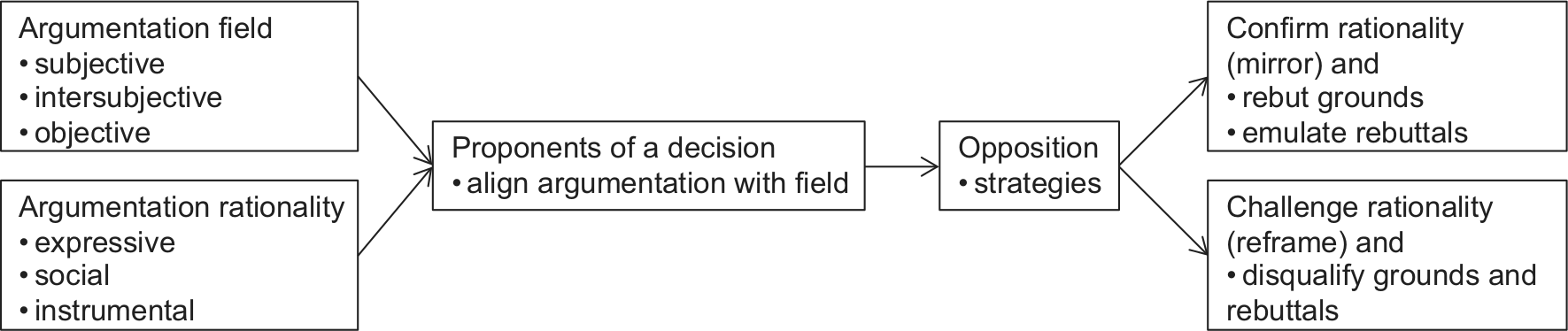
Process model of argumentation
There are scholars who have stressed the contextual character of decision making, but there is hardly attention in management studies for the field dependence of argumentation rationality in strategic decision making. Only von Werder (1999) is slightly touching on it. The process model pictured in Figure 3 helps to fill this gap in the literature. The model contributes with strategies of mirroring and reframing, which are induced by the fit/misfit of argumentation rationality and argumentation field. Mirroring helps to challenge a decision in case of an assumed fit as suggested in the right-hand-top box, reframing works in case of a misfit as suggested in the bottom box. Because controversial strategic decisions often relate to different argumentation fields with conflicting rationalities, it is a real challenge to put the right emphasis on the most relevant rationality. Parties initially disagree on this emphasis in controversial debates, and emphasis can change over time due to the debate. Although modal qualifiers are not part of this study, it is likely that the perceived degree of certainty of arguments is a moderator in the process of reframing rationality, even if the degree of certainty suggested by decision makers and stakeholders is usually high in controversial debates. However, in the Gurkha debate, the certainty of cost arguments is contested, which helps the shift away from IR argumentation. This moderating force of modality could be explored further. Moreover, a misfit between argumentation rationality and the argumentation field is a good research context to further explore processes of reframing (Cornelissen, Holt, & Zundel, 2011) and the related concept of dissociation (Perelman, 1982).
A second contribution is that the study illustrates how stakeholders gain power with their argumentation strategies, and become what Mitchell, Agle, and Wood (1997) call a definitive stakeholder. For stakeholders, it is as crucial as for decision makers to support their case with arguments appropriate to the argumentation field of the debate. When they do, they challenge the views of Eisenhardt and Zbaracki (1992) or Elbanna and Child (2007) who conceptualize rational and political approaches to decision making as completely distinct. This study shows how argumentation rationality is a means to gain political influence and to constrain coercive powers of decision makers. Reframing a debate as in the Gurkha case even nullifies agenda setting powers of decision makers (cf. Lukes, 1974). The findings thus add to Townley’s (1999) argument against the conceptual opposition of rationality and political power. There are no reasons to suspect that this stakeholder influence is unique for the three cases. It is an influence that managers have to deal with in public strategic debates (Cludts, 1999; Gioia & Chittipeddi, 1991; Palazzo & Scherer, 2006), no matter if their organization is public or private. Good alignment of a managers’ argumentation rationality and the field of discussion most related to a controversial strategic decision is crucial for its final execution. Improving this alignment is a business opportunity for consultants in their role as legitimizer (Bouwmeester & van Werven, 2011; Saxton, 1995).
Other contextual elements may also influence the persuasiveness of reasoning apart from argumentation fields, like, for example, national culture or professional backgrounds (Corvellec, 2007; Schildt et al., 2011; J. A. A. Sillince, 2002). In the British debate on the hijab, a ban was not feasible, because a hijab was mainly regarded a matter of personal expression, of choosing your own cloths: a private domain not to be meddled with by the government. In other countries (notably France or Turkey), measures against some forms of Islamic veils have been taken, indicating that social rationality is regarded more relevant in that culture than expressive rationality, which makes the domain of allowed personal expression smaller. Culture thus influences the social construction of argumentation fields. However, there are limits to what extent the field dependence of argumentation is flexible. In the Netherlands, the right-wing politician Wilders suggested to make wearing the hijab subject to taxation, thus framing the debate in terms of costs. This framing felt so inappropriate that the proposal was ridiculed. Future research could explore what dimensions constitute an argumentation field, because the concept seems more differentiated then initially suggested by Toulmin. Suddaby (2010) indirectly supports this research agenda in arguing that the study of rhetoric is a main challenge for institutional theory. Exploring argumentation fields could help to develop still tentative notions as “institutional logics” (Green et al., 2008; Suddaby & Greenwood, 2005) or “spaces of reason” (Schildt et al., 2011) so adding to a more “linguistic conception of institutionalization” as proposed by Green, Li, and Nohria (2009, p. 12).
A last perspective for further research offers the conceptualization of rationality, which holds the potential for further distinctions than the three discussed ones. Especially, social rationality has a multifaceted character in value rationality, aesthetic rationality, or political rationality. The analysis of tension stemming from different social rationalities might contribute to the research agenda outlined by Clegg et al. (2007), who argue that ethical practices need to be better explored. Especially, social rational arguments express ethical concerns.
Footnotes
Acknowledgements
The author would like to thank Stefan Heusinkveld and the anonymous reviewers for their helpful suggestions to improve the article. Gijs van Houwelingen has made a substantial contribution to an early version of this article, partly with his master’s thesis research and partly as research assistant in helping with finding controversial decision-making debates, collecting newspaper articles, and coding arguments.
Declaration of Conflicting Interests
The author(s) declared no potential conflicts of interest with respect to the research, authorship, and/or publication of this article.
Funding
The author(s) received no financial support for the research, authorship, and/or publication of this article.