



Abstract
This article discusses the de/construction of liminal identities in relation to translocal patterns of work. Through a phenomenological analysis of three autobiographical narratives, it informs management and organization studies, discussing liminality and translocality as embedded and embodied phenomena experienced in relational, spatio-temporal, and inter-corporeal levels. In particular, the article proposes that a post-dichotomous conceptualization of place and non-place, self and other, and fixity and mobility unveils the complexities of studying identity, liminality, and translocality as interrelated phenomena. Liminal identities are explored as socio-spatial, temporary crystallizations of translocal bodily experiences, disrupted by differentially embodying displacements and emplacements across space–time. Finally, we suggest that translocal socio-spatial scales are inter-corporeal performances that challenge both material and immaterial boundaries. The article concludes with the contributions of this work to identity, liminality, and translocality studies and a discussion of future research directions.
Introduction
Prevailing features of contemporary societies include interrelatedness and interdependence of people across the globe, movement of populations, and the erosion of clear boundaries separating markets, states, and cultures, or what Beck (2008) called the “confrontation with the alien other all over the globe” (p. 794). In this era of rapid socio-economic and technological change, people and organizations are increasingly becoming translocal (Chongyi & Changzhi, 2006; Greiner, 2010; Schein, 2006; Sun, 2006). As a result, translocality, “being identified with more than one locations” (Oakes & Schein, 2006a, p. xiii), is increasingly being discussed in several disciplinary contexts such as geography (Featherstone, 2011; Verne, 2012), cultural anthropology (Bennett & Peterson, 2004; Escobar, 2001; Gottowik, 2010; Ma, 2002; Peleikis, 2003), and development studies (Zoomers & Westen, 2011).
In particular, translocal approaches explore the dynamics of locality and place, providing various conceptual frameworks regarding globalization, transnationalism, cosmopolitanism as well as identity (Appadurai, 1996, 2003; Conradson & McKay, 2007; Daskalaki, 2012). They also address complexities in the circulation of ideas, symbols, and knowledge and offer promising perspectives on global mobilities, migration, and networks of populations. Translocality studies, further, provide the tools to study the processes and practices through which territories become dispersed, contested, and blurred, and conclude that socio-spatial scales are socially constructed, simultaneously fluid and fixed, as well as relational (e.g., Brown & Purcell, 2005; Freitag & von Oppen, 2010). Thus, stressing the translocal dimensions of the ways in which bodies and things move, the socio-political and cultural implications of movements, as well as the embodied experiences of mobility, translocality research addresses the histories and the geographies of moving populations and challenges rigid categorizations of the “refugee,” the “migrant,” the “cosmopolitan,” or, more generally, the “other.” Due to that, translocality research redresses the here/there and the global/local dichotomies and reveals patterns of embeddedness across different localities (Greiner, 2010; Hedberg & do Carmo, 2012; Steinbrink, 2009).
Intriguingly, while mobility as a theme emerges as central in discussions of the relationship between locality, place, and identity (Easthope, 2009; Marcu, 2014), translocality approaches expand the focus beyond individual mobility, to study the role of socio-spatial interconnections and in-between places in the construction and re-construction of identities (de Lima, 2012; Oakes & Schein, 2006b; Stenbacka, 2012). Building upon these approaches, this article stresses the in-between dimensions of translocal experiences and discusses translocality in relation to liminal identities—precarious states of being in-between (Beech, 2011; Cohen, 1994; Ibarra, 2005; Mayrhofer & Iellatchitch, 2005). In particular, our approach is concerned with the socio-spatial, relational, and inter-corporeal dimensions of identity, pointing toward a complex “actor-oriented and multi-dimensional” understanding of translocality (Greiner & Sakdapolrak, 2013, p. 376). Therefore, the exploration of translocality, liminality, and identity as interlinked phenomena offers an opportunity to unpack the intermediary, dynamic entanglements that are enacted across diverse sites and the iterative, dynamic and, at times unpredictable movements across boundaries, as these occur during identity transformations. This approach allows the study of translocality and liminality in relation to first, “intermediary arrangements, fluidity and intermingling processes” (Verne, 2012, pp. 17-18, emphasis added), and second, non-linear, embodied practices involved in identity transformations in-between space–time.
In the sections that follow, we study stories of translocal arrangements and nomadic experiences at work, experiences which leave individuals feeling almost being constantly on the move. This movement describes the linkages and connections between places, which while situated can never be static. In other words, “being grounded is not necessarily about being fixed; being mobile is not necessarily about being detached” (Ahmed, Castaneda, & Fortier, 2003, p. 1). Translocal (work) spaces, we will propose, are polycentric and ambiguous and transcend socio-spatial scales, constituting and re-constituting inter-subjective meanings and liminal identities. As a result, both liminality and translocality are embodied, lived experiences the complexities of which are unveiled through three interacting conceptual domains, namely, place/non-place, self/other, and fixity/mobility. Thus, we will suggest, the study of translocality in conjunction with liminal identities encourages organization and management scholarship to focus upon differentially performed liminalities across intermediary spaces, mediated by patterns of what Urry (2007) called “intersecting mobilities.”
Hence, contributing to the study of in-between identities (Beech, 2011; Ibarra, 2005; Ibarra et al., 2010), we link liminality with translocality, unveil the lived dimensions of liminal experiences, and study their impact upon identity de/construction. To achieve this, we propose a bodily mediated understanding of translocality and liminality, a post-dichotomous ontology of “self-other-things” (Merleau-Ponty, 2012). We thus employ a phenomenological reading (Merleau-Ponty, 1968, 2012) of translocality and liminality and discuss perpetual, translocal experiences and in(ter)-between identities as differentially embodied, inter-spatial and inter-corporeal experiences. This enables the exploration of perceptions, affects, places, meanings, and actions as well as interpersonal and socio-material dimensions of practice in a fluid and dynamic manner (Küpers, 2011a, 2011b; Küpers & Edwards, 2008).
In terms of methodology, we employ autobiographical narratives as a self-reflexive device for the exploration of our translocality and otherness within and outside work contexts. In particular, through our personal narratives, we describe the process of becoming-an-academic (identity de/construction), a process that frequently involves translocal work experiences, mobility, or migration as well as liminal work arrangements (Colic-Peisker, 2010; Dany, Louvel, & Valette, 2011; Fotaki, 2013; Parker & Weik, 2014). Autobiographical narratives, as we will propose, capture being-in-liminal-worlds, a recurrent transformation through liminal experiences, which are expressed in spatio-temporal, relational, and, finally, inter-corporeal levels. These three levels are not independently affecting the lived experience but instead, they operate constantly in interaction to frame and re-frame movements, displacements/emplacements, and inter-subjectivities.
The article is structured as follows: First, reviewing prior studies of translocality and liminality, we propose a phenomenological reading of the narrative de/construction of identities that encapsulates three interrelated levels of lived liminal experiences: lived space–time, lived relations, and lived body. Before the three autobiographical texts, we describe the autobiographical-phenomenological methodological framework through which we analyze these texts as well as the processes of identity de/construction. In the analysis and discussion sections that follow, we propose three interrelated conceptual domains that emerge from the analysis of the texts, namely, place/non-place, self/other, and fixity/mobility. We then explain how they co-construct liminality and translocality as polycentric, multi-dimensional and ambiguous reconciliations of differences, in-between lived states of becoming, and outline the contributions of the article. Finally, we summarize our work and propose future research directions.
Liminality, Identity, and Translocality
Mead’s (1962) thinking about the “I/Me” relationship enables people to create meaning for themselves and the broader world through the interpretation of common symbols: The self is thus individual only through its reciprocal relations with others and the community (see also Goffman, 1959). “The self is both a subject and an object, the ‘I’ as the subject which thinks and acts, the ‘Me’ as the individual’s awareness of self as an object in the world existing for others” (Swingewood, 1991, p. 266). Identity consists of aspects of an individual’s self-image that derive from the social categories through which the individuals perceive themselves as belonging (Tajfel & Turner, 1979). During the construction of one’s identity, both individual (personal values) and social sources (communities) are important as individuals continuously construct identity in interaction, negotiating and modifying conceptions of social identity and personal identity (Kohonen, 2005; Stone, 1962).
Based on the above, identities are fluid and temporary constructs that are differentially performed in translocal spaces through “disjunctured flows” (Appadurai, 1990). We examine these translocal spaces as “a set of dispersed connections across spaces, places and scales which become meaningful only in their corporeality, texture and materiality—as the physical and social conditions of particular constructions of the local, become significant sites of negotiations” (Brickell & Datta, 2011, p. 6). Accordingly, translocal identities involve liminal experiences, states of being “neither here-nor there,” “between-and-betwixt” (Beech, 2011; Ibarra, 2005; Mayrhofer & Iellatchitch, 2005). These states, according to Turner (1964, 1969), describe individuals on the verge of a different state of being, a state of between-ness found at pilgrimages, in which the normative assumptions, relationships, and conventional practices are being suspended. For this reason, liminal experiences have been described as “moments in and out of time” (Delanty, 2010, p. 31).
Earlier, in the book The Rites of Passage, Van Gennep (1960) proposed a structural framework explaining the process of making identity changes. This is comprised of three stages, which can be seen as means by which people make role transitions. At the outset, “separation rites” are linked to the process of “letting go” the old position. Next, “transition rites” refer to an “in-between” stage where the individual is no-where. In the final stage, “incorporation rites,” individuals become assimilated and socialized into the new position. This framework deals with identity changes and how rites help to structure transitory experiences. In the transition or liminal phase, individual identity remains ambiguous, because the individual has been disengaged from one role or possibly multiple roles (e.g., jobholder, work group member, organizational member) and has not yet engaged in a new role(s). This period describes the experience of being in a void.
In organization studies, as early as 1999, the liminal position of “temporaries” was explored as an ambiguous position involving both risks and yet at the same time enabling cultural creativity (Garsten, 1999). The transient nature of the MBA experience or the “Awayday” have also been discussed as liminal, “in between” spaces (Arya, 2011; Simpson, Sturges, & Weight, 2010). Czarniawska and Mazza (2003) suggested that consulting could be represented as a liminal space for both consultants and their client organizations. Furthermore, the effects of liminal episodes were explored focusing on how, in a more transient organizational context, individualized careers, fashioned out of liminality, impact upon identity (Beech, 2011), organizational learning (Tempest & Starkey, 2004), and leadership (Küpers, 2011a). Finally, studies relating identity and liminality suggested that liminality emerges “at the intersection of structure and agency and so are particularly well-fitted to expanding our understanding of self-identity/social-identity mutual construction” (Beech, 2011, p. 286). In the aforementioned studies, there has been an agreement that social actors, who are perpetually in a liminal position, are constantly crossing the limen (threshold) and because of this, they identify with none and/or many positions at the same time (Ellis & Ybema, 2010; Ybema, Beech, & Ellis, 2011).
Interestingly, prior research has also articulated “transitional liminality,” social actors’ experience of being in-between an old and a new situation, and “perpetual liminality,” a more lasting experience of ambiguity and in-betweeness (Ybema et al., 2011; see also Beech, 2011; Czarniawska & Mazza, 2003; Fenwick, 2007; Garsten, 1999; Sturdy, Schwarz, & Spicer, 2006). More recently, Johnsen and Sorensen (2014) inspired by Turner’s (1969) “institutionalized liminality” (p. 5), referred to permanent liminality as part of a new social order, which is not to be questioned or redeemed. Crucially, “liminality is not only transition but also potentiality” (Turner & Turner, 1978). This potentiality, for Ward (1993), is materialized by the “boundary-dwellers,” those who permanently live in-between structures and cause threat to social order by constantly crossing boundaries (remain translocal). Hence, those “dwelling” in liminal spaces (Sturdy et al., 2006, p. 930; see also Shortt, 2015) are required “to navigate a sea of complex relationships” (Zabusky & Barley, 1997, p. 395), embrace translocality, and “develop a strong backward-looking and an equally strong forward-looking consciousness, temporally constructing a sense of self by invoking former and future identities” (Ybema et al., 2011, p. 24).
Following this, the “where” and “how” of in-between experiences can be examined via a sedentary conceptualization of a moving body. Places of work and non-work, following this, ought to be explored as nomadic spaces 1 of living in-between, where frequent displacements and emplacements are required; and it is through this process that liminal spaces are being inhabited. Work experiences are thus embedded in a journey of repeated emplacements/displacements, during which we write ourselves in and out of place, construct our narratives in space–time, and re-construct our identities albeit temporarily in a bodily emplaced relation with-the-other. “Place serves as the condition of all existing things . . . to be is to be in place” (Casey, 1993, pp. 15-16; see also Casey, 1997).
Therefore, in this article, we discuss identities in relation to space–time and their liminal performances, which make them part of culture, society, and economy (Hetherington, 2007; Muhr, 2012). That is, we explore movements and flows in relation to their effects on social relations, history and, most importantly, identity (Augé, 1995). Accordingly, the reading of the narrative accounts that we provide is a phenomenological one, one that includes three interacting and interrelated levels of the lived liminal experience: lived space–time, lived relations, and lived body. As we will show, these levels co-constitute liminal identities as embodied between-space and between-time. Below we explain how this is achieved, by introducing the methodological framework employed to analyze the three autobiographical texts under study.
On Methodology: Autobiographical Narratives and Phenomenology
Building upon prior auto-ethnographic contributions in organization studies (Czarniawska, 2008; Daskalaki, 2012; De Cock & Land, 2005; Empson, 2013; Haynes, 2006; Humphreys & Learmonth, 2011; Land & Sliwa, 2009; Malsch & Tessier, 2015; Rhodes & Brown, 2005), we share our personal accounts of living in-between, discussing narrative reflections of our identity work. We employ personal narratives to de/construct identities (Cohen, Duberley, & Musson, 2009; Learmonth, 2007; McKenna, 2010; Muncey, 2005; Reed-Danahay, 1997, 2001; Spry, 2001; Wright, Nyberg, & Grant, 2012) in an in-between space–time. In our approach, we challenge “the distanced and detached observer and [look] towards the embrace of intimate involvement, engagement, and embodied participation” (Ellis & Bochner, 2006, pp. 433-434). However, we do not fully commit to Ellis and Bochner’s (2006) evocative auto-ethnography that refuses to explain and arguably overlooks the ways in which it fits in other traditions of social inquiry.
Instead, adopting an analytic approach to auto-ethnography (Anderson, 2006; Learmonth & Humphreys, 2012), we provide a phenomenological reading of our texts (see Finlay, 2009; Moustakas, 1994, for a discussion on phenomenological research methods) and, through that, contribute to the refinement and elaboration of theoretical understandings of liminality, translocality, and identity. Throughout the analysis of our texts, we retain reflexivity, a key component in phenomenological research. Similar to Jones’s (2013; see also Roth, 2006) reflective-reflexive auto-ethnographic account, we also follow an “iterative journey within and across boundaries and define distinct cultural and social spaces to which I [/We] seek to gain access against the backdrop of my [/our] subjective experiences” (p. 746).
Critics of the auto-ethnographic writing have suggested that the focus on individual subjects is indicative of “(over) excited subjectivity” (Clough, 2000) or “excessive individualism” (Harrison, 2009, p. xxx) and undermines the study of social structures and institutions traditionally seen as related to individual action. Similarly, Chang (2008) warned auto-ethnographers of the dangers of the approach including excessive focus on one’s self in isolation from others and over-emphasis on narration rather than analysis and cultural interpretation. Yet, an autobiographical-phenomenological perspective, we propose, provides “distinctive trajectories, strategies and forms of identification, [as] the starting point to understanding how these are also contingent on time, space and social structures in which they are located” (Harrison, 2009, p. xxxi). Furthermore, acknowledging that in-betweeness is experienced in the intersection of structure and agency (Beech, 2011), we examine liminal identities temporarily located in “anthropological places” (Augé,1995). In such places, texts are positioned within social and historical situations through an inter-corporeal reflective process. In that respect, “life stories reveal processes of temporal ordering and differentiation; individual and social actions within and without the social networks of which s/he is a part” (Harrison, 2009, p. xxxii).
In addition, auto-ethnographic approaches have been criticized for disregarding theory. In our autobiographical-phenomenological approach, we focus on personal narrative “fractions” (Ashworth, 2003, 2006) ensuring reflexivity through the inversion of binary categories (such as self/others, place/non-place, displacement/emplacement, dis/embodiment, fixity/mobility): “collapsing them into one another without abandoning any of the frames available for thinking and being in the world” (Gannon, 2006, p. 477). Through that, theoretical texts are being discovered within our autobiographical ones, offering a significant, we hope, contribution to the analytical ethnographic tradition.
Despite the fact that in auto-ethnography the subject and object of research merge into the body/thoughts/feelings of the writer (Gannon, 2006), our reflexive autobiographical writing is a process of constantly de/constructing identities within specific social contexts in which we temporarily “situate” ourselves. Consequently, also building upon a post-structuralist reading of identity, we highlight multiplicity and ambivalences of embodied meanings and bring critical self-awareness of our own inter-subjective experiences (both as authors and subjects), our interests and assumptions, and how these impact upon the writing and analysis processes. That is, the “I” in our texts is only granted authority through “being there,” an embodied lived experience that seeks to destabilize the autonomous subject in favor of liminal, dynamic, and contingent “truths” (Gannon, 2006, p. 480). According to Cixous and Calle-Gruber (1997), writing is the body inside and outside at the same time; it is “i/rational, embodied, it proceeds elliptically and tentatively, in a fractured style, with the voices of others wound about the voice of the author . . .” (Gannon, 2006, p. 491).
Accordingly, in this article, we decided to use three autobiographical texts intact, as written in our diaries prior to this study with no editing. 2 This, we believe, respects the entwining of body-self/other-writing in a given space–time, where/when the body engages in theory making through the production of a text (Probyn, 2003; Zita, 1998). By focusing on the identity dynamics at work within single texts, we analyze them as lived spatio-temporal, relational, and inter-corporeal experiences. Each text, following this, becomes site for the dispersal and re-constitution of the self (Barthes, 1977), a site, which is always inter-corporeal, experienced in relation to the other. Accordingly, within each single text, but also across the three texts included, experiences of liminality are captured as in(ter)-between phenomena.
For example, as the following section demonstrates, pronominal reference shifts (i.e., shifts between “I” and “you”) and time–space references “write” liminality as an embodied and embedded movement from one identity to the other, constantly deferring identity “closure” and “weaving incommensurable positions together” (Iedema, Degeling, Braithwaite, & White, 2004, p. 15; see also Ybema et al., 2011). As a result, through a within- and between-reading of the three texts, we capture the lived experiences of liminality and translocality, foregrounding in this way the “fragility of self-knowledge . . . in embodied social spaces” (Gannon, 2006, p. 492). To achieve this, we adapt Seamon (2011) and employ a phenomenological approach that communicates lived space–time, lived relations, and the lived body (see Table 1) as co-constituting liminal experiences. We thus conceptualize translocality through the following interacting dimensions: first, the material existence of place (the corporeal); second, the social dimension including the meanings assigned to place (relational); and finally, “genius loci” (a metaphor for intersecting spatio-temporalities), “the associations that an individual or collective subject has acquired in relation to a specific place” (Rigby, 2003, p. 110).
Three Levels of the Lived Liminal Experience.

We propose that these interacting categories neither isolate the subject from the outside world nor fix bounded and rigid subjectivities. Instead, they restore trans-subjectivity (see the work of Bachelard, 1969) and endorse the phenomenological impulse to get to the “essence of things” (Husserl, 1948/1973). 3
“Je me souviens,” “Here We Go Again,” “In Transit”: Reflecting Upon the Lived Experience
In previous studies, life story researchers have stressed the value of personal documents, such as letters, diaries, journals, auto/biographies, and memoirs (Cooper, 1987; Harrison, 2009; Stanley, 1993; Thomas & Znaniecki, 1958). Here, we employ three diary entries that unveil aspects of our academic lives. These three texts by each of the authors reflect upon the experience of living and working in contexts other than the country of origin, an experience that embodies an inter-cultural existence as a result of self-initiated international careers (Dorsch, Suutari, & Brewster, 2012). Focusing on how this choice affects the constitution and re-constitution of identity, we reflect upon the familiar and the other, the communities in which we are enmeshed and the places we inhabit during translocal work experiences. Specifically, the first text describes identity de/construction in relation to contested and ambivalent places, nationalities, and cultures. The second reflects upon cultural hybridity and identity transitions during perpetual mobility from/to home/non-home; finally, the third narrative explores experiences of transience and temporarity as part of a work role with permanent translocal dimensions.
“Je me souviens”
I remember. It is the official motto of the province of Quebec, the home of French Canada, and the place where I was born. Born to English Canadian parents in the city of Montreal during the “Quiet Revolution” when French nationalism surged. Born into a divided nation struggling with identity and tearing in half. I remember as a child being taunted by my neighbours for being English. Sometimes more than taunts were hurled, glass, stones, rotten apples, by the French too. In 1969, General Charles de Gaulle of France proclaimed “Vivre le Quebec libre” in my birthplace of Montreal. My hometown was 80% French and I remember what it was to be English. I was a teen in troubled 1970s Quebec. The October Crisis of 1970. The Canadian Army was on the streets amidst kidnappings, letter bombs, and death. I remember being 10 and missing Hallowe’en. The decade marched on to the 1976 election of the Parti Quebecois, a party with the overarching aim for La Belle Province of separation from Canada. I remember my dad deciding to ask for a transfer at work. Away from Quebec. Separated. I remember being torn. I remember feeling English. I remember my dad saying he had been offered a job in London, England. This was not the transfer to Toronto and into (English) Canada that we had anticipated. It was a transfer away from Canada; separated from it by the Atlantic Ocean. And English! I was enrolled in an American secondary school in London and there, on British soil, I became Canadian. An English Canadian. Not English. And not American in a school that was 80% American. I remember moving in the late 1970s to English Canada, a place I had never lived, as an undergraduate. I remember going out for dinner with my aunt and uncle on my first evening in Toronto. I remember saying I found the accents strange. In my own (divided) country. I remember what it felt like to not understand jokes, cultural references made by fellow students and friends. I was English and not English. I was torn. Divided in two. Always quebecoise. Je me souviens. I remember returning to London to work in the late 1980s. I remember feeling like I was watching an old film, but I was playing a part. I remembered London from 10 years earlier. Grainy and grimy. I wanted to belong, but didn’t quite. Not yet. People asked often “Where in America are you from?” Not American. Canadian. Oh sorry. Less often now and simply “Where are you from?” Perhaps I am an English Canadian now? Or English? I do not know. I remember though that at work I am regularly reminded that I am “other.” Twenty years on I am (still) shocked by some jokes while laughing at others. Still shocked too by the indirect, the unstated. Still frustrated. Still divided. Still divided into English/other, Quebec/other, Canada/other. Still torn. Je me souviens. (Diary Entry 1, March 28, 2011)
“Here We Go Again”
Sitting in the airplane, flying from Belgrade back to London. It has been like that for almost thirteen years now. Coming back, going back. Back? Where? Home? The thing is, even after so many years of living and working in Britain, there is this feeling in me, feeling of loss and separation every time I leave Belgrade, as if I were leaving home; yet, every time I land there it is not exactly like coming home . . . The other day I saw a car with a UK number in the centre of Belgrade (must have been one of the Serbian enthusiasts living in Britain who do not hesitate to drive all the way from England to Serbia). And that sight made me feel like seeing something “mine” . . . As if I were a stranger in the city I grew up . . . Yet, whenever I take a holiday, my colleagues ask me—are you going home? The truth is that the more the time is passing by the more I feel in Belgrade like a stranger—or rather strange . . . As a visitor, thinking about where my home is. Where do I belong? When exactly has this change happened? How I did not notice this process? It was like yesterday when I was informed that I got the place at the university and scholarship for my Master’s. And before I could believe that it really happened (it was the time of great turmoil in Serbia), I was on the plane to London. I had been given scholarship, a plane ticket, and a student single entry visa and was not supposed to go back to Belgrade before finishing my studies . . . And expecting that I will not be coming back for one year was difficult to take on. Little did I know then that it would be almost two years before I flew back to Belgrade again. And that I would never feel at home there again . . . That I would not feel at home anywhere. That I would feel somehow uprooted and not belonging anywhere . . . That was the moment I realized that some very deep forces of transformation have already worked their way in me. I could feel that I have changed, irreversibly. And this made me start thinking, perhaps for the first time seriously, who I am really and where I belong . . . Is my home where I am? When I arrived in England nothing there seemed similar to things I was used to in Serbia. Coming from a very dynamic, “loud,” and chaotic environment where uncertainty and instability in all spheres of life had been the only constant for a long time, to something that I had experienced as the opposite place in the world, was a kind of a shock in itself . . . In trying to find my own “place in the UK sun,” I had to learn and adapt to the accepted ways of behaving, communicating, and interacting with others. I had to learn to be more “diplomatic”—listen more, somehow get “quieter” so that I could read the context more accurately; “tone down” my “too direct” communication style, which could in a way be considered “rude”; needless to say, all the “fine tunes” of English expressions were there—and still are—waiting for me to learn . . . Am I this “successful person from Serbia living abroad”? Or a “foreigner in England”? Or “one of the millions of expatriates in London”? Or simply “academic”? “One of us?” (Diary Entry 2, May 17, 2011)
“In Transit”
In a week’s time, I will be leaving again, and I have already started considering the changes that my other life will bring about. For years, the effort to create a homogeneous, continuous and flowing transition between the two national and cultural contexts seems futile, as I continue to experience a break; I carry on living my fragmented and disparate realities. Departures, which for some reason seem more than my returns: I can see you as I am leaving you behind getting smaller and smaller, when I return again you will be different. And the time we spend together appears like a dream, an interruption. It never happened: I never left and I never came back. I remember only my departures; the returns have a faded colour. I have learned to be away from you, to be a different me. Soon, I am leaving you again; soon, I will be at some place else, someone else. When I come back, the dream will continue; I never left, I never came back. In transit-ion, in-between, re-placing myself here and there, with you, without you, I feel like leaving the movie before “THE END” appears, always leaving so not to watch how the story ends. Sometimes fast, sometimes slow, time changes changing me, changing everything. I am learning to leave you behind only to find you again. I am learning that continuity and stillness only exist because of movement. I open my eyes and look outside the window; in a week everything will be different, everything will smell differently, and because of this, I will become another me. I pull the door and drag my suitcase down the corridor with hesitation . . . How many times? I am leaving again . . . A new suitcase, another trip, another departure, vivid red (the colour of my suitcase and of my mood), this time is a large one, a lot of memories and stories have to fit in it, stories that will search for a new audience upon return—only then when sharing stories, the fragments can come together, the links can be found, my life to appear, for a moment in time, complete; not to you, to me. You only know some fragments, and the fragments that are missing are the ones that I constantly re-arrange trying to re-construct a reality: not for me, a reality for you, so one day you can say that you have met me once . . . only for a while though; and then I left again . . . (Diary Entry 3, September 30, 2010)
Stories on the Move: Analysis of Auto-Ethnographic Texts
In previous studies, location and locale show the physical position of a place and the actions occurring within this place capturing both individual experience and meanings (Cresswell, 1996). As Kalandides (2011) noted, there are two place dimensions, the stable elements of what Seamon (2011) called the “sense of place” (the material-physical environment and the dynamic and transforming social interactions) and the symbolic elements of place. In our analysis of locale, place, and translocality as depicted in the texts above, we also take into account the embodied dimensions that explain how experiences of space–time, relationality, and inter-corporeality (see the work of Merleau-Ponty, 2012) are brought about. We thus discuss translocality and its liminal dimensions as co-constituted by three interacting dynamics, namely, the spatio-temporal, relational, and inter-corporeal (see Figure 1).
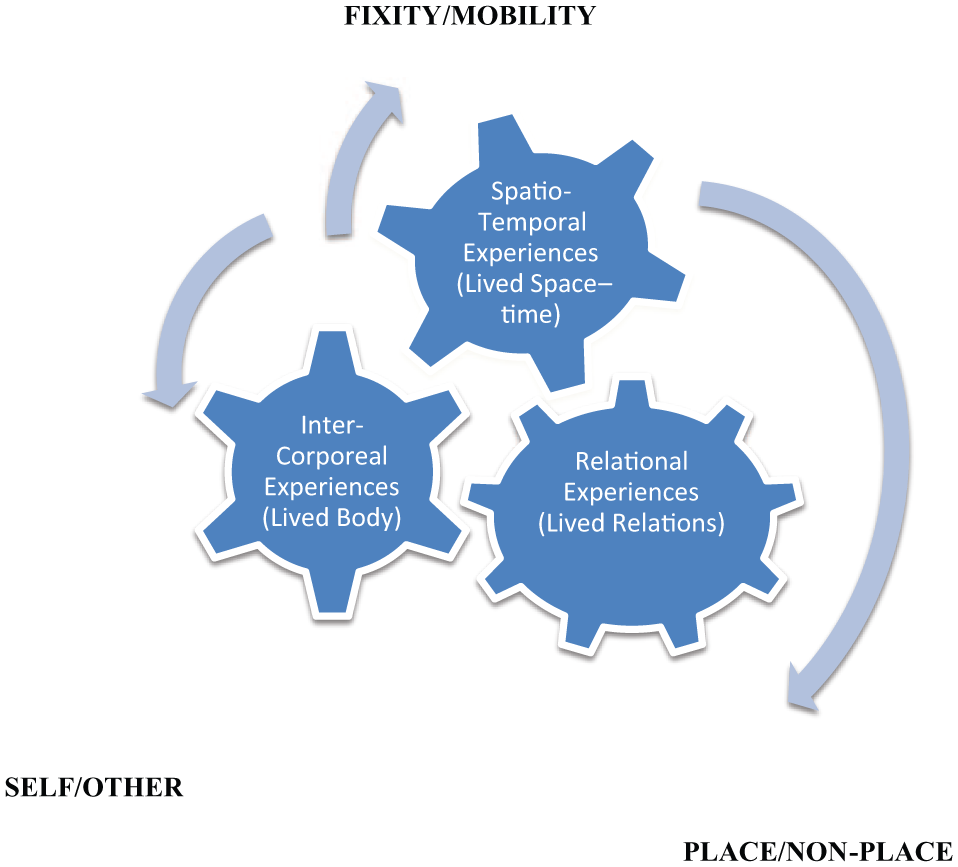
Liminality and the lived dynamics of translocality.
To begin with, our experiences of liminality are characterized by uncertainty, instability, dynamism, and chaos involving deep, subtle, uncontrolled, “irreversible” feelings of loss and separation from “home”: “Expecting that I will not be coming back for one year was difficult to take on” (Diary Entry 2); “I am learning to leave you behind only to find you again” (Diary Entry 3). Yet,
home is not an object, a building, but a diffuse and complex condition that integrates memories and images, desires and fears, the past and the present . . . It engages us with issues of identity and memory, consciousness and the unconscious . . . (Pallasmaa, 1992, p. x)
We are bodies-in-place and, due to our physical form, our world is relational, conceived in terms of here/there, near/far, fixed/mobile: “You will not be there and because of this, I will become another me” (Diary Entry 3); “It was a transfer away from Canada” (Diary Entry 1). It is through engagement with a place that our own being is experienced. We inhabit place “as incorporating a lived engagement and process whereby human beings afford and are afforded by the world of places in which they find themselves” (Malpas, 2009, p. 23).
We are rethinking our senses through corporeal encounters (window, suitcase, corridor, door, glass, stones, rotten apples, airplane, ticket); yet sensing is also a condition of both cognition and emotion (Coverley, 2006; Serres, 1994). Hence, through the entanglement of content and form, our texts become bodies-on-the-move. As a result, translocality becomes an embodied narrative where sensory experience, affect, and cognition merge constantly—“every story is a travel story—a spatial practice” (de Certeau, 1984, p. 42), which, according to Debord (1958), lies in the intersection between human affective experience of place and the materiality of the environment within which encounters happen (Coverley, 2006; Sinclair, 2006).
Yet, stories remain
fragments: splinters of light that illuminate our journey while simultaneously casting questioning shadows along the path . . . The belief in the transparency of truth and the power of origins to define the finality of our passage is dispersed by this perpetual movement of transmutation and transformation. (Chambers, 1994, pp. 3-4)
We quote from the texts: “The truth is that the more the time is passing by the more I feel in Belgrade like a stranger . . . thinking about where my home is. Where do I belong?” (Diary Entry 2). Transformation is an iterative process of emplacement/displacement, fixity/mobility: “Soon, I will be at some place else, someone else” (Diary Entry 3).
Critically, the process of transformation requires “letting go” and signals a journey that is open and incomplete, that requires continual fabulation, a construction, in which there is no fixed identity or final destination (Chambers, 1994). In studies of migrancy, cultural hybridity, and multi-positional identities (Benmayor & Skotes, 1994; Chambers, 1994; Ritivoi, 2002), we are encouraged to embrace “the difficult moment of letting go as old certainties are abandoned for the uncertain outcome of continual encounters in which all worlds and chronologies become unstable, subject to question and reformulating” (Chambers, 1994, p. 28). In transformation, we are engaging with several, fragmented spatio-temporal “I/you” (self/other): “You only know some fragments, and the fragments that are missing are the ones that I constantly re-arrange” (Diary Entry 3). That is, the de/construction of the “I” is largely relational: “I am learning to leave you behind,” “not to you, to me,” “I will be someone else. You will not be there.” Deploying both the “I” (self) and the “you” (other) in the texts, we are moving from place to place and are transforming our “time and place within a culture, a language, an institution, a tradition, a set of histories,” we are rethinking “the purpose, direction and limits of these very categories” (Chambers, 1994, p. 28).
Also space–time references in the texts, such as “returning to London to work in the late 1980s” (Diary Entry 1) or “in a week’s time I will be leaving again . . . and the time we spend together” (Diary Entry 3), show the spatio-temporal dimensions of translocal transformation. Liminality is thus embodied through movement from one relationally defined identity space to the other, one that defies closure: “I would not feel at home anywhere” (Diary Entry 2), “regularly reminded that I am ‘other’” (Diary Entry 1), and “leaving the movie before ‘THE END’ appears” (Diary Entry 3). Following this, temporary individuations are “constructions in relation to both the spatial and the experiential place of ‘home’, in reaction to both the exilic and idyllic spaces of being; it is as much an existential as it is a social act” (Christou, 2006, p. 1048). Furthermore, the contested nature of homecomings (being at home/non-home) is discursively constructed also in relation to our bodily existence: “I open my eyes and look outside the window; in a week everything will be different, everything will smell differently, I will be someone else” (Diary Entry 3).
The “other” locale, the lack of home, becomes a non-place because no (prior) local individual identities interact with it, only the non-identities of “someone else” that exist for a sole function, to be the “foreigner,” to be the “other.” “I remember what it felt like to not understand jokes, cultural references made by fellow students and friends” (Diary Entry 1). Yet, repeated experiences of localization and emplacement lead to a re/constructed liminal identity space that converses with the other, embodying the “in-between,” an identity that transcends the dichotomy of place/non-place (home/non-home): “I will be someone else. You will not be there and because of this, I will become another me” (Diary Entry 3).
Nevertheless, this liminal, in-between space is not a cohesive one. Instead, it is a polycentric site of contestation, competing powers and challenging differences. “The non-synchronous temporality of global and national cultures opens up a cultural space—a third space—where the negotiation of incommensurable differences creates a tension peculiar to borderline existences” (Bhabha, 1994, p. 218; see also Soja, 1996). Citing from our diary entries,
Coming from a very dynamic, “loud,” and chaotic environment where uncertainty and instability in all spheres of life had been the only constant for a long time, to something that I had experienced as the opposite place in the world, was a kind of a shock in itself. (Diary Entry 2)
In a different diary entry, the narrator reflects on these emotions of dislocation and transition:
I was English and not English. I was torn. Divided in two . . . I remembered London from 10 years earlier. Grainy and grimy. I wanted to belong, but didn’t quite. Not yet. People asked often “Where in America are you from?” Not American. Canadian. (Diary Entry 1)
Indeed,
. . . narratives about people’s places in places continuously materialize the entity we call place. In its materializations, however, there are conflicts, silences, exclusions. Tales are told and their meanings wobble and shift over time. Multiple claims are made. Some stories are deemed heretical. The resulting dislocations, discontinuities, and disjunctures work to continually destabilize that which appears to be stable: a unitary, univocal place. (Price, 2004, p. 4)
Crucially, negotiation of power positions and micro-politics involved in the transitions we describe, highlight issues of resistance to cultural assimilation and the tensions and conflicts involved in the process of becoming other. Ong (1999) in her analysis of the cultural logics of transnationality showed the “embeddedness in differently configured regimes of power” (Ong, 1999, p. 4): So strategies of flexible citizenship and translocal agency are understood as local and translocal through between and across multiple levels of analysis or dimensions. From the diary entries: “. . . re-placing myself here and there, with you, without you, I feel like leaving . . . always leaving so not to watch how the story ends. Sometimes fast, sometimes slow, time changes changing me, changing everything” (Diary Entry 3). Identity is a temporary construct, ambivalent and re-invented, translated and fractured, embodied through dislocations and discontinuities in-between space–time.
Clearly, liminality conditions encapsulate separations of place/non-place and time, moving away from and returning to.
“Are you going home? The truth is that the more the time is passing by the more I feel in Belgrade like a stranger—or rather strange . . . As a visitor . . . home? . . . I would not feel at home anywhere. (Diary Entry 2)
As the liminality spaces evolve, home and non-home become blurred, and place and non-place acquire dream like qualities: “like a dream, an interruption. It never happened: I never left and I never came back” (Diary Entry 3). Choosing an identity does not seem to be relevant in this context but instead the process of displacements and emplacements remains perpetual and incomplete: “Does one feel rather more like a Canadian inside a Brit inside a Canadian and so on ad infinitum? Maybe a true ‘trans-Atlantic’ with a ‘Matryoshka’ of identities? ‘I remember’” (Diary Entry 1). We are neither completely one nor the other, nor are we both. Liminality is a space that makes itself permanent, like Purgatory but unlike Purgatory, it has a distinct attraction, at least for some time (Czarniawska & Mazza, 2003; Rottenburg, 2000):
It can offer a sense of freedom, a possibility of creation, a special sense of community with the others in the limbo that has little to do with identity—rather a shared sense of alterity, as it were. When aporia prevails, the exits are open and so, peculiarly for our time and place, also the entrances. One can leave for good—but also come back. (Czarniawska & Mazza, 2003, p. 273)
We have actively employed these exits and entrances to shape our conceptualization of a constantly mobile subject: “Continuity and stillness only exist because of movement” (Diary Entry 3). By crossing boundaries, we challenge fixed, dualist positions (either self/other, either place or non-place, either fixed or mobile) and embrace continuous becoming:
In this state of becoming the individual that desired (to undergo this process) is already gone and the one who would welcome it is not yet there. Such is the paradox of nomadic subjectivity at the height of its process of becoming other-than-itself, suspended between the no longer and the not yet . . . It marks a qualitative transformation, the non-place where the “no longer” and the “not yet” reverse into each other, unfolding out and enfolding-in their respective “outsides.” (Braidotti, 2006, p. 157)
Accordingly, movement is a continuous process of displacement/emplacement, one that creates temporary experiences of in-betweeness, a feeling of simultaneous departure and arrival, a lived experience that enacts constant transformation. Reflecting upon three personal texts, we discussed experiences of liminality and translocality, focusing on the lived space–time (spatio-temporal), lived relations (relational), and lived body (inter-corporeal). The analysis of these texts led to the emergence of three conceptual domains, namely, place/non-place, self/other, and fixity/mobility, which have brought the study of identity, liminality, and translocality together (Table 2). These theoretical fields are further discussed in relation to the three domains in the following section, which also outlines the main contributions of our work.
Translocality as Lived Experience: Emerging Themes.

Discussion
Following the analysis in the previous section, liminality and translocality are lived events that transform personal (and professional) boundaries and social relations, imminently (re-)writing identities across space–time. In a context of intensified and intersecting mobilities, our translocal perspective on identity de/construction, first, proposes a post-dichotomous conception of place and non-place, self and other, stability and mobility; second, studying liminal identities as socially and spatially embedded, it stresses the ambiguities and multiplicities characterizing flows, unfoldings, and movements; and third, it suggests that translocal socio-spatial scales go beyond bounded entities and are “constructed on a far larger scale than what we happen to define for that moment as place” (Massey, 1991, p. 28). In detail, the article contributes to the study of identity, liminality, and translocality as follows.
In terms of identity studies and the concepts of “self” and “other,” the article builds upon prior work on multiple, fluid and liminal identities (Beech, 2011; Coupland & Brown, 2004; Daskalaki, 2012; Ibarra, 2005), and suggests that one is never fully emplaced (place/non-place), one is not fully fixed (fixity/mobility), one is not just “I” but also “an-other” (self/other): Identities-on-the-move are ambiguous and contested becomings. Thus, as our first contribution, we propose that in-between identities are temporary crystallizations of translocal bodily experiences, constantly disrupted by differentially embodying displacements and emplacements, when writing and re-writing differently the self (and others) across space–time. Accordingly, we enrich identity research proposing the study of the inter-corporeal and inter-spatial dimensions of becoming, which unveils distinctive patterns of identity transformation.
These patterns, as already suggested, evolve when one engages with temporary, ambivalent, and fractured translocal experiences of becoming; they are not cohesive but sites of contestation, difference and ambiguity, co-constituting repeated nomadic experiences where the self remains in a state of anticipation, envisaging what is “Not-Yet-Become” (Bloch, 1986). To grasp the present self, one ought to understand its emergences from the past but also the open possibilities residing in an anticipated future. Identity de/construction does not only involve transitions from one cohesive and conscious position to another; but sometimes also embroils elusive transformations, movements in time–space that occur through the folding and the unfolding of things unknown but imagined. 4 Thus, the unknown, the “Not-Yet-Conscious” (Bloch, 1986) that partakes in the process of identity de/construction, designates a capacity and desire for future becomings, a source of creativity and imagination.
In terms of liminality studies, we provide a phenomenological perspective of permanent or “institutionalized liminality” (Johnsen & Sorensen, 2014; Turner, 1969) and suggest that such framing of liminality reveals three interrelated domains, namely, place/non-place, self/other, and fixity/mobility, which together co-constitute the liminal experience. Accordingly, as our second contribution, we propose that liminality is not a condition that the subject strives to eliminate so to find herself in relative fixity and permanence, in one place, not in limbo. States of liminality, rather, designate a disorderly movement (a transformation) during which no single moment of observation can capture identity in stasis. Thus, liminality signifies a complex, unbounded arrangement of inter-spatial and inter-corporeal relations that together co-construct a sense of self that constantly invokes identities yet to come. Contributing to the debate on liminals as boundary dwellers (Ward, 1993), we further suggest that boundaries are not physical, symbolic, or imaginary lines but lived conditions where the “inside/outside” is constantly negotiated, emergent, and blurred. As a result, liminal spaces are never linear and uncontested but polycentric, multi-dimensional and ambiguous sites of un/becoming.
In terms of translocality studies, we stressed that our translocality approach highlights conditions of inter-spatial liminality, a lived experience that signifies the intersection between human affective experience of place and the materiality of the environment within which encounters occur. Translocality, constituted by embodied narratives, describes a movement during which experiences of emplacement/displacement are discursively constructed. The negotiation of power positions involved in these movements highlight the transformation and the tensions involved in the process of becoming. Accordingly, as our third and final contribution, we support that “writing the self” in relation to translocality re-frames the latter as a multifaceted phenomenon, an everyday practice where normative behaviors and routinized actions are engaged with critically. Translocality is an inter-corporeal performance according to which individuals and collectives challenge both material and immaterial boundaries. This performance, that includes transgressions and inversions, collapses binaries and captures the increasingly complicated nature of spatial processes and agencies. The translocal, therefore, is situated across a variety of scales and the study of translocality ought to “map out how other spaces and places can become significant during the process of migration and movement” (Brickell & Datta, 2011, p. 10, emphasis added).
Consequently, the article explored these “other” spaces and places, by describing translocality as a multi-scalar, embodied, and embedded practice. It examined particular inter-spatial contexts where a dynamic theory of embodiment and subjectivity can be realized through a reflexive transformation of identities in a given space–time. As a result, this study captures individual’s “ability not just to experience the social relations that are located in the place in which he or she is corporeally standing, but also . . . to experience social relations that are located in places elsewhere” (Gielis, 2009, p. 275; emphasis added). Hence, we described one’s lived realities but also possible, future, imagined lives, embodied as a social practice that connects one with other places and other selves.
Conclusion
Reflecting upon stories on the move, we stressed the value of auto-ethnographic research in studying the spatio-temporal, relational, and inter-corporeal dimensions of translocality and liminality. The phenomenological reading of three autobiographical texts offered the opportunity to study identity processes, as these become differentially embedded and embodied across space and time, and identify three interacting conceptual domains (place/non-place, self/other, and fixity/mobility) that co-constitute the lived experience of being in-between. These three domains, we proposed, re-frame identity processes in a more open and less linear way capturing the diverse and contradictory effects of being in-between. Thus, the article emphasized that liminality and translocality are spatio-temporal, relational, and inter-corporeal experiences that emplace/displace the self through multi-dimensional, polycentric, ambivalent, and contested practices. We hope that such re-framing can inform different theoretical sub-domains, which can expand our research in other fields of research.
In particular, we highlighted the inherent ambivalence of the described translocal positions and the embodied dis/placements and movements as well as embodied agencies involved. This analysis challenged the traditional dichotomies of place versus non-place (or home vs. non-home), self versus other, and fixity versus mobility and re-framed them as liminal experiences of the lived space–time, lived relations, and lived body. As far as studies on careers are concerned, for example, a translocal framing of precarity could focus on the effects of frequent boundary-crossings (such as cultural, national, organizational) and examine how post-dichotomous thinking can contribute to an alternative analysis of precarious work contexts in global labor markets.
In addition, in our common re-discovery of (non) place/home, we identified different patterns of how the processes unfolded and the narratives developed: The three texts show variant translocality experiences. It is important therefore to note that the liminal dimensions of translocal experience create spaces that could be differentially enacted. For example, one may resist the different, only to absorb and gradually expand it, a unique process of re-constructing oneself in relation with the other. The inhabitation of temporary crystallized positions during this process, we propose, can open possibilities for more transformative forms of organizing. We invite, therefore, studies on entrepreneurship and particularly institutional approaches, to focus on these temporarily and differentially inhabited, mobile and precarious sites of organizing and systematically examine their role in institutional entrepreneurship and transformation.
For example, future work in this area could focus upon multiple engagements between mobile and more stable workplaces and explore the interactive effects of such collaborations particularly with regard to the role of “unexpected encounters” in promoting institutional transformation. Mobility may be “responsible for temporarily constituting a new territory that has unexpected qualities” and can “enact multiplicitous encounters,” inviting “dis-continual epistemology of embodied de-territorializing and re-territorializing” (Daskalaki, 2014, p. 225). Thus, we encourage research on how temporary forms of organizing enhance (or hinder) creative engagements and how by creating liminal spaces, organizations can encourage creative collaborations with transformative potentialities.
Finally, through our focus on the concept of im/mobility and non/place as liminal conditions, we take a distance from the glorified images of the vagabond and the surfer who constitutes a privileged cosmopolitan elite. Liminality is a temporary death, a journey into nothingness—undoing, dissolution, and decomposition (Turner, 1964). Yet, at the same time, it is accompanied by moments of growth and transformation, the re-constitution of difference. Embracing both death and re-birth is essential for the exploration of liminality as a boundary-spanning process. Liminals, as boundary dwellers, live in-between structures, challenge the social order, and participate in the creation of polyvocal, alternative spaces of organizing where new directions and innovative practices can be explored. Therefore, future work in the field of organization studies can focus on alternative forms of organizing that involve self-organized communities, co-working spaces and workers’ co-operatives, that is, alternative work environments where the creative potentialities of living in the limen could be tested. For example, translocality can challenge established organizational forms in favor of more open, fluid, and inclusive modes that creatively embrace the spatio-temporal, relational, and corporeal dimensions of organizing.
To conclude, illustrating the value of autobiographical-phenomenological approaches, we reflected upon the contexts that we are (becoming) part of and the non/places we inhabit and offered an analysis of recurrent experiences of liminality. Through the study of the iterative identity processes, we studied translocality and liminality as polycentric, multi-dimensional and ambiguous reconciliations of differences, inter-spatial and inter-corporeal states of becoming. We hope that with an auto-ethnographic approach that stresses the phenomenological dimensions of being both emplaced and on the move, we have contributed to a critical and comprehensive understanding of identity, liminality, and translocality.
Footnotes
Acknowledgements
The authors would like to thank the editor and the anonymous reviewers for their encouragement and insightful comments throughout the reviewing process.
Declaration of Conflicting Interests
The author(s) declared no potential conflicts of interest with respect to the research, authorship, and/or publication of this article.
Funding
The author(s) received no financial support for the research, authorship, and/or publication of this article.