



Abstract
Organizational restructures have been occurring for decades but are often rife with problems. Although researchers have studied these restructures, many studies focus on financial, strategic, and integration aspects and are limited in addressing the human side of restructuring. In addition, there is little study of internal restructures involving the movement of divisions within one organization. In our inductive case study, we examine how organizational members’ identification perceptions evolve and impact an internal restructure at a large university. We present our emergent findings in a process model that illustrates how identification perceptions evolved, as well as triggers that impacted identifying and de-identifying processes. These triggers, which helped move members simultaneously from a state of identification with the former entity (pre-restructure) to both de-identification with the former entity and identification with the new one (post-restructure), included experiences and expectations involving resources, justice, and organization oneness.
Keywords
“It was a rocky road . . . getting this all to happen.”
Organizational restructures are messy and often yield negative outcomes (Cartwright & Schoenberg, 2006; Dauber, 2011; Stahl et al., 2013), thereby weakening organizations while creating advantages for competitors (Bastien, Hostager, & Miles, 1996). One doesn’t have to look far to find examples of restructure missteps, such as the 2008 Sears restructure into more than 30 distinct units, each with its own president and board of directors (Kimes, 2013). This structural change sparked colossal battles and competition among units and contributed to abysmal stock earnings for the company. Similarly, analysts and, subsequently, Procter & Gamble (P&G) leaders pointed to the handling of P&G’s Organization 2005 initiative to move the organization from a geographic to a product structure as a major factor in the company’s negative performance following the reorganization (Tucker, 2000). Sears and P&G are but two of many instances of perceived restructuring failures, yet restructures continue.
In an effort to alleviate future negative results involving restructures, academics and practitioners have conducted numerous studies involving “nuts and bolts” aspects of restructures, such as finances and facilities, but less is known about the human experiences. Some scholars have focused on how human aspects affect restructure outcomes; however, exactly how these aspects impact the various stages of a restructure and its outcomes is still being discovered (Amiot, Terry, & Callan, 2007; Giessner, 2011; Nahavandi & Malekzadeh, 1988; Schmidt, 2002; Schweiger, 2005; Stahl et al., 2013). We focus here on the human behavior processes at work during an internal restructure through an inductive look at employees’ shifting identification perceptions. Specifically, we interviewed academic unit employees who were restructured from one college (division) to another within the same university (organization) and asked questions focusing on employee perceptions regarding both the old and new divisions. We focused on perceptions because they are important drivers of employee behaviors that can support or impede restructure efforts, and one type of perception that emerged as very important was identification, or the perception of “oneness” with an entity (Ashforth & Mael, 1989). Thus, through our grounded theory methodology, we contribute to the intersection of two established research streams: restructures and identification. Our primary purpose in undertaking this research was to address the need for greater understanding of the human side of restructures. Our results reveal relevant and understudied aspects of restructured unit employees’ shifting identification between their old and new divisions. The following pages illustrate in detail our contributions to these research areas.
Early in the study, our inductive approach revealed an intriguing process of identification shifts taking place at the individual level; therefore, our findings focus on these shifts. Triggers associated with these identification shifts led employees affected by the restructure to actually desire the change. These triggers, including expectations of increased resources, fair treatment, and identification with the new division, as well as experiences of reduced resources, injustice, and a lack of identification with the old division, advanced the identification process of “unhooking” from the old division and “rehooking” to the new division. Although earlier work has revealed antecedents of identification with the new division or entity, for example, prestige of the entity (Mael & Ashforth, 1992) and need for identification (Glynn, 1998), we will show how the triggers we found enable not only identification with the new division but also more rapid de-identification with the old division.
Fostering employee shifts in identification from the old to the new division is important, because highly identified employees are often associated with positive outcomes such as reduced employee turnover (Mael & Ashforth, 1995) and increased organizational citizenship behaviors (Dukerich, Golden, & Shortell, 2002).
Our research provides a window into the mechanisms driving shifts in individuals’ identification in restructured units, providing potentially significant decision-making information for organizational leaders contemplating internal restructure events. We encapsulate our findings and contributions in the form of a process model unpacking the shifts in identification and the triggers that emerged to advance these shifts.
Restructures, Identification, and Justice
Scholars have begun to explore individual perceptions, such as identification and justice perceptions that organization members hold during structural changes in organizations. For instance, a few researchers (e.g., Bartels, Douwes, De Jong, & Pruyn, 2006; Boen, Vanbeselaere, Brebels, Huybens, & Millet, 2007; Giessner, Ullrich, & van Dick, 2011; Gleibs, Mummendey, & Noack, 2008; Lok & Willmott, 2014) have examined employee identification shifts in mergers between or within organizations. Identification has been defined as “the perception of oneness or belongingness to some human aggregate” (Ashforth & Mael, 1989, p. 21). Often identification is characterized by feelings of “fit” with the members of an entity, such as a team or organization, and various types of identification have been identified. For example, Kreiner and Ashforth (2004) propose four types of identification: identification, or perceived oneness with an entity; disidentification, or feeling no sense of oneness with the entity and in fact defining the entity and its values as what one is not (Elsbach & Bhattacharya, 2001; Kreiner & Ashforth, 2004); ambivalent identification, or feeling both identification and disidentification with the entity simultaneously; and neutral identification, or having no particular feeling of attachment to the entity one way or the other.
As an additional type, anticipatory identification is defined as an expectation of future identification that an individual holds, although that person has not yet identified with the focal entity (Ashforth, 2001; Bartels et al., 2006). Researchers examining anticipatory identification in a merger found at least partial evidence that factors such as pre-merger identification, expected future identification, and group standing can have an impact on formation of post-merger identification (Amiot et al., 2007; Bartels et al., 2006; Giessner, 2011; Gleibs et al., 2008). However, the ways in which anticipatory identification perceptions are formed and their impact on restructures, particularly when the restructure is internal, are yet to be explored. During a restructure, it is reasonable to question what type(s) of identification organization members might feel toward the entities involved and whether and how shifts in identification will occur.
Researchers have also explored variables impacting organizational members’ identification post-merger. In a quasi-experimental case study, Bartels et al. (2006) find mixed results for the relationship between pre- and post-merger identification. Van Knippenberg, van Knippenberg, Monden, and de Lima (2002) provide evidence that perceived continuity in one’s individual identity during a merger has an impact on identification with the merged organization. These studies point out that mergers, a form of restructure event, lead individuals to redefine and reassess their relationships with the organization. In sum, shifting identification plays a significant role in restructure events such as mergers, but how these processes unfold in other forms of restructures and, in particular, internal restructures is not altogether clear. For example, one might expect less ambiguity and more continuity in a restructure where one remains in the same organization, albeit in a different division, versus moving to a new organization entirely; however, the example of Sears given earlier would suggest that is not always the case.
Our inductive study also revealed that organizational justice perceptions are particularly salient during restructures; that is, individuals are concerned with whether they are treated fairly (Ellis, Reus, & Lamont, 2009; Melkonian, Monin, & Noorderhaven, 2011). Researchers generally define organizational justice in four dimensions (Colquitt, 2001): distributive (fairness of outcomes), procedural (fairness of the process), informational (fairness of communication), and interpersonal (fairness of treatment). A significant body of recent research has examined the impact of justice perceptions on organizational restructures, addressing scenarios such as mergers and acquisitions (Ellis et al., 2009; Klendauer & Deller, 2009; Lipponen, Olkkonen, & Moilanen, 2004; Melkonian et al., 2011; Meyer, 2001; Seo, 2005), strategic alliances (Ariño & Ring, 2010; Lou, 2007), and downsizing events (Skarlicki, Ellard, & Kellin, 1998). The bulk of these studies suggest that justice perceptions do impact outcomes of restructures (Melkonian et al., 2011), but they fail to fully characterize justice expectations and potential justice shifts throughout the entire restructure process and do not take into account the effects of these shifting perceptions on restructure outcomes.
The studies above provide evidence that identification and justice perceptions affect some types of restructure events; however, there are still a number of unanswered questions and some equivocal results, suggesting a need for additional research. Also, questions remain about internal organization restructures and the way particular perceptions might apply. To address these issues, we undertook an inductive study, guided by the broad research question, “In an internal restructure, how do organization members’ perceptions of the restructuring entities evolve and impact the restructure?”
Research Design
The case study method was chosen given the conflicting findings in restructure research (Eisenhardt, 1989), as well as the need to answer the research question of how perceptions unfolded (Yin, 2009). For multiple reasons, we chose to inductively study the move of an academic department (economics) from the College of Arts and Sciences (CAS) to the College of Business (COB) at a large public university located in the Midwest. First, the move had stirred controversy within the university, and we believed this would make individuals’ perceptions more salient and allow us to gather diverse views on the event. Second, we had access to individuals in all of the units involved in the move. As we learned, interesting and sometimes contrasting perceptions emerged that made the case well suited for studying shifting perceptions.
Data Collection and Analysis
Data were collected from two primary sources. First, the first author conducted 12 one-hour interviews, initially using the purposive sampling techniques of Lincoln and Guba (1985). Also, participants were asked for referrals at the end of each interview, using a chain referral technique (Biernacki & Waldorf, 1981). Although all faculty participants were tenure-track or tenured employees of the university, the pool of participants was diverse and also represented key stakeholder groups such as students and administrators. Participants included 54% of economics department members involved in the restructure (see Table 1). All interviews were professionally transcribed, and transcripts were entered into NVivo 10, a software package created to catalog and analyze qualitative data.
Sources of Case Study Data.
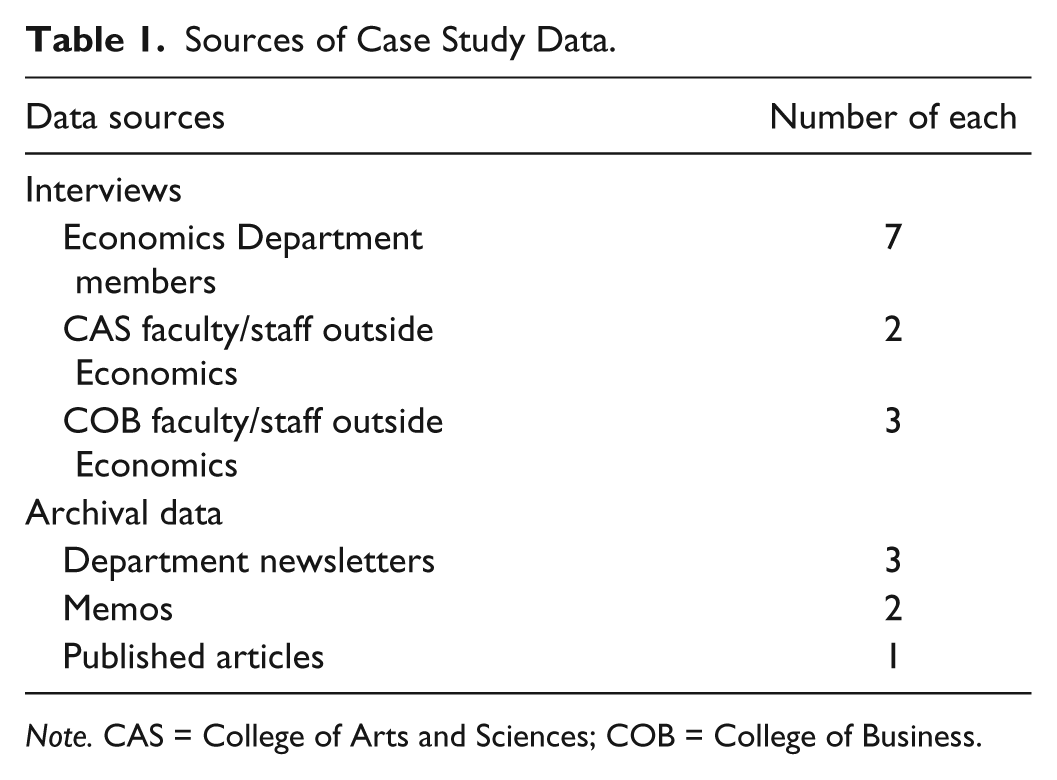
Note. CAS = College of Arts and Sciences; COB = College of Business.
According to Yin (2009), a guiding principle of case study methodology is the inclusion of at least two data sources as a way of triangulating the data. True data triangulation, as incorporated in this study, exists only when multiple sources are used to corroborate the same phenomenon, providing higher assurance that findings are representative. Therefore, a second data source was incorporated in the form of archival records addressing the economics move, such as newsletter articles and university memos (see Table 1), as a way of corroborating what was revealed in the interview data.
Throughout our data collection and analysis, we relied on an “orienting theoretical framework” to inform our understanding of the complex restructure phenomena we were studying. In grounded theory, an orienting theoretical framework “guides researchers in what they should pay attention to but does not focus research so narrowly as to exclude data whose importance may not be recognized at the outset of a project” (Locke, 2002, p. 20). Therefore, although we were sensitive to theory in areas such as identification and justice, we also remained open to what our respondents were telling us, and we iteratively adjusted our interpretations as we coded and analyzed our data.
Once transcribed, each interview was coded independently by the first and second authors. Initially, open coding was employed, in which the coders identified in vivo codes (terms or phrases used by respondents) as well as other codes that described phenomena we saw in the data (Strauss & Corbin, 1998). The two coders then compared codes and resolved any coding discrepancies. These first-order codes or concepts are sometimes described as the “facts” of the case analysis (Van Maanen, 1979). Throughout the open coding process, emergent codes were recorded in the data dictionary, which was updated during each coding session based on constant comparison of existing codes to additional data from subsequent interviews, all of which was done in an effort to identify emergent theory (Glaser & Strauss, 1967) grounded in the data. In addition, we iterated between the data and the relevant literature to look for possible connections and inform theory development. Our coding process continued until we reached theoretical saturation, the point at which no new first-order codes were emerging in our analysis and existing codes were sufficiently developed (Glaser & Strauss, 1967). This occurred with the 10th transcript; however, we conducted and coded two more interviews to gather additional examples for analysis.
Then, axial coding was used to identify groupings of second-order higher concepts, or “themes” that emerged from the first-order concepts. Second-order themes that emerged in our study, as well as illustrative quotes, are provided in Table 2. Second-order themes can be viewed as the “theories” of the case analysis (Van Maanen, 1979). As Strauss and Corbin (1998) explain, axial coding is a way of piecing back together the data, which was fragmented during open coding. Through axial coding, relationships between first-order categories are identified and larger phenomena are exposed. Therefore, our axial coding served to bring fragmented subcategories together into larger, more theoretical concepts, resulting in an overall data structure (see Figure 1). It is important to note that, in forming these first-order concepts and second-order themes, we again employed the constant comparison method of Glaser and Strauss (1967) to ensure that codes were updated and adjusted as new data were analyzed.
Development of Second-Order Themes.

Note. CAS = College of Arts and Sciences; COB = College of Business.
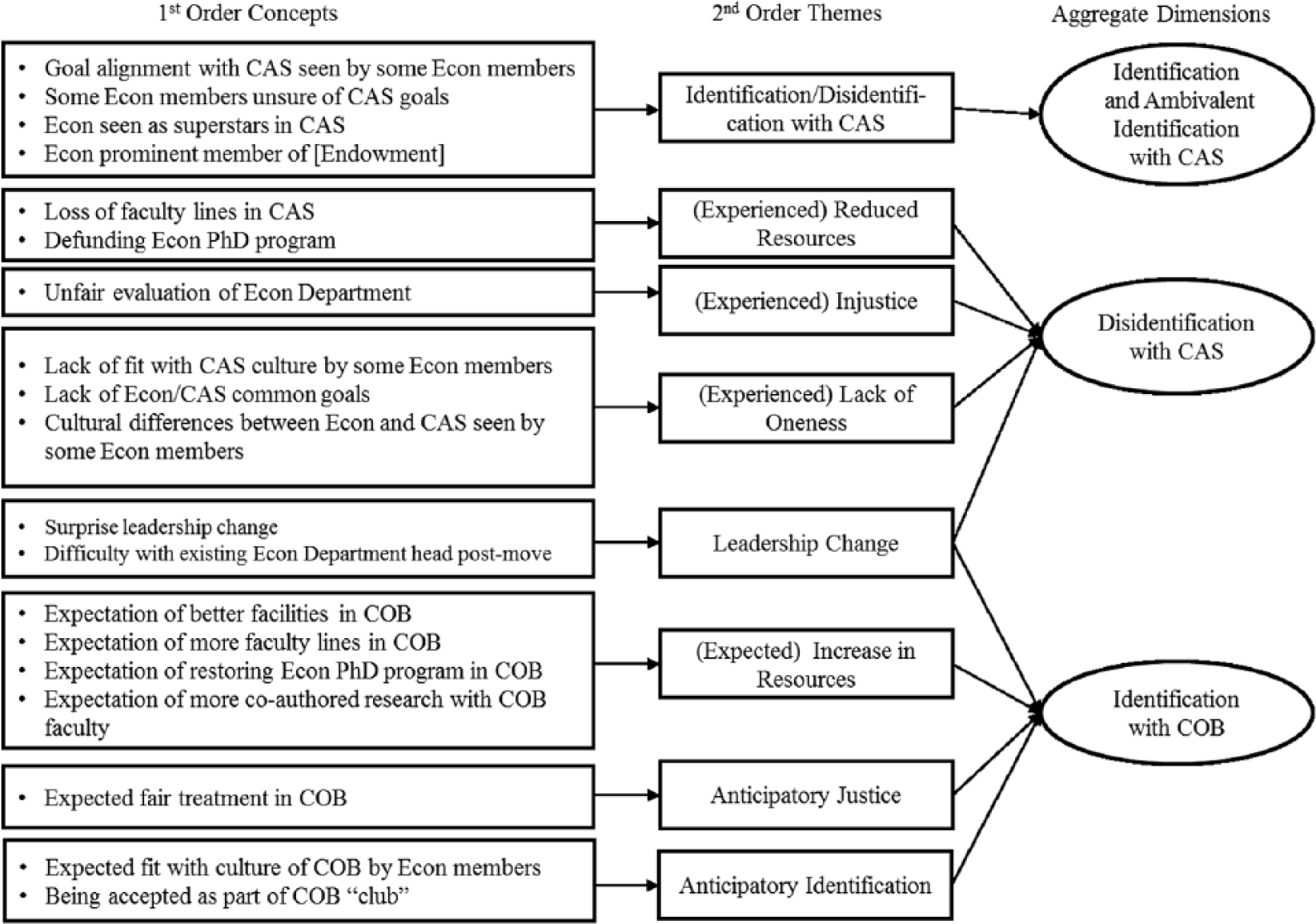
Data structure.
Another important step in the analysis process was the continual construction of memos to capture emergent ideas and themes (Strauss & Corbin, 1998). Memo creation involved the coders drafting short paragraphs to describe interesting relationships that we found in the data, as well as ideas and connections to the literature that we were reading concurrently. These memos were instrumental in capturing ideas from our constant comparison process and in developing our emergent model of shifting perceptions, which we present in the Findings section below.
To illustrate the coding process of moving from first-order concepts to second-order themes, we will provide an example from our analysis. While talking with economics members, they consistently mentioned several key expectations they held pre-move for how resources (facilities, new hires, etc.) would be better in COB than in CAS.
Eventually to be given a space other than the 12th floor of (CAS Building), which was, yeah, it’s just not a nice space, you know, and just to be not on the fringe and to be valued. [EF2]
1
We thought there was a chance to get a PhD program back. [EM3] (CAS) salary was not competitive, and primarily because there was, I believe, again, this is our perception, the College wanted to maintain some equality salary-wise . . . in (COB), they have more resources. [EM4]
Data from sources outside the economics department reinforced this expectation of an improved situation for economics members.
Economics faculty believed their ability to recruit faculty and students would be enhanced if they were housed in (COB). [AD1] I think they felt underappreciated in (CAS), as if they had been picked on, singled out, so it’s in some ways not surprising that they might have been looking for greener pastures . . . I think economics saw an opportunity, saw the possibility of greener pastures both from the standpoint of potentially higher salaries in business for the faculty, but I think probably as important, better support, including the possibility that they would get their doctoral program back. [AM2]
A pattern of anticipated benefits was repeated over and over again in the data, and these benefits generally fell into one of two higher, or second-order, categories: expected increase in resources and expected future identification with COB (anticipatory identification). Expected increased resources included more faculty lines, better facilities in COB, a restored PhD program, and more co-authored research with COB faculty, whereas anticipatory identification with COB centered on feeling a better “fit” and being accepted as part of the COB “club.” Once the second-order themes were developed, we re-looped back to the raw data, ensuring that integrity and meanings had not been lost while fragmenting the data via open coding and then re-grouping the data via axial coding into pooled categories and themes.
In studying the second-order themes that emerged, some clear aggregate dimensions surfaced that explained what was happening in the data (Gioia, Thomas, Clark, & Chittipeddi, 1994). Specifically, the data converged on the theoretical dimensions of “identification and ambivalent identification with CAS,” “disidentification with CAS,” and “identification with COB.” From these dimensions and the underlying themes, we developed our emergent model of shifting identification during a restructure, which we will discuss in more detail below.
Findings
Analysis of both the interview and archival data revealed several interesting insights around shifting perceptions, mostly in regard to identification. In the following section, we build a case for two focal shifts that occurred over the course of the restructure. Specifically, evidence is provided to show key inputs in the process of moving from identification with CAS to both disidentification with CAS and simultaneous identification with COB. These key inputs functioned as triggers to the shifts in identification and can be characterized as fitting into two categories: inputs expected to benefit economics members after the restructure to COB and inputs actually experienced while the economics department remained a member of CAS. As a result of our analysis and findings, we propose a model to account for shifting identification during an internal restructure. Before providing an in-depth discussion of our research findings and proposed model, we first briefly review the economics department’s turbulent back-story to situate our findings in context.
Economics: A House Divided
By the time the economics department was preparing for the actual move to COB, its members were already a scarred and divided group. Twenty years earlier, the department had gone through what multiple study participants referred to as a “blow-up” [BM1, AF1]. The organization had formed two camps around traditional academic divides; one side wanted to focus resources on building a better research reputation, while the other side stressed the need to better respond to student demands. Eventually, several of the economics professors retired, and new faculty were hired. However, as one study participant noted, “When you get a culture like that going, it’s really hard to get it undone . . . ” [AF1]. This same participant described the economics culture as having “cliques or cabals” [AF1].
From early interviews, it became clear that not only the culture but also the identity of the economics department was fragmented (Meyerson & Martin, 1987). Some economics members had formed a “superstar” identity as recognized researchers within CAS, causing them to identify with CAS, while other members reported feeling little connection with CAS whatsoever. As an example, one economics member noted, “That’s the frustrating thing, being in (CAS). What’s so common sense to you, they (CAS) all look at you like you have an antenna and green skin. They’re looking for the spaceship” [EM6]. Conversely, another member, who voiced strong identification with CAS, noted, “We were all in the same ship (CAS), and maybe in different parts, but when that ship was successful . . . it was gratifying . . . ” [EM10]. The lack of consistency in members’ identification with CAS would become important later, as economics members began the process of shifting identification to COB.
Another important aspect of the economics department’s history is the suspension of its doctoral program by CAS leadership several years prior to the move to COB. The department still maintained a master’s program, but the loss of PhD students was a big blow to the group. Although some faculty were relieved to focus on their own teaching rather than on mentoring doctoral students, several members resented the decision of CAS leadership to cut the program. This explains the importance that several economics members placed on the potential for re-starting the program after a move to COB.
Figure 2 shows the timeline of key events that occurred immediately before, during, and after the restructure. Although the formal restructure of the organization occurred in late 2010, informal discussions among key leaders began in early 2009. Faculty were given opportunities to voice their opinions of the restructure, but the final decision was made by the higher administrations of CAS and COB. After the University Board approved the restructure, economics remained physically housed in CAS for a full year before moving to offices in COB. Another key milestone to note was the change in economics department leadership in mid-2012 in which a non-economics member of COB was named as department head for economics. Following this change, COB approved and allocated funds for the creation of the economics PhD program.
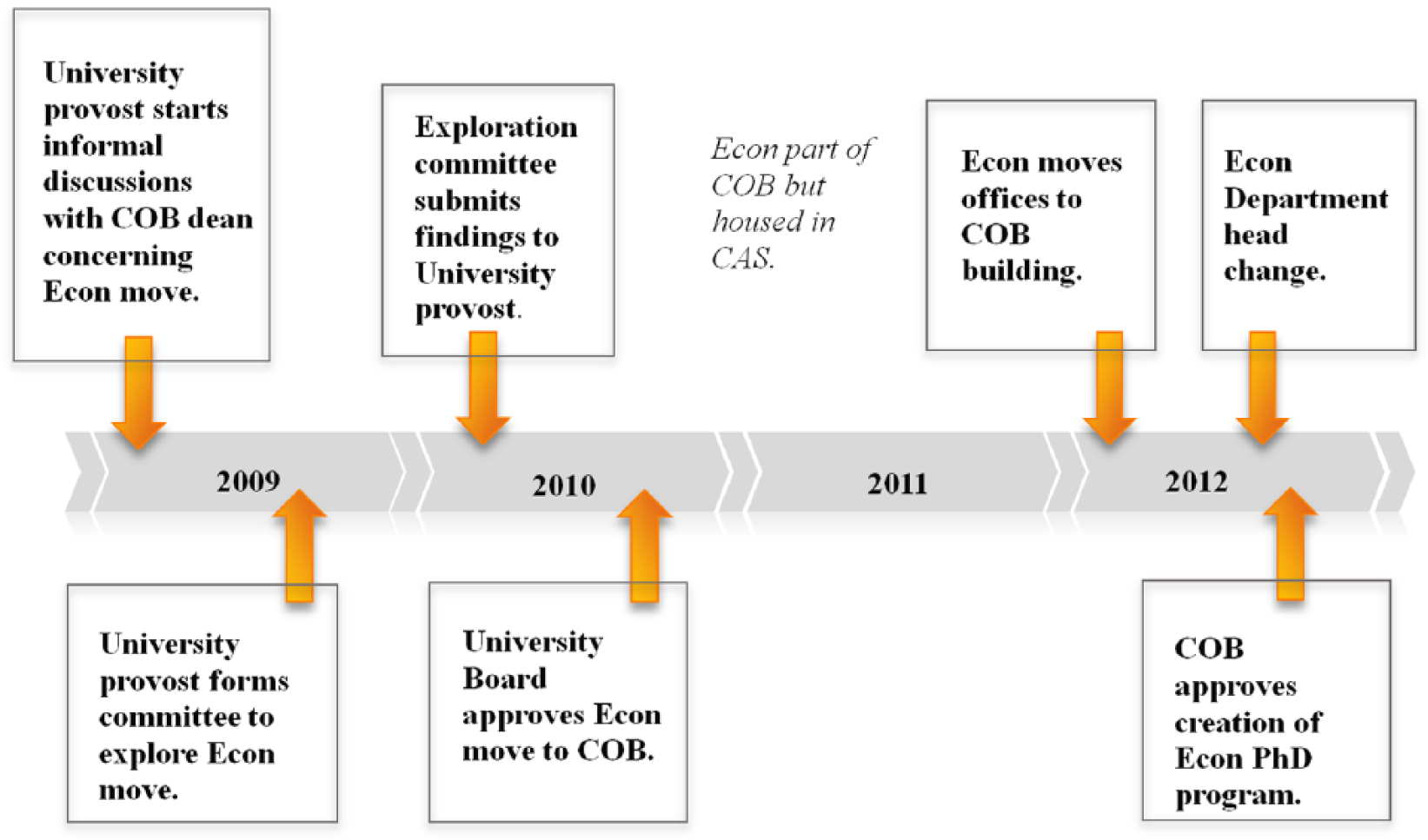
Timeline of economics department move.
A Process Model of Shifting Identification
With the knowledge of the economics department’s history and the findings of our research, we contribute to both the restructure and identification research streams by proposing a process model to explain the identification shifts that were taking place from the pre-move to the post-move phases of the restructure.
We use our model as a springboard to discuss the processes and changes that occurred to move individuals from one static state of identification to the next. Figure 3 shows two main shifts: (1) a shift from identification with CAS to disidentification with CAS and (2) a simultaneous shift to identification with COB. These shifts took place via either the de-identifying process or the identifying process. By de-identifying, we mean reducing one’s feelings of belonging and fit with an organization. By identifying, we mean increasing one’s feelings of belonging and fit with an organization. Several triggers emerged in the data that impacted these shifts. The following sections will address each shift and the associated triggers, as well as describe our study participants’ identification at the beginning and end of the process.
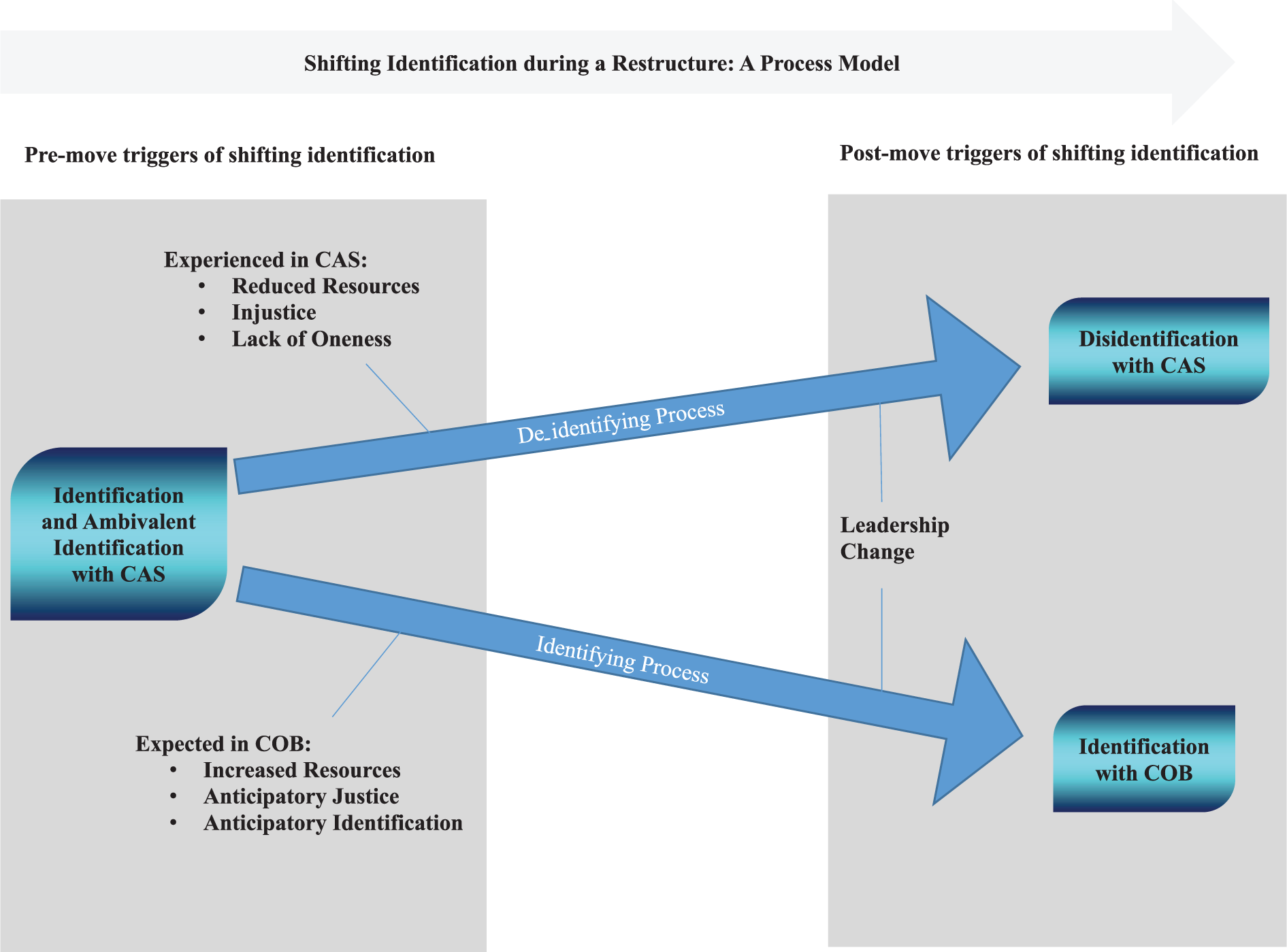
Shifting identification during a restructure: A process model.
Pre-Move Identification and Ambivalent Identification With CAS
The fragmentation in the economics department meant that while some members identified with CAS, others identified with CAS in one area and experienced disidentification, or a lack of shared attributes (Elsbach & Bhattacharya, 2001) with CAS, in another. As noted earlier, Kreiner and Ashforth (2004) refer to this as ambivalent identification (when members feel both identification and disidentification for an organization). Clear evidence of co-existing identification and disidentification emerged in our study participants’ comments, particularly those regarding the “endowment,” a very large monetary gift given for the benefit of several named CAS departments, including economics. A CAS committee controlled the distribution of these endowment resources, and economics relied heavily on the endowment to fund its department activities.
Study participant EM3 provides an example of ambivalent identification with CAS. Regarding the endowment and his perceptions toward CAS in general, he had this to say, which suggests identification:
We’re an (endowment) department, which is a fund in the University. It’s great—resources for travel, for students, for funding. It’s a fantastic resource. It’s not for every department in (CAS). Certain departments were named in the fund. [EM3] It (economics) is theory, more about the economy and the world in general. More foundational. In that sense, we fit in (CAS). [EM3]
However in the same interview, he clearly displayed feelings of disidentification with CAS:
The problem was that I was never sure what the goals of (CAS) were. [EM3] You talk to people in English (department) and they say they hate money. That’s their response when you tell them you are in business or econ. Sure you do. So, we (in economics) feel like the ugly stepchild in (CAS).” [EM3]
Thus, this participant expresses simultaneous identification and disidentification (or ambivalent identification) with CAS pre-move.
Shifting Identification Via the Process of De-Identifying With CAS
In his seminal work on role transitions and shifting identities in organizations, Ashforth (2001) speculates that when individuals are anticipating a large shift in roles or identities, they are likely to achieve this shift through a process called de-identification. In contrast to disidentification, which, as noted earlier, is a state of seeing attributes in oneself that are not shared or are, in fact, contradictory to the organization (Elsbach & Bhattacharya, 2001), de-identification is the opposite of identification (Ashforth, 2001) and “occurs when one no longer perceives an affinity” (Ashforth, 2001, p. 75) with a role or organization. A significant shift in identification is likely necessary when individuals perceive that there will be substantial cultural differences between their initial organization and their new organization (Dutton, Dukerich, & Harquail, 1994). Both economics and non-economics study participants voiced strong contrasts in the cultures of CAS and COB.
But I think that sort of . . . value doesn’t exist in (CAS). I think there’s too much diversity and decentralization for that. And so (CAS) lacks this collaboration emphasis, which I think is really important here (in COB). [BF2] In (CAS), here and lots of places, you know, usually the College of Arts & Sciences is the largest unit on the campus. [It] often has the diverse set of departments, okay? And those departments are usually larger than any of ours here (COB). And they’re more autonomous. [BM1] It’s (COB) very applied . . . and it worries about things like ROI, which (CAS) shouldn’t, actually. Because the return on investment for a liberally educated person comes 30 years down the road and also often happens in graduate school. It’s not trade school. It’s a very different approach to education. It’s foundational. [EF2]
Given this very different view of the cultures of CAS and COB, it is likely that economics members would perceive their impending move as requiring a significant shift to fit in with the new culture. In addition to CAS and COB being viewed as different cultures, they were also viewed as having different identities—what was central, distinctive, and enduring to CAS was not central, distinctive, and enduring to COB, and vice versa. Recall the earlier example in which some economics department members viewed their identity as “superstar” researchers and the identity of COB as being more applied. The large perceptual gap between unit identities—“who we were” (CAS identity) and “who we are becoming” (COB identity)—would likely require a de-identifying process leading from identification to disidentification with CAS.
Pre-Move Triggers of Shifting Identification Toward Disidentification With CAS
In analyzing the de-identification process, several topics emerged repeatedly as being particularly important. They were centered on the experienced reality of being an economics department member in CAS and seemed to serve as triggers for the de-identification process. For example, these experienced realities were repeatedly given as reasons for why the economics department should shed its affiliation with CAS and move on to COB. The main triggers included reduced resources, injustice, and a lack of oneness with CAS.
Experienced reduced resources
All data sources confirmed that the economics department had experienced both a historical and near-term reduction in resources while in CAS. Before the restructure and in addition to losing their doctoral program, the economics department was told “that they had to make their graduate program self-supporting” [AF1], forcing cuts in support for master’s degree students. Following recent retirements, the department was not allowed to hire replacements, effectively reducing the department size. Economics members, who were seeing their resources dwindling, began to question their own identification with CAS, making loss of resources a trigger that started the de-identification process.
Experienced injustice
Economics members also reported experiencing unfair treatment while in CAS: “There was a perception that our department in particular was getting the short end of the stick” [EF2]. The area in which economics members felt the greatest injustice was regarding lack of rewards for teaching such a large percentage of the students in CAS.
Well, the thing is, if we do a good job in terms of having a good program . . . there was absolutely no reward in that with (CAS). We knew that we were still generating a lot of money (for CAS) because we had a lot of students of economics. So we were a big generator of money. [EM5]
From an equity theory (Adams, 1965) perspective, economics members perceived that they were offering a larger percentage of inputs (teaching hours, students served, etc.) to CAS yet receiving a smaller percentage of outcomes (rewards) than were other departments. Similar to loss of resources, economics members frequently referenced feelings of injustice in direct contrast to equitable treatment that they anticipated receiving in COB, which often led them to subsequently comment on how COB would be a better home for the economics department than CAS was, again contributing to de-identification with CAS.
Experienced lack of oneness
As explained earlier, several economics members were experiencing areas where they didn’t seem to belong in CAS. As one economics member noted, “Most of CAS is so different, there’s no way you would collaborate with those people. They are just kind of different” [EM3]. The data showed varying degrees of this perception in economics, with some members reporting greater discomfort with CAS than others did. However, comments from our study participants clearly showed a progression of uneasiness among members leading up to the restructure event. Ashforth (1998) characterizes the process of identification as a “becoming,” in which an individual experiences some sort of crisis that contributes to or triggers the de-identification process. An increase in areas of discomfort experienced by economics members, as part of the larger impending move, is such a crisis that triggered, in part, the de-identification process with CAS.
Pre-Move Triggers of Shifting Identification Toward Identification With COB
In contract to de-identification processes, individuals experience an identifying process on their journey to forming identification with an entity (Ashforth, 1998). Although we were aware of this process research before conducting our study, our questions to our study participants regarding identification were open-ended and allowed for extensive elaboration on their part. Interestingly, the data revealed that economics members appeared to be traveling through both the de-identifying and identifying processes simultaneously. They were “unhooking” their identification through de-identifying with specific aspects of CAS at the same time as they were “rehooking” by identifying with specific areas of COB. This finding is in contrast to Ashforth’s (1998) shifting identification process model in which these processes are characterized as occurring in consecutive stages. Our data suggest that these stages are perhaps best depicted as processes occurring in tandem.
The data revealed that the identifying process moving economics members to a state of identification with COB was impacted by three triggers. Interestingly, these triggers are similar to those impacting the de-identifying process only reversed in direction and quality (expected increase in resources, anticipatory justice, and anticipatory identification), and they fostered identification with COB.
Expected increase in resources
In the early pre-move stage, economics members displayed minimal to no feelings of identification with COB. Most of them reported having little or no contact with faculty in COB. However, as CAS and COB leadership began talking realistically about the potential of a move to COB, scheduling meetings with faculty members to discuss the potential move, and convening a committee to officially report back on advantages and disadvantages of the move, economics members reported beginning to dream of potential benefits of the move. Again, as shown previously, their expectations centered on better facilities in COB, more faculty lines, a restored PhD program, and more co-authored research with COB faculty. Researchers have noted that identification has to do with the feeling of membership as well as the value associated with that membership (Ashforth, Harrison, & Corley, 2008; Tajfel, 1982). The expectation of increased resources was perceived as a value by economics members, thus serving as a trigger of the identifying process.
Anticipatory justice
During this pre-move phase, economics members also made some assumptions about the way they would be treated in COB. One area of particular importance to them was fairness, and they displayed evidence of expecting fair treatment when they moved their department to COB. Previous research has shown that employees facing an organizational change may try to minimize their uncertainty by developing perceptions of how fairly they expect to be treated in the future (Rodell & Colquitt, 2009; Shapiro & Kirkman, 2001). This is known as anticipatory justice. More specifically, in the present study, anticipatory justice refers to economics members’ expected justice perceptions to be experienced after the move, as opposed to their actual experienced justice. According to Rodell and Colquitt (2009), anticipatory justice perceptions can be measured along the same dimensions as organizational justice. In this case, the anticipatory justice economics members appeared to feel was related to the dimension of distributive justice, or anticipation of fair and equitable outcomes. Economics members talked about expecting “incentives” in COB that would be paid out fairly based on the number of classes taught or research published by each department. Indirectly, this also reflects anticipatory procedural justice, in which the rules for allocating outcomes to departments would be based on accurate information and consistent procedures (e.g., Leventhal, 1980). When economics members talked about moving to COB, they stated that they anticipated equitable treatment such that their efforts at teaching and publishing would be fairly rewarded. These comments surfaced explicitly when economics members were expressing why the move to COB would be a better fit for them.
. . . people (in COB) talk about incentives . . . they (economics members) just wanted to be among other like-minded people as the (economics) field and also as a way of doing things. [EF1]
The trigger effect that anticipatory justice had on initial identification with COB was an emergent finding in the data and seemed to be a key driver to the identifying process en route to identification with COB.
Anticipatory identification
As they learned more about COB faculty and culture, economics members also expected a better sense of belonging with the new organization as many of them were experiencing a lack of oneness with CAS and were feeling out of place. Several economics members made such comments and reported looking forward to being with COB members, who were more “like-minded.” Referring to her colleagues in economics, one member commented “I think they (economics members) were hoping that they would feel more part of the club” [EF2]. This theme of expecting a better sense of belonging with COB is consistent with the definition of anticipatory identification proposed by Ashforth (2001) “whereby one begins to internalize the attributes that are thought to define occupants of the envisaged role” (p.124). The data showed this anticipatory identification to be a trigger of the identifying process.
Post-Move Trigger of Leadership Change
The identifying and de-identifying processes did not stop once the restructure occurred, but continued early into the post-restructure phase. As economics members experienced first-hand the COB culture, they become more identified with COB and saw more areas of disidentification with CAS. Those non-economics members close to the restructure strongly believed that the dean’s decision to replace the economics department head was a significant factor in completing the identifying process. The initial economics leader, who had been the economics department head in CAS and had led the group’s transition into COB, was replaced with a non-economic COB veteran leader who had prior high-level COB administrative experience. This leadership change occurred over a year after the restructure was finalized, and a few months after economics officially moved into the COB building.
We went through the rocky piece (post-restructure) and had a leadership change, I mean, I think not very different from corporations. We moved a leader, a known leader from another group into that group (economics department) to lead. Right? And so that leader helped us then kind of socialize the group more to some of these issues, and at least be someone within the department, trying to explain what was going on (in COB). [BF2]
This individual, along with others, explained that the change in leadership seemed to mark a shift in the way the economics department approached their membership in COB. Under the old leader, the department tended to cling to its old ways of conducting administrative tasks, arguing that these old procedures were just the way things were done in CAS. The new leader was able to understand why the economics department was clinging to its old procedures as well as why COB needed the department to change its procedures, given his own previous experience as a COB administrative leader. This ability to talk the language of both sides and explain each side’s thinking to the other seemed to trigger an acceleration of both the identifying and de-identifying processes, with no negative feelings experienced by economics members. However, the data suggest that the leadership change is a stronger trigger for the identifying process than for the de-identifying process. These findings on leadership change suggest that installing a leader in the post-restructure unit who can understand the culture and behaviors of the two units being aligned and can successfully communicate with each group as a “translator” may accelerate the identification and disidentification shifts.
Evidence of End States
To study shifts in individual identification during the restructure, it is important to establish both the beginning state and end state of identification for these individuals. As we have shown above, most economics members pre-move reported experiencing either significant identification or ambivalent identification with CAS and little to no identification with COB. Evidence also exists in the data to support the end states of disidentification with CAS and identification with COB for economics members. Regarding disidentification post-move, one economics member noted,
I really didn’t notice much of a difference (after the move to COB) . . . and then I thought back and I was like yeah, that makes sense. It’s not really, you know, it [CAS] wasn’t aligned with my goals very much. [EM6]
Identification with COB post-move was also evident in the data.
The first faculty meeting that I attended and somebody said, “Isn’t it nice to actually have other people talking about incentives?” which is the first thing that we as economists think about people behaving, right? I mean, incentives are—that’s what I teach my students the first week of class. People respond to incentives, good or bad. So even just hearing the word, in that sense it’s more like like-minded. [EF1] I’m sure people fight and argue, but for the most part everybody speaks the same kind of language, so it’s easy to agree, or agree to disagree. It’s not talking completely different languages and having a completely different world view and they just don’t comprehend what you’re saying and vice versa. [EM3] I feel like this [COB] is home. [EM6]
The existence of these end states confirms that a shift in identification had taken place. It is important to note that these shifts in identification were observed at the individual level.
Discussion
We began this study by asking how, in an internal restructure, organization members’ perceptions regarding their restructuring divisions evolve and impact the restructure outcomes. This question is very relevant given that restructure events occur frequently within organizations, with substantial dollars at stake, and often achieve mixed results. Although research has traditionally focused on financial, strategic, and integration aspects of the event, we chose to follow the direction of recent restructuring studies and focus on the human aspects of these events in an attempt to gain insights that could eventually reduce the negative outcomes. We also chose to focus on an internal restructure, an understudied type of restructure occurring frequently in organizations.
Previous research has established a link between restructures and identification shifts (Van Dick, Ullrich, & Tissington, 2006). However, although research shows the link between identification and positive outcomes, little is known about how these identification shifts occur. Our data revealed both pre- and post-restructuring triggers that impact the identifying and de-identifying processes occurring simultaneously during the restructure event. The triggers that emerged to impact the de-identifying process, resulting in disidentification with the former division (pre-restructure), centered on the experienced reality of members in their former division and included reduced resources, injustice, and lack of oneness with the division. The triggers identified as impacting the identifying process, resulting in identification with the new division (post-restructure), were focused on expected improved future experiences and included increased resources, anticipatory justice, and anticipatory identification with the new division.
Our study suggests that restructure leaders might use triggers to increase the speed of employee identification with the division to which the employees are moving. One way organizations can increase this process is by assuring employees, via appropriate and timely communication, that they will receive needed resources in the new division (post-restructure). It is important to understand that employees must perceive that these resources will materialize. If organizations plan to provide these resources, but employees moving to the new division are not aware of them, the identification process will not be aided by these resources. By making explicit or implicit promises about future resources in an attempt to speed up identification shifts, organizations may also be shaping employees’ psychological contracts, defined as “an individual’s beliefs regarding the terms and conditions of a reciprocal exchange agreement” (Rousseau, 1989, p. 123). We did not see evidence of such effects on psychological contracts in our study; however, the extent to which organizations can proactively influence psychological contracts in the process of an organizational restructure is a potential area for future research.
This study contributes most notably to the intersection of restructure and identification research in two areas. First, extant research points to shifts in identification during restructures as generally occurring in stages (Ashforth, 1998). The findings of this study question this assumption and point to a simultaneous occurrence of de-identifying and identifying processes. This concurrent relationship between the two processes emerged in the data when informants repeatedly reported perceiving the triggers for both processes at the same time and also linked these triggers distinctly to one of the two processes. Through our qualitative case study approach, we were able to allow informants to explain their thinking and to make their own links between triggers and processes.
Second, this study proposes, via a process model, a relationship between anticipatory identification, de-identification, and disidentification. A restructure event provides an ideal context in which to see the relationships among these phenomena because individuals are likely to experience each of these forms of identification. To date, little research has been conducted that incorporates these three distinct areas of identification, and the current findings shed light on their inter-relationship.
Of the three identification concepts, the least is known about de-identification. As noted earlier, de-identification represents the process through which an individual “unhooks” his or her identification with an entity, resulting in disidentification. This process has received little research attention, despite the fact that learning more about how de-identification takes place could affect how organizations more effectively manage identification shifts during restructure events. If an individual is unable to de-identify with the original organization, this could hinder identification with the new organization, resulting in negative outcomes. In describing role exit, Ashforth (2001) notes, “the more psychologically engaged the exiter becomes in future possibilities beyond the current role, the less engaged he or she remains in the current role” (p. 123). Indeed, people can carry “hangover” identities (Ebaugh, 1988) from previous roles or positions into new ones, which can prevent them from disengaging in one role and engaging more completely in another one. Our study suggests that a similar phenomenon occurs when individuals change divisions within an organization. In the latter case, lessening of engagement involves “unhooking” identification during the restructure, as the affected individual’s focus shifts from a present orientation toward a future orientation through a de-identification process. This focusing toward the future and away from the past and present is necessary to make a successful transition and “re-hook” to the new organization. The present study provides insights into triggers that may affect the de-identification process, which can serve as a basis for future research. For example, researchers could try to pin down additional factors that might prompt de-identification and identification processes to help explain why some restructure events are deemed as failures by the organizations experiencing them.
Due to the inductive nature of the current study, findings also advance understanding at the intersection of anticipatory justice and identification shifts. Specifically, we found that restructure division employees’ anticipation of equitable treatment from the new division actually triggers the identifying process. In fact, informants reported perceiving both anticipatory identification and anticipatory justice concurrently, suggesting that these two processes may have a reciprocal relationship. More study is needed to unpack this relationship and to determine its full impact on restructure events. For example, expectation of fair treatment in our study most often involved directly anticipating distributive justice, with an indirect focus on procedural justice; there was little mention of the anticipated fairness of interpersonal treatment or information. Our study participants had little interaction with the division to which they were moving, and potential outcomes (and the procedures by which they would be allocated) were perhaps more visible and thus accessible bases for triggering de-identifying and identifying processes. Future researchers might explore whether advance contact with future colleagues and supervisors (cuing expectations for interpersonal and informational justice) might similarly affect the extent to which participants in an internal move experience (dis)identification. In addition, in our study, the two anticipatory perceptions (justice and identification) occurred concurrently; however, it would be interesting to explore, through variance-based research, relationships between these two perceptions, in predicting end state (dis)identification in a restructure.
Limitations and Future Directions
Although the current research has led to a process model of identification during a restructure, it is not without limitations. For example, given that some data were derived from study participants in post-move interviews, retrospective sense-making may have occurred. However, we made every effort to couch questions in a clear time frame, beginning questions regarding pre-move perceptions with the phrase “Thinking back to when the economics department was part of (CAS) . . . ” to return the informant to pre-move thinking and experiences. Moreover, archival data were collected and examined to help corroborate the timing of events and reactions (Golden-Biddle & Locke, 1993). Future research might incorporate a longitudinal approach, capturing informant perceptions in real time during the pre-move phase as well as in the post-move phase.
A second limitation deals with the question of external validity, which is often present in case study research. Yin (2009) addresses this limitation by stating that case study research relies on analytical generalization, as opposed to the statistical generalization typically associated with quantitative research. As he notes, “In analytical generalization, the investigator is striving to generalize a particular set of results to some broader theory” (Yin, 2009, p. 43). Thus, in this study, although generalization to other organizations is not possible, our findings contribute to the broader theories of restructuring, identification, and anticipatory justice. Because the goal of inductive research is to develop or elaborate theory, not to test theory, generalizability is less important; instead, emphasis should be placed on purposive sampling, which means that the organization was chosen for examination because it provided a rich opportunity to understand an internal restructure (Eisenhardt & Graebner, 2007). As mentioned previously, we chose the university restructure event as it was an ideal case to study shifting perceptions within an organization as members of one division moved to another division. What our results do not show, due to the nature of the university setting, are outcomes such as the ultimate impact that managing the identifying and de-identifying process might have on the organization’s bottom line. However, it is possible that more traditional businesses may receive even greater gain by applying the findings from our study, given the potentially higher ease of turnover in organizations without a tenure system.
The findings of our research led us to propose an emergent model grounded in the data that explains at least a piece of the shifting perceptions puzzle. Another next step for future researchers would be to test this model with quantitative research to more fully define the relationships and phenomena observed and to enhance the understanding of both scholars and practitioners regarding restructure events. Exploring important contextual factors such as the impact of high-commitment cultures and human resources practices could also strengthen the model and advance research in this area.
Conclusion
This research study examined how employees’ initial perceptions regarding the divisions involved in a restructure events evolved and impacted the end state identification and disidentification outcomes. Findings showed that shifting identification was a major component of the internal restructure and that identification changes were triggered by various experiences and expectations of the employees involved in the restructure. A process model was proposed, and calls were made for future testing of the model. Application of this study’s findings by managers to future internal restructure events has the potential to improve how well employees successfully unhook from one unit as they re-hook with another one.
Footnotes
Authors’ Note
An earlier version of this article was presented at the 74th Annual Meeting of the Academy of Management in Philadelphia.
Declaration of Conflicting Interests
The author(s) declared no potential conflicts of interest with respect to the research, authorship, and/or publication of this article.
Funding
The author(s) received no financial support for the research, authorship, and/or publication of this article.