



Abstract
Mindful organizing has been heralded as an important way of managing unexpected events. Prior studies have mostly taken a human-centered approach to mindful organizing. To account for the relevancy of tools in organizational practice, we draw on the notions of inscriptions and sociomateriality to examine how a computer-based tool shapes mindful organizing in a German hospital. This perspective on tools brings aspects of mindful organizing to the fore—inscribing the big picture, inscribing temporality, and inscribing accountability—that have rarely been considered so far. Interestingly, some of the tool’s shortcomings also fostered mindful organizing. The contribution of our study is to “pick up” the importance of tools and integrate their role in a model of mindful organizing. This allows discussing issues of temporality that go beyond conceptualizing time as a mere resource and the impact of accountability as it is produced in everyday work.
Introduction
The stage is seldom set in an operation theater because unexpected events happen within as well as outside the theater: emergency patients arrive, scheduled patients become ill so that the surgery cannot be performed, the hospital-intern patient transport service arrives with the wrong patient or too late at the operation theater, the planning and monitoring tool gets crashed, and so on. In such a dynamic environment, actors on the stage of the operation theater have to perform what has been called mindful organizing to maintain highly reliable work processes (Weick & Sutcliffe, 2007; Weick, Sutcliffe, & Obstfeld, 1999). The challenge is to get the work done with high quality despite uncertainties, and there is evidence that mindful organizing is a means to achieve this high reliability in hospitals (Carroll & Rudolph, 2006; Hines, Luna, Lofthus, et al., 2008; Pronovost et al., 2006; Vogus, Sutcliffe, & Weick, 2010).
In health care organizations, computer-based tools, which incorporate standards or clinical practice guidelines, are ubiquitous (Ferlie & Shortell, 2001; Kohn, Corrigan, & Donaldson, 2000; Nigam, 2012; Timmermans & Berg, 2003). Despite the omnipresence of tools in medical work, previous studies on mindful organizing in this context are mostly human centered. They often focus on directly transferring the five processes of mindful organizing as outlined by the seminal work of Weick et al. (1999) to medical work (e.g., Carroll & Rudolph, 2006; Sutcliffe, 2011; Vogus & Sutcliffe, 2007a, 2007b). Alternatively, they deal with antecedents of mindful organizing, in particular open communication and teamwork or safety culture (Hines et al., 2008; Pronovost et al., 2006; Vogus et al., 2010). Possibly, Weick’s (1996) famous call “Drop your tools” may have been taken too literally and led to a neglect of nonhuman factors such as tools in studies about mindful organizing. Notable exceptions focus on the impact of computer-based tools on mindful organizing (Butler & Gray, 2006; Carlo, Lyytinen, & Boland, 2012; Melby & Toussaint, 2011; Valorinta, 2009) but yield ambiguous, sometimes contradictory, findings about whether they facilitate or inhibit mindful organizing. As a consequence—and although the call for research about the role of tools in mindful organizing is not new (see Gärtner, 2011; Jordan, 2010)—we know little about how tools shape processes of mindful organizing.
This article presents the findings of a case study in which we explored how a computer-based tool—the operation theater allocation plan (OTAP) that was used to manage the organization of a hospital’s operation theaters—influences mindful organizing. To analyze this influence, we draw on the notions of sociomateriality and inscriptions because they emphasize the constitutive role of nonhuman actors as part of social processes, and pay particular attention to their materiality (Latour 1986, 2005; Orlikowski & Scott, 2008). Inscriptions are material textual translations of any setting, such as written texts, tables and charts, numbers, and lists, which are to be acted upon (Latour, 1986). In our case, we ask how the OTAP, as a nonhuman actor with a specific materiality, enables or inhibits mindful organizing, which is represented and operationalized by the five processes of mindful organizing.
Our findings show that the OTAP frequently supports the five processes of mindful organizing which echoes previous research in this regard (e.g., Melby & Toussaint, 2011). In addition, applying our theoretical lens to our data brings aspects of mindful organizing to the fore—inscribing the big picture, inscribing temporality, and inscribing accountability—that have rarely been considered so far, neither by studies that focus on interactions among humans nor by inquiries into the role of tools in mindful organizing. We find and detail ambiguous relations between the tool and its impact on mindful organizing. For example, the very shortcomings of the tool can, ironically, contribute to mindful organizing.
By focusing on tools and outlining a model of the sociomateriality of mindful organizing, our study adds to the existing literature, which is dominated by human-centered approaches to mindful organizing. The contribution is to “pick up” the importance of tools and integrate their role in a model of mindful organizing. This allows discussing issues of temporality that go beyond conceptualizing time as a mere resource and the impact of accountability as it is produced in everyday work.
Theoretical Background
Mindful Organizing
High-reliability organizations (HROs) aim at reducing vulnerability to unexpected events and do so by establishing mindful organizing (Weick & Sutcliffe, 2006, 2007; Weick et al., 1999). Mindful organizing is defined as the collective capability of continuously refining expectations based on newer experiences and drawing on a more nuanced appreciation of context while retaining awareness of the big picture about ongoing operations (Gärtner & Huber, 2015; Vogus & Sutcliffe, 2012; Weick & Sutcliffe, 2007). If collective mindfulness is established, members of a work group are more likely to notice changes from what is routinely expected, to see how ongoing events may unfold, and to quickly respond to unanticipated events before they amplify to serious errors (Vogus & Sutcliffe, 2007b, 2012; Weick & Sutcliffe, 2007). In brief, mindful organizing induces “a rich awareness of discriminatory detail and a capacity for action” to keep things on track (Weick et al., 1999, p. 88). If the distinctiveness of deviations is lost in broader categories, the quality of organizational attention and an organization’s action repertoire decreases (Weick & Putnam, 2006; Weick & Sutcliffe, 2006). The result is a less mindful or mindless way of organizing, which is characterized by acting on automatic pilot, precluding attention to new information, relying on past categories, and fixating on a single perspective (Weick et al., 1999; Weick & Putnam 2006). The Weickian perspective on mindfulness tends to treat it as the opposite of routine behavior. It is now widely accepted, however, that routines and preexisting categories are crucial for mindful organizing due to three reasons: First, routines serve as a repertoire of action that enables mindfulness by freeing scare resources of attention (Levinthal & Rerup, 2006). Second, routines have to be enacted, and this can be done more or less mindfully (Gärtner, 2011). Third, routines or preexisting categories set expectations for what should occur. Without expectations, it is difficult to detect deviations or risks and to foresee the possible dysfunctional effects of adhering to a chosen course of action (Vogus & Sutcliffe, 2012).
Mindful organizing is a social process that becomes collective through the actions and interactions among individuals (Vogus & Sutcliffe, 2012; Weick et al., 1999). These social processes are as follows: (a) preoccupation with failure, (b) reluctance to simplify interpretations, (c) sensitivity to operations, (d) commitment to resilience, and (e) deference to expertise (Weick & Sutcliffe, 2006, 2007; Weick et al., 1999). The five processes (also called practices, for example, Sutcliffe, 2011) emerged from case studies, and subsequent research developed more systematic behavioral measures that researchers have used as proxies for identifying mindful organizing. Among these practices are fostering perspective taking (acting with awareness of how one’s actions affect others) and synthesizing the resulting awareness into a more nuanced, shared understanding (Vogus & Sutcliffe, 2007a, 2007b, 2012). These practices enable employees to identify where potential failures reside in ongoing operations at an early stage (see Processes 1 and 3) and to produce rather complex interpretations of what is happening because several perspectives are considered (see Processes 2 and 5).
Prior research has drawn on the five processes and explored their effects in different work contexts such as aircraft carriers and nuclear power plants (Weick & Sutcliffe, 2007; Weick et al., 1999), logistics and procurement (Valorinta, 2009), architectural design and construction (Carlo et al., 2012), or medical work (Melby & Toussaint, 2011; Sutcliffe, 2011; Vogus & Sutcliffe, 2007a). As our research interest is at the intersection of the impact of computer-based tools on mindful organizing and the role of mindful organizing in medical work, we focus on studies from these two literature streams and start with the latter.
One set of studies of mindful organizing in medical work offers hands-on advice on how to implement the five processes (Carroll & Rudolph, 2006; Hines et al., 2008; Sutcliffe, 2011). For example, Hines and colleagues (2008, p. 7) list that “sensitivity to operations” encompasses checks of patient identity, vital signs, medications as well as awareness by staff, supervisors, and management of broader issues that can affect patient care, ranging from how long a person has been on duty to the availability of needed supplies. A second set of research focuses on the content and form of conversations because sensemaking via communication is seen as the major social process through which the five processes of mindful organizing operate. In the field of medical work, studies often find that open communication and respectful interaction (Sutcliffe, 2011; Vogus & Sutcliffe, 2007a, 2007b) or safety culture (Pronovost et al., 2006; Vogus et al., 2010) foster mindful organizing. For example, Vogus and Sutcliffe (2007a, 2007b) demonstrate that respectful interaction among nurses establishes higher degrees of mindful organizing and mindfulness, which results in fewer medication errors and patient falls. The majority of the aforementioned studies is firmly rooted in the Weickian view on mindful organizing, and therefore focuses on action and communication. More recently, research recognized the role of tools in mindful organizing.
Carroll and Rudolph (2006) argue that tools are beneficial for mindful organizing in health care organizations because they contribute to mapping causal relationships, noting and accounting for time delays, and finding points of leverage for system changes that are usually hidden. In contrast, Melby and Toussaint (2011) show in their case study that tools hinder mindful organizing as unforeseen events become harder to understand through standardized templates. Other scholars, whose research has not taken place in the medical work context, have suggested more complex forms of interaction with both negative and positive effects on mindful organizing (Butler & Gray, 2006; Carlo et al., 2012; Valorinta, 2009). For example, Butler and Gray (2006) argue that computer-based tools use routines to induce reliability but that they are inherently flawed systems, which is why the interaction between users and information systems is often more emergent than prescribed in a routine. They, therefore, suggest mindfulness-based reliability as a supplementing concept in addition to routine-based reliability. In contrast, Valorinta (2009) shows that computer-based tools enhance mindfulness by heightening attention through cultivating awareness of risks, careful analysis of issues, and increased organizational collaboration, as well as by enriching action repertoires. However, Valorinta also finds that computer-based tools inhibit mindfulness by routinizing, automating, and making work inflexible.
Against the background of these ambiguous and sometimes contradictory findings, we suggest that scholars should pay more attention to the nature and role of computer-based tools because the theoretical conception shapes the way scholars study organizational practices (Orlikowski & Scott, 2008). For example, tools and technology are traditionally portrayed in terms of planning, predictability, and standardization because computer-based tools can support actors in anticipating the occurrence of inputs and outputs within a pattern or sequence of tasks (see Butler & Gray, 2006; Timmermans & Berg, 2003). Planning and predicting are particularly crucial in mindfully managing unexpected events because this happens in a dynamic and time-constrained environment. In contrast to this rather optimistic view, critical management scholars argue that tools are used as a means to exert control over organizational members (Clegg & Courpasson, 2004; Hodgson, 2002). From this perspective, tools shape organizational practices in terms of assigning, claiming, or refuting accountability. Although these studies do not address mindful organizing explicitly, they draw attention to issues of temporality and accountability that become salient when tools are considered. The idea that exploring the nature of tools brings aspects of mindful organizing to the fore that have been neglected by the existing literature is rooted in the concept of sociomateriality.
Sociomateriality, Inscriptions, and Tools
Sociomaterial accounts suggest that tools or technology and interactions with them should not be treated as separate but that both are constitutive and consequential for organizational phenomena. In other words, work will be performed differently depending on its enactment, which involves people as well as material artifacts such as tools (Orlikowski & Scott, 2008). In the information systems literature and organization studies, the notion of sociomateriality has emerged as an umbrella term for analyses that focus on “material” aspects of organizational practices (Jones, 2014; Orlikowski & Scott, 2008). Here, materiality refers to the persistence of the arrangement of an artifact’s physical and/or digital materials across space and time (Jones, 2014). Based on this understanding, we view tools as artifacts (i.e., human-made nonhuman objects) that consist of material and/or immaterial templates, and codify organizational rules for how to process these templates to solve a business-related problem. In contrast to a medical “tool” or instrument (e.g., a scalpel), which may embody the rule of how to hold and use it, our definition of tools stresses the organizational dimension of rules. Computer-based management tools normally offer templates or forms that are digitally represented on a screen, and can or must be populated with text, numbers, or graphics according to codified rules of planning, coordinating, decision making, or reporting. As both the templates and the rules are crucial, further theorizing is needed here.
The notion of inscription has been found helpful to explain the nature and role of computer-based management tools such as the templates of enterprise resource planning systems (Quattrone & Hopper, 2005), charts and tables of a Balanced Scorecard (Qu & Cooper, 2011), or clinical practice guidelines (Timmermans & Berg, 2003). Inscriptions refer to material textual translations of any setting, such as written texts, tables and charts, numbers, and lists, which are to be acted upon (Latour, 1986). The concept of inscriptions suggests that (technological) artifacts convey information about work tasks to their users and preconfigure the course of action without determining it (Bechky, 2003; Pentland & Feldman, 2008). In health care settings, some scholars found that information about surgical and medical care practices is materialized through different media (Ferlie & Shortell, 2001; Timmermans & Berg, 2003). Three ideas are crucial here: First, inscriptions prescribe, but this does not mean determining. Rather, it is to be understood in terms of the many “metaphysical shades” of what “things” can do: “authorize, allow, afford, encourage, permit, suggest, influence, block, render possible, forbid, and so on” (Latour, 2005, p. 72). It is an empirical question whether, for example, a tool is perceived to act in the background and only “allowing” some course of conduct or whether it is perceived to actively “encourage” or “block” social processes. Second, in health care settings, a specific interest is on the role of inscriptions in authorizing and regulating people’s activities, expectations, and responsibilities because issues of accountability become more crucial with regard to aiming at financial incentives or avoiding penalties such as lawsuits. Thereby, actors involve tools and their inscriptions in capturing, transforming, and refuting claims (Timmermans & Berg, 2003). Third, in line with the sociomateriality thesis, Latour (1986, 2005) stresses that nonhuman actors are inevitably involved in the constitution of social practice. Accordingly, expectations do not only reside in the heads of employees but are also distributed in an expectancy network that is constituted by human and nonhuman actors such as tools. This also means that expectations are not only distributed among people but also in spatial, temporal, and material terms.
Against this background, we argue that a tool may involve different inscriptions, instantiated by different physical and/or digital materials, with variable capacities to enable, translate, and regulate behavior. In this article, we are interested in how the OTAP’s inscriptions are involved in accomplishing mindful organizing, that is, in enabling or constraining the continuous refinement of expectations and drawing on a more nuanced appreciation of context while retaining awareness of the big picture (see Figure 1). The inscriptions in question are the graphical user interfaces on the spatially distributed desktops, where codified organizational rules and functionalities are displayed, and the OTAP’s material as well as digital traces (i.e., printouts and data records).
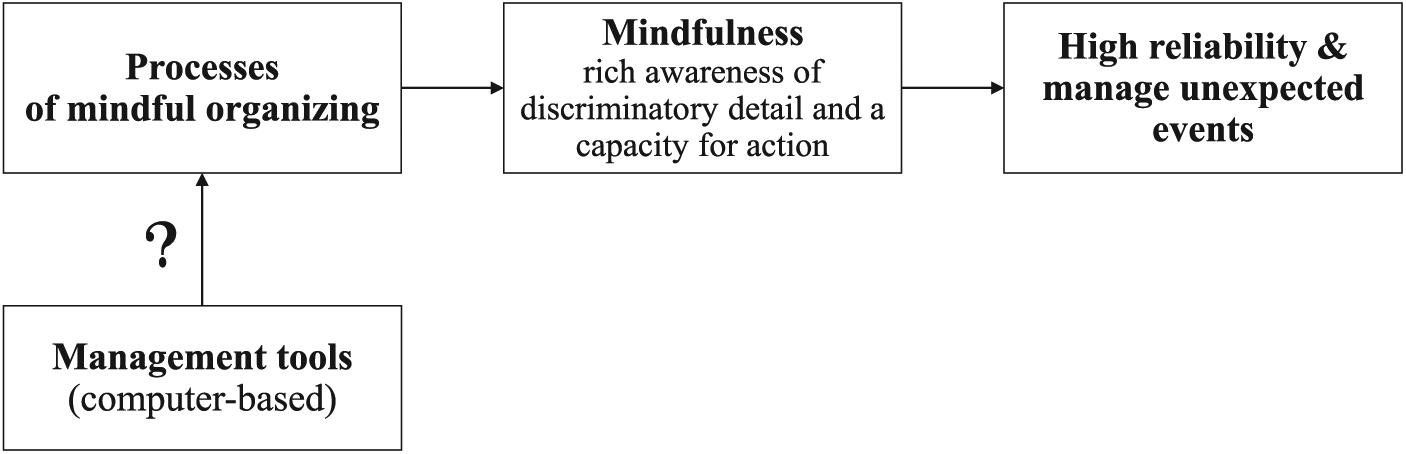
Existing literature and research gap.
Our theorizing acknowledges that the accomplishment of mindful organizing will be performed differently depending on its material enactment through different tools and their inscriptions. This both builds on and departs from previous research that stresses the role of coordination in managing unexpected events (Bechky & Okhuysen, 2011; Faraj & Xiao, 2006). In line with this research, we argue that responses to unexpected events build on material, social, and cognitive resources already available in an organization. For example, Faraj and Xiao (2006) demonstrate that coordination in trauma centers takes place through relying on prearranged protocols and rules, which codify the knowledge of experts involved in patient care and establish the sequences of activities for providing it. While the OTAP also incorporates protocols and rules, they are more about how to plan, organize, and monitor work rather than about how surgeries or medical care should be performed. In contrast to Bechky and Okhuysen (2011), we are not interested in how the available resources are created in the first place but treat the OTAP as already given. The most crucial difference, however, lies in our tool-focused perspective on mindful organizing and the emphasis on the material dimension of mindful organizing, which acknowledges the importance of physical and digital materials in shaping an expectancy network. This does not exclude sociocognitive resources such as common understandings and expectations or shared situational awareness, but asks how these are shaped by (im-)material inscriptions rather than treating them as being merely conversationally mediated.
Research Context
The setting of our in-depth qualitative case study is a hospital in Northern Germany. We focus on operation theaters and their surrounding infrastructure because they are prone to not only emergencies but also unexpected events that are related to the management and organization of surgeries and operation theaters (software and hardware breakdowns, delays, etc.). The challenge to get the work done efficiently and with high quality despite uncertainties frequently creates a need for mindful organizing. We assume that our research site is not substantially different from other hospitals in terms of having established highly reliable work practices by mindful organizing.
The hospital of our case has a capacity of 300 beds, and is treating emergency and elective patients in 15 different specialized departments (e.g., orthopedic and trauma surgery, neurophysiology, dentofacial surgery, urology). All departments of the hospital share the five central operating theaters, and each theater is assigned to a specific department. Normally, each department only uses the assigned theater, but in cases of unexpected events (emergencies, schedule overrun, etc.), there may be changes. Availability of the operating theaters is found to be scarce, and it needs to be organized as to which operating room is occupied by which team (specialized surgeon, anesthetist, nursing staff) and with what medical instruments. This is managed by use of the OTAP.
The OTAP is a computer-based tool that provides information about the planned, ongoing, and forthcoming surgeries in the five operation theaters (see Figure 2). Its most obvious features are that it displays the ongoing surgeries within the five operation theaters as a set of boxes, and shows additional information when the user clicks on the boxes representing the surgeries. Managing time slots via the OTAP is a practically complex task, as it concerns that the operation theaters are used efficiently and for the most important operations. In addition, the allocation of operation time to departments is the result of negotiations between the specialized departments and the hospital management, which takes place 2 times per year. To further complicate matters, labor regulations have to be respected, the entire operation team (surgeon, anesthetist, nurses) needs to be coordinated, and sterilized operating instruments must be made available. These issues are reflected in a guidebook on operating theater rules and procedures, which is part of a larger quality assurance program across the hospital. Some of the OTAP’s main functionalities are based on rules from this guidebook. As the OTAP is part of the hospital’s management information system, it is connected to other modules and functionalities. We focus on the OTAP because it is the one tool on which all actors in and around the operation theaters consistently drew on.

Screenshot of the OTAP.
Data Collection and Analysis
The empirical study draws on three sources of data: interviews, observations, and documents. First, we conducted a set of 21 interviews (Phase 1): We interviewed hospital’s top executives, surgeons, and heads of departments (15), the manager of the operating theaters (interviewed twice), the head of nursing (1) as well as the management accounting team (3). A practice-based approach needs scholars to become involved in their field of study to get to know the specifics of the challenges at hand. This is even more important in our case because exploring the role of materiality should not rely on interview data alone. Thus, as a second step, we shadowed (Czarniawska, 2014) the manager of the operation theaters for two days. Each author shadowed the manager for an entire working day, including visits to the operation theaters themselves and related work sites (e.g., the sterilization unit, the anesthetic recovery room). We observed his interactions with the tool, how other organizational members used the tool, and we talked to several staff members. Additional observations were made during and after our interviews. We kept handwritten field notes of our observations and interpretations. In addition, we collected and analyzed a number of internal documents (e.g., a handbook and a manual with rules that form the basis of the OTAP, checklists, Balanced Scorecard-documents, statistics about emergencies) as sources of data. After our field observations, we conducted additional seven interviews (Phase 2), to make further sense of our observations and confirm initial interpretations. In this second phase, we engaged with experienced surgeons of various departments (4), the administrator responsible of the OTAP and the hospital information system (1), and organizational support staff (1). In a third phase, we conducted another five interviews with anesthetists (2) and nurses (3) to refine previous versions of our analysis and theorizing.
Data analysis progressed in several stages and was adopted from Gioia, Corley, and Hamilton (2013), and the resulting data structure is presented in Figure 3. First, we engaged in open coding of interviews; that is, we were searching for passages that referred to how and why the tool was used. We added codes that were informed by what we had observed during the job shadowing and the document analysis. Following multiple rereadings to identify similarities and differences between codes, we gradually combined codes into first-order conceptual categories. The categories delineate components of practices, that is, human and nonhuman actors whose patterns of interaction are characterized by a certain mode or quality and where the tool’s inscriptions are sometimes foregrounded and sometimes moved to the background. At the end of this stage, we resolved discrepancies through discussions and occasional recoding. In a further round, we tentatively combined first-order categories into second-order themes that should answer the question “What’s going on here?” (Gioia et al., 2013, p. 20); that is, they describe ways in which the tool shapes mindful organizing. For analyzing relations, we referred to practices that prior research used as proxies to identify the five processes of mindful organizing (Sutcliffe, 2011; Vogus & Sutcliffe, 2007a, 2007b), and asked how the OTAP contributes to these. For example, practices of perspective taking and synthesizing the resulting awareness into a shared understanding were used as indicators of preoccupation with failure and sensitivity to operations. Throughout this exercise, we were double checking interpretations with our observations, field notes, and documents. The findings showed that the OTAP affects mindful organizing in different ways. Thus, we finally distilled the second-order themes into aggregate dimensions by discussing relationships among the themes. This process was facilitated by referring to our sociomaterial theorizing about mindful organizing and tools, which provided theoretical categories (Locke, 2001). The results were the dimensions of what we termed the “sociomateriality of mindful organizing”; that is, these aggregated notions are helpful in explaining how tools shape mindful organizing. To increase the reliability of our overall interpretation, we shared provisional interpretations with our key informant and research colleagues for feedback. This led to several adjustments throughout the research process.

Data structure.
Findings
Figure 4 shows a model that integrates the themes and concepts we found by adopting a sociomaterial lens to study mindful organizing. We find that the way the OTAP is used (i.e., sociomaterial practices) influences processes of mindful organizing that generate collective mindfulness (i.e., a rich awareness of discriminatory detail while maintaining the big picture). Our model is a visual representation of the ways in which a specific tool influenced processes of mindful organizing, and how direct and indirect influences relate to each other. It does not, however, make general claims about deterministic causalities. Such an understanding would run counter to our account. We present our findings along this model, and start with describing how the OTAP shapes the processes of mindful organizing by “inscribing the big picture.”
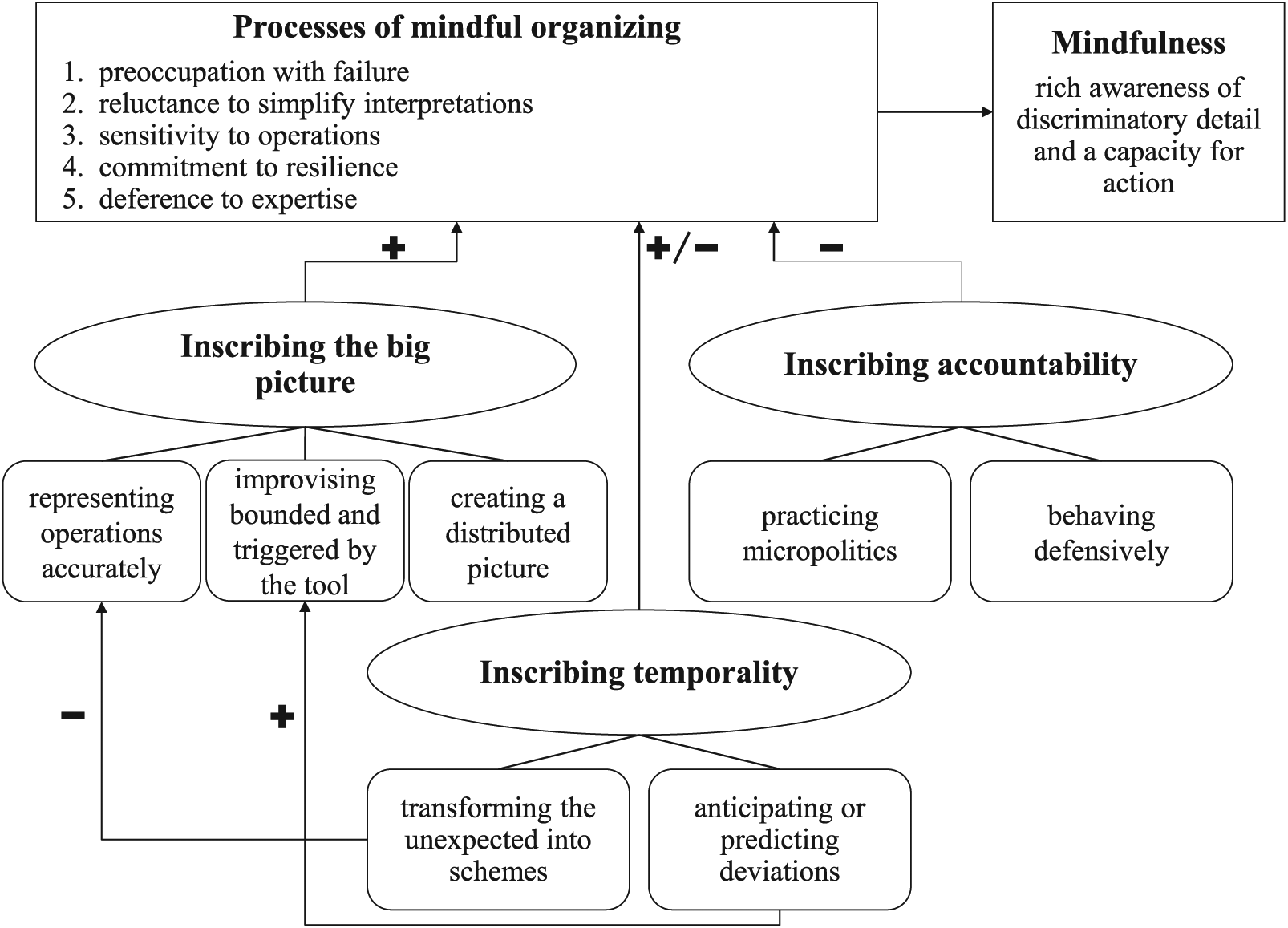
Overview of findings and relations.
Inscribing the Big Picture
Three practices describe how the OTAP inscribes the big picture. The first two practices—“representing operations accurately” and “creating a distributed picture”—describe how the visual and material design of the OTAP’s inscriptions shapes mindful organizing. The third practice—“improvising bounded and triggered by the tool”—captures how formal and informal tool-related rules ensure an enhancement of the speed, range, and quality of actions taken.
Representing operations accurately
The status of each surgery is indicated by the box on the monitor representing the surgeries, including a color coding by department, signal lights that display the status of a surgery, and a red line that indicates the elapsed time. For the manager of the operation theaters, one of the first tasks in the morning was to have a quick glance at the last screenshot he made the day before and then a look at the current OTAP to compare for differences. This comparison allowed him to directly recognize changes made during the night and to set expectations about the first surgeries. It took him parts of a second to “read” and understand the changes that have been made: “I immediately see if there were changes over night. And I can tell you that this time there were no changes. I would just see them” (First interview manager of operation theaters). Another example of how the OTAP’s visual design eases setting and adjusting expectations is scheduling emergencies and deciding whether stopping an ongoing surgery or changing operation theaters is possible. Whenever an emergency patient is registered, available operation theaters can be perceived by simply comparing the size of the bars that represent the ongoing operations, watching out for gaps and omissions between the bars. In addition, the red line that indicates the progress of time is a point of reference for “visually estimating” the risk of double bookings in the near future. Thus, the layout of the digital objects on the screen is part of the materiality of the OTAP’s inscriptions and shapes ongoing work activities.
There is another way of comparing what is expected with what is going on. At the beginning of each work shift, the manager made a screenshot of the OTAP main display and saved it in a MS Word document. The paper-based version was used in meetings; for example, the morning meeting of all anesthetists that he attended. The reason was that information about patients and planned surgeries was exchanged, which helped the manager of the operation theaters to “get a feeling” of the probability that the plan will be realized. Throughout the work shift, the manager of the operation theaters annotated the paper-based version of the OTAP with information that he perceived as useful to maintain an accurate representation of what was going on (see Figure 5).

Printout of the main screen.
Creating a distributed picture
The OTAP is instantiated on different computers and workstations, and can be accessed from spatially distributed sites: from within the operation theaters, from several bureaus within the hospital’s different medical departments, and from the two bureaus of the manager of the operation theaters. Thus, different professional groups can “see” which surgeries are going on, which are planned, and whether the ongoing operations develop as planned without having to interact in person. For example, nursing staff, who prepared patients for surgery and took care of them afterward outside the operation theater, knew about the activities of surgeons within the operation theater. Depending on how timely the documentation was made, this feature of the tool captured several details of who was doing what in the operation theater, which kind of instruments and medical equipment were used, and how the surgery developed. This information is saved in the OTAP and can be displayed by a mouse-over effect. While the manager of the operation theaters has access to all the details, surgeons, anesthetists, or nurses only see the parts that are relevant for them.
Improvising bounded and triggered by the tool
We find that the behavior of the human actors in our medical care scene is bound by several rules that are inscribed in the OTAP. At the core of the OTAP is a categorization and rule system that is applied to all surgeries and which has been adopted in accordance with nation-wide standards (see Bauer, Hinz, & Klockgether-Radke, 2010). Whenever a surgery is registered, it is assigned to one of five categories, ranging from A to E, that characterize the urgency of a surgery. Category E patients (elective surgeries) are the only ones who are planned in advance. Category D includes emergency patients who need to have surgery within 24 hr, C corresponds to a maximum waiting time of 6 hr, B up to 2 hr, and Category A patients may experience no delay. The rule for Category A patients (ca. 1% of all surgeries) is to put an ongoing surgery on halt or move it to another operation theater if there is no available operation theater. For Category B patients (ca. 6% of all surgeries), the next available operation theater is reserved, which changes the overall schedule. Once the responsible surgeon sets the category when she or he registers a patient, nursing and medical care staff, patient transport people as well as the manager of the operation theaters must adhere to the categorization. The access authorization system of the tool only grants the manager of the operation theaters and the surgeon who has done the initial categorization the right to change categories; all others are not allowed to change them. However, the manager of the operation theaters insisted that he would never change a patient’s categorization:
I will never change the category, never ever. Although I could. And even when a surgeon calls me on the phone and asks me to quickly change the categorization because he’s busy, I won’t do that. I tell him that he must log on and make the change himself. (First interview manager of operation theaters)
In addition to the unwritten rule that the manager of the operation theaters would not make changes to categorizations, there are other informal rules regarding the rescheduling of surgeries. Rescheduling becomes problematic when the surgery program of another department is interfered with and most employees acted with an awareness of how their actions affected others. To avoid the anger of colleagues, there was a strong tendency to stick to the timeslots assigned to one’s own department. The only legitimate violations of this unwritten rule were emergency patients of high priority. Interviewees frequently mentioned that “adhering to rules” and “clear responsibilities” were inevitable to work reliably (e.g., manager of operation theaters, Surgeon 2, Surgeon 5, head of organizational support). Thus, the OTAP’s inscriptions preconfigure action (or, to put it the other way round: Actors’ behaviors are bound by the tool) by supporting the maintenance of shared expectancies; that is, what others will do once (unexpected) surgeries are registered.
The OTAP also codifies rules that affect behavior more directly. For example, whenever the manager of the operation theaters wanted to change relevant information in the OTAP (e.g., surgeries or allocated team members) as a reaction to unexpected changes, the system requested to answer several pop-up windows. Most of them offered the options “Yes” and “No.” Counterintuitively, the position of the buttons labeled “Yes” and “No” switched places during a series of questions: While the “Yes” button appeared on the left side of the first pop-ups, it “suddenly moves to the right,” as the manager of the operation theaters complained. While the manager was annoyed of this feature, he also mentioned that he is required to “pay attention to the boxes and actually read the questions” (field notes). The information technology (IT) administrator referred to features like these as “digital coercion” (Interview IT administrator).
In addition to being bound by the tool, medical care staff and surgeons displayed what we call a “can do attitude,” and put personal sensitivities aside to improvise and respond appropriately to surprise and breakdowns. Some of these breakdowns relate to the OTAP directly. For example, the main display froze from time to time, or the whole program crashed so that neither medical care staff nor surgeons or the manager of the operation theaters could use the OTAP before it has been rebooted with the help of the IT administration. In these cases, the manager of the operation theaters “did all I could do to keep things going” (Second interview manager of the operation theaters). He provided information about ongoing operations, either by drawing on the printouts and saved screens of the OTAP, or by calling the surgeons, or by going into the operation theaters himself. He also reported that in case of a longer breakdown, the printouts were pinned on walls and doors, so that surgeons and medical care staff could see what is going on.
Inscribing the big picture and mindful organizing
Our evidence points toward multiple ways in which inscribing the big picture via the OTAP has positive influences on processes of mindful organizing. First, our findings suggest that the digital and material instantiations of the OTAP enhance the speed and quality of gathering the details of work while staying aware of the big picture. While comparing the paper based with the digital version of the OTAP speeds up the sensing of changes, the mouse-over effect captures details that are represented by the spatially distributed instantiations of the tool which then provides the big picture to several professional groups. In this way, the materiality of the tool’s inscriptions—material or digital—is beneficial to the process of sensitivity to operations.
Second, creating a distributed picture facilitated perspective taking and deference to expertise by visualizing ongoing activities and expectations about planned activities and enabling multiple actors to access this information. By showing portioned and updated information to distributed individuals, the OTAP supports the establishment, maintenance, and adjustment of collective cognition about emerging and possibly unexpected situations. Accurate representations synthesized the distributed information into a nuanced and shared understanding. This fosters all of the five processes, except commitment to resilience.
Third, the findings suggest that the mindfulness and reliability of everyday work performances are to a crucial extent based on codified rules. The Weickian perspective tends to treat mindfulness as the opposite of rule-based routine behavior. We find, however, that sticking to rules and assigned roles and trying to avoid rescheduling do not necessarily reduce mindfulness but are rather means to improve the reliability of work. The example of “digital coercion” shows how simple codified rules force users of the OTAP to stay mindful in routine procedures. Nevertheless, inscribed rules do not determine behavior but must be enacted in practice. In our case, the practices are characterized by a “can do attitude,” which enhances the speed of coping with unforeseen events and increases the range of solutions available in a situation—a characteristic of commitment to resilience (Sutcliffe, 2011). In addition, the inscribed rules and the “digital coercion” of the tool enforce reluctance to simplify interpretations. Rules mandate a close confrontation of each case and its subsequent management within the big picture of other cases, while the changing buttons avoid working in the dreaded autopilot mode.
Inscribing Temporality
The OTAP was not only involved in managing time constraints of nonhuman agents, such as the availability of operation theaters or medical instruments, but also employees. In addition to time constraints, the OTAP played a role in representing and maintaining expectations, which connect past experiences with ongoing and future events. We find that the tool’s inscriptions of temporality are not only directly related to mindful organizing but also indirectly because they also shape two of the practices of inscribing the big picture. Two practices shed light on these complex relations: “transforming the unexpected into schemes” and “anticipating or predicting deviations.”
Transforming the unexpected into schemes
An obvious starting point for understanding the way temporality is inscribed in and through the OTAP relates to the emergency categorization system. In it, new patients were labeled in categories ranging from E (i.e., preplanned) to A (emergencies so important that an ongoing surgery would be put on hold to clear the operation theater). These categories define temporal boundaries because they punctuate when activities start and end, and convey this information to different user groups (Orlikowski & Yates, 2002). By doing so, the categorization system translates emergencies as one type of unexpected events into events, which can be planned and worked upon. Unexpected events become manageable because the OTAP’s inscriptions assign start and end points, rules of prioritization and how to cope with ongoing operations (via the emergency categorization) as well as near-future events (e.g., newly registered surgeries, rescheduled surgeries). Our data also bring the visual-material aspect of expectations to the fore: The sizes of the boxes on the screen represent expectations about surgeries’ durations. The boxes’ spatial relation to other boxes not only indicates expectations about the temporal sequence (what comes first, what is parallel) but also their relative importance because longer surgeries were expected to bear a greater risk that something unexpected can occur. The latter is codified in the scheduling rule that the longest surgery must never be the last in one shift. When rescheduling occurred, the representation of time in the tool via the size and location of boxes changed, which would then, again, structure actors’ anticipations of the next events.
Anticipating or predicting deviations
Another facet of inscribing temporality through the OTAP was raised when we asked surgeons and those filling in the timeslots into the OTAP about the usefulness of planning. The general feeling was one of unquestioned usefulness. However, one concern was raised several times. When entering a new surgery into the tool, a standard time is set. This standard time can be changed in the mouse-over details of the created box that represents the surgery or by moving the box with the mouse. Both procedures are tricky, as the graphical interface is not very responsive to mouse movements. In addition, only a few interviewees were aware that they could enter the number of minutes for a surgery directly via keyboard. The majority of surgeons and anesthetists bemoaned that they had to use the standard times. The standard times were initially customized before the OTAP was rolled out in the hospital, but regularly misrepresents the anticipated and actual time needed.
These standard durations for surgeries hardly work out. I would prefer that the tool would ask me how long I expect the surgery to take rather than predetermining a time slot. You see, it will take longer if an assistant doctor performs the surgery or if I do it. (Interview Surgeon 12)
Actors perceived their estimations of surgery durations more precise than the standardized estimates because of their experience with the speed of their colleagues. Our respondents told us that they know their colleagues because the hospital is a rather small one. The German phrase “Ich kenne meine Pappenheimer” was used in nearly every interview with surgeons, nurses, and anesthetists, and describes the informal knowledge about the (lack of) abilities of their colleagues in a jovial and mildly degrading way. For example, a surgeon remarked that “when the colleagues from the dentofacial department insert 2 hr, it will take 4” (Interview Surgeon 11). For surgeons, anesthetists, and nurses, this resulted in a flexible attitude toward the actual starting point of their surgeries and in the need to directly assess what is going on by entering an operation theater. As one interviewee remarked, “I take a look at the tool, say, 10 to 15 times a day. But I also go into the operation theatres by myself and have a look because I cannot see how the other surgeries are progressing” (Interview Surgeon 11). The manager of the operation theaters also makes use of this possibility and draws on his experience with surgeries to predict deviations with a high degree of precision. Here is a field note on such an assessment from shadowing the manager of the operation theaters:
This is the first time I enter an operation theatre since I got my appendix removed as a child. I now look like a surgeon in the movies: all green with face mask and cap . . . The third operation theatre I enter strikes me as the most gruesome one. A large metal bin with bloody rags is close to the operating table where three or four people stand around. I’m told not to touch anything as everything is sterile. Grinning, the manager of the operation theatres tells me that this is plastic surgery in which bone from a leg is moved to a patient’s jaw which had to be removed as part of a cancer treatment. The procedure is done to make the patient look somewhat normal again. And indeed what I see is a bloody mess. Part of the flesh around the right jaw is removed and the surgeon works on the bone. I slowly turn as green as my suit. The manager of the operation theatres looks at the bloody jaw with open flesh and blood everywhere for about half a second, nods satisfied and informs me that the operation will last for another 25 minutes. I’m happy to leave the operation theatre with its manager. . . . Later he adjusts—somewhat frustrated by the imprecision of the program’s responses to his mouse movements—the time of the surgery in the OTAP. It actually finished 25 minutes after he made the—correct—prediction. My jaw hurts.
Inscribing temporality and mindful organizing
The relation between tool-based inscriptions of temporality and mindful organizing is ambivalent. Some of the ambiguity can be explained by the two types of practices of inscribing temporality, which not only influence the processes of mindful organizing directly but also indirectly via influencing practices of inscribing the big picture.
Directly, the OTAP hinders mindful organizing as the transformation of the unexpected into schemes does not work out smoothly. The configuration of temporality via categorizations and standard time slots creates orderliness and defines the baseline of what is expected to occur during the day—and it is against this background of expectancies that organizational actors revise plans, adjust resources, and update interpretations while coping with unexpected events (see Patriotta & Gruber, 2015). We also find, however, that this does not work out smoothly because the OTAP is slow, unhandy in use, prone to freezes, and bound to unrealistic standard times. Consequently, the OTAP actually makes it more difficult for actors to remain sensitive to operations and reluctant to simplify interpretations. For example, if a surgery starts too late, clock time and event time are incongruent, which can be directly seen on the display: The red line indicates that clock time “crosses” the box indicating the duration of a surgery, but the signal light indicates that the surgery has not started yet. This diverts support staff’s attention away from what is going on to speculating about what may have occurred or is occurring, even if it was common knowledge to other actors that the estimate was often wrong. In theory, inscriptions that offer standard time slots are inventories of established routines that serve as a repertoire of actions that enable mindfulness at work (Levinthal & Rerup, 2006). In practice, the relationship is more complex.
On one hand, standard times are likely to interfere with creating a more nuanced appreciation of context as they do not pay attention to situational specifics but treat different events (e.g., experienced and unexperienced surgeons performing the same surgery) as similar. The obvious misrepresentations of time and temporal progress counter the awareness of the big picture about ongoing operations as they paint an inaccurate picture and direct attention in a potentially misleading way if actors base their decisions on what is displayed by the OTAP. The tool failed to inscribe existing common knowledge or even change past—wrong—inscriptions easily, and it seems not to be flexible enough to represent temporal changes. To assess the actual progress and anticipate the duration of surgeries, surgeons and the manager of the operations theater had to go into the operation theaters by themselves and assess the situation based on their expertise. This does not only take up their time but also create additional effort for the team in the operation theater that now has to explain about rather than conduct the surgery.
On the other hand, it is probably the most intriguing finding in our case study that some limitations of the tool actually triggered actors to improve their attempts to organize mindfully. As the tool’s misrepresentations were widely known, actors were preoccupied with possible failures that result from the frequent inaccuracies. The tools’ shortcomings of not accurately representing what is actually happening trigger reflexive interaction (e.g., discussions about deviations) and improvisation to cope with the unexpected course of events. Thus, the practices of anticipating and predicting deviations, which are conducive of a preoccupation with failure (Sutcliffe, 2011), can be seen as being triggered by the tool’s shortcomings. During these practices, the tool is pushed to the back or is supplemented with expert assessments, which are quite precise. In a sense, the shortcomings of the tool prompted a deference to expertise, especially when actors engaged in practices of inscribing the big picture and tried to represent operations accurately. Once the schedule and progress of surgeries had been updated in the OTAP, the process of inscribing temporality via the OTAP stopped.
Inscribing Accountability
A final major aspect of the OTAP that had an impact on mindfulness is “inscribing accountability,” which we infer from “practicing micropolitics” and “behaving defensively.” Through the material and immaterial inscriptions it created and left behind (e.g., printouts, logfile), the OTAP functioned as and was used as a producer of accountability.
Practicing micropolitics
The already mentioned activity of making screenshots and saving and/or printing them is also about safeguarding against unwanted or self-interest-seeking behavior by other organizational members. The manager of the operation theaters not only made a screenshot of the OTAP in the morning but on average 4 times per day. When asked for the purpose of this routine, the manager of the operation theaters responded that he checked whether surgeons had added elective patients (lowest urgency) and smuggled them into the schedule by changing the category to a higher urgency level. Several interviewees mentioned that smuggling is possible because the fasting guidelines are less strict in more urgent cases, and surgeons who like to conduct a surgery earlier because it would better fit their personal schedule could achieve this through a category “upgrade.” As the different departments compete for the scarce time slots and additional elective patients earn individual (high-ranked) doctors extra income, changes in the priority of patients had some potential for being subject to political gaming. In a later interview, the manager of the operation theaters stressed that the screenshots served as decisive evidence in several disputes with surgeons about who made the decision about the category, why there was a change, and who would be hold accountable in case of false categorizations. In addition, changes in the order of patients might, owing to various technical, economical, and organizational reasons, influence the amount of time in an operation theater allocated to a department by the top management. Thus, the agreed and legitimized allocations should be safeguarded against politically motivated changes by making screenshots that could proof that changes had been made. Ironically, safeguarding is itself a micropolitical practice.
Behaving defensively
With our focus on the tool’s materiality, we also found evidence of the creation of accountability trails (see Power, 1997). As common in many IT systems, users of the OTAP have to log in to enter or change data. Only certain users are allowed to make crucial changes; for example, changing the emergency categorization of a patient, say from C to B. As mentioned, the manager of the operation theaters insisted that he does not do that. Even if he is logged in and is asked by a surgeon to change the emergency categorization, he would never change the categorization himself, but log out, have the surgeon log in, make the change, log out, and then the manager would log in again. Indeed, we witnessed this procedure. The operation manager employed strong rhetoric to justify the rather complicated procedure: “I won’t go to prison for this job!” Clearly, defensive behavior reduced to speed of action for the sake of leaving a trail of evidence.
The way the OTAP creates accountability is through the traces its inscriptions create and leave behind. Surgeons, anesthetists, and the manager of the operation theaters alluded to questions of accountability in case of medical malpractice resulting from a wrong categorization of a patient. This could lead to severe consequences if a patient was insufficiently cared for owing to a too low categorization, or that an unjustifiably high categorization of a patient prevents the appropriate treatment of another patient. During our job shadowing, we observed that a surgeon wanted to upgrade a patient from D to C to be able to perform the surgery sooner. This attempt led to a dispute about the patient’s state of unintoxication and safety. The manager of the operation theaters considers upgrading patients to more urgent categories detrimental to high reliability because insufficient fasting and unintoxication are associated with health risks (e.g., pulmonary aspiration). In case of legal procedures, the OTAP would provide evidence for which user had been logged in and made changes.
Inscribing accountability and mindful organizing
Our findings show instances of practicing micropolitics and defensive behavior that can be associated with the danger of “crowding out” mindful organizing, if simply by taking up valuable time and attention. The routine of making screenshots may be interpreted as being conducive to mindful organizing because it enables the operation theater manager to bounce back and cope with unexpected events such as a power or IT system blackout (he would have the latest schedule). However, this was not the purpose. Rather, the fact that the tool materializes who did what and when directs attention away from the operations in the here and now toward a distant and potential future which is decoupled from localized organizing in the operation theater. The detrimental effect of “inscribing accountability” on mindful organizing is that attention is drawn away from sweeping in interconnected details to interpreting ongoing events in the light of possible risks. As a consequence, sensitivity to operations may be replaced by merely thinking about the risk of a possible lawsuit. Moreover, people may overstretch the adherence to formalized procedures to avoid blame, legal consequences, and public scrutiny. Such an overly strong focus on outside perception, reputation, risk, and aversion of legal responsibility is antithetical to mindful organizing, which is focused on the moment and ongoing operations. Here, we see an interesting tension with respect to the sociomateriality of the OTAP. While its visual-material and rule-based inscriptions give form to details, time and space amenable to mindful organizing, they also bear the risk of misdirecting attention by distancing actors from the actual events in the operation theater.
Discussion
In our study, we set out to examine how a computer-based tool shapes mindful organizing. We believe that a closer look at the nature of tools helps explicate their role and sheds light on mechanisms that facilitate or inhibit mindful organizing but have not been explored so far. Our theorizing is rooted in the concepts of inscriptions and sociomateriality, which are used to analyze the nature and role of the OTAP. Our findings indicate that while some inscriptions had a direct positive influence on processes of mindful organizing, others had a negative effect. Interestingly, some of the tool’s shortcomings also fostered processes of mindful organizing. Figure 4 shows these effects and presents our contribution toward integrating tools into a sociomaterial model of mindful organizing. By focusing on the role of tools in the network of human and nonhuman actors, our study extends the human-centered approach to mindful organizing of previous research. The existing literature on mindful organizing focuses on people, (respectful) communication, and (safety) culture (Pronovost et al., 2006; Sutcliffe, 2011; Vogus et al., 2010; Weick & Sutcliffe, 2007). This is hardly surprising because the literature on HROs is informed by accounts of sensemaking that focus on human cognition and communication, and tends to neglect artifacts such as tools and their materiality. While we emphasize the role of the OTAP, we do not claim that the tool alone determines the five Weickian processes of mindful organizing in our case. Rather, nonhuman and human actors form the sociomaterial practices of managing the unexpected. Especially during surgeries, social interaction is crucial—but often involves medical instruments and artifacts, of which the OTAP is only one. Thus, our study is only a first step toward picking up tools and integrating them into a sociomaterial model of mindful organizing. We now discuss the implications of this model for researchers and practitioners.
Picking Up Visual-Material Design
Our analysis shows that visual and material aspects of a tool are crucial because material and digital instantiations are involved in inscribing the big picture, make expectations about temporal relations between past, ongoing and planned surgeries visible, and produce traces that inscribe accountability. In addition, codified rules and standards that inscribe temporality can be understood as artifacts and are thus part of the materiality of tools. The boxes, bars, lines, and templates as well as the mouse-over feature affect the relation between details and the big picture because they afford actors to pay attention to some details that appear as information; that is, some cues become literally manifested while other details are faded out or unavailable. This suggests that the digital and material instantiations are not neutral but play an active role in shaping organizational interaction because they afford and authorize as well as block or forbid information, sensemaking and eventually, courses of action. Such a perspective is in line with other accounts that attribute a more active to nonhuman objects (see Nicolini, Mengis, & Swan, 2012). Our theorizing and empirical focus help explicate how the visual-material dimension of a tool’s inscriptions leads to ambiguous effects on mindful organizing. This extends accounts that depict mindful organizing in purely cognitive or symbolic terms, which only sheds light on one dimension of managing the unexpected.
From a Weickian perspective on mindfulness, our study suggests rehabilitating the role of tools. Ever since Weick’s famous call to “drop your tools,” research has been somewhat dismissive of the potential of tools to foster mindful organizing. Our study points toward such a potential and outlines some facets which deserve further consideration, for example, tools and their relations to routines or “acting on automatic pilot.” From a Weickian perspective on mindfulness, tools should not tap into preferred and routinized courses of action but rather stimulate actors to reflect or even leave them puzzled, so that they stop and think about what is happening. With regard to the visual-material layout of tools, Gärtner and Huber (2015) argue that the power of the visual might afford narrowing down the focus of attention to only some details and simple or easy-to-grasp explanations, which would inhibit mindfulness. For practitioners, it will be crucial to reflect on the design of tools, because the visual-material layout is likely to induce or inhibit mindfulness. The scarce literature that deals with how to design tools often draws on a vital principle of engineering design: ease of use. Well-designed products or systems are those that can be used without much cognitive effort because they engender user trust, confidence and conform to users’ preferred perspectives and expectations (Butler & Gray, 2006). The imperative of “ease-of-use,” however, means to favor routinized courses of action or acting on autopilot. Consequently, future research might focus on the design of tools and their inscriptions to specify how practitioners are affected by the visual-material dimension and how to design tools to facilitate mindfulness as a way of managing the unexpected.
Picking Up Temporality
Scholars in this field have remained largely implicit about their conceptualization of time, but their passing comments indicate that they assume a linear clock time and they treat time as a resource that can be “spent.” For example, Weick and Sutcliffe (2006; emphasis added) emphasize that HROs
spend (a) more time examining failure as a window on the health of the system, (b) more time resisting the urge to simplify assumptions about the world, (c) more time observing operations and their effects, (d) more time developing resilience to manage unexpected events, and (e) more time locating local expertise and creating a climate of deference to those experts. (p. 516)
In contrast, we pick up the idea that temporality is a complex organizational phenomenon as it has been outlined by scholars who investigated the temporal structuring of sensemaking processes in managing the unexpected (Patriotta & Gruber, 2015) and organizational practices in general (Orlikowski & Yates, 2002). Their concept of temporality does not treat time as a mere resource that can be gathered or spent, but as being relative to several points of reference. We build on and extend these studies by considering the notion of inscriptions to show that a revised understanding of time and its relation to materiality changes the way scholars can think about mindful organizing. Understanding temporality as an organizational and sociomaterial phenomenon allows discussing the role of visual and material aspects in the temporal structuring of how routine and mindful processes in managing the unexpected are mutually constituted.
First of all, different kinds of time (clock time, event-based time, etc.) relate to the OTAP’s material and visual inscriptions. For example, the red line is a case of clock time, and the boxes are instances of event time because they indicate starting time and duration of surgeries. The (relative) size and location of these boxes are based on rules (e.g., the longest surgery should never be the last in one shift) and standard times for the duration of a surgery. These visualizations and their different material instantiations are not mere representations of availabilities (who “has” time), but inscriptions that routinely convey information to different user groups. The conveyed information about temporal boundaries (when activities start and end) and workloads (who is staffed where and when) is used in planning and predicting the unexpected, because defining temporal boundaries contributes to the constitution of distributed and shared expectations about the temporal sequencing of work (what comes first, what is parallel). While the different user groups are likely to be aware about the content of these expectations, they are unlikely to be aware about how these expectations are constituted, maintained, or changed. Our findings show that the OTAP’s inscriptions play a vital role in these processes and, thereby, in the routinized structuring of time. Consequently, our findings support the idea that artifacts are not merely physical traces of an organizational routine but constitute and influence routines (see Pentland & Feldman, 2008).
In addition to the sequencing of work, the OTAP’s inscriptions shape the relative importance of work and materialize preferences of different professional groups. For example, the OTAP codifies the rule that longer surgeries are seen as more important than shorter ones, and also rules about allowed and forbidden time slots or periods of rest for surgeons and staff. This produced differences regarding the focus of attention and what kind of events the different groups were prone to react to. For example, working time slots indicated whether a surgery could be performed or not, which freed organizational members from spending time on arguments about work allocation and prevented them from others’ requests. This is vividly illustrated by the incident when one surgeon tried to bring a Category D patient forward to an earlier time slot to prevent the surgery staff from having to work overtime. The medical point of view (fasting guidelines would have required postponing the surgery) created a conflict with inscribed time-related points of reference (the categorization system and work regulations). Time may, therefore, be conceived as a scarce resource whose allocation is negotiated based on interests but, in addition, the different forms of time inscribed by the OTAP’s (im)material artifacts structure preferences and (re)direct attention from patients’ safety to other issues while managing unexpected events. Picking up temporality understood this way sheds light on the role of tools in structuring time and considering or rejecting interests, which affects the ability to manage unexpected events and, eventually, may contradict the aim of high-reliability organizations.
While our findings suggest that there is a mixture of inscriptions related to temporality, further research may focus on controlling for different kinds of time and analyzing their relation to routine or mindful behavior. For example, scholars may argue that inscriptions that refer to event-based and clock time induce a cognitive style where actors think about ongoing changes as a sequence of (unexpected) events rather than being able to consider that they occur in parallel. The effect on mindful organizing may then be detrimental because actors’ attention is limited to a sequence of events rather than having a rich awareness of discriminatory detail. Our sociomaterial account urges scholars to not only focus on human actors but to also consider the role of nonhuman actors as well. For example, Howard-Grenville (2005) assumes that it is employees who hold different orientations toward time in their minds, and that it is organizational members’ orientations toward the past, present, or future that influences the flexibility with which a routine is applied. Extending such studies, our account suggests exploring how these orientations are distributed between employees and the inscriptions of the OTAP, and how inscriptions shape the cognitive effort and flexibility with which routines are applied. In this regard, our findings indicate some counterintuitive relations between the OTAP and mindful organizing, which help understand findings that remain ambiguous otherwise.
Picking Up Accountability
In prior studies of mindfulness, accountability has only received passing attention. While disasters such as the Tenerife Airplane Crash (Weick, 1990) or the deaths in the Bristol Royal Infirmary (Weick & Sutcliffe, 2007) focus on what led to mistakes, questions of legal and formal accountability have not been studied explicitly. However, accountability is a major topic for practitioners, especially in medical care, as the enormous resources used for documentation of quality management or highly publicized legal cases show (Kurunmäki, 2004; Timmermans & Berg, 2003). These procedures of documentation, which enable reconstructing accountability after events are usually highly routinized. Levinthal and Rerup (2006) explore the complex relationship between routines and mindfulness, and suggest that routines may both foster and hinder mindful behavior, depending on how routines and established role structures interact. In our study, we add to this a further layer. The attempts to construct accountability were routines but not part of formalized accountability systems (cf. Timmermans & Berg, 2003). It is not only the professional roles and hierarchy that keep members accountable to one another for their activities, as suggested by Faraj and Xiao (2006); rather, the everyday work with the OTAP to plan surgeries, monitor their progress, reschedule them, and so on that produced accountability.
When screenshots were printed and compared with digital data, additional work was invested in constructing accountability, effectively diverting attention away from processes of mindful organizing. Thus, our study offers a different explanation of the negative effect of “accountability routines” as the detrimental effect of materializing accountability on mindful organizing is not necessarily depended on its routine-like form. Rather, the loss of attention resulted from the failure of the tool to produce formal accountability procedures, which were regarded as efficient by the actors. Such a potential misdirection of attention has been discussed in recent critical literature on accountability (Messner, 2009; Power, 2007). This literature shows that focusing too much on creating legalistic evidence to avoid blame can have deteriorating effects on the performance on which one is potentially held accountable for. In our case, we termed such practices “behaving defensively” and “practicing micropolitics,” and show their deteriorating effects on the performance of mindful organizing on the stage of operation theaters. This echoes findings by Qu and Cooper (2011) who show that inscriptions are used by actors to influence others and courses of action in pursuit of their own interest. In addition, our findings suggest that pursuing interests and exercising power in relation to a tool are also related to inscribing temporality because it structures preferences. Further research may explicitly focus on investigating the relation between a tool’s inscriptions, temporality, and practicing micropolitics in greater detail. While our findings suggest a detrimental effect of micropolitics on mindful organizing, one may also argue that power is a capacity for action to keep things on track, and thus beneficial for swift responses to unexpected events.
In sum, we believe that exploring how tools shape processes of mindful organizing is helpful because it enhances our understanding of how mindful organizing is socially, materially, and spatially distributed and how it unfolds over time. As our analysis is limited to explaining how one specific tool is involved in producing ambiguous effects on mindful organizing, future research may draw on the identified themes of the “sociomateriality of mindful organizing,” and analyze other tools and technologies that are crucial in health care (e.g., electronic patient records or medication administration records) or other high-reliability settings.
Footnotes
Acknowledgements
We are deeply grateful to Tim Vogus for his feedback and suggestions on a previous version of this article. We are also indebted to Kathleen Sutcliffe, Georg Schreyögg, Daniel Geiger, and all members of the track “Managing the unexpected” at the EGOS Colloquium in 2014, the members of the Professional Development Workshop “Researching organisational mindfulness and mindful organizing: Theory, method, and practice” at the Academy of Management Annual Meeting in 2014 as well as the members of the Symposium on Process Organization Studies (PROS) in 2015 who provided feedback and valuable suggestions for improving previous versions of this article.
Declaration of Conflicting Interests
The author(s) declared no potential conflicts of interest with respect to the research, authorship, and/or publication of this article.
Funding
The author(s) received no financial support for the research, authorship, and/or publication of this article.