



Abstract
Utah Valley University is a large, regional, open-admission institution with growing enrollments and changing demographics. It has a history of transformation and change, beginning as a trade school in 1941 and evolving to a university in 2008. This article illustrates how the university has engaged in on-going strategic planning to anticipate and effectively manage threats and opportunities. The article begins with background information and statistics about the university and the Woodbury School of Business, explains how the university has leveraged its elective Carnegie classification as a community engaged institution, and shares examples of transformations in teaching and learning to enable student success. It then illustrates how the university’s Woodbury School of Business has paralleled the directions of the university to build capacity among its faculty for engaged learning and pedagogical innovations. The article ends with a summary of key outcomes and thoughts on the sustainability of transformation.
Most universities face threats and opportunities that require resilience and change. Utah Valley University (UVU), home of the Woodbury School of Business, is a prime example. Founded in 1941 as a vocational school to offer courses previously provided by local businesses, its primary purpose was to train workers for war production efforts (UVU, n.d.). Expanding its training programs, it became a technical institute in 1963, and a technical college with associate degrees in 1967. In 1987, it broadened its scope and transformed into a community college, and then a state college with bachelor’s degrees in 1997. Master’s degrees were added in 2008, and the institution was reborn as a university.
Throughout its history, UVU has shown the ability to transform itself in response to business and community needs—the essence of its mission. The mission of the Woodbury School of Business expresses this same commitment: Through exceptional business education, we help students become successful professionals who build our community. The Woodbury School of Business, accredited by AACSB in 2006, followed a similar trajectory as UVU—offering certificates of completion and applied science degrees in areas such as business, secretarial, and marketing in the late 1960s, and then associate degrees in accounting, business-data processing, data management, business management, general business, and marketing in the early 1970s. The MBA program, initially offered in 2010, was one of the first graduate programs.
Had the university and the school of business not anticipated and responded to on-going needs in the local environment, it would likely not be the largest university in the state nor would the school of business have the largest number of students in the university. Schools of business must anticipate needs and prepare students for the jobs of the future. Rapid technological advances, competition from a variety of educational providers, and an increasingly diverse student population (see Kovoor-Misra, this issue), which can be considered both threats and opportunities, have been viewed by UVU and the Woodbury School of Business as opportunities for curricular and pedagogical innovation by unleashing the powers of the faculty.
Threats and Opportunities
As a large, regional, public, open-admission university, UVU has a growing number of first-generation and nontraditional students, more than half of whom work at least part-time. Many students need developmental coursework in math and English and also flexible access to coursework. The institution has been successful in improving first-year retention and is working to improve graduation rates (see Table 1, UVU, 2017a, 2017b). The university has made great strides to increase 1-year retention rates, experiencing a 7% increase over the past 3 years. The current goal is to increase the 26% graduation rate to 32% (the current rate of the School of Business) by 2020. Most remarkable, though, is UVU’s enrollment growth and growth projections, which indicate an anticipated enrollment of approximately 45,000 by about 2025 as shown in Figure 1 (Johnson, 2016).
UVU Facts and Figures.

A 7% increase over Fall 2017.
An increase of 154 students over Fall 2017.
A 4.1% increase over Fall 2017 overall and a 2.7% in the school of business. The Woodbury School of Business has the largest enrollments of all colleges/schools at UVU and the largest percentage of minority students.
One-year retention has increased from 47% in 2003-2004 to 66% in 2016-2017.
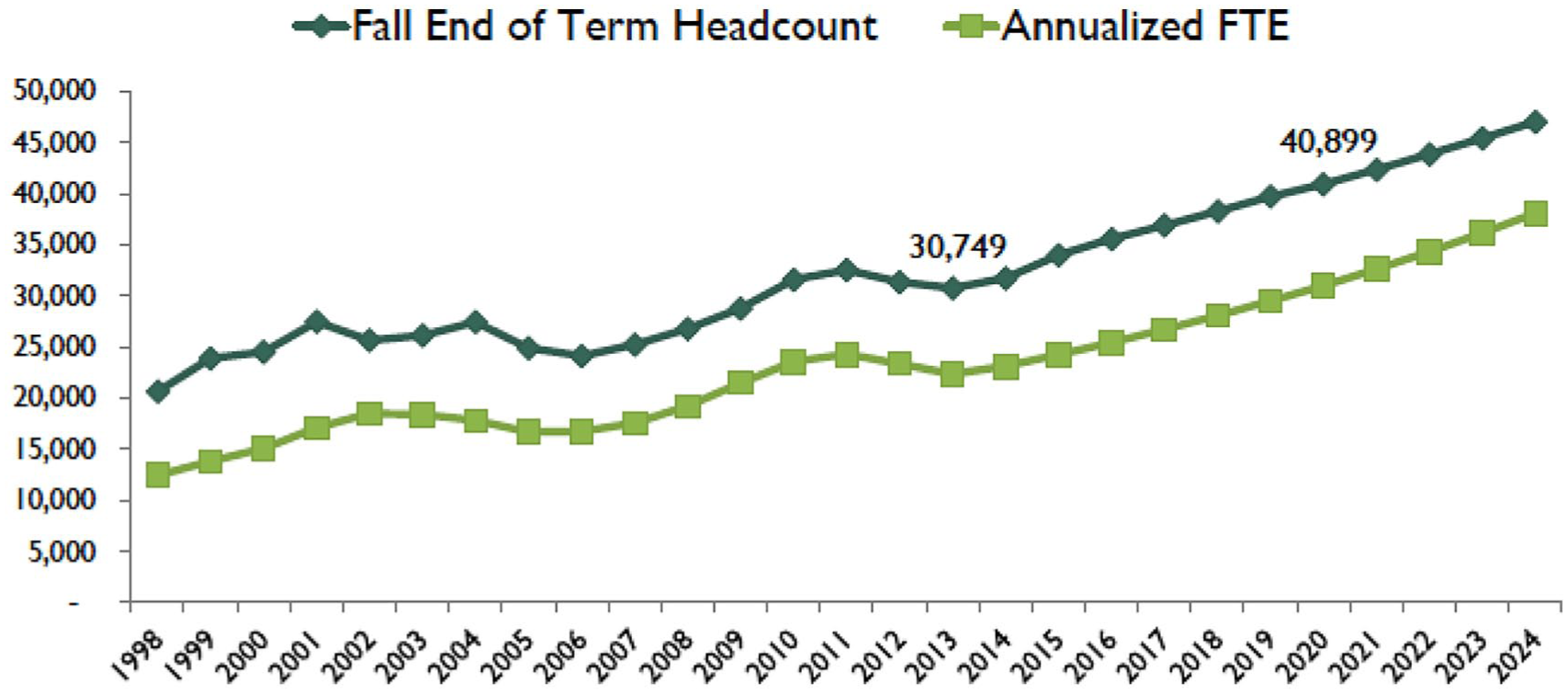
Enrollment history and projections.
Innovation and Change
Growth and a diverse student population have led to a number of innovations designed to enhance learning and fulfill the university’s mission. These reflect the alignment of institutional and business school strategies and an institutional culture of transformation. They also enable the faculty to prepare future leaders and innovators.
Establishing the Foundations for Resilience and Change
Since approximately 2008, the university has engaged in strategic planning to address demographic change and enrollment growth projections. It has demonstrated commitment to its mission while working collaboratively with stakeholders to establish a strong foundation for change. The following discussion demonstrates how the university has implemented structures to support growth and opportunity for faculty, which consequently have a positive impact on a diverse and expanding student body.
Carnegie classification for engaged learning
Based on its roots and continued commitment to serving the community, UVU was awarded elective Carnegie classification for community engaged learning in 2008, defined as a “collaboration between institutions of higher education and their larger communities for the mutually beneficial exchange of knowledge and resources in a context of partnership and reciprocity” (New England Resource Center for Higher Education, n.d.). Carnegie classification for engaged learning is under the stewardship of the Swearer Center for Public Service at Brown University (2018). To support continued development of engaged learning activities, UVU provides the following opportunities through a Title III grant. These opportunities enable faculty innovations in teaching and learning.
Grants for Engaged Learning—Classroom- and non-classroom-based projects, service learning, undergraduate research, learning communities, and inquiry-based learning; awards of $2,500 to $10,000.
High Impact Engaged Learning Grants—Innovative curricular initiatives based on high-impact practices that have a documented effect on student completion and success; awards up to $30,000.
Undergraduate Research, Scholarship, and Creative Activities—Faculty mentoring of upper-division students to conduct research or do creative work, particularly projects relevant to the region; $2,000/student.
Service Learning Fellowships—Training, resources, and mentoring aimed at redesigning courses to include an academic service-learning component; $500 stipend.
Delivery modalities and pedagogy
The Office of Teaching and Learning provides workshops, trainings, and instructional design and technology services. This office is also responsible for leading the institution in an expansion of online and blended courses to address growth and meet the needs of nontraditional students in terms of scheduling flexibility. The institution is actively seeking to change its current ratio of 79% face-to-face, 17% online, and 4% blended courses by increasing online and blended options. This goal is being reached incrementally. For example, in the current semester, 24 new online courses with 43 sections and 20 blended courses with 31 sections were launched. New instructors teaching online numbered 61 with an additional 29 teaching blended sections.
Training pathways and fellowships are a key means of building capacity for success in this endeavor as well as for enhancing teaching and learning generally. Completion of professional development pathways lead to teaching and learning fellowships from the Higher Education Academy (Advance HE, 2018) in the United Kingdom (https://www.uvu.edu/otl/faculty/tep.html). The seven pathways include mastery of fundamental practices; course design and curriculum development; teaching across flexible modes; global, intercultural, and inclusive approaches; pedagogical strategies; academic service learning; and advanced teaching practice. Each pathway consists of six workshops designed to develop related content knowledge and skills.
Four fellowships through the Higher Education Academy are available—fellow, associate fellow, senior fellow, and principal fellow. These are granted on evidence of having met specific criteria based on a framework consisting of three dimensions: areas of activity (what a teaching and learning professional does), core knowledge (what a teaching and learning professional needs to know), and professional values (how a teaching and learning professional carries out appropriate practices). Fellowships reflect a commitment to teaching and support of learning in higher education. They advance the institution’s teaching mission and enhance teaching and learning practice for UVU’s diverse students.
Organizational infrastructure and leadership
To make these efforts successful, changes in organizational infrastructure were needed as well as effective and collaborative leadership. Organizational infrastructure changes included establishing an Office of Engaged Learning with an associate vice president, and more recently, restructuring various campus entities to form the Office of Teaching and Learning and create a strong presence for it. Establishing these units were an institutional priority and as such, they received the support and resources necessary to accomplish their objectives. Transformational success has been enabled due to the leaders of these areas who established faculty-centered task forces to create and implement initiatives and recognize those contributing to short- and long-terms wins.
Enrollment growth has enabled the university to create new administrative, faculty, and staff positions each year, such as those mentioned, which allows the university to hire those who can take the institution in desired directions. Other examples of new positions that have helped build the organizational infrastructure and enable change include a director for a first-generation student office, additional instructional designers to support online course expansion, and new faculty to allow lower class sizes for writing enriched courses. These positions are focused on current and future needs such as changing student demographics (e.g., nontraditional and first-generation students), enrollment growth, and regional employer requirements (e.g., new degree programs and types of degrees).
Innovation and Change in the Woodbury School of Business
As part the transformation and change occurring at the institutional level, the Woodbury School of Business established its own initiatives. In the examples that follow, the first, Whale Tank, was led by the dean, who had the foresight to obtain external funding for faculty innovations that support institutional and college goals for engaged teaching and learning. A fairly recent opportunity, Whale Tank is enabling faculty to enhance faculty-student collaboration and, consequently, to increase student learning engagement.
The second example, referred to as Delta, is essentially the dean’s way to recognize faculty for their efforts. This approach reinforces desirable teaching and learning activities by illustrating their success and motivating through recognition. As such, it contributes to long-term cultural change within the school of business. The final example demonstrates how the encouragement of innovation (accompanied by needed funding) can inspire and enable a single individual, whose enthusiasm and accomplishments then contribute to transformation across the institution.
Whale tank
The Woodbury School of Business holds a bi-annual event called Whale Tank, based on a popular television show, in which faculty members make a case for funding for engaged learning projects by providing a summary, budget, number of students influenced, learning/performance indicators, and measures of success. Successful bids for funding have included local and international consulting and service learning projects, class materials and tools, and industry certifications (e.g., Gallup Strengths Finder). The competition is judged by members of the National Advisory Board for the School of Business who also provide the funding. Faculty members make a brief pitch after which the judges (Advisory Board members) ask questions and vote.
Delta and monster delta
Delta—maximizing student improvement through engaged learning—is one of the core themes of the Woodbury School of Business. Delta projects include student participation in local and national competitions in marketing, strategic planning, personal financial planning, internal auditing case competitions, and others; local, national, and international internships; undergraduate and graduate-level study abroad programs to Europe, Asia, and South America; club leadership (e.g., Society for Human Resource Management, Institute of Internal Auditors, Institute of Management Accountants, Beta Alpha Psi); student business ventures (new companies formed); consulting projects for local businesses, industry certifications (e.g., exams such as the Chartered Financial Analyst Exam; software mastery), industry connections (e.g., job shadowing, company visits, professional meetings, managing speaker series, events), and undergraduate research resulting in presentations and publications through faculty-student mentoring. The dean tracks Delta initiatives and the hours involved. “Monster Delta” projects require a time commitment from students of over 30 hours.
Project Delphinium
An example of online learning innovation in business education, led by one of UVU’s business professors, is Project Delphinium (2018). Its primary aim is to motivate learners by integrating content and pedagogy in a game format to improve student achievement and course completion. This involves the use of game elements such as leaderboards, challenges, and collaborations, all aimed at changing student behaviors and attitudes. They encourage students to self-evaluate, spend an appropriate amount of time on task, and improve assignment quality and completion. Designed for management courses in the Woodbury School of Business, the design features are gradually being rolled out to other courses across the university, demonstrating how this bottom-up innovation has moved beyond school of business boundaries to have a wide institutional impact. In addition to the motivational aspects, creators of the project are aiming for scalability to address enrollment growth.
Key Outcomes
It should be noted that these changes at the institutional and school levels were neither designed to increase student enrollments or diversity nor even to react to changes that had already occurred. Largely, they represented strategic planning based on environmental scans indicating future needs and opportunities. This planning flowed from the institutional level to the business school, demonstrating common vision, unity in achieving that vision, and targeted goals. As a result, they have led to the achievement of key outcomes such an increasing culture of innovation in teaching and learning among the faculty, which corresponds to greater capacity to not only manage enrollment growth and demographic changes but also help students be successful.
Due to effective leadership and well-aligned resource allocation, the changes described have increased capacity for resilience and transformation. The examples shared indicate the viability of both top-down and bottom-up approaches; in all cases, the changes involved the faculty in ways that inspired its creativity, and were founded in its commitment to the students served by UVU. In other words, these transformations released the power of the faculty. Success is also attributed to the institution’s history of transformative capacity, which faculty and staff are proud of and committed to continuing.
Sustaining Capacity for Transformation
Threats and opportunities for schools of business include economic, reputational, technological, social, and psychological (Kovoor-Misra, this issue). For UVU, regional economic growth and significant increases in demand have been drivers for change. Enrollment growth has created a more diverse student population with varying social and psychological needs. As such, the university’s mission and degree offerings have evolved. So, how has the institution remained poised for change, demonstrated resilience, and implemented transformation without becoming overwhelmed?
Although areas within the university compete to some extent for funding and resources related to opportunities for change, transparent budgeting processes allow stakeholders to understand needs across campus and collaborate on resource allocations. In addition, while initiative fatigue can be an issue, accompanied by insufficient staffing (e.g., the institution tends to be in a continual state of catch up in terms of sufficient numbers of staff and faculty), this is addressed through negotiation—Certain projects are put on hold while others are prioritized in the same way that new positions are prioritized collaboratively. In short, an institutional culture has evolved over the years that values transformation, and consequently, stakeholders work together to identify needs and opportunities.
Conclusion
The transformation of business education relies on effective teaching and learning that prepares students to be professionals, leaders, and innovators in local and global communities. The innovations described demonstrate how UVU and the Woodbury School of Business are transforming what we teach, how we teach, and where we teach. As a public institution, our resilient response is different from the private schools that are also highlighted in this dialog series such as the University of Denver and Redlands. For us, enrollment has not been an issue, whereas engaging students with varying levels of academic preparation in ways that will enable their success is paramount. To accomplish this, we have looked for creative ideas (e.g., Whale Tank) and funding (e.g., Title III grants) which support our elective Carnegie classification as a community engaged institution to be resilient and change in support of our mission.
The initiatives described could be adopted or adapted by other schools of business; however, much of their value lies in the fact that they are based on a specific context and mission. Institutions must respond to their own challenges and opportunities. Collectively, schools of business can transform business education to prepare students in advance for areas of study and practice that may not even be on the horizon as of yet. Success will depend to a large extent on institutional culture in terms of reflecting the values of resilience and change, and also on finding the right people to effectively manage transformation.
Footnotes
Declaration of Conflicting Interests
The author(s) declared no potential conflicts of interest with respect to the research, authorship, and/or publication of this article.
Funding
The author(s) received no financial support for the research, authorship, and/or publication of this article.
