




Abstract
In blurring the distinction between third- and first-person perspectives of entrepreneurial action, current theories fail to differentiate the knowledge domains of scholars and entrepreneurs. We develop a shift in theorizing entrepreneurial action, focusing on a self engaged in practical reasoning. In our framework, entrepreneurial action is what makes one an entrepreneur—there is no entrepreneur prior to it. We elucidate entrepreneurial action as implicating a complex intention, with the entrepreneurial self as the cause of action. Entrepreneurship thus entails time-extended, social agency: entrepreneurs act both in the present and for the future. By regaining the first-person footing of entrepreneurial action theory, we open new avenues for theoretical development.
Keywords
If Mary wanted to meet her new colleague John, and it turns out (when she meets him) that he is a classmate of her cousin, it would be inappropriate to say that Mary wanted to meet her cousin's classmate. What Mary knows when she expresses her desire to meet her new colleague differs from knowing that John is a classmate of Mary's cousin. Conflating what Mary desires with facts about John results in referential opacity, exemplified by the falsity of the statement “Mary wanted to meet her cousin's classmate.” This misattribution of Mary's intentional state arises from the failure to distinguish between statements about desires articulated from her own first-person point of view and facts that can be known from a third-person point of view.
This distinction between first- and third-person perspectives is fundamental to any adequate theory of human action (Anscombe, 1957/2000; Davidson, 1963; Korsgaard, 2009; Searle, 2001), including theories of entrepreneurial action (Dimov et al., 2021; Packard, 2017; Packard & Madjdi, 2026; Ramoglou et al., 2020). When agents deliberate and act, they hold propositional attitudes such as beliefs, desires, and intentions, directed toward imagined states, possibilities, or outcomes. These attitudes structure how agents orient themselves toward the world and guide their actions. Yet, propositional attitudes operate within a different logical frame than third-person descriptions of those same agents’ contexts or outcomes. What an agent wants and believes when deliberating (first-person) differs fundamentally from what an observer or theorist knows about that agent's situation (third-person). Conflating these perspectives by allowing third-person knowledge to seep into descriptions of first-person deliberation distorts our understanding of the logical structure of intentional action.
This conflation becomes especially problematic when theories are used to provide retrospective accounts of time-extended phenomena. Consider two agents at t0, each deliberating about and pursuing imagined future ventures under uncertainty about their actualization (Ramoglou, 2021). From their first-person perspectives, both hold propositional attitudes of the form “I believe the venture is possible and worth pursuing.” At t1, after outcomes are known, a third-person observer might be tempted to characterize one as having pursued what was in fact possible, and the other as having pursued what was only imagined. While such distinctions are meaningful retrospectively, confusion arises if they are imported into descriptions of the individuals’ original first-person deliberative frame, since such knowledge was unavailable to both at t0. Thus, at t0, neither the agents nor any third-person observer could know which, if any, possibilities would actualize at t1. A theory that incorporates such post-hoc third-person knowledge into its description of deliberative states risks mischaracterizing how agents actually reason and decide what to do.
This essay argues that theorizing about entrepreneurial action requires a reframing in order to adequately distinguish what agents can know from their own first-person perspective and what theorists can observe from their third-person perspective. We call for this reframing because questions about the conditions for entrepreneurial success and questions about what it means to act entrepreneurially require different logical foundations. Our work addresses the latter, complementing existing approaches to address the former. We develop a first-person account of entrepreneurial action as the constitution of a self embarking on a venture creation process. This entrepreneurial self must navigate tensions in deliberating what to do. In our framework, entrepreneurial action is what makes one an entrepreneur—there is no entrepreneur prior to it. To develop our framework, we draw on ideas from analytic and moral philosophy of action to elucidate entrepreneurial action as implicating a complex intention, with the entrepreneurial self as the cause of action. Entrepreneurship thus entails time-extended, social agency: entrepreneurs act both in the present and for the future. We argue that the challenge for a normative theory of entrepreneurial action is not instructing entrepreneurs about what to do, but rather enhancing their capacity for practical reasoning as something that must be both practical and reasoned.
Our main contribution lies in opening space for first-person practical reasoning in theories of entrepreneurship. In effect, we switch the pronouns of the theory from “they” (entrepreneurs as external to the theorist) to “I” (the theorist adopting the stance of the entrepreneur). This eases the application of the theory as a guide to action. Anyone adopting the theory can readily occupy the space of “I.” In this way, our work facilitates the development of self-knowledge through which entrepreneurs can enhance their practical reasoning. By understanding how their intentions and actions constitute them as entrepreneurs over time, they become better practitioners.
The essay is structured as follows. We discuss the tension between first- and third-person accounts of entrepreneurs, before providing a philosophical analysis of the logical structure of propositional attitudes and highlighting key blindspots in prominent accounts of entrepreneurial action. Next, we provide the conceptual foundations for entrepreneurial action as a future-oriented practical reason and thus an expression of an entrepreneurial self. Finally, we discuss the constitution of the entrepreneurial self, highlighting its holistic nature, its time-extended agency, and its social entanglement.
What Can We Know About Entrepreneurs?
The problem of delineating what agents know when acting from what observers can know after the results of those actions transpire is particularly acute in developing entrepreneurial action theory (EAT) (e.g., Alvarez & Barney, 2007; Dimov, 2021; Fisher et al., 2021; Lerner et al., 2018; McBride & Wuebker, 2022; McMullen et al., 2021; McMullen & Shepherd, 2006; Sergeeva et al., 2021; Wood et al., 2021). Consider Sophie, who begins deliberation at t0 and acts entrepreneurially at t1, Sophie can be described as an entrepreneur at t1, but not at t0. Yet, an adequate theory of entrepreneurial action needs to capture Sophie both deliberating at t0 and acting at t1. If the theory describes Sophie as an entrepreneur at both points in time, it renders itself blind to how Sophie constitutes herself as an entrepreneur by acting. More fundamentally, Sophie's deliberation at t0 involves propositional attitudes toward radically uncertain futures: she envisions possibilities whose existence, actualizability, or value remain genuinely uncertain (Packard et al., 2017; Ramoglou, 2021; Townsend et al., 2018).
EAT must accommodate these propositional attitudes without importing third-person ontological commitments (about whether certain things “really exist” or “will come to exist”) that are unavailable within Sophie's first-person deliberative perspective. This issue is particularly pressing in light of the recent development of an actualization view of entrepreneurship (AVE), according to which entrepreneurial work entails the actualization of “desired and believed-to-be-possible futures” (Ramoglou & McMullen, 2024, p. 274). Because “futures” are implicated both in propositional attitudes (as desired) and in third-person posits (as actualized), the concept calls for careful logical treatment.
Although scholars have recognized the importance and irreducibility of the first-person perspective of entrepreneurs in understanding their actions (Dimov et al., 2021; Johnsen & Holt, 2023; Packard, 2017; Packard & Madjdi, 2026; Ramoglou et al., 2020; Thompson et al., 2023), EAT has not fully taken their implications into account. At the core of discourse about entrepreneurial action are conceptual distinctions that blur the disparate logical frames of third- and first-person perspectives, thereby risking misattribution of intentional states (Dimov et al., 2025). For example, discussions of third-person opportunities (McMullen & Shepherd, 2006), entrepreneurial agency as transformative capacity (McMullen et al., 2021), or entrepreneurs as “midwives of the possible” (Ramoglou & McMullen, 2024) valuably integrate system- and individual-level theories of entrepreneurship. Yet, such integration requires care to avoid slippage between what scholars can observe and what entrepreneurs believe. Our work provides logical tools to maintain this distinction.
Propositional attitudes provide the conceptual ground needed for preserving the first-person perspective. The something in “I want to achieve something” (first-person) operates within a different logical frame from the something in “Something s/he achieves” (third-person). Entrepreneurs’ propositional attitudes toward uncertain futures differ structurally from scholars’ third-person descriptions of entrepreneurial contexts (Townsend et al., 2018, 2024), rendering different senses of what is possible or worth pursuing (McBride et al., 2023). Therefore, assessing conditions that influence entrepreneurial outcomes (third-person analysis) is a different intellectual exercise from understanding how individuals reason, from within their own perspectives, about which actions might advance their aspirations (first-person practical reasoning). A first-person perspective needs its own conceptual ground that doesn’t presuppose third-person knowledge about which possibilities “really exist” or which ventures will succeed.
Properly accommodating the first-person perspective requires attending to the logical structure of propositional attitudes. This requires sensitivity to how the scope of existential quantification affects the coherence of statements about intentional action. At stake is how we talk about existence (logic of propositional attitudes) rather than an argument about what exists (ontology). When we describe entrepreneurial action with statements like “Entrepreneur E pursues opportunity O,” the scope of existential quantification matters crucially. Drawing on Quine's (1956) analysis of referential opacity, we can distinguish:
Quantifying into the propositional attitude: “There exists an O such that E pursues O.” This commits us to O's independent existence before we describe E's intentional state. Quantifying within the propositional attitude: “E pursues what E believes to be an O.” This captures E's first-person orientation without presupposing O's ontological status.
The former imports third-person ontological commitments into descriptions of first-person deliberation; the latter preserves the logic of how the agent actually relates to imagined possibilities. This distinction provides the conceptual ground the first-person perspective requires. Consider Sophie again. At t0, we might describe her as “pursuing an opportunity in sustainable fashion.” But what does this description commit us to? If we quantify into her propositional attitude, we assert: “There exists an opportunity in sustainable fashion such that Sophie is pursuing it.” This presupposes the opportunity's independent existence. But if we quantify within, “Sophie is pursuing what she believes to be an opportunity in sustainable fashion,” we capture her intentional orientation without settling whether the opportunity pre-exists, will be created, or represents some other modal category. The second form preserves Sophie's first-person perspective; the first imports third-person ontological claims.
This logical framework is not merely technical precision for its own sake. It provides the foundation for understanding entrepreneurial action as practical reasoning. When entrepreneurs deliberate, they don’t begin by asking, “Do opportunities exist ontologically?” They ask practical questions: “What should I do? What can I do? Is what I can do worth doing?” These questions involve propositional attitudes toward imagined possibilities whose existence, actualizability, or value remain genuinely uncertain. Practical reasoning operates within the first-person perspective of the deliberating agent. It requires evaluating possible courses of action against both normative considerations (what should be done?) and feasibility assessments (what can be done?) without presupposing third-person knowledge of outcomes. The tension between these dimensions—whether what can be done should be done, or whether what should be done can be done—structures entrepreneurial deliberation. This tension can be analyzed properly only if we describe propositional attitudes using logical forms that preserve the first-person perspective. How can we understand the practical reasoning involved in entrepreneurship from a first-person perspective?
Entrepreneurship From a Logical Point of View
When someone aspires to be an entrepreneur, we typically understand that they would like to run their own business one day. Similar to “building a house,” this is an abstract aspiration, related to something not yet defined. Even though the person wants to do something, they may not have anything specific in mind. The conditions for fulfilling such an abstract aspiration are twofold. First, the something needs to be specified: the person must define the particular business they want to run or the specific house they want to build. Second, the something needs to be realized: the business and the house have to be built. Accordingly, as the person reasons about what to do, they can question (1) whether their specification is clear and compelling enough or (2) how they can realize what is specified. Questions of the first sort concern whether something should be pursued; questions of the second sort concern how it can be achieved. Thus, entrepreneurs may pursue something impossible or achieve something trivial.
What is specified—something or it—is a linchpin that gives focus and impetus to the entrepreneurial aspiration and holds together the two questions. We could even say that it makes talk of entrepreneurial action possible, for now there is something that the action is about. It needs to play a fundamental role in EAT, yet it poses a distinct theoretical challenge because it (e.g., the specific business) is not exogenous to the acting person, but rather endogenous. In other words, it arises within a first-person space of reasoning. Thus, any theory that treats it as exogenous is bound to entangle itself in ontological questions (does it exist?) that stir referential opacity. For instance, a theory of someone searching for a solution to a mathematical problem needs to make the solution endogenous to the person's belief structure and not exogenous, thereby avoiding discussion of whether the solution exists. Or else, this theoretical term becomes problematic.
Under-appreciation of this subtle move has been a blindspot for theories of entrepreneurial action. To illuminate this blindspot, we offer a philosophical analysis that helps evaluate some key perspectives of entrepreneurial action on the basis of their treatment of propositional content, i.e., the content of the various intentional states exhibited by entrepreneurs, such as beliefs, desires, intentions, hopes, etc. At stake is how the logical structure of such propositional content is aligned with the stance from which a scholar builds their theory.
A theory involves entities, and some of its statements provide existential quantification of these entities, i.e., they posit the existence of such entities in a certain domain. Thus, the statement “there are entrepreneurs” can be expressed logically as (∃x)(x is an entrepreneur), i.e., there exists x such that x is an entrepreneur. Propositional attitudes—that is, mental states that are about some proposition or content—pose particular challenges to existential quantification, arising from the distinction between quantification within and into a propositional attitude (Quine, 1956). Consider again the example of the person looking for a solution to a hitherto unsolved mathematical problem and what marks its propositional attitude: something that the person strives to find.
Quantification into this propositional attitude has the following form:
(∃x)(x is a solution. The person strives that they find x).
In this formulation, the existence of a solution is posited (quantified) as exogenous to the striving of the person for the purpose of explaining their striving. A theory involving this statement thus commits us to the existence of a solution, which in turn gives rise to discussions of whether such solution really exists. The challenge here is that whether the solution exists is genuinely uncertain: it may exist, it may not. 1 Under this formulation, we are compelled to settle first ontological questions related to whether the solution exists before we move to understanding and evaluating the person's propositional attitude. This is a side track that we aim to avoid.
The person's behavior is perfectly rational and coherent when we quantify within their propositional attitude. This has the following form:
The person strives that (∃x)(x is a solution. The person finds x)
Here, the solution is part of the content of the person's propositional attitude and does not refer to anything outside of that content. Thus, there is no commitment to the existence of a solution. We stay within the first-person perspective of the problem solver. We understand perfectly what they are trying to do, without having to consider whether a solution exists.
This formulation appropriately captures the entrepreneurial condition. Entrepreneurs work on market problems for which profitable solutions may or may not exist (Ramoglou & McMullen, 2024), just as mathematicians work on problems whose solutions may or may not exist. How we talk about existence—the logical scope of existential quantification—matters for making sense of statements about intentional action. We know entrepreneurs are after something, but for their actions to make sense, there is no need to consider whether this something pre-exists their actions. Avoiding this move prevents entanglement in referential opacity when there is a mismatch between what is known outside the scope of a propositional attitude and what is known within it. Accounts of entrepreneurial action that invoke propositional attitudes thus need to be developed within the reasoning space of the agent. The agent provides a context in which the pronoun “I” designates who engages in practical reasoning. As the next section shows, we are not always interested in the “I” of entrepreneurial action; sometimes, it is sufficient to use “they.”
Entrepreneurial Action in Theories of Entrepreneurship
Entrepreneurial action is something that both explains and needs explaining. It can be both an input and an output of theoretical accounts, one directing us to the action's effects and the other to the reasons behind it. Therefore, not all theories of entrepreneurship require a (first-person) account of entrepreneurial action. When we as theorists take a systemic view of economic activity—a dynamic arena in which we observe the introduction of new goods and services, the creation of new businesses, and the generation of new value as entrepreneurial outcomes—we occupy a third-person stance in which entrepreneurial action is something we take for granted. We are external observers who can record what transpires and then provide theoretical explanations, as reflected in research questions about how future goods and services come into existence (Venkataraman, 1997). This view calls for a theory of entrepreneurial outcomes, which can only arise if entrepreneurial action has taken place (McMullen et al., 2021). The actions of entrepreneurs are third-person phenomena, that is, what entrepreneurs do can be observed and documented. Simply put, entrepreneurial outcomes require entrepreneurial actions.
Yet, entrepreneurial action does not require entrepreneurial outcomes. If we are interested in the reasons people have for acting, we need first-person accounts. Reasons are invoked in the deliberation of actions and include various intentional states such as beliefs, desires, hopes, fears, obligations, intentions, commitments, etc. (Dimov et al., 2021; Packard, 2017). As such, actions implicate propositional attitudes as reasons one chooses to act upon (Searle, 2001). This calls for a theory of entrepreneurial action, in which propositional attitudes take center stage.
Entrepreneurial outcomes are a function of entrepreneurial action, and entrepreneurial action is a function of propositional attitudes. These functions operate in distinct domains: why one does something and what happens as a result are qualitatively different questions, posed in first- and third-person senses, respectively. Building on Kant's distinction, Korsgaard calls this a difference between looking at ourselves as phenomena and noumena: “We view ourselves as phenomena when we take on the theoretical task of describing and explaining our behavior; we view ourselves as noumena when our practical task is one of deciding what to do” (1996, p. 204).
Blindspots arise when the two functions—deciding to do something and explaining what happens as a result—are combined into a single theory. Without regard for the logical discontinuity between first- and third-person perspectives as domains for existential quantification, we can regard entrepreneurial outcomes ultimately as a function of propositional attitudes. This enables the theorist of entrepreneurship to totalize what to the actor occurs only in succession (Dimov, 2020). As a result, a tension arises: while understanding entrepreneurial outcomes requires quantification outside of propositional attitudes, understanding propositional attitudes requires quantification within them. Thus, when a third-person term slips into a first-person account, referential opacity arises, and unnecessary considerations about existence soon follow.
Consider McMullen and Shepherd's (2006) comprehensive theory of entrepreneurial action. Its explanation entails a two-stage process in which an individual first acknowledges a third-person opportunity (for someone) and then evaluates it as a first-person opportunity (for themselves). Third-person opportunities are conceptualized as objective preconditions for entrepreneurial success, such as latent market demands that can be seized by introducing new products or services (Shane & Venkataraman, 2000). The claim that such objective preconditions exist is made from a third-person perspective elaborated through a disequilibrium perspective of the economy (Eckhardt & Shane, 2003), outside of any individual propositional attitudes. The value of the McMullen and Shepherd (2006) model lies in its connecting system- and individual-level theories of entrepreneurship. Yet, when third-person opportunities are posited as objects of attention and evaluation for prospective entrepreneurs, a slippage occurs into the first-person account, rendering an existential quantification into propositional attitudes. The logical structure of this argument can be expressed as follows:
(∃x)(x is a third-person opportunity. An individual acknowledges and evaluates x)
This formulation leads us to consider whether the “opportunity” that an individual describes is indeed the kind of thing (x) posited to exist. We are thus primed to wonder what the individual is referring to. If success proves elusive, and we cannot find any fault in the individual's abilities, we may reasonably conclude that what the individual pursued was not really x, that is, they pursued “what was never possible.” Hence, if we are interested in how prospective entrepreneurs reason, we fail to appreciate that their actions are expressions of propositional attitudes and not a function of a third-person account of the world. Thus, what a totalizing theorist can say about third-person opportunities is different from how a prospective entrepreneur can reason with them.
Similar slippage occurs with the terms “entrepreneur” and “entrepreneurial.” Consider the argument that a defining feature of entrepreneurship is structural transformation, which in turn requires the exercise of entrepreneurial agency: to realize its objective, the action must transform to some degree the structure in which it takes place (McMullen et al., 2021). Interest in entrepreneurial action thus focuses “attention on those agents who exercise the power of transformative capacity—which we define as the capability to intervene in worldly events to produce definite outcomes by getting circumstances and others to comply with one's wants” (McMullen et al., 2021, p. 1200).
But what does it mean for someone to have “transformative capacity”? That the entrepreneur is transformational is a dispositional statement similar to “sugar is soluble,” meaning that sugar would dissolve if submerged in water; similarly, the world would change in specified ways if the entrepreneur acts. As Ryle (2009) points out, “dispositional statements about particular things and persons are also like law statements in the fact that we use them in a partly similar way” (p. 108). As a particular sort of dispositional statement, capacities involve performance-verbs (e.g., transform), which signify achievements, that is, “not merely that some performance has been gone through, but also that something has been brought off by the agent going through it. They are verbs of success” (Ryle, 2009, p. 114). While task verbs (e.g., play, search) refer to some ongoing activity, achievement verbs (e.g., win, find) do not refer to anything that an agent does beyond the corresponding task-verb activity, but simply report the success of that activity. When we use an achievement rather than a task verb, “we are asserting that some state of affairs obtains over and above that which consists in the performance, if any, of the subservient task activity” (Ryle, 2009, p. 132). Thus, in finding something, one does not do anything beyond searching, but something additional is asserted as an outcome of the search process.
This suggests that in seeing the entrepreneur as someone who has and exercises “transformative capacity,” we recognize both the activity of attempting to transform (i.e., the task-verb correspondent of transform) and the success of that activity. The logical structure of the description (definition) of an entrepreneur can be expressed as follows:
(∃x)(x is a transformation. An individual attempts and achieves x)
Here, the outcome (x) is quantified outside of propositional attitudes. However, the conjunction of “attempts” and “achieves” is a red flag for one expresses a propositional attitude and the other does not. Therefore, (x) is quantified into the propositional attitude expressed by “attempts.” We can avoid this by separating what the individual attempts to achieve from what the individual achieves:
An individual strives for (∃x)(x is a transformation. The person achieves x) (∃y)(y is a transformation. The individual achieves y)
In the first expression, we have someone striving to achieve something, that is, an attempt. In the second expression, we have a statement about what someone has achieved. There is no question of x = y for x is something thought and y is a state of the world. X is quantified within a propositional attitude; y is quantified outside of it. It is when the identity of x and y is asserted that problems of referential opacity arise.
Ramoglou and McMullen (2024) rightly emphasize that “opportunity” as an entity does no theoretical work. Instead, an entrepreneur's use of this word involves what Ramoglou and McMullen (2024) call “confidence talk”: entrepreneurs express beliefs in the existence of conditions that would allow actions to realize a desired future. Our framework extends this insight by clarifying where the concept of opportunity does meaningful work: within propositional attitudes, as the content of entrepreneurial striving. This preserves the separation of striving (first-person) and achieving (third-person) that both approaches recognize as important. Thus, we can formalize the definition of entrepreneur around the propositional-attitude statement alone—it is about striving, the exertion of effort, taking action. By implication, there is no entrepreneur if there is no striving; there is just a person.
Where does striving come from? Is it a question of necessity as external determination or of autonomy as self-determination? The autonomy of human decision-making reveals itself in individuals opting not to act despite fulfilling all seemingly necessary conditions (Dimov et al., 2021; Packard, 2017). Unlike a rock moving unquestionably in response to sufficient external force, humans act based on reasons—normative commitments to particular actions (Korsgaard, 2009; 2019; Mitchell, 2023). These reasons can only be understood from a first-person perspective, where the agent decides that a motivation is worth pursuing or that a skill is worth deploying. This is how someone constitutes themselves as an entrepreneur by acting, by becoming a striver.
Future-Oriented Practical Reasoning
Complex Action
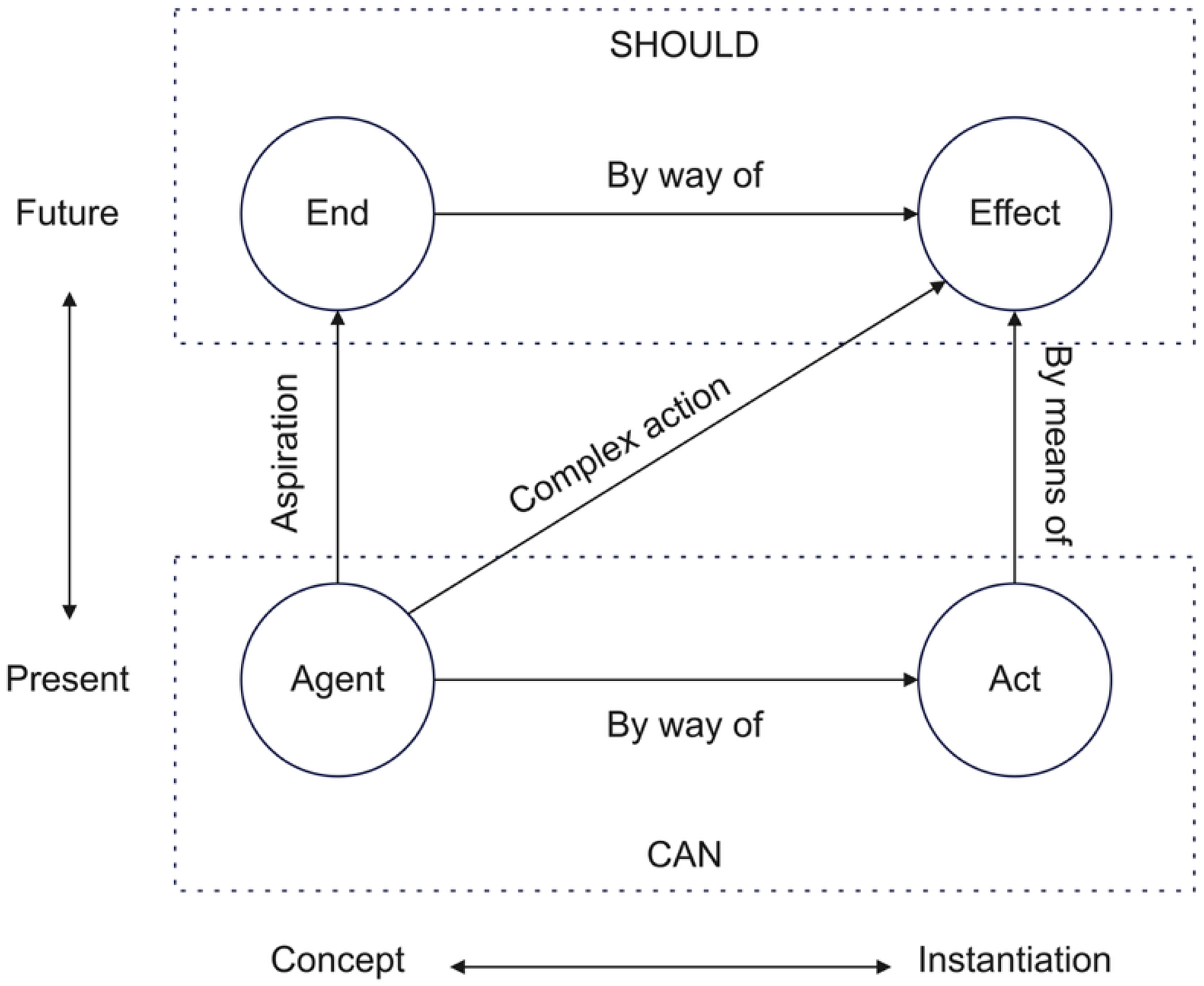
When we theorize about entrepreneurial action, the basic assumption is that the specific acts done by someone are means related to the end of creating a future business (Alvarez & Barney, 2007; Dimov & Pistrui, 2020; McMullen & Shepherd, 2006; Wood et al., 2021). But how can we establish this relationship? In her analysis of different decision-making logics, Sarasvathy (2001) makes an important distinction between ends, effects, and means. Ends denote abstract aspirations (e.g., becoming rich), effects denote particular operationalizations of such ends, and means denote how particular effects can be achieved. An important distinction arises between constitutive and causal relations regarding the satisfaction of certain ends (Searle, 2001).
A constitutive relation is a by-way-of relation. It determines what counts as satisfying the end. For instance, someone can vote by way of raising their arm. In this case, raising the arm does not cause voting but counts as voting. In contrast, a causal relation is a by-means-of relation. It determines the steps to be taken to reach the end. For instance, one can vote by means of taking the bus to the voting station. With this distinction in mind, it is clear that Sarasvathy's (2001) notion of effect as the operationalization of an end specifies a constitutive (by-way-of) relation between effect and end. In turn, means have a causal (by-means-of) relation to the effect.
On this basis, we present in Figure 1 a framework for understanding human action that distinguishes, on the one hand, an agent (the doer) and an act (what is done); and, on the other hand, an end and an effect as what is ultimately intended by the act (why it is done). The relationships between agent and act, and between end and effect, are relationships between an abstract concept and its instantiation. Indeed, speaking of an abstract end identifies no particular thing that is desired. This concept thus requires an instantiation as a by-way-of relation. Similarly, speaking of an agent identifies no particular thing that is done. It is the act that instantiates the agent as such. This is also a by-way-of relation.
A framework for understanding complex action.
In turn, agent and act pertain to the present, while end and effect pertain to the future. The relationships between agent and end, and between act and effect are causal in nature (by-means-of). The connection between the agent and the end comes through an aspiration, the enactment of which is to bring about the end. The connection between act and effect is such that the act can be seen as part of a chain of actions that could bring about the effect.
With this in mind, to say that the effect is something future-focused that the agent intends to bring about is to recognize that this entails complex action on the part of the agent. That is, obtaining the effect requires a multitude of connected actions over time—it is not down to the current act, which simply sets the chain of actions in motion. In contrast, what can be described as a simple action would involve no end and no separate effect, that is, no future objectives. It is an action entirely focused on the present, whereby the act is performed for its own sake.
To speak of complex action, therefore, activates two distinct pathways that can be seen (mathematically) as the derivation of the agent→effect vector. The first pathway is the sum of the agent→end and end→effect vectors. That is, the agent aspires for an end that is instantiated by the effect. The second pathway is the sum of the agent→act and act→effect vectors. That is, the agent acts and the act can ultimately lead to the effect. Thus, the agent→end→effect pathway specifies why the agent intends the effect, i.e., it provides a reason for the complex action. And the agent→act→effect pathways specify how the agent will fulfill this intention, i.e., it provides the means for the complex action.
Given this distinction between reason and means for the complex action, the two by-way-of relations have different meanings for the agent. The link between end and effect specifies what the agent should do by virtue of what they aspire for, while the link between agent and act specifies what the agent can do by virtue of what outcomes they seek to obtain. The two aspects of the action–should and can–are brought together in the by-means-of relation that connects the act and the effect. This relation represents a complex intention when seen from the perspective of the initial act, as discussed in the next section.
Complex Intention
What does it mean for an agent, by doing an initial act, to intend a future effect that requires more than the initial single act and takes time to achieve? Feinberg (1970) introduces a distinction between complex and simple acts in terms of their causal complexity. While a simple act requires “no earlier doing as a means,” a complex act produces results “by mean of other, relatively simple, constitutive acts” (Feinberg, 1970, p. 132). In Feinberg's (1970) words, “this well-known feature of our language, whereby a man's [sic] action can be described almost as narrowly or as broadly as we please, might fittingly be called the ‘accordion effect’, because an action, like the folding musical instrument, can be squeezed down to a minimum or else stretched way out” (p. 134). It enables us to replace an ascription of causal responsibility with an ascription of agency. Thus, “Peter did A, which caused X in Y” can be replaced with “Peter X-ed Y.”
Searle (1983) develops this idea formally by arguing that not all intentional actions have prior intentions. Indeed, one could do something on the spur of the moment, without having thought about it beforehand. Where prior intentions are involved, their fulfillment requires causal self-reference between the prior intention and the conditions of its satisfaction. For instance, if a person has the prior intention to go for a run, and this person realizes that a colleague has inadvertently left work with her jacket, thereby prompting her to chase after the colleague's car, the person ends up running, but not because of their prior intention to do so.
Consequently, an agent can meaningfully intend only what her intention can cause. Thus, complex acts require more extensive practical reasoning since they involve complex intentions. Searle defines complex intentions as “those where the conditions of satisfaction include not just a bodily movement a, but some further components of the action, b, c, d,…, which we intend to perform by way of (or by means of, or in, or by, etc.) performing a, b, c,..., and the representation of both a, b, c,… and the relations among them are included in the content of the complex intention” (1983, p. 99). In other words, to say “Peter X-ed Y” instead of “Peter did A, which caused X in Y,” there needs to be a formal set of relations that show how A leads to X.
For example, to say that an agent launched business Y is to recognize a set of relations that convey a belief by the agent about how some initial action by this agent can ultimately lead to the creation of Y. Such relations need to be included in the content of the agent's complex intention to launch the business Y. If not, we can’t say the agent intended to launch business Y (despite their desire to do so). While the chain of actions up to some ultimate business-launch outcome can be revealed retrospectively by re-tracing the story of business Y, they are difficult to specify prospectively, as part of someone's complex intention to launch some imagined future business Y, while performing some initial act, such as registering Y's domain name.
What is at stake, in this case, is whether someone can say both “I am registering Y's domain name” and “I am launching business Y.” While the first statement is unproblematic as it describes the person's intention-in-action, the second statement requires a plausible link between the initial act and the ultimate outcome. Some might ask, isn’t it enough for the agent to simply say they are launching Y, even if they do not have any idea of how their initial action might eventually lead to the creation of Y? By Searle's (1983) formal account above, this is not a complex intention at all, as there is no link between the intention and the conditions of its satisfaction (the launch of Y).
How is the link between an entrepreneurial intention as expressed in the present and the creation of a new business as the future fulfillment of that intention established (Dimov, 2021)? As Searle (1983) argues, when there is no causal self-reference between a prior intention (e.g., the intention to launch Y) and the conditions of its satisfaction (e.g., Y actually being launched), there is no intention but just a desire and a belief. A causal self-reference involves not only that the agent believes that registering Y's domain name is required to launch business Y and desires to do so, but also that they engage in practical reasoning based on this belief and desire, which results in a prior intention that causes them to launch business Y by-means-of registering Y's domain name, to be followed by further by-means-of relations (Searle, 2001). In this way, registering Y's domain name becomes one step in the chain of actions required to fulfill the complex intention of launching business Y. Unless there is a causal self-reference between the prior intention and the condition of satisfaction for the action, a belief or a desire “can be about anything and not just about what it can cause” (Searle, 1983, p. 105). In other words, for the agent to say credibly that by registering Y's domain name, they are also launching Y, they should be able to answer questions about the course of action that connects the two. As we will argue in the next section, to make the theoretical claim that by taking some specific action, someone is also acting entrepreneurially requires the presumption of a complex intention.
Entrepreneurial Action Revisited
What follows from the previous section is a formal way of engaging critically with reports of entrepreneurial intention and thus with presumed instances of entrepreneurial action. Consider the following situations in which such critical engagement may be warranted. In every situation, when someone states an intention to create a future business, they are asked what they have in mind and/or what they will do. The answers that follow represent cases of increasing specificity:
I don’t know yet what business. I am not sure what business, perhaps something to do with coffee. A coffee shop, but no specific concept yet. A coffee shop with a specific concept, but no specific course of action. A coffee shop with a specific concept and a specific course of action.
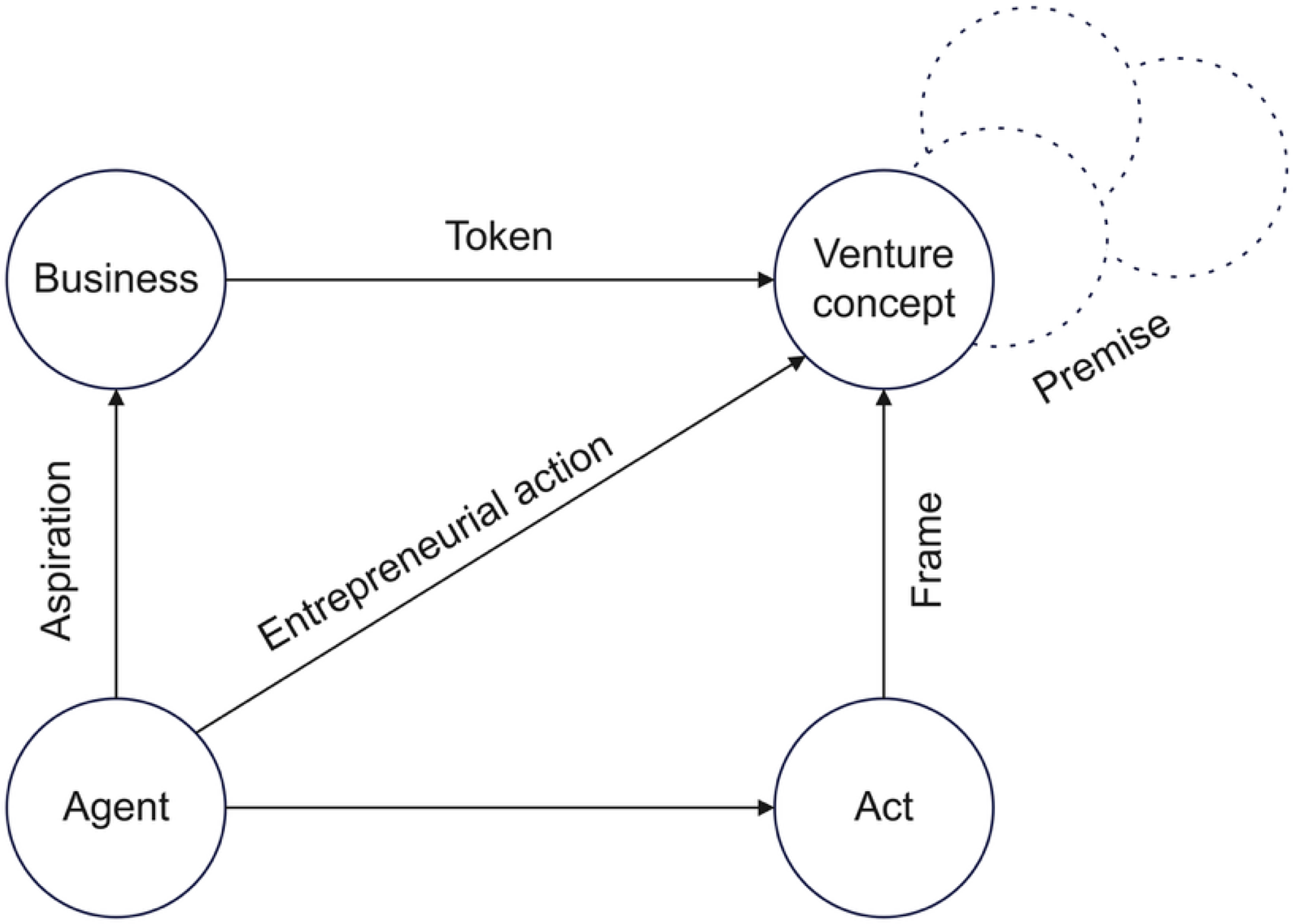
We argue that only the last case warrants someone to say they are creating a future business (coffee shop) by taking initial action. This is the only case where the person has a sense of something concrete they want to do—a venture concept 2 outlining why and how the coffee shop will operate—and is taking concrete steps to bring this business to life, e.g., renting a location, purchasing inventory, acquiring an espresso machine, hiring a barista, and registering a domain name. In all the other cases, the agent has a desire that becomes more concrete as they move from 1 to 4. We illustrate this idea in Figure 2, which builds on Figure 1 and portrays an agent who performs a specific act, raising the question of whether this act can also be described as entrepreneurial action. In all cases, there is an aspiration to establish a future business. In cases 4 and 5, this aspiration is given a particular instantiation in the form of a venture concept, but only in case 5 is this concept linked causally to current acts. In this sense, entrepreneurial action is a type of complex action in that it needs a future effect as an instantiation of a general aspiration and a set of (by-means-of) relations between the current act and future effect.
A framework for understanding entrepreneurial action.
The venture concept thus represents a focal point for entrepreneurial action: a holistic token, frame, and premise for the specific acts involved in creating a future business (Nair et al., 2022; Vogel, 2017). It is a token of the general aspiration to establish a business. It is a frame for enabling complex action by virtue of establishing by-means-of relations to the current act. It is a premise for further inquiry in that it is not final but tentative, subject to change while remaining a token and a frame (i.e., a connecting point for general aspiration and current action).
Crucially, we refer to agent and not to entrepreneur in Figure 2, because although the current act is an instantiation of agency, it is not an instantiation of entrepreneurial agency unless the performed act can also be described as an entrepreneurial action. In other words, it is by engaging in entrepreneurial action that one is constituted as an entrepreneur (Dimov et al., 2021). There is no entrepreneur prior to or in the absence of entrepreneurial action.
Using the eventual establishment of a business as a basis for describing someone as an entrepreneur or an action as entrepreneurial should be treated with caution. This is a functional interpretation that serves to ascribe intentions retrospectively, regardless of whether such intentions were indeed present at the start (Packard, 2017). Thus, if someone with a general aspiration to start a business does eventually start a business, it is tempting to assume that the aspiration was in fact an intention, thereby counting the person as an entrepreneur from the very start. We argue, instead, that the person was not an entrepreneur at the start (i.e., their initial action was not entrepreneurial), but they did become an entrepreneur at some point during the process of creating the business. It is at that point, when the person has a specific venture concept and a specific course of action in mind, that their action becomes entrepreneurial. By acting entrepreneurially, the person constitutes themselves as an entrepreneurial self.
Constituting the Entrepreneurial Self
For Korsgaard (2009, 2019), we constitute ourselves as agents by acting. This raises the “paradox of self-constitution” (Korsgaard, 2009, p. 35): how can one constitute oneself through action unless one is already an agent? The solution to this paradox, according to Korsgaard (2009), lies in recognizing that the self is simultaneously the cause of the action and being constituted by acting. In other words, while the self initiates action, the action itself also constitutes the self. Thus, by acting, humans engage in an ongoing process of self-constitution. In Korsgaard's words, “to act is to constitute yourself as the cause of an end” (2009, p. 72). In this sense, an action is attributable to a person by virtue of their having determined themselves as a cause of their behavior. In the practical reasoning that determines one's own causality, the self as an “I” operates as a whole, above and beyond the specific reasons that bear on the deliberation. It is this holistic self that chooses the reasons to be acted upon. Practical reasoning serves to unify the will (differentiate the holistic “I”) and thus exerts an agentic force.
This self-as-cause framework matters for EAT because it breaks the circularity between entrepreneurial and entrepreneur: it helps explain how one becomes an entrepreneur, when such constitution happens, and what distinguishes entrepreneurial from other forms of self-constitution. Someone with only a general aspiration (at t0) is not yet constituting themselves as an entrepreneurial self. Yet, armed with a venture concept and a course of action (at t1), they are. The difference is that, at t1, their practical reasoning unifies their will around a specific venture concept as a chosen reason for action. This choice—selecting the concept as something to act upon—constitutes them as an entrepreneurial self. In this sense, the entrepreneurial self is not a pre-existing type of person, but rather something constituted through the choice of reasons to act upon, unifying the will around a venture concept.
According to Korsgaard (2009), the self who acts can only be understood by accounting for the power of the will. In Korsgaard's account, practical reasoning—that is, reasoning about what to do on the basis of reasons, including beliefs and desires—serves to unify the will and thereby to constitute oneself as an agent. Korsgaard (2009, p. 213) sees this as both a process of falling apart and gathering oneself together. When the will recognizes aspirations, hopes, fears, and so forth as different inputs for practical reasoning, the self is falling apart: these inputs are distinct from each other. But when the will unites beliefs and desires into a reason for acting, the agent unifies the self as a cause of the action.
Practical reasoning is thus “a power of self-determination” (Korsgaard, 2009, p. 69). The basis of such self-determination lies in principles or maxims that reflect one's own conception of what should be done, as opposed to an external rule to which one is subjected. A movement counts as an action—something willed—because it is determined by such maxims. Korsgaard (2019) follows Kant to outline two constitutive principles of action. The categorical imperative is the principle of acting only on maxims that you will as applicable if the same situation occurs again. In this way, acting on a maxim allows you to determine your will by creating a rule that specifies how you should act rather than letting the behavior be mechanically determined by your given beliefs and desires. While the principle of the categorical imperative provides a form, it is the self that must give the maxim material content by choosing the rule to follow (Korsgaard, 2019).
The hypothetical imperative suggests that if you will an end, you must will the means to that end. What differentiates will from desire or wishful thinking is the commitment to bring about or cause a certain end. The hypothetical imperative binds you in determining yourself to be the cause of the end. The categorical imperative binds you in determining the cause to be yourself. This means that, rather than allowing forces outside you (e.g., external factors such as social expectations) or forces within you (e.g., impulses or inclinations) to simply determine what you do, adhering to these two principles allows you to decide which ends are worth pursuing and to pursue them. In other words, your actions are not (directly) caused by your beliefs and desires, but by yourself in choosing to act on certain beliefs and desires (Korsgaard, 2019). In doing so, you autonomously choose your ends and make yourself an effective cause in their pursuit. Conversely, not adhering to these constitutive principles of action in effect deactivates the will. When this happens, “the distinction between my will and the operation of the desires and impulses in me does not exist, and that means that I, considered as an agent, do not exist” (Korsgaard, 2009, p. 70).
Of course, an agent's will takes place in a vast, complex, and overwhelming world. “The ideal of agency is the ideal of inserting yourself in the causal order, in such a way as to make a genuine difference in the world” (Korsgaard, 2009, p. 89). The moment of insertion separates causes that come before you and those that come after you. Being an agent is not only about ensuring that what comes before you does not fully determine what you do, but also that what you do determines (or makes a distinct contribution to) what comes next. These considerations define what Korsgaard sees as essential characteristics of agency: autonomy and efficacy.
Autonomy arises when the agent's behavior is self-determined, that is, their own. It is the categorical imperative that enables us to be autonomous, formulating our own sense of should. In turn, efficacy relates to bringing about desired states of affairs through one's actions. It is the hypothetical imperative that enables us to be efficacious, energizing our sense of can. The joint consideration of autonomy and efficacy keeps our practical reasoning in balance. Hence, any considerations about what I should do are checked by a concern for what I can do. Conversely, what I can do is checked by a concern for what I should do. Thus, the entrepreneurial self must simultaneously ask “Should I do what I can?” and “Can I do what I should?”
Korsgaard enables us to grasp that the agent who effectively chooses a specific course of action by autonomously choosing a specific concept constitutes themselves as an entrepreneur. In this way, entrepreneurial action involves the self-constitution of becoming an entrepreneur. In inserting themselves in the causal order of the world, entrepreneurs position themselves between the present and the future as a conduit between the two. Autonomy in entrepreneurial agency is about pushing off from the present by setting things in motion. The enemy of autonomy is hesitation. Efficacy is about being “hooked” on a future by aiming to bring things to a certain closure. The enemy of efficacy is ignorance (Shepherd et al., 2007).
Entrepreneurial Self as Time-Extended
As purposeful agents, we reflect on our reasons for acting, develop plans to organize our activities over time, and see our agency as enduring through the completion of temporally extended projects (Bratman, 2000). Reflection requires us to switch gears between different logics. Plans—understood in the broadest sense of the term as outlined courses of action—provide basic structures that can hold together our activity over time. They provide a stable framework for practical reasoning, on which we can fall back over time. In this sense, plans are akin to solidified desires. Yet, unlike desires, they are subject to norms of consistency, coherence, and stability (Bratman, 2000). Temporally-extended agency is what enables us to say that the same agent begins and completes a project that spans time and involves different activities. The continuity that such a time-extended agency requires is constituted by plans, which in turn receive continuous reflective endorsement by the agent as reasons for action.
The implication here is that the lack of plans or the lack of endorsement of prior plans can break down time-extended agency in the sense that it is not the same agent acting at different times, but different agents. This question is particularly relevant in venture-creation activities, which take place over a significant period of time (Dimov, 2020; Johnsen & Holt, 2023; Lévesque & Stephan, 2020; McMullen & Dimov, 2013; Wood et al., 2021). While we can readily see the same person acting, can we say that the same entrepreneur is acting? Wood et al. (2021) suggest that the temporality of entrepreneurial action relates to how entrepreneurs must consider when to act, in what order, and with what expected result. But this view does not consider how the acting self either persists or changes by acting.
For example, in 2020, the two founders of Zume Pizza, Alex Garden and Julia Collins, abandoned their pizza venture and, building on the admiration their pizza boxes had received, shifted focus to sustainable packaging, renaming the company Zume, which was also eventually abandoned. When Zume pivoted to sustainable packaging, with Alex and Julia still at the helm, are they the same entrepreneurs as at the start, or are they different entrepreneurs now? As the venture concept shifts, Alex and Julia remain entrepreneurs, but they renew their self-constitution as entrepreneurs. Initially, they constitute themselves as pizza entrepreneurs and later as entrepreneurs in sustainable packaging. Because the venture concept is internal to their reasoning, it shapes the particular kind of entrepreneurs they become. As the venture concept changes, their “practical identities” (Korsgaard, 2019) change accordingly. Thus, as Korsgaard argues, in the “course of choosing our actions, we constitute our own practical identities” (2019, p. 111), meaning that by choosing to act on a specific venture concept, the agent becomes a specific entrepreneur.
Plans hold together a time-extended project, and it is the venture concept that defines what the plans are about. Plans naturally change as different aspects of the venture concept become refined. But how should we think about a change in the venture concept itself? To the extent that this is not a radical start from scratch, there is likely to be continuity of elements between the old and the new concept, even if this entails an entirely different business. Thus, aspects of the plan that pertain to those elements can be carried over to the new concept, thereby ensuring continuity of plans as well. As for Zume Pizza, the design and production of the pizza boxes is something that has become a pillar of the new sustainable packaging venture concept.
Therefore, both venture concepts and plans are sources of continuity over time. The same venture concept can hold together evolving plans. Similarly, the same (parts of a) plan can hold together different venture concepts. In this way, an entrepreneurial self persists over time by retaining a venture concept in search of a new plan or by retaining elements of a plan in search of a new concept. The entrepreneur is leaning on one or the other—using it as support—in making their way forward. In retaining a venture concept, one is looking for a certain plan of action. In retaining elements of a plan, one is looking for a new effect (venture concept) to be pursued.
Coordinating Others
The agent who acts to realize a venture concept and thereby constitutes themselves as an entrepreneur is not isolated from others. On the contrary, since entrepreneurship is a social activity—aiming to deliver value to others—it requires the engagement of others for the complex intentions of venture creation to be fulfilled (Bosse et al., 2023; Ramoglou et al., 2023). For example, when an entrepreneur offers a product or service, the actual sale depends on how the consumer responds. Therefore, expectations about how others will react to a new market offering are embedded in the complex intention of creating a future venture (McMullen, 2015). This makes entrepreneurial action a type of what Weber calls social action, “where the meaning intended by the actor or actors is related to the behavior of others, and the action is so oriented” (2019 [1921], p. 79; Mitchell et al., 2021, p. 4). Although we have so far focused on the venture concept and plan for action as mental categories that entrepreneurs use to self-govern their activities over time, interactions with others not only bring entrepreneurs closer to fulfilling their complex intentions but also help them develop and revise their venture concepts and plans as actions spark reactions.
Once an entrepreneur interacts with others—consumers, investors, supporters, regulators, employees, and so forth—their venture concept and plans are no longer private but become embedded in a social game of giving and asking for reasons (Sellars, 1963). For example, if an entrepreneur seeks funding to launch a venture, potential investors are likely to ask, “What are you doing?,” “Why are you doing this?,” or “How are you doing this?” By answering these questions, the entrepreneur's venture concept and plans for action become visible to others. In this way, presenting a venture concept to a potential investor integrates this concept into the investor's web of beliefs (McBride & Wuebker, 2022). By doing so, the venture concept can establish a “common ground” (Alvarez & Sachs, 2023) for further interactions. For example, it allows entrepreneurs to discuss with others, such as a potential investor, the best course of action to realize a future venture (Fisher et al., 2021). In this way, while entrepreneurs must make sense of their venture concepts for themselves and convey that sense to others, Cornelissen and Clarke (2010) see these two processes as intertwined. Entrepreneurs must make their venture concepts appealing to others, and in doing so, they influence the development of the concept itself. Thus, as the investor provides feedback, the entrepreneur can revise their venture concept and plans for action.
A key challenge for entrepreneurs is to develop a venture concept that resonates with a wide range of people who often have varying expectations (Suddaby et al., 2023). Moreover, different individuals have varying stakes in the future venture, depending on their level of investment (Mitchell et al., 2021). Berglund et al. (2020) suggest that interactions between entrepreneurs and others can take many forms and serve different purposes. For an entrepreneur who has already developed a venture concept and offers a prototype product to assess market demand, others provide vital feedback not only for the product as an instantiation of the concept but also for the concept itself. In this case, testing serves to refine and update the venture concept. In turn, someone aspiring to become an entrepreneur but who has not yet developed a venture concept might engage others to co-develop the concept. Here, entrepreneurship becomes a collaborative endeavor: a venture concept serves to coordinate the actions of different people.
Over time, what is initially a focal point of individual intentionality becomes a focal point of collective intentionality (McBride & Wuebker, 2022; Mitchell et al., 2021). In this way, the entrepreneur (as the actor-progenitor of the venture concept) and the new business (as the materialization of the venture concept) can gradually separate to the point where the actor can be removed while the venture remains, with the entrepreneurial role carried on by others.
Discussion and Implications
Moving from first- to third-person perspective is akin to desiccating the concepts used to describe practical reasoning. In effect, the content of a propositional attitude—what one believes, desires, fears, or aspires—is extracted and objectified, i.e., it becomes no one's content. What is lost thereby is the personal attitude that links the agent to the content: the experience of wanting, believing, aspiring, and intending. To speak of entrepreneurial beliefs or desires in a general, third-person sense is like speaking of people's attire, i.e., it says nothing about its personal significance. There is also a shift of knowledge domain, whereby what is contextual and time-bound to a first-person is lost in the totalizing view of an external observer. In contrast, nothing is lost in the third-person perspective of a stone, for the stone has no first-person experience.
By focusing on the constitution of a self embarking on a venture creation process, we have regained the first-person footing of EAT (Dimov et al., 2021; Packard, 2017; Ramoglou et al., 2020). In our framework, entrepreneurial action is what makes one an entrepreneur. Drawing on ideas from Searle (2001), Korsgaard (2009), and Bratman (2000), we have portrayed entrepreneurial action as implicating a complex intention with the entrepreneurial self as the cause of action. This makes entrepreneurship a time-extended, social agency: entrepreneurs act both in the present and for the future. This dual description of the action—as a simple act and a complex, future-focused intention—has posed a significant challenge for entrepreneurship research as it drives a wedge between a first-person, time-bound perspective and a third-person, totalizing perspective. Our work thus makes several contributions to entrepreneurship research as we speak to the nature of theories and the process of their development rather than expanding their content.
From Partial to Holistic
We highlight that entrepreneurial action is a complex action (Dimov, 2021). To be an entrepreneur is not only to act in the present but also to intend thereby to create a future business. Here, a venture concept serves as a focal point, both as an instantiation (token) of a general aspiration to start a business and as a frame within which a course of action can be formulated as a set of (by-means-of) relations between the current act and future effect. Thus, a venture concept plays a crucial twofold role in creating the conditions for entrepreneurial action to take place (Dimov, 2021; Nair et al., 2022; Vogel, 2017). First, it defines the specific content of intention that can be fulfilled by the eventual establishment of a future business. Second, by having a causal, self-referential relationship with current actions, it can be currently intended, i.e., it is part of the complex intention marking an entrepreneurial action.
The dual nature of a venture concept poses a challenge for entrepreneurship research by spanning the present and the future. On the one hand, it indicates what the entrepreneur should do (Bernacchio et al., 2025; Dimov et al., 2021). It is to provide a reason for the action in the sense that a future business, as defined by the venture concept, can be established. Hence, the venture concept must serve as a premise in the practical reasoning of the entrepreneur, used in deciding what to do. While no reasoning is possible without such a concrete premise, the question of whether this is a good or right premise looms large. It lies at the core of the entrepreneur-as-scientist perspective, which aims to help entrepreneurs avoid pursuing the impossible, such as offering a product or service that fails to solve a consumer problem (Zellweger & Zenger, 2023).
On the other hand, a venture concept needs to be something that entrepreneurs can do. It is to provide means for the action in the sense that a venture is ultimately established. This poses the question of how to identify such means, which can lead to decision paralysis. This is a danger that the effectuation perspective aims to avert, for otherwise we have someone struggling to decide on a course of action (Sarasvathy, 2001).
The questions “What can I do?” and “What should I do?” are not to be answered separately, but interwoven, each keeping the other in check. In this sense, while different normative perspectives provide good intuitions for how the entrepreneurial process can unfold, the point is not to choose a single perspective. Yes, successful entrepreneurs eventually get what they want and want what they get. But such a meeting point of ends and means is not to be built from one direction only. The gap to be leaped over reflects the time separation of present and future. The entrepreneur-as-scientist perspective aims to bring the future closer by seeking assurance of where to leap. In contrast, the effectuation perspective tries to extend the present by delaying the leap. In this way, while one perspective focuses on where the entrepreneurial process should end, the other perspective is focused on where it can start. Hence, entrepreneurs must be focused both on the next step to take and on where they are heading.
Entrepreneurial Self as the “I” of Entrepreneurial Action
Gartner's (1988) suggestion that “Who is an entrepreneur?” is the wrong question articulated a strong sense that any differences between entrepreneurs and non-entrepreneurs are not to be found in the psychological profile of a person. Ramoglou et al. (2020) expand on this insight to suggest that entrepreneurship is an expression of the normative force of human intention, a sense that one ought to act entrepreneurially (Dimov et al., 2021). We reinforce this line of thought by formalizing the distinction between person and entrepreneur via the introduction of the entrepreneurial self as the cause of entrepreneurial action. It is from this self that the normative force of “ought to” comes. While Gartner (1988) originally suggested shifting focus to the process of new venture creation, we re-focus “Who is an entrepreneur?” on the acting self. We examine how an agent constitutes themselves as an entrepreneur through entrepreneurial action, while still avoiding the fallacy of an individualistic perspective that seeks entrepreneurial markers in particular personality traits or psychological profiles (Dimov et al., 2021).
We bring insights from analytical and moral philosophy of action to portray the self as a unification of the will—differentiation of the holistic “I”—that arises through practical reasoning and is manifested in the choice of reasons to be acted upon (Korsgaard, 2009). This brings important clarity in our attempts to theorize entrepreneurial action. Entrepreneurial action is not caused by personal characteristics or other historical dispositions of the person (Dimov et al., 2021; Packard et al., 2017; Packard & Bylund, 2021). It is chosen by someone who constitutes themselves as an entrepreneurial self within specific contextual circumstances. In asserting the self as the cause, the choice is not to be predicted but taken as a sign of the existence of an entrepreneurial self. Thus, EAT is not about explaining away the self, but about revealing it.
Normative EAT as Enhancing Self-Knowledge
There has been a recent normative turn in EAT with scholars interested in developing “actionable guidance” (Sarasvathy, 2024, p. 2) or “practical tools” (Felin et al., 2024, p. 3081) for entrepreneurs. Yet, if entrepreneurs were to adopt our advice unreflectively—simply following our lessons as external norms without regard for the specific situation—they would effectively relinquish their entrepreneurial agency in determining their course of action. Rather than offering knowledge that must be applied when creating future businesses, we suggest that normative EAT should strive to provide self-knowledge. By acquiring self-knowledge, entrepreneurs can develop a deeper understanding of being an entrepreneur, appreciating how their wills and minds work, thereby becoming better practitioners of new venture creation. Developing practical reasoning is akin to developing logical reasoning—it is about the process of navigating should/can tensions, not about prescribing specific content for entrepreneurial decisions.
In this way, heuristics should not be seen as standalone tools that entrepreneurs must adopt regardless of the situation. Quite the opposite, the set of heuristics developed by lean startup and effectuation, for example, constitutes a toolbox that entrepreneurs can draw upon in different scenarios (Berglund et al., 2020). We should recognize that different perspectives offer complementary rather than mutually exclusive advice. Our focus on the entrepreneurial self highlights that normative theories of entrepreneurial action should emphasize the autonomous adoption of a heuristic, constituting it as a premise for action. This shifts attention not only to the environment in which the heuristic is useful but also to the entrepreneurial self who must apply the heuristic in their practical reasoning. This requires awareness of reasoning about what to do.
By enhancing self-knowledge, those who act to realize a venture concept can become better at recognizing the reasons for which they act and what those reasons involve. Specifically, choosing reasons for acting involves autonomously deciding what should be done and effectively pursuing what can be done. Improving the capacity for practical reasoning in entrepreneurship is thus a matter of becoming more aware of which contexts call for which responses, discerning which ends are worth pursuing and by what means, and thereby taking seriously the kind of entrepreneur one becomes by acting. This entails making explicit the considerations that are implicit in the venture concept that the entrepreneurial self is pursuing.
Entrepreneurial Action as a Rigorous Theoretical Concept
Quine (1992 [1960]) reminds us that science is contiguous with common sense. The language of science is an extension of everyday language as a regimented version of it. Such regimentation is achieved by a precise definition of all concepts that form part of the scientific domain, which creates a coherent conceptual scheme. Quine's idea of regimented language is readily illustrated in computer programs. The challenge there is to ensure that code written in a high-level language can be compiled into machine-level instructions. The compilation process establishes whether the machine can understand what we have written.
This is a useful thought experiment for considering what it would take for a machine to understand the term “entrepreneurial action.” In other words, what is the ontology—a term used by computer scientists to define objects, relationships, and functions with which a program is to operate—necessary to define the term entrepreneurial action? Understood as a function that transforms certain inputs (parameters) into outputs (a series of actions), what parameters does this function need? In line with our discussions of entrepreneurial action (Figure 2) and time-extended agency, it needs at a minimum (1) an agent, (2) a future goal (venture concept), defining what the action is about, and (3) a plan (course of action), defining how different acts over time can be deemed part of the same, not-yet-completed entrepreneurial action.
In this way, our work increases the rigor of the theorizing of entrepreneurial action by establishing its main constitutive elements. It invites comparison with the recently proposed notion of entrepreneurial work, defined as the work needed to actualize a future state A via course of action B (Ramoglou & McMullen, 2024). Indeed, Ramoglou and McMullen's set {entrepreneur, A, B} is remarkably similar to our set {(1), (2), (3)}. Both frameworks recognize that “opportunity” as an identifiable entity does no theoretical work—a point of convergence. Our contribution clarifies where A and B are located logically: as local variables within propositional attitudes rather than global variables accessible outside them. This matters because A and B, as real possibilities of the world, cannot be known by an agent prior to acting and thus can feature in practical reasoning only as conjectures (Townsend et al., 2024). Thus, A and B function as templates for reasoning (variable types), not as values (specific instantiations). Consider two agents who both aspire to open a coffee shop (A) by securing a good location (B): we cannot establish whether they conjecture the same A and B without detailed descriptions to pinpoint what each agent specifically envisions. Without identity, there is no entity, as Quine would say. Detailed descriptions take us into the agents’ propositional attitudes, while A and B are content categories that enable system-level connections.
Since the entrepreneur's very action is constitutive and recursive, that is, it participates in changing the circumstances of subsequent actions (Berglund & Dimov, 2025), there is genuine uncertainty about what can transpire (Townsend et al., 2018). This calls for a framework that does not pre-define future objects, and this is precisely what we emphasize: a way to describe entrepreneurial intentionality that remains coherent regardless of whether what is pursued pre-exists (discovery), comes into being through action (creation), or represents a future contingency whose ontological status is indeterminate.
Implications for Future Research
Our focus on complex intentions in entrepreneurial action opens up various avenues for future research. The notion of venture concept as a future focus for entrepreneurial action can help connect entrepreneurship research with adjacent studies of future-making (Beckert, 2016; Wenzel et al., 2025). We can explore not only how different visions of the future influence actions in the present, but also how such actions in the present influence how the future is imagined (Muñoz & Dimov, 2015; Thompson & Byrne, 2022).
Given the importance of causal self-reference in complex intention, future research can explore the different forms of the relations between initial action and future outcome (McBride & Wuebker, 2022). For instance, for very simple ventures, like a lemonade stand, the steps needed to be taken can be common cultural knowledge and perhaps can be readily observed. As the complexity of the venture increases, how does this affect the complex intention and the balance between available cultural knowledge and new pathways to be developed for less familiar venturing spaces?
An important implication for future research is the need to specify what renders certain actions entrepreneurial while being attentive to the many forms that entrepreneurial action can take (McMullen et al., 2021). While we have called for greater conceptual sensitivity in the study of entrepreneurial action, our focus on complex intentions and venture concepts does not restrict entrepreneurship to certain forms of new venture creation. In this regard, future research should be pluralistic (Wadhwani & Lubinski, 2017; Welter et al., 2017). Thus, a venture concept can designate a lifestyle business as well as a high-tech start-up. The key is to consider what is implied in a venture concept and thus serves as a premise for acting.
Focusing on practical reason, future research can seek to elaborate its role within entrepreneurship, connecting with business ethics and moral philosophy. This is particularly important as we see entrepreneurship as a solution to social and environmental problems. Importantly, research can focus on the normativity that lies in desiring a future different from the present (Bernacchio et al., 2025; Dimov et al., 2025). It is here that ethics and entrepreneurship connect, since both are concerned with creating a future different from the present.
Finally, going beyond research, our work lays the groundwork for a conception of entrepreneurship education focused on the development of entrepreneurial selves as future makers. This entails the development of self-knowledge as the appreciation of how one's will and mind work. This also involves a shift in how theorizing in entrepreneurship is understood. Rather than focusing solely on frameworks designed to explain observed new ventures from a third-person perspective, theorizing can also aim to develop first-person frameworks for practical reasoning. Prospective entrepreneurs can use such frameworks within their own practical reasoning to become more aware of what they are doing and what they should do. In this sense, the purpose of theorizing shifts from explanation alone toward the enhancement of self-knowledge. Such self-knowledge is an important stepping stone to becoming a better practitioner, focused on the cultivation of practical reasoning as the capacity to act with autonomy and efficacy.
Conclusion
In Ethics of Ambiguity, Simone de Beauvoir (2018 [1947]) reminds us of the irresolvable tension of being both a subject and an object, in between the freedom of our internality and the limitations of our externality. In entrepreneurial terms, entrepreneurial action contains both hope for a different future and certain despair that it is ultimately not down to us. We need the confidence to take a step forward but also the humility to accept that we cannot know. These tensions are not to be shunned by removing or downplaying some of their components, but lived with. Experiencing and appreciating the tension is a self, finding itself in between the past and the future.
Footnotes

Funding
The authors received no financial support for the research, authorship, and/or publication of this article.
Declaration of Conflicting Interests
The authors declared no potential conflicts of interest with respect to the research, authorship, and/or publication of this article.