



Abstract
The purpose of this study was to investigate preservice educators’ knowledge of basic information about classical repertoire found in popular culture. Specifically, preservice music teachers answered whether they (a) had heard the music before, (b) could name the titles of the music, (c) could name the composers of the music, and (d) could identify the music history periods in which the music was composed. Participants (N = 200) for this study were preservice music educators who listened to 30 classical music excerpts and answered the research questions for each piece. The majority of preservice educators (94%) reported previously hearing the music. However, many could not correctly title the music (71%), name the composer of the music (65%), or identify the period the music was composed (61%). Further results and implications are discussed within the article.
Keywords
Western art music is often used in contemporary media, such as movies, television, radio, video games, and cellular phone ring tones. Using classical repertoire within these media regulates it to the role of background music (Parakilas, 1984) in order to create paired associations between moods, events, or products and is well established within the areas of consumer and marketing research. These musical associations are used so regularly that standard classical repertoires will be heard numerous times within various media over a lifetime (Firth, 2002); they are engrained in our minds, become familiar parts of our society, and are often predictable in specific instances (Johnson, 2002). An example of this is the opening few measures of J. S. Bach’s Toccata and Fugue in D minor, BWV 565, which is often associated with Halloween. Thus, individual classical pieces become so popular they barely retain their classical identity (Parakilas, 1984).
The idea that some classical music could be considered popular music as well, at least in cultural terms, is evident in everyday life. However, this expands previous definitions in which researchers state that “popular music is music created by, and especially for, the enjoyment and enrichment of everyday people in their everyday lives” (Bowman, 2004, p. 36), whereas art music has “the distinction of its listeners’ taste over and against the mass cultural predilections of the popular classes” (Toynbee, 2000, p. xix). These definitions fail to acknowledge the impact that contemporary media has on society when hearing classical music, especially on persons who are hearing the music for the first time. Most music educators have experienced this impact personally when their students hear certain pieces of classical music, such as Aaron Copland’s “Hoe-Down” from Rodeo, in which students identify it as the background theme for the “Beef: It’s What’s for Dinner” advertising campaign. In this context, one could argue that classical music is also popular music because it is identified with popular culture and the students do not have any other point of reference to tell them the music is anything but a piece composed for the television commercial.
Students prefer popular style music or “outside music” because it meets their musical, social, and media needs (Boal-Palheiros & Hargreaves, 2001; Brittin, 1991; Greer, Dorrow, & Randall, 1974; Hargreaves & North, 1999; LeBlanc, 1981; North, Hargreaves, & O’Neill, 2000; Tarrant, North, & Hargreaves, 2001). Research has also found that fifth-grade students exhibit little interest in studying classical music (Geringer & Guerra, 2002) and adolescent students can have negative attitudes about classical music because they equated it to “school music” (North et al., 2000). This may be due to the classical repertoire selected for study. Interestingly, research has found that adolescent students do prefer familiar classical music to that which is unfamiliar, especially when paired with video media (Hamlen & Shuell, 2006).
Research examining adolescent students’ familiarity of Western art music used in contemporary media was recently examined (VanWeelden, 2012). Middle and high school students (N = 668) were asked if they had heard 30 pieces of classical repertoire found in popular culture and where they had heard the music. Of the 30 pieces, 50% of the students had heard all the pieces and 90% had heard 18 of the pieces, mainly in movies and on television, which indicated they were familiar (Price, 1986) with several of the classical pieces of music. However, results also revealed that 50% or more of the students had heard only two pieces in school, Pomp and Circumstance and Symphony No. 5. It is these last results that are of particular interest to the current study.
Due to the small number of pieces students perceived they heard in school in the VanWeelden (2012) study, the questions of whether pre- and in-service teachers are aware of, know, and use classical music found in popular culture in order to help students connect “school music” to “outside music” have yet to be answered. Therefore, the purpose of this study was to investigate preservice teachers’ knowledge of basic information about classical repertoire found in popular culture. Specifically, preservice educators answered whether they (a) had heard the music before, (b) could name the titles of the music, (c) could name the composers of the music, and (d) could identify the music history periods in which the music was composed. Additionally, the study examined whether listening condition (audio or audiovisual) would result in differences concerning the above research questions.
Method
The participants (N = 200) for this study were undergraduate music education majors from 14 different colleges/universities across the United States. A music education faculty member at each location selected the students to participate. There were no stipulations to participate, but students were allowed to take part in the study only one time.
The dependent measure was a survey created by the researcher. Prior to the study, four pilot tests were administered to undergraduate music education students (Pilot Test 1, N = 17; Pilot Test 2, N = 22; Pilot Test 3, N = 24; Pilot Test 4, N = 15) to determine the clearest survey configuration, amount of time needed to respond to the questions, best music selection to use as an example, most popular sections of the music to use, and most audible listening examples within the movie scenes. These data were not used in this study.
The final survey had a small demographic section at the top of the first page asking the students to indicate their current year in school and number of music history course taken. Following this section were 16 music excerpt boxes that contained four separate questions and response space. The following questions were in each box: (1) Have you heard this piece before? (2) What is the name of the piece? (3) Who is the composer of the piece? (4) What music history period is the piece from? For Question 1, the survey provided yes/no check boxes and students were prompted to check one. Space was provided for students to write their responses to Questions 2 and 3. Question 4 listed five music history periods: Renaissance, Baroque, Classic, Romantic, and 20th century. Check boxes were provided for each music history period, and students were requested to check the one that applied.
The repertoire chosen for this study were the same selections used in the VanWeelden (2012) study, which investigated whether middle and high school students had heard the music prior to the study and where they had heard the music (YouTube, video games, radio, TV, movie, MP3 player/recording, school music class, live performance, and other). The whole repertoire was selected from Classical Music’s Top 100 Greatest Hits, which bases the inclusion of music on its list by the exposure each piece has in today’s popular culture (Kickass Classical, n.d.). This website, however, does not base its list on empirical findings; therefore, each piece was further investigated to determine the types of contemporary media in which it was found as well as the number of times and how recently each piece occurred. Repertoire was considered for the study if it had been used 50 or more times in popular culture (i.e., movies, television, radio, the Internet, cellular phone ring tones, and public events). These uses also had to occur within the past 10 years and in three different media. A list of music meeting these criteria was compiled (n = 69), and 30 classical music selections were randomly chosen (Random.Org, n.d.) for the study.
Each piece was pilot tested to determine the most popular section, which mirrored the sections heard in popular culture, to obtain a 30- to 45-second excerpt. For example, the beginning 42 seconds of J. S. Bach’s Toccata and Fugue in D minor, BWV 565, was used whereas the beginning 2 minutes and 35 seconds had to be cut of Tchaikovsky’s 1812 Overture–Finale, Op. 49 so as to include the most recognized portion of the piece.
After the excerpts were selected, an audio recording and a movie scene that used the music as background audio were located for each piece. The audio recordings used the instrumentation indicated in the original score, such as full orchestra, string quartet, full band, or solo instrument; no arrangements were used. Movie scenes were considered for this study if they had minimal dialogue, they contained no graphic material, the audio could be clearly heard, and the audio mirrored the audio recording in instrumentation and section of the piece. A list of the repertoire and movies used in the study is located in Appendix A (available online at http://jmt.sagepub.com/supplemental).
Two musicologists from different universities were asked to determine which music history period the pieces were composed. The researcher asked the musicologists to use the music history period terminology on the survey. No other directions were given. There was 100% agreement on composition period for all pieces. For most pieces, the music history period was straightforward, such as Baroque for Toccata and Fugue in D minor, BWV 565. However, two pieces had more than one period chosen by the musicologists: Classic and Romantic for Symphony No. 5 and Moonlight Sonata, both composed by Ludwig van Beethoven. A list of the repertoire’s music history period categorization is located in Appendix A (available online at http://jmt.sagepub.com/supplemental).
Due to the amount of repertoire and number of participants in the study the music was randomly divided into two groups of 15 pieces. This enabled 100 students to listen to a single playlist of music, 50 per audio condition and 50 per audiovisual condition. For the audio and the audiovisual conditions, the excerpts were placed in two different orders, selected randomly, with a gap between each excerpt. Directly before the excerpts were played an example excerpt, YMCA performed by the Village People, was added. Since the purpose of the example was to demonstrate the study’s procedure, it was important to choose a piece of music that most students had heard in popular culture. Therefore, YMCA was chosen based on the pilot-test data in which all music education majors had heard the piece and could name the selection.
Procedure
The researcher obtained informed student consent from all participants before the study. Music education professors at each college/university then administered the study to intact classes of students, range 12 to 35, over the course of one semester. Each class of students was randomly assigned to a listening condition (Audio Playlist 1, Audiovisual Playlist 1, Audio Playlist 2, or Audiovisual Playlist 2). Since students were not allowed to participate in the study more than once, no student listened to all 30 excerpts or more than one listening condition.
To begin the study, students were asked to complete the demographic section of the survey. Procedures for the study were then explained, which were also listed on the survey, using the example box as reference. Students in the audio condition were told that they were going to hear 15 Western art music audio excerpts, each between 30 and 45 seconds in length, and that they should complete the questions in the corresponding music excerpt box while listening to the music. Students in the audiovisual condition were told that they were going to watch 15 movie scenes that had different Western art music excerpts used as background music, each between 30 and 45 seconds in length, and that they should focus their attention on the background music used within each to complete the questions in the corresponding music excerpt box. The music education faculty moderators were asked to reiterate the survey’s written prompts, such as “check one,” as well as give visual cues on a survey held in front of the students. Participants were allowed to ask response clarification questions at this time.
Following the instructions, the students were asked to listen (audio condition) or watch and listen (audiovisual condition) to the example excerpt and complete the corresponding answer box to become acquainted with the study’s format. Directly after the example, the moderators reiterated the written prompts and asked if there were questions. The students were asked not to talk during the remainder of the study. Each listening condition was then played in its entirety, with no additional stops. During the gap between pieces, the researcher announced the next excerpt number via audio recording on the CD or a movie slide on the DVD, which corresponded to their survey question boxes, as well as prompted the students to turn to the correct page on the survey. The entire study procedure took 15 to 20 minutes.
Data Analysis and Results
Responses to the Survey
The demographic information was used to determine if students’ responses could be used in the final analysis. Since the study was conducted within intact classes at universities other than the researcher’s, only surveys that indicated they were from undergraduates who had completed at least two music history courses were used for analysis. The total number of participants who met these criteria was 227. To complete the analysis, 50 students per condition were randomly chosen: Playlist 1 audio = 50, Playlist 1 audiovisual = 50, Playlist 2 audio = 50, and Playlist 2 audiovisual = 50.
Responses from all students were calculated to obtain percentages for previously heard music, correctly named music titles, correctly named composers of the music, and correctly identified music history period in which the music was composed. The criterion for judging acceptable music title and composer name responses was determined a priori, and data were divided into two categories: incorrect response and partially/fully correct response. For the incorrect category, spaces left blank or wrong titles/composer names were not given credit. In the second category, responses such as “Mountain King” for “In the Hall of the Mountain King” or “Korsakov” for Rimsky-Korsakov were counted as partially correct answers and given credit along with the responses that listed the complete title/composer name. Additionally, students were given credit for a correct music title if they listed the major work from which the excerpt was taken, such as Carnival of the Animals for “Aquarium.” Finally, there was no penalty for incorrect spelling, provided the response could be clearly recognized. The researcher and an independent observer graded all responses. Interrater reliability was 100%.
Two music examples had more than one music history period in which they could have been placed, Symphony No. 5 and Moonlight Sonata, both composed by Ludwig van Beethoven and identified by the musicologists as belonging to either the Classic and/or Romantic period. Therefore, students were given credit if they chose either of those periods. However, for the third piece composed by Beethoven, “Ode to Joy” from Symphony No. 9, the musicologists identified the piece as belonging to the Romantic period; therefore, credit was only given to responses in that period.
Preservice Music Teachers’ Responses
All responses from both the audio and audiovisual listening conditions were combined, and data were analyzed by total overall response, playlist, and each individual piece per playlist. For overall response, the vast majority of students (94%) reported they had heard all music prior to the study. However, many students did not correctly title the music (71%), name the composer of the music (65%), or identify the period the music was composed (61%; see Table 1).
Preservice Music Teachers’ Responses by Percentages for All Questions, Playlists, and Individual Pieces.
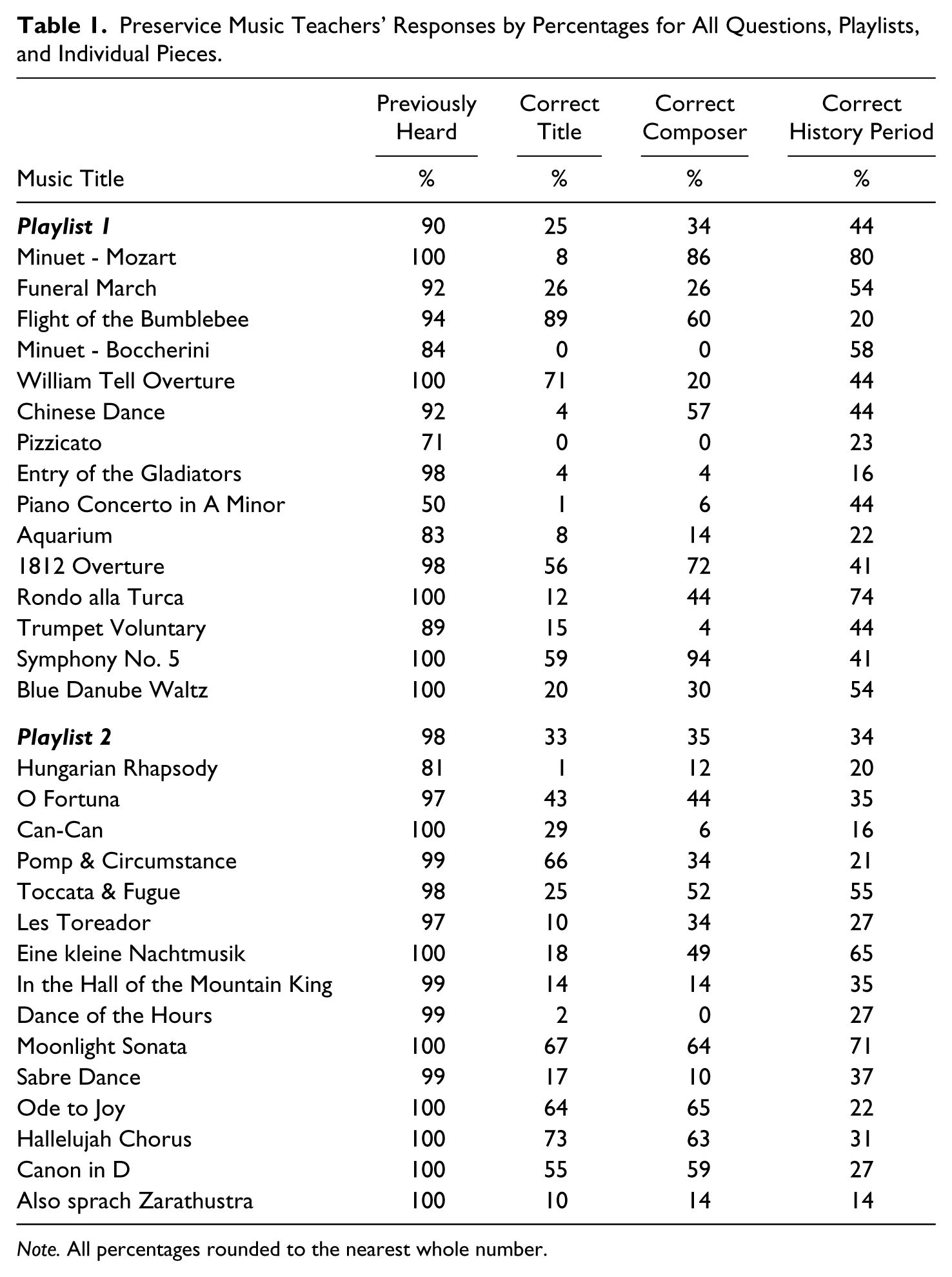
Note. All percentages rounded to the nearest whole number.
Total responses were also divided by playlist. For Playlist 1, results revealed that 90% of the students had previously heard the music, 25% correctly titled the music, 34% correctly named the composer, and 44% correctly identified the period the music was composed. Similar results were found for Playlist 2, in which 98% of the students had previously heard the music, 33% correctly titled the music, 35% correctly named the composer, and 34% correctly identified the period the music was composed (see Table 1).
Analysis of each individual piece was also completed. Results revealed that the majority of students (50%) had heard all 30 pieces of music. Moreover, the vast majority (90%) of students had heard 10 of the 15 pieces on Playlist 1 and 14 of the 15 pieces on Playlist 2. Results also revealed that 50% or more of the students correctly titled 4 pieces on Playlist 1 and 5 pieces on Playlist 2, correctly named the composer of 5 pieces on Playlist 1 and 5 pieces on Playlist 2, and correctly identified the period for 5 pieces on Playlist 1 and 3 pieces on Playlist 2 (see Table 1).
Preservice Music Teachers’ Responses by Listening Condition
All responses were grouped by listening condition (audio or audiovisual), and data were analyzed by total overall response, playlist, and each individual piece per playlist. Results revealed that most students had heard all music before the study (audio = 94%, audiovisual = 95%). Many students, however, could not correctly title the music (audio = 73%, audiovisual = 72%), name the composers of the music (audio = 66%, audiovisual = 65%), or identify the music history period the music was composed (audio = 63%, audiovisual = 60%; see Appendix B [available online at http://jmt.sagepub.com/supplemental]).
Responses were also divided by playlist. For Playlist 1, results revealed that most students had previously heard the music (audio = 89%, audiovisual = 92%); however, they did not correctly title the music (audio = 74%, audiovisual = 76%), name the composer (audio = 69%, audiovisual = 62%), or identify the period the music was composed (audio = 62%, audiovisual = 50%). Similar results were found for Playlist 2 in which most students had heard the music prior to the study (audio = 98%, audiovisual = 98%), yet could not correctly title the music (audio = 70%, audiovisual = 67%), name the composer (audio = 64%, audiovisual = 67%), or identify the period the music was composed (audio = 63%, audiovisual = 69%; see Appendix B [available online at http://jmt.sagepub.com/supplemental]).
Analysis of each individual piece was also completed. For previously heard music, the vast majority of students (90%) who listened to the audio condition or the audiovisual condition reported that they had heard 10 pieces on Playlist 1 and 14 pieces on Playlist 2. Furthermore, the majority of students (50%) in either condition correctly titled 4 pieces on Playlist 1 and 5 pieces on Playlist 2. Fifty percent of the students in the audio condition correctly named the composer of 4 pieces on Playlist 1 and 6 pieces on Playlist 2, whereas the same percentage of student in the audiovisual condition correctly named the composer for 6 pieces on Playlist 1 and 5 pieces on Playlist 2. Finally, the majority of students (50%) in the audio condition correctly identified the period composed of 4 pieces on Playlist 1 and 3 pieces on Playlist 2, whereas students within the audiovisual condition correctly identified the period composed of 8 pieces on Playlist 1 and 3 pieces on Playlist 2 (see Appendix B [available online at http://jmt.sagepub.com/supplemental]).
Differences
Chi-square statistical tests were completed to determine if there were differences between playlist, listening condition, or individual piece by listening condition responses. For previously heard music, results revealed a significant difference between playlists, χ2 = 84.13, p < .001; however, there were no significant differences between the audio and audiovisual listening conditions when playlists were combined together or separated by individual playlist. Significant differences were found for four individual pieces on Playlist 1 when analyzed by listening condition (see Appendix B [available online at http://jmt.sagepub.com/supplemental]). No significant differences were found for any individual piece on Playlist 2 by listening condition.
Results revealed no significant differences for correctly naming the music title between playlists or when the audio and audiovisual conditions were combined or separated by playlist. There were, however, significant differences between the conditions for three pieces on Playlist 1 and three pieces on Playlist 2 (see Appendix B [available online at http://jmt.sagepub.com/supplemental]). Results also revealed no significant differences for correctly naming the composer of the music between playlists or when the audio and audiovisual conditions were combined or separated by playlist. Significant differences were found, however, for several pieces on Playlist 1and Playlist 2 when analyzed by listening condition (see Appendix B [available online at http://jmt.sagepub.com/supplemental]).
For identifying the period the music was composed, results revealed significant differences between playlists, χ2 = 34.18, p < .001, between the audio and audiovisual listening conditions when playlists were combined, χ2 = 6.46, p < .01, and between the audio and audiovisual listening conditions for Playlist 1 (χ2 = 48.85, p < .001) and Playlist 2 (χ2 = 13.16, p < .001). Significant differences were also found for several pieces on Playlist 1 and Playlist 2 when analyzed by listening condition (see Appendix B [available online at http://jmt.sagepub.com/supplemental]).
Correlations
To determine whether there were relationships between repertoire previously heard, title of the piece, name of the composer, and music history period, a series of Spearman correlation coefficients were completed. Results found weak to moderately positive relationships for most pairs; however, there were a few weak negative relationships found within the music history period (see Appendix C [available online at http://jmt.sagepub.com/supplemental]).
Discussion
The purpose of this study was to investigate preservice educators’ knowledge of basic information about classical repertoire found in popular culture. The data indicated that half of the students (50%) had previously heard all of pieces of music chosen for this study and the vast majority (90%) had heard 24 of the 30 pieces. There were also very few differences between the preservice educators within the two listening conditions concerning whether they had previously heard the music. These data seem to indicate that adding a visual stimulus did not prevent preservice educators from focusing on the audio, which may not be surprising. Listening experiences frequently include visual stimuli (Geringer, Cassidy, & Byo, 1996), such as driving while listening to the radio, watching movies or television with various soundtracks, and attending a concert in which live performers are present. Thus, listening to music without visual stimuli may be a more infrequent occurrence.
Overall, the preservice educators within both listening conditions and playlists had great difficulty naming the repertoire. Results also revealed that having previously heard the music did not correlate to naming the piece. For example, W. A. Mozart’s Piano Sonata No. 11 in A Major—Rondo alla Turca located on Playlist 1 was identified as previously heard by 100% of the preservice teachers; however, this piece was correctly named by only 16% of the preservice educators in the audio condition and 8% in the audiovisual condition.
Implications for Preservice Music Teacher Education
Correctly naming classical music by listening to the audio is a skill music majors are required to master within their degree programs. Music history, conducting, literature, theory, and education classes routinely ask music majors to listen to and identify music repertoire as well as remember melodic, harmonic, and rhythmic material so they can transfer the information in later situations. Thus, although preservice music educators often learn about this music in courses that are designed for all music majors, most do not understand and/or realize how this music can be used within their future music classrooms, such as creating transfers to help their future students understand the connections between “outside music” and “school music.” Therefore, since popular classical music is heard throughout our everyday lives, preservice educators should not only know this music but also know how to use this music as another way to introduce classical repertoire to their future students.
These transfers, however, may not take place since the results of this study indicated that the majority of preservice educators could not correctly name the piece, the composer or identify the period. Thus, music teacher educators may need to provide more examples and/or guidance of how to incorporate commonly heard classical music in popular culture within their course assignments and lectures so preservice teachers understand its importance. Specifically, instructing preservice teachers how to (1) find this music in popular culture, (2) remember basic information that is age appropriate for K–12 music students, (3) hear this music in new and interesting ways, (4) use this music as a bridge between outside music and school music, and (5) use this music to teach concepts is needed. This guidance could be particularly useful to preservice educators as they prepare for their professional careers.
Future Research
There are several questions that have arisen from this line of enquiry that future researchers may want to investigate: (a) What basic information do preservice music educators know about classical music? (b) How do preservice and in-service music educators choose classical music to study in K–12 classrooms? (c) Would examples of how to use this music in K–12 music classrooms result in greater use of this music? (d) What are the attitudes and preferences of K–12 students about popular classical music? (e) Is popular classical music considered a bridge between outside music and school music by K–12 students and preservice and in-service music educators?
Footnotes
Declaration of Conflicting Interests
The author(s) declared no potential conflicts of interest with respect to the research, authorship, and/or publication of this article.
Funding
The author(s) received no financial support for the research, authorship, and/or publication of this article.