



Abstract
Creativity research has a long history in music education, including the development of theories and strategies to foster the music creativity of students of all ages and levels. Underexplored is how teacher education programs can cultivate pre- and in-service teachers’ abilities to develop their educational creativity when designing curricula and delivering instruction. By reviewing key research in creativity and the traits of creative persons, this article demarcates characteristics of creative music teachers, as well as their instruction and curricula, in order to offer implications for music teacher education. This framework suggests that creative pedagogues (a) are responsive, flexible, and improvisatory; (b) are comfortable with ambiguity; (c) think metaphorically and juxtapose seemingly incongruent and novel ideas in new and interesting ways; and (d) acknowledge and use fluid and flexible identities. The article provides possible strategies music teacher educators can employ to help pre- and in-service educators develop the dispositions and core practices of creative music pedagogues.
As one of the central foci of music education, creativity has a rich history in the literature. Researchers have focused studies on defining (Burnard, 2012), evaluating (Hickey, 2001; Webster, 1987), and educating music creativity in general (Odena, 2012) and in composition (Burnard & Yonker, 2004; Hickey, 2003) and improvisation (Hickey, 2009; Whitcomb, 2013). Some music educators also use creativity research to provide frameworks for fostering music creativity for practicing and preservice educators. Randles and Smith (2012) found that U.S. preservice teachers are less confident about their own music creativity, as well as teaching music creativity, as compared to English counterparts. Odena and Welch (2012) found that in-service educators with composing and improvising experience were more comfortable with these tasks in their classrooms. Because of this, music teacher educators have called for music teachers to be educated in skills that readily employ creative thinking, such as composition (Kratus, 2012; Odena & Welch, 2007, 2012) and improvisation (Bernhard, 2013; Wright & Kanellopoulos, 2010). Knowledge and skills in these areas increase preservice teachers’ ability to foster differing types of music and musicking, which “might gradually lead to the development of a critical perspective on both music education theories and practices” (Wright & Kanellopoulos, 2010, p. 71).
This body of research has focused on creativity within music—the process of generating and having knowledge of music—for the betterment of students and teachers. In other words, creativity research has centered on creativity pertaining to content knowledge and how teachers might foster, in themselves and their students, skills and dispositions to become creative musicians. But may a broader application of creativity benefit music teacher education? What if music teacher educators apply this attention on creativity to pedagogical skills and knowledge, including the formation of instruction and curricula? A broader application is appropriate because focus on music creativity is important and necessary but, alone, insufficient. Music creativity, when not made explicit to teaching, does not necessarily transfer to pedagogical creativity. Becoming a creative musician or composer is not the same as, or a guarantee of, becoming a creative educator, and thinking creatively about music does not necessarily lead to creative teaching.
In hope of fostering creativity of teaching equally with music creativity, this article proposes a framework for what may be called pedagogical creativity in music teacher education. By reviewing key research in creativity and the traits of creative persons, this article demarcates characteristics of creative music teachers, as well as their instruction and curricula, to offer implications for music teacher education. This framework suggests that creative pedagogues (a) are responsive, flexible, and improvisatory; (b) are comfortable with ambiguity; (c) think metaphorically and juxtapose seemingly incongruent and novel ideas in new and interesting ways; and (d) acknowledge and use fluid and flexible identities. Music teacher educators can employ specific strategies to make these traits explicit to pre- and in-service educators and to develop the dispositions and core practices (Grossman & McDonald, 2008; McDonald, Kazemi, & Kavanagh, 2013) of creative music pedagogues.
“Pedagogical creativity” has a broad application to music teaching in a variety of settings. A creative pedagogue employs creative strategies when instructing and designing curricula, even when creativity is not the explicit topic of the lesson. Creative pedagogues do not necessarily teach “creative thinking” and may not be musically creative themselves, but they creatively approach the application and refinement of their educational practices. For this reason, pedagogical creativity has application to all music teaching.
Trait 1: Responsiveness
Creative pedagogues are responsive to their students and environments, and as a result, they are also flexible and improvisatory. Many conceptions of music pedagogy emphasize preparation by the teacher: determining objectives, organization of curricula into a sequential predetermined order, devising and collecting materials, and so forth. Although these activities are important, the ability to continually respond to unplanned changes, such as student input or results from formative assessments, is equally necessary. As the educational philosopher David Hansen (2005) notes, Creativity in teaching often has less to do with inventiveness per se than it does with . . . . a kind of ongoing attentiveness, by which I mean a dynamic combination of patience, listening, and initiative. Rather than issuing solely from what the teacher brings to the educational setting . . . creativity can point to what the teacher is capable of deriving or drawing from it. Creativity as responsiveness denotes a form of openness to the setting, which may or may not complement or fit harmoniously with what is preset, prefigured, or anticipated. (pp. 57–58)
Other educational researchers have described this ongoing attentiveness in similar terms. Halliwell (1993) suggests that teacher creativity is characterized by “the ability to read a situation; The willingness to take risks; The ability to monitor and evaluate events” (p. 71). Craft (1997) found that creative teachers display “personal flexibility,” or the ability to adapt. In their study of three creative female teachers, Horng, Hong, ChanLin, Chang, and Chu (2005) found that the teachers “all possessed a sense of keen observation, perception and sensitivity. On discovering novel ideas, the subjects were easily able to infuse these skills into their instruction” (p. 353).
This responsiveness requires that teachers remain flexible in their instructional goals. These studies speak to a flexibility in the aims and means a teacher employs. “An aim” in education, Dewey (1916) notes, must be flexible; it must be capable of alteration to meet circumstances. An end established externally to the process of action is always rigid. Being inserted or imposed from without, it is not supposed to have a working relationship to the concrete conditions of the situation. What happens in the course of action neither confirms, refutes, nor alters it. Such an end can only be insisted upon. The failure that results from its lack of adaptation is attributed simply to the perverseness of conditions, not to the fact that the end is not reasonable under the circumstances. (p. 104)
Creative teachers adapt, and sometimes even abandon their lessons based on information students offer. Rather than creating an entire curriculum ahead of time or unilaterally subscribing to one specific methodology, creative teachers find what is best for those particular students, at that particular time, using the materials found in the environment at hand. This might preclude a universal adherence to specific teaching methods. Instead, educators may use these and other sources as structures from which they borrow and adapt to students’ needs, jettisoning them if necessary, combining them in unique and interesting ways when possible.
This responsiveness and flexibility are employed through a sort of reactive improvisation. Like the creative music improviser, the creative pedagogue derives new meaning from a situation not completely created nor planned prior to the experience. Similar to the ways jazz musicians follow chord changes, creative pedagogues work within restraints that guide their improvisation. This requires an ongoing awareness of the students and the environment. As Sawyer (2004) notes, this improvisation is not haphazard, occurring spontaneously without preparation or rigor, but is “disciplined” because creative teaching “always occurs in broad structures and frameworks” (p. 13). This disciplined improvisation helps teachers navigate the “gap between the curriculum-as-planned and curriculum-as-lived” (Beghetto & Kaufman, 2011, p. 94), allowing the curriculum to “come to life” and meet student needs.
Music teacher educators may use a variety of music improvisation metaphors that stress attentiveness. As noted above, improvisation in jazz and popular music may be adequate. However, some music education students may feel that such an educational structure leaves too much undetermined. Therefore, it might be important to stress that instructional improvisation may be more predetermined, as in a da capo aria, where only embellishment is improvised. Within these metaphors, students may imagine a continuum between improvisation and the predetermined, finding levels of improvisation they feel comfortable with, which can serve as a gateway to practicing instructional improvisation.
Although metaphors allow students to conceptualize instructional improvisation, its effective execution requires the acquisition of some necessary skills. For example, lesson planning is often a part of teacher education preparation, but how do students prepare for unanticipated reactions to that lesson plan? Improvisation requires a series of responses to unanticipated or spontaneous factors, including students’ actions, as well as changes in the teaching environment. As Grossman, Hammerness, and McDonald (2009) note, “Having opportunities to rehearse such responses ahead of time, in environments that are less complex than classrooms, can help novices hone their practice and prepare them for when they will need to respond in the moment” (p. 279).
Music teacher educators may “fix” or prescribe other parameters within the classroom for students to address pedagogical responsiveness and improvisation. For example, the instructor may provide students with objectives, materials, or even a complete lesson plan and then create scenarios involving unanticipated events. He or she may devise questions typical school-age students ask, inviting pre- and in-service teachers to generate as many answers as possible. The instructor may posit misunderstandings that may arise and devise potential responses with the student on how to address such concerns on the spot. He or she may also eliminate materials or parameters that the student expected to be present, such as simulating a technology failure or the truncation of the class period, as commonly occurs during a typical fire drill or other classroom disruption. Creating such situations allows pre- and in-service teachers opportunities to “practice” their creative pedagogical skills.
Trait 2: Comfort With Ambiguity
Another trait of the creative pedagogue is the desire and ability to accept, and even find comfort in, tension and ambiguity; music teacher educators can encourage pre- and in-service educators to develop this ability. Davis (2004) notes that creative persons enjoy working with new ideas, unformed thoughts, and seemingly incongruent concepts. Fromm (1959) described creativity as the capacity to be puzzled; the ability to accept, rather than avoid, conflict or tension. Similarly, Rogers (1959) believed that creative persons are open to experiences that prohibit rigidity; they are able to accept instability and experiment with different possibilities. Insecurity and the unknown do not discomfort them; conversely, they enjoy playing with and testing uncertain ideas and solutions.
The opposite of comfort with ambiguity is “cognitive closure,” the need for swift, unambiguous solutions. Research has suggested that a high need for cognitive closure is linked with lower levels of creativity (Chirumbolo, Livi, Mannetti, Pierro, & Kruglanski, 2004; Wiersema, Van der Schalk, & Van Kleef, 2012). Persons who exhibited an elevated discomfort with new ideas and open-ended situations demonstrated less creativity than participants more at ease with ambiguity. DeBacker and Crowson (2009) found that students with a high need for cognitive closure were more likely to force conclusions, seize on obvious solutions, and assume the veracity of erroneous ideas. Students uncomfortable with ambiguity were also more likely to be satisfied with a generalized understanding of a topic; they were less likely to explore a topic more deeply, frequently seeking out opinions and strictures that conformed to their preconceptions. Music teacher educators might actively seek to help students develop a comfort with ambiguity so that they are open to educational ideas that are new to them and to create unique pedagogies with creative solutions. Music teacher educators may use a variety of strategies to help pre- and in-service teachers recognize and accept ambiguity. Students may take an ambiguity tolerance test to better understand their personal acceptance of tolerance (Kruglanski, Webster, & Klem, 1993; for a free online test, see http://www.psyctherapy.com/Enrolled/Activities/ToleranceForAmbiguityScale.htm). This allows students to become aware of their natural affinity for, or aversion to, ambiguity and assess whether this is an area they need to development.
Creative music pedagogues highlight the value of ambiguity and avoid cognitive closure by accepting and displaying knowledge as conditional and ambiguous. For example, rather than uniformly teaching that the transition from the Baroque to the Classical period was a change in texture and form, creative pedagogues might explore similarities between periods and search from contradictory evidence, realizing the tension of viewing classical music history as both a continuous evolution as well as a series of regular ruptures. Creative pedagogues accept that the answers worth knowing often do not have unambiguous, fixed answers and, most important, lead students to those conclusions as well. Even the most commonly agreed-on truths were once controversial, or people were unsure of their validity. Rameau (cf. 1722/1971), for example, was unsure of the existence of chords, a truth that seems logical and obvious to contemporary musicians. The theory of gravity was once in doubt. Individuals come to truths through uncertainty, illuminating the joy of answering real and ambiguous questions. Music teacher educators can invite their students to explore the ambiguities of the “truth,” testing to see if information they hold as immutable are products of doubt and discovery. This may assist pre- and in-service teachers to approach all knowledge differently and to form dispositions of interrogating the content of curricula by questioning how knowledge is constructed and structured in music education settings.
Acceptance of ambiguity also allows creative pedagogues to forge dialogic relationships with their students. Creative pedagogues believe that uncertainty and ambiguity do not display intellectual weakness or a lack of knowledge, and as a result, they make new discoveries together with their students. When knowledge is considered fixed, it can follow that information can be deposited within the student. But if teachers believe that knowledge is often ambiguous and dynamic, that it can be viewed from multiple perspectives, and that ideas may contradict and not lead to definitive answers, they take their students’ perspectives seriously, engaging in true dialogue, and devising provisional truths together. Music teacher educators may ask students to create lesson plans with ambiguity specifically in mind. They can ask students to write lessons that purposely elicit a variety of divergent and sometimes conflicting answers to a music problem, lessons that deliberately do not privilege any one or group of answers. By exploring ambiguities of knowledge, music teacher educators can help pre- and in-service educators develop a disposition of accepting and incorporating their students’ constructions of truth.
Trait 3: Combination of Disparate Ideas
Creative pedagogues juxtapose seemingly incongruent and novel ideas in new and interesting ways, and developing this manner of thinking helps pre- and in-service music educators devise innovative instruction and refine their understanding of students’ abilities and development. The process of combining disparate ideas is often called “analogical” or “metaphorical” thinking (Davis, 2004), and it occurs when ideas are transferred or applied to a new context, often in surprising ways. Treffinger, Isaksen, and Dorval (2000) suggest that creative thinking includes “encountering gaps, paradoxes, opportunities, challenges, or concerns, and then searching for meaningful new connections by generating many possibilities, varied possibilities (from different viewpoints or perspectives), unusual or original possibilities” (p. 7). Khatena and Torrance (1973) argue that the creative person has “the power of the imagination to break away from perceptual set so as to restructure or structure anew ideas, thoughts, and feelings into novel and associative bonds” (p. 28). Mednick (1962) describes these typical ways of organizing ideas or perceptual sets as “associative structures.” Creative thinkers, Mednick argues, dig deeply into their “associative structures,” probing beyond obvious connections to find novel or remote linkages in order to form original solutions to problems. These researchers suggest that creativity involves combining unlikely associations in original, unexpected, yet useful ways.
Gordon (1961) uses the Greek word synectics to refer to this process of creatively combining different and apparently irrelevant elements. His technique has been used for years in diverse environments, from advertising agencies to preschools, as a means of formally encouraging analogical thinking. Synectical exercises could be useful in music education courses to promote flexibility and the combination of incongruent elements in teaching. Music teacher educators could require students to create lesson plans that combine differing pedagogies and design curricula that approach a single pedagogical problem from varying perspectives. Music teacher educators can also ask students to combine music education with other disciplines. Teachers should have a wide range of knowledge in many areas, across music and across disciplines; music teacher educators may encourage the introduction of, say, sociological perspectives, comparative literature, popular culture, and even the culinary arts into the music classroom. Music teacher educators might provide the following scenario: You have been notified by your principal that next year you will teach music, physical education, and art in one combined class. You are further instructed to teach it interdisciplinarily. What do these disciplines have in common? How can you use each one to support and strengthen the other? What classroom activities will best facilitate this?
This process of combining disparate ideas may help pre-and in-service teachers approach music education from new and interesting avenues.
Researchers propose that exposure to variety is one way that analogical and metaphorical thinking can be developed. Ritter et al. (2012) found that diversifying experiences—“highly unusual and unexpected events . . . that push individuals outside the realm of ‘normality’” (p. 961)—often led to creativity via cognitive flexibility—“the ability to break old cognitive patterns, overcome functional fixedness, and thus, make novel (creative) associations between concepts” (p. 961). These diversifying experiences created active schema violations. Active, not passive or vicarious, engagement with new and novel experiences caused people to question the ways they organize experiential knowledge. This study found that new experiences led to increased cognitive flexibility and the ability to combine disparate ideas in interesting ways.
To foster this cognitive flexibility through highly unusual ideas and events, music teacher educators may ask students to explore diverse examples of education. This could include unique models of domestic K–12 education, adult education, informal settings of music, or conducting a comparative study of educational paradigms from around the world. Exposure to differing, unusual, and unexpected examples may push students outside the realm of what they consider “normal” or “correct” music education practice. Teacher educators may also take common aspects of instruction, such as rhythm reading, breath support, or diction and devise highly unusual strategies to address those skills.
Music teacher educators might also encourage an exploration of the diversity within music and teaching. Students are aware of diversity in music genres such as classical, jazz, hip-hop, mariachi, and pop and of modes of production such as playing from notation, improvising, performing live, and creating electronic music. Innovation can come from combining these elements in new and unique ways. It is just as important for students to discover that there are equally inexhaustible forms of music education. A variety of educational paradigms exist: constructivist, behaviorist, Orff, Kodály, Music Learning Theory, Dalcroze, and critical pedagogy, among others. These music and educational practices sometimes buttress each other, but they can contradict and expose competing epistemologies. Inviting pre- and in-service educators to live among these tensions, accepting and enjoying the possibilities of these dissonances, and finding ways to appropriately combine these pedagogies can inspire creativity. This stands in contrast to an approach to teacher education where the “best” or correct form of practice is sought. Perhaps surprisingly, from a creativity perspective, delineation of a singular, “best” pedagogy may encourage cognitive closure by prematurely foreclosing inquiry. Conversely, exploring multiple practices develops the cognitive flexibility that may foster creative pedagogical dispositions.
Finally, it is reasonable to assume that analogical and metaphorical thinking is linked to a comfort with ambiguity. A person with a higher comfort with ambiguity, who does not feel compelled to force a solution or immediately derive the “right” answer, would be more likely to assemble a fresh idea from seemingly incongruent ones. Facility with one trait leads organically to ease with the next. A person with a lower need for cognitive closure would take time to “play,” transferring ideas from other areas, because they do not as highly value conformity. The traits of comfort with ambiguity and facility with metaphorical thinking underscore the active nature of creativity. Not innate qualities, students can learn these dispositions and behaviors.
Because of this, the ability to combine disparate ideas may also influence pre- and in-service teachers’ expectations of their individual growth and the growth of their students. Pre- and in-service teachers who understand that intelligence and creativity are dynamic constructs are more apt to develop their own creativity and the creativity of their students. Blackwell, Trzesniewski, and Dweck (2007) described the difference between the achievement of students possessing a fixed view of intelligence and those who consider it malleable. Students who possessed a “growth mind-set,”—a belief that individual efforts increase intelligence—outperformed students who had a “fixed mind-set”—believing that intelligence was an unchangeable construct. Similarly, creativity can be understood through a “growth mind-set.” Individuals who believe that creativity is inborn and fixed would not expect to develop and use their creativity. Conversely, students and teachers who believe they can advance their creativity will more readily benefit from explicit education on in this area. It is important that pre- and in-service teachers understand creativity research and develop a growth mind-set. Comfort with ambiguity and the ability to combine ideas in unique ways are behaviors that transcend any specific music or pedagogical knowledge or skill. From this perspective, a creative teacher does not require an ever-growing arsenal of teaching techniques but simply needs the responsiveness to know when and how to apply already-possessed knowledge and skills with fluidity, novelty, and flexibility. Also, familiarity with growth mind-set research may help pre- and in-service educators develop a disposition of teaching every child regardless of ostensive abilities. The belief that every child can learn helps question binaries of “talented/untalented,” “gifted/ungifted,” and teachable/unteachable.
Trait 4: Fluid and Flexible Identities
Some researchers suggest that individuals who embrace and combine multiple identities devise more creative solutions to problems. In an experimental study of female engineering students, Cheng, Sanchez-Burks, and Lee (2008) found that students who possessed higher levels of identity integration, who saw themselves as “female engineers,” rather than “female and engineer,” viewed their identities as related and produced solutions that were more creative. Cheng et al. (2008) concluded, “Higher levels of identity integration—perceived compatibility between two social identities—predict higher levels of creative performance in tasks that draw on both identity-relevant knowledge domains” (p. 1178).
Embracing multiple identities has direct implication for music teachers. Research in music teacher identities has suggested that pre- and in-service music teachers often struggle to integrate their teaching and musician selves. Music educators often have a bifurcated self, wrestling between an identity as performer of their primary instrument and sometimes conductor and composer, and their identity as music teacher (Austin, Isbell, & Russell, 2012; Bernard, 2004, 2005; Bouij, 2006; Dolloff, 2006; Pellegrino, 2010; Roberts, 2004; Scheib, 2004). Pellegrino (2009) notes, “The literature suggests that preservice and in-service music educators view themselves first as a performer and second as a music teacher” (p. 40).
This bifurcation of musician and teacher identities may be a result of the structures of music schools, which typically foster stable, clearly divided identities. Nettl (2002) argues, “within the social structure of the Music Building, the concept of ‘studio’ is much more personalized than that of ‘department.’ A student identifies himself or herself as belonging to a particular teacher’s studio” (p. 71). A student’s instrument is central to the formation of identity. Ensembles, he notes, fulfill a similar social function by creating and maintaining fissures between band, chorus, and orchestra, and “select” ensemble from everyone else. This suggests that the careful circumscription of identities created by the structure of music schools discourages the creative thinking that is increased by the cultivation of more fluid and integrated identities (Cheng et al., 2008; Craft, 1997).
For Scheib (2007), music schools’ structures perpetuate this preference and esteem of performer above teacher, insufficiently preparing students for a career in education. The structures of schools and the division of musician and teacher may lead to a decrease in job satisfaction when music education students enter the profession (Pellegrino, 2011; Russell, 2012; Scheib, 2006). Russell (2009) found that in-service string educators with a stronger teacher identity, as opposed to musician identity, had higher job satisfaction. Russell (2012) found that, generally, in-service secondary music educators had a more integrated musician/educator identity. To counteract this lack of job satisfaction and other difficulties teachers might find resulting from this bifurcated identity, Austin et al. (2012) suggest that music teacher educators should foster a holistic musician/teacher identity. Others have argued for in-service teachers to integrate their music selves into teaching (Pellegrino, 2011; Scheib, 2006). For example, Pellegrino (2011) suggests that teachers should receive professional development credit for making music with others because it helps them integrate high levels of musicianship into their teaching and grow as musicians and educators.
A creative pedagogical framework not only supports these researchers’ argument for the integration of pre- and in-service educators’ musician and teacher identities but also extends these assertions by suggesting that music educators’ instruction would also benefit from the purposeful incorporation of nonmusic avocations. Craft (1997) notes that creative teachers are able to access their “multiple selves,” meaning, as one participant commented, “You can’t separate yourself from your teaching” (p. 84). Teacher educators can better prepare preservice students for the demands of teaching by exploring these music and nonmusic “multiple selves.” Teachers’ identities are professional (performer, theorist, composer, pedagogue), personal (amateur chef, golfer, painter, parent), and social (race, gender, sexuality, class, and able-bodiedness). Creative music educators engage in a variety of activities both within and outside of music; they use and combine experiences to positively inform their teaching.
In addition to acknowledging the various attributes in themselves, creative pedagogues recognize these qualities in their students. Rather than viewing their students’ roles in the music classroom as fixed around that of “musician,” or more narrowly around, say, a “theorist,” “performer” of a particular instrument or voice, or “composer” of a specific genre, educators can begin to see students’ desires, goals, and interests within and outside of music. Creative pedagogues use these various identities to connect with students and create relevant curricula. This trait is related to the previous trait of juxtaposing disparate ideas: Creative pedagogues combine their identities in unique ways. Acknowledging shifting identities also allows for a dialogical relationship with students.
Music teacher educators may foster this creative melding of identities by asking students to identify and articulate their varying identities. Students can delineate their music identities—performer, composer, improviser, theorist—and “nonmusic” identities—gender, age, class, interests, and hobbies. Coming to view their identities as complex, multifaceted, and intersecting will help them approach future students and teaching in more creative ways. Furthermore, imagining and creating curricula and instruction that acknowledge the various and intersecting identities of themselves and their students may spark pedagogical creativity. Music teacher educators might invite pre- and in-service educators to combine identities in education by asking questions like, “How would you teach ritornello form to someone who is a chef? What analogies might you use?” Students can be asked to identify a personal identity to combine with their musician identity, and use it to construct a lesson. For example, a student might be an athlete, as well as a performer. Their knowledge of physical training can be used to construct an innovative lesson on practicing strategies. Students could also interview an elementary or secondary student, asking them about their personal interests, as a means of finding ways to motivate their at-home practice and participation in class.
Conclusion
The previous exposition of creative traits suggests the following dispositions and core practices listed in Figure 1.
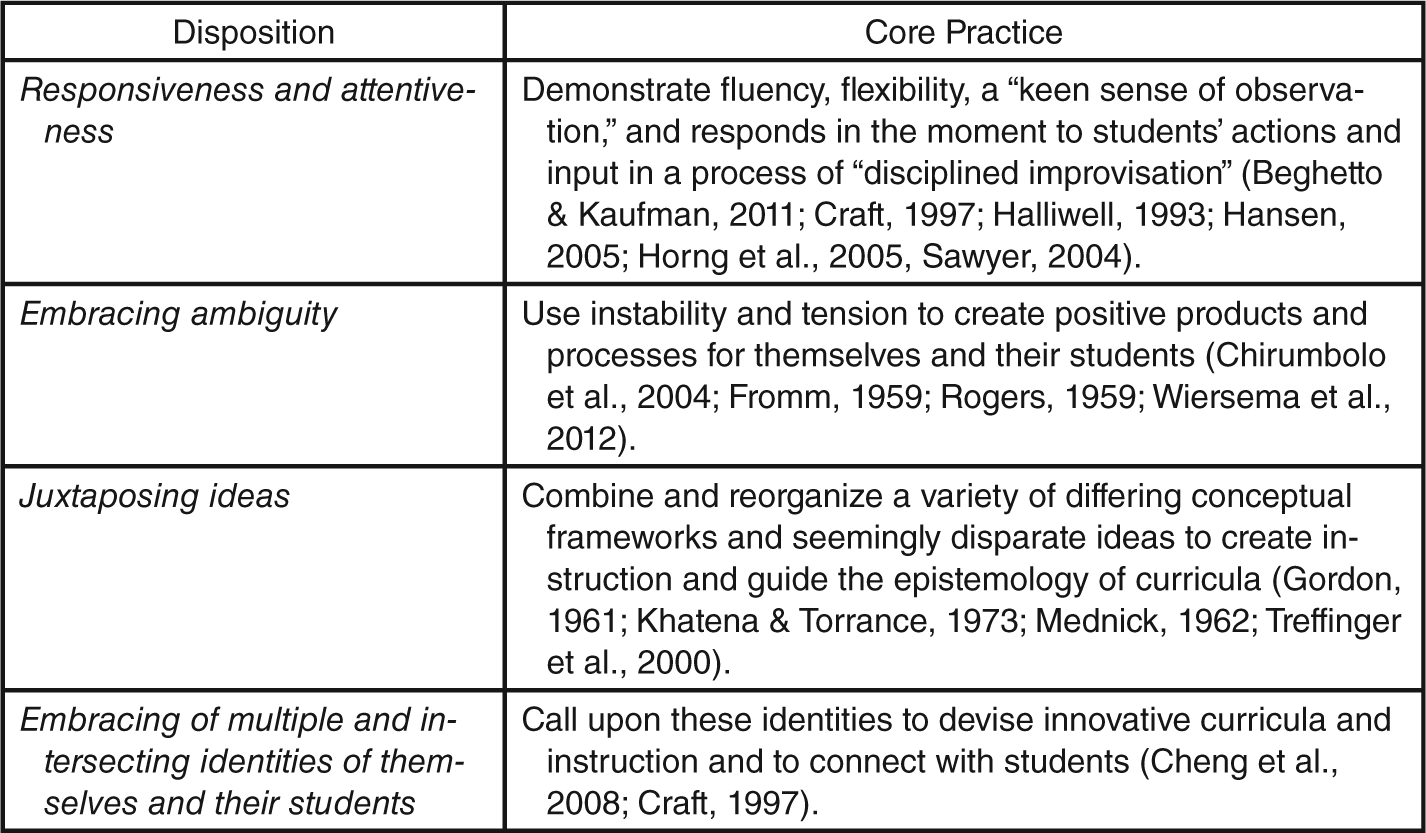
Dispositions and core practices of creative music pedagogues.
Although this is not an exhaustive review or a complete list of all creativity, these traits serve as a framework for music teacher educators to help students cultivate creative dispositions and acquire and refine core practices.
The specific language of “creativity” is particularly important in these aims. Although many teacher educators may stress some or all of these traits, it is beneficial to explicitly describe these traits as “creative” because creativity has cultural capital, and in particular, music creativity is important to students. Great performers and composers are often admired for their “Creativity” (with a capital C). Stressing educators’ work as purposefully creative and explicitly inviting students to be “creative pedagogues,” similar to creative composers or performers, is a metaphor that students can use to conceptualize their dynamic roles as educators.
These creative pedagogical traits may also be placed on music making. Relishing ambiguity, cultivating responsiveness, and combining disparate elements may aid students in the cultivation of their musicianships. Emphasizing this crossover may make these ideas palatable to reluctant students. For students who believe aiming for innovation risks abandoning tradition, demonstrating that the history of music practice is built on innovation and creativity is an effective way for them to similarly conceive of pedagogical practice. In addition, for students who identify as musician above educator, highlighting that these ideas benefit their musicianships provides an avenue for them to become interested in creative pedagogy. This is another reason it is beneficial for teacher educators to explicitly use the language of “creativity” and of becoming a “creative pedagogue.”
Approaching music teacher education as a process of becoming a creative pedagogue can serve as a complement to the cultivation of creativity in performance, composition, and improvisation. Stressing that the development of their creativity as a pedagogue is independent of, albeit related to, their creative music development allows students to nurture their teaching. Creative musicianship is different from creative pedagogy, and teacher educators can and should encourage specific dispositions and core practices in the development of pre- and in-service teachers.
Footnotes
Declaration of Conflicting Interests
The author(s) declared no potential conflicts of interest with respect to the research, authorship, and/or publication of this article.
Funding
The author(s) received no financial support for the research, authorship, and/or publication of this article.