



Abstract
Culturally responsive teaching values students’ identities, backgrounds, and cultural references as key tools for building meaningful learning environments. It has been adopted by many educators globally, but has not been incorporated consistently by music educators. Few researchers in music education have investigated the impact of culturally responsive teaching and misconceptions exist about what it means to teach music in a culturally responsive manner. The purpose of this research was to investigate the impact of an in-service program on cooperating teachers’ perceptions of culturally responsive teaching. At the conclusion of the workshop, participants rated familiarity and importance of culturally responsive teaching higher than they did prior to the workshop. Sixteen of the 18 participants indicated that the workshop had changed their understanding of culturally responsive teaching.
Keywords
The disparity between the cultural backgrounds of U.S. public school teachers and the students they teach has become axiomatic. According to the National Center for Education Statistics, U.S. Department of Education (2015), the average U.S. public school teacher is white and female, whereas U.S. public school student populations reflect a wide variety of cultures and ethnicities. Data compiled by the Higher Education Arts Data Services (2015) and recent research on music teacher demographics (Elpus, 2015) suggest that this disparity is no less true with regard to U.S. music teachers and their students.
Since 1978 when the National Council for the Accreditation of Teacher Education (NCATE) standards were revised to include a requirement that preservice teachers demonstrate knowledge, skills, and dispositions related to diversity, discourse in teacher education has focused on developing cross-culturally competent teachers who employ culturally responsive approaches to learning and teaching (NCATE, 2008). The Council for the Accreditation of Educator Preparation (CAEP), the current accrediting body for teacher preparation programs, requires that programs address issues of cultural diversity and develop teacher candidates’ cultural competence (CAEP, 2013). As a teacher education program area, music education is subject not only to the CAEP accreditation standards but also to National Association of Schools of Music (NASM, 2014) accreditation standards and is influenced by curriculum content standards established by the National Association for Music Education (NAfME). In their respective standards documentation, both NASM (2014) and NAfME (National Coalition for Core Arts Standards, 2014) have emphasized the importance of including multicultural perspectives in music curricula.
Culturally responsive teaching incorporates cross-cultural competence, increased global perspective, and multicultural music through using the cultural characteristics, experiences, and perspectives of ethnically diverse students as conduits to teach them more effectively (Gay, 2010). The definition implies an ability to affirm diverse cultural characteristics, perspectives, and experiences and to use these multiple perceptions of reality and ways of knowing to form bridges to new learning and ideas. Research also has suggested that music instruction provided by teachers who are culturally knowledgeable about and culturally responsive to their students, is a crucial component in improving student well-being, motivation, sense of belonging and achievement (Bishop & Berryman, 2006; Gay, 2010; Green, 2001; Ladson-Billings, 1995; Stalhammer, 2000; Villegas & Lucas, 2002).
Culturally responsive teaching practices are important to music education because music is intimately connected to culture and can be a source of identity for many cultural groups (McKoy, 2009). Teaching music without considering the cultural meaning the subject may hold for students overlooks an important reference point from which new knowledge may be constructed and program relevance can be maintained or reestablished (McKoy, 2009). Additionally, factors specific to music teacher education underscore the need for developing culturally responsive teachers. Kelly (2003) noted that most preservice music teachers from suburban middle class schools expressed a preference for teaching in schools similar to their own precollege experiences. However, preservice music teachers are expected to function successfully within educational environments that are sometimes dissimilar from the contexts for which they are being prepared (Reeder-Lundquist, 2002).
Music education researchers (Frierson-Campbell, 2006a, 2006b; Kindall-Smith, 2008; Kindall-Smith, McKoy & Mills, 2011; Mixon, 2009) have noted the specific challenges of access to music education services for students in urban schools. These issues include a lack of financial and human resources, as well as the frequent cultural disconnect between urban music teachers and the students they teach. In discussing his own personal experiences teaching in an urban educational setting, Benham (2003) asked, “How will [teachers] respond when faced with the task of adapting instruction and relating to the expectations and norms of other cultures?” (p. 21). In such circumstances, teachers sometimes come to a surprising realization of their own status as cultural “outsiders” or “others.” Teachers may experience discomfort and disorientation, particularly if their undergraduate preparation reflected a paradigm in which only traditional ways of teaching and learning were valued (Abril, 2009; Benedict, 2006; Martinson, 2011).
A simple shift or change in instructional practice is not enough to effectively incorporate culturally responsive teaching in music; being culturally responsive in terms of instructional approach involves a particular mindset (Gay, 2010; Howard, 2010). Promoting a disposition toward culturally responsive teaching practices within preservice music teachers requires a combination of pedagogical content knowledge and the opportunity to apply that knowledge in clinical practice (Emmanuel, 2005). Consequently, developing culturally responsive teaching practices among in-service cooperating teachers is also important, especially because they partner with university teacher education faculty in preparing future teachers.
The purpose of this research was to investigate the impact of an in-service program designed to provide professional development in the area of culturally responsive teaching, on cooperating teachers’ perceptions of culturally responsive teaching. The following research questions guided our investigation: (a) Are the cooperating teachers familiar with culturally responsive teaching? (b) Do the cooperating teachers have concerns that impact their comfort with regard to culturally responsive teaching? (c) Is teaching in a culturally responsive way important to the cooperating teachers? (d) What impact does the in-service workshop have on the cooperating teachers’ perceptions of culturally responsive teaching?
Method
Participants
Participants in this study were experienced music teachers currently engaged as cooperating teachers for the University of North Carolina at Greensboro (UNCG). This population of teachers was selected for the in-service training workshop so that our university students would later benefit from their mentorship during student teaching. The workshop was designed to address student teacher mentorship, assessment methods, culturally responsive teaching, and the development of the student teacher portfolio. Because of the anticipated number of student teachers (n = 40) needing mentorship during the spring 2012 semester, eligible teachers included 40 prospective cooperating teachers. We determined that 20 cooperating teachers would be selected to attend the workshop so that later comparisons could be made between the cooperating teachers who had attended the workshop (trained) and those who had not (untrained). Teachers were admitted to the workshop on a first-come-first-served basis until the 20 slots were filled. Of the final 20 participants selected, two participants were unable to attend the workshop.
Participants (N = 18) included choir teachers (n = 4), band teachers (n = 6), orchestra teachers (n = 3), and general music teachers (n = 5). The years of music teaching experience ranged from 6 to 25 years. Participants were given the opportunity to self-identify their gender and race. Participant demographics included: female (n = 15), male (n = 3), Caucasian (n = 13), and African American (n = 5). The cooperating teachers reported whether they taught in an urban (n = 7), suburban (n = 9), or rural school (n = 2), as well as the age-groups that they taught (K–5, n = 6; Grades 6–8, n = 5; Grades 9–12, n = 2; Grades 6–12, n = 5). All the music teachers had previously supervised a preservice intern or student teacher.
In-Service Workshop
In June 2011, the UNCG Music Education faculty provided participants with an in-service workshop for 5 consecutive days (see Figure 1). The workshop included daily sessions on culturally responsive teaching, assessment strategies, and mentoring student teachers, both in the general student teaching experience and with regard to the new student teacher portfolio. The culturally responsive teaching sessions included interactive lectures with musicians and teachers who represented music genres and music-making experiences found in the area schools. These experiences included hip-hop music, electronic music and composition, introduction to jazz and improvisation, and old-time string band music.
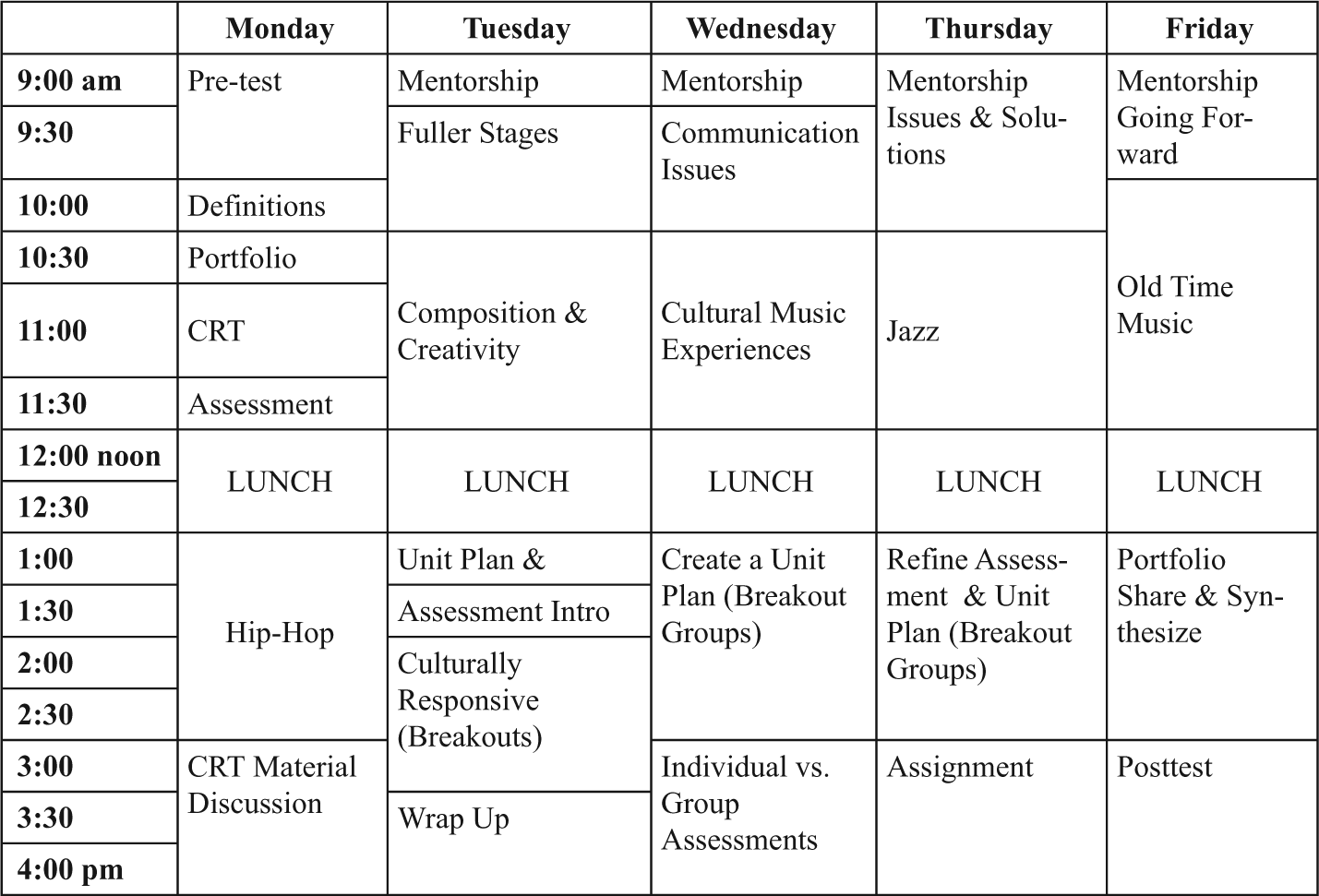
In-service workshop schedule.
Breakout sessions were included on Tuesday, Wednesday, and Thursday afternoon, during which the cooperating teachers and a university faculty mentor discussed and designed culturally responsive unit plans for the teachers to implement during fall 2011. These breakout sessions were content area specific (orchestra, band, choir, general music), thus providing opportunities for discussion among teachers within the same discipline. The unit plans prepared during these sessions were shared with the entire group on the final day of the workshop.
Survey Instrument
Data were collected via pretest/posttest surveys that provided participants with opportunities to rate their familiarity, comfort level, effectiveness, and concerns for (a) mentoring student teachers, (b) assessing student learning, and (c) culturally responsive teaching, using a 5-point Likert-type scale. Questions specific to each area included (a) rating the types and frequency of formal and informal assessments in both group and individual settings and (b) familiarity with, importance of, and frequency employing culturally responsive teaching strategies. Anchors relative to specific questions were provided for each rated question. For example, depending on the question, 1 and 5 respectively indicated uncomfortable and very comfortable; infrequently and frequently; negative and positive; or never and always. In addition, each section included opportunities for additional depth in response through associated open-ended responses. Demographic information solicited included (a) personal background, (b) teaching background, (c) mentorship experience, and (d) descriptions of teaching environment.
Procedure
The pretest survey was administered at the start of the in-service workshop to identify the participants’ familiarity and comfort level related to mentorship, assessment, and culturally responsive teaching. The posttest survey was administered at the completion of the workshop and focused on mentorship, assessment, and culturally responsive teaching. The posttest survey included the questions from the pretest survey and the following open-ended questions: Did the workshop change any of your ideas or strategies regarding the mentorship of student teachers? Did the workshop change any of your ideas or strategies regarding the assessment of your students? Did the workshop change your understanding of culturally responsive teaching? Do you plan to use any of the ideas presented in this workshop in your classroom?
Results
Participants were asked to rate their familiarity, frequency of use, perceptions of importance, comfort and concerns related to culturally responsive teaching. Participants were also asked to describe the culturally responsive strategies that they used in their classrooms and share specific concerns that they may have concerning the use of culturally responsive teaching. Finally, participants were asked to describe whether their understanding of culturally responsive teaching changed following the in-service workshop.
Mean ratings were calculated for both the pre- and posttest Likert-type responses and analyzed separately using a Wilcoxon matched-pairs signed-rank test. An alpha level of p < .05 was established prior to analysis. Open-ended responses were analyzed and coded for emerging themes. The researchers each independently categorized the participant responses to the final question on the survey and reliability was calculated using the formula [(agreements)/(agreements + disagreements)]. Reliability between the researchers ranged from .76 to .84 and was deemed acceptable (Johnson, Price, & Schroeder, 2009).
Familiarity With Culturally Responsive Teaching
Participants’ pre- and posttest ratings relative to familiarity with culturally responsive teaching were compared and a significant difference was found (t = −3.16, p < .002). Participants indicated that they felt more familiar with culturally responsive teaching following the workshop than prior to attending the workshop (M = 2.78, SD = 0.73; M = 3.72, SD = 0.46, respectively).
Descriptions of Culturally Responsive Teaching
Participants were asked to “describe what culturally responsive teaching means to you” in an open-ended survey question. The responses were analyzed qualitatively by looking for recurring themes or categories. Prior to the workshop, participant responses varied and could be grouped into five categories: (a) awareness of diversity, (b) cultural background, (c) music of other cultures, (d) meeting individual student needs, and (e) a lack of knowledge about culturally responsive teaching.
Four themes emerged from the posttest descriptions of culturally responsive teaching. The first theme to emerge was cooperating teachers’ awareness that culture included more characteristics than they had previously believed. The teachers reported an increased awareness that race, ethnic background, age, gender, socioeconomic status, technology, and various music cultures (hip-hop, rock, classical) were all aspects of culture. For example, one of the cooperating teachers responded that culture was “. . . not just race—its gender, economic background, language, educational ability, and more.” Another teacher had become more aware of “utilizing factors such as technology, socio-economic factors, family factors, student backgrounds and preferences to plan lessons.”
The second theme to emerge from the posttest was an increased awareness of the impact that cultural background had on student learning and that making assumptions with regard to students’ cultural backgrounds was inappropriate. The majority of participants focused their comments on learning about the culture of the students in their classroom. For example, one participant noted,
It means using [the] various cultures of students in your classroom to enhance your teaching and provide opportunities for your students to take more ownership of the teaching and learning by participating in it. It means to not make assumptions and to adapt your teaching to benefit all cultures and create more respect within your class for different cultures.
The third theme to emerge was the value of acquiring background information about the students enrolled in the teachers’ respective classes rather than using broad generalizations about school demographics. For instance, one teacher wrote, “Being alert to and therefore responsive to the various cultures of the group about you—the class, the school, the community.”
Finally, making connections between students and instructional content once a student’s culture was identified was an important theme. Participant comments relating to learning about culture prior to designing instruction frequently mentioned “making connections” and “giving [students] information that they can make connections with.”
Frequency of Using Culturally Responsive Teaching Strategies
Participants were asked to rate the frequency with which they used culturally responsive teaching strategies in their classrooms prior to and following the workshop. No significant difference was found between the participants’ pre- and posttest ratings for this question (M = 3.17, SD = 0.71; M = 3.39, SD = 0.92, respectively).
Culturally Responsive Teaching Strategies Used
An additional open-ended question on the survey asked participants to “describe the kinds of culturally responsive teaching strategies you use, if any.” After reviewing the descriptions written by the cooperating teachers on the pretest relative to culturally responsive teaching strategies, three recurring themes emerged: (a) presenting songs and materials from other cultures, (b) using music from the students’ own culture or based on student preference, and (c) uncertainty about what constitutes culturally responsive teaching strategies.
In the posttest, a number of participants expressed an increased awareness of culturally responsive teaching strategies and/or seemed willing to adapt instruction using these strategies to make learning more relevant to their students. “Looking back, I realize that I wasn’t doing very many [culturally responsive teaching strategies], other than modifying assignments for EC students.” A band teacher indicated, “I will now use [a] variety of genres and research outside of my world to bring in examples from other places to reinforce the concepts I am teaching.”
The remaining comments were varied and related to using students’ cultural background, student preferences, diversity, and music from a variety of cultures to design instruction. “I choose music that my students can identify with. I take them places that have historical significance to their background. I discuss various kinds of music/musicians they may identify with.”
Comfort With and Concerns About Culturally Responsive Teaching
No significant difference was found between the pre- and posttest ratings relative to comfort level using culturally responsive teaching. Participant ratings increased following the workshop (pretest M = 3.67, SD = 1.03; posttest M = 3.89, SD = 0.76) only slightly (see Table 1).
Mean Pretest, Posttest, and Gain Scores for Culturally Responsive Teaching (CRT).
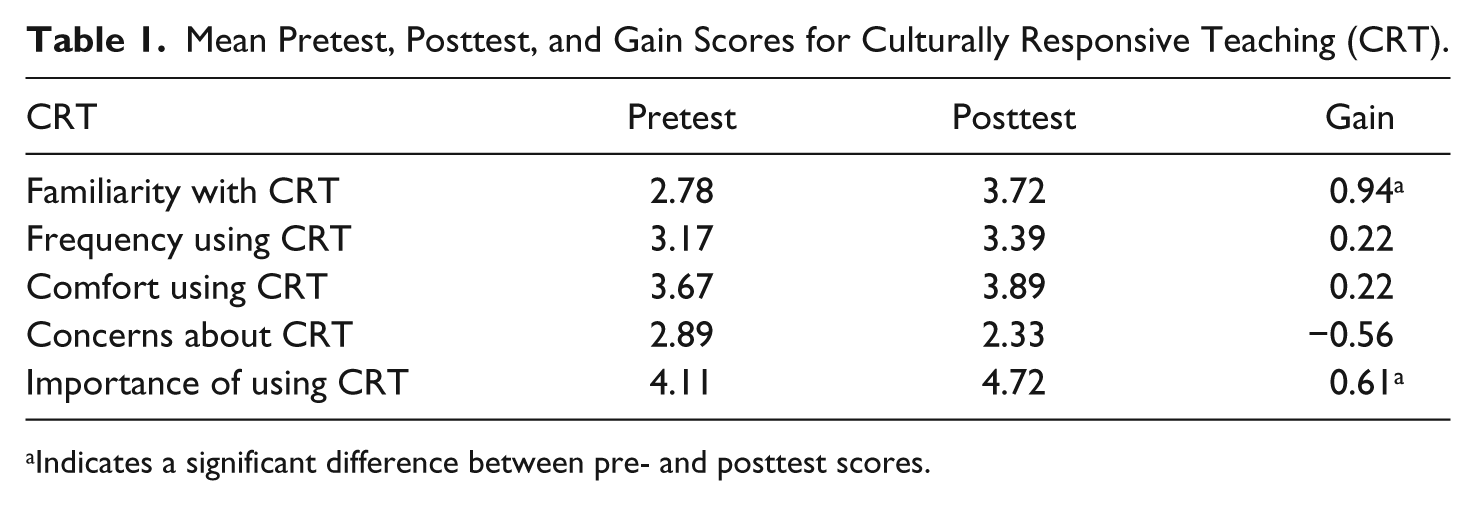
Indicates a significant difference between pre- and posttest scores.
Participants were asked whether they had concerns about culturally responsive teaching and to describe their concerns. Prior to the workshop, 12 of the 18 teachers expressed concerns. Following the workshop, 8 of the teachers expressed feelings of concern. On the pretest, participants shared concerns that they were unfamiliar with culturally responsive teaching. Many teachers articulated that they would like to learn more, some were uncertain as to how to learn about or reach their students, and others were dissatisfied with the resources available to them.
Participants who felt that they were unfamiliar with the concept of culturally responsive teaching reported concerns that “I don’t know what it is”; “I am not sure what it is”; and “I may be describing something else because I am not sure of the term, ‘culturally responsive.’” Related comments implied that some cooperating teachers were uncertain, but interested in learning. “How can I become even more culturally responsive? What techniques can I use to teach my students to become culturally responsive as well?”
One participant who rated the importance of culturally responsive teaching high on her pretest questioned her own ability to use culturally responsive strategies, “I am not sure that I will present the culture correctly to my students, and that I do not know enough about other cultures to make effective presentations to my students.” Another reflective participant questioned, “Do I truly understand each child’s cultural background? How do I know that I really “get” it when I haven’t lived it?”
Three general music teachers expressed concern on pretests related to resources and materials. One teacher pointed out that she needs better resources for foreign language songs, “Often the books don’t give good translation. They just say ‘This is a welcome song from ___.’ Kids want more information.” Another general music teacher explained that there is “a need for great materials suitable for use and resources to get them in me and then into kids.” Yet another general music teacher pointed out, “I am from a very different time in teacher ed[ucation]. I do not feel that our basal texts have changed anywhere close to enough.”
Following the workshop, eight participants continued to share concerns on the posttest about their ability to use culturally responsive strategies in the classroom. One teacher noted that her primary concern was “Doing it right!” An orchestra teacher reflected, “Sometimes, I make assumptions I shouldn’t make. I say things in a way that are [sic] not as sensitive as they should be.” This concern was noted by another orchestra teacher, “I thought I could just figure out what this [culturally responsive teaching] was by making a decent assumption, but I have learned that assuming is not knowing.”
Some of the participants wanted to do “a better job at learning who my students really are.” One elementary general music teacher was concerned that using culturally responsive strategies might “take more work, more planning, more research.” Another general music teacher expressed similar concerns, “I would need to have more pupil data readily available to be more effective in this area. It is important to be correct and not offend.”
Importance of Culturally Responsive Teaching
Participants’ ratings about the importance of culturally responsive teaching were compared and a significant difference was found between the pre- and posttest ratings (t = −2.78, p < .005). Participant ratings on the importance of culturally responsive teaching increased following the workshop (pretest M = 4.11, SD = 0.90; posttest M = 4.72, SD = 0.61).
Impact of the Workshop
Participants’ understanding of culturally responsive teaching changed for 16 of the 18 participants during the workshop. The majority of comments indicated that the participants felt more informed in this area. Two related subthemes included an increased awareness that culture was more than race and that culturally responsive teaching was more than multiculturalism. Specifically, this workshop helped several teachers realize that culturally responsive teaching and multicultural music education were not the same. An elementary general music teacher wrote, “I thought it [culturally responsive teaching] meant study [sic] music that is non-western. It is so much more than that.” Another general music teacher agreed, “I think I am understanding the concept more and how it is NOT multicultural teaching.”
Numerous comments focused on increased awareness of culturally responsive teaching. A chorus teacher noted, “I am now more aware of issues that need to be addressed with the changing student population.” Another chorus teacher wrote, “The workshop gave me new insight into what is “culture” in teaching. I feel like it is a great way to meet the kids with what they know and understand already.” One of the band participants also suggested that culture included more than he previously believed, in that he “became aware of even more cultures that exist in the classroom (e.g., youth, technology, drug, etc.).”
Three additional comments indicated an affirmation of previously acquired knowledge in the area of culturally responsive teaching. Two of these comments came from the participants who responded that the workshop had not changed their ideas with regard to culturally responsive teaching. One orchestra teacher wrote, “It put importance on something I already value. It reaffirmed that I am on the right track.” A band teacher replied, “It just enhanced my prior knowledge concerning the importance of this piece.”
Discussion
The purpose of this research was to investigate the impact of an in-service program designed to provide professional development in the area of culturally responsive teaching on cooperating teachers’ perceptions of culturally responsive teaching. At the conclusion of the workshop, participants rated familiarity and importance of culturally responsive teaching higher than they did prior to the workshop, but were still somewhat uncertain about the idea of culturally responsive teaching and how to implement this approach. Many of the concerns that the participants expressed related to not offending students, not quite knowing where to start, and the desire to “do it right.” One teacher lamented the difficulty of fully understanding her students’ perspective if she herself had not “lived it.” These sentiments suggest that the teachers recognized their entry into “new territory” and were negotiating their status as “other” in relation to students from backgrounds other than their own (Abril, 2009; Benedict, 2006; Benham, 2003; Martinson, 2011). A sense of discomfort and uncertainty are to be expected when a teacher considers a new paradigm or value system with regard to teaching practice. Exposing both in-service and preservice teachers to the concept of culturally responsive teaching is an important step in moving the profession forward.
The ways in which the participants understood the idea of culture changed over the course of the workshop. That is, culture extends beyond race and ethnicity and includes everything from age, gender, and socioeconomic status, to religious upbringing, drug and alcohol experiences, gangs, Deaf culture, and more (Gay, 2010). This increased understanding seems important for both experienced and preservice teachers. Encouraging preservice teachers to explore their understanding of the meaning of culture and how culture impacts learning seems crucial to meeting the needs of our increasingly diverse P–12 student population. Furthermore, music teacher educators may also benefit from an increased understanding of culturally responsive teaching to provide training for both preservice and in-service teachers.
During the workshop, participants became more aware that they should not make assumptions about students’ backgrounds or cultural experiences and that studying the aggregate demographics of the school simply was not informative enough to enable teachers to embrace the idea of culturally responsive teaching. Teachers need to explore culture within their own classrooms and with their own students and then make connections between what students already know and what teachers want students to know (e.g., Gay, 2010; Ladson-Billings, 1995; Villegas & Lucas, 2002). Both preservice and experienced teachers would benefit from incorporating activities into their lessons that allow students to share their cultural background so that they can make more connections to what students already know. For example, preservice and novice teachers sometimes assume that students come into the classroom with very little musical training. Increasing awareness of the musical skill sets that students do bring to the classroom will allow teachers to make connections between the students’ existing areas of strength and what they need to learn.
The majority of the cooperating teachers who participated in the workshop reported an increased awareness and understanding of culturally responsive teaching and indicated that they would implement ideas and strategies that they had acquired during the workshop into their own classrooms. That the workshop may have generated more questions than answers for some participants about culturally responsive teaching is not a negative outcome, especially if the questions cause teachers to reexamine their own instructional practice. One of the characteristics of culturally responsive teachers is the willingness to reexamine teaching practice (Brown-Jeffy & Cooper, 2011; Villegas & Lucas, 2002), and the teachers’ response to this workshop may be a first step toward adopting the mindset of a culturally responsive teacher. Certainly, if music teacher educators want their students to develop dispositions that support culturally responsive teaching, they will need to identify and partner with in-service teachers who are willing to expand their understanding of and ability to apply culturally responsive teaching practices.
Finally, recognizing that students’ musical knowledge, skills and dispositions are culturally specific will be of vital importance as both preservice and experienced teachers negotiate the diversifying landscape of students enrolled in U.S. public and private schools (Gay, 2010). As music educators, we have an incredible opportunity to use culture as the launching pad for wonderfully diverse musical experiences and understandings. Indeed, the model of culturally responsive teaching can validate home and community cultures and strengthen students’ connections between home and school music environments (Brown-Jeffy & Cooper, 2011). The capacity of culturally responsive teaching to strengthen connections between the school, home, and community is frequently cited only in relation to urban education and issues of social justice, socioeconomics, equity, and access. However, culturally responsive teaching practices have benefits for a variety of instructional settings where the school climate and the backgrounds of teachers differ markedly from the cultural environments of students’ homes and communities.
There are several limitations associated with this study and results should be viewed with caution given the small sample size. While significant differences were found between pre- and posttest ratings for familiarity and importance of culturally responsive teaching, gain scores in these areas were not large and cannot be generalized. Furthermore, we investigated experienced teachers who served as mentors for our student teachers at the University of North Carolina at Greensboro. The student teacher portfolio used at our institution influenced the development of the in-service workshop. This portfolio is specific to our institution and requires student teachers to use culturally responsive knowledge and teaching practices during their student teaching experience; thus our cooperating teachers were encouraged to model culturally responsive teaching. This may be idiosyncratic to our university. Finally, this study was limited to the 1-week workshop, the extent to which culturally responsive teaching was used in the participants’ classrooms remains beyond the scope of this study.
Conclusion
This study served as an initial exploration of culturally responsive teaching in music with a limited population. However, additional research that incorporates observations of culturally responsive teaching, students’ engagement and response to culturally responsive teaching, and best practices in this area is needed. Considering the connection between music and culture, the benefits of culturally responsive teaching in music education become apparent. Helping preservice music teachers develop dispositions toward incorporating culturally responsive practices in their teaching requires collaborative partnerships between music teacher educators and cooperating teachers who also employ those practices on a consistent basis. The results have the potential to maximize music learning for all students, for as Gloria Ladson-Billings (1995) has noted, the strength of culturally responsive teaching lies in the fact that it’s “just good teaching” (p. 159).
Footnotes
Declaration of Conflicting Interests
The author(s) declared no potential conflicts of interest with respect to the research, authorship, and/or publication of this article.
Funding
The author(s) disclosed receipt of the following financial support for the research, authorship, and/or publication of this article: This study was funded by the National Association for Music Education.