




Abstract
The purpose of this study was to investigate participation in a Facebook social media community known as Band Director’s Group (BDG) through examination of members’ demographic profiles, self-reported usage behaviors, and perceptions about how group activity satisfies their professional development needs. Respondents to an online survey (n = 336) reported near-daily interaction with BDG, with a notable trend toward lower average levels of contributing new content compared with relatively higher levels of passive and semipassive engagement such as reading and “liking” posts of other users.
The rapid growth of Internet availability during the past 20 years (Telecommunication Development Sector, 2015) has shaped the ways people create and share music. Likewise, Internet access has provided multiple forums for people to discuss aspects of music creation, consumption, teaching, and learning. As early as 1995, Bryant reported on a study of Folk_Music, an Internet-based music discussion group. Since then, numerous authors have examined similar music-related online communities centered on sharing composed songs and remixes (Salavuo, 2006), creating virtual garage bands (Harvey, 2009), and the collection and trading of live music recordings (Nieckarz, 2005). Other authors have focused more narrowly on users’ interests in musical genres like Irish traditional music (Waldron & Veblen, 2008), Old Time music (Waldron, 2009), and hip-hop (Cherjovsky, 2010), among others.
Music education researchers have examined how the Internet can be used for music teaching and learning, in both asynchronous and synchronous formats. Waldron (2011) discussed the sharing of teaching and learning strategies related to banjo music, whereas Kruse and Veblen (2012) analyzed the content of Internet instructional videos for banjo, fiddle, guitar, and mandolin. Kruse, Harlos, Callahan, and Herring (2013) investigated the possibilities and challenges of using Skype to conduct collegiate-level piano lessons. Dammers (2009) explored the use of Skype for long-distance trumpet lessons and concluded that the videoconference lessons were “functional, but not equivalent to face-to-face instruction” and that “synchronous online instruction is likely to expand and supplement music instruction, but not revolutionize it” (pp. 22–23).
Professional development for educators—in both online and offline formats—has also received much attention in previous research (Bowles, 2002; Hammel, 2007; Hookey, 2002; Stanley, 2012). Education researchers have recently focused on online teacher professional development in particular, and examined the efficacy of online approaches (Holmes, Signer, & MacLeod, 2011), learner success (Vu, Cao, Vu, & Cepero, 2014), and collaboration through online interaction (Francis & Jacobsen, 2013). Locating a succinct definition of the term professional development is surprisingly difficult, but the Framework for Teaching evaluation instrument and handbook authored by Charlotte Danielson (2013) provides some help. Danielson framed teaching in terms of four large domains that can guide evaluation and teacher growth. The four domains are (1) Planning and Preparation, (2) The Classroom Environment, (3) Instruction, and (4) Professional Responsibilities. Each domain is divided into multiple components. Within Component 4e, Growing and Developing Professionally, Danielson (2013) outlined activities and dispositions expected of practicing teachers. Key to professional development is that it represents ongoing refinement of educators’ “understanding of how to engage students in learning; thus growth in content, pedagogy, and information technology are essential to good teaching” (p. 103). More specifically, Danielson outlined the elements of this component as [1] enhancement of content knowledge and pedagogical skill: teachers remain current by taking courses, reading professional literature, and remaining current on the evolution of thinking regarding instruction [2] receptivity to feedback from colleagues: teachers actively pursue networks that provide collegial support and feedback [3] service to the profession: teachers are active in professional organizations in order to enhance both their personal practice and their ability to provide leadership and support to colleagues. (p. 103, numbering added)
Authors have also focused on the specific professional development needs of teachers in different career stages (Bauer, 2007; Conway, 2008). Fallin and Royse (1994) investigated problems of beginning teachers whereas Eros (2013) explored the professional development perceptions of second-stage teachers, who have passed the first five “survival years” when the majority of attrition occurs (p. 20). Berg et al. (2005) suggested that providing new roles for experienced teachers creates opportunities for them “to engage in differentiated work in their schools and districts, and thus challenge what has traditionally been a “flat” career” (p. 4). Research on professional development needs of music educators at different career stages appears to be an area of ongoing need (Society for Music Teacher Education, n.d.).
A subset of studies on professional development for music educators has focused specifically on how the Internet can be used to improve teaching practices. Bauer (1999) found that music educators were using the Internet for professional reasons and though widespread Internet access was relatively new at the time of the study, participants were already using email and web browsers to learn more about music and teaching. Bauer and Moehle (2008) studied a 1-year period of activity on the NAfME (then known as MENC) Internet discussion boards and examined topics discussed in the band, choir, general music, and orchestra forums. Approximately 71% of the postings were deemed “curricular,” whereas the remaining 29% were coded as “co-curricular.” The authors concluded that participants appeared to be “committed to professional growth and development” (Bauer & Moehle, 2008, p. 80). Furthermore, they posited that online professional development forums should be examined “to determine how they could be most effective in helping teachers gain understandings in areas of need” (Bauer & Moehle, 2008, p. 81).
In relation to the current study, the learning community of interest is known as Band Director’s Group, henceforth referred to as BDG. BDG is embedded in the widely used social media site, Facebook, which surpassed an estimated 1 billion users in 2012 (Tam, 2013). As of July 12, 2016 the membership of BDG was 17,373. The authors (Brewer & Rickels, 2014) previously completed a content analysis of the member interactions in BDG, guided by the work of Bauer and Moehle (2008). The authors explored the frequency of curricular, cocurricular, and community-oriented topics as well as the application of Wenger’s theory of communities of practice to the group’s structure and dynamics. Salient findings included an emphasis on repertoire and equipment recommendations as frequent topics of discussion and a substantial amount of activity devoted to developing members’ “sense of belonging to the whole” (Wenger, McDermott, & Snyder, 2002, p. 121), which is particularly important in virtual communities where members communicate asynchronously and across large geographical distances (Froehlich, 2009).
The content analysis of BDG also revealed the ways in which participation in the development of professional knowledge via BDG can be considered a form of “crowdsourcing.” This term was first attributed to Jeff Howe (2006) and currently defined by him as “the act of taking a job traditionally performed by a designated agent . . . and outsourcing it to an undefined, generally large group of people in the form of an open call” (http://www.crowdsourcing.com/cs/). In this manner, the format of BDG decentralizes information authority and disperses it across the “wisdom of the crowd” (Surowiecki, 2005). An early and often cited example of crowdsourcing’s power occurred in Sir Francis Galton’s (1907) observation of people’s remarkable ability to collectively estimate the weight of an ox at an English county fair. After studying numerous examples of this phenomenon, Surowiecki (2005) suggested, “when our imperfect judgments are aggregated in the right way, our collective intelligence is often excellent. . . . [We] should stop hunting [for the expert] and ask the crowd instead. Chances are, it knows.” (pp. xiv–xv).
While previous research has examined professional development of teachers in a variety of offline modes and some Internet-based modes, research is missing on the demographics, needs, motivations, and behaviors of the teachers who choose social media sites like Facebook for social–professional interactions. Authors of existing research have yet to fully explore the function of crowdsourcing in large online groups such as BDG and the potential for crowdsourcing to serve a unique role in satisfying teachers’ professional development needs. In the current study, examined BDG members’ demographic profiles, their self-reported usage behaviors with regard to the group, and their perceptions about how group activity satisfies their personal and professional development needs. Three research questions guided the study:
What are the professional and personal profiles of BDG members?
In what ways do BDG users report using the group to interact with other members and group content and how do these interactions represent or relate to professional development activities?
What professional and personal needs are served by participation in BDG as reported by members?
Method
The data for this study were collected by means of an online survey using the Qualtrics service (www.qualtrics.com). The complete survey is included online in the Appendix. Given the descriptive nature of the research questions, the items were constructed using a combination of forced-choice responses, open numeric responses, and scale responses. Operational definitions for key terms were included in each survey section to increase reliability and validity. Although no formal pilot of the survey was conducted, early drafts were reviewed by two music educators who were not part of the survey sample for pretesting, with minor wording and item order changes made based on feedback. To address Research Question 1, a set of demographic items (gender, age, ethnicity, teaching assignment, and education) were included. Research Question 2 was investigated using a series of items asking respondents to indicate the amount of time or the number of times in an average day or week they devoted to particular features and activities within BDG, as identified in the author’s previous content analysis of BDG (Brewer & Rickels, 2014). Data to support Questions 2 and 3 were also gained through two sets of Likert-type response items. One set asked respondents to rate the usefulness of nine potential types of professional development activities (including BDG participation) on a 7-point scale from Not At All Important to Extremely Important. A separate set of items contained attitude statements on professional development needs as reflected in BDG activity, with responses on a Strongly Agree–Strongly Disagree scale. The items in both Likert-type response sets were influenced by the professional development activities and needs identified in Bowles (2002), Hammel (2007), and Hookey (2002). The authors collaborated on developing an item pool, with slight revisions made during the pretesting described above (e.g., listing common professional associations in the item asking about professional conference attendance). At the end of the survey, an optional open-ended item allowed respondents to provide additional information to the prompt: “If you were going to recommend BDG to a fellow band director, what would you tell him/her about your reasons for participating in BDG?” Responses to this item were analyzed thematically using NVivo8 software to provide supplementary evidence (either confirmatory or disconfirming) in support of the rating scale response items.
The researchers compiled a list of all members in BDG whose Facebook privacy settings allowed their membership status to be displayed to other group members. An initial survey email invitation was sent to 9,866 group members, with two reminder emails sent over a 6-week period. These emails were sent to the designated Facebook profile email address for each individual, meaning the messages would be delivered to the Messages section of each user’s Facebook account. A random subsample of 1,000 of these members were also manually sent a private message directly through the Facebook message interface. This message contained the same unique survey link each member was sent by email to prevent duplication. Due to Facebook privacy settings, 1 it is probable that the large majority of these survey messages (both by email and by private message) were delivered to the user’s “Other” message folder. Similar to a spam/junk mail folder, messages in the “Other” folder were still accessible to the user, but Facebook would not notify the user, making it less likely that the individual would actually read and respond to the message. While calculating the exact number of messages that were marked as junk/spam is not possible due to dynamic Facebook algorithms that measure the relationships between users, based on warning messages displayed while sending the subsample of 1,000 messages using the Facebook message interface, we estimated that in excess of 75% of survey invitations were delivered to the “Other” message folder.
To increase accessibility of the survey to BDG members, the survey link was also posted to the group news feed three times over a 1-month period. This link allowed users to access the survey in cases where their personalized invitation by email or Facebook message may have been blocked, but this also meant that we could not track specifically which users responded using this link. By the close of the data collection period, we received 306 finished surveys, plus an additional 30 partial completions, for a total of 336 usable responses.
Results
Due to the privacy-related technical obstacles in contacting strangers via Facebook as outlined above, a meaningful response rate could not be calculated since the number of individuals who actually received an invitation was not known. While Babbie (1990) has often been quoted with the advice that surveys should have a response rate of 50% or greater, the author went on to note that such response rate targets “are only rough guides; they have no statistical basis, and a demonstrated lack of response bias is far more important than a high response rate” (p. 182). Our analysis therefore began with an examination of potential sources for response bias to demonstrate the validity of the sample.
Since the parameters were not known for the population of all BDG members, it was not possible to compare respondents with known demographic distributions. Armstrong and Overton (1977) outlined several methods for estimating nonresponse bias in surveys, including extrapolation methods for when population parameters are unknown. Such methods are based on “the assumption that subjects who respond less readily are more like nonrespondents” (Armstrong & Overton, 1977, p. 397). In other words, individuals who respond late in the data collection and only after repeated prodding are more representative of nonrespondents, and can be used to estimate the characteristics of individuals who did not respond at all (Pace, 1939). Using a time trends approach (Ferber, 1948-1949), we analyzed the time codes of our completed surveys to look for a point where responses tapered off after the final survey reminder was sent to the sample. Based on this cutoff, we identified 11.5% of our sample as late responders to use as estimates for nonrespondents. We then compared these late responders with the primary responders on four selected variables from the survey that could introduce potentially problematic response biases when interpreting the survey results: teaching status, gender, current age, and average minutes per day reading BDG content.
On all four variables, there was no significant difference between the primary responders and the late responders. The distribution of participants between the primary and late responders did not differ significantly by teaching status (director, music major, other music teacher, none), Pearson χ2 (3, n = 338) = 2.020, p = .568 or by gender (male, female), Pearson χ2 (1, n = 336) = 0.069, p = .792. Using analysis of variance, there was no significant difference between primary and late responders on current age, F(1, 336) = 0.000, p = .997 (primary responders M = 36.17, late responders M = 31.16). Likewise, there was no significant difference between groups on average minutes per day reading BDG, F(1, 336) = 2.096, p = .149 (primary responders M = 19.24, late responders M = 14.41). According to this method, we inferred from the late responders that the nonrespondents would not have a biased distribution on any of these four variables compared with primary responders. The complete sample of respondents (n = 336) was then assumed to be a valid representation of the population of BDG.
Proceeding with the analysis of the complete sample, we found that 42.6% of respondents were female (n =143) and 57.4% were male (n = 193). A total of 326 individuals responded to a demographic question on race using U.S. Census Bureau categories (Humes, Jones, & Ramirez, 2011). Of these, 311 (95.4%) identified as “White,” while 28 individuals (8.6%) identified as one or more non-White race(s), with “Black, African American, or Negro” (n = 8, 2.5%) and “American Indian or Alaska Native” (n = 6, 1.8%) as the next most reported individual race categories. Responses do not sum to 100% because respondents could select more than one race identification. On a separate question, approximately 4.6% (n = 15) out of 329 respondents identified as having a Hispanic origin. Respondents reported a current age mean of 36.17 years (SD = 11.02), with a moderate positive skew (median = 33.00, interquartile range [IQR] = 19.00). Respondents’ level of education was captured through a survey item asking for the number of completed credits beyond a bachelor’s degree. Responses on this item were not normally distributed (M = 29.92, SD = 27.09, median = 32.00, IQR = 36.25). Strong positive skew was noted, despite the mean being lower than the median. The two most notable responses by frequency were zero credits (n = 77 responses), indicating possession of only a bachelor’s degree or less, and 32 credits (n = 63 responses), which roughly corresponds to the credits usually required for completion of a master’s degree.
Of 338 responses to a question about current role, 268 (79.3%) indicated that they were currently a band director, whereas 34 (10.1%) selected they were some other kind of music teacher. A total of 23 respondents (6.8%) indicated that they were a music major enrolled in college. A small number, n = 13 (3.8%), responded that none of these roles described them, which might include retired teachers, college/university instructors who are not band directors, or former band directors who were currently in full-time graduate school or had left the teaching profession. Two questions asked respondents to provide the highest and lowest grades currently taught. For the lowest grade currently taught, the median value indicated 6th grade, whereas the median for the highest grade taught indicated 12th grade. A total of 60.9% of respondents indicated that they taught up through 9th to 12th grade, with a further 24.0% of respondents indicating that they taught up through 7th or 8th grade. This suggests that 84.9% of the sample consisted of educators involved with teaching middle school/junior high and/or high school, with the remaining portion being composed of elementary teachers (6.9% who responded that 6th grade was the highest taught) and college/university instructors (8.3% who responded that college/university was the highest level taught). Responses do not sum to 100% because of rounding. The mean number of years teaching in Grades K–12 was 12.12 (SD = 10.16), and exhibited positive skew (median = 9.00, IQR = 16.00). The mean number of total K–12 teaching positions held throughout the respondents’ careers was 2.57 (SD = 1.81), which also exhibited positive skew (median = 2.00, IQR = 2.00). A total of 305 respondents provided the geographic locale for their current primary place of employment. Of these, 64 (21.0%) identified as urban, 134 (43.9%) identified as suburban, and 107 (35.1%) identified as rural.
When asked if access to social media (such as Facebook) was blocked or restricted at their work site, 33.1% of respondents indicated that social media websites were fully blocked, 29.0% indicated that social media was partially blocked, and 31.1% of respondents indicated that social media websites were not blocked in any way. Respondents indicated overwhelmingly that they had never received any kind of professional development credit for activity in BDG (98.1%).
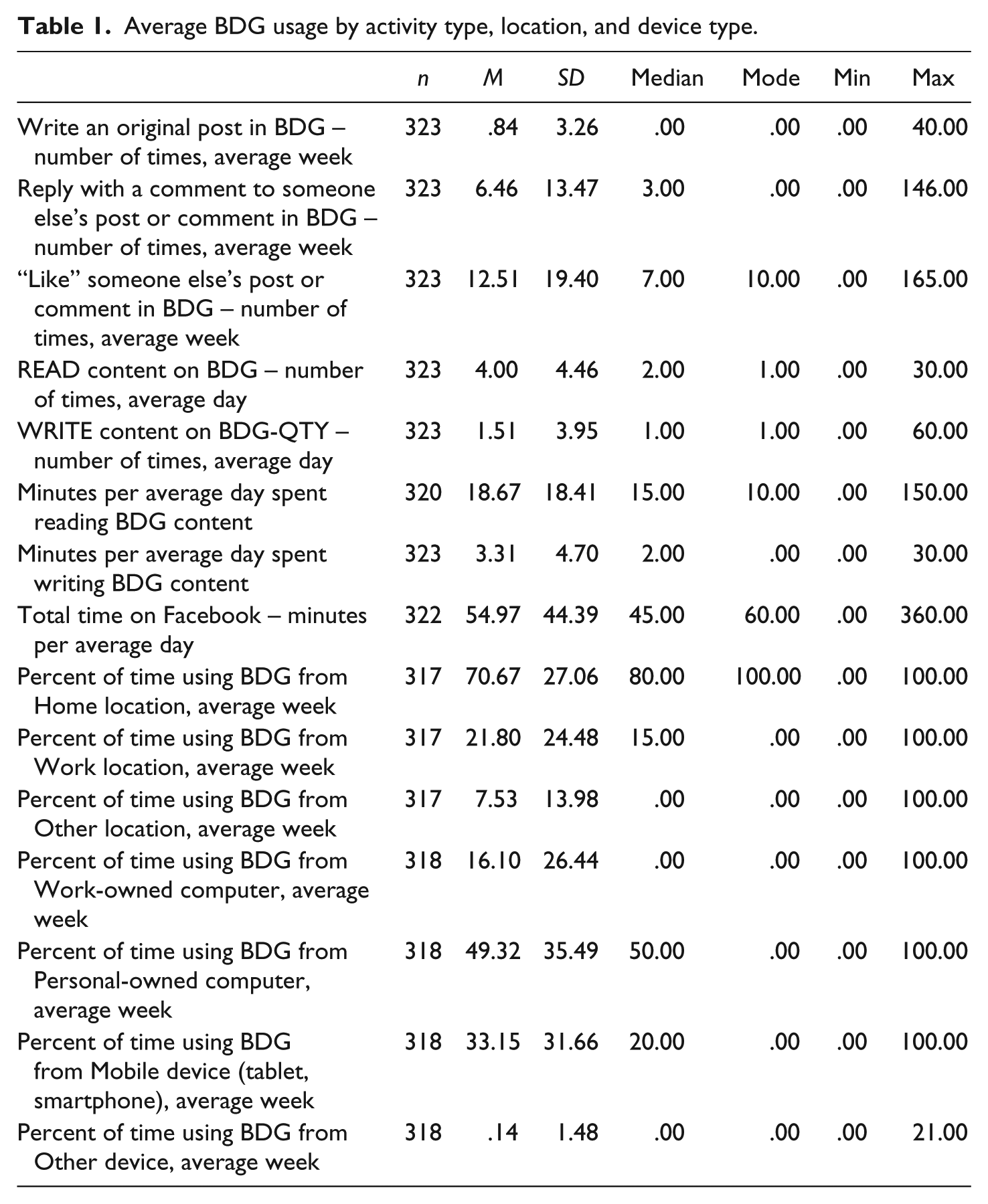
A series of survey questions were designed to investigate how BDG members engage with the Facebook group. The results of these items appear in The results of these items appear in Table 1. There was a notable trend toward lower average levels of contributing new content compared with relatively higher levels of passive and semipassive engagement such as reading and “liking” posts. Table 1 also lists the reported usage by location and device type. The average BDG user reported most usage occurring from home on a personally owned computer or mobile device.
Average BDG usage by activity type, location, and device type.
Respondents were asked to rate nine types of potential professional development activities on a scale from Extremely Important to Not At All Important. The results of these ratings are summarized in Table 2, ranked in descending order by mean. Participation in BDG ranked in the middle of this list. Table 3 contains additional attitude items related to participation in BDG, to which participants responded on a standard Likert-type Strongly Agree–Strongly Disagree scale. The items are listed in descending order by mean response. Although scale development was not a goal of this descriptive study, the researcher-constructed attitude items in Table 3 were subjected to a Cronbach’s alpha analysis as a post hoc check of reliability. The resulting 12-item scale had a reliability of α = .867, indicating high reliability of responses.
Importance of activities to meeting professional development needs.

Scale: 7 = Extremely Important, 1 = Not At All Important.
Attitude items.
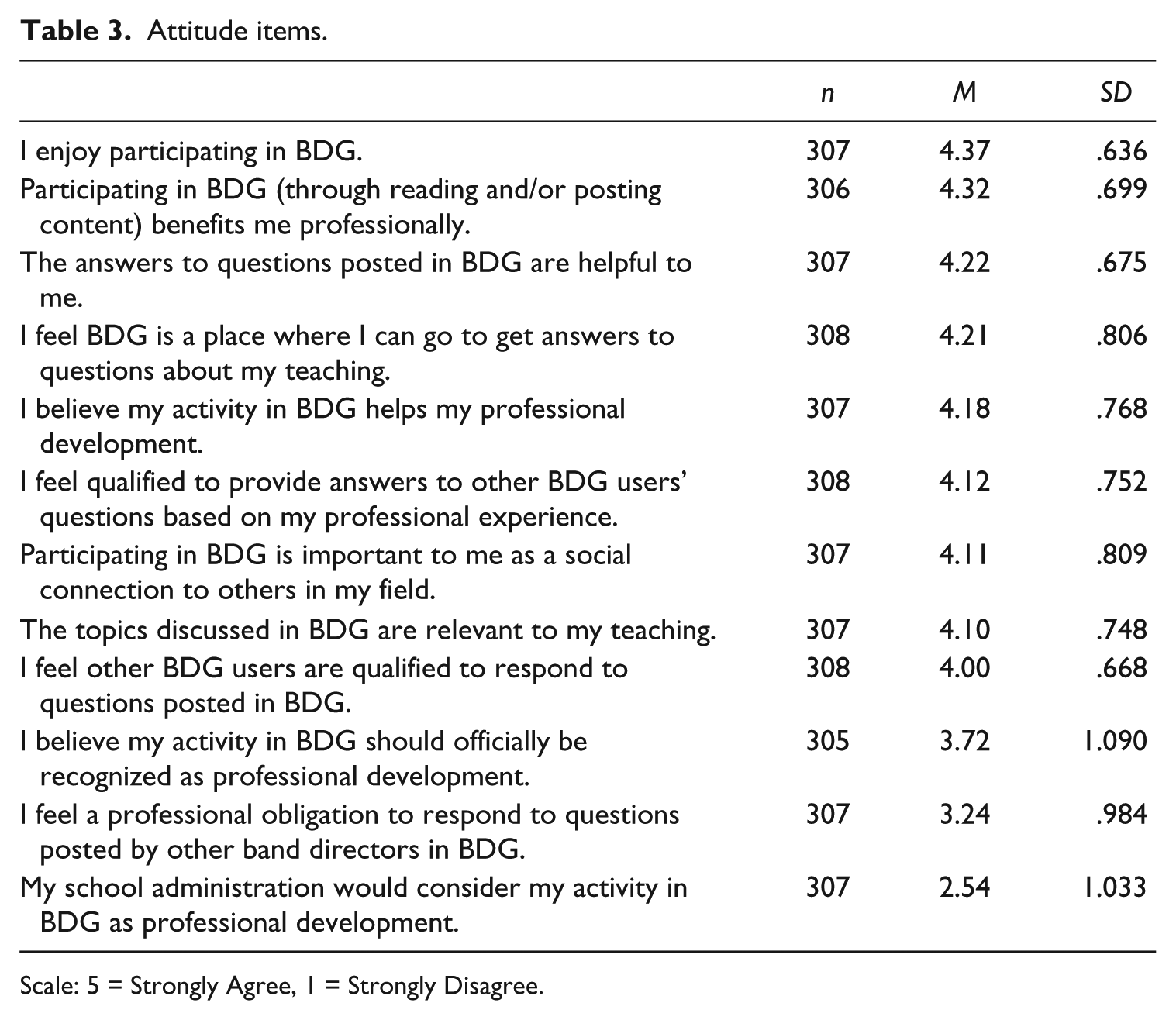
Scale: 5 = Strongly Agree, 1 = Strongly Disagree.
A total of 123 respondents chose to enter text on the optional open-response item. Responses generally reflected a positive outlook toward BDG’s potential to allow for forming connections and obtaining support from other band directors. After common words like “band,” “director,” and “BDG,” the most common words represented in the responses were “great,” “ideas,” “questions,” and “resource.” No patterns emerged that would indicate disconfirming evidence of the generally positive responses on the scale items from BDG participants.
Discussion
Two unique features of BDG are (1) its large size and (2) the way that information authority is dispersed across members of the group via crowdsourcing. Harnessing this collective wisdom, where individual members pose questions to a very large group of people in different geographical and work situations, is a primary benefit of participating in BDG. These characteristics distinguish BDG from other more traditional forms of professional development such as conferences and from smaller, locale-based collaborative teacher study groups such as those explored by Stanley (2012). In the open-ended survey responses, several participants mentioned the speed and quantity of responses as well as the value of networking with people from different regions of the country and the world.
In considering the ways in which the group functions via crowdsourcing, it is important to take group demographics into account because, as noted by Surowiecki (2005), diversity of opinion is an important characteristic of intelligent crowds. The results of survey items related to Research Question 1 suggest that BDG membership is diverse across several variables of interest, including gender. Additionally, respondents represented a wide cross-section of both ages and number of years in the profession. This diversity, paired with the large size of the group, creates quantity and variety in responses that help users gain a range of perspectives on each topic. Several respondents highlighted this advantage in their open-ended responses, such as receiving “advice from people from a wider range of areas who look at things from different angles depending on their situations.” While traditional forms of professional development rely on vetted and centralized expertise from academic faculty or specially selected conference presenters, BDG relies on the wisdom of the crowd for vetting ideas. Our data indicate that group participants find this type of expertise to be reliable, as noted in Table 3.
A notable lack of diversity exists in participants’ ethnicity with more than 95% of respondents identifying as White. This lack of ethnic diversity, though unfortunate, is representative of the current state of the teaching profession as evidenced by previous research. Feistritzer (2011) noted that “teaching is still an overwhelmingly female occupation . . . [and] the profession is … strikingly White, but there is some shift toward more people of color entering the ranks of teaching” (p. x). Future researchers might examine these demographic trends in relation to music education to uncover parallel trends within our field.
In relation to Research Question 2, the data gathered in the authors’ previous study (Brewer & Rickels, 2014) as well as the current study suggest that members are using BDG as a form of professional development to address some of the expectations and dispositions outlined by Danielson (2013). Because the discussions in BDG are ongoing and current (by nature of the medium), teachers can pose questions and receive immediate responses from colleagues encountering or solving the same issues in their own classrooms. This interaction between teachers may function as an additional support for contextualizing the theoretical and practical knowledge gained in formal music teacher education coursework. The data demonstrate that user activity is ongoing and frequent with many participants logging into the group one or more times per day, often from home and using their own computers (Table 1). Additionally, members often solicit general advice about issues ranging from instrument pedagogy, to dealing with students and administrators, to simply sharing stories of success. These types of interactions suggest the pursuit of “collegial support and feedback” as described in the Danielson (2013) framework (p. 103). Whether BDG could be considered a traditional “professional organization” is debatable, but this activity could be construed as providing “leadership and support to colleagues” (Danielson, 2013, p. 103), especially in cases where members take an active role in the group.
In further exploration of Research Question 2, the results indicate that these teachers seek out BDG as a resource despite obstacles or lack of supports. Respondents report high usage rates for personal mobile devices and computers, perhaps in response to blocked social media access at work, as noted by nearly two thirds of respondents. The rating data on perceived administrative support (Table 3) appears to show that BDG participation is not considered a recognized form of professional development, despite the potential for such engagement to be part of a broad range of professional development activities as outlined in Danielson’s (2013) Component 4e. It is possible that social media usage is seen as recreational, and not valued for its potential to foster professional learning communities.
In relation to Research Question 3, the data suggest that respondents perceive participation in BDG as contributing to their professional growth. Users believe that participating in BDG is an important professional development activity, more important than many regular or periodic events in their own schools (Table 2). Our study did not attempt to assess frequency as a comparative factor across all these item types, but simply the perceived importance of each. While we recognize that the nine items in the survey list do not occur with equal frequency (i.e., BDG participation might be a source of daily engagement whereas district workshops or professional conferences might occur once a year), the average importance that respondents attribute to these items shows a clear pattern. BDG outranks four options that are not music-specific, whereas the four options that rank higher than BDG are music specific, suggesting a desire for content-relevancy that BDG seems to provide. The importance of content-relevant professional development has been noted in previous research, and Stanley (2011) suggested that “music teacher professional development should be unfailingly oriented around music pedagogy and/or content” (p. 75). In concert with Dammers’s (2009) suggestion regarding online music instruction, the data in this study show that participating in BDG is helping educators “expand and supplement” their professional knowledge, but will not necessarily “revolutionize” the field by completely replacing other forms of professional development (Dammers, 2009, pp. 22–23).
In further exploring the results related to Research Question 3, the data suggest that participation in BDG provides an aspect of (virtual) interaction with professional colleagues, also an important feature of traditional conference participation. As noted in our previous study (Brewer & Rickels, 2014), the social dimension of BDG (in combination with professional interaction) is critical to establishing a vibrant community of practice (Wenger et al., 2002). Participants in this survey appear to agree, as the results for Research Question 3 show mean ratings at 4.00 or higher for enjoyment, social interaction, and professional benefit. Furthermore, several respondents commented specifically that BDG helped lessen their sense of professional isolation, a topic that has been explored in previous research (Conway & Christensen, 2006; Conway & Zerman, 2004; Sindberg & Lipscomb, 2005). One respondent noted, that “band directors, and music teachers in general, tend to be isolated. In many to most cases, there is only one music teacher in a building, so we don’t have an easy way to collaborate with others in our field.” Another respondent from a rural area added: My favorite part of BDG is the realization through reading and discussing posts that “I’m not alone.” When I’m the only band director in my building in a rural school, my experiences (frustrations and celebrations alike) can sometimes feel isolating.
The existence of such a large and active professional group holds important implications and possibilities for music teacher education. The current study has focused on the behaviors and needs of in-service teachers participating in the group, but such forums may also hold value for others in the music education field as well. Preservice teachers might benefit from observing the activities and discussions in the group in relation to issues raised in course assignments or discussion in which they are engaged. These observations could serve as an early “induction” (Conway & Zerman, 2004) into the field and help propel the professional socialization process that has been explored by previous researchers (Scheib, 2007). Furthermore, collegiate teacher education faculty might benefit from observing or participating in groups like BDG to stay in touch with the daily professional lives and concerns of practicing music educators. This could in turn influence the types of assignments, discussions, or courses that comprise teacher preparation programs as universities aim to stay in line with current trends and demands in the field. These are just a few examples of the role that a group like BDG might play in shaping our field; certainly, numerous other possibilities exist. Exploring the activities and usage of this group and others like it through systematic inquiry are the first steps in understanding these potential possibilities and limitations.
In closing, we wish to state clearly that this study is limited to participants in BDG. We do not assume that these online engagements are representative of all band directors or other types of music educators. Additionally, BDG is a unique online social media forum and it cannot be assumed that other forums will have similar benefits to participants. Future researchers could explore different social media groups and online formats, and the attitudes of a wider cross-section of music educators toward online forms of professional engagement. As Lock (2006) suggested, the development of a learning community is not about adding technology on to current professional development practices. Rather, it is about designing, building, and supporting a structure and a process that are purposeful and fluid in nature and in meeting the personal ongoing professional development needs of teachers. (p. 663)
As digital tools for collaboration and sharing of information continue to proliferate, research on how to best meet educators’ changing needs and how educators themselves are satisfying these needs via the Internet will become increasingly prevalent and important.
Footnotes
Declaration of Conflicting Interests
The author(s) declared no potential conflicts of interest with respect to the research, authorship, and/or publication of this article.
Funding
The author(s) received no financial support for the research, authorship, and/or publication of this article.
Supplemental Material
The Appendix is available in the online supplemental material.
Notes
References
Supplementary Material
Please find the following supplemental material available below.
For Open Access articles published under a Creative Commons License, all supplemental material carries the same license as the article it is associated with.
For non-Open Access articles published, all supplemental material carries a non-exclusive license, and permission requests for re-use of supplemental material or any part of supplemental material shall be sent directly to the copyright owner as specified in the copyright notice associated with the article.
