



Abstract
The purpose of the study was to examine the features of Texas’s Alternative Route to Certification (ARC) programs in music education, the demographics and prior experiences of program completers, and the employment of ARC completers in K–12 public schools. Data were collected from the State Board of Educator Certification about demographics and employment information for all individuals who completed ARC programs in music education between 2002 and 2012 (N = 1,200), and individuals from that population were surveyed concerning their experiences (n = 214). Survey respondents completed programs that varied widely in duration, features, instructional modalities, and providing institutions. Music educator gender and ethnicity were significantly associated with the route used to pursue alternative certification. Relative to the distribution of music teaching positions across the state, ARC completers were disproportionately employed in large urban districts, charter school districts, and in districts with large proportions of economically disadvantaged students.
Individuals are increasingly entering the music education profession through routes other than traditional baccalaureate programs. Alternative Route to Certification (ARC) constituted 31% of all U.S. teacher preparation programs as of 2014, with programs offered in 45 states and the District of Columbia (U.S. Department of Education, 2016). ARC in education, and music education specifically, are used more frequently in Texas than in any other state (Dye, 2011). In the 2011–2012 academic year, the upper boundary of the present study, 26% of active teaching licenses in Texas had been earned through ARC. This proportion has continued rise, reaching 30% in 2015–2016 (Ramsay, 2017). In 2014, Texas represented 7% of the nation’s enrollees in teacher preparation programs but 13% of ARCs based in institutions of higher education (IHEs) and 41% of enrollees in ARCs outside of IHEs (U.S. Department of Education, 2016).
According to the National Association for Music Education’s (NAfME) position statement on alternative certification, which was established in 2003, veteran music educators should mentor ARC-trained music teachers; ARC programs should be field-based, include “comprehensive music pedagogy courses,” and offer a supervised internship experience; and “knowledge and skills in music are absolutely essential and that without them, music teachers will not be successful and the musical education of the students they teach will be impaired” (NAfME, 2017). Within this policy statement, NAfME leadership further emphasized the need for alternative certification program regulation to be developed on the basis of empirical research.
Hellman, Resch, Aguilar, McDowell, and Artesani (2011) proposed a research agenda for ARC issues in music education focusing on candidate quality, impacts on the profession, impacts on university music education programs, and certification policy. They asserted that ARC policy “has the potential to alter the face of music education preparation and practice, but has not yet received considerable attention from music education researchers” (p. 84). Asmus (2003) explored the idea that moving licensure outside of the university setting could provide university music teacher educators with greater freedom in shaping their degree programs. Conway (2003) suggested that ARC programs in music education could address teacher shortages, provide useful pathways for recruiting nontraditional candidates, and diversify the music teaching work force.
Demographic data are particularly critical to many of the policy debates surrounding ARC (Hammerness & Reininger, 2008). ARC program participants and completers are typically more racially diverse than traditionally certified teachers and the general teaching population (Feistritzer, 2005; Humphrey & Wechsler, 2007) which may reflect the fact that alternatively certified teachers tend to be employed in urban school districts where more teacher diversity is evident. ARC completers have been found to be, on average, older than their traditional route counterparts (Feistritzer, 2005; Humphrey & Wechsler, 2007), excluding Teach for America participants (Decker, Mayer, & Glazerman, 2004). There is no evidence, however, of significant differences in gender distribution for ARC and traditionally certified teachers.
The educational backgrounds and work experiences of ARC program completers have been examined in prior research. Humphrey and Wechsler (2007) found that 42% of ARC participants were full-time students or working in education immediately before beginning their ARC programs. In Feistritzer’s (2005) national sample, 34% of respondents had been students or teachers in the year prior to beginning their ARC programs, and 57% had been working full-time in another field or had been in the military. In addition to previous education and work experiences, ARC completers also have varied music backgrounds. McDowell and Hellman (2011) surveyed and interviewed a purposive sample of music teacher candidates enrolled in one of seven ARC programs within three states. Just over one half of the 43 participants had completed an undergraduate degree in music, and most of those had very limited coursework and field experience in music education. A common concern about ARC program preparation was the lack of opportunities to develop pedagogical content knowledge specific to music. While some individuals have speculated that certain education, work experience, and music backgrounds may be more relevant or meaningful in determining how successful ARC-prepared teachers are once in the field (NAfME, 2017; Scribner & Akiba, 2010), and such assumptions undergird standards for teacher preparation, there is no empirical evidence linking a specific educational or career profile and teaching effectiveness, let alone student-learning outcomes.
In lieu of substantive information about the recruitment and admission of ARC program participants, the nature and quality of their preparation for music teaching careers, or their job placements and accomplishments, professional accreditation organizations and state regulatory boards play an important role in establishing the guidelines and standards that all teacher certification programs must meet, be they traditional or alternative in nature. The National Association of Schools of Music (2016), for example, has provided curricular guidelines and identified specific competencies to be demonstrated by undergraduates receiving degrees in music education and becoming qualified for music teacher licensure or certification. Within the state of Texas, the Texas State Board for Educator Certification (SBEC, 2003) has established 10 standards for music teacher competency.
Across all subject areas, ARC programs vary widely in their design and features. Single and multiple case studies of ARC programs have highlighted the variance of these features (Humphrey & Wechsler, 2007; Selke & Fero, 2005; U.S. Department of Education, 2004). The National Research Council (2010) concluded that in many cases there are greater differences within the categories of “traditional” and “alternative” than between the groups.
ARC represents a substantial proportion of teacher preparation programs across the country, and nearly 3 in 10 current Texas teacher licenses were earned through ARC programs. Despite some general agreement about the characteristics of effective alternative certification programs, current programs vary considerably in terms of policies and standards. Moreover, there are differences of opinion as to whether ARC programs (when compared with traditional teacher certification programs) adequately prepare novice teachers for workplace realities, increase teacher workforce diversity, improve teacher retention rates, or enhance student behavior and learning outcomes.
Purpose and Research Questions
Little is known about the backgrounds, experiences, and employment of alternatively certified music educators, yet the practice of ARC in music education has implications for music education practice, potential teacher candidates, teacher job markets, traditional teacher education programs, and policy-making bodies. The purpose of the study was to examine the features of ARC programs in music education, the demographics and prior experiences of program completers, and the employment of ARC completers in K–12 Texas public schools. The following research questions were considered:
Method
Two sources of data were collected: demographic and employment information maintained by the SBEC and survey data from the researcher-designed Music Education Certification Survey (MECS). The state of Texas was chosen for this study because of its range of ARC program types and large population of ARC completing music educators. SBEC designates Educator Preparation Programs for particular subject areas and permits music licensure candidates to enroll in alternative programs administered by IHEs, local and regional educational agencies (LREAs), and independent corporations. SBEC also issues annual accreditation reports, rating Educator Preparation Programs based on the licensure exam pass rate for program completers.
Instrument
MECS data included in the study were drawn from 21 items concerning prior career experiences and education, features of certification programs, student teaching experiences, and features of current teaching situations (MECS item wording, research question alignment, and item sources/rationales are presented in the online supplemental material). Career and educational experience items included degrees earned and majors, primary activity in the 12 months before beginning the ARC program, and prior career experience in music, education, music education, and other fields. Program characteristics included in the MECS were the length of the programs, instructional modality in the programs, and coursework taken in programs. Student teaching items included the presence or absence of student teaching and the length of the experience. Items related to current teaching included teaching status, areas of music education and grade levels taught, number of campuses, and area of primary specialization.
The survey instrument was analyzed for face and content validity by three music education researchers and was piloted with a sample of individuals who had earned alternative certification in music education in another state (n = 6). On the basis of pilot study results, I confirmed the feasibility of the web protocol for survey implementation and made minor revisions to the wording of MECS items.
Procedures
A public information request was submitted seeking the names, contact information, age, gender, race/ethnicity, certification program completed, and district of current employment for all individuals who were granted music education certifications through SBEC-designated alternative routes during the time frame of September 1, 2002, to August 31, 2012 (N = 1,200). Demographic and employment data provided by SBEC were analyzed at the population level. The sample for the survey consisted of population members for whom SBEC had an e-mail address, augmented by cross-referencing the population list with the online Membership Directory of the Texas Music Educators Association. Additional e-mails were sought by Internet searches using individuals’ names and their listed district of employment as search terms.
Valid e-mail contact information was obtained for 635 individuals from the population of 1,200. Four contacts were made: a prenotice, two e-mail invitations with links to the survey, and a follow-up postal letter with instructions to complete the survey online. Participation was incentivized by a random drawing for one of five $50 gift cards. A total of 214 completed the MECS, yielding a response rate of 33.7%. Survey responses were linked via unique access codes to demographic data. The respondents were representative of the population in terms of gender, χ2(1) = 0.01, p = .980, and distribution of school of employment, χ2(6) = 12.48, p = .052. However, the sample was overrepresentative of white individuals and those who were presently employed as K–12 teachers in Texas public school districts. The sample was also, on average, somewhat older at the time of earning certification (M = 33.91, SD = 8.97) than the population. Following Lindner, Murphy, and Briers (2001), the potential of nonresponse bias was checked by using the number of days from invitation to response as an independent variable in regression analyses. These analyses showed no significant relationships between response time and ARC program length, employment status, age, gender, or race/ethnicity. The lack of difference in responses and respondent characteristics between early and late responders may indicate a similar lack of difference between respondents and nonrespondents.
Results
Population Demographics and Employment Characteristics
During the 10 years under study, 1,200 individuals earned music education certification through 1 of 61 alternative programs, including 20 IHEs, 16 local or LREA, and 25 corporate programs. LREA programs include large schools districts and many of the state’s region service centers. Corporate programs are not-for-profit and for-profit organizations independent of IHEs and LREAs which offer a variety of in-person and online services. IHE programs produced 11.0% of all completers, LREA programs accounted for 28.6%, and 60.4% completed corporate route programs.
ARC music education completers ranged from 20 to 61 years of age on September 1 of the academic year in which they earned their certification (M = 31.85; SD = 8.58). A one-way analysis of variance test showed no significant difference in the mean ages of completers by route type, F(2, 1197) = 1.94, p = .144. Of the 1,200 ARC completers, 51.5% were identified as female. Gender varied independently of route type, χ2(2) = 10.82, p = .004, with females representing 41.7% of IHE completers, 57.7% of LREA completers, and 50.3% of corporate route completers. The race/ethnicity distribution of completers includes individuals identified as white (67.3%), Hispanic/Latino (17.4%), black/African American (11.6%), Asian (1.8%), two or more ethnicities (0.9%), American Indian or Alaskan Native (0.5%), Hawaiian or Pacific Islander (0.1%), and Other (0.4). A bivariate chi-square analysis conducted after collapsing the data into four categories (White, Hispanic/Latino, Black/African American, and Other) showed systematic variation of race/ethnicity by route type, χ2(6) = 20.81, p = .002. Individuals identified as black/African American were proportionally more likely to complete certification through an LREA than through the other route types. However, Hispanic/Latino completers were proportionally less likely to use an LREA program and proportionally most likely to complete a program run by an IHE. Gender and ethnicity also varied systematically, χ2(3) = 37.14, p < .001, as a majority of black and Hispanic completers were male, while most white completers and those of other ethnicities were female.
Among the population, 70.8% were employed by a Texas public school district in the fall of 2013, including 68.9% of IHE program completers, 71.7% of LREA program completers, and 70.6% of corporate program completers. African American (82.7%) and Hispanic (80.4%) completers were employed at a higher rate than white completers (66.5%). In the aggregate, male completers were also significantly more likely to be employed than female completers (p < .001; two-tailed Fisher’s exact test), though this did not hold true when employment rate was conditioned on ethnicity.
Employing districts were considered according to two metrics: urbanicity and socioeconomic level. Urbanicity was classified according to the Texas Education Agency District Classification schema. Socioeconomic level was determined according to the percentage of students identified as economically disadvantaged in the 2012–2013 Public Education Information Management System (PEIMS) Standard Reports (Texas Education Agency, 2013). This label includes all students who are eligible for free or reduced lunch, as well as students who do not qualify for free or reduced lunch but whose families have an income below the poverty line, are eligible for public assistance, receive need-based educational financial assistance, are eligible for assistance under Title II of the Job Training Partnership Act, or are eligible for food stamp benefits. The distribution of employed ARC teachers was compared with the distribution of music positions statewide, taken from the PEIMS Standards Reports in terms of full-time equivalencies.
Alternatively certified music teachers worked in districts of every Texas Education Agency classification (Figure 1). However, they were significantly overrepresented among teachers in Major Urban (Type A) districts, χ2(1) = 34.746, p < .001. Almost one quarter (24.47%) worked in Major Urban districts, though Major Urban districts employed only 16.86% of all music teachers, statewide, by full-time equivalency. ARC completers were also significantly overrepresented among music teachers in Charter School districts (Type I), χ2(1) = 7.476, p = .006. Charter School districts employed 1.65% of public school music teachers statewide, while 2.85% of employed ARC completers were teaching in Charter School districts.

Distribution of Texas public school music positions and employed ARC completers by Texas Education Agency district type.
Of the 849 employed ARC completers, 813 were employed by districts with published socioeconomic status (SES) data in the 2012–2013 PEIMS. The remaining 36 teachers were employed by districts for which SES data are not reported because of restrictions on individually identifiable information mandated by the Family Educational Rights and Privacy Act. There were 951 districts with SES data published in the 2012–2013 PEIMS, representing 95.8% of music teacher positions in the state. The average Texas music teacher, by full-time equivalency, teaches in a district with 58.3% of students classified as economically disadvantaged. The mean proportion of students of ARC completers classified as economically disadvantaged is significantly higher, M = 64.3%, SD = 22.17%, t = 7.68, p < .001. The median ARC completer’s district has 68.6% of its students labeled as economically disadvantaged. I constructed a distribution of statewide music teacher positions and employed ARC completing music teachers, creating 10 categories each representing a 10% range in the proportion of low-SES students. Although districts with 70% or more of their student population identified as economically disadvantaged account for only 32.1% of statewide music teacher positions, 47.6% of ARC completers work in such a district. ARC completers are underrepresented in every decile of the distribution below the 70% threshold and are overrepresented in each of the top three deciles (Figure 2).
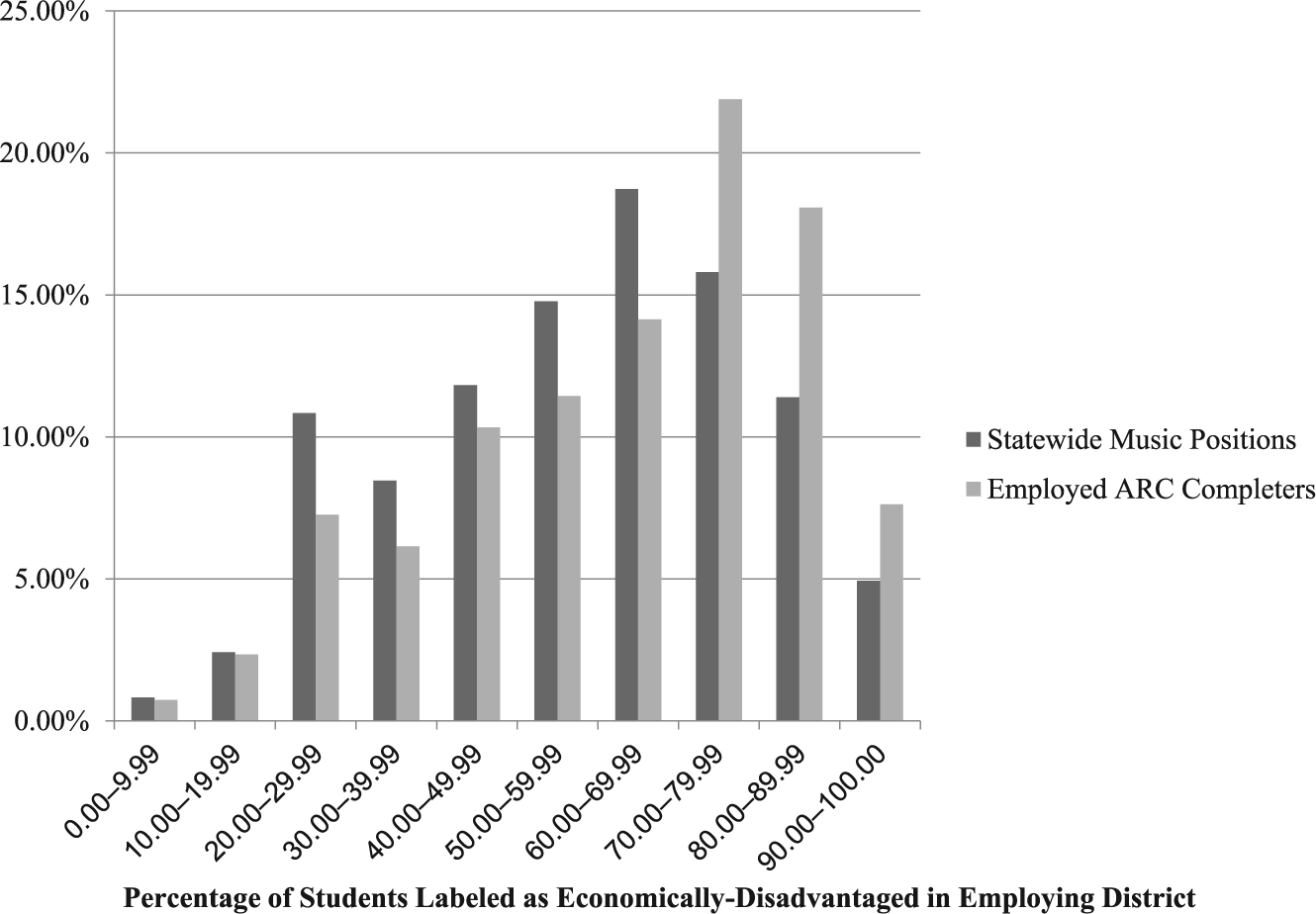
Distribution of Texas public school music positions and employed ARC completers by proportion of students labeled as economically disadvantaged in employing district.
Responses to the Music Education Certification Survey
Prior Experiences
All respondents reported having earned a bachelor’s degree, the large majority of which (88.8%) were earned in a music field. Most either earned a bachelor’s degree in performance or in music without a specific concentration, such as a bachelor of arts degree in music. Performance degrees were also the most commonly earned advanced degrees reported. Nearly half of respondents had earned a master’s degree and 4.2% had a doctoral degree.
In the 12 months prior to beginning a certification program, 36.4% of respondents were primarily working as teachers, either through a private studio, at a public school without certification, at a private school, as a substitute or paraprofessional, at a college or university, at a preschool, or as a certified music teacher in another state. The other most common responses were working in an occupation outside the fields of music and education (17.3%) or attending a 4-year college or university as an undergraduate student (16.8%). Respondents also reported a wide range of work experiences both in and out of the fields of music and education. The vast majority (90.7%) reported at least one area of previous music teaching experience, most often teaching private lessons (68.2%). Some respondents (29.0%) reported work experience in the field of education outside of music, primarily through substitute teaching (10.3%) and working as a classroom aide (7.9%). Nearly three fourths of respondents (73.8%) reported professional experiences in music outside of music education, most commonly working as a professional performer (57.5%) or church musician (19.6%). The majority of respondents (61%) also reported prior work experience outside of the fields of music and education, most often in office administration positions and in retail and sales.
ARC Program Characteristics
All but two respondents (n = 211) reported a program length of 3 years or shorter. The majority of IHE and LREA completers reported that the program took 1 year to complete, while 50% of corporate program completers reported lengths less than 1 year. IHE completers were most likely to report a program length of at least 1 year.
The majority of IHE and LREA completers (60.0% and 61.4%, respectively) received all instruction in-person, while 39.7% of corporate program completers reported receiving only in-person instruction. Corporate completers were more likely to report receiving no in-person instruction (28.2%) than either IHE or LREA completers (4.0% and 12.3%, respectively). Just more than 30% of all respondents reported receiving a blend of online and in-person instruction.
The most common areas of coursework reported in alternative certification programs were general (not music specific) instructional strategies, classroom management, and educational psychology or child development. A majority of respondents took required courses in each of these areas. Academic courses in music areas, music performance, and music-specific pedagogy were reported much less frequently.
Most respondents (63.1%) reported no student teaching or internship as part of their certification program, serving as full-time teachers under provisional certificates while completing their programs. Among those who did report student teaching or an internship, over 82% reported internships lasting at least one semester, including 57.0% who completed year-long experiences and 5.1% who completed experiences lasting at least 2 years.
Employment Characteristics and Music Education Specialization
Most respondents (91.1%) were currently employed as a K–12 music educator. Of those, nearly all were employed in full-time positions (98.5%). A large majority (92.2%) taught only music classes. Respondents taught vocal or choral classes (37.9%), elementary general music (31.3%), instrumental winds/percussion/band (29.7%), secondary general music (18.5%), instrumental strings/orchestra (17.9%), and music theory (17.9%). The mean respondent reported teaching 1.90 areas (SD = 1.11). A majority of respondents (66.5%) taught on a single campus, while others taught on two (23.2%), three (6.7%), four (1.6%), five (1.6%), or more than five campuses (0.5%).
Every group of primary instrument was represented among the respondents. Responses included voice (n = 63), brass (n = 40), bowed strings (n = 31), keyboard (n = 29), woodwinds (n = 23), percussion (n = 15), guitar (n = 8), and other (n = 5). Respondents’ teaching responsibilities were compared with their reported primary instrument and primary area of music education specialization. More than 80% of respondents who taught vocal or choral classes identified voice (62.2%) or keyboard (18.9%) as their primary instrument. For instrumental ensembles, 85.5% of instrumental wind/percussion/band respondents primarily play brass, woodwind, or percussion instruments, and 77.1% of respondents teaching strings/orchestra classes selected strings as their primary instrument. Similarly, at least 80% of instrumental wind/percussion/band teachers and string/orchestra teachers identified that focus as their primary music education specialization (81.8% and 80.0%, respectively). However, only 64.4% of teachers of vocal and choral classes identified voice/choir as their primary specialization, and less than half of elementary general music teachers (46.7%) chose general music as their primary specialization.
Discussion
The findings of this study indicate that a majority of music education ARC completers in Texas earn their certification in their late 20s or 30s. This is in line with the results of previous research on ARC completers nationally (e.g., Feistritzer, 2005). Demographic findings show alternatively certified Texas music educators are more likely to be male than other teacher populations in the state and previously researched ARC populations (Feistritzer, 2005; Ramsay, 2013a, 2013b). The ARC music education population is more racially diverse than Texas teachers as a whole and Texas ARC teachers across all subject areas (Ramsay, 2013a, 2013b). The present finding that the demographic variations across route types as a function of gender and race/ethnicity suggest that each route contributes differently to the diversity of the music teaching population. LREA programs are attracting larger proportions of black/African American candidates, and IHE programs are disproportionately enrolling Hispanic candidates. Further study is needed to determine if these contributions are a sign that ARC is increasing the overall diversity of the music teacher population, or if, as Humphrey and Wechsler (2007) have proposed, ARC is attracting a disproportionate number of minority candidates who may have otherwise completed traditional route programs. If this is the case, it may have the effect of reducing diversity in traditional teacher education programs.
More than a quarter of survey respondents were full-time students in the year prior to beginning their certification program. This is a higher proportion than has been found in national studies by Feistritzer (2005; 12%) and Humphrey and Wechsler (2007; 18%). As Chin and Young (2007) suggested in their survey of ARC completers in California across all subject areas, only a small proportion of ARC-prepared teachers are “true” career teachers, coming to education after extensive work experience in another professional field.
When compared with previous studies of ARC-completing populations, the greatest departure seen in the present comes from the relevance of respondents’ prior experiences. Although professional experience and education has been hailed as a strength of ARC candidates dating back to the Southern Regional Education Board’s (1981) initial recommendation for alternative certification, those direct connections have not been an emphasis in creating ARC policies nor have they been a consideration in national studies of ARC participants and completers (e.g., Feistritzer, 2005; Humphrey & Wechsler, 2007). However, as was previously found by McDowell and Hellman (2011), the vast majority of survey respondents had degrees in music, and 9 out of 10 reported at least one area of prior experience in music education, primarily teaching private lessons. More than half have professional experience as performers. These results suggest that many candidates entering ARC programs in music education have the kinds of musical and music teaching experiences that could potentially set them up for professional success, provided their certification programs equip them with the pedagogical and classroom management skills needed for public school teaching. It is also concerning that about a 10th of respondents either did not have degrees in music or had no previous experience teaching music in any context. Given the overrepresentation of currently employed teachers in the present study’s sample, these subgroups may be even larger among the population, with many not persisting in the field. The overrepresentation of white individuals among the survey respondents may also obscure some variations in the preparation of teachers across race/ethnicity.
ARC programs preparing music educators in Texas vary widely in their features, consistent with previous findings (Humphrey & Weschler, 2007; National Research Council, 2010; U.S. Department of Education, 2004). As compared with features common to traditional route programs, survey respondents’ programs were much shorter in duration, lack subject-specific coursework, and often do not include a student teaching or internship experience. The majority of programs involve at least some online instruction, and more than 20% provide all coursework online. Online instruction is most commonly provided by corporate route programs. Relative to traditional route programs, the streamlined time frame and scheduling flexibility offered by ARC programs may attract a number of candidates. Additionally, the lack of student teaching typically means that candidates seek immediate employment on a provisional license, enabling them to earn a full-time teaching salary while completing certification. However, Texas’s SBEC (2003) standards for music teachers and NAfME’s (2017) position statement on alternative certification consistently emphasize the need for teachers to have music-specific preparedness. Without coursework in pedagogy specific to music and field experience, student teaching, or internships in music classrooms, many ARC candidates may be at a disadvantage as they begin their public school teaching careers.
ARC-prepared music teachers represent the full range of K–12 music teaching positions across the state, working at all grade levels and teaching a variety of ensemble types and general music courses. A large majority teach in areas tied to their primary instrument. Following completion of the certification program, minority ARC completers are employed at significantly higher rates than white completers. In terms of employment patterns, ARC completers are disproportionately teaching in Major Urban districts and charter schools. They are also overrepresented in districts with 70% or more of students labeled as economically disadvantaged. It can be concluded that ARC in music education is providing teachers for areas most often thought of as “high need.”
Further study is needed to assess the overall impact of ARC programs on the quality of music education in Texas public schools. Many individuals with music degrees and significant professional experience have used ARC programs to expedite their path to certification and teaching positions in public schools. By accepting challenging positions in schools that could be considered geographically or socioeconomically disadvantaged, they could be preventing music education learning opportunities for K–12 students from being reduced or eliminated. However, the basic threshold of qualifications and limited provisions of some ARC programs have led to some individuals becoming certified teachers with no music degrees and limited professional experience in music or music education. Others who have music degrees and professional experiences are not consistently receiving instruction in music pedagogy or the kinds of field experiences and professional support that are characteristic of teachers who are successful in the field. The same patterns of employment that are resulting in the successful filling of jobs in urban and underresourced schools may also be matching up Texas’ most economically disadvantaged students with the state’s least-prepared music educators.
The important implications of ARC programs and the individuals certified through them for the profession, as illustrated by the results of this study, suggest a need for policy change in music teacher certification and the structure of music teacher preparation programs. Faculty affiliated with traditional certification programs, for example, might considering adopting some of the characteristics that make ARC programs attractive to candidates, particularly nontraditional candidates and candidates of color. ARC programs, however, also should adopt appropriately rigorous admission standards and provide admitted candidates with course work and supervised field experiences that adequately develop pedagogical and classroom management skills specific to music and commensurate with state educator standards. State policymakers need to balance the market demands to fill teacher shortages with the need to maintain high standards for teachers in all classrooms.
Footnotes
Declaration of Conflicting Interests
The author(s) declared no potential conflicts of interest with respect to the research, authorship, and/or publication of this article.
Funding
The author(s) received no financial support for the research, authorship, and/or publication of this article.
Supplemental Material
Table S1 is available in the online supplemental material.
References
Supplementary Material
Please find the following supplemental material available below.
For Open Access articles published under a Creative Commons License, all supplemental material carries the same license as the article it is associated with.
For non-Open Access articles published, all supplemental material carries a non-exclusive license, and permission requests for re-use of supplemental material or any part of supplemental material shall be sent directly to the copyright owner as specified in the copyright notice associated with the article.
