




Abstract
The purpose of this study was to examine inservice band directors’ perceptions of their undergraduate instrumental conducting curricula. Members (N = 141) of the Facebook Band Directors Group who had completed undergraduate conducting and rehearsal techniques coursework responded to an online survey. Respondents felt more confident demonstrating technical conducting behaviors versus expressive ones, perceived their instruction in conducting skills superior to their rehearsal skill instruction, and desired additional conducting and rehearsal experiences that were more representative of what they encountered once they began teaching. Respondents’ most desired curricular change was for additional instruction in rehearsal planning, error detection and correction, and instrument-specific pedagogy. The three most frequently used score study behaviors were “initial, casual read-through of the score,” “define all unfamiliar terms,” and “marking important cues.” Based on our findings, we discuss ways in which music teacher educators can improve their instrumental conducting courses.
Preservice music educators’ first opportunities to acquire the skills necessary to lead instrumental ensembles typically occur during instrumental conducting courses. Given that conducting involves a complex interaction of psychomotor skills (e.g., baton technique, gestures, conducting plane) and nonverbal and verbal behaviors as primary modes of rehearsal pedagogy, the task of preparing students for their future work as conductor-educators is essential for their career success (Berg, 2014). In fact, most music education programs include two conducting courses as part of their required coursework (Hart, 2018; Manfredo, 2008). Hunsberger and Ernst (1992) emphasized the importance of undergraduate conducting curricula when stating that “the improvement of college conducting classes is a matter of widespread concern, particularly since a large percentage of graduates will use their conducting skills extensively during their careers and many—perhaps most—will receive no additional formal instruction” (p. xvii).
Researchers have found that undergraduate conducting course instructors’ curricular practices are diverse. For example, Hart (2018) found that conducting instructors ranked music content knowledge, such as knowledge of music styles and conducting gestures, over pedagogical content knowledge (e.g., explanation and demonstration of music concepts) and general pedagogical knowledge (e.g., knowledge of learner characteristics). Manfredo (2008) reported that curricular decisions were often based on the background of the course instructors. Instructors with a performance background (as compared with those with a music education background) in Manfredo’s study tended to emphasize gestural competencies over score study and pedagogical approaches. Chapman (2008) articulated that some instructors incorporated certain movement practices intended to improve their students’ conducting expressivity, such as Dalcroze Eurhythmics, mime/theater studies, and Laban movement theory. The variety of curricular practices evidenced in previous research reflects what Manfredo (2008) referred to as a “subjective approach to curricular design” (p. 56). This could be due to the diverse experiences, interests, and values of course instructors, as well as the time constraints of undergraduate degree programs (Romines, 2003).
How teachers and students perceive undergraduate conducting coursework may also affect how courses are structured. Romines (2003) found that many undergraduate conducting teachers perceived live-ensemble conducting experiences to be an essential component of undergraduate conducting curricula; however, these experiences tended to be limited to in-class, peer-ensemble conducting episodes. Silvey (2011b) found that students also expressed the need for more live conducting experiences in preservice coursework. An important aspect of those conducting episodes is the opportunity for course instructors to work one-on-one with their students as they develop and refine their conducting and rehearsal skills. Such interactions could allow both teachers and students to discover for themselves what attributes and behaviors are most important for successful conductors. Interestingly, Silvey and Baumgartner (2016) found that university instructors viewing undergraduate conductors had difficulty distinguishing between basic conductors (those who had completed one semester of conducting coursework) and nonconductors (those who received one hour of preparation), which the researchers suggested could be indicative of a need for instructors to clearly define what key conducting competencies separate novice and expert conductors.
Successful conductors exhibit a repertoire of many attributes and skills (e.g., conducting pattern, gesture, cues, fermata, left-hand independence). Among those skills, undergraduate students have reported gesture as the most important one to master (Silvey & Major, 2014). Silvey (2011b) found that many students felt most confident in their conducting patterns, and least confident in the areas of error detection and error correction. He also reported that students’ leadership abilities grew throughout their undergraduate conducting coursework, and that students felt confident in their ability to lead and conduct. Conversely, Silvey and Major (2014) found that students in undergraduate conducting courses had trouble adopting a leadership role. Based on these disparate findings, there is a need to further understand former students’ perceptions of undergraduate conducting coursework—particularly concerning how students learn nongestural competencies like rehearsal techniques and conductor leadership skills. Asking practicing teachers to reflect on how they were prepared to conduct and rehearse throughout their undergraduate coursework might provide deeper insight into how music teacher educators (MTEs) can best prepare future instrumental music teachers.
Score study is a related conducting competency because how conductors study scores is essential for their rehearsal preparation and for developing an aural concept of the music they are conducting (Colwell et al., 2018; Labuta & Matthews, 2018). In fact, Battisti and Garofalo (1990) exhorted conductors to hold themselves to the same standard of practice before rehearsal (i.e., through score study) as they expect from the members of their ensembles during rehearsal. Undergraduate conducting students who were given score study instruction demonstrated better eye contact and score familiarity when rehearsing an ensemble as compared with those receiving no assistance (Silvey, 2011a), and students also reported feeling more confident in score study strategies after completing two semesters of conducting coursework (Silvey, 2011b).
Lane (2006) found that there was a lack of transfer between undergraduate music education majors’ knowledge of score study procedures and how they studied scores independently. He also reported that participants generally avoided using aural sound sources (e.g., piano, other instrument, voice) while studying full scores. Similarly, in an observational study of instrumental music education majors engaged in score study, participants spent most of their time studying silently or marking their score (Silvey et al., 2017). Silvey et al. (2016) found that many instructors teach score study strategies to their students based on the strategies they have personally used. Together, those findings suggest that while both conducting teachers and students value score study as an essential skill, changes in score study pedagogy may be warranted to more effectively prepare future conductor-educators.
Although researchers have previously examined conducting teachers’ (Manfredo, 2008; Romines, 2003) and undergraduate students’ (Silvey, 2011b) beliefs about conducting curricula, inservice band directors’ perceptions of their undergraduate conducting coursework remains an underinvestigated area of inquiry. Recommendations about curricular change, such as the need for increased “podium time” expressed by Silvey’s (2011b) undergraduate participants, are beneficial for MTEs, yet we believe that an examination of inservice band directors’ recommendations would be uniquely valuable in guiding curricular and pedagogical change because practitioners regularly apply conducting and rehearsal skills in their work with school musicians. Furthermore, previous research findings indicated that conducting teachers used a variety of score study strategies in their undergraduate conducting courses (Silvey et al., 2016), but it is not known how inservice band directors actually apply these strategies. We believe that inservice band directors’ responses would be especially valuable in understanding what score study practices will best prepare them for success in their future teaching careers.
The purpose of this study was to examine inservice band directors’ perceptions of their undergraduate instrumental conducting coursework, particularly in relation to their current practice as music teachers. We surveyed directors to determine their perceptions of (a) the effectiveness of the instruction they received, (b) the amount of instructional time devoted to specific classroom activities, (c) their confidence in their ability to conduct and rehearse ensembles, (d) the aspects of their undergraduate conductor coursework that they believe needed to be changed, and (e) score study practices/strategies they considered most effective.
Method
We recruited members of the Band Directors Group (BDG) on Facebook for participation in this study. Given that this closed-membership group is inclusive of band directors of all levels with a national geographic distribution, we believed that the BDG represented an ideal sampling frame in terms of years of teaching experience, geographic region, and size and skill level of ensembles taught (Rickels & Brewer, 2017), and that their members might be interested in reporting their experiences and reflections concerning previous undergraduate conducting courses.
We used the online tool Qualtrics to create an IRB (institutional review board)-approved questionnaire for the study. Questionnaire items were repurposed from prior studies of undergraduate conducting curricula (Silvey, 2011b) and score study strategies (Silvey et al., 2016). In addition, new items were created to address rehearsal planning and post-rehearsal reflection, and the viewing of expert conductor videos. The current questionnaire was divided into four sections designed to gather information about inservice band directors’ (a) beliefs about their nonverbal conducting preparation, and their confidence in their conducting and rehearsing abilities (18 items); (b) perceptions of the amount of time they spent engaged in particular activities during their undergraduate conducting courses (9 items); (c) opinions about what changes could have been made to their undergraduate conducting courses in order to better serve them as inservice teachers (four questions); and (d) personal score study practices and behaviors (22 items). The questionnaire, which took approximately 10 minutes to complete, featured Likert-type scale, frequency, yes/no, and open-ended response questions. After completing these sections of the questionnaire, participants provided demographic information (e.g., gender, degrees completed, and years of teaching experience). Responses to questionnaire items within each of the four major sections exhibited a high level of internal consistency, with Cronbach’s α ranging from .853 to .938.
Current music student teachers (n = 4) and university conducting faculty (n = 4) from our institutions were invited to pilot test the questionnaire to establish content validity and suggest revisions. We considered student teachers to be a suitable group for pilot testing, since they had recently completed their conducting and instrumental methods coursework but were not yet engaged in the profession full time. To complement their perspectives, university conducting faculty could provide an expert opinion on the contents of the questionnaire. Prior to taking the questionnaire, pilot participants were asked to confirm they did not belong to the BDG to ensure they would not respond to the actual questionnaire at a later date. Based on student teacher and conducting faculty feedback, we added (a) two more activities to choose from concerning their undergraduate conducting and rehearsal techniques coursework, (b) one open-ended response question about any perceived changes in their conducting and rehearsal skills, and (c) one additional score study behavior.
Band directors who were members of the BDG at the time of data collection were invited to participate in the study via a Facebook post to the group page. In our post, we provided a brief description of the project and a link to the online questionnaire. The first page of the questionnaire served as the consent form and included a detailed description of the study, the purpose/rationale, and the researchers’ contact information. Two weeks after the initial solicitation, a follow-up request for participation was posted. At the end of this period, 141 BDG members had completed the questionnaire.
Respondents were men (n = 88) and women (n = 49) and four persons who left this and other demographic questions blank; no respondent indicated options of nonbinary/third gender or “prefer not to answer.” Most of the sample currently taught at the high school level (n = 94, 66.7%), including 40 people (28.4%) who taught at the high school level exclusively and 54 others (38.3%) who taught both high school and either middle or elementary school. Forty respondents (28.4%) taught middle and/or elementary school exclusively, and seven respondents (5.0%) did not indicate grade-level taught. Including the current year, respondents had a wide range (from 1 to 39 years) of experience teaching a conducted ensemble (M = 10.81 years, SD = 9.08). Some respondents had no graduate study (n = 44), while many had completed a graduate degree (n = 73), and others were currently taking graduate coursework (n = 20). Areas of graduate study included music education (n = 53), conducting (n = 18), music performance (n = 6), music theory or composition (n = 2), and other combined areas of study (n = 14).
Results
Beliefs About Instructional Effectiveness
Respondents were asked to “rate how prepared you felt to demonstrate each of the behaviors and rehearsal skills as a result of your undergraduate conducting and rehearsal techniques coursework” in the first section of the questionnaire, and provided answers using a Likert-type scale anchored by 1 (not prepared) and 5 (well prepared).
Generally, band directors’ mean ratings for their preparedness were high, with “conducting patterns” and “preparatory beat” rated highest (M = 4.60, SD = 0.74 and M = 4.34, SD = 0.92, respectively), followed closely by “posture” and “preparatory breath” (M = 4.30, SD = 0.96 and M = 4.27, SD = 1.04, respectively). Directors gave the lowest preparedness ratings to “facial expression” (M = 3.27, SD = 1.31), “expressive gesture” (M = 3.41, SD = 1.25), and “demonstrating music styles” (M = 3.56, SD = 1.18).
Mean ratings for all rehearsal skill items were lower than all conductor behavior items except “facial expression.” Of the rehearsal skills, “error detection” was rated highest followed by “delivering feedback” (M = 3.37, SD = 1.11 and M = 3.27, SD = 1.15, respectively), whereas “pacing” and “rehearsal planning” received the lowest ratings (M = 3.06, SD = 1.17 and M = 3.09, SD = 1.27, respectively). All responses appear in Table 1.
Mean Scores for Band Directors’ Ratings of Perceived Conducting and Rehearsal Skill Preparedness.
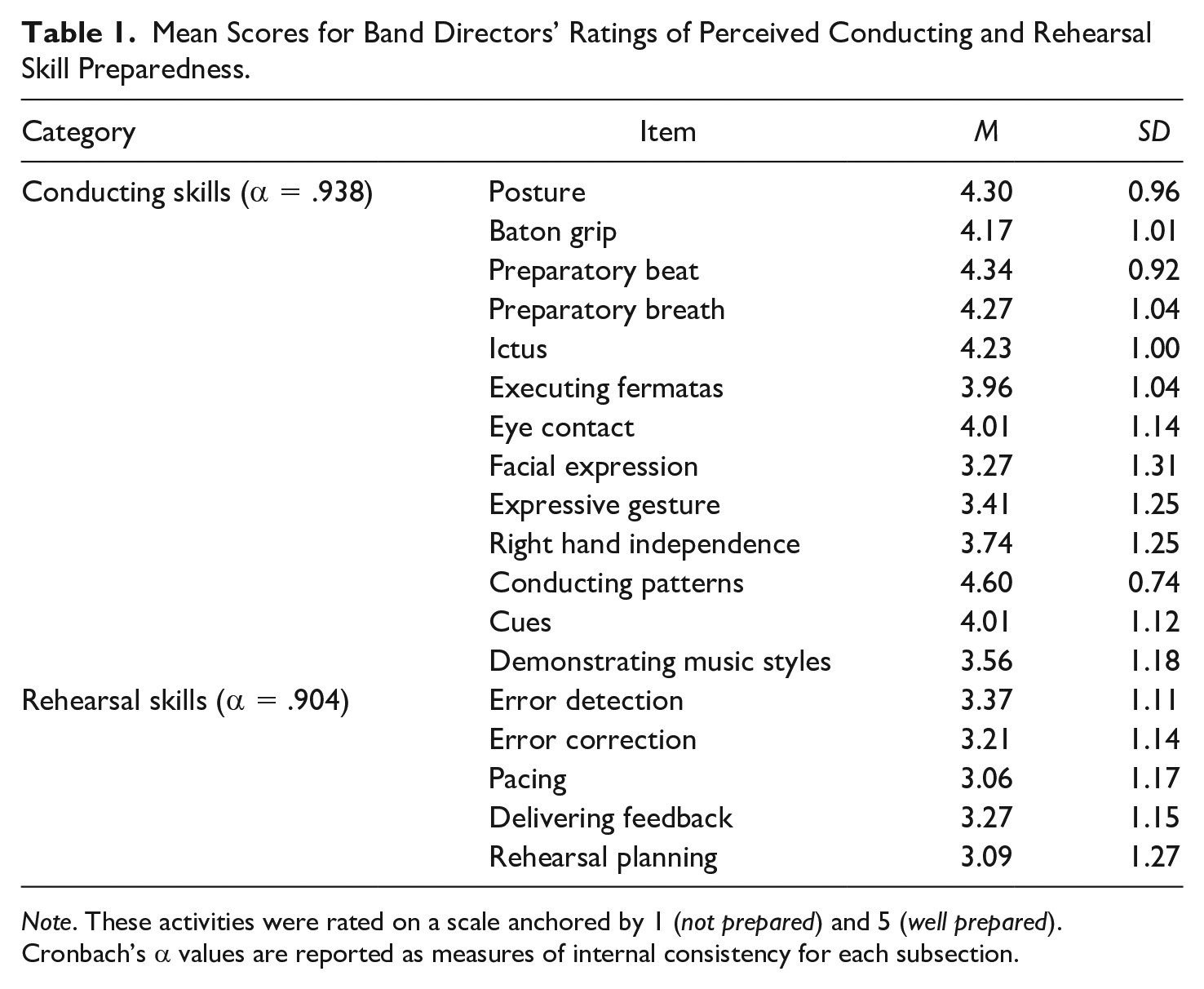
Note. These activities were rated on a scale anchored by 1 (not prepared) and 5 (well prepared). Cronbach’s α values are reported as measures of internal consistency for each subsection.
Perceptions of Time Spent During Undergraduate Conducting Courses
In this section, respondents rated nine activities (e.g., “Score study techniques,” “Rehearsal procedures”) on a Likert-type scale anchored by 1 (never) and 5 (a great deal).
The activities reported as being most prominent were “Instructor of the course giving feedback” (M = 3.88, SD = 0.90), “Conducting live ensemble” (M = 3.53, SD = 1.23), and “Peers giving feedback to student conductors” (M = 3.16, SD = 1.08). The least prominent activities were “Instrument-specific pedagogy” (M = 2.86, SD = 1.19), “Postrehearsal reflection” (M = 2.80, SD = 1.26), and “Programming music” (M = 2.51, SD = 1.11). Descriptive statistics for all items are presented in online supplemental Table A.
We conducted a repeated-measures analysis of variance to determine whether these observed differences in ratings were statistically significant. The results of this analysis indicated a significant difference in respondents’ ratings of these nine activities, F(6.65, 917.70) = 30.720, p < .001, η2 p = .182. Post hoc pairwise comparisons with a Bonferroni-corrected α level of .000694 (.05 ÷ 72 possible pairs) indicated 16 significant differences, which are displayed in Table B accompanying the online version of this article.
Conducting and Rehearsal Techniques Confidence
Participants also created narrative responses to open-ended prompts about their confidence in conducting and rehearsing after completing undergraduate coursework. Individual responses were analyzed and coded for topics related to conducting and rehearsing using Saldaña’s (2013) “Touch Test”—a coding method in which clearly tangible topics (e.g., beat patterns, eye contact, or error detection) are grouped together under more abstract concepts (e.g., conducting fundamentals or rehearsal techniques). Two authors coded the responses independently, then met to discuss any discrepancies until they reached consensus on all responses (Denzin & Lincoln, 2000). Recurring topics in the responses were labeled and tallied, then categorized into broader concepts.
Six broad concepts emerged from our analysis of the responses: (a) conducting fundamentals (e.g., beat patterns, cues, dynamics); (b) expressivity (e.g., facial expression, eye contact, left hand gesture); (c) rehearsal techniques (e.g., feedback, error detection and correction, instrument-specific pedagogy); (d) programming; (e) score study; and (f) transfer and application of skills (i.e., respondents’ ability to reflect on their conducting as well as their ability to apply the knowledge and skills learned in undergraduate conducting courses to younger, more inexperienced ensembles). The majority of respondents (n = 92, 67.2%) reported feeling most confident in fundamentals of conducting. Some respondents also wrote about having feelings of confidence in their rehearsal technique (n = 36, 26.3%), score study (n = 11, 8.0%), and expressivity (n = 8, 5.8%).
Respondents’ answers varied when asked what they felt least confident about in their conducting and rehearsal techniques after completing undergraduate conducting coursework. Slightly over half of the respondents (n = 69, 50.4%) expressed feeling least confident in their rehearsal techniques. They also indicated feeling least confident in the areas of expressivity (n = 33, 24.1%), score study (n = 15, 11.0%), and programming (n = 12, 8.8%). A relatively small number of respondents reported conducting fundamentals, particularly cues and fermatas, as the area they felt least confident in after completing their undergraduate conducting courses (n = 18, 13.1%). A few respondents (n = 7, 5.1%) also expressed feeling least confident with transfer and application of skills. Results for both questions are provided in online supplemental Table C.
Personal and Curricular Changes in Conducting and Rehearsal Techniques
Nearly all respondents (n = 126, 89.3%) provided open-ended comments to our question about how their conducting and rehearsal skills changed since taking undergraduate coursework. Of these, respondents reported the most growth in expression (n = 11, 8.7%), gesture (n = 6, 4.7%), and overall confidence (n = 6, 4.7%). Four (3.1%) respondents reported being more “functional” or “practical.” Although some respondents (n = 26, 20.5%) cited advanced study (e.g., graduate work, conducting symposia, workshops/conferences) as influential in their growth, others credited peer feedback (e.g., watching other conductors, discussions with colleagues; n = 7, 5.5%) and overall experience (n = 13, 10.2%). Concerning rehearsal skills, respondents cited improvement in error detection/identification (n = 20, 15.6%), pacing (n = 11, 8.7%), providing instrument-specific pedagogy (n = 5, 3.9%), and varied and effective rehearsal/instructional techniques (e.g., modeling, sizzling, asking questions; n = 7, 5.5%). Additionally, band directors cited preparation skills such as literature selection/programming (n = 4, 3.1%), score study (n = 6, 4.7%), and lesson planning (n = 5, 3.9%). Eight (6.3%) respondents specifically mentioned the importance of rehearsal skills over conducting in their professional work, despite a heavy focus on gesture in their undergraduate curricula: “Very little time in undergraduate work was spent learning how to deliver instruction”; “I felt very prepared to conduct Stravinsky and Copland, but my life very quickly became Balmages and Robert W. Smith. I had very few rehearsing skills learned from these classes but had a lot of technical conducting skill.”
When asked what they would change about their undergraduate conducting and rehearsal technique courses, respondents wrote about their desire for an increased focus on rehearsal concepts and less on actual conducting. Respondents suggested more effective strategies/techniques (n = 22, 17.5%), listening/error detection (n = 13, 10.3%), rehearsal planning (n = 12, 9.5%), and instrument-specific pedagogy (n = 9, 7.1%) in their coursework. Almost a quarter of respondents (n = 28, 22.2%) mentioned the importance of more “real-world” conducting/rehearsing experiences—particularly ones with young musicians, not their college-aged peers. Similarly, respondents (n = 12, 9.5%) wanted an increased focus on selecting literature for younger, school-aged ensembles. The most frequent conducting responses included expression (n = 4, 3.2%), style (n = 2, 1.6%), and gesture (n = 2, 1.6%), although some band directors suggested that conducting technique should be more related to teaching younger ensembles during coursework. Responses included statements such as “simplifying conducting for beginner ensembles” and “how to conduct more without a baton and for younger students.”
Personal Score Study Practices and Behaviors
There were 22 statements that respondents answered concerning score study practices, each on a frequency scale from 1 (never) to 5 (always). Results are presented in online supplemental Table D. The highest rated statement was in response to “Initial, casual read-through of the score” (M = 4.58, SD = 0.67). Four other statements were also rated between 4 and 5 (i.e., the top two rating options), namely “Define unfamiliar terms” (M = 4.28, SD = 0.88), “Marking important cues” (M = 4.15, SD = 0.91), “Marking meter changes” (M = 4.06, SD = 1.10), and “Marking tempo changes” (M = 4.04, SD = 1.10). Thirteen of the 22 statements were evaluated above 3 (i.e., the midpoint of the scale). Three statements yielded mean scores between 1 and 2 (i.e., the bottom two rating options), namely “Enlarge the score” (M = 1.67, SD = 1.02), “Reduce the score to its essential parts at the piano” (M = 1.50, SD = 0.90), and “Input lines into notation software for playback” (M = 1.44, SD = 0.92).
Thirty-three respondents also provided open-ended comments concerning other score study practices that they regularly use. Six mentioned availing themselves of published, online, or interpersonal resources to assist in their study, and five mentioned highlighting or color-coding their scores. Four respondents mentioned listening to recordings in various other fashions (i.e., beyond “conduct with a recording” as we had indicated in the questionnaire). The remaining 18 responses were largely idiosyncratic and unique to each respondent. Sample responses included “compare to source material/original if a transcription or simplified version” and “contact directors that have played the piece in a setting similar to mine.”
In an exploratory effort, we further analyzed the data in this section of the questionnaire according to selected demographic groups. Thinking that score study practices might differ between high school and middle school teachers, we categorized participants’ responses concerning their teaching assignments as high school only (n = 40), high school plus a younger grade level (n = 54), and middle school and/or younger grade levels (n = 40). One-way analyses of variance on each of the score study practices in the questionnaire, with subsequent post hoc tests using a Bonferroni correction, revealed significant differences among groups for two criteria, namely “Written harmonic analysis of the work,” F(2, 131) = 3.438, p = .035, η p 2 = .050, with high school only teachers offering significantly higher scores (M = 2.38, SD = 1.27) than middle school teachers (M = 1.75, SD = 0.87), and “Study from individual instrumental parts to complement study of conductor score,” F(2, 131) = 5.680, p = .004, η p 2 = .080, with middle school teachers rating this practice significantly higher (M = 3.20, SD = 1.24) than high school only teachers (M = 2.25, SD = 1.17).
We also explored if reported score study practices might differ according to experience level. To ensure roughly equivalent group sizes that would allow for a comparison of more experienced and lesser experienced teachers in our sample, we split the data set according to the median years of teaching experience (9 years), and used independent sample t tests to compare those with 9 or more years of experience (n = 70) to those who had been teaching conducted ensembles for 8 or fewer years (n = 66). Three criterion statements showed significant differences between experience levels, namely “Define all unfamiliar terms,” t(134) = 2.052, p = .042, d = .353, and “Research composer and historical background,” t(134) = 2.938, p = .004, d = .504, both with more experienced teachers offering higher scores (M = 4.43, SD = 0.81, and M = 3.34, SD = 1.09, respectively) than less experienced teachers (M = 4.12, SD = 0.94, and M = 2.77, SD = 1.17), and “Play selected lines on primary instrument,” t(134) = 2.212, p = .029, d = .381, this time with less experienced teachers rating this practice higher (M = 3.38, SD = 1.37) than more experienced teachers (M = 2.87, SD = 1.31).
Discussion
Our respondents rated their preparedness to demonstrate technical elements of conducting higher than expressive elements. In addition, they also rated their perception of preparedness to demonstrate rehearsal skills lower than all conducting behaviors except “facial expression.” These findings are consistent with undergraduate music majors’ perceptions of instrumental conducting curricula (Silvey, 2011b). We speculate that respondents in our study felt less confident in their ability to conduct expressively because many of their conducting instructors likely focused on more technical aspects of conducting (e.g., patterns, time beating) than expressive ones, especially given that these skills are featured more prominently in undergraduate conducting textbooks (Pasquale, 2008). It is also possible that these teachers focus their instructional energies on eliciting expression from their ensembles even when their own conducting is not correspondingly expressive, as found by Price and Chang (2005). Considering that both inservice band directors and undergraduate music majors have indicated feeling less prepared to demonstrate expressive elements as a result of instrumental conducting curriculum, it seems prudent to suggest that conducting teachers alter their curricula by introducing, expanding, and reinforcing expressive elements and rehearsal techniques sooner and more frequently.
Respondents reported that their instructors spent more time on certain conducting activities as compared to others. Most instructional time was spent with the course instructor giving feedback to students about their conducting, followed by “Conducting live ensemble” and “Peers giving feedback to student conductors.” Respondents indicated that the least amount of time was spent on “instrument-specific pedagogy,” “postrehearsal reflection,” and “programming music.” Therefore, in terms of time use, it seems that these inservice teachers were more engaged in activities involving the mechanics of conducting than in concert programming and rehearsal skills during their preservice coursework. Based on these responses, music faculty may consider including related competencies in conducting courses (e.g., instrument-specific pedagogy and programming music) that will help students make transfers across courses.
Responses to the open-ended questions about conducting and rehearsal techniques revealed inservice teachers’ confidence levels. Most respondents reported feeling most confident in their conducting fundamentals (e.g., patterns, posture, cues). These findings are congruent with Silvey (2011b), who reported conducting patterns as the area in which undergraduate music majors felt most confident after completing an undergraduate conducting course. Although just over a quarter of the respondents in the current study reported feeling most confident in their ability to plan and lead a rehearsal, about half of the respondents listed rehearsal techniques as an area of least confidence. Interestingly, many of the individual responses specified “instrument-specific pedagogy” as a concept of concern, which aligns with our finding that respondents spent the least amount of time in their conducting classes focused on this area. The disparity among inservice band directors concerning their confidence with rehearsal techniques is compelling, and could be the result of differing structures and emphases found among undergraduate conducting courses (Manfredo, 2008). However, the lack of confidence in rehearsal techniques among inservice directors may also support Hart’s (2018) assertion that undergraduate conducting courses lack a solid basis in rehearsal pedagogy. Conducting teachers may benefit from incorporating further instruction in rehearsal techniques throughout all levels of their undergraduate conducting courses. Larger scale curricular changes may also accomplish this aim, such as combining courses that are often taught in a modular fashion (e.g., Conducting, Instrumental Methods, Rehearsal Practicum) into a series of more integrated courses (e.g., Instrumental Pedagogy I, II, and III).
Inservice band directors expressed a desire for more authentic teaching and rehearsing opportunities in their undergraduate conducting curricula, supporting findings from previous investigations involving instrumental conducting and rehearsing (Romines, 2003; Silvey, 2011b; Silvey & Baumgartner, 2016). Similarly, preservice and beginning teachers have cited authentic-context learning (ACL) experiences as the most valuable component of undergraduate curricula (Baughman & Baumgartner, 2018). In the future, researchers might examine the potential impact of these ACL experiences on development of both gesture and rehearsal skills in preservice instrumental music teachers.
The most common self-reported score study procedures among respondents tended to concern salient, surface-level features of the work under study. After an initial, casual read-through of the score (the highest rated practice), marking various score elements (e.g., cues, meter changes, key changes) was a frequently reported practice, followed by conducting (either with or without a recording). Formal analyses of any type were less common. This seems to indicate that inservice band teachers are most concerned with simply being able to “get through” a given piece of music in their preparation to satisfactorily lead students in rehearsal. Attention to artistic or expressive matters may cede to more practical or pedagogical concerns, or they may be so pervasive in a teacher’s instructional practice as to obviate any need for more explicit or in-depth score study. For teachers of younger ensembles in particular, the music may often be simple or brief enough in its construction such that more extensive study is unnecessary. To the extent that these findings could (or should) be instructive for teacher education programs, collegiate conducting instructors may consider providing numerous opportunities for preservice teachers to extract surface-level features in their score study, as well as opportunities to develop “universal” ensemble instructional skills that can be exercised when teaching many different music selections. A longitudinal study involving inservice band directors’ reports of score study processes could provide insight into not only what strategies are being employed, but how and why they might change based on experience or ensemble level.
Differences in score study practices according to teacher experience were few. It is probably unsurprising that newer teachers resorted to playing lines of music on their primary instrument in their study, reflecting their more novice level of skill in being able to generate an aural image of the score. Perhaps more interesting is the finding that more experienced teachers were more likely to do research on a composer or the historical background of a piece. This may reflect a maturity of their instructional perspectives as to what is interesting or important about teaching music repertoire. Future investigators might consider exploring more deeply the score study practices of defined cohorts of teachers at different experience levels, perhaps in conjunction with direct observations of their rehearsals, in an effort to understand the development of ensemble teaching expertise as it relates to rehearsal planning (cf. Montemayor, 2016; Worthy & Thompson, 2009). Some level-based differences were also found. Most notably, middle school teachers reported being particularly attuned to the individual instrumental parts in their score study. This would also seem to be instructive for preservice teachers as they develop skills and insights in selecting appropriate ensemble literature for young musicians. We believe it would be beneficial for conducting instructors to model many of these types of score study practices for their undergraduate students because it would show them a variety of different strategies—some that may be more effective depending on the age and experience of the ensemble.
Study Limitations
Similar to recent survey studies (Silveira & Hudson, 2015; Silvey, 2011b; Sims & Cassidy, 2019), it was not possible to calculate a response rate due to our questionnaire distribution method (recruitment post on the Facebook BDG). We chose this sampling strategy given previous research highlighting the extent, size, and diversity of membership of the BDG (Rickels & Brewer, 2017), which allowed us to sample from band directors with varied experience levels from around the United States—beyond those whom we could recruit via databases of recent graduates at our home institutions. It is important to recognize that those who chose to participate in the study could have been different (e.g., more motivated, more interested in the study topic) from those who chose not to participate. Given this limitation, it is important for readers to examine the demographic information summarized previously to determine the extent to which the sample is representative of the population (as recommended by Sims & Cassidy, 2019).
Implications for Teacher Educators
Based on the results of our questionnaire, we have several recommendations for conductor teacher educators. Given our respondents’ desire for more “real-world” concepts in conducting coursework, it seems paramount that authentic, lab-based opportunities be included/expanded in the undergraduate teacher preparation curricula. Instructors should seek opportunities to pair the application of conducting and rehearsal skills in authentic settings (i.e., school-aged learners, not peers) such as field experience in public schools or with community music ensembles. In addition to these outside-of-coursework settings, MTEs should consider including ACL experiences in courses other than conducting. Given the importance of a spiral curriculum, such experiences may be more impactful if rehearsal techniques are revisited throughout the undergraduate sequence as a component of music education methods courses and/or instrument pedagogy/technique courses.
Considering that our respondents’ score study involved somewhat superficial analysis, conducting teachers should consider assigning some music excerpts that are revisited multiple times during the semester. In this way, novices would be forced to study a single excerpt more thoroughly, hopefully by using several score study strategies—perhaps by giving a list of those used by expert conductors—that would provide a greater understanding of the music. Finally, because respondents indicated less confidence in their rehearsal techniques than conducting techniques, conducting and instrument technique instructors should find ways of integrating these skills through assignments that use and transfer conducting and pedagogical skills in the rehearsal environment. Improving the education of preservice conductors will hopefully lead to them having more successful, long-lasting, and fulfilling teaching careers.
Supplemental Material
Table_A_Online_Supplemental – Supplemental material for Band Directors’ Perceptions of Instrumental Conducting Curricula
Supplemental material, Table_A_Online_Supplemental for Band Directors’ Perceptions of Instrumental Conducting Curricula by Brian A. Silvey, D. Gregory Springer, Christian M. Noon, Christopher M. Baumgartner, Alec D. Scherer and Mark Montemayor in Journal of Music Teacher Education
Supplemental Material
Table_B_Online_Supplemental – Supplemental material for Band Directors’ Perceptions of Instrumental Conducting Curricula
Supplemental material, Table_B_Online_Supplemental for Band Directors’ Perceptions of Instrumental Conducting Curricula by Brian A. Silvey, D. Gregory Springer, Christian M. Noon, Christopher M. Baumgartner, Alec D. Scherer and Mark Montemayor in Journal of Music Teacher Education
Supplemental Material
Table_C_Online_Supplemental – Supplemental material for Band Directors’ Perceptions of Instrumental Conducting Curricula
Supplemental material, Table_C_Online_Supplemental for Band Directors’ Perceptions of Instrumental Conducting Curricula by Brian A. Silvey, D. Gregory Springer, Christian M. Noon, Christopher M. Baumgartner, Alec D. Scherer and Mark Montemayor in Journal of Music Teacher Education
Supplemental Material
Table_D_Online_Supplemental – Supplemental material for Band Directors’ Perceptions of Instrumental Conducting Curricula
Supplemental material, Table_D_Online_Supplemental for Band Directors’ Perceptions of Instrumental Conducting Curricula by Brian A. Silvey, D. Gregory Springer, Christian M. Noon, Christopher M. Baumgartner, Alec D. Scherer and Mark Montemayor in Journal of Music Teacher Education
Footnotes
Declaration of Conflicting Interests
The author(s) declared no potential conflicts of interest with respect to the research, authorship, and/or publication of this article.
Funding
The author(s) received no financial support for the research, authorship, and/or publication of this article.
ORCID iDs

Supplemental Material
Supplemental material for this article is available online.
References
Supplementary Material
Please find the following supplemental material available below.
For Open Access articles published under a Creative Commons License, all supplemental material carries the same license as the article it is associated with.
For non-Open Access articles published, all supplemental material carries a non-exclusive license, and permission requests for re-use of supplemental material or any part of supplemental material shall be sent directly to the copyright owner as specified in the copyright notice associated with the article.
