



Abstract
We examined the experiences of 95 lesbian, gay, bisexual, transgender, and queer (LGBTQ+) music education majors, along with 39 heterosexual allies, who were student members of the Texas Music Educators Association. Participants addressed curricular practices and institutional factors that lend themselves to LGBTQ+ inclusion and safety among students, faculty, and staff. We collected data through an anonymous online survey, which included questions related to LGBTQ+ students’ experiences in their programs and across campuses. Five students participated in follow-up interviews designed to provide more in-depth information about their classroom experiences and campus-level actions taken to promote systemic change. Through multivariate analyses, as well as content analysis of the qualitative data, we found that although preservice music teachers in Texas feel accepted and supported in their music teacher education programs, they are entering the field feeling underprepared to address LGBTQ+ issues and support students who identify as such.
Educational researchers have examined the extent to which marginalized individuals experience oppression at institutional and personal levels. For example, Jennings (2007) surveyed 142 public universities and found that among the diversity criteria considered, gender and sexuality were prioritized least in both elementary and secondary teacher training programs. In 2015, the Gay, Lesbian, and Straight Education Network (GLSEN) conducted the National School Climate Survey, which reflected the ninth biennial report on the lived experiences of self-identified lesbian, gay, bisexual, transgender, and queer (LGBTQ) youth. Students between the ages of 13 and 21 years representing all 50 states and the District of Columbia (N = 10,528) served as participants (Kosciw et al., 2016). Authors of the GLSEN survey suggested that there was a general trend toward more inclusion in schools, but also a dire need for greater emphasis on LGBTQ topics in school curricula and teacher education programs.
Several researchers have examined the lived experiences of LGBTQ youth in music classes and programs (Carter, 2011; Fitzpatrick & Hansen, 2011; Haywood, 2011; Natale-Abramo, 2011). For example, in high school settings, Fitzpatrick and Hansen (2011) and Natale-Abramo (2011) found that music students who identified as gay, lesbian, or heterosexual ally felt safe, respected, and welcomed in the music wing of their schools. They also believed they could express their sexual orientation and gender identities in music class, which contributed to their mental and physical well-being. Conversely, these music students also reported that their sexual orientation was often a major source of friction between themselves and others outside of their music environments. However, Fiorentino (2016) noted that “none of the students [in the above studies] reported that their teachers discussed LGBTQ issues in their music curriculum or specifically enumerated anti-harassment policies” (p. 12). Similarly, in a study by Haywood (2011), one LGBTQ teacher stated, “it kind of goes unspoken to say that LGBT students should feel included in the music community, but we never actually talk about it” (p. 36).
Like LGBTQ students, many LGBTQ teachers also conceal their identity and adapt to different social and professional situations, navigating the figurative closet by being “out,” or open about their sexual identity in some areas of their life, while projecting a different image or persona in others (Natale-Abramo, 2011; Talbot & Hendricks, 2016). Although being open about one’s sexuality can be difficult, remaining closeted as a teacher can exact a psychological toll (Natale-Abramo, 2011, Taylor, 2011a). Teachers in several studies have reported that they often avoided suspicions concerning their sexual orientation by entrenching themselves in their professional lives and sharing very little about their personal lives in conversations with colleagues (Cavicchia, 2010; Furman, 2011; Talbot & Hendricks, 2016). Within highly educated social circles and music communities, however, gay teachers reported never having to formally come out at all as “concerns for integrity, character, and emotional stability far outweigh[ed] the importance of sexual orientation and preference” (Cavicchia, 2010, p. 11). In both Cavicchia’s (2010) and Talbot and Hendricks’ (2016) studies, LGBTQ teachers advised future educators to send positive messages to students, to maintain professionalism, and to know oneself. Last, teachers reported that being open with students, peers, administrators, and the community about their sexual identity led to improvements in relationships with students and others (Furman, 2011) as well as in their own mental and physical health (Taylor, 2011b). Taylor’s (2011a) and Talbot and Hendricks’ (2016) findings support the contention that mentorship from other LGBTQ music teachers within the same district or from nearby districts helps build a sense of resilience and support among early career music teachers.
In many states, there are statutory laws, regulations, or ethical codes that explicitly address teacher conduct related to the treatment of elementary and secondary school students, though not all are LGBTQ-inclusive. In 22 states and the District of Columbia, for example, there are laws designed to prevent harassment and/or bullying of students based on sexual orientation and gender identity. Conversely, two states have antibullying laws that actually prevent school districts from specifically protecting LGBTQ students, and Texas is one of seven states with laws that restrict the inclusion of LGBTQ topics in school (Human Rights Campaign, 2020). For more detailed information about the Texas Health and Safety code (2007), please see the online supplementary file. While 16 states and the District of Columbia have laws that address discrimination against students based on sexual orientation and gender identity, two states have laws that address discrimination based on sexual orientation only, and 32 states still have no laws that specifically protect LGBTQ students from discrimination (Human Rights Campaign, 2020).
Need for the Study
Discussions of student diversity in general, and sexual orientation in particular, are not commonplace within university music education programs (Sweet & Paparo, 2011; Talbot & Hendricks, 2016). General education instructors typically address sexual orientation in relation to human development (Sweet & Paparo, 2011) or legal matters (Jennings, 2010). Because music teacher educators often work with their students across multiple years and in field experiences in addition to courses, LGBTQ students may develop a level of trust needed to view music teacher educators as sensitive to their concerns and important sources of support and guidance.
Researchers have examined the lived experiences of LGBTQ secondary school students (Carter, 2011; Fitzpatrick & Hansen, 2011; Haywood, 2011; Natale-Abramo, 2011) and have reported results from climate studies on diversity in university teacher education programs (Jennings 2007, 2010), but there clearly is a need to understand the experiences of LGBTQ music education majors, and the extent to which the climate within music teacher education programs and the surrounding music school and campus cultures supports inclusion. Sexual orientation and gender identity may be conceptualized in terms of direction and/or intensity. While there are many abbreviations, acronyms, and terms used to reference students who may identify as lesbian, gay, bisexual, transgender, queer, questioning, intersex, asexual, demisexual, or pansexual, through the remainder of this article, we use the term LGBTQ+ to encompass all such individuals represented in our study as well as students who are heterosexual allies. 1 Holmes and Talbot (2017) studied inclusion among LGBTQ+ music education majors, but their study sample was limited to the Commonwealth of Pennsylvania. To build on that investigation, we decided to conduct our study within the state of Texas. Texas provides an interesting context for studying inclusion because of the large population, robust support for music education, and evolving statutes/laws specific to the bullying, harassment, and discrimination of students based on sexual orientation and gender identity.
Thus, in our study of LGBTQ+ student experiences within higher education institutions across Texas, we examined the following research questions:
Method
Participants
To gather data, we sent an e-mail message to all college student members (N = 1,394) of the Texas Music Educators Association (TMEA) in September 2017, inviting anyone who identified as LGBTQ+ to participate. We also contacted music education professors in Texas who were members of TMEA and asked them to encourage college student TMEA members to participate. After two follow-up messages, sent 2 weeks apart, 134 participants responded; of these, 39 (29.1%) identified as heterosexual allies and 95 (70.9%) as LGBTQ+.
LGBTQ+ Climates in Higher Education
Participants completed the LGBTQ+ Climates in Higher Education Questionnaire (Holmes & Talbot, 2017), which begins with demographic questions identifying students’ gender identity and sexual orientation as well as their institutions’ size (liberal arts college/university less than 3,500 students; midsized university from 3,500 to 20,000 students; large university more than 20,000 students) and type (public, private, parochial). Participants then answered whether their institutions had policies related to bullying, harassment, or assault and whether these policies specifically mentioned sexual orientation or gender identity/expression. Respondents also indicated whether they could identify any LGBTQ+ faculty or staff members in their music education programs and any of several inclusive practices their instructors had embedded in the curricula, such as inviting guests to speak about gender and sexuality in classes, encouraging students to take advantage of LGBTQ+ resources on campus, and expressing accessibility for students to come to them with questions about sexuality or gender identity. Similarly, participants indicated whether professors encouraged them to share their personal stories in class and to think critically about curricular and institutional practices.
In the next section of the questionnaire, participants responded to 27 items using a 5-point Likert-type scale (5 = strongly agree to 1 = strongly disagree). These items address the students’ (a) level of outness with family, friends, and faculty; (b) level of comfort expressing gender and sexuality in their music education program and across campus; (c) perceived support received from students, faculty and staff within their music education program and across their campus; (d) perceived curricular focus on LGBTQ+ issues in their music education programs; and (e) perceived preparedness to address issues of social justice in their future classrooms. Because identifying as an ally of sexual and gender minorities also involves risk and vulnerability, we were interested in their responses as well. As such, we wrote these 27 items to assess the experiences of sexual and gender minorities as well as allies. Although Holmes and Talbot (2017) grouped the items according to the a priori categories described above, we used principal components analysis to determine whether participants’ responses could be grouped in alternative, empirically-informed ways. Finally, we asked participants to provide their email address if they wanted to be contacted for a follow-up interview so we could qualitatively explore their experiences of these topics.
Interviews
From the 62 participants who provided e-mail addresses, we purposively selected five individuals based on their sexual orientation and gender identity/expression (excluding heterosexual allies), their attendance at a small, medium, or large institution, and their attendance at a private, parochial, or public institution. The selected interviewees were (1) an Hispanic cisgender female student who was preparing to become a choral director and identified as pansexual, (2) an African American cisgender male student who was studying to become an orchestra director and identified as gay, (3) a White cisgender male student studying to become a choral director who identified as gay, (4) a White cisgender male student studying to become a band director who identified as gay, and (5) a white cisgender male student studying to become a band director who identified as aromantic/asexual. The first author conducted a semistructured interview via Skype or FaceTime with each participant; sessions lasted between 15 and 45 minutes. We designed the interview questions, which were based directly from Holmes and Talbot (2017), to explore students’ relationships and interactions with others, reports of inclusion practices, perceptions of being a resource for future students, and suggestions for change.
The first author transcribed interview recordings and analyzed the data using Creswell’s (2013) Data Analysis Spiral as a guide to identify emerging codes and themes. Accordingly, he began a sequential process of managing the collected data and inserting memos during repeated readings. Following several readings, he sought to describe the data using in vivo codes derived directly from participants’ words. Further classification continued with the identification of broader categories and overarching themes, which were then represented visually for clarification. Rather than occurring as a linear process, the data analysis spiral allowed for continual revisiting of memos, codes, themes, and organization. The second and third authors served as peer reviewers. We sought trustworthiness through member checks with each participant and made minor adjustments in verbiage that had been unclear in the recordings.
Results
Demographic and Descriptive Data
The majority of our 134 participants attended large, public institutions and identified within the LGBTQ+ umbrella. To capture the variety of terms associated with sexual orientation and gender, we gave students the opportunity to check varied designations, including pansexual, gender nonconforming, and others. Ninety-five individuals identified as lesbian, gay, bisexual, pansexual, demisexual, asexual, or queer, and 39 identified as heterosexual allies. See Table 1 (online supplement file) for detailed frequencies and percentages.
Perceptions of LGBTQ+ Representation
In answer to our first research question, the majority of participants (87%; n = 116) reported antibullying policies in their schools. Yet only 55% (n = 74) affirmed specific protection for sexual orientation and just 35% (n = 47) attested to policies mentioning gender identity. Most participants (80%; n = 107) reported they knew faculty or staff across campus who publicly identified as LGBTQ+, though only 37% (n = 44) could identify a music education course instructor who did so. Over half the respondents (63%; n = 82) thought these faculty or staff worked to foster an inclusive environment for LGBTQ+ students across campus and in their music education program. In the open response section of the questionnaire, we asked participants to elaborate on their experiences concerning LGBTQ+ inclusion on campus. They observed that faculty and staff tended to address inclusivity with broad strokes assumed to apply to all students, rather than singling out the LGBTQ+ community. For instance, one student wrote, “There was no talk directly in class. I have observed placards on their door indicating safe space and posts in social media.” In response to items addressing broad topics that transcended issues of gender and sexuality, the largest proportion of students reported engaging in (a) discussions in which they shared personal experiences (86%) or qualified opinions (76%), or (b) readings about inclusive teaching models (79%), and activities that required frequent self-reflection (78%). Fewer students had opportunities to read about social issues in general, critique institutional policies or classroom practices, or apply interdisciplinary studies content to their music education classes.
Data Reduction for Institutional Climate Items
To answer our second research question, we isolated the 27 Likert-type items that addressed students’ perceptions about institutional climate. Before conducting a principal components analysis, we removed 17 cases, where four or more items were left unanswered; for three participants who did not answer three or fewer items, we replaced missing data with mean responses for each item.
When conducting a principal component analysis (PCA), the researcher's goal is typically one of reducing responses for a large number of items into a smaller, discrete set of components or variates, thereby bringing conceptual clarity to a group of related measures or reducing the number of dependent variables that subsequently must be analyzed. We considered our ratio of cases to items adequate for conducting an exploratory PCA. Utilizing Bartlett’s (1950) test of sphericity (χ2 = 5269.13, degrees of freedom = 190, p < .0001) and the Kaiser-Meyer-Olkin (KMO) measure of sampling adequacy (KMO = .91), we had evidence that item bivariate correlations were adequate for factorability (Tabachnick & Fidell, 2018). Furthermore, the number of components extracted was based on an “eigenvalues > 1” standard, and we employed Promax rotation to enhance the interpretability of the component solution (see Table 2 in online supplement file).
We identified six related components: (a) Outness—student disclosure of their LGBTQ+ status to others (five items; α = .94); (b) Comfort—student comfort expressing gender and sexuality on campus and within their music education programs (five items, α = .92); (c) Curriculum—professors addressing gender and sexuality in classes (three items, α = .82); (d) Preparedness—student preparedness to address broad issues of social justice in the classroom (five items, α = .89); (e) Music Program Acceptance—student perceptions of acceptance within music departments (four items, α = .92); and (f) Campus Acceptance—student perceptions of acceptance across campus (five items, α = .81).
Group Analyses for Institutional Characteristics
Prior to determining the relationship of institutional characteristics to our determined components, we examined whether straight allies (n = 25) and LGBTQ+ students (n = 90) responded similarly to one another across the six outcomes. There were no univariate or multivariate within-cell outliers at p < .001. Box’s test of equality of covariance matrices and Levene’s test of equality of variances were acceptable according to cutoffs and variance differences recommended by Tabachnick and Fidell (2018). The multivariate analysis of variance (MANOVA) test result was not statistically significant, Pillai’s Trace = 0.012, F(6, 108), p = .968, ηp2 = .012, suggesting that the allies and LGBTQ+ students responded similarly across the institutional climate composites. Thus, we combined the allies and LBGTQ+ students into a larger LGBTQ+ group (n = 115) to examine institutional characteristics in relation to our climate composites.
As we only had two students from a large private institution, we omitted those participants from subsequent analyses and created a single variable that represented three size-by-type institutional groupings for students in our sample (public/small-medium, n = 36; private/small-medium, n = 18; public/large, n = 61). To address our third research question, we conducted a one-way between-subjects multivariate analysis of variance. There again were no univariate or multivariate within-cell outliers at p < .001. Box’s test of equality of covariance matrices and Levene’s test of equality of variances were acceptable according to cutoffs and variance differences recommended by Tabachnick and Fidell (2018).
The MANOVA test result was statistically significant, Pillai’s Trace = 2.24, F(12, 216), p = .013, ηp2 = .111. According to follow-up univariate analysis of variance tests, students in the three institutional groups differed significantly in their perceptions of preparedness, F(2, 112) = 4.04, p = .020, ηp2 = .07, and acceptance experienced on campus as a whole, F(2, 112) = 5.98, p = .003, ηp2 = .10. Group differences for outness, comfort, curriculum, and music program acceptance were not significantly different. In Table 1, we present Ms, SDs, and post hoc comparison tests for all component scores.
Means, Standard Deviations, and Univariate F Values Across Composite Factors.
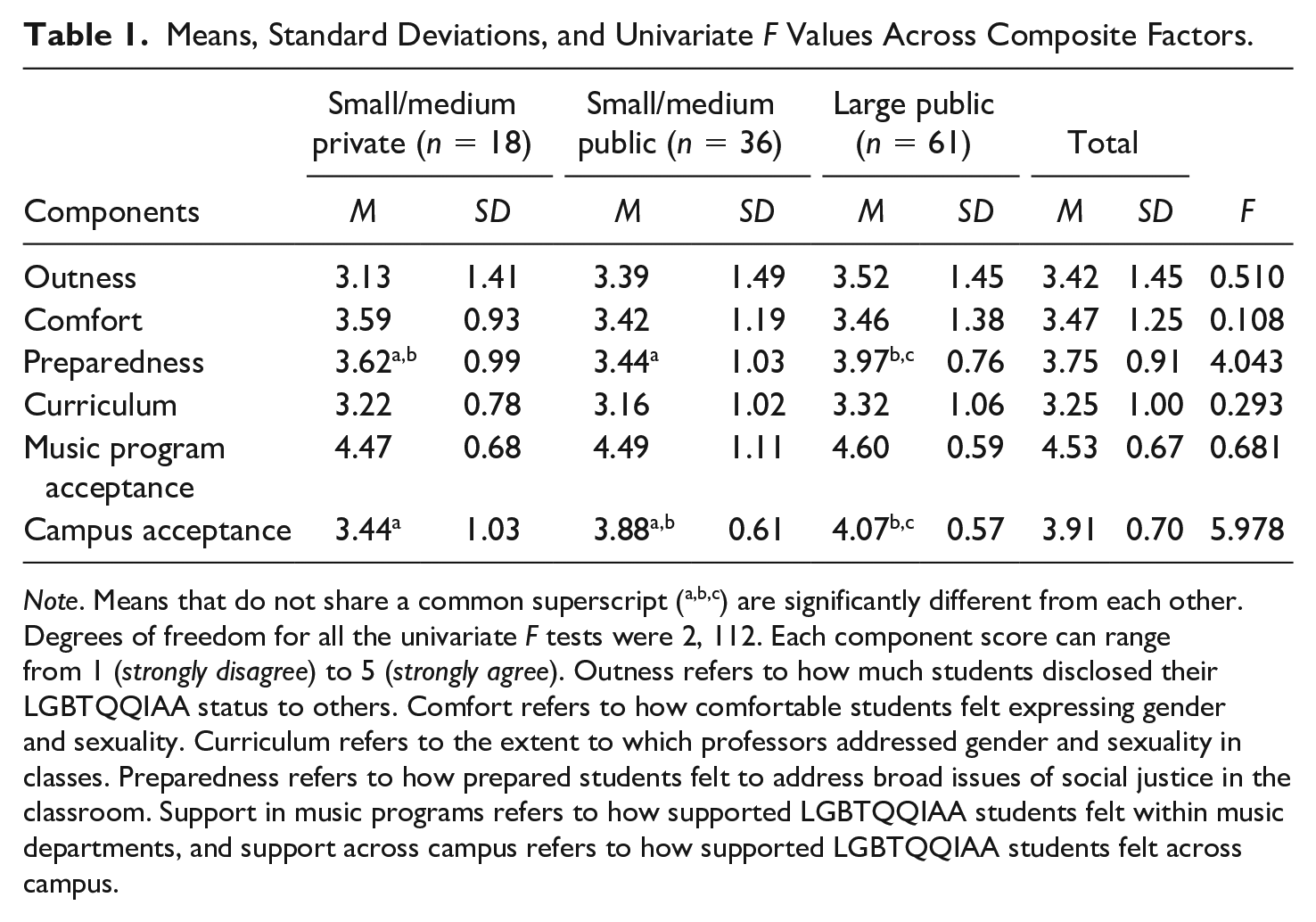
Note. Means that do not share a common superscript (a,b,c) are significantly different from each other. Degrees of freedom for all the univariate F tests were 2, 112. Each component score can range from 1 (strongly disagree) to 5 (strongly agree). Outness refers to how much students disclosed their LGBTQQIAA status to others. Comfort refers to how comfortable students felt expressing gender and sexuality. Curriculum refers to the extent to which professors addressed gender and sexuality in classes. Preparedness refers to how prepared students felt to address broad issues of social justice in the classroom. Support in music programs refers to how supported LGBTQQIAA students felt within music departments, and support across campus refers to how supported LGBTQQIAA students felt across campus.
Social Justice Preparation
Students who attended a large public institution reported being significantly more prepared to address broad social justice issues (M = 3.97; SD = 0.76) than students who attended small/medium public schools (M = 3.44; SD = 1.03; Cohen’s d = 0.59); students at private schools did not differ significantly from either group. Across all participants, 44% (n = 51) felt prepared to be a resource to students who have questions about gender expression or sexual orientation. When asked about broader issues of social justice, 69% (n = 79) agreed that they were prepared to create socially conscious programming, and 65% (n = 75) agreed that they could speak confidently about social issues in education as a result of what they had learned and experienced in their educational programs. Indeed, 86% (n = 99) of students agreed that they were prepared to create a music classroom that was inclusive of all backgrounds, and 60% (n = 68) agreed that they were prepared to advocate for social change in their career.
Acceptance Across Campus
Students who attended large public institutions reported being significantly more accepted (M = 4.07, SD = 0.86) than students who attended small-medium private schools (M = 3.44, SD = 1.03; Cohen’s d = .90); students at small/medium public schools did not differ significantly. Across campus, a clear majority of respondents perceived acceptance by faculty (79%; n = 91), student peers and administrators (74%; n = 85), and staff (73%; n = 84).
Interviews
Through consensus, we identified one overall theme that pervaded the data: Lack of LGBTQ+ Discussion. Subsidiary codes included social media and information from nonmusic classes. All five respondents acknowledged a general feeling of support for social justice within their music education programs but shared that discussions of LGBTQ+ issues were lacking in their curricula.
Respondent 2 acknowledged program support but noted a lack of LGBTQ+ discussion in his courses. Likewise, Respondent 3 shared, In any of my music ed classes, I know most of my teachers, if not all, are supportive of students who identify with that community, but it's never really been openly discussed enough to where I can say firmly that they are on the same side as we are. But nor have I ever heard them say anything that slanders or hinders the name of the LGBTQ community. So I'd say for the most part, yes, they are approachable about it. (Interview, October 27, 2017)
Similarly, Respondent 4 stated, Just acknowledging what it would be like to be a public educator in Texas as a gay man; that’s not something that I’ve ever been taught how to handle. And I mean I don’t even know how I would go about that, you know? But I don’t think the phrase LGBT had ever been used until one of my professors emailed us this survey. (Interview, November 4, 2017)
Consistent with other participants, Respondent 4 knew that some faculty identified as part of the LGBTQ+ community via social media, but when asked how approachable they were, he replied, “I honestly don’t know. I don’t know how comfortable I would feel approaching them.”
Thus, it appears that although general statements of inclusion may be appreciated, specific discussion of LGBTQ+ topics may be beneficial, not only to support those students in the LGBTQ+ community, but for all preservice music teachers who will inevitably encounter LGBTQ+ students on their own.
Interviewees explained that any information concerning LGBTQ+ topics was gleaned through courses and experiences outside the music education curriculum. Respondent 1 noted that any reference to LGBTQ+ issues were derived from classes outside the music department. She found a course in Chicana feminist literature to be particularly enlightening, and shared, “That was like an open discussion that came up every week. About how sexuality plays a role in (pause) just everything social, I guess. It always comes up” (Interview, November 1, 2017). Similarly, Respondent 3 explained that his main source of information came from his own research in a general education course examining gender and social change. Although respondents recognized the breadth of content that already must be covered within music education curricula, they suggested that LGBTQ+ concerns be addressed organically throughout the semester in conjunction with topics such as classroom management and repertoire selection.
Discussion and Implications for Music Education
Consistent with case study research (Fitzpatrick & Hansen, 2011; Haywood, 2011; Natale-Abramo, 2011), preservice LGBTQ+ music teachers in our study generally felt safe and accepted within their music education programs; students at large public institutions reported acceptance across their campuses as a whole. Participants also believed they were generally prepared to address broad issues of social justice and inclusion, but less than half thought they could be a resource to students who might have questions about gender expression or sexual orientation. Although preservice teachers in large public institutions reported higher levels of preparedness than those in smaller schools, their responses were still relatively neutral, rather than positive.
Congruent with previous climate surveys in general education (GLSEN, 2017; Jennings, 2007) and studies within music education (Fiorentino, 2016; Sweet & Paparo, 2011; Talbot & Hendricks, 2016), fewer than half of our respondents (24%) reported that their professors included topics related to gender and sexuality in their curriculum and an even smaller number (14%) said their professors engaged in positive dialogue on these topics. With more than twice as many millennials (8.2%) now identifying as LGBTQ+ compared with previous generations (Newport, 2018), music teacher educators may wish to consider giving more attention to gender and sexuality topics, regardless of their students' sexual orientation or gender identity.
In line with reports of LGBTQ+ high school students in music programs (Fitzpatrick & Hansen; 2011; Natale-Abramo, 2011), our participants described high levels of perceived acceptance from faculty, staff, and administrators within university music environments. Yet music education majors who identify as LGBTQ+ were unsure how to negotiate personal identity in the classroom or handle issues that might arise one day with their own P–12 students who identify as LGBTQ+ (e.g., coming out to other students in class, transitioning gender identity, bullying). Granted, music teacher educators have enormous amounts of material to cover in order provide preservice teachers with the practical tools they need to thrive in the classroom. However, given that LGBTQ+ visibility has been relatively high over the past decade and that more young people are now identifying as part of the LGBTQ+ community (Newport, 2018), it may be more crucial now, than in past years, for instructors to address these issues specifically, rather than giving support in broad strokes.
Many instructors in music education programs across Texas may have acknowledged the importance of diversity, equity, and inclusion, yet to the students in these programs, issues specifically related to gender and sexuality were insufficiently examined. Adding additional topics to syllabi can be intimidating. However, embedding and layering these topics throughout music education curricula might make it easier for instructors to connect these ideas into their existing syllabi, rather than reducing coverage to make room for one day of LGBTQ+ discussion. In introductory music education classes, professors might encourage students to consider how simple changes in gendered language can engender a sense of belonging, which would provide a foundation for critical work to be done in later courses during their 4- or 5-year experience. Palkki and Caldwell (2017) and Hess (2016) suggested that through subtle changes in language (e.g., referring to “bass, tenor, alto, and soprano” rather than “men” or “women”), teachers can demonstrate compassion. Likewise, providing assignments that include critical examinations of gender and sexuality within elementary and secondary general music songs and games, choral repertoire, composer representation in instrumental music, or uniform and costuming decisions could help prepare preservice teachers for the new generation of students they might encounter (Hess, 2016).
As Freer (2019) noted, we cannot assume that faculty members who have not addressed LGBTQ+ issues are necessarily unsupportive. Considering that few have professional expertise in these areas, they may feel intimidated or unqualified to address issues of gender and sexuality. Furthermore, some teachers may experience conflict between their personally held beliefs, which might arise from conservative religious traditions, and their value of interacting with all students from a place of compassion. Perhaps allowing LGBTQ+ students opportunities to share their own perspectives, and distinguishing between personally held beliefs and universal values of acceptance, offers a starting point for establishing positive dialogue between educators and their students. Through an empathic approach to instruction, teachers can acknowledge the diversity of student experiences without changing their own belief systems. As preservice music teachers learn about and share their lived experiences within their music teacher education programs, they may feel free “to discover who they are and . . . become who they are not yet through music” (Talbot, 2013, p. 58).
Limitations and Suggestions for Future Research
We collected data from 134 participants, including 39 heterosexual allies, who self-identified as LGBTQ+. While the 95 students who identified as lesbian, gay, bisexual, pansexual, demisexual, asexual, or queer represented only 6.8% of the student we invited to participate, that proportion is consistent with recent demographic trends concerning LGBTQ+ status (Newport, 2018). Our relatively small and geographically specific sample limits the generalizability of our findings. Thus, in future studies, researchers may want to survey similar samples of students from different states and/or geographic regions to determine the extent to which our data provide a broad and valid representation of LGBTQ+ music education students’ attitudes and experiences within universities. Second, our qualitative interviews were not meant to be extensive, but rather to supplement the quantitative responses from the students. Several female students who initially agreed to participate in interviews did not follow through, resulting in women being underrepresented in that part of the study. We support continued research into the experiences of women, transgender students, and other members of the LGBTQ+ community whose voices have not been fully heard. In particular, qualitative studies of LGBTQ+ issues are needed to provide more in-depth examinations of school climate and school policy awareness that are both representative and rich.
Supplemental Material
Main_Document,_May_30,_2020_1 – Supplemental material for Experiences of LGBTQ+ Students in Music Education Programs Across Texas
Supplemental material, Main_Document,_May_30,_2020_1 for Experiences of LGBTQ+ Students in Music Education Programs Across Texas by Donald M. Taylor, Brent C. Talbot, Edward J. Holmes and Trent Petrie in Journal of Music Teacher Education
Supplemental Material
Table_2,_with_suppressed_values – Supplemental material for Experiences of LGBTQ+ Students in Music Education Programs Across Texas
Supplemental material, Table_2,_with_suppressed_values for Experiences of LGBTQ+ Students in Music Education Programs Across Texas by Donald M. Taylor, Brent C. Talbot, Edward J. Holmes and Trent Petrie in Journal of Music Teacher Education
Footnotes
Declaration of Conflicting Interests
The author(s) declared no potential conflicts of interest with respect to the research, authorship, and/or publication of this article.
Funding
The author(s) received no financial support for the research, authorship, and/or publication of this article.

Supplemental Material
Supplemental material for this article is available online.
Notes
References
Supplementary Material
Please find the following supplemental material available below.
For Open Access articles published under a Creative Commons License, all supplemental material carries the same license as the article it is associated with.
For non-Open Access articles published, all supplemental material carries a non-exclusive license, and permission requests for re-use of supplemental material or any part of supplemental material shall be sent directly to the copyright owner as specified in the copyright notice associated with the article.
