



Abstract

With the publication of this issue, the Journal of Music Teacher Education (JMTE) begins its 30th volume. We will not actually celebrate the 30th anniversary of JMTE until 2021; the journal was approved by the then Music Educators National Conference (MENC) National Executive Board in March 1991, and the first issue was published in Fall 1991. In a prior column (Austin, 2019), I described how the launching of a journal dedicated to music teacher education issues arguably saved the Society for Music Teacher Education (SMTE). In this column, I aim to provide some context for understanding how JMTE has developed and matured over the past three decades.
Like people, research journals go through a maturation process and developmental phases. In their infancy, research journals may struggle to attract the quantity of manuscripts needed to fill an issue. Journal space, instead, may be occupied by columns, guest opinions, book reviews, or conference calls. In some instances, editors may call on authors and employ guest editors for special issues devoted to timely or important topics. As a research journal moves into adolescence, the mission of the journal may be shifted or sharpened, reviewer guidelines may be tightened and evaluative standards elevated, instructions for contributors may be refined, the number of articles submitted and accepted for publication may grow, and the editorial committee may be expanded to offset increasing workloads. Pronounced development during adolescence may result in a greater number of journal issues appearing in a given volume.
As a research journal enters adulthood, the editors, reviewers, and readers may begin to observe important changes in the breadth and quality of manuscripts. The topics investigated and the methods employed to study them may become more diverse or sophisticated. Authors may begin to view the journal as a “first stop” for publication rather than a “backup” should the manuscript be rejected by a different journal. Given growth in the quantity and quality of manuscripts submitted, reviewers may become more selective in the manuscripts they recommend for publication. As the quality of published work improves, the journal itself may grow in scope and stature with regard to the audience it reaches through subscriptions or downloads, the number of times that articles published in the journal are cited in other prominent journals, the indexing of the journal, and the strength of various metrics used to assess journal impact.
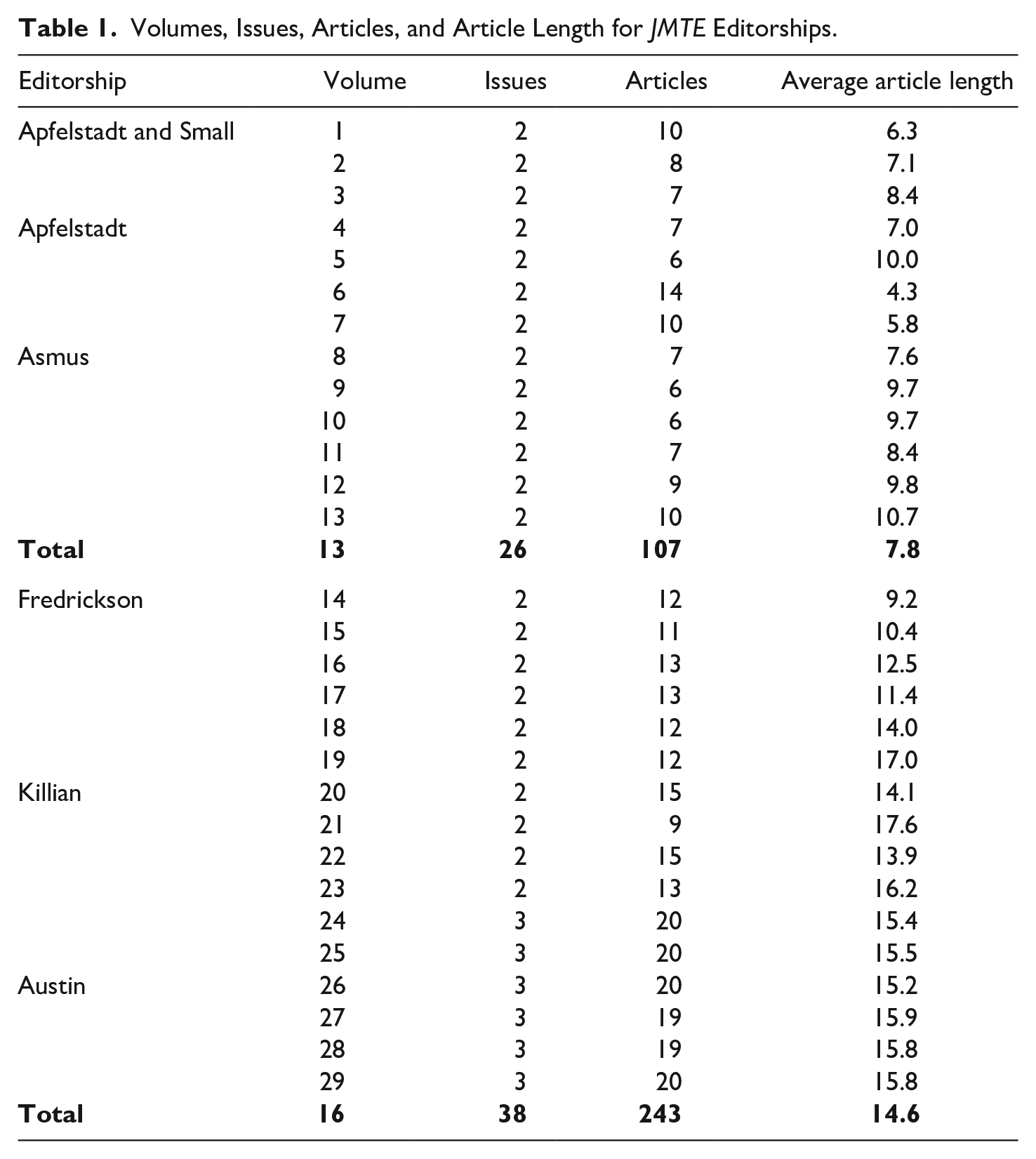
In considering the 30 years of JMTE’s existence, I propose that its infancy or childhood stage encompasses the coeditorship of Hilary Apfelstadt and Ann Small (Vols. 1–3, 1991–1994), and the editorships of Hilary Apfelstadt (Vols. 4–7, 1994–98) and Edward Asmus (Vols. 8–13, 1998–2004). During this early period, the tradition of publishing columns written by the SMTE Chair and the JMTE editor(s) was established, 1 there were two issues per volume, and each issue included anywhere from two to five articles, with an average article being roughly eight pages in length (see Table 1).
Volumes, Issues, Articles, and Article Length for JMTE Editorships.
Many of the articles published in Volumes 1 to 3 were extended essays written by “big thinkers” within music teacher education (perhaps solicited by the editors) and clearly served the initial journal mission as envisioned by Irma Collins (1991) and described in her first column: The journal is not a research journal per se; rather it is an exploration of the Society’s thoughts and feelings about music teacher preparation. . . . This new journal can and should act as a forum for philosophical inquiry into these and other issues that daily surround us in higher education. (p. 1)
A special issue of JMTE was published in Spring 1997, and the articles therein (typically four pages or fewer in length) summarized scholarship presented at the 1996 Allerton Retreat on Choral Music Education. One might speculate that Apfelstadt, as editor, was motivated to support publication of this special issue by virtue of her own work as a choral conductor and educator, but its appearance might just as likely reflect the editor’s struggle to otherwise publish even four articles per issue during that period.
The move from print publication to online publication occurred during the Asmus editorship, effective with the Fall 2002 issue. It is interesting that there is no mention of the change to an online format in Asmus’s editor column for that issue, but in the subsequent issue, Asmus (2003) did observe that the journal was becoming more robust: JMTE is the youngest of the MENC journals. Its readership has grown significantly since its early years, reaching the majority of music education’s professorship. Its future is bright with every-increasing numbers of high-quality submissions. Certainly, it can be said to be achieving the original purpose that the founding members of the Society for Music Teacher Education envisioned. (p. 11)
If the infancy-childhood phase of JMTE ended with Asmus’s editorship, then the adolescent phase is reflected in the editorships of William Frederickson (Vols. 14–19, 2004–2010) and Janice Killian (Vols. 20–25, 2010–2016), along with the first 4 years of my editorship (Vols. 26–29, 2016–2020). JMTE chairs and editors have always used their columns to advance music teacher education discourse, and not merely to spotlight a particular article or overview the issue, as is common with many peer journals. Throughout JMTE’s adolescent phase, however, both SMTE chairs and JMTE editors have tackled increasingly complex issues and trends specific to music teacher education policy, practice, and research. This is not surprising given how society and education have evolved (or “devolved” in some respects) over the past 15 years.
During Fredrickson’s editorship, two special issues were published. The Spring 2005 issue (Vol. 14, No. 2), which was titled “The Future of Music Teacher Education,” coincided with the SMTE Preconference Session held during the 2004 MENC National Biennial Conference in Minneapolis, and foreshadowed the first SMTE Symposium, held in Greensboro, in September of 2005. A second special issue appeared in Fall 2007 (Vol. 17, No. 1), with five articles focused on “Music Teacher Education as Professional Development” and two additional articles that did not fit under the professional development theme. No special issues have been published since, largely due to a sizable increase in publishable manuscripts and the editorial committee’s desire to avoid publication backlogs and reduce time to publication for authors.
Adolescence is characterized by growth spurts and that is certainly true for JMTE. In 2014, during Jan Killian’s editorship, the journal was expanded from two issues per volume to three issues per volume, and the editorial committee grew from nine members to 10. Throughout JMTE’s adolescence, average article length almost doubled, the number of articles published more than doubled, and a greater proportion of articles were centered on original research, with interest articles on theories, models, or issues less evident. Most notably, articles encompassed a wider range of research topics and methods during this period. More on that in a future column.
While JMTE’s mission has evolved to include a blend of commentary and scholarship, readers likely remain unaware that, in November of 2017, JMTE was accepted into the Emerging Sources Citation Index (ESCI). This index, established by the Web of Science Group in 2015, includes journals identified as meeting 24 quality criteria and four impact criteria as determined by Clarivate Analytics. Those criteria address journal relevance to a scholarly community, interest to opinion leaders, coverage of emerging areas of inquiry, and feedback from readers. All ESCI journals are peer reviewed, follow ethical publishing practices, and are searchable, discoverable, and citable. Once a journal is selected for ESCI inclusion, the curating process is ongoing such that a journal could be dropped from the index, remain in the index, or be “promoted” to the Social Science Citation Index (SSCI) with official impact factors assigned. SSCI journals typically maintain the highest publishing standards (i.e., lower acceptance rates) and strongest editorial content, while achieving greater international representation or readership and elevated citation activity.
As JMTE approaches adulthood, the journal must continue to attract a larger volume of higher quality manuscripts reflecting rigorous scholarship on issues germane to music teacher education. As this volume increases, the proportion of manuscripts accepted for publication may be expected to fall from the current figure of roughly 34% to less than 30%. As the quality of manuscripts improves, the citation rate for journal articles also should increase. The editorial committee is currently considering various strategies to improve international scholar representation. Current weighted indexing metrics (Scopus’s SJR [SCImago Journal Rank]) that account for the prestige of the publications in which articles are cited, place JMTE eighth out of 148 music research journals, and in the top third of education research journals. Much has been accomplished since the journal’s birth 30 years ago, and I anticipate continued maturation through JMTE’s adulthood.