



Abstract
This research provides an in-depth exploration of the relation between police rank and police integrity. In 2008, a stratified representative sample of 1,130 Croatian police officers evaluated hypothetical scenarios describing a range of various forms of police misconduct. Supervisors tended to be somewhat more knowledgeable of official rules than nonsupervisors. Although absolute evaluations of seriousness differed across the two groups, relative assessments of seriousness were quite similar. Line officer and supervisor views were more similar with respect to the discipline they thought the police agency should mete out than with respect to what they thought the appropriate discipline should be. The analyses indicate that there are two similar, yet distinct codes of silence, with the supervisor code being narrower than the line officer code.
Keywords
Introduction
After the fall of the Berlin Wall, many East European countries have been pursuing widespread reforms of their economy and government. Croatia, one of the East European countries in transition, declared independence from the former, communist Yugoslavia in 1991. The Croatian police, headed by the Ministry of the Interior, have been affected by, and were changing in response to, the transformations occurring in the society at large. Its transition toward democracy has been challenging (Kutnjak Ivković & Klockars, 2004, p. 56):
The journey has been far from smooth; the country has experienced a defensive war against the aggression of the Serb-dominated Yugoslav Army and various paramilitary troops, the influx of refugees from Bosnia and Herzegovina, a decade-long governance of a strong, right-wing oriented political party, the strengthening of nationalism, a continued legacy of mismanagement of the economy, the transition into market economy, and a high unemployment rate. All these factors shape the environment in which the Croatian police operate and have a strong impact on the state of police integrity.
In the early 1990s, when the war was ravaging throughout most of the country and the police were the only legitimate organization authorized to use force, the police performed both the police role and the military role. The congruence of police and military roles and the war experiences created a powerful sense of camaraderie and loyalty among the officers and strengthened the code of silence (see, e.g., Kutnjak Ivković, 2000, p. 54). Surrounded by destruction of life and property, saving lives of other police officers, and experiencing other police officers saving their lives on a daily basis, this war-born camaraderie built strong ties among the police to the extent that far transcended the boundaries of the ties resulting from doing regular patrol work in a peaceful city (see, e.g., Kutnjak Ivković, 2000).
The war also necessitated loosened hiring standards, shortened police training, strengthening of the code of silence, and relaxation of official rules (Kutnjak Ivković, 2004a). In the late 1990s, “the-war-is-over” mentality settled in, reforms were designed, and their execution planned. The new laws regulating the work of the police were enacted (e.g., Criminal Procedure Code, 1997; Police Law, 2001), with democratization of the police as one of their key goals. The key concepts driving the reforms were depolitization, demilitarization, demystification, professionalism, and downsizing (Kutnjak Ivković, 2004a). The 2000s brought new changes in the tasks and operations of the police. The Croatian version of community policing—“Police in the Community” (Cajner-Mraović, Faber, & Volarević, 2003)—was introduced as a pilot project in 2003, to be expanded nationwide in 2004. Also, the police have been striving for greater accountability, while facing the erosion in the level of support for the police (Kutnjak Ivković, 2008).
This article explores police integrity, one of the crucial components of democratic policing (e.g., Marenin & Caparini, 2005), among Croatian police officers. The article not only empirically measures the extent of police integrity but also provides an in-depth analysis of the differences in the extent of police integrity among supervisors and nonsupervisors. The article builds a theoretical argument that police integrity is a complex phenomenon and that all measures of police integrity—perceptions of misconduct seriousness, views about appropriate discipline, and the adherence to the code of silence—may not be equally affected by the differences in views and attitudes expressed by nonsupervisors and supervisors.
Police Integrity and the Croatian Police
Klockars and Kutnjak Ivković (2004; Klockars, Kutnjak Ivković, Harver, & Haberfeld, 1997, 2000) proposed a theory of police integrity. They defined police integrity as “the normative inclination among police to resist temptations to abuse the rights and privileges of their occupation” (Klockars et al., 1997). The theory has four dimensions (see, e.g., Klockars et al., 1997, 2000; Klockars & Kutnjak Ivković, 2004), all of which are crucial for the understanding of how police integrity works.
According to the first dimension of the police integrity theory, quality of official rules and the way these rules are made, communicated, and understood by the police are directly related to the level of police integrity (Klockars & Kutnjak Ivković, 2004, p. 1.4). When police agencies establish and enforce official rules that prohibit police misconduct, they are creating environments in which police integrity can flourish. However, establishing the rules is just the first necessary step; what matters is not only that the police administrators promulgated the official rules that prohibit misconduct, but, equally importantly, that they are enforcing those rules.
Legal framework for the police conduct is established through constitutional norms and several legal statutes. The first step in the rule of law—establishing the fundamental values—was completed early in modern Croatian history; the 1990 Constitution provides the basic rights to the citizens (e.g., the freedom of thought and expression, equality before the laws, presumption of innocence) and establishes the duty for public servants, including police officers, to observe and protect these rights. A complete reform of the criminal justice system and the related legislation was necessary to implement these new democratic principles established in the Constitution. The war in the early 1990s delayed the reform until the mid-1990s.
In 1997, Croatian legislature enacted the new Criminal Code and the new Code of Criminal Procedure, with the Police Law following in 2000. The Criminal Code (1997) affirmed the police officers’ right to use force, when required as part of the job and carried out in accordance with the laws (Article 32). The Code contains articles protecting the fundamental values declared in the Constitution, some of which directly affect police work (e.g., prohibition of a differential treatment of citizens, criminalization of unlawful home entry, unlawful search, and unlawful arrest, prohibition of the use of excessive force). In addition, the Code describes behaviors regarded as criminal (e.g., extortion, bribery, forgery of official documents, and negligent performance of duty) and enumerates punishment for such behaviors. The Criminal Procedure Code (1997) defined the police officers’ right to use force and the search procedures. The Criminal Procedure Code of 1997 was substantially revised in 2008 (its enforcement in regular criminal cases had been postponed until September 1, 2011).
The second part of the large reform in the late 1990s was the enactment of the Police Law of 2000. This code defined the police as a “public service within the Ministry of the Interior entrusted to perform the tasks enumerated by the law” (Article 2, Police Law, 2001). The Police Law (2001) regulates the police right to use force and channels the use of discretion. The Law further determines that police officers are public servants who can be held personally accountable for their misconduct and that the state could be held civilly liable.
Thus, the basic legal rules—both substantive laws and procedural laws—are in place. Another part of the equation is whether these rules are enforced at all and, if so, whether they are enforced consistently. This issue remains open; only scarce data are available. In the 1990s, a small percentage of police officers (fewer than 300 per year in a country with at least 20,000 police officers at the time) were charged with a crime (Kutnjak Ivković, 2004a, p. 212).
In addition, surveys of police officers could be used as an indication of whether police officers know the official rules. In a 1995 survey, police officers were presented with hypothetical scenarios describing mostly corrupt behavior (Kutnjak Ivković & Klockars, 2004). Only two thirds of the respondents or fewer recognized the behavior described in the scenario as rule violating across the majority of the scenarios (8 out of 11). The 2008–2009 survey of police officers suggests that circumstances may have improved to a certain degree (Kutnjak Ivković, 2009). In particular, the number of scenarios in which two thirds of police officers or fewer recognized behavior as rule violating decreased (6 out of 11), and in two scenarios nine tenths of the respondents evaluated the behavior as rule violating (Kutnjak Ivković, 2009). Police officers tended to be more likely to label as rule violating, the most serious forms of police misconduct, severe to the point of constituting violations of the criminal law. Finally, the results of the Ivanović study (2001) suggest that a substantial proportion of police officers did not understand at least some of the official rules properly.
The second dimension of the police integrity theory postulates that the quality of police agency’s own methods of detection, investigation, and discipline of rule violations affect integrity (Klockars & Kutnjak Ivković, 2004). Police agencies vary greatly in regard to both the methods of misconduct control they use and to the intensity with which they use them. The assumption is that most agencies rely primarily on reactive methods of misconduct control, with early warning systems being an exception from the rule. The expectation is that there is a positive relation between the level of integrity in the police agency and the use of an elaborated system of corruption prevention and control.
The Police Law (2001) establishes the police officers’ disciplinary responsibility for the violation of official rules (Article 110) and classifies police misconduct into minor and serious breaches of official duty (Articles 11–112). 1 The disciplinary procedure and the decision maker depend on the severity of the breach. For minor breaches, the Law (2001, Article 113) determines that the supervisors initiate the proceedings and that the decision is made by the minister or the person authorized to do so by the minister. For serious breaches, the Law (2001, Article 113) determines that the procedure is initiated by the minister or the authorized person and that the decision is made by the disciplinary court. In reality, the majority of the internal investigations are performed by the supervisors, while the Office of Internal Affairs (directly responsible to the Chief of Police) investigates only a small subset of certain cases (e.g., more complex cases). Regardless of who the decision maker is, the police officer has the right to appeal the decision, as regulated by the Police Law (2001).
The Police Law (2001, Article 6) also recognizes the citizens’ right to submit a complaint against a police officer if the citizen perceives that the police had violated his or her civil rights. This citizen’s right is the mirror image of the police officers’ duty to perform in accordance with the law and the personal accountability for the violation of the laws and official rules (Police Law, 2001; Constitution, 1990). In fact, the Criminal Code (1997) goes a step farther; it criminalizes the misuse of police officers’ office with the purpose of preventing citizens from submitting complaints.
The detailed data on the disciplinary procedures are not publicly available. The available data, covering the period 1992 to 1999, indicate that the disciplinary procedures have been initiated against about 2,000 to 3,500 police officers each year (Kutnjak Ivković, 2004a, p. 212). During the earlier period, more serious violations of official rules dominated disciplinary procedures, but the situation changed as the effects of the war weakened, and the proportion of more serious violations decreased to less than one half of the overall number of disciplinary cases (Kutnjak Ivković, 2004a).
In a 1995 survey of Croatian police officers, which focused mostly on police corruption scenarios, the respondents told the researchers that they expected dismissal, the most serious disciplinary option, in only 1 out of 11 scenarios (Kutnjak Ivković, 2004a). The respondents’ expectation of discipline for other forms of corruption, including the acceptance of a bribe from a motorist caught speeding and the theft of money from a found wallet, is that the police agency would meet out either no discipline or discipline less serious than dismissal. According to the respondents, the use of excessive force on a fleeing car thief would probably result in public reprimand, the least serious type of discipline (Kutnjak Ivković, 2004a). The 2008–2009 survey contained 6 identical, and thus comparable, scenarios (Kutnjak Ivković, 2009). In most of them, the modal discipline that the respondents selected was the same; when it did differ (e.g., the acceptance of a bribe from a motorist caught speeding, a 5% kickback), the respondents in the 2008–2009 survey expected it to be more severe (dismissal vs. suspension) than the respondents in the 1995 survey did (Kutnjak Ivković, 2009).
According to the third dimension of the police integrity theory, curtailing the code of silence is a critical component of a police agency of high integrity (Klockars & Kutnjak Ivković, 2004). The police code of silence is the informal prohibition against reporting misconduct by other police officers. It develops in each police agency as a consequence of its paramilitary organization. The widespread code of silence allows police officers to engage in misconduct without the fear of being reported by fellow police officers and investigated/disciplined by their supervisors.
The war in the early 1990s had two consequences directly related to the code of silence. First, at the beginning of the war, many police officers from the communist regime—primarily of Serb ethnicity—abandoned their posts and eventually left Croatia (Kutnjak Ivković & Klockars, 2004). As novice police officers were learning their jobs from only a handful of experienced officers (Kutnjak Ivković, 2004a), they were also developing the police culture anew. Second, the war experience, with the overlap of the military and police functions, created close camaraderie among the police.
The code of silence among the police in Croatia has been measured rarely. In the 1995 study of police officers, Kutnjak Ivković and Klockars (2004) reported, not surprisingly, that they detected the presence of the code. The code that they detected was not a flat prohibition of reporting; rather, its strength varied across scenarios. For some scenarios, 25% of the respondents said that they would not report. On the other hand, the percentage of the respondents who said that they would not report grew to 65% for other scenarios (Kutnjak Ivković & Klockars, 2000). The 2008–2009 survey revealed the code of silence that was not as strong (Kutnjak Ivković, 2009). In particular, for five out of the six scenarios identical across the two surveys, the percentage of police officers who said that they would stick to the code of silence was higher for the 1995 survey than it was for the 2008–2009 survey. The results are consistent across scenarios, regardless of whether the respondents evaluated them as very serious or not at all serious.
According to the fourth dimension of the police integrity theory, the level of police integrity within the police agency is related to the expectations of and views about proper ethical behavior of public servants (Klockars & Kutnjak Ivković, 2004). The larger social and political environment creates certain expectations and pressures on police agencies; in the societies in which police integrity is expected, police agencies are more likely to expect high integrity and police officers are more likely to behave in such a way.
Corruption and nepotism have been serious challenges facing the Croatian government. Public opinion and victimization surveys suggest that corruption is part of life in Croatia. In 2001, about 15% of the respondents in the International Crime Victimization Survey said that they were asked to pay a bribe to a governmental official during the preceding year (Kutnjak Ivković, 2008). In another survey, more than 30% of the respondents said that they paid a bribe to a public official (Derenčinović, 2000). In the most recent, 2010 United Nations Office for Drugs and Crime (UNODC) survey, 12% of the respondents reported giving public officials money, gift, or favor on at least one occasion during the preceding 12 months (UNODC, 2011, p. 16). In 2010, the majority of the respondents (56%, Transparency International, 2010, p. 47) evaluated the government’s efforts to deal with corruption as ineffective.
Police Integrity and Rank
Police integrity does not necessarily imply that all police officers in the police agency will have the same inclination to resists all types of temptation. Police officers are part of the police agency. They can be assigned to different geographic areas (e.g., low-income, crime-riddled neighborhoods vs. affluent neighborhoods), shifts (e.g., day shift vs. midnight shift), or assignments (e.g., patrol vs. vice detectives). Thus, they may be under supervision of the first-line supervisors who may have different visions of police integrity, interpret, apply, or enforce official rules differently, or simply be overburdened and ineffective in controlling misconduct. Consequently, contours of police integrity within the same police agency could vary greatly across different organizational units or different supervisors. For example, the Mollen Commission (1994) found that police corruption in New York city was concentrated, flourishing in crime-ridden, low-income neighborhoods in which police supervision was sparse and ineffective.
Supervisors are part of the police agency’s official mechanisms of misconduct control. They are the first line of defense and are primarily responsible for identifying and responding to misconduct (Kutnjak Ivković, 2005b). In a 2000 nationwide survey of the U.S. police officers, 90% of the respondents perceived that supervisors play an important role in the prevention of misconduct (Weisburd & Greenspan, 2000, p. 6). There are numerous examples in which the breakdown of supervision or the supervisors’ reluctance or inability to engage in misconduct control leads to serious consequences (e.g., Knapp Commission, 1972; Los Angeles Police Department, 2000; Mollen Commission, 1994; Pennsylvania Crime Commission, 1974). In fact, the commissions investigating police misconduct perceived the lack of accountability as the most fundamental managerial failure or defect (e.g., Knapp Commission, 1972; Los Angeles Police Department, 2000; Mollen Commission, 1994).
Prior research on police integrity that explored potential differences between the ranks primarily focused on the code of silence. The research (e.g., Huon, Hesketh, Frank, McConkey & McGrath, 1995; Klockars et al., 1997; Weisburd & Greenspan, 2000) indicates that the police officer rank could be related to their adherence to the code of silence. Because supervisors are expected to perform their role in control and prevention of police misconduct, they should be less likely to adhere to the code than line officers. At the same time, while they were nonranked police officers, supervisors had been socialized into the same police culture shared by line officers. Thus, if they did not change their views drastically once they became supervisors, their comprehension of the code might be very similar to that of line officers.
Studies that directly compared the code of silence among line officers and supervisors revealed that, if there are differences at all, the supervisor code seems to be narrower than the line officer code (see, e.g., Kremer, 2004; Kutnjak Ivković & Klockars, 2000; Kutnjak Ivković & Shelley, 2008; Pagon & Lobnikar, 2004). The 1995 survey of Croatian police officers revealed that the code of silence seemed to be stronger among line officers than among supervisors (Kutnjak Ivković & Klockars, 2000). In a comparative study of the code of silence, Kutnjak Ivković and Shelley (2008) found that the contours of the code among officers and supervisors were more uniform in Bosnia and Herzegovina (which experienced the war in the 1990s and thus stronger bonding among the officers) than in the Czech Republic (which experienced a peaceful disintegration of a former communist country). In addition, the study indicated that the gap between the supervisor and the line officer perceptions of code of silence in the Czech Republic was wider for the misconduct evaluated as the least serious.
While the existing research on policing has recognized the importance of distinguishing supervisors and line officers in their views, attitudes, and responsibilities, no prior research on police integrity has moved beyond exploring the rank-related differences with respect to just one aspect of police integrity—the code of silence. Yet, police integrity is more than the ability to resist the code of silence; rather, is a complex phenomenon that can be defined as “the normative inclination among police to resist temptations to abuse the rights and privileges of their occupation” (Klockars, Kutnjak Ivković, & Haberfeld, 2006, p. 1). Consequently, police integrity can be measured beyond the code of silence and across several other components, such as the officers’ knowledge of official rules, estimates of misconduct seriousness, views about appropriate discipline, and views about expected discipline. An open research question is whether rank affects all components of police integrity equally. It is possible, for example, that views concerning some of the measures (e.g., knowledge of official rules) are more likely to vary with the rank of the respondent. This article seeks to fill this void by analyzing the differences in police integrity between supervisors and line officers across all measures of police integrity employed in this research.
Data and Methods
Questionnaire
In 1995, Klockars and Kutnjak Ivković proposed a theory of police integrity and developed an accompanying questionnaire to measure police integrity (Klockars & Kutnjak Ivković, 2004). The questionnaire incorporates hypothetical scenarios, the overwhelming majority of which address various forms of police corruption, from the acceptance of gratuities and holiday gifts to opportunistic thefts and shakedowns. In 1995, the questionnaire has been used to survey the Croatian police (Kutnjak Ivković, 2004b, 2005c; Kutnjak Ivković & Klockars, 1998, 2000, 2004; Kutnjak Ivković, Klockars, Cajner-Mraović, & Ivanušec, 2002). Successful and widespread use of the police corruption questionnaire has been carried out since in many countries across the world, as diverse as the United States, England, Canada, Japan, and Pakistan (see Klockars, Kutnjak Ivković, & Haberfeld, 2004), including several East European countries in transition, such as Slovenia, Bosnia, Poland, Hungary, and the Czech Republic (see Klockars et al., 2004; Kutnjak Ivković & Shelley, 2005, 2007, 2008). The police corruption questionnaire measures only one aspect of police integrity—the ability to resist for-gain temptations (Klockars et al., 2000). To ameliorate this limitation and expand the coverage of the questionnaire, Klockars, Kutnjak Ivković, and Haberfeld developed a police integrity questionnaire that incorporates descriptions of different forms of police misconduct, including police corruption, use of excessive force, perjury, planting of evidence, and verbal abuse of citizens (Klockars et al., 2006; Appendix A). In consultation with the Croatian police, I augmented the collection of scenarios from that survey with three additional scenarios. The first added scenario describes the failure to note on the report that a crime could be classified as a hate crime (Scenario 12). The second focuses on one of the more frequent form of police corruption in East European countries (Frič & Walek, 2001)—the acceptance of a bribe from a motorist caught speeding (Scenario 13). Finally, the third added scenario taps into the attitudes about failure to intervene when the police officer sees juveniles writing graffiti on a wall (Scenario 14).
The respondents were instructed that the police officer in question has had 5 years of experience, a satisfactory work record, and no prior discipline. After reading each scenario (see Appendix A), the respondents were asked to assess whether the described behavior violates official rules, how serious they evaluate the behavior to be, what they think the appropriate and expected discipline should be and would be, and whether they would report the described misconduct (see Appendix B). Demographic questions inquired about the length of the respondents’ police experience, rank, assignment, and whether they were employed in a supervisory position. These questions were kept to a minimum on purpose—to prevent potential identification of the respondents and thus entice police officers to participate and provide truthful answers.
Research questions
This article explores the relation between police integrity and rank. I did not anticipate that the respondents’ rank will affect equally all components of police integrity. Rather, I hypothesized that, because of their crucial roles in the management of the police organization in general and the control and prevention of police misconduct in particular, police supervisors are more knowledgeable of official rules than nonsupervisors are and that supervisors perceive misconduct as more serious than nonsupervisors do. Prior research on police evaluations of scenario seriousness indicated that, consistent with the extant literature on crime severity that indicates a shared understanding of crime seriousness (initiated by Sellin & Wolfgang, 1964), relative evaluations of seriousness (an internal rank order of the scenarios) tend to be similar across ranks, although absolute evaluations of seriousness tend to vary across supervisory lines to a certain degree (e.g., Criminal Justice Commission, 1995; Huon et al., 1995; Kutnjak Ivković, 2005c, McConkey,Huon, & Frank, 1996). Thus, if at all there were differences between supervisors’ and nonsupervisors’ evaluations of seriousness, I expected some variation in the absolute evaluations of misconduct seriousness and little, if any, variation in the relative evaluations of misconduct seriousness.
I further hypothesized that supervisors’ roles in the police agency’s internal disciplinary system would compel them to advocate as appropriate more severe discipline than nonsupervisors would. However, because the actual discipline meted out by the agency should be consistent across the agency, I did not expect any differences in the views of expected discipline between supervisors and nonsupervisors. Lastly, as prior research has indicated (see, e.g. Kutnjak Ivković & Klockars, 2000; Pagon & Lobnikar, 2004; Kremer, 2004; Kutnjak Ivković & Shelley, 2008), nonsupervisors might have more tolerant views of police misconduct and be more likely to adhere to the code of silence than supervisors do. Accordingly, I expected that the code of silence would be stronger among nonsupervisors than among supervisors.
The Sample of the Croatian Police Officers
The survey of the Croatian police was carried out in the late 2008 and early 2009. The Croatian police are a centralized police agency, under the auspices of the Ministry of the Interior, employing about 20,000 sworn officers (Kutnjak Ivković, 2005a). On top of the hierarchical structure are the Minister of the Interior and the Chief of Police (Police Law, 2001), followed by 20 police administrations and about 200 police stations at the bottom of the structure. The Police Law (2001, Article 13) prescribes that police administrations be classified into categories. The Ministry implements the rule and, based on several criteria (e.g., geographic size, population size, number of crimes known to the police, traffic patterns, and geographic location; see Ministry of the Interior, 2009), classifies each police administration into one of the four categories. The majority of regular police work is performed at the level of police stations, classified into three categories on the basis of the same criteria used to classify police administrations (Article 15, Police Law, 2001).
The sample used in this study is a representative stratified sample of the Croatian police. 2 It was drawn to represent both police administrations (four categories) and police stations (three categories). Specialized police stations (e.g., border police, maritime police), in which police officers do not regularly patrol the beat, were excluded from the sample. Two stations were picked at random from each of the 11 cells created by multiplying 4 categories of police administrations by 3 categories of police stations (see Table 1). 3 Finally, I included additional 185 community policing officers from other stations in the sample. The response rate was 88%.
Sample distribution

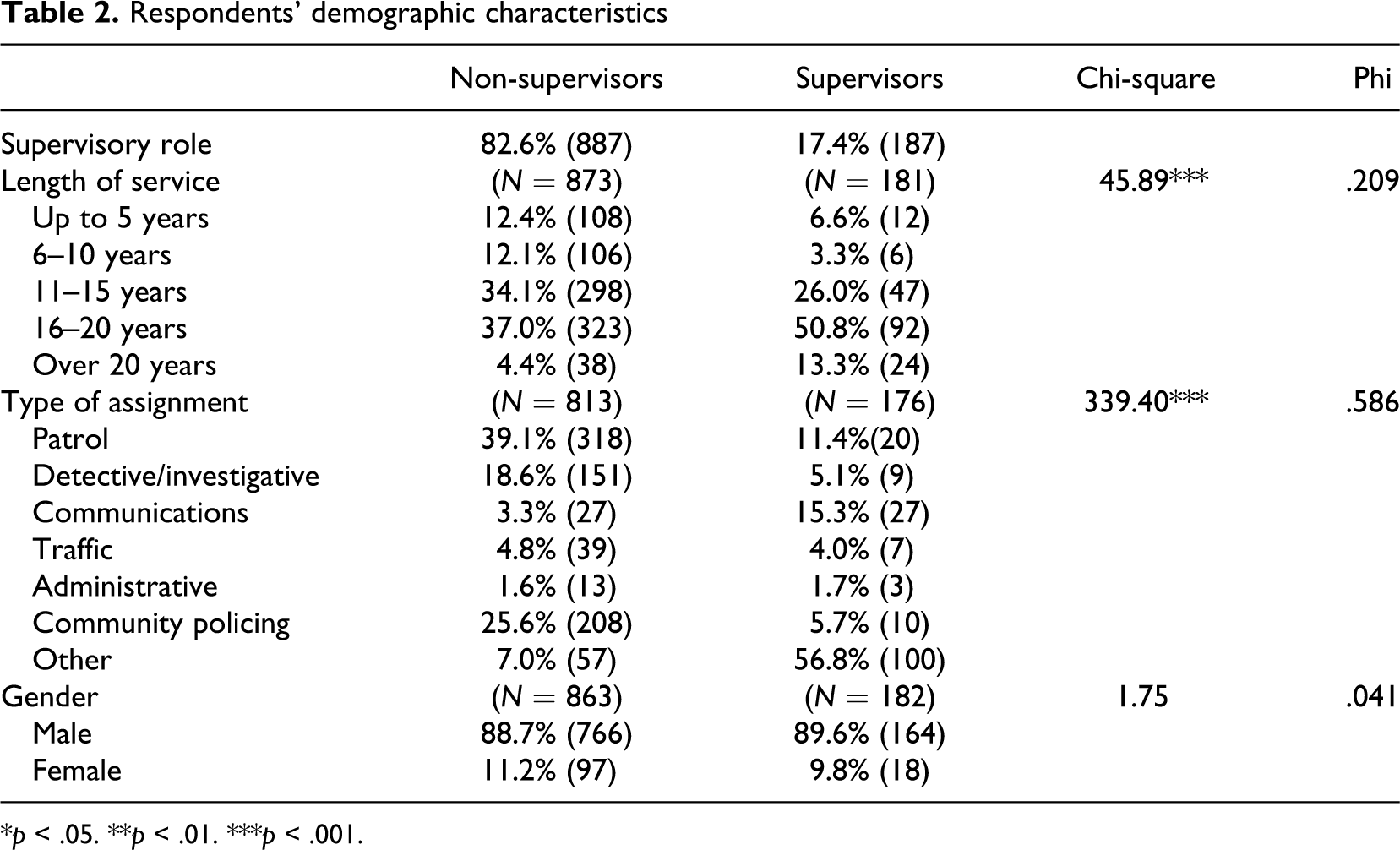
The overwhelming majority (83%; Table 2) of the respondents were nonsupervisors; fewer than one in five respondents were supervisors. Supervisors tended to be more experienced than nonsupervisors; about 64% of the supervisors and 41% of the nonsupervisors had more than 15 years of experience (Table 2). At the same time, only 12% of nonsupervisors and 7% of supervisors had fewer than 5 years of experience. Both groups—supervisors and nonsupervisors—were assigned to a range of assignments, with nonsupervisors mostly focusing on patrol and community policing and supervisors primarily being assigned to “other” assignments (Table 2). About 10% of both nonsupervisors and supervisors were women (Table 2). 4
Respondents’ demographic characteristics
*p < .05. **p < .01. ***p < .001.
The Measurement of Police Integrity
Knowledge of the Official Rules
To assess whether supervisory and nonsupervisory knowledge of the official rules differ, I provided the respondents with 14 hypothetical scenarios describing a range of forms of police misconduct and asked them to evaluate whether the described behaviors constitute violations of official rules. The respondents could pick among three choices: “yes,” “no,” and “not sure” (see Appendix B). By virtue of the research design, all behaviors described in the questionnaire should be labeled as violations of official rules, and a number of them also as violations of criminal law.
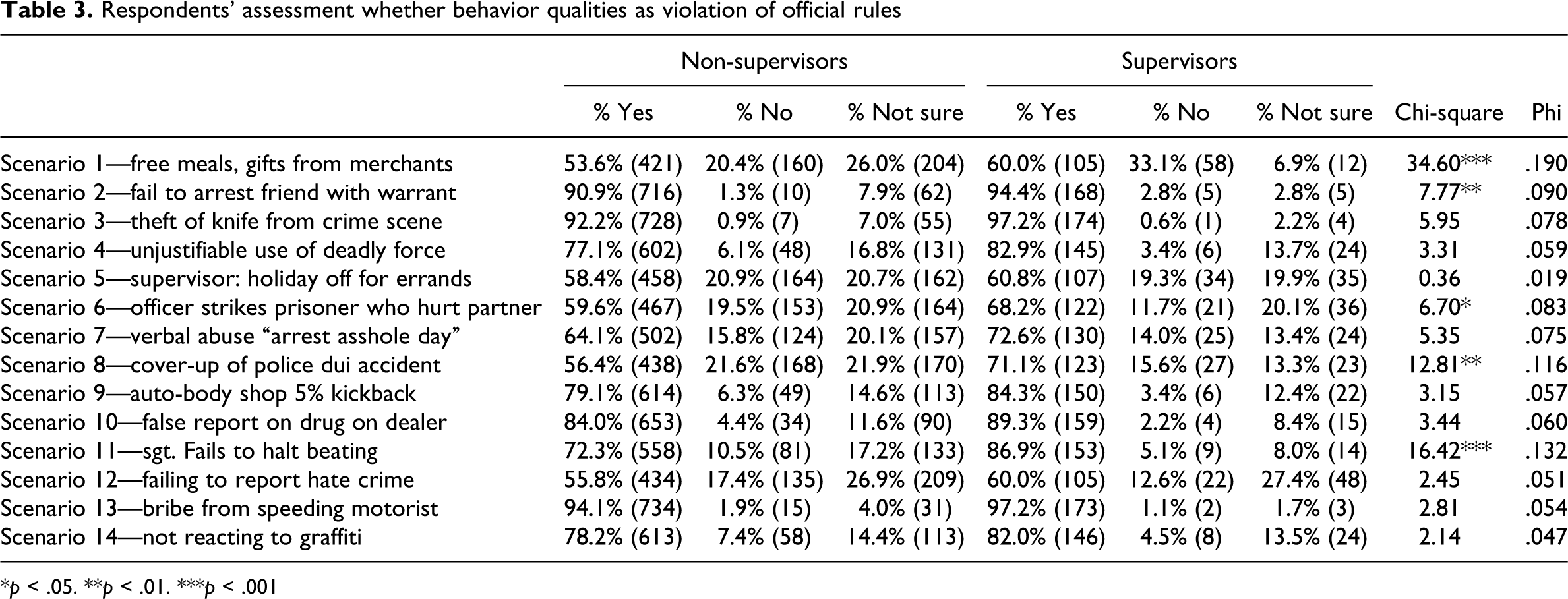
Table 3 shows that the percentage of nonsupervisors who recognized these behaviors as rule violating varies from 54% for the scenario describing the acceptance of free meals and discounts on the beat (Scenario 1) to 94% for the scenarios describing the acceptance of a bribe from a motorist caught speeding (Scenario 13) and the theft of a knife from the crime scene (Scenario 3). The percentage of supervisors who recognized these behaviors as rule violating is very similar—it varies from 60% for the scenario describing the acceptance of free meals and discounts on the beat (Scenario 1) to 97% for the scenario describing the acceptance of a bribe from a motorist caught speeding (Scenario 13).
Respondents’ assessment whether behavior qualities as violation of official rules
*p < .05. **p < .01. ***p < .001
There is substantial variation over the opinions whether these behaviors should be labeled as rule violating (see Table 3); for some scenarios, barely one half of the respondents recognized behaviors described in some scenarios as rule violating (e.g., Scenario 1—free meals, gifts from merchants; Scenario 5—supervisor: holiday off for errands; Scenario 6—Officer strikes prisoner who hurt partner; Scenario 8—cover-up of police driving under the influence DUI accident; Scenario 12—failing to report hate crime). On the other hand, there were some scenarios (e.g., Scenario 2—fail to arrest friend with warrant; Scenario 3—theft of knife from crime scene; Scenario 13—bribe from speeding motorist) which 90% or more of the respondents recognized as rule violating (Table 3).
There were statistically significant differences in only 5 out of 14 scenarios (see Table 3). This suggests that the initial hypothesis that supervisors would be more knowledgeable of the official rules has not been supported. I found that their knowledge of the official rules is not statistically significantly different. In addition, using the 10% difference as a rule of thumb to indicate substantively important differences, only 3 out of 14 scenarios (Scenario 1—free meals, gifts from merchants; Scenario 8—cover-up of police DUI accident; Scenario 11—Sgt. fails to halt beating) had substantively important differences, which only further contributes toward my finding that the supervisor and nonsupervisor views are rather similar. I found that supervisors were more likely than nonsupervisors to recognize and label such behaviors as rule violating in two out of three of these scenarios (Scenario 8—cover-up of police DUI accident; Scenario 11—Sgt. fails to halt beating). The scenario describing the acceptance of gratuities (Scenario 1—free meals, gifts from merchants) is unusual; a similar percentage of both supervisors and nonsupervisors said that accepting food and small gifts from merchants is a violation of official rules (60.0% and 53.6%, respectively; Table 3).
However, supervisors were more likely to say that it was not a violation, while nonsupervisors were more likely to say that they were not sure (Table 3).
Perceptions of Seriousness
To assess potential differences between supervisors and nonsupervisors in their evaluations of misconduct seriousness, I asked the respondents to evaluate the seriousness of the behavior described in each of the scenarios. They could pick an answer on a 5-point Likert-type scale, from 1 = “not serious at all” to 5 = “very serious” (see Appendix B).
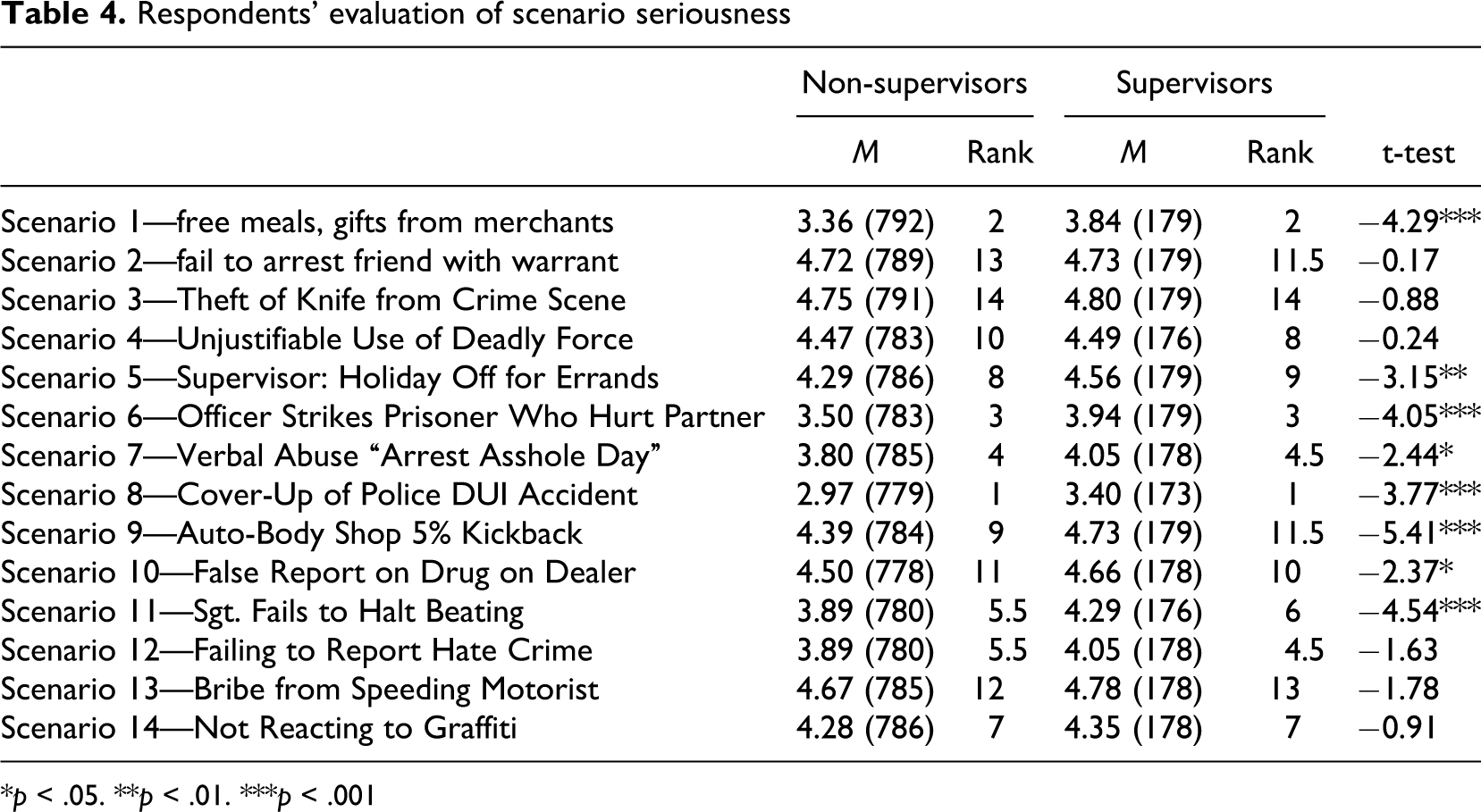
The means for nonsupervisors’ evaluations of seriousness varied from as low as 3 for the scenario describing the cover-up of police DUI (Scenario 8; Table 4) to as high as 5 for the scenario describing the theft of a knife from a crime scene (Scenario 3). Similarly, the means for supervisors’ evaluations of seriousness varied from as low as 3 for the scenario describing the cover-up of the police DUI (Scenario 8; Table 4) to as high as 5 for the scenario describing the theft of a knife from a crime scene (Scenario 3).
Respondents’ evaluation of scenario seriousness
*p < .05. **p < .01. ***p < .001
The respondents, both nonsupervisors and supervisors, thought that the seriousness of behaviors described in the questionnaire varies greatly. On one hand, both supervisors and nonsupervisors evaluated theft of a knife from a crime scene (Scenario 3—theft of knife from crime scene), failure to arrest a friend with an outstanding warrant (Scenario 2—failure to arrest friend with warrant), and the acceptance of a bribe from a motorist caught speeding (Scenario 13—bribe from speeding motorist) as the most serious forms of misconduct, with means close to 5 (Table 4). On the other hand, both groups evaluated the cover-up of a fellow police officer’s DUI (Scenario 8—cover-up of police dui and accident), the acceptance of free meals and gifts from merchants (Scenario 1—free meals, gifts from merchants), and striking a prisoner who hurt the police officer’s partner (Scenario 6—officer strikes prisoner who hurt partner) as the least serious forms of behavior (Table 4).
A comparison of supervisor and line officer views reveals statistically significant differences for 8 out of 14 scenarios (Table 4). In all of these scenarios, supervisor means are higher than line officer means. However, in some scenarios (e.g., Scenario 10—false report on drug on dealer), the differences are fairly small (0.16 on a 5-point scale). None of the scenarios passed the 0.50 rule of thumb threshold of substantive importance previously used by Klockars and colleagues (Klockars et al., 2006, p. 26). Overall, I found statistically significant differences in the about one half of the scenarios (thus supporting the initial hypothesis), but these differences tended to be small (thus suggesting weaker support).
I rank-ordered scenarios from those with the smallest mean (#1) to those with the largest mean (#14) for supervisors and nonsupervisors (Table 4). It is obvious from the ranking—the relative measure of seriousness—that nonsupervisors and supervisors have very similar views of relative seriousness (i.e., how scenarios compare to other scenarios in the questionnaire). Moreover, Spearman’s correlation between the supervisor and nonsupervisors estimates of seriousness is very large (Spearman’s r = .966, p < .001).
My initial hypothesis was that supervisors would evaluate misconduct as more serious than nonsupervisors would. In 8 out 14 scenarios, I found statistically significant differences between supervisor and nonsupervisors absolute evaluations of seriousness, and thus weak support for the initial hypothesis. The support is even weaker because the differences were relatively small (none passed the .50 rule of thumb threshold of substantive importance). My initial expectation of very similar relative evaluations of seriousness (i.e., the internal ranking of scenarios based on their seriousness) was strongly supported; I found almost no differences in the seriousness rankings between supervisors and nonsupervisors.
Opinions About the Appropriate and Expected Discipline
To assess potential differences between supervisor and nonsupervisor views of appropriate and expected discipline, the respondents were asked what they thought that the appropriate discipline for the behaviors described in the questionnaire should be, as well as what the actual discipline meted out by their agencies would be (see Appendix B). Based on the norms of the Law on Civil Servants and Public Employees (2001), the answers the questionnaire offered were “no discipline,” “public warning,” “fine in the amount of 10% of the employee’s salary,” “fine in the amount of 20% of the employee’s salary,” “reassignment,” and “dismissal” (see Appendix B). In the analyses, I condensed these responses into three categories: “no discipline,” “less serious discipline,” and “dismissal.”
Table 5 contains the percentage distribution of supervisors’ and nonsupervisors’ answers about the appropriate discipline. The percentage of nonsupervisors who thought that no discipline would be appropriate varied from 1% for the scenario describing the theft of knife from the crime scene (Scenario 3; Table 5) to 30% for the scenario describing the cover-up of police DUI (Scenario 8). Similarly, the percentage of supervisors who thought that no discipline would be appropriate varied from 0% for the scenarios involving the failure to arrest a friend with an outstanding warrant (Scenario 2) and stealing a knife from a crime scene (Scenario 3) to 18% for the scenario involving the cover-up of a police DUI (Scenario 8).
Respondents’ views of appropriate discipline

*p < .05. **p < .01. ***p < .001
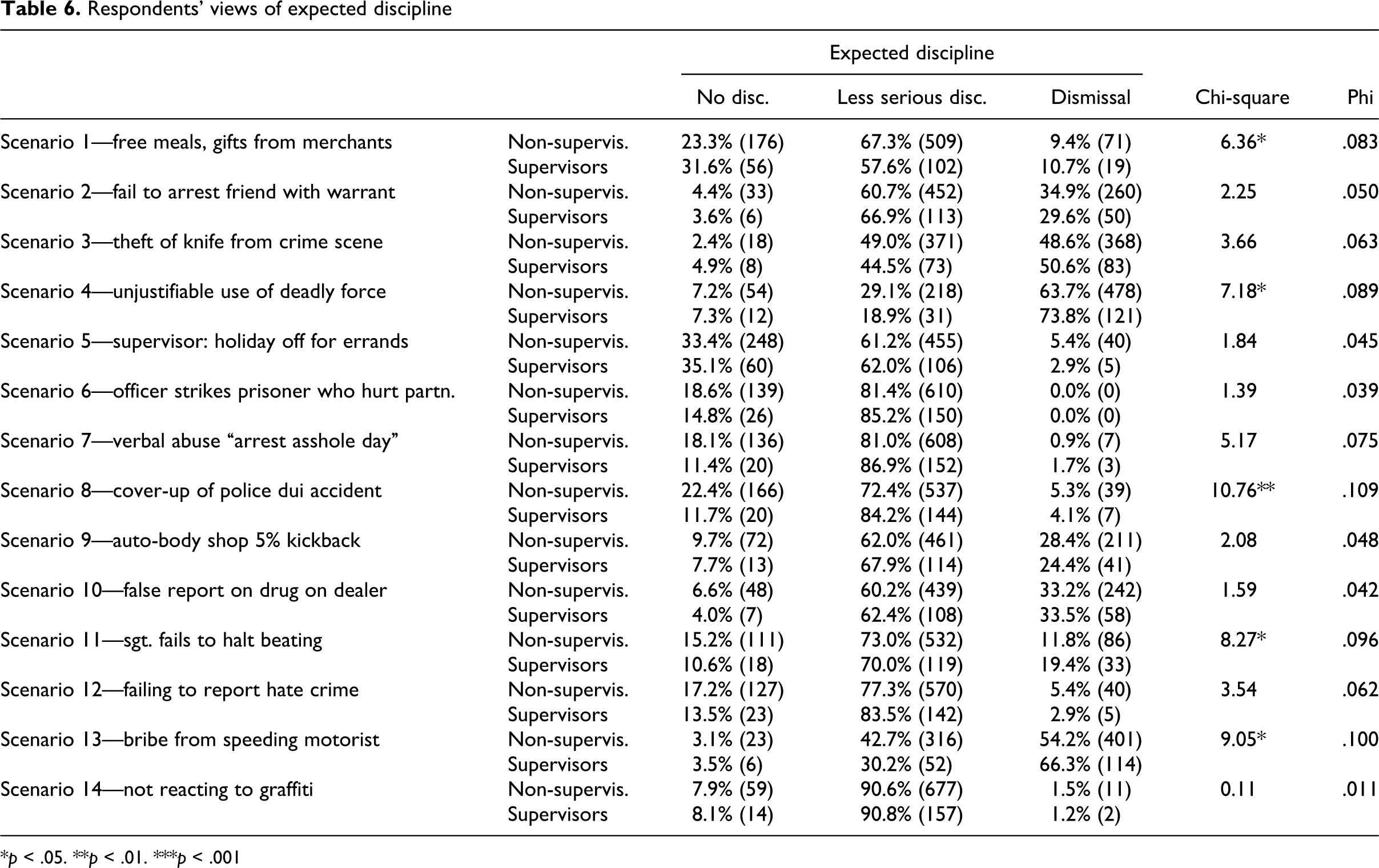
Table 6 contains the percentage distribution of supervisors’ and nonsupervisors’ answers about the expected discipline. The percentage of nonsupervisors who thought that no discipline should be expected varied from 2% for the scenario describing the theft of knife from the crime scene (Scenario 3; Table 6) to 33% for the scenario describing the supervisor’s offer of holiday off in exchange for a police officer running some personal errands for the supervisor (Scenario 5). Similarly, the percentage of supervisors who thought that no discipline should be expected varied from 3% for the scenario involving the acceptance of a bribe from a motorist caught speeding (Scenario 13) to 35% for the scenario describing the supervisor’s offer of holiday off in exchange for a police officer running some personal errands for the supervisor (Scenario 5).
Respondents’ views of expected discipline
*p < .05. **p < .01. ***p < .001
The views about the appropriate discipline varied greatly across scenarios, from those regarding which about a quarter of nonsupervisors thought no discipline should be meted out (e.g., Scenario 1—free meals, gifts from merchants; Scenario 6—officer strikes prisoner who hurt partner; Scenario 8—cover-up of police DUI accident) to the scenarios regarding which more than one half of the respondents—both nonsupervisors and supervisors—thought that the police officer deserved dismissal for such behavior (e.g., Scenario 3—theft of knife from crime scene; Scenario 4—– unjustifiable use of deadly force; Scenario 13—bribe from speeding motorist; Table 5).
Line officer and supervisor views of appropriate discipline were statistically significantly different in 9 out of 14 scenarios (Table 5). These scenarios range in terms of their seriousness from the least serious ones (e.g., Scenario 1—free meals, gifts from merchants; Scenario 7—verbal abuse “arrest asshole day”; Scenario 8—cover-up of police DUI accident) to the most serious ones (e.g., Scenario 2—fail to arrests friend with warrant; Scenario 3—theft of knife from crime scene; Scenario 13—bribe from speeding motorist); their common feature is that supervisors thought that more serious discipline should be appropriate than nonsupervisors did. In some scenarios (e.g., Scenario 2—fail to arrest friend with warrant; Scenario 3—theft of knife from crime scene), supervisors were more likely to advocate for dismissal than nonsupervisors were, while in other scenarios (e.g., Scenario 6—officer strikes prisoner who hurt partner; Scenario 7—verbal abuse “arrest asshole day”) supervisors were less likely to advocate for no discipline, and more likely to advocate for some discipline than nonsupervisors were (Table 5).
The opinions about the discipline that the respondents thought the police administration would mete out for the behaviors described in the scenarios varied across the scenarios as well, but the heterogeneity across ranks was less pronounced than it was for the assessments of appropriate discipline. There were only 5 scenarios (out of 14) featuring statistically significant differences between the supervisor and line officer expectations of discipline the administration would mete out (see Table 6). In other words, in the majority of the scenarios, supervisors and nonsupervisors had very similar expectations concerning discipline severity. In 4 out of the 5 scenarios regarding which their expectations differed (Scenario 4—unjustifiable use of deadly force; Scenario 8—cover-up of police DUI accident; Scenario 11—Sgt. fails to halt beating; Scenario 13—bribe from speeding motorist), supervisors expected discipline to be harsher than nonsupervisors did. In the remaining scenario (Scenario 1—free meals, gifts from merchants), nonsupervisors expected harsher discipline than the supervisors did (see Table 6).
The initial expectation of large differences between the supervisor and nonsupervisor views of appropriate discipline has been met. Indeed, in 9 out of 14 scenarios, I found that the supervisors advocate more severe discipline than line officers do. On the other hand, I expected that the respondents’ views about expected discipline should be more similar. Accordingly, I found relatively few differences (in 5 out of 14 scenarios) between supervisors and nonsupervisors, thus suggesting that the message about the discipline the agency would mete out is comprehended consistently across both supervisors and nonsupervisors.
Willingness to Report Misconduct
To assess whether nonsupervisors are more likely to participate in the code of silence than supervisors are, the last question after each scenario asked the respondents to express their willingness to report misconduct or, put differently, their willingness to protect such behavior in silence and thus adhere to the code of silence. They could pick an answer on a 5-point Likert-type scale, from 1 = definitely would not report to 5 = definitely would report (see Appendix B).
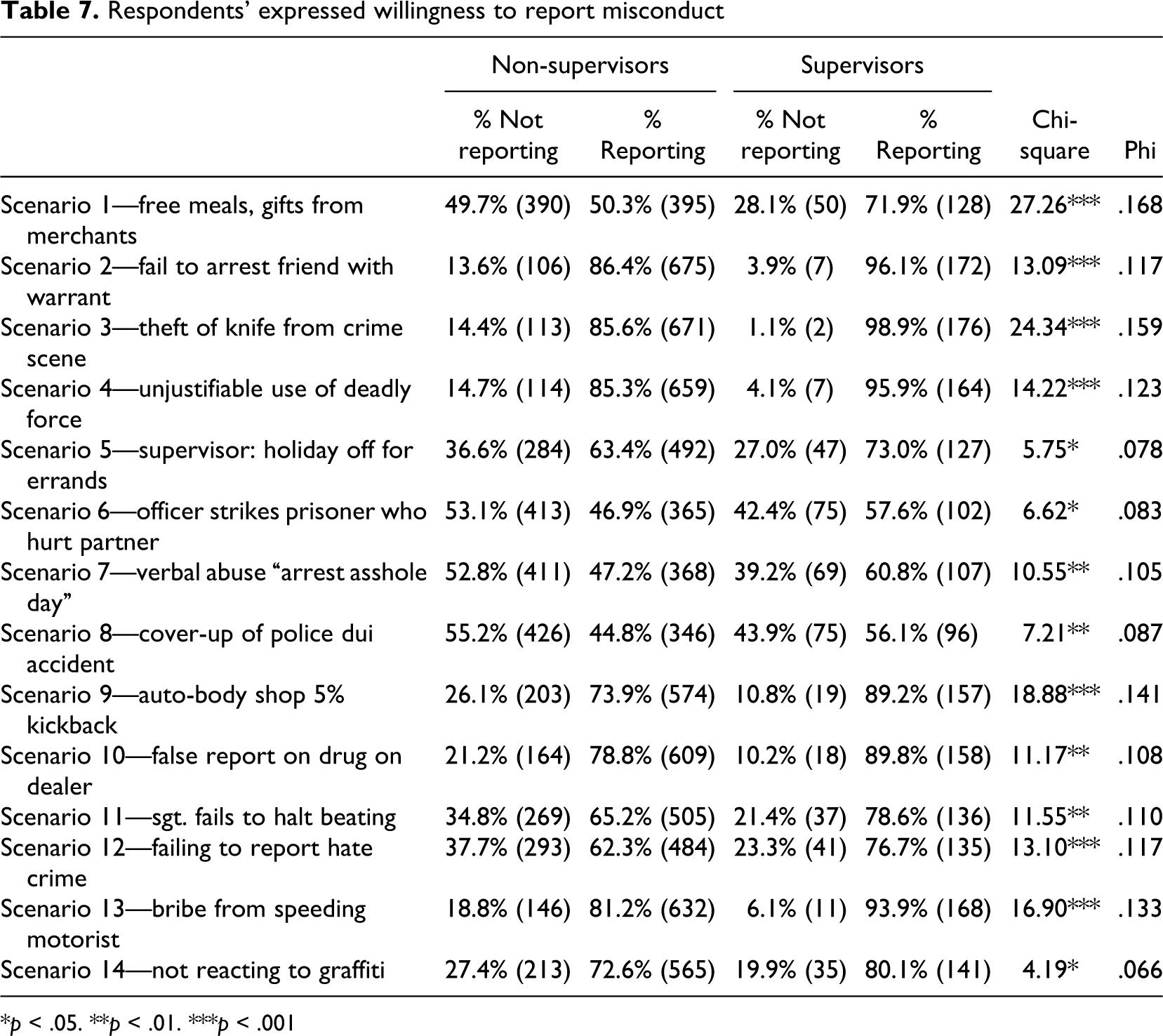
The percentage of nonsupervisors responding that they would not report the described misconduct ranges from 14% for the scenarios describing the failure to arrest a friend with an outstanding warrant (Scenario 2; Table 7) and theft of a knife from a crime scene (Scenario 3) to 55% for the scenario describing the cover-up of police DUI (Scenario 8). Similarly, the percentage of supervisors responding that they would not report the described misconduct ranges from 1% for the scenario describing the theft of knife from the crime scene (Scenario 3) to 44% for the scenario describing the cover-up of police DUI (Scenario 8).
Respondents’ expressed willingness to report misconduct
*p < .05. **p < .01. ***p < .001
The results show that the contours of the code of silence vary substantially across the scenarios, from those in which a strong minority, or even the majority, of nonsupervisors and/or supervisors would protect such behavior in silence (e.g., Scenario 1—free meals, gifts from merchants; Scenario 6—officer strikes prisoner who hurt partner; Scenario 7—verbal abuse “arrest asshole day”; Scenario 8—cover-up of police DUI accident; Table 7) to the scenarios in which a small minority shared the same sentiment (e.g., Scenario 2—fail to arrest friend with warrant; Scenario 3—theft of knife from crime scene; Scenario 4—unjustifiable use of deadly force; Table 7). A stronger code of silence was associated with behaviors more likely to be viewed as less serious both among nonsupervisors (Spearman’s ρ = .953, p < .001) and supervisors (Spearman’s ρ = .890, p < .001).
A comparison of the percentages of nonsupervisors and supervisors who responded that they would not report such behavior was statically significant in all 14 scenarios (see Table 7); in every scenario, the code of silence was stronger among nonsupervisors than it was among supervisors. Typically, the differences in percentages were about 10–15% (only one scenario had a difference below 10%), with one scenario exceeding the 20% threshold (Scenario 1—free meals, gifts from merchants; Table 7). In none of the scenarios did the majority of the supervisors say that they would not report the described behaviors, while the majority of nonsupervisors said that they would not report the behavior described in three (Scenario 6—officer strikes prisoner who hurt partner; Scenario 7—verbal abuse “arrest asshole day;” Scenario 8—cover-up of police DUI accident; Table 7). Thus, my initial hypothesis that nonsupervisors would be more likely to participate in the code of silence than supervisors has strong support in the data (I found statistically significant differences in 14 out of 14 scenarios, and substantively important differences in 13 out of 14 scenarios).
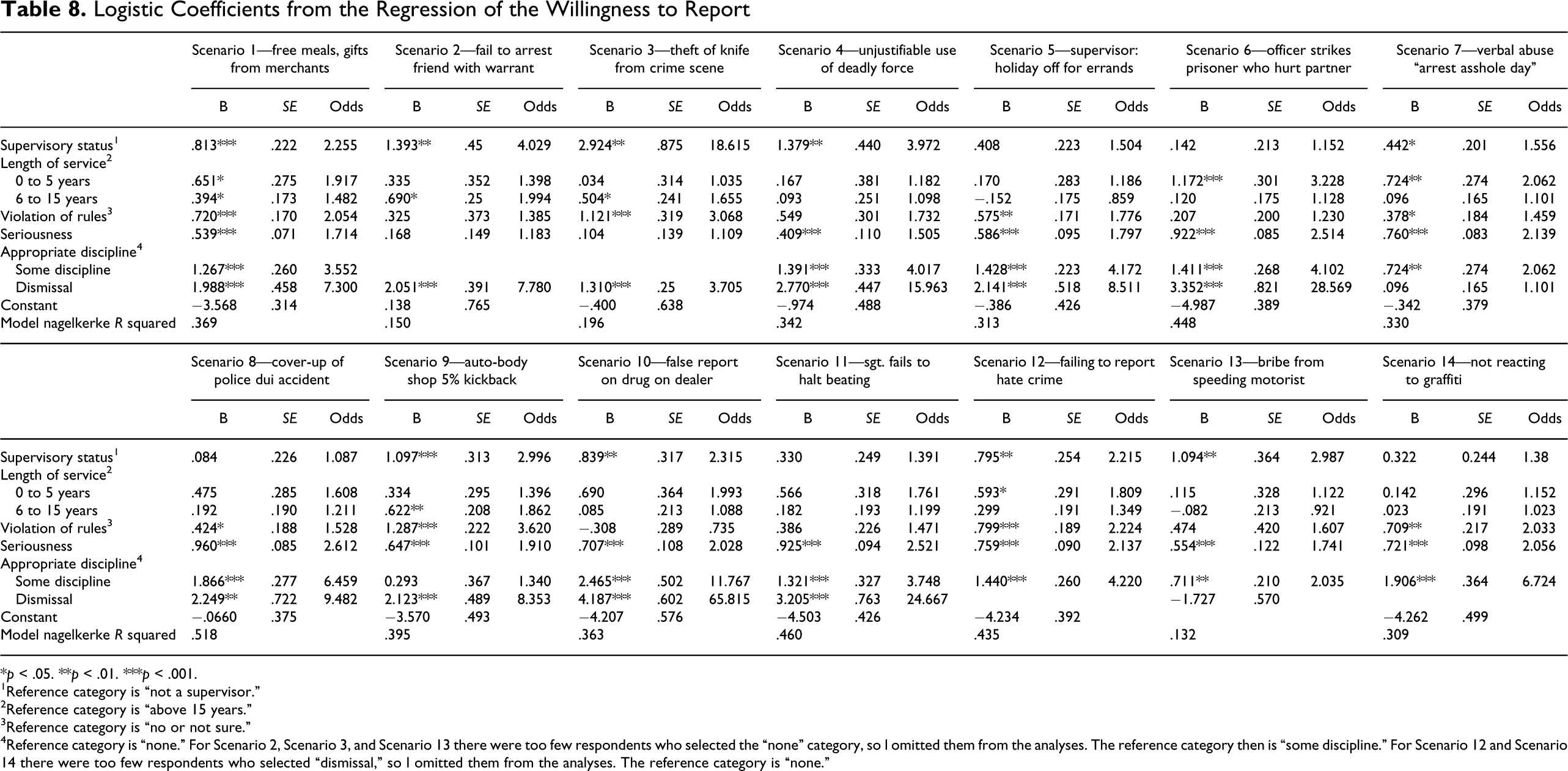
Among all the measures of police integrity (i.e., violation of official rules, views of seriousness, perceptions of appropriate and expected discipline, willingness to report), I found by far the largest and strongest differences between supervisor and nonsupervisor adherences to the code of silence. I thus explored this relation further in a multivariate setting (see Table 8).
Logistic Coefficients from the Regression of the Willingness to Report
*p < .05. **p < .01. ***p < .001.
1Reference category is “not a supervisor.”
2Reference category is “above 15 years.”
3Reference category is “no or not sure.”
4Reference category is “none.” For Scenario 2, Scenario 3, and Scenario 13 there were too few respondents who selected the “none” category, so I omitted them from the analyses. The reference category then is “some discipline.” For Scenario 12 and Scenario 14 there were too few respondents who selected “dismissal,” so I omitted them from the analyses. The reference category is “none.”
I used logistic regression to study the nature of the relation between willingness to report and supervisory status. Table 8 presents 14 logistic regressions (one for each scenario). The dependent variable is the respondents’ willingness to report (dichotomized into yes and no). I included the supervisory status and length of service as demographic variables. In addition, I included several substantive variables (e.g., violation of the official rules, seriousness, appropriate discipline). While I dichotomized the violation of official rules, I divided the views about the appropriate discipline into three categories (no discipline, some discipline, and dismissal). 5
The relation between the respondents’ adherence to the code of silence and supervisory status remained strong in the multivariate setting. The respondents’ supervisory status was one of the key explanatory variables in 9 out of 14 scenarios (see Table 8) 6 ; compared to nonsupervisors, supervisors had significantly higher odds of saying that they would report. The odds varied from 1.5 for Scenario 7 (verbal abuse “arrest asshole day”) to 18.6 for Scenario 3 (theft of knife from crime scene; Table 8). The respondents’ views of the appropriate discipline was the key explanatory variable in the models (Table 8); in all 14 scenarios, the respondents who advocated that the harsher discipline should be used were more likely to say that they would report misconduct than the respondents who advocated using less severe discipline. Similarly, the respondents’ perceptions of the misconduct seriousness were a significant predictor in 12 out of 14 scenarios (Table 8); the respondents who evaluated misconduct as more serious were also more likely to say that they would report than the respondents who evaluate misconduct as less serious. Knowledge of official rules and the length of service turned out to be significant in about one half of the scenarios (see Table 8).
Conclusion
The initial point of my inquiry was the extent of officers’ knowledge of the official rules. I expected to find that police supervisors were more knowledgeable of the official rules. Although this hypothesis was not supported overall, in the few scenarios in which I did find some differences, I concluded that the supervisors seemed to be more likely to recognize and label the described violations as rule violating. A particularly revealing case is the scenario describing the acceptance of gratuities (Scenario 1—free meals, gifts from merchants), regarding which nonsupervisors were more likely to indicate that they were not sure whether this was a violation of official rules than supervisors who were sure. Such a large discrepancy in the views is suggestive of a certain level of confusion regarding the rules prohibiting the acceptance of gratuities. There are several possible, not mutually exclusive explanations. First, the official rules dealing with this form of misconduct are not clear or are not taught in a way that allows police officers to adopt and apply them. Second, there is an unofficial policy that tolerates gratuity acceptance, trumping the official policy. Third, application of these official rules is inconsistent across the board. The inconsistency may apply to how often the rules are enforced, whether certain groups are exempt from the enforcement, and how uniform the enforcement of the rules is across different police administrations or police stations.
The second issue I explored was the police officers’ perceptions of misconduct seriousness. Although I did find statistically significant differences between supervisors’ and nonsupervisors’ absolute seriousness evaluations in 8 out of 14 scenarios (thus indicating some support for the initial hypothesis), none of these scenarios had large and substantively important differences. At the same time, nonsupervisors’ and supervisors’ relative assessments of seriousness—how scenarios compare to one another—were quite similar (thus providing strong support for my initial hypothesis, suggesting no differences in opinions). This result is by no means surprising; it is in accordance with prior research on evaluations of scenario seriousness, indicating that, although the absolute evaluations of seriousness tend to vary across supervisory lines to a certain degree (e.g., Criminal Justice Commission, 1995; Huon et al., 1995; Kutnjak Ivković, 2005c, McConkey et al., 1996), relative evaluations tend to be similar. Thus, there seems to be a shared understanding of police misconduct seriousness, consistent with the extant literature on crime severity (e.g., Sellin & Wolfgang, 1964).
I expected that supervisors would be more supportive of harsher discipline than nonsupervisors, but, at the same time, that their expectations of the discipline the police administration would mete out would be similar. Because of their supervisory status and the procedural role it entails in disciplinary matters, supervisors’ perceptions of appropriate discipline would be somewhat harsher than nonsupervisors’ perceptions. Indeed, the results suggest that the differences were statistically significant in the majority of the scenarios (9 out of 14); in all of these scenarios, the supervisors’ assessment of appropriate discipline was harsher than the nonsupervisors’ assessment (thus providing support for my initial hypothesis).
At the same time, my initial hypothesis was that supervisors and nonsupervisors would share the views about the discipline meted out in the actual disciplinary cases. Accordingly, I found that, although there were some differences between the supervisor and line officer perceptions of expected discipline (in 5 out of 14 scenarios), their views of expected discipline were much more similar than their views of appropriate discipline (in 9 out of 14 scenarios there were no significant differences, thus providing support for my initial hypothesis).
Lastly, prior research on police integrity exploring potential differences between the ranks almost exclusively focused on the code of silence (see, e.g. Kremer, 2004; Kutnjak Ivković & Klockars, 2000; Kutnjak Ivković & Shelley, 2008; Pagon, Kutnjak Ivković, & Lobnikar, 2000) and reported that, if there are differences between the line officer and supervisor reporting tendencies to begin with, the supervisor code seems to be narrower than the line officer code (see, e.g. Kremer, 2004; Kutnjak Ivković & Klockars, 2000; Kutnjak Ivković & Shelley, 2008; Pagon et al., 2000). The only study measuring the differences in the code of silence between supervisors and nonsupervisors in Croatia (Kutnjak Ivković & Klockars, 2000) suggested that the code of silence in 1995 seemed to be stronger among nonsupervisors than among supervisors (Kutnjak Ivković & Klockars, 2000). The results of my study, conducted more than a decade later, are consistent with these findings. They show that there are two similar, yet distinct codes of silence, with the supervisor code being narrower than the line officer code. Both bivariate and multivariate analyses show strong support for my initial hypothesis of significant differences between the supervisor and nonsupervisor adherence to the code of silence.
There are a few potential limitations of the study. First, the data in the present study are cross-sectional and not longitudinal. Both samples (1995 and 2008–2009) are representative. To protect respondents’ anonymity and increase the chances that the respondents would provide truthful answers, I did not keep track of their identities. As such, I cannot evaluate the changes in the respondents’ behavior over time. Although not without potential drawbacks, future use of longitudinal data would allow scholars to explore how changes in control efforts (e.g., a new official policy on the acceptance of gratuities) might affect the respondents’ views and attitudes both short- and long-term.
Second, a lack of information about the respondents’ actual involvement in police misconduct could be viewed as a potential limitation of the current study. However, this was a deliberate strategic decision, inherent to this methodological approach (see, e.g. Kutnjak Ivković, 2003), made with the purpose of enhancing the likelihood that the police administrators would allows us to collect the data and that police officers would participate and provide truthful answers.
Third, in a country in which the police have experienced a significant overlap between the traditional police and military roles, it might be beneficial to assess how this military experience—with quite different expectations of “proper” performance—affects the respondents’ views and attitudes. In the present study, conducted 13 years after military operations involving the Croatian police had ended, I did not ask questions about the respondents’ prior involvement in the war. Aside from the general tendency to keep the number of demographic questions to a minimum, I was well aware of the long-run trends in police hiring freezes since the war. The overall size of the police dropped from more than 30,000 immediately after the war to around 20,000 at the time of the survey. There were retirements and buyouts, and hiring was greatly reduced, thus making it very likely that a substantial majority of my respondents had been hired in the 1990s. Indeed, more than three quarters of nonsupervisors and around 90% of supervisors in the sample have been on the force for 11–15 years or longer. This circumstance minimizes concerns related to the timing of hiring in the current study. However, future projects on police culture and police integrity in postconflict societies (e.g., Rwanda, Bosnia, South Africa, and Northern Ireland) could seek to exploit the variation in tenure with the police (those hired before the regime change and since the regime change) and take the extent and intensity of the respondents’ merging of the police and military experience into account by exploring how police culture is shaped by these military and quasi-military experiences. Quite possibly, war-related experiences might not influence all aspects of police integrity equally; because of the widespread use of violence during the war, the use of force misconduct might be more likely to be tolerated by the police officers than some other forms of misconduct such as corruption or perjury.
As Klockars and colleagues noted, police integrity could be measured through different types of questions. Among all of the questions focusing on different elements of police integrity, the measure that results in the greatest heterogeneity of opinions is the measurement of the code of silence. On the other hand, relative perceptions of seriousness yield the greatest homogeneity of views. The results of this study clearly point out that police integrity is a complex phenomenon and that the results depend upon the specific elements measured. Police integrity can be perceived to vary substantially—as was the case with the measures of the code of silence—or very little—as was the case with the relative perceptions of seriousness.
Footnotes
Appendix A
Appendix B
Declaration of Conflicting Interests
The author declared no potential conflicts of interest with respect to the research, authorship, and/or publication of this article.
Funding
The author received no financial support for the research, authorship, and/or publication of this article.