



Abstract
The study of perceived organizational support (POS) has received considerable attention in the academic literature. However, in police circles, POS has received minimal scholarly attention. To address this gap, the present study surveyed 145 police officers selected randomly from five police districts in Accra, Ghana, to investigate how officers’ perception of organizational support influence their effectiveness in performing assigned duties. The study further examined the influence of officers’ demographic characteristics on their perception of organizational support. Findings revealed that the perception of organizational support among officers influenced their perception of effectiveness and that older and shorter tenured officers expressed perceptions of greater support. Policy implications of the findings are discussed.
Introduction
Perceived organizational support (POS) reflects employees’ belief that their organization values their contributions and cares about their well-being. Since the concept was first introduced to investigate employees’ inferences concerning the organization’s commitment to them (Eisenberger, Huntington, Hutchison, & Sowa, 1986), POS has received considerable research attention in the social sciences (Armeli, Eisenberger, Fasolo, & Lynch, 1998; Bowling & Mitchel, 2011; Liu & Ding, 2012; Rhoades & Eisenberger, 2002). These empirical studies have observed that high POS is positively related to reduced absenteeism, prosocial behavior, and performance.
Research in policing has argued that organizational support is an essential resource capable of influencing officers’ performance and effectiveness (Adebayo, 2005; Armeli et al., 1998; Currie & Dollery, 2006; Olatise, 2001). These scholars believe that policemen and women charged with the noble cause of protecting lives and property need the support of their organization to be effective in performing their daily duties. Moreover, it has been observed that higher perceptions of organizational support correspond with increased performance. Organizational support has broadly been categorized into tangible forms, such as good shelter, equipment, infrastructure, and adequate remuneration (Adebayo, 2005), and intangible forms, such as emotional support, caring, esteem, and approval (Eisenberger et al., 1986; Rousseau, 1989, 1990).
The intense negative publicity related to the performance of the Ghana Police Service (GPS) over the years has ensured that policing has become a controversial area of Ghanaian public policy. As research has shown, an essential attribute of officers’ performance resides in the degree of support they receive from the organization. However, for several years, the GPS has lapsed in providing adequate support to its officers, leading to apparent poor performance. Ghana’s constitution (1992) provides in chapter 15, section 3 that “the Police Service shall be equipped and maintained to perform its traditional role of maintaining law and order.” This promise has not yet been realized, as the police service continues to suffer from an acute lack of resources. The lack of resources places a great deal of strain on the service, hindering its ability to provide the necessary support that would elicit officers’ high-quality performance. For instance, in Ghana, housing of police officers is the responsibility of the GPS. Yet, only a fraction of officers are housed, leaving the majority to search for their own accommodation. Of those who receive housing, less than half live in decent accommodation; the rest live in “uncompleted buildings, offices, garages, and dilapidated buildings” (Strategic National Policing Plan, 2010, p. 3). It needs to be mentioned that efforts have been made by both past and incumbent governments to provide resources for the police service to perform their duties.
Given the importance of organizational support to officers’ effectiveness, the present study supplements previous research to examine the influence of police officers’ perceptions of organizational support on their effectiveness, using surveys conducted in Ghana. Second, the study examines the influence of officers’ demographic characteristics on their perceptions of organizational support to determine whether perceived support levels vary based on individual characteristics. This study makes a significant contribution to the policing literature because it fills the void created by the lack of comparable studies in the African context, and more specifically, in the Ghanaian context. A notable exception is Tankebe’s (2010b) study, which examined factors that shape Ghanaian officers’ commitment to the organization, but failed to examine organizational support and how it affects the performance of the officers.
Theoretical Framework
The present study is based on the assumption that police officers’ commitment is tied to the support they receive from the organization. This assumption is derived from the organizational support theory (Eisenberger, Cummings, Armeli, & Lynch, 1997; Eisenberger et al., 1986; Shore & Shore, 1995), which postulates that employees develop global beliefs concerning the extent to which the organization values their contribution and cares about their well-being. Employees perceive their organization as supportive when they are rewarded beyond their contractual agreements. Organizational support theorists further contend that employees develop perceptions of support to meet socioemotional needs and to determine the organization’s readiness to reward increased efforts made on its behalf (Eisenberger et al., 1986; Rhoades & Eisenberger, 2002).
POS as a concept was first introduced by Eisenberger, Huntington, Hutchison, and Sowa (1986) to investigate “employees’ inferences concerning the organization’s commitment to them, and the contribution of such perceived organizational support to employees’ commitment to the organization” (p. 500). The authors noted that commitment is the sense of being bound emotionally or intellectually to some course of action, individual, group, or organization. POS is assumed to encourage employees’ identification with and support for organizational goals (Shore & Wayne, 1993; Wayne, Shore, & Liden, 1997). It is thought that this exchange between the organization and its employees may not be equal. However, it is based on fairness and trust. Employees abandon the pursuit of organizational interest and become self-seeking when they feel unfairly and disrespectfully treated. Studies have shown that fairness is an important organizational resource that needs to be preserved (Simons & Roberson, 2003). Moreover, previous research has demonstrated that fairness predicts employees’ satisfaction, cooperation, and trust in the organization (Murphy & Cherney, 2012; Tankebe, 2008b; Tyler, 1990).
Relating to the influence of employees’ perception of organizational support, a substantial body of research has found that it has positive effects on employees’ work outcomes, such as reduced absenteeism, turnover intentions, increased affective commitment, innovations and prosocial behaviors, performance, and compliance with organizational safety management policies (Armeli et al., 1998; Bowling & Mitchel, 2011; Byrne & Hochwarter, 2008; Eisenberger, Armeli, Rexwinkel, Lynch, & Rhoades, 2001; Eisenberger et al., 1986; Eisenberger, Fasolo, & Davis-LaMastro, 1990; Eisenberger, Stinglhamber, Vandenberghe, Sucharski, & Rhoades, 2002; Liu & Ding, 2012; Rhoades & Eisenberger, 2002; Shoss, Eisenberger, Restubog, & Zagenczyk, 2013; Tremblay, Cloutier, Simard, Chenevert, & Vandenberghe, 2010; Wang & Hsieh, 2013). These studies have demonstrated that when employees perceive the organization as providing them with essential incentives apart from what is defined in their contracts, they tend to tailor their behavior toward the fulfillment of organizational goals: That is, a perception of organizational support among employees is reciprocated with high-quality service. For example, Bowling and Mitchel (2011) observed a strong effect of abusive supervision on counterproductive work behavior directed toward the organization. Similarly, Shoss, Eisenberger, Restubog, and Zagenczyk (2013) found that a decrease in POS was significantly related to counterproductive work behavior of employees and led to reduced work performance. The findings of these two studies intuitively suggest that a perceived lack of organizational support among employees results in the belief that the organization cares little about their well-being. Hence, it leads to negative work outcomes such as low or ineffective performance, absenteeism, and noncompliance with organization policies.
In police literature, the issue of POS has received limited attention. The dearth of research suggests that more empirical studies are needed to extend our knowledge of how organizational characteristics such as organizational support can influence officers’ productivity and effectiveness. The few studies that do exist deserve some attention (Adebayo, 2005; Armeli et al., 1998; Currie & Dollery, 2006; Gillet, Haurt, Colomat, & Fouquereau, 2013; Hochwarter, Treadway, Witt, & Ferris, 2006; Parsons, Kautt, & Coupe, 2011; Tankebe, 2010b). These studies have observed patterns similar to the results obtained in previous studies conducted by other social scientists.
For instance, Adebayo (2005) used a sample of Nigerian police officers to test the moderation effects of POS on the relationship between officers’ ethical attitudes and prosocial behavior, and found that officers who possessed low POS adopted more unethical attitudes and less prosocial behavior. This finding suggests that officers who believe that the police organization cares less about their well-being develop unprofessional attitudes toward work. This results in a host of negative work-related outcomes such as poor work performance, ineffectiveness, and lack of organizational commitment. Studies conducted later have found further evidence to support this conclusion. Using an Australian sample, Currie and Dollery (2006) found a strong effect of officers’ perception of organization support on their levels of organizational commitment. This finding is consistent with similar Australian studies conducted in the 1990s and a Ghanaian study conducted in 2010. Tankebe (2010b) has demonstrated that positive evaluation of the treatment officers receive enhances their commitment to the organization. Moreover, findings from the most recent studies, conducted in 2011 and 2012, offer further credence to the effect of organizational support on officers’ work outcome. Parsons, Kautt, and Coupe (2011) observed that senior police officers who feel less valued and more disillusioned with organizational leadership feel less commitment to the organization. Similarly, Gillet, Haurt, Colomat, and Fouquereau (2013) tested the effect of officers’ perception on their motivation to work using a self-determination theoretical framework as a guide and found a significant positive effect. They observed that officers who believed the organization supported them, valued their contributions, and cared about their well-being reported higher work motivation.
Collectively, the findings of the previously mentioned reviews have established an exchange relationship between police organizations and their officers. In this relationship, there are mutual expectations. Police officers expect the organization to provide them with support such as fringe benefits, pay raises, decent accommodation, equipment to work with, uniforms and boots, care, and love. Once these are provided, the organization expects quality service, high levels of performance, effectiveness, and commitment. These assumptions are derived from the social exchange theory, which, in this case, would suggest that police officers who see the organization as not supportive will develop poor work ethics, leading to ineffectiveness and low performance. Conversely, those who perceive the organization to be supportive develop good work ethics, leading to effectiveness and high performance. Based on this argument, the present study tests the following hypothesis:
Effects of Recognition and Cooperation on Police Effectiveness
Employee recognition has its roots in motivation theories (Skinner, 1974); according to such theories, recognition has the potential of improving employees’ performance and behavior. Studies that have tested this assumption have found considerable evidence to support it (Adebayo, 2005; Haines & St-Onge, 2012; Hill, 1991). These studies have observed that recognition positively influences employees’ work outcomes. For example, Adebayo (2005) found a positive relationship between public recognition and unethical attitudes and behavior among a select group of Nigerian police officers. Specifically, he found that officers who perceived that their performance in controlling crime was being recognized by the public were less likely to develop unethical attitudes and behavior.
Moreover, previous studies that have examined police effectiveness have shown that public cooperation with the police is essential (Bradford, 2012; Goudriaan, Lynch, & Nieuwbeerta, 2004; Kochel, Parks, & Mastrofski, 2013; Tankebe, 2009). It has been demonstrated by these studies that citizens’ willingness to report crime and offer information about suspicious and criminal activities is important to ensuring effective policing in democratic societies. However, researchers have argued that citizens’ cooperation with the police depends on their level of trust in the police (Mazerolle, Antrobus, Bennett, & Tyler, 2013; Murphy & Cherney, 2012; Tyler, 2005). According to these scholars, citizens who trust the police willingly cooperate with officers to apprehend criminal suspects.
The previously mentioned reviews show that recognition and cooperation are important predictors of police effectiveness. Therefore, it is assumed in this study that officers’ perceptions of public recognition and cooperation will significantly influence their perception of effectiveness in controlling crime in the neighborhoods. Hence, such effects are accounted for in the regression model.
Demographic Characteristics and POS
Employees’ demographic characteristics such as age, gender, marital status, tenure, race, and education have received considerable attention in both psychological and criminal justice research. For example, studies have examined the effects of demographic variables on work outcomes such as performance, satisfaction, turnover, selection, and leadership (Blau, 1985; Parsons & Liden, 1984; Steckler & Rosenthal, 1985), and documented a significant association between the demographic variables and these work outcomes. Despite the considerable research attention to demographic characteristics, studies specifically examining the effects of demographic variables on employees’ perception of organizational support are lacking.
Demographic variables are often included in regression models as control variables to account for the spuriousness between POS and its hypothesized antecedents (Amason & Allen, 1997; Rhoades & Eisenberger, 2002). For instance, Amason and Allen (1997) examined gender differences in the relationship between POS and employee perceptions of their communication with management, supervisors, and coworkers; they found that males who perceived higher quality information from coworkers reported higher POS. In this study, the demographic variable of employee gender was used as a mediating variable between intraorganizational communication and POS. In their meta-analysis, Rhoades and Eisenberger (2002) found a significant relationship between demographic variables (age, education, gender, and tenure) and POS. Similarly, Gyeke and Salminen (2009) found that workers who were older, married, highly educated, and long-tenured expressed perceptions of greater support than their counterparts. The authors also found that females expressed perceptions of greater support than male counterparts.
Building on prior research, the present study examines the relationship between police officers’ demographic characteristics and their perceptions of organizational support. In view of this, the study tests the following hypotheses:
Methodology
Research Design and Location
A cross-sectional survey design was utilized to collect data regarding participants’ perceptions of organizational support and effectiveness in performing their duties as law enforcement officers. A survey was administered that included items relating to participants’ demographic characteristics. The target population for the present study included policemen and women of the GPS. 1
The GPS originated from the Gold Coast Police Force, 2 making it a product of colonial creation (Aning, 2002; Boateng, 2012; Gillespie, 1955; Ward, 1948). Researchers have argued that the GPS today has not changed much from its colonial predecessor (Tankebe, 2008a). In terms of organizational structure, the GPS is centralized, with its headquarters located in the capital region of Ghana, Accra. 3 For effective policing and maintenance of law and order, the GPS is structured into 12 administrative regions, 51 divisions, 179 districts, and 651 stations across the country. Survey administration for the present study was conducted in five police districts conveniently selected from the Accra region of the GPS from December 2012 to January 2013. Individual officers from each district were randomly selected from a list of officers provided by the districts. For each district, a quota of 40 officers was used, and officers were selected until the quota was met.
Conducting a study of this nature with police officers requires that the researcher must obtain permission from the appropriate quarters. To seek permission from the police administration, a letter was sent to the GPS Public Relations Office detailing the nature of the study and how information obtained would be treated; it was submitted to the administration unit. After 1 week, the police administration granted permission to conduct the study. A letter was issued by the police headquarters, which was shown to each of the five district commanders in charge of the districts in which the survey was administered. This process was necessary to be granted access to the districts. District secretaries also proved to be very valuable, assisting in the random selection 4 of officers to be included in the study as well as collecting completed questionnaires. The first page of the questionnaire provided informed consent for participation, detailing that the survey was voluntary and officers were not under any obligation to offer any information. Finally, to ensure anonymity, information that could link responses to a particular officer was omitted from the questionnaire.
Participants
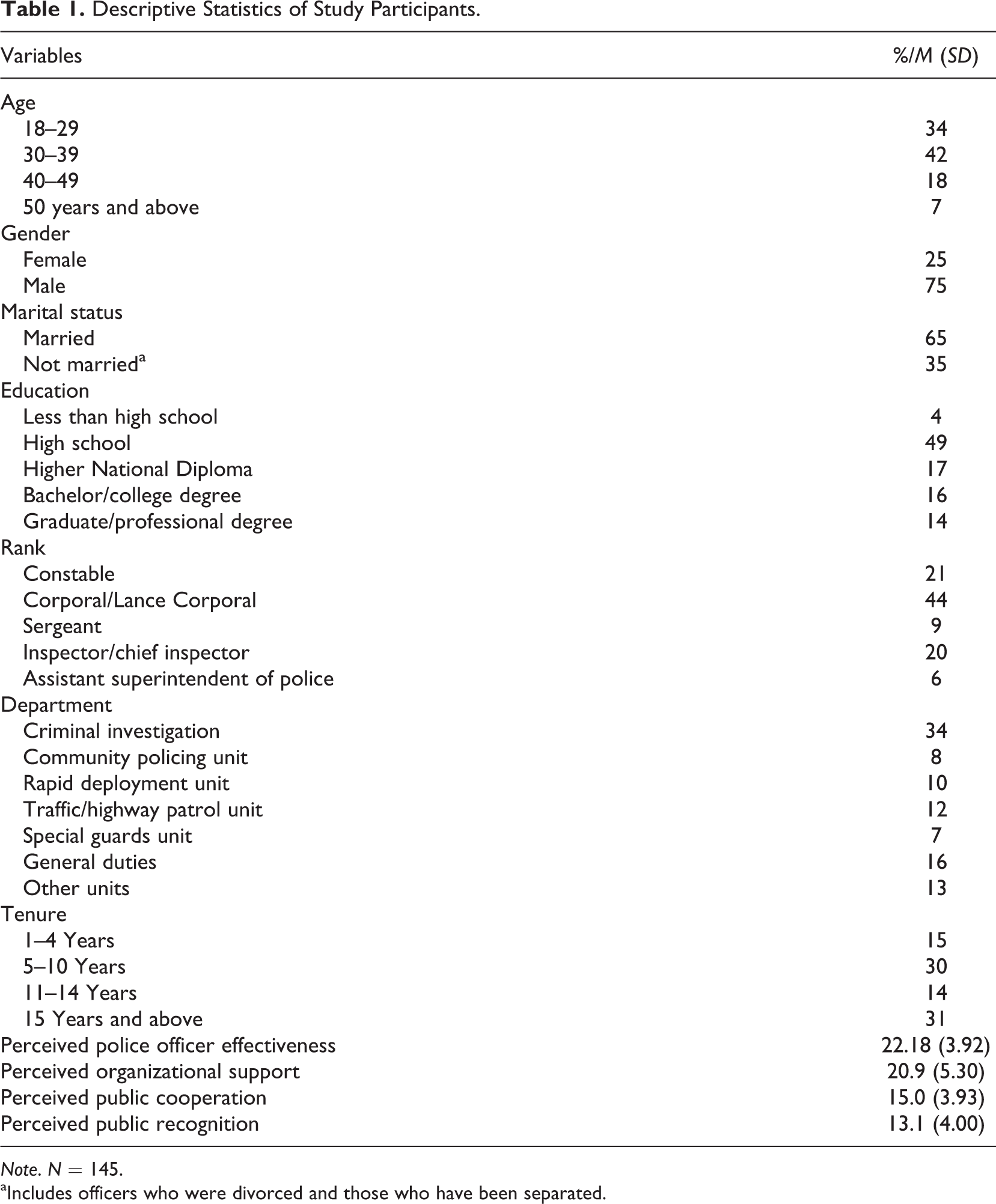
Two hundred police officers from the ranks of constable to superintendent were initially selected randomly to participate in the study; 145 of them filled out and returned their questionnaires, for a response rate of approximately 73%. The descriptive statistics of the sample (Table 1) are as follows: A majority of the officers (75%) were men between the ages of 30 and 39 (42%). In terms of marital status, 65% were married and 35% were not married. Regarding officers’ educational backgrounds, 49% possessed a high school education, followed by 17% with a Higher National Diploma qualification. 5 Forty-four percent of the officers were either corporals or lance corporals, 21% were constables, 20% were either inspectors or chief inspectors, 9% were sergeants, and 6% were assistant superintendents.
Descriptive Statistics of Study Participants.
Note. N = 145.
aIncludes officers who were divorced and those who have been separated.
Most of the officers (34%) worked in the criminal investigation department and had served for between 5 and 10 years (40%). It is worth mentioning that the gender and rank distributions of the study participants closely reflect official GPS statistics. According to the GPS Annual Report, approximately 79% of officers were male, and in terms of rank distribution, 30% were constables, 28% were corporals and lance corporals, 14% were sergeants, 10% were inspectors, and 2% were assistant superintendents (pp. 6–8). There was no available information on officers’ age, education, or marital status.
Measures
Dependent variable
Perceived officer effectiveness in crime control is the dependent variable of the present study. For years, researchers have argued that the traditional measures of police officers’ performance—reported crime rates, arrest rates, clearance rates, and response times—which worked well under the traditional model of policing, are not adequate measures of performance in today’s policing with its emphasis on community- and problem-oriented approaches (see Alpert & Moore, 1993; Kelling, 1992; Kennedy & Moore, 1995; Langworthy, 1999; Wilson, 1993). Measuring officers’ actual effectiveness sometimes can be tedious, especially when the police do not keep proper accounts of their activities. In Ghana, measuring officers’ actual effectiveness and drawing meaningful conclusions is not possible because of the lack of accurate official records. To avoid drawing invalid conclusions based on inaccurate records, the present study measured officers’ perceptions of effectiveness instead. Perception is of relevance because, more often than not, our behavior is a reflection of what we think or perceive. As a result, measuring officers’ perceptions of effectiveness will give us some insight into their actual effectiveness.
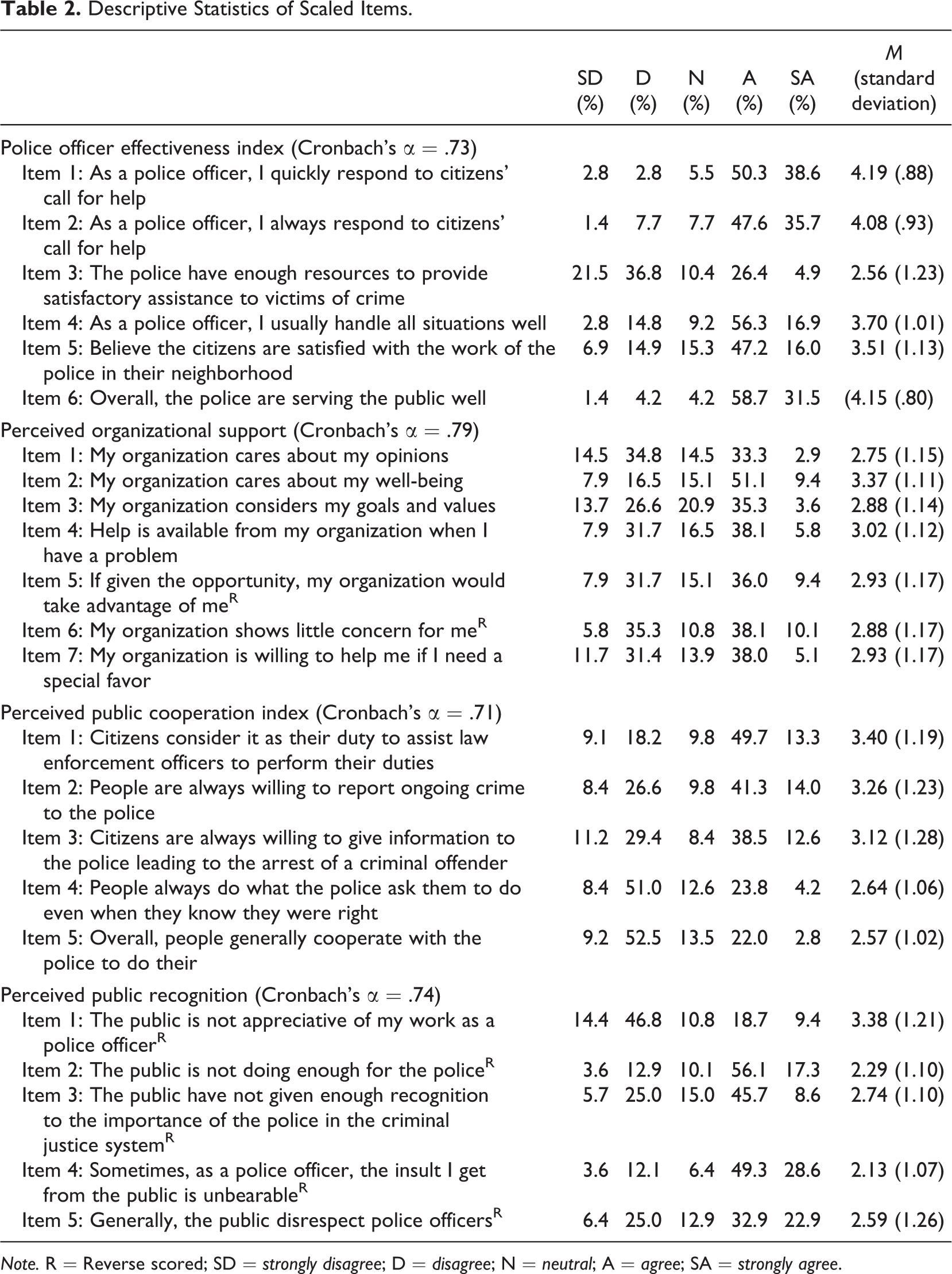
To measure perceived officer effectiveness, the present study adopted an effectiveness scale that has been tested and used by prior studies (Sunshine & Tyler, 2003; Tankebe, 2010a). 6 The scale included 6 items with an α coefficient of .73, and the factor loadings ranged from 0.51 to 0.77 (see Table 2 for details).
Descriptive Statistics of Scaled Items.
Note. R = Reverse scored; SD = strongly disagree; D = disagree; N = neutral; A = agree; SA = strongly agree.
Independent variable
POS 7 was the key independent predictor of the study. Measures were adopted from the short version of the survey of POS used by Eisenberger, Fasolo, and Davis-LaMastro (1990) to assess participants’ perception of organizational support. Prior studies that utilized the short version of the survey to measure participants’ evaluation of organizational actions that affect their well-being demonstrated a high internal consistency (Byrne & Hochwarter, 2008; Hutchison, 1997). These studies obtained α coefficients of .86 and above.
In this study, 8 items were initially used to measure officers’ perception of organizational support. However, after conducting a principal component factor analysis using a varimax rotation method, items with Eigenvalues greater than 1 were retained and summed to create the measure. Seven items (see Table 2 for details) loaded on the same factor with loadings ranging from 0.46 to 0.81. The POS scale was then constructed using these 7 items, and the assessment of internal consistency demonstrated sufficient effects, possessing an α coefficient of .79.
Control variables
Several variables have been found to influence police performance in prior studies. Therefore, in order to estimate the true effect of POS on the effectiveness of police crime control, it was necessary to account for the effects of some of those variables. Hence, the present study controls for the effects of predictors such as perceived public cooperation, perceived public recognition, and demographic characteristics of police officers.
Prior studies have documented that public cooperation has a significant influence on police effectiveness (Bradford, 2012; Tankebe, 2009). These studies have indicated that citizens’ willingness to supply information about crime and criminals in the community to law enforcement officers is crucial to the successful discharge of the police mandate. On the basis of these findings, the present study assumed that police officers who perceive the public to be cooperative will believe they are more effective at controlling crime on their assigned beats. To measure perceived public cooperation, 6 items were initially used; after conducting a principal component factor analysis using a varimax rotation method, 5 items that possessed Eigenvalues greater than 1 were retained and summed to create the perceived public cooperation scale (see Table 2 for details). The items’ factor loadings ranged from 0.61 to 0.82 and the α value of .71 demonstrated sufficient effect.
Similarly, public recognition has been found to have a significant effect on police effectiveness, and hence is worth controlling for. The degree to which police officers perceive that their efforts in maintaining law and order are recognized by the people they serve will determine the degree to which they perform their work. In this study, perceived public recognition was initially measured by 7 items modeled after Romzek’s (1985) public service recognition scale. However, after conducting a principal component factor analysis, 5 items loaded on the same construct with loadings ranging from .54 to .76 (see Table 2 for details). These items were summed to create the perceived public recognition scale with an α value of .71 demonstrating sufficient effect.
The effects of officers’ demographic characteristics—age, gender, marital status, education, rank, department, and tenure (number of years as a law enforcement officer)—were also controlled. Table 1 provides detailed information about how demographic characteristics were measured.
Analysis Plan
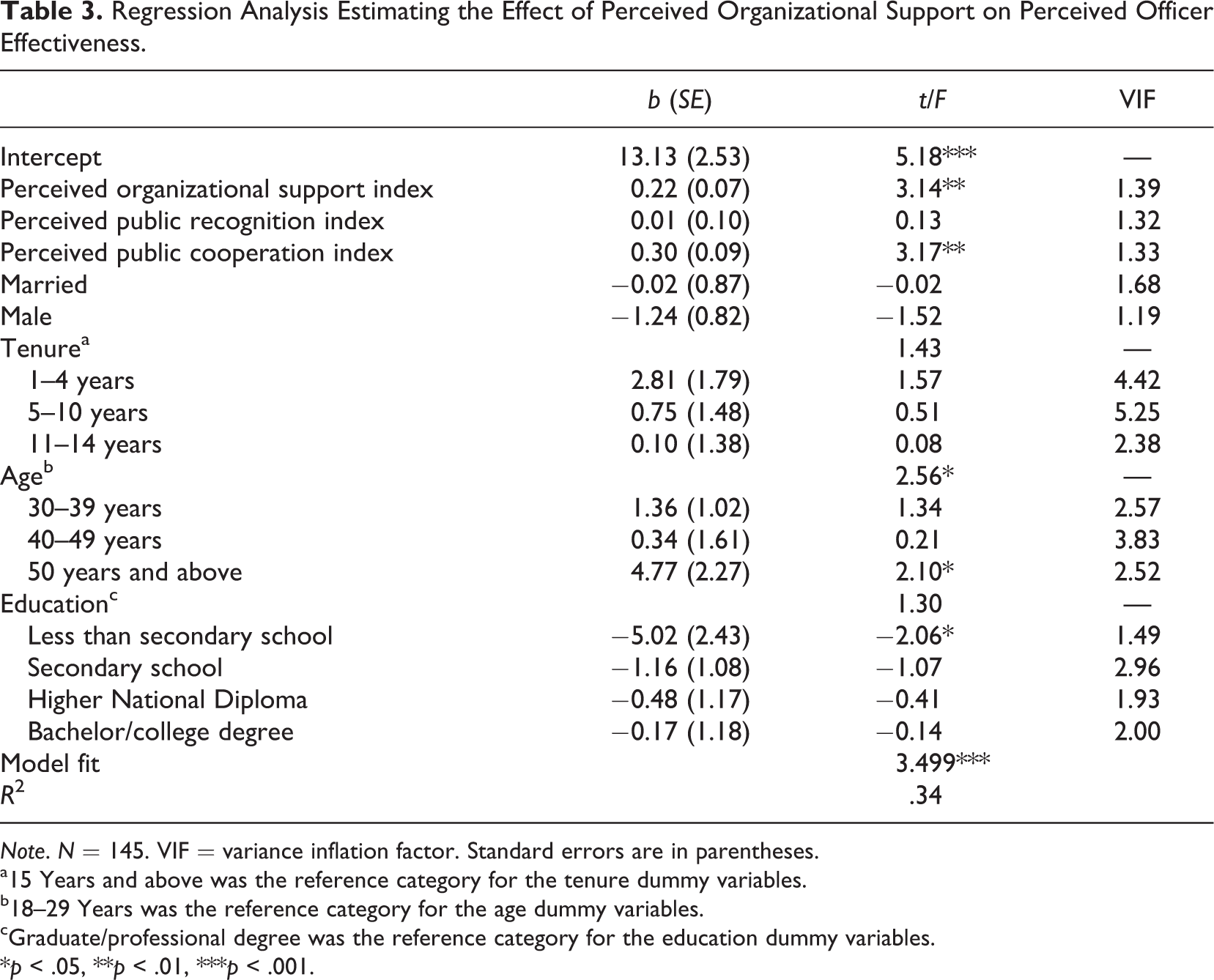
The analysis portion of this study has two sections. In the first section, the effect of POS on officers’ effectiveness is tested using regression techniques. Specifically, ordinary least square regression model was conducted to determine the relative impact of the independent variable on the dependent variable. According to Sunshine and Tyler (2003), regression analysis enables one to conclude that the impact of any significant variable in the model is independent of the impact of any other variable in the model. Therefore, since the aim was to examine the unique impact of POS on officers’ effectiveness net of control variables, conducting a regression analysis was the best option. Further, correlation analysis was conducted (results not reported) to find out whether there was any issue of multicollinearity. The results of the analysis indicated there was no concern for multicollinearity, since none of the predictors was strongly related to the other (r < .07). This was confirmed by the variance inflation factor (VIF) statistics presented in Table 3. In the second section, difference of means tests analysis was conducted to determine the effects of officers’ demographic characteristics on their perceptions of organizational support.
Regression Analysis Estimating the Effect of Perceived Organizational Support on Perceived Officer Effectiveness.
Note. N = 145. VIF = variance inflation factor. Standard errors are in parentheses.
a15 Years and above was the reference category for the tenure dummy variables.
b18–29 Years was the reference category for the age dummy variables.
cGraduate/professional degree was the reference category for the education dummy variables.
*p < .05, **p < .01, ***p < .001.
Results
Effect of POS on Officers’ Perception of Effectiveness
In this part of the analysis, an ordinary least square regression was conducted to examine the potential effect of POS on police officers’ perceptions of their effectiveness. The results of this analysis are presented in Table 3. The overall model fit was significant, F(15, 101) = 3.499, p < .001, and explains 34% of the variance in perceived police officer effectiveness. The table shows that the relationship between POS and perceived officer effectiveness is positive and statistically significant (t = 3.14, p < .01), holding other variables constant.
A slope coefficient of .22 indicates that a unit increase in perception of organizational support leads to a corresponding increase of .22 in perception of effectiveness. Among all the control variables examined in the model, only perceived public cooperation (t = 3.17, p < .01) and age (t = 2.56, p < .05) were found to have predictive effects on perception of effectiveness. The slope coefficient indicates that a unit increase in perceived public cooperation results in a .30 increase in perceived officer effectiveness. Compared to officers in the age range of 18–29, officers 50 years old and above were more likely to perceive themselves as being effective in controlling crime. Apart from the age variable, no other demographic variable was found to predict officers’ perception of effectiveness in controlling crime on their assigned beats.
Officers’ Demographic Characteristics and POS
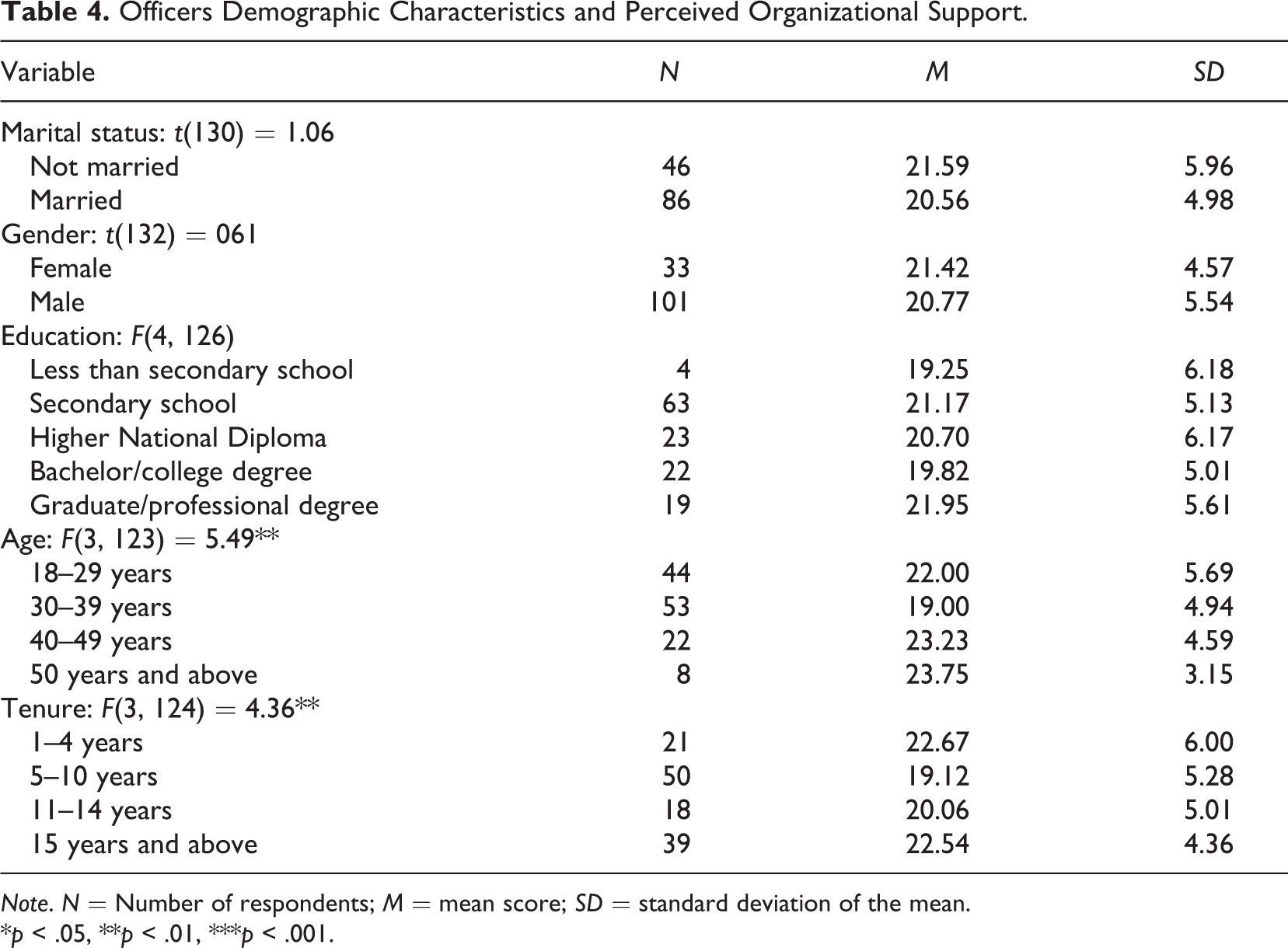
In this section of the analysis, a difference of means test was conducted to examine the effects of police officers’ demographic characteristics on POS. Table 4 presents the results of the difference of means test. From the table, it is clear that two of the demographic variables examined had a statistically significant relationship with POS. Age was significant, F(3, 123) = 5.49, p < .01, and, as expected, older officers (i.e., 50 years old and above, followed by officers between 40 and 49 years old) had the highest levels of perceived support. Similarly, tenure was statistically significant, F(3, 124) = 4.36, p < .01. However, contrary to the author’s expectation, short-tenured officers (i.e., officers with tenures of 1–4 years) had greater levels of perceived support than their long-tenured counterparts.
Officers Demographic Characteristics and Perceived Organizational Support.
Note. N = Number of respondents; M = mean score; SD = standard deviation of the mean.
*p < .05, **p < .01, ***p < .001.
Discussion
The present study used data collected from Ghana to first examine the influence of POS on police officers’ effectiveness in controlling crime, and second, examine the effect of officers’ demographic characteristics on their reported levels of POS. The findings obtained revealed two patterns in the Ghanaian context.
First, findings from this study support the general assumption that employees’ performance increases as their perceived level of organizational support increases (Armeli et al., 1998; Byrne & Hochwarter, 2008; Eisenberger et al., 1986, 1990, 2002; Rhoades & Eisenberger, 2002). According to Eisenberger et al. (1986), organizational support theory posits that employees develop global beliefs concerning the extent to which the organization values their contributions and cares about their well-being. Therefore, employees who are convinced beyond a doubt that their emotional and physical needs are catered to by the organization will model their behavior toward the fulfillment of organizational goals and philosophies. Moreover, it has been emphasized that employees’ perceptions of organizational support are increased by the receipt of praise and approval. Praise and approval are both important resources that can be used to shape employees’ attitudes and performance. In addition, Eisenberger et al. (1986) offered that giving employees material rewards such as pay, rank, and job enrichment will increase their perceptions of organizational support. An increased perception of organizational support, as noted earlier, undoubtedly results in positive work-related outcomes (Liu & Ding, 2012; Shoss et al., 2013; Tremblay et al., 2010; Wang & Hsieh, 2013).
Studies conducted in the Western countries have found a positive relationship between organizational performance outcomes in policing and officers’ perceptions of how much the police organization cares about their well-being and values their contributions as crime fighters and peacemakers (Armeli et al., 1998; Currie & Dollery, 2006; Gillet et al., 2013; Hochwarter et al., 2006; Parsons et al., 2011). Officers’ perceptions of the support they receive from the organization relate not only to their performance but also to their levels of commitment to the police organization (Currie & Dollery, 2006). For instance, a study conducted by Armeli, Eisenberger, Fasolo, and Lynch (1998) found that patrol officers’ performance increases as their perception of organizational support increases. Employee commitment generally implies a psychological state that (a) characterizes their employees’ relationship with the organization and (b) has implications for the decision to continue or discontinue membership in the organization (Meyer, Allen, & Smith, 1993, as cited in Currie & Dollery, 2006).
Interestingly, the findings of previous studies are supported by the findings from the Ghanaian sample. That is, the present study observed that Ghanaian police officers who believe that the organization is supportive and cares about their well-being will be more effective in performing their normal police duties of preserving lives and apprehending criminals. Hence, rendering support to the hypothesis that POS will positively influence police officers’ perception of effectiveness in controlling crime. This observation in Ghana is also consistent with social exchange theory (Blau, 1964), which is based on the supposition that the exchange of favors creates a sense of indebtedness on the part of the recipient to the donor. Therefore, the recipient remains in a state of indebtedness until the donor has been repaid in kind. This condition is what Gouldner (1960) refers to as the “norm of reciprocity” (p. 174). Relatedly, it has been well established that positive and beneficial actions directed at employees by the organization contribute to the establishment of high-quality exchange relationships that create obligation in positive ways (Moorman, Blakely, & Niehoff, 1998; Settoon, Bennett, & Liden, 1996). Therefore, when organizations spend money and time training and developing employees, the employees reciprocate through desirable work outcomes.
To relate this argument to policing in Ghana, two things can be deduced. First, police officers will view the GPS as supportive when they are rewarded beyond what is officially stated in their contracts. Such rewards could include fringe benefits, pay raises, decent accommodation, skill training, opportunity for higher education, and fulfillment of their socioemotional needs like caring and love. Second, according to the exchange relationship theory and the norm of reciprocity, the provision of this support will make officers feel indebted to the organization and reciprocate with good performance and effectiveness. As discussed in the Introduction section, the GPS continues to be criticized for poor performance and ineffectiveness; if the assumptions of the exchange relationship theory and the norm of reciprocity are true, we can conclude that the ineffectiveness of the police is due to the organization’s inability to meet their physical and emotional needs. This conclusion seems to support Marenin’s (2003) conclusion about ordinary officers in Ghana: [They are] treated as if they were servants rather than members of the same organization and feel themselves looked down upon by the higher-ups as uneducated ignorant pawns … [They] have no sense that the managers have much interest in their welfare but tend to look out for themselves, forcing lower ranks to be corrupt in order to support family and children. (as cited in Tankebe, 2010b, p. 80)
The findings of the present study have practical implications for the GPS. The study observed that the support officers receive from the organization positively impacts their perception of performance. Therefore, any discussions regarding improving police performance must not stop at building public support, but must extend to enhancing that support and providing managerial support to officers. As demonstrated by the present study, police officers will be effective when they consider the organization to be supportive. Hence, Ghana police administrators must adequately cater to their officers if they expect good performance. Apart from providing officers with types of support such as increased pay, accommodation, promotion, love, and care, programs that will promote higher education and skill development must be instituted. Moreover, once the programs are established, each officer must be given equal opportunity to benefit from them. This will avoid discriminatory treatment of officers and further ensure that officers of all ranks are treated fairly. At present, we may be tempted to assume that police officers in Ghana are ineffective in performing their duties due to a lack of support from the organization.
The present study, like most studies that utilize self-report measures to study the police, is not without limitations. An acknowledged limitation is the study’s relatively small sample size. Two reasons explain the study’s sample size. The first is limited resources and the limited feasibility of collecting a larger sample. The second reason relates to the natural attitude of police organizations toward research. Police organizations everywhere are skeptical regarding research conducted within the organization, and getting subjects to participate becomes a difficult task for the researcher. Another limitation worth noting was the fact that the study solicited views from officers, and the possibility that officers inflated their responses by reporting higher levels of effectiveness and organizational support cannot be ruled out, creating an error Gyeke and Salminen (2009) called social desirability bias. This type of error occurs when respondents tend to respond to questions in ways that will be considered by other people as favorable.
In conclusion, despite the aforementioned limitations, the present study and its findings make a significant contribution to the policing literature by testing a theory that has not received much attention in policing or in the African context.
Footnotes
Acknowledgment
This study would not have been possible without the supports from some individuals and organization. I am most grateful to the Ghana Police Service for granting me the permission to carry out the study. For the individual police officers who despite their busy schedules devoted unlimited time to participating in this study, I say a big thank-you. I would also like to thank Professor Otwin Marenin, Assistant Professor Zachary Hamilton (Washington State University), and Assistant Professor Justice Tankebe of the University of Cambridge, Institute of Criminology for their critical and wonderful comments on the earlier versions of this article.
Author’s Note
The viewpoints and opinions expressed herein are those of the author who accepts all responsibilities.
Declaration of Conflicting Interests
The author declared no potential conflicts of interest with respect to the research, authorship, and/or publication of this article.
Funding
The author received no financial support for the research, authorship, and/or publication of this article.