




Abstract
This study provides a first empirical test of the relationship between indicators of police performance and homicide rates in cross-national perspective. Results show that police performance indices are strongly associated with lower homicide rates, controlling for the levels of socioeconomic development, economic problems (poverty–inequality), democracy, and incarceration. They also show that police performance fully mediates the relationship between socioeconomic development and homicide. Thus, richer and more developed nations may have lower homicide rates because they have better police. Overall, results suggest that good policing matters for cross-national criminology, in addition to social and economic factors. Finally, the new police performance index is provided for future research.
Introduction
Most cross-national studies of homicide examine the effects of socioeconomic variables such as the level of development, inequality, and poverty (Koeppel, Rhineberger-Dunn, & Mack 2013; La Free, 1999; Messner, 2003; Nivette, 2011; Ouimet, 2012a). Surprisingly, there is limited cross-national research on the relationship between policing and homicide. Pridemore (2011) explicitly mentioned the need for policing research in cross-national criminology (p. 764). This lack of research is even more surprising, given the vast policing-crime literature within specific countries, particularly the United States (e.g., Braga, Papachristos, & Hureau, 2012; Cusson, 2010; Eck & Maguire, 2000; Weisburd & Eck, 2004). A possible explanation is the difficulty in finding empirical data to measure the quality or the performance of police across nations. In this study, I propose to examine plausible proxy indicators for police performance across nations and their relationships with the homicide rate.
More specifically, this study will first show that different proxy indicators of police performance are coherently related to each other and can be combined into a more general index. Van Dijk (2008) created one index of police performance that will be used in this study. A new index will also be created and compared with Van Dijk’s. Second, it will investigate whether the well-known negative correlation between socioeconomic development and homicide is partially or fully mediated by police performance: Perhaps countries with higher levels of socioeconomic development have lower homicide rate because they have the financial and institutional means to have better police. Third, it will assess whether the effect of police performance on homicide remains strong and statistically significant even when controlling for alternative explanations such as levels of economic problems (an index of poverty–inequality), democracy, and incarceration. These control variables are important because they should be correlated with both police performance and the homicide rate. For example, perhaps countries with higher police performance also incarcerate more offenders, and it is incarceration not policing that is associated with lower homicide. Before presenting these analyses, I briefly review the theories and evidence regarding the relationship between policing and homicide (and crime).
Literature Review: Policing and Homicide
Although common sense would suggest that professional, competent police can play a role in reducing homicide, criminologists must address two problems. First, the empirical literature shows that the relationship between policing and homicide is complicated and conditional. Second, the specific theoretical mechanisms linking policing and homicide are not clearly established.
Some criminologists are skeptical that the police influence the frequency of homicides. They argue that most studies on the number of police officers show inconsistent or null patterns (Bailey, 1994; Eck & Maguire, 2000) or that most homicides are impulsive acts committed during conflicts and that the police only intervene after the outcome (e.g., Gottfredson & Hirschi, 1990). Finally, more critical criminologists argue that the real causes of homicide are rooted in social inequalities and injustice, and that the police are merely agents of the status quo that ultimately may be contributing to the problem instead of helping to solve it (Colvin & Pauly, 1983; Quinney, 1974; Reiman, 1984).
In contrast, other criminologists are more optimistic about the impact of policing on homicide (Braga, 2005; Braga & Bond, 2008; Braga et al., 1999, 2012; Cusson, 2010, 2013; Weisburd & Eck, 2004). A first observation is that all national governments maintain police forces, even if it is well known that they have significant costs (Cusson, 2010). If one assumes that the police play no role in controlling violence, stopping dangerous individuals, and maintaining the safety of the public, then we would expect that some stable and progressive nations would reduce and ultimately abolish their police services and invest the savings in more useful institutions. Yet nobody is doing it: Stable, prosperous, and progressive nations all make massive investments in policing. How can this observation be explained? Perhaps these nations are carelessly headed the wrong way with their wasteful policing expenditures. Perhaps, as some critical criminologists believe, the police merely operate as an order maintenance institution that helps preserve existing social and economic arrangements and provides a reserve force for managing major disorders (Colvin & Pauly, 1983; Quinney, 1974; Reiman, 1984). Or, as I will hypothesize in this study, perhaps these nations realize that good policing does contribute to reducing violence and maintaining public safety and are worth the investment.
A second observation is that empirical studies published in the last 10–15 years found support for the idea that policing can have a real impact on homicide and violence; it is not the number of police officers that matters, but it is the quality of their interventions (Cusson, 2010, 2013; Eck & Maguire, 2000; Weisburd & Eck, 2004). For example, according to Weisburd and Eck (2004), general policing strategies are not very effective at reducing violence (e.g., the simple presence of patrol officers on the streets or the hiring of more officers by a city). In contrast, policing strategies that focus on precise targets and use diversified solutions to problems are more effective. These strategies include intense police interventions in violent “hot spots” that combine repressive and nonrepressive approaches. In his book L’Art de la Sécurité (The Art of Security), criminological theorist Maurice Cusson (2010) provides an historical analysis of successful policing intervention from past to present. French “Maréchaussée” (Marshals) drastically reduced the frequency of highway robberies during the enlightenment (Garnot, 2009; Lorgnier, 1994). Reduction in violence and theft was observed in Victorian England and was attributed by historians to improved policing activities (Gatrell, 1980; Philips, 1977). More recently, Braga (2005); Braga and Bond (2008); Braga et al. (1999); Braga, Papachristos, & Hureau (2012) provided convincing experimental evidence that problem-oriented policing is effective at reducing violence, and some studies also suggest that police “crackdown” can destabilize violent hotspots (Cusson & La Penna, 2007; Scott, 2003).
A third observation is based on countries where the police are very corrupted, because they provide a very instructive comparison group (vs. countries with professional, honest, and competent police). For example, Hartford (2005) argues that in countries with corrupted police, poorly paid police officers often behave like the criminals they are supposed to control. These officers spend very little time intercepting offenders or helping victims; rather, their main activity is to collect bribes from tourists and unlucky bystanders. Presumably, bribes from criminals are also welcome, in exchange for the police to look the other way. Thus, corrupted police not only contribute to theft by collecting bribes, but they also contribute to violence by not controlling violent criminals. One should not assume that low income is the only factor explaining police corruption, however, as other studies have analyzed the role of police culture, leadership, and individual differences to understand variation in police corruption (see Kane & White, 2009; Lee, Lim, Moore, & Kim, 2013; Parnaby & Leyden, 2011). Gerber and Mendelson (2008) use the term “predatory policing” to highlight a similar issue. They argue that the police become predatory when they use their authority and powers to promote their own financial interests instead of protecting society and controlling crime. They use Russian police as a case study for their argument, showing the negative influences of predatory policing on the Russian public.
In summary, there are different reasons to believe that police who are professional, well-paid, and competent can control and even reduce the frequency of homicides. There are also different reasons to believe that corrupted, underfunded, and predatory police are letting many people “getting away with murder,” so to speak. However, the specific theoretical mechanisms linking policing and homicide are not well developed in the criminological literature. A notable exception is the recent body of theoretical analysis by Cusson (2010, 2013). Although Cusson organized his propositions somewhat differently across these studies, they can be summarized as follows: Competent police will solve a high proportion of homicide cases, which will be known by most people. Most murderers will be punished and would-be murderers will think twice before acting. Competent police will also control incivilities, excessive drunkenness, conflictual behaviors, and some property crimes, which have a tendency to escalate toward more serious violence if left unchecked. Competent police will enforce firearm laws and weapon-carrying laws. Firearms and other weapons will be less available during conflicts, thus lowering homicide risks. Competent police will often organize successful interventions against violent hotspots and criminal gangs. When called before or during escalating conflicts, competent police will pacify the conflicts, separate protagonists, and provide protection to vulnerable victims. Competent police will use necessary force against very violent individuals. In the most extreme situations, they will use deadly force. Competent police will provide victims and their family with an alternative to violent retaliation, self-help, and personal vendettas. Thus, they will prevent escalating “blood feuds” where one act of retaliation leads to a series of them.
Although it is currently unknown which of the seven mechanisms are more important than the others, whether the effects of the mechanisms are additive or interactive, and why some police are more competent than others in the first place, Cusson’s theoretical framework provides a compelling and logical standpoint to examine the relationship between policing and homicide. In the current study, I propose a cross-national comparison between 77 countries.
The Current Study
There are many empirical studies on the relationship between policing and homicide within specific countries such as the United States or England (Cusson, 2010; Eck & Maguire, 2000; Weisburd & Eck, 2004). There are also some studies of policing in cross-national perspectives (e.g., Brodeur, 2010; Cao, Lai, & Zhao, 2012; Lemieux, 2010; Pino & Wiatrowski, 2006) but they tend to be more qualitative and sociohistorical, and importantly they do not focus on explaining variations in homicide. To my knowledge, there are no cross-national quantitative study based on a large sample of countries that examine the relationship between policing (i.e., police performance) and homicide rates. Until recently, such a study would have been impossible because of the absence of credible data to compare countries on the quality of their police. Fortunately, a book by criminologist Jan Van Dijk (2008) provides researchers with new data to assess the quality of policing across nations.
The goal of this study is to better understand the relationship between policing and homicide rates in cross-national perspective. More specifically, this study will (1) examine the coherence of different proxies of police performance. Strong and coherent correlation patterns would suggest that the proxies and indicators are valid, while weak and inconsistent patterns would suggest the opposite. (2) It will examine the correlations between two scales of police performance (Van Dijk’s scale and a new scale), the homicide rate, and other correlates of homicide (level of development, economic problems, democracy, and incarceration). (3) It will test whether the negative relationship between the level of development and the homicide rate is partially or fully mediated by the level of police performance. This mediation is theoretically expected because more developed nations have stronger governmental institutions in general (Przeworski, Alvarez, Cheibub, & Limongi, 2000) and possibly because they can generate more tax revenue to finance good police forces. (4) It will investigate whether the two scales of police performance are significant predictors of the homicide rate, controlling for all the covariates mentioned previously. The hypotheses for this study can be summarized as follows:
Method
Most cross-national data used in this study come from Van Dijk’s (2008) book The World of Crime. Additional data were collected from the Human Development Report (United Nations, 2011), The Economist’s Democracy index (see Kekik, 2007), and the World Prison Population List (Walmsley, 2007). The final sample includes 77 nations. This sample is based on a simple criterion: Nations must have available data on both the homicide rate and police performance. Like all cross-national criminological studies, nations with higher levels of development and democracy are more likely to be included in the sample, often because of lack of data for some developing nations or totalitarian regimes (Pare, 2006). Many developing nations are included in the sample, however (see Appendix).
The dependent variable is the homicide rate per 100,000 population. The rate is based on an average for 1998–2002 (as used in Van Dijk, 2008). Homicide data are available from the U.N. Office on Drugs and Crime (see Pridemore & Trent, 2010; Ouimet, 2012a; Shaw, Van Dijk, & Rhomberg, 2003, for a discussion of homicide data validity). Most data from U.N. Office on Drugs and Crime are the same as the World Health Organization data (Ouimet, 2012a; Van Dijk, 2008). Since the raw homicide rate has a strong log-normal distribution (many nations have low homicide rates and a few nations have very high rates), it is transformed with a log 10 function (a common practice in cross-national criminology and economic studies of homicide).
The independent variable is police performance. Unfortunately, there is no direct measure of police performance across nations. Therefore, a proxy method must be used. Van Dijk (2008) created an index of police performance based on five variables: (1) Citizens’ willingness to report crime to the police; (2) victims satisfaction toward police; (3) citizens’ general satisfaction toward police; (4) businesses’ perception that police can be trusted to enforce laws; and (5) a measure of homicide clearance. The index makes the assumption that in nations with more competent, professional police, people will be more likely to report crime, victims and the general public will be more satisfied, businesses will have greater trust that the police will be there to enforce the laws, and crime clearance will be higher. Van Dijk used data from different sources to create the police performance index. Citizens’ willingness to report crime to the police, victims’ satisfaction with the police, and citizens’ general satisfaction toward police are based on rates calculated from the International Crime Victims Surveys (ICVS, 1996, 2000, 2005). Businesses’ perception that police can be trusted to enforce laws is based on a survey of competitiveness from the World Economic Forum (2003, 2004) and countries are scored from 1 to 7, where 1 = the police is not reliable at all to 7 = we can always trust the police. The homicide clearance rate is calculated from the U.N. Office on Drugs and Crime 8th U.N. Crime Survey. However, a careful examination of this variable cast doubts on its validity. For example, the United States and Canada apparently score among the lowest on homicide clearance, with clearance rates around 20%. These numbers are highly suspicious. In addition, the definition of clearance varies across countries, and some countries probably misreport their real clearance rates. For that reason, although Van Dijk’s police performance index is used in this study, a new index is also created.
The new police performance index is based on four of the five variables from Van Dijk’s index (citizens’ willingness to report crime to the police; victims’ satisfaction toward police; citizens’ general satisfaction toward police; and businesses’ perception that police can be trusted to enforce laws) but replaces the homicide clearance rate with a measure of corruption. It is based on the ICVS question “During the last year, did agents of the state like custom agents, police officers or investigators asked you or indirectly suggested that you give them a bribe?” Although the question mentioned state agents more generally, police officers have been identified as the profession requesting the most bribes in countries with high corruption (Alvazzi del Frate & Van Kesteren, 2004; Van Dijk, 2008). A factor analysis is used to calculate the new police performance index (see Appendix for specific scores of nations).
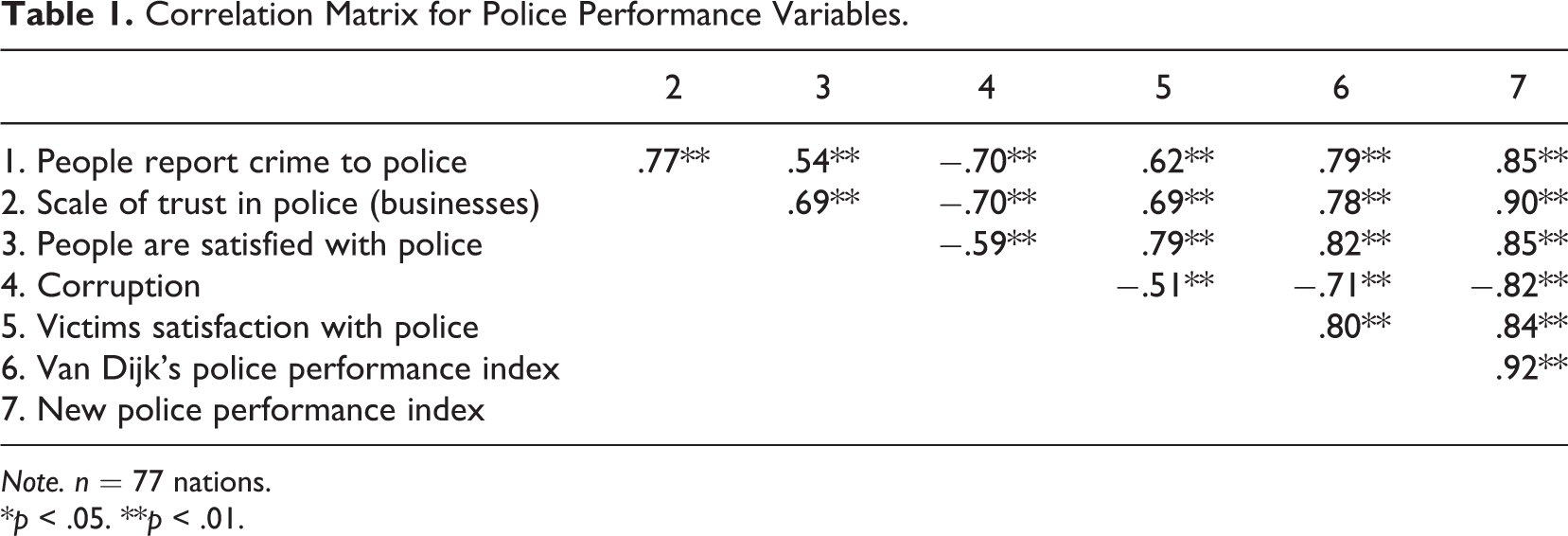
These two indicators of police performance are not without flaws. For example, it is likely that specific proxies are better predictors of the latent “police performance” variable while other proxies are weaker predictors. The indices are averages of these proxies. One might also argue that some proxies have alternative interpretations. Perhaps police corruption is a different theoretical concept than police performance. Perhaps trust in police is more generally related to trust in government and other nonpolice institutions. However, given the strong correlations between the proxies (see Table 1) and the fact that they all load on a single component in the factor analysis, the decision to combine them into an index seems reasonable. Finally, one might always argue that other proxies would have been useful in measuring police performance, including more direct proxies if they become available in future studies.
Correlation Matrix for Police Performance Variables.
Note. n = 77 nations.
*p < .05. **p < .01.
In order to estimate the effect of police performance on the homicide rate, it is important to take into account other cross-national differences that may influence the homicide rate and be correlated with police performance. The first covariate is the human development index from the United Nations (2002). This variable is commonly used in cross-national research (Nivette, 2011; Ouimet, 2012a; Pare, 2006) and provides an overall measure of socioeconomic development of nations based on average income adjusted for cost of living, access to education, adult illiteracy rate, and average life expectancy. The original scores are calculated between 0 and 1. I multiplied it by 100, to make a score similar to a percentage. For example, the score for Canada is 94, and the score from Zimbabwe is 49. Theoretically, the effect of development on homicide is sometimes interpreted as a “civilizing process” (Elias, 1982): More developed societies culturally promote nonviolence through education and other means, provide nonviolent legal mechanisms to solve conflicts, and punish violent individuals with severe sanctions. The second covariate is an index of economic problems, combining poverty (the infant mortality rate—see Pare, 2006, and Pridemore, 2008, 2011, for a discussion of the measurement of poverty with the infant mortality rate in cross-national studies) and income inequality (Gini) into a single measure. This index was created for three reasons. First, preliminary analysis showed multicollinearity issues when police performance, development, poverty, and inequality were included in the same model (variance inflation factor [VIF] above 10). The VIF score falls below 5 when poverty and inequality are combined together, an acceptable level. Second, a factor analysis showed that poverty and inequality load on a single factor, with strong factor loadings of .90. Thus, nations with high inequality have high poverty and vice versa (see Pare, 2006, for a detailed analysis of why nations with high inequality have a large proportion of their population living in absolute poverty). Third, the goal of this study is to focus on the impact of policing on homicide, and the recent poverty versus inequality debate (Messner, Raffalovich, & Sutton, 2010; Ouimet, 2012a; Pare, 2006; Pridemore, 2008, 2011; Wilkinson & Pickett, 2009) is a distraction from this goal. Thus, the economic problems index efficiently controls for the levels of poverty and inequality of nations. The index has scores between −1.56 and 2.34. Nations with low scores include the Czech Republic, Iceland, and Japan. Nations with high scores include Zimbabwe, Bolivia, and South Africa (see Appendix). Theoretically, scholars who argue that income inequality is criminogenic often implicitly or explicitly rely on argument involving either frustration (Agnew, 1999; Brush, 1996; Wilkinson, 2004) or anomie (Merton, 1938; Messner & Rosenfeld, 1997). Those who argue that poverty is criminogenic often rely on cultural explanations (Anderson, 1999; Wolfgang & Ferracuti, 1967), social disorganization or low collective efficacy in poor communities (Bursik, 1988; Sampson, Raudenbush, & Earls, 1997), or self-help due to limited access to the law to address grievances (Black, 1983).
The third covariate is an index of democracy and political freedom from The Economist (Kekik, 2007). This index is based on 60 variables related to freedom and fairness of election and the political process, separation of power between government branches, freedom of the media, and so on. The index provides scores between 1 and 10. Nations with low scores include Saudi Arabia, Cote d’Ivoire, and Azerbaijan. Nations with high scores include Iceland, Sweden, and New Zealand. Many studies suggest transitional states and emerging democracies face more problems with policing activities, institutions, and reforms (Brogden, 2005; Brogden & Nijhar, 2005; Pino & Wiatrowski, 2006; Shearing, 1997). It may also be that in less democratic nations, the police serve the interests of a military regime or power elite instead of those of regular citizens (Brodeur, 2010). Thus, it is likely that more democratic nations have more competent police (and less corrupted) and it is important to control for the level of democracy when assessing the impact of policing on homicide.
The last covariate is the incarceration rate. This variable is important because the impact of policing could be spurious once incarceration is taken into account. Incarceration rates are measured with the World Prison Population List (Walmsley, 2007), provided by the International Centre for Prison Studies at King’s College of London. Interestingly, the relationship between incarceration and homicide could be bidirectional (Bernard, Paoline III, & Pare, 2005). On one hand, incarceration could lead to lower homicide through deterrence (Stafford & Warr, 1993; Ward, Stafford, & Gray, 2006). On the other hand, high levels of homicide could lead to higher incarceration if nations are successful at sanctioning murderers (Ouimet, 2012b). It may also be that homicide is correlated with a variety of other crimes (e.g., high violence and high drug trafficking) and that some nations incarcerate more criminals in general. Whatever scenario is the leading explanation, it is important to test whether the impact of policing on homicide remains significant once levels of incarceration are controlled for.
The analyses presented in this study are based on correlations and ordinary least square regressions. Two confirmatory factor analyses were used to create the new police performance index and the economic problems index. Missing data were handled with SPSS Expectation-Maximization technique, which provides predicted values for missing cases via a maximum-likelihood estimator and adds random noise to the values to avoid overfitting. There is one missing value for the infant mortality rate and three for the Gini. There are more missing values on the variables included in the police performance index, but because it is an index based on five variables, it was easy to estimate adequate levels for the overall index based on the available data and the Maximization-Expectation technique. On average, 3.3/5 variables were available per nation to estimate the new police performance index. In addition, the correlation between the new police performance index and Van Dijk’s police performance index is .92 (see Results section), suggesting that the two variables are adequately measuring the same concept.
Results
A preliminary step before the main analysis is to examine the correlations between the proxies and the indices of police performance. Table 1 shows very coherent correlation patterns between all the variables. The strong correlations indicate that some nations tend to have more people reporting crime to police, more confidence in police from businesses, more satisfaction in police from the general public and from victims, less police corruption, and high scores on Van Dijk’s and the new police performance indices. Some nations also tend to experience the opposite. Van Dijk’s index is correlated in the .70–.80 range with all police performance proxies (reversed for corruption). The new index is correlated in the .80–.90 range with the same proxies. Finally, Van Dijk’s and the new police performance indices are correlated at .92, suggesting that they are measuring the concept. Overall, these patterns lend credibility to the idea that police performance can be assessed cross-nationally with proxy variables. It is impressive that data from different sources, on different aspects of policing, are so coherently correlated with each other.
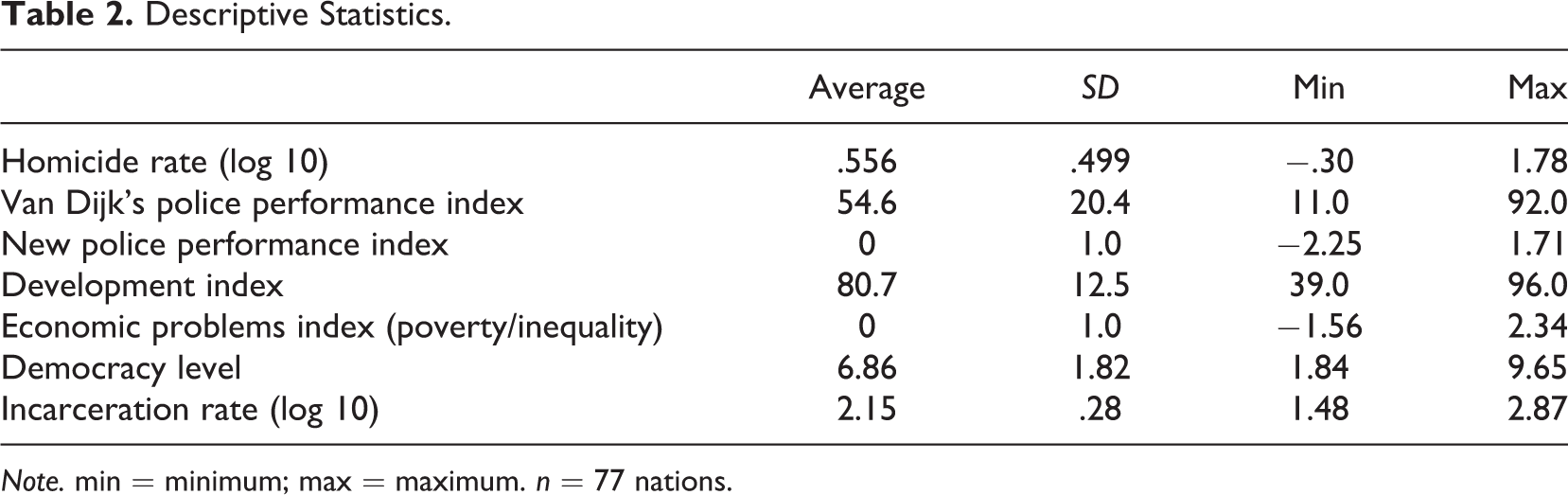
Descriptive statistics for the main analysis are presented in Table 2. The homicide rate (log 10) has an average of .556 and vary between −.30 (Morocco, homicide rate of 0.5 per 100,000) and 1.78 (Colombia, homicide rate of 60.5 per 100,000). The two police performance indices are based on different metric. Van Dijk’s scores are similar to percentages, with an average of 54.6, a minimum of 11 and a maximum of 92. The new police performance index is based on a factor analysis and has mean of 0 and a standard deviation of 1. A positive score indicates that a nation has better-than-average police, and a negative score indicates the opposite. A similar logic applies to the economic problems index: A positive score indicates higher levels of poverty and inequality and a negative score indicates lower levels. The incarceration rate (log 10) has an average of 2.15 and varies between 1.48 (India, incarceration rate of 30 per 100,000) and 2.87 (United States, incarceration rate of 738 per 100,000).
Descriptive Statistics.
Note. min = minimum; max = maximum. n = 77 nations.
Correlations between the homicide rate, police performance indices, and the control variables are presented in Table 3. All variables are correlated with the homicide rate. Nations with higher levels of police performance (r = −.67; p < .01 for Van Dijk’s index; r = −.72; p < .01 for the new index), socioeconomic development (r = −.48; p <.01), and democracy (r = −.28; p < .05) tend to have lower homicide rates, while nations with higher levels of economic problems (r = .62; p < .01) and incarceration (r = .38; p <.01) tend to have higher homicide rates. In addition, nations with higher levels of socioeconomic development and democracy, and lower levels of economic problems tend to have higher levels of police performance (the same patterns for Van Dijk’s and the new indices). Interestingly, police performance and incarceration rates are not correlated. Thus, good policing does not necessarily lead to increased incarceration.
Correlation Matrix for Homicide Analysis.

Note. n = 77 nations.
*p < .05. **p < .01.
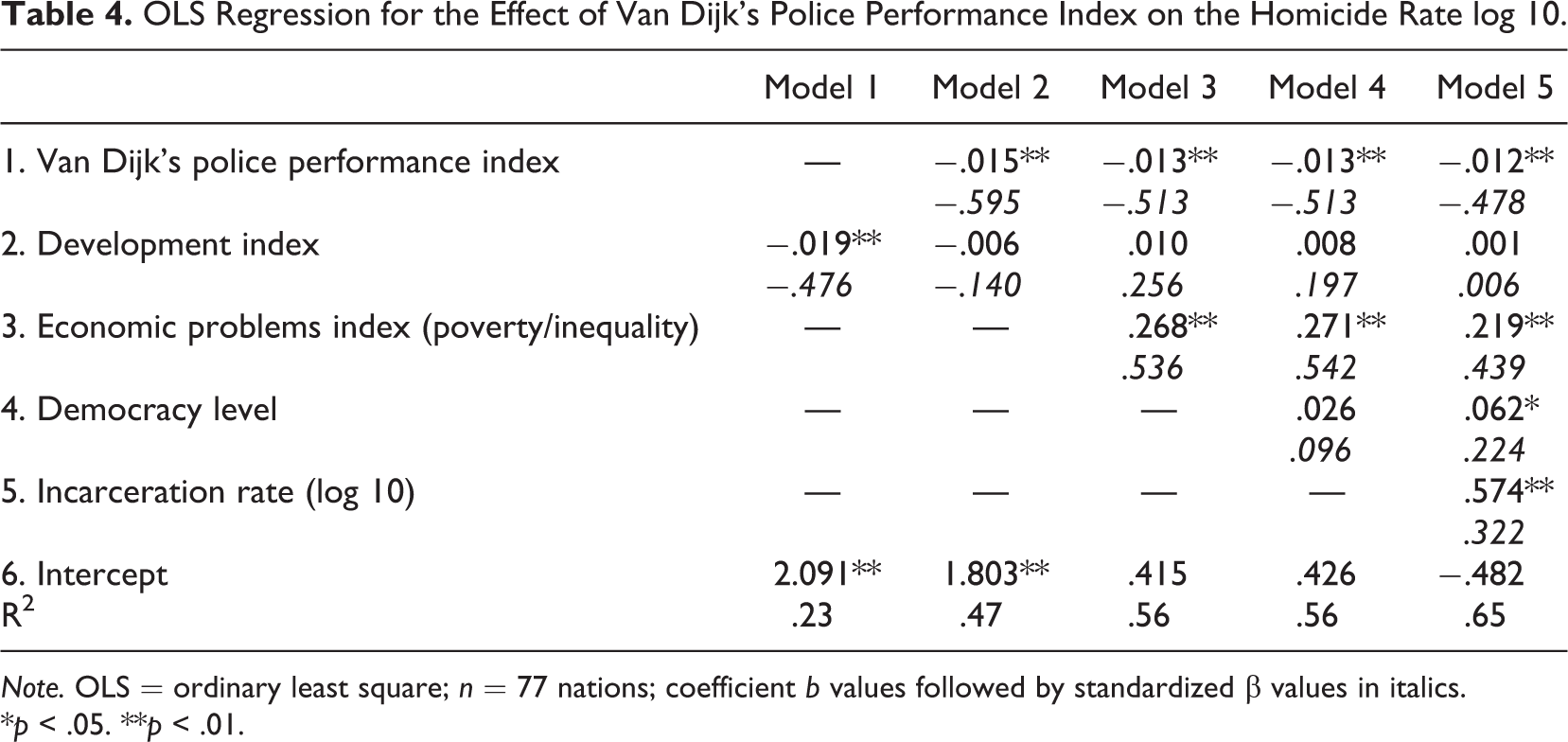
Results from multivariate regression models are presented in Tables 4 and 5. The two tables are very similar: Table 4 is based on Van Dijk’s police performance index as the main independent variable and Table 5 is based on the new police performance index instead. Results are strikingly similar between the two tables, but the patterns are somewhat stronger (as measured with the R 2 ) with the new police performance index. This suggests that replacing the clearance rate with a proxy for police corruption did improve the measurement of police performance.
OLS Regression for the Effect of Van Dijk’s Police Performance Index on the Homicide Rate log 10.
Note. OLS = ordinary least square; n = 77 nations; coefficient b values followed by standardized β values in italics.
*p < .05. **p < .01.
OLS Regression for the Effect of a New Police Performance Index on the Homicide Rate log 10.

Note. OLS = ordinary least square; n = 77 nations; coefficient b values followed by standardized β values in italics.
*p < .05. **p < .01.
Models 1 and 2 in Tables 4 and 5 show the mediating effect of police performance on the relationship between socioeconomic development and homicide. Results consistently indicate that the significant negative relationship between socioeconomic development and homicide (Model 1) is fully mediated when police performance is taken into account (Model 2). Thus, an important reason why richer, more developed nations tend to have lower homicide rates is that they have better police. In Models 3–5, the negative relationship between police performance and homicide is tested by adding relevant control variables. Even when controlling for economic problems (poverty/inequality), level of democracy, and incarceration rate, the relationship between police performance and homicide remains strong and significant for both policing indices. In addition, Model 5 in Tables 4 and 5 indicates that police performance is the strongest predictor of homicide among all the variables (see standardized β values in italics).
The control variables also explain variations in homicide rates, however. The index of economic problems is strongly associated with higher homicide rates in Tables 4 and 5. There is also a small positive effect of the level of democracy on homicide, suggesting that controlling for other factors, there might be a small criminogenic cost to greater freedom and liberties (vs. repressive regimes). It must be noted, however, that the correlation in Table 3 between democracy and homicide was negative. Thus, this result should be interpreted with caution, as the direction of the effect seems unstable. Finally, the incarceration rate is associated with higher homicide. It is possible that high incarceration is itself criminogenic, as suggested by Labeling theorists and others (Cullen & Jonson, 2014; Cullen et al., 2011; Maruna, 2011), or perhaps the relationship is bidirectional and high rates of homicide and other violence also encourage some nations to incarcerate more (Ouimet, 2012b).
Discussion
The general goal of this study was to examine the relationships between indicators of police performance and homicide rate from a cross-national perspective. The main conclusion is that good policing matters, above and beyond the effects of other covariates. This main conclusion is in line with Cusson’s (2010, 2013) theory presented earlier regarding the role of the police in reducing violence. Because this study is cross-national, based on countries as units of analysis, it is only possible to test Cusson’s general hypothesis that a good, competent police should play an important role in lowering rates of violence. It is not possible to test the seven specific hypotheses related to the mechanisms regarding police behaviors during specific events, such as the role of the police in mediating conflicts, enforcing firearm laws, dismantling criminogenic “hotspots,” or protecting vulnerable victims. Cusson’s general hypothesis was also used to generate four hypotheses that were tested in this study. These four hypotheses will now be discussed subsequently in more detail.
Hypothesis 1. Proxies and indicators of police performance will be strongly and coherently associated with each other. The first hypothesis is supported. Correlations between proxies such as crime reporting to police, satisfaction with police, businesses trust in police, and police corruption were all strongly and coherently correlated with each other. They were also strongly and coherently correlated with the two indices of police performance. The two indices of police performance shared a .92 correlation, suggesting that they are capturing the concept. This first hypothesis is important for the study as a whole: Weak or contradictory correlations between the proxies would have cast serious doubts on the validity of the data and the possibility of creating police performance indices.
Hypothesis 2. The two scales of police performance will be strongly and negatively correlated with the homicide rate. The second hypothesis is supported. Van Dijk’s police performance index is correlated at −.67 with the homicide rate. The new police performance index is correlated at −.72 with the homicide rate, a small improvement. Overall, these two variables are the strongest correlates of the homicide rate in the study. This suggests that indices of police performance should be an additional variable of interest for cross-national criminologists.
Hypothesis 3. The negative relationship between the level of development and the homicide rate will be mediated by the level of police performance. The third hypothesis is supported. It is fairly well known that richer, more developed nations tend to have lower homicide rates, at least in terms of bivariate relationship. The reasons why are less clear. In the past, scholars have often tried to explain the relationship with theories based on poverty, inequality, or the demographic structure of the population (e.g., more young males in developing nations). Results of this study suggest an alternative explanation: Richer, more developed nations have the financial and institutional means to support more professional, competent police, which in turn helps to maintain low homicide rates.
Hypothesis 4. The level of police performance will be a significant predictor of the homicide rate, above and beyond the effects of development, economic problems (poverty–inequality), democracy, and incarceration. The last hypothesis is also supported. Although it is fairly easy to believe that indices of police performance can be correlated with homicide rates across nations, is the effect robust when alternative explanations of homicide are taken into account? Perhaps nations with better police also have less economic problems, or maybe they incarcerate more offenders? Results indicate that both Van Dijk’s and the new police performance indices are strong and significant predictors of lower homicide rates, even when controlling for these alternative explanations. In addition, both these indices are the strongest predictors in the full models, even if economic problems (poverty–inequality) and incarceration are also strong predictors.
Why is the policing effect so strong, when many prior policing studies have shown mixed or inconclusive results? Two possible explanations come to mind. First, many prior studies focused on the number of police officers per capita in different neighborhoods or cities. However, many policing scholars now believe that it is the quality of policing instead of the number of officers that is the crucial element (Braga, 2005; Cusson, 2010, 2013; Eck & Meguire, 2000; Weisburd & Eck, 2004). Second, cross-national data provide much more variation in policing quality than analyses within single nations. For example, there is more variation between policing in France and policing in Mexico than there is difference between American policing in New York City and Boston. Larger variations in policing performance allow for a better test of its effect on homicide rates. Thus, results of this study support the idea that police who are professional, competent, and honest play a major role in the control and reduction of homicide. They also cast doubts on the argument by some scholars that police are powerless against homicide or that they contribute to the problem. Police contribute to the problem when they are underpaid, predatory, and corrupted (Gerber & Mendelson, 2008; Hartford, 2005).
Another question emerging from this study is why do nations vary in their levels of police performance? Although providing a full answer is not the goal of this study, the correlations presented in Table 3 can be instructive. First, the level of development is positively associated with police performance. Presumably, industrialized nations with more prosperous economies have more resources to invest in their police forces and can require higher standards from their employees. They can also provide better remuneration, thus reducing the risks of corruption. Following a similar logic, nations with greater economic problems like high levels of inequality and poverty tend to have lower levels of police performance. This could be interpreted in different ways. At the individual level, perhaps police officers themselves are more likely to be poor, which could be associated with lower educational opportunities and more temptation from corruption. At the structural level, it is likely that governments in nations with high levels of inequality and poverty do not generate enough revenues from taxation to support very performant police forces. Finally, the level of democracy is positively associated with police performance. This correlation is in line with studies by Brogden (2005), Brogden and Nijhar (2005), Pino and Wiatrowski (2006), and Shearing (1997), highlighting the difficulties of policing transitional states and emerging democracies.
Limitations
Some limitations of this study must be acknowledged. First, to my knowledge, there is no direct variable measuring police performance for cross-national analysis. Therefore, indirect proxies like police satisfaction surveys or perception of corruption must be used to approximate the levels of police performance of nations. These proxies are imperfect, and more direct measures of police performance would be useful. One might also argue that some proxies could be interpreted not necessarily as police performance but instead as alternative explanations, such as trust in government and other nonpolice institutions, or levels of corruption in society more generally. However, high and coherent correlations suggest that the current proxy measures of police performance are valid. Another limitation is the choice of control variables. It is possible, like any study based on nonexperimental surveys, that other control variables not included in this study might weaken the impact of police performance on homicide. The results are strong as or stronger than those of many previous cross-national studies on other topics, however. Future research will tell whether police performance indices can resist more falsification attempts in different models with different control variables. Also, because the study is based on a macro, cross-national approach, it is not possible to examine the specific mechanisms explaining why the police affect homicide, such as the seven explanations provided by Cusson (2010, 2013). These mechanisms should be studied with microlevel analyses, in which the behaviors of police officers and police organizations can be compared. Finally, one must be careful about the political implications of the study. The main implication is not to promote the overpolicing of society. Instead, it is to recognize that a competent, professional police play a significant role in controlling and reducing homicide, an important function in any society.
In conclusion, this study provides a first test of the relationship between police performance and homicide across nations. The study indicates that good policing matters. Competent, professional police help to keep the public safe and control homicide. Corrupted, incompetent police who spend their time chasing bribes are literally letting offenders “getting away with murder.”
Footnotes
Appendix
List of Nations With New Police Performance Index and Economic Problems Index.
Declaration of Conflicting Interests
The authors declared no potential conflicts of interest with respect to the research, authorship, and/or publication of this article.
Funding
The authors received no financial support for the research, authorship, and/or publication of this article.