



Abstract
Public safety consolidation of police and fire departments has long existed, but there are no quantitative measures of its implementation. Previous research has suggested a typology ranging from nominal to full consolidation. Our research explores how public safety departments may vary by both command consolidation and cross-training of personnel. Considering both these dimensions is essential to measuring the form and extent of implementation of this service model. To develop a scale for consolidation, we surveyed all known U.S. public safety departments, asking each about its services, administrative structure, and training requirements. Altogether, 74 of the 130 (57%) departments we were able to identify responded to a mail survey with phone follow-up, providing us information on their levels of structural integration and cross-training, among other characteristics. The results showed both some concentration at lower and higher levels of measured consolidation as well as some variation among departments with identical scores. Although our research is limited by a relatively small number of departments, preventing development of more sophisticated measures, use of this additive scale can still yield insights on what influences consolidation, the problems consolidation may ameliorate or produce, and operational characteristics by extent of consolidation.
Public safety consolidation of police and fire departments into a single organization has long existed. In the United States, consolidation of police and fire services into a single department dates back more than a century to when Grosse Pointe Shores, MI, created the first public safety department (Matarese, Chelst, Fisher-Stewart, & Pearsall, 2007). Outside the United States, some even trace the model to ancient Rome and note its use in the early 20th century in Germany, Japan, and the United Kingdom (International Association of Firefighters and International Association of Fire Chiefs, n.d.; Morley & Hadley, 2013). More recently, the model has also been used in Canada (Rosen, 2010) and again in the United Kingdom, where communities have turned to it to increase efficiencies and free public funds for other purposes (Cameron, 2015; Lloyd, 2014).
Previous research (e.g., Lynch & Lord, 1979; More, 1970) has suggested that public safety departments may be classified as nominal, partial, or full. Yet there has been no empirical examination of this or other options for categorizing or measuring this form of consolidation. A valid index measure of public safety consolidation would provide at least four major benefits.
First, a measure of consolidation would help illustrate the extent of variation in the implementation of the model. It would be useful to know whether the range of consolidation is small or large. Likewise, knowing if consolidated departments tend to cluster around certain types of implementation or along a continuum would be helpful.
The second benefit of an index measure of consolidation would be the ability to identify with greater sensitivity what influences its implementation. For example, the measure could help show whether and how community and department characteristics affect consolidation. Previous case-study analyses (Wilson & Grammich, 2015, 2017a) have found mixed evidence on how environmental capacity, that is, the ability of police organizations to act independently of third-party organizations (Maguire, 2003), affects consolidation. Such analyses have also found mixed evidence on how community change, such as that resulting from population growth, affects consolidation. Moreover, while it is generally accepted that resource constraints are a primary motivation for communities to consolidate their public safety services, little is known about whether economic issues affect adoption solely or the actual type or level of implementation. A measure of consolidation could better illustrate the relationship between community resources and consolidation.
Third, an index measure of consolidation may also enable deeper analyses of how the internal features of consolidated public safety departments affect the extent of consolidation. Better measuring the form and extent of consolidation can help in assessing whether broader tasks and scopes determine the type or increase the extent of consolidation. This may be particularly true if nonroutine technologies are associated with organic structures and processes (Perrow, 1967) and if nonroutine tasks are likely to lead to consolidation of departments with personnel able to perform multiple tasks.
The fourth benefit of more nuanced and sensitive measures of public safety consolidation is that they can facilitate assessments of its effects. Critical questions exist regarding how the form of service delivery affects organizational performance relative to a variety of outcome metrics including crime control, quality and comprehensiveness of service, community policing, and, of course, the cost of service delivery. Such analyses have import for both practitioners and policy makers considering or implementing consolidation and for scholars developing the science of public safety organizations.
Previous case studies of consolidation help illustrate the contours of public safety consolidation, but using a very small number of cases makes it difficult to determine its overall variation and the causes and effects of this variation. In particular, using a very small number of cases makes it difficult to control for spurious or confounding variables (Goggin, 1986). Empirical analyses can focus more precisely on elements of implementation (Meier, 1999).
This work seeks to develop a scale measure of public safety consolidation. After reviewing relevant past research on public safety consolidation and types of implementation, this article explores findings from a recent survey of existing consolidated departments in the United States. It identifies measures that can be derived from these data and discusses future research goals, both in assessing the types and extent of implementation of public safety consolidation and in future improvements to assessing it.
Literature Review
Public Safety Consolidation in the United States
Public safety consolidation may be viewed within the broader context of research on public service consolidation. Whether larger jurisdictions can provide better quality of services, particularly police and fire, is often assumed, though evidence is also often lacking (Ostrom, Parks, & Whitaker, 1973). Indeed, public administration can be more efficient in metropolitan areas more fragmented by governments (Parks & Oakerson, 1989). Comparative analyses of metropolitan areas have also found those with more unified government services do not necessarily feature greater political efficacy or satisfaction of services (Lyons & Lowery, 1989).
One possible reason for this is the greater internal transaction costs that occur within larger governmental organizations (Brierly, 2016). Contact transition costs can increase in particular for police and fire services, where administration may be centralized but municipalities still need to maintain contact points (e.g., stations) throughout their jurisdiction. At the same time, jurisdictions may need to consider a trade-off between scale and coordination of services. And communities with higher demands for services may bear higher costs for supporting them. Indeed, some have suggested that communities can better fulfill new homeland security duties through consolidated police and fire agencies (Mata, 2010; Matarese et al., 2007). And residents of one affluent community support higher costs for public safety consolidation, so that as one of its leaders said, “somebody who arrives at [a resident’s] door in two minutes knows what to do regardless of the situation” (Wilson & Grammich, 2017a).
The earliest research on public safety consolidation focused on its appeal among smaller communities seeking efficiency and cost effectiveness and to capitalize on existing volunteer safety programs (Ayres, 1957). While communities integrated police and fire services to offer fire services to fast-growing communities, minimize work hours and personnel costs, and provide service to annexed areas, opposition arose among labor unions contending consolidation would lead to service inadequacies (Wall, 1961). City managers were most supportive of consolidation and fire chiefs least supportive, with police chiefs between these two groups in their support (Bernitt, 1962).
Interest in the model intensified as citizens demanded more and better services without tax increases (Berenbaum, 1977; Lloyd, 2014). Advocates for consolidation sought to (1) develop a public safety “culture” beyond cross-training officers and (2) convert fire stations into public safety stations. An assessment of public safety consolidation in North Carolina found advantages of the model included more contact with the public, better response, better career opportunities, and cost effectiveness, but disadvantages included dual supervision, conflicting opinions over flexibility, preferences among officers for police rather than fire work, and perceptions that public safety promotion opportunities were limited (Lynch & Lord, 1979).
While the number of consolidated departments continues to grow, the number of deconsolidated departments has also grown. Commonly cited objections to public safety consolidation include the views that police and fire work differ too much for any one person to do both well, extensive training requirements, and inapplicability to larger jurisdictions (Farr & Daniel, 1988). A survey of public safety directors found that firefighters were most opposed to consolidation but that police personnel also objected to it when they perceived it threatened their individual positions (Crank & Alexander, 1990). The survey also found opposition was greatest in departments that had not fully consolidated (e.g., departments which had separate fire and police management structures) in part because of ambiguous lines of authority.
A recent case-study analysis (Wilson & Grammich, 2017a) found communities persisting in consolidation doing so for reasons ranging from those stemming from contingency theories linking the behavior of organizations to their task environments (Donaldson, 1995; Maguire, 2003) to those stemming from institutional theories linking the behavior of organizations to foundational “myths” or standards of sanctioning organizations (Crank & Langworthy, 1992; Meyer & Rowan, 1977). One consolidated department, for example, originated in response to a city budget crisis and has continued to provide services for fewer resources than separate police and fire departments had. Another has taken care to develop a public safety culture among its recruits, ensuring they can fulfill any police, fire, or emergency medical service needed at any given time in its jurisdiction and to the standards of national sanctioning bodies, even if doing so at a higher cost than its neighbors incur in providing separate police and fire services.
At the same time, a recent case-study analysis of deconsolidated communities (Wilson & Grammich, 2015) found other departments deconsolidating for reasons that could be linked to both contingency and institutional theories. Most of the deconsolidation communities had consolidated to meet a community need (e.g., to improve fire coverage or to provide better response times) yet ultimately deconsolidated in response to changing tasks (such as those calling for more specialization) or institutional influences (such as firefighters seeking more institutional support).
This work seeks a measure of consolidation implementation for public safety departments. Such a measure might subsequently help identify what influences communities to implement the model. It may also yield insights among communities that have implemented the model on what influences them to adopt greater or lesser levels of consolidation and the effects of doing so.
Types of Public Safety Consolidation
Previous research has suggested that public safety departments can be classified into three broad types (e.g., Lynch & Lord, 1979; More, 1970). Nominally consolidated public safety departments generally have consolidation limited to the chief executive. Partially consolidated departments may have a limited integration of police and fire services, and some public safety officers (PSOs) cross-trained in both police and fire work. Fully consolidated departments have complete integration of police and fire services, consolidated management and command, and fully cross-trained PSOs. Table 1 summarizes this classification and the characteristics of each type.
Classification of Public Safety Departments and Their Characteristics.
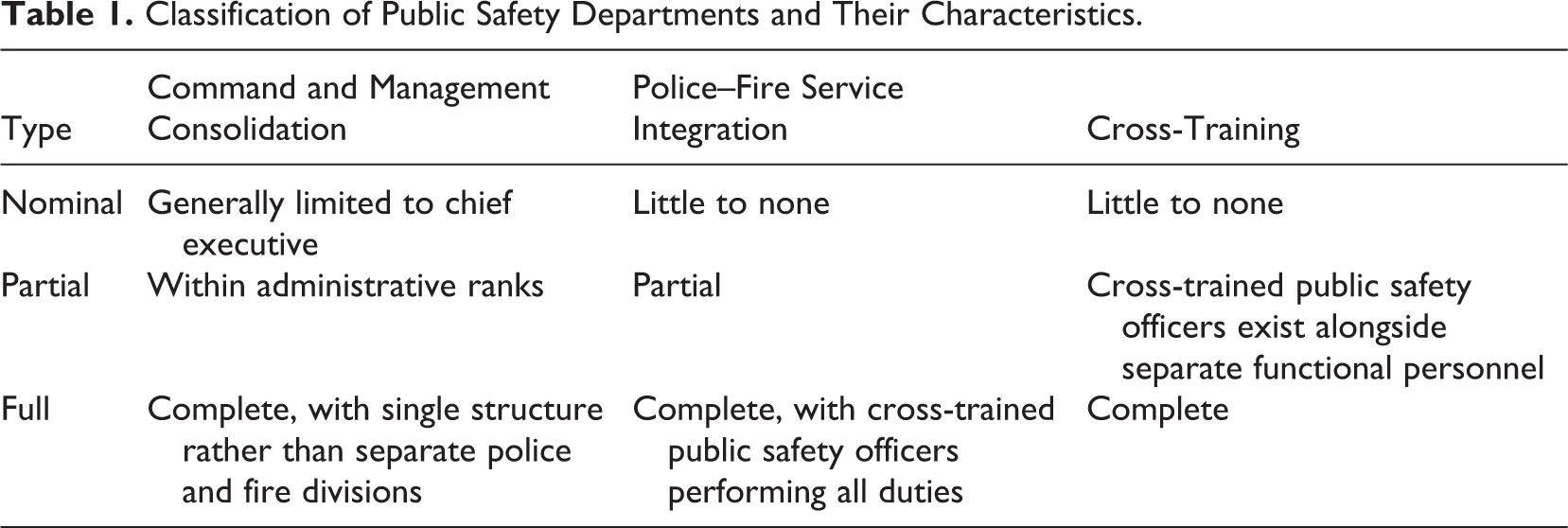
A nominal, partial, and full typology offers a means for categorizing these departments but can miss some nuances. Such a typology assumes that integration of police and fire services, administrative consolidation (i.e., whether there are separate police and fire commands), and proportion of personnel cross-trained to perform both police and fire duties all covary. Nevertheless, these categories are not always clear-cut (Wilson & Grammich, 2017b). For example, some departments that have separate commands for separate police and fire divisions also cross-train some or even all of their personnel. Similarly, some departments with consolidated commands do not cross-train all their personnel. Devising a nuanced measure of consolidation and assessing how it varies by community context or over time can offer lessons for communities interested in this model as well as a foundation for further study of this emerging form of service delivery.
Summary
Research on public safety consolidation has a number of shortcomings. Key among them is that there is little systematic research on this form of service delivery. This could be due, in part, to the fact that relatively few communities have consolidated public safety. This limits the amount of information we know about the model. Much of the work that has been completed is based on case studies of small samples of communities. While case studies provide rich detail about the process, form, and function of public safety consolidation, they provide few empirical lessons about the full range of public safety implementation or measuring consolidation, variation in consolidation, and the causes and effects of consolidation.
Research that examines implementation on a continuum can be more helpful than studies treating it as an either/or option (Lester & Goggin, 1998; Schneider, 1999; Winter, 1999). Such research can also facilitate statistical and comparative research that can provide greater value than small numbers of case studies in determining “equivalency” in implementation, testing hypotheses, generalizing results, and accumulating knowledge (Dryzek & Ripley, 1988; de Leon, 1999; Meier, 1999; O’Toole, 2000; Palumbo, 1987; Winter, 1999; Yin, 1982).
The present work uses a recent survey to establish a scale of public safety consolidation and its implementation and to explore variation in public safety consolidation across the United States. Future research may use our measure to test for causes and effects of consolidation and its implementation.
Method
To gather systematic data on consolidated public safety departments, this research sought to identify every such department in the United States. Unfortunately, no reliable list of public safety departments existed when this effort began. This work therefore included a two-phase process to compile such a list.
First, this work gathered and solicited as much information as possible about departments that might be consolidated public safety departments. Its efforts included: Creating and marketing nationwide a form posted on the Michigan State University School of Criminal Justice website asking individuals to notify us of any such departments they knew, whether their own or another Reviewing past lists of public safety and law enforcement agencies (e.g., from the National Directory of Law Enforcement Administrators, Law Enforcement Management and Administrative Statistics, a state association of chiefs of police, and related Internet sites) Conducting extensive outreach to practitioners and experts, including those from public safety departments and professional associations Reviewing the practitioner and academic literature Conducting Internet searches of department, media, association, and other websites.
Second, this research confirmed that each department so identified actually consolidated public safety services at least nominally. Not all agencies referred to as a “department of public safety” are consolidated police and fire departments, and some consolidated police and fire departments are referred to only as a “police department.” This work confirmed whether each department was consolidated by gathering information directly from its website, by e-mail, or by phone. It ultimately identified 130 consolidated public safety departments providing police and fire services to communities across the United States. (For our complete list, see appendix in Wilson, Hollis, & Grammich, 2016.)
To assess department characteristics, this research developed with the Michigan State University Office of Survey Research a survey regarding major administrative features of the consolidated departments, using standard mail survey protocols (Dillman, 1978, 1991). The survey was fielded, both by mail and follow-up phone call, from October 2013 to May 2014 to all 130 public safety departments identified.
Among the 130 public safety departments to which we mailed surveys, 74 ultimately completed surveys on their command, consolidation, and cross-training features, yielding a response rate of 57%. We asked responding departments whether a municipal, township, county, or civil parish, regional, tribal, or special district government operates their agency. All reported operation by a municipal (69 departments, 93% of responses) or a township (5 departments, 7% of responses) government; none reported operation by another type of government.
Responding and nonresponding jurisdictions did not differ by statistically significant amounts in mean levels of total population, population change in recent years, percent non-Hispanic White population, or per capita income. They did differ in crime rates and educational attainment of residents, with responding jurisdictions being somewhat higher on both. Larger jurisdictions were somewhat more likely to respond. Among 68 departments serving communities with at least 10,000 residents, 43 (63%) responded; among 62 departments serving smaller communities, 31 (50%) responded. While we did not find many characteristics of these departments to vary significantly by size, our survey results will not be representative to the extent that they do.
Building from previous research on classifying public safety departments (e.g., Lynch & Lord, 1979; More, 1970), the survey included several questions used below to categorize and assess the extent of consolidation in each department. These included questions on characteristics of division and command of departments (e.g., whether department has a single director who oversees both police and fire operations or separate police and fire divisions); personnel and cross-training (e.g., whether none, some, or all personnel are cross-trained).
To better understand the variation across public safety departments on the two dimensions of command consolidation and cross-training, we first coded each component of consolidation. Structural integration, coded 0 if being only nominally consolidated, 1 if having combined commands, and 2 if having both combined divisions and combined commands. Cross-training, coded 0 if no personnel are cross-trained, 1 if some but not all personnel are cross-trained, and 2 if all personnel are cross-trained.
We used this coding scheme to develop an index of consolidation. This measure crossed all levels of both variables to determine every type of possible consolidation implementation option. This created a matrix of nine possible types of implementation (three levels of structural integration by three levels of cross-training). We then classified each department based on its form of implementation to determine which types of consolidation existed and were most common. We created the index scale of consolidation by summing the scores of the two variables for each department. This yielded a 0–4 score on the extent of public safety consolidation as defined by command consolidation and cross-training. (Because this is a formative, additive scale [Diamantopoulos & Winklhofer, 2001], we do not provide a reliability measure, such as Cronbach’s, 1951, α coefficient of reliability or consistency, for this index.) Below, we review department responses to these questions and the index of consolidation they ultimately create.
Survey Findings
Implementation by Variable
All responding departments indicated they have a single public safety director (or equivalent) who oversees police and fire operations. Beyond that, departments were concentrated among those with both separate divisions and separate commands or both consolidated divisions and consolidated commands. Specifically, responses (n = 74) to both division and command questions show: 26 departments have separate police and fire divisions and separate command staff (beyond the director) for these divisions. 8 departments have separate divisions but consolidated commands. 40 have consolidated commands and divisions.
Most (42 of 74) responding departments indicated that all their personnel are cross-trained, and 21 more indicated that at least some of their personnel are cross-trained. Not surprisingly, nearly all departments with consolidated commands and divisions have nearly all cross-trained personnel. Yet most departments with separate divisions and commands also report at least some cross-trained personnel.
Index of Consolidation
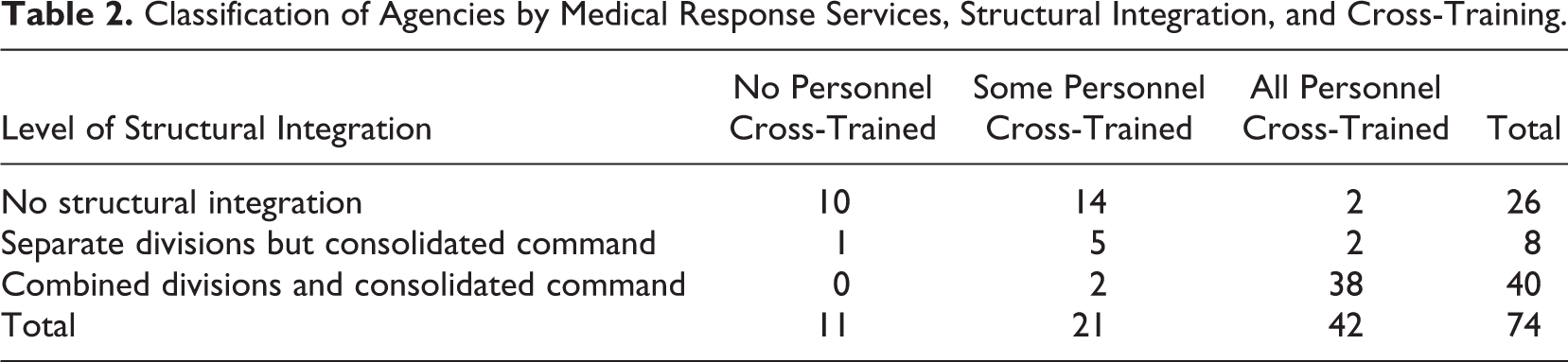
As noted earlier, we used our coding scheme on extent of cross-training and level of structural integration to classify departments. We identified nine different types of consolidated departments, as shown in Table 2, indicating some variation between completely nominal and fully consolidated, that is, among partially consolidated departments. At the top left of the table are 10 departments that are completely nominal, with consolidation consisting only of a single public safety director and with no cross-training. At the bottom right are the 38 departments that are fully integrated, with combined divisions, consolidated command, and full cross-training. In between these two categories are seven intermediate ones, six of which have at least one department in the survey. Among the 26 departments in these intermediate categories, 19 are concentrated in two types, and 14 in those with no structural integration but still cross-training some personnel.
Classification of Agencies by Medical Response Services, Structural Integration, and Cross-Training.
Index Scale of Consolidation
The 74 departments we were able to classify on both structural integration and cross-training have a mean score of 2.61 on the additive consolidation index (with a median score of 4.00 because most departments are fully consolidated). Table 3 presents a frequency distribution that illustrates how departments are spread across the index. The distribution does not show a linear increase in number of departments with increasing consolidation. Rather, there is a cluster of departments at the lower (scores of 0 or 1) and higher (scores of 4) ends of the scale. With half of the departments at the highest level of consolidation, this is by far the most frequent form of implementation.
Additive Consolidation Scores by Traditional Consolidation Type.
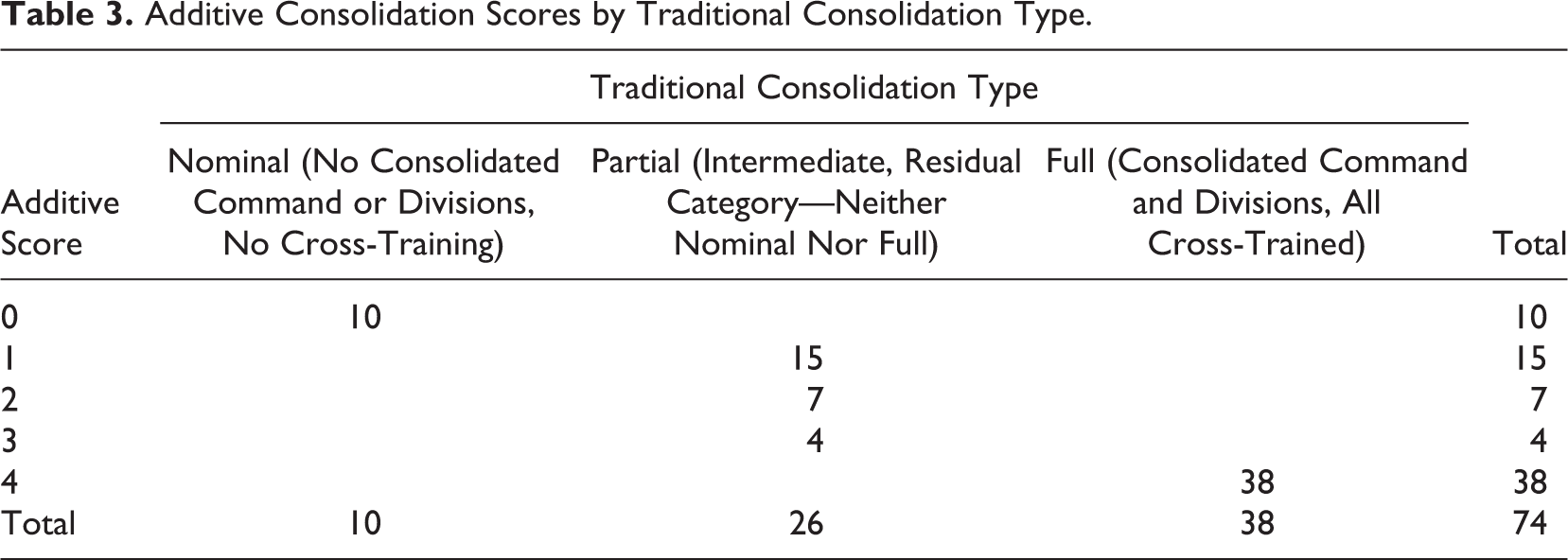
Our index highlights differentiation among partially consolidated departments. All 10 of the nominally consolidated departments received a consolidation score of 0, having no consolidated command or divisions and no cross-training, while all 38 fully consolidated departments received a consolidation score of 4, having both fully consolidated divisions and command and cross-training all personnel. So scores of 1, 2, and 3 all belong to partially consolidated departments.
Partially consolidated departments take a variety of approaches. Figure 1 shows, for departments receiving a score of 1, 2, or 3 in our index, the number that have no, some, or complete cross-training of personnel. Essentially, this is a graphical presentation of the middle column of Table 3, but showing whether a score is a result of cross-training, structural or command consolidation, or both.
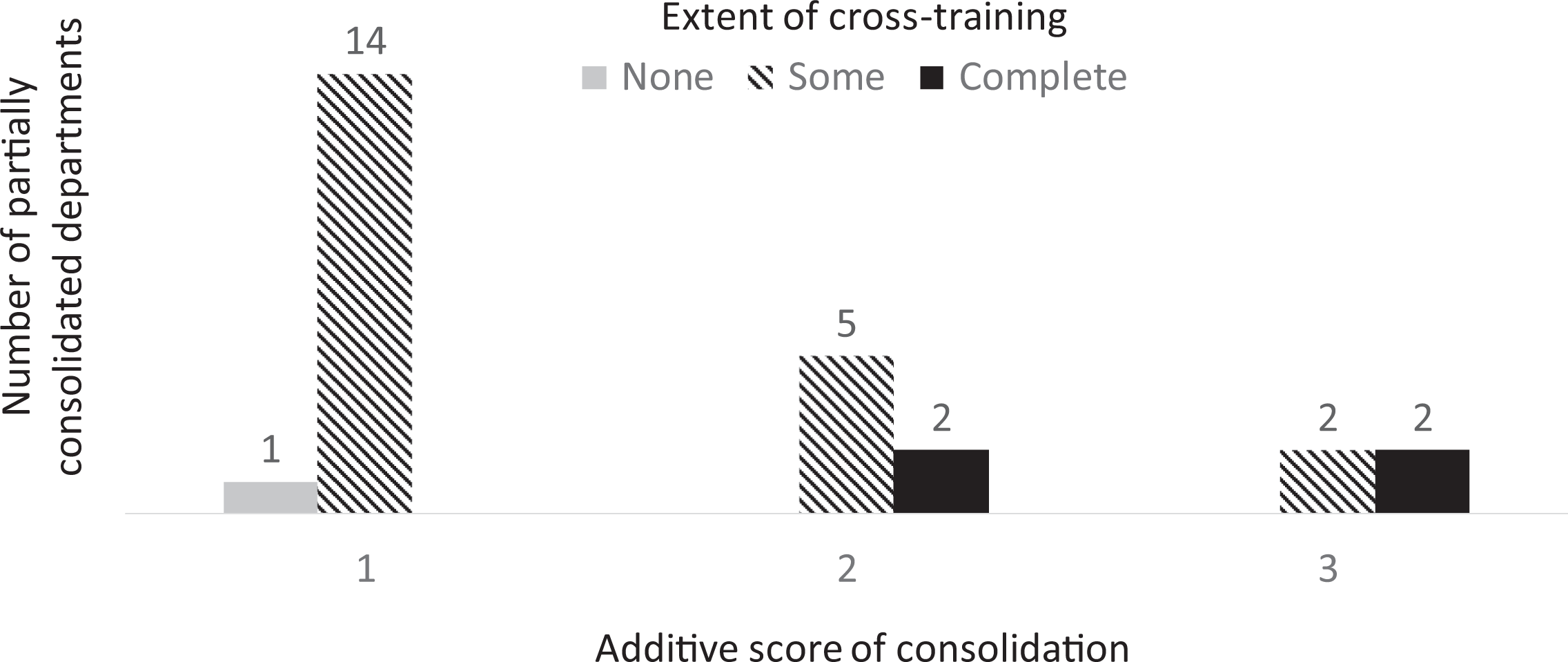
Additive consolidation scores by command structure and cross-training for partially consolidated departments.
Among the 15 partially consolidated departments receiving a score of 1, one has consolidated command and no cross-training, and 14 have cross-training but no consolidated command. Among the seven receiving a score of 2, five have consolidated commands and some cross-training, while two have complete cross-training but no consolidated command. Among the four receiving a score of 3, all have consolidated command, and two have some cross-training while the other two have complete cross-training.
These data suggest consolidating departments may find it easier to adopt at least some cross-training than to consolidate command. Unfortunately, our data do not indicate in what order departments may have adopted elements of consolidation, or whether departments may have adopted consolidation in increments rather than all at once. Earlier research has suggested that partially consolidated agencies will receive consistent opposition from firefighters as well as possible resentment from both firefighters and police over their roles in the agency (Coe & Rosch, 1987). Our own previous work (Wilson & Grammich, 2017a) has suggested that developing a public safety culture, under which officers of consolidated departments increasingly think of themselves as “public safety” officers rather than as police or fire officers working for a public safety agency, can help ensure the success of consolidation. Future research may wish to explore whether departments undertake cross-training before command consolidation to ensure greater acceptance of department consolidation.
Discussion
Strict application of traditional classifications of public safety consolidation would require assuming administrative and structural integration covaries with personnel cross-training. While they do to a great extent, and nearly two thirds of the departments in the sample can be classified as purely nominal or fully consolidated, there is some variation between these two extremes. This is particularly true in the extent of cross-training and command consolidation among partially consolidated agencies. Cross-training is more common among these agencies than command consolidation is, suggesting agencies may find cross-training easier to adopt in undertaking consolidation.
When classifying departments by three levels of structural integration (none, separate divisions but consolidated command, and combined divisions and consolidated command) and level of cross-training (none, some, or complete), we identify nine different theoretical types of consolidation and find at least one department in eight of these categories. Fully consolidated departments are the most common, accounting for more than half of our sample. Departments with some cross-training but no structural integration are second most prevalent, followed by those with neither cross-training nor structural integration.
Equally important, we used these variables to create an index scale of public safety consolidation. This scale offers an interval-level estimate of consolidation and shows that departments are dispersed throughout the continuum, albeit clustered at the lower and higher ends. This has implications for future research topics that we discuss below.
Prior to discussing the implications of this research for future study, it is important to point out its limitations. Specifically, the overall number of consolidated departments is relatively small, and the number responding to the survey smaller still. This prevents development of more precise or sophisticated measures, and the possible identification of consolidation types not evident in the sample. Furthermore, because the scale presented in this article is additive, it inherently assumes all elements are weighted the same in valuation, for example, moving from 1 to 2 in cross-training is valued the same as moving from 0 to 1 on consolidation of command, or complete cross-training is equivalent to complete consolidation of command and divisions. Given the greater prevalence of cross-training, these may not be equally difficult steps for communities. Those using this index may wish to weight the elements according to their own assessments of the value of each. Finally, the data compiled do not permit the examination of multiple dimensions of service integration. While the study differentiates departments by their integration of police and fire services, it cannot distinguish departments by the extent to which cross-trained officers actually perform multiple functions. This is an important element of integration as previous research has shown that some public safety departments assign cross-trained PSOs to a primary function for considerable lengths of time whereas others routinely have cross-trained personnel rotate among the functions, some even on a daily basis (Wilson & Grammich, 2017a).
Still, this research does provide a foundation for future research on public safety departments. It found organizations may vary on both their level of structural integration and their level of cross-training. While perhaps not surprising—especially given the existence of departments that have partially consolidated or cross-train some but not all of their members—the extent of variation on each was perhaps unappreciated.
There are several avenues for future research in this area. First, of course, compiling data on additional integration dimensions and on more of these departments, particularly as their numbers grow, would allow development of more refined and sophisticated measures and typologies. For example, this could include metrics on the extent to which PSOs are cross-trained by the type of service and level of certification, and the frequency by which they perform various service functions. Similarly, there may be ways to enhance the measure of structural integration by examining how and how frequently staff work together operationally. Of course, there may also be other variables to examine that help capture the essence and variation of public safety consolidation. A good start here might be the deployment of cross-trained personnel. Previous research has shown a wide variability in how PSOs engage in multiple services (Wilson, Weiss, & Grammich, 2016). For instance, some have a primary role (such as police) and perform other services (such as fire) on occasion (e.g., as backup or to cover a shift). Some personnel may bid and rotate service provision assignment at fixed times (e.g., every year), while others work 24-hr shifts and rotate primary services every day in specific-hour blocks. This level of service integration may further differentiate the majority of departments that cross-train staff.
Second, future research may wish to explore in particular the integration of emergency medical services. Among the departments we analyze, 63 of 74 (85%) offer at least some emergency medical services. Among these 63, there is considerable variation in the level of emergency medical services offered. Some offer only first response services, while others offer basic life support, and still others offer advanced life support. Furthermore, even among the 11 departments offering police and fire services only, some supply officers for medical duty to the jurisdiction (e.g., county) offering emergency medical services. Future research might explore which jurisdictions offer emergency medical services, the level they offer, and how this affects overall integration, including that for broader services such as those for homeland security, that communities seek through public safety consolidation.
Third, now that a refined typology and scale have been developed it is possible to statistically examine the variables that influence the type and extent of consolidation. Previous research (Wilson & Grammich, 2015, 2017a) has suggested both contingency theory and institutional theory as reasons for departments to consolidate or even to deconsolidate. Further research might explore whether contingency or institutional influences have greater influences on departments with varying types and levels of consolidation as indicated by the measures developed in this work. This research illustrated the most and least common types of public safety consolidation. Departments were most likely to implement either a “lower” or “higher” level of consolidation, with fewer departments opting for a model at more intermediate levels. Studies that identify predictors of the type and level of consolidation would be very helpful in understanding what leads to consolidation. Future research might confirm the reasons partially consolidated departments are more likely to adopt cross-training than consolidation of command. It also might examine why full consolidation is the predominant mode of consolidation, including whether it is the most efficient use of political capital for communities or whether communities find synergies in consolidation that favor its full adoption.
Fourth, much rhetoric surrounding the implementation of public safety consolidation regards the problems it may ameliorate or produce. There would be great value in using the measure developed in this study to examine the effects of consolidation in communities. This measure could be used to examine empirically whether and how type and level of consolidation affect a variety of performance measures such as the cost of providing service, crime control, community policing, citizen satisfaction, fear of crime, crime clearance rates, response times, or the ability to meet professional standards (e.g., accreditation by the Commission on Accreditation for Law Enforcement Agencies or compliance with National Fire Protection Association Standard 1710 regarding career fire department organization and deployment).
Fifth, future research might assess operational characteristics of public safety departments, comparing such departments with themselves and with single-discipline police and fire departments in communities of similar size. Proponents of the model, for example, generally claim it saves money. Identifying how specific operational characteristics vary with level of consolidation would help identify the ideal implementation circumstances for it. Comparing the characteristics of these departments with single-discipline police and fire departments in communities of similar size may provide further insights on why communities adopt the public safety model. Comparing levels of accreditation with such departments may also help determine whether such accreditation is more prevalent in public safety departments and, if so, why.
Local policy makers considering consolidation of command in police and fire departments or cross-training personnel in such departments may use this research as a guide to further deliberations. Traditional considerations of whether a department is nominally, partially, or fully consolidated are helpful but incomplete. This research clearly illustrates there are a multitude of ways to implement public safety consolidation. By determining characteristics of structural integration, cross-training, and services a community may desire for a public safety department, local policy makers can better identify other departments with similar characteristics and what lessons they may learn from them. Moreover, public safety scholars may find this research helpful for establishing a classification of public safety departments and scale measure of consolidation that could facilitate their research on the causes and effects of consolidation, which will advance both theory and practice.
Footnotes
Authors’ Note
The opinions contained herein are those of the authors and do not necessarily represent the official position or policies of the U.S. Department of Justice. References to specific agencies, companies, products, or services should not be considered an endorsement by the authors or the U.S. Department of Justice. Rather, the references are illustrations to supplement discussion of the issues.
Declaration of Conflicting Interests
The authors declared no potential conflicts of interest with respect to the research, authorship, and/or publication of this article.
Funding
The authors disclosed receipt of the following financial support for the research, authorship, and/or publication of this article: This project was supported by grant numbers 2011-CK-WX-K011 and 2012-CK-WX-K023 awarded by the Office of Community Oriented Policing Services (COPS Office), U.S. Department of Justice.