




Abstract
Jurisdictions across Australia have implemented a range of policies to tackle problems associated with alcohol consumption in and around licensed premises. One key measure, patron banning, has proliferated in various forms. Banning applies spatial restrictions and locational prohibitions upon recipients. It is typically predicated upon a presumed deterrent effect for both recipients and the wider community to reduce alcohol-related disorderly behaviors and to improve public safety. This article documents a mapping review of patron banning mechanisms across Australian jurisdictions, using an analysis of legislation, operational practices, policy documentation and reviews, published data, and research literature. The mapping review then frames an analysis of banning policy. Key conceptual and operational issues are discussed with respect to deterrence and community protection; displacement, diffusion, and isolation of effects; enforcement; due process and legitimacy; and the steady civilianization of punishment. Given the wide range and reach of banning mechanisms, there is an urgent need for specific empirical examination of the use and effect of spatial exclusion and prohibition across Australia’s nighttime economy to inform policy development and refinement, to strengthen the assurance of due process, and to optimize the potential beneficial effects of patron banning.
Alcohol-related violence and disorder in licensed premises and across entertainment districts has prompted jurisdictions across Australia to develop a range of policies and operational responses (Donnelly et al., 2017; Graham & Homel, 2008; McNamara & Quilter, 2015; Menendez et al., 2015, 2017; Miller et al., 2012; National Centre for Education and Training on Addiction [NCETA], 2011); Room, 2012; Smith et al., 2011; Taylor et al., 2018). Spatial exclusion is one response, and its use has expanded steadily (Farmer et al., 2018). Powers to prohibit and exclude are presumed to increase community safety and act as a deterrent to reduce undesirable behaviors. Australia is not alone in its use of such provisions. Persak (2017) documents the control of public space and the spatial regulation of disorder in European jurisdictions, such as Belgium, Spain, and Hungary. Beckett and Herbert (2010) examined discretionary powers to exclude in Seattle, WA, where police officers are able to issue on-the-spot exclusion orders from public spaces, which can last for up to a year. In England and Wales, the Criminal Justice and Police Act 2001, the Anti-Social Behaviour Act 2003, and the Violent Crime Reduction Act 2006 introduced dispersal orders and a range of police exclusionary powers, which can be issued on-the-spot in response to disorderly behaviors (Crawford, 2009). In 2014, section 59 of the Anti-Social Behaviour, Crime and Policing Act created Public Spaces Protection Orders (PSPOs), enabling local authorities to apply prohibitions and other requirements within specific public areas for an almost unlimited range of behaviors (Heap & Dickinson, 2018). Exclusion from public areas is also used in response to antisocial behaviors in other countries, such as Germany (Belina, 2007), Canada (Sylvestre et al., 2015), and Denmark (Sogaard, 2018).
Since 2007, across Australian jurisdictions, a key feature of responses to issues of alcohol-related disorder in entertainment districts has been the introduction of one or more methods of patron banning. In 2011, Trifonoff et al. provided a jurisdictional breakdown of liquor licensing legislation in Australia, the remit of which included an overview of banning powers then in operation. Palmer and Warren (2014) examined police zonal banning in Australia and set out core concerns regarding its use and the potential wider effects for recipients. More recently, Farmer et al. (2018) analyzed the proliferation of police banning powers in Australia and identified issues with respect to the underlying presumptions of need and effect. Over the last decade, the use of patron banning provisions has continued to expand both legislatively and operationally. Concern has been expressed about a lack of scrutiny of the use of banning as a mechanism to address alcohol-related disorderly behaviors and the particular consequences for due process and the individual rights of recipients (Curtis et al., 2018; Farmer, 2017a, 2017b, 2018, 2019a, 2019b; Miller, Curtis, Chikritzhs, et al., 2016; Miller, Curtis, Palmer, et al., 2016; Palmer & Warren, 2014; Taylor et al., 2018). However, despite minimal oversight and limited evidence-based analysis of their effects, all Australian jurisdictions have now introduced one or more forms of patron banning.
Australia’s federal system empowers jurisdictions to implement their own criminal justice and operational policing measures. Each state and territory typically functions autonomously, and the implementation of patron banning has been piecemeal. In what has become a complex set of legislation, policy, and practice, this article provides a clear baseline from which to build further discussion and specific research. The four key patron banning provisions in operation across Australia are introduced briefly. This is followed by a mapping review of specific policy and practice, documenting the application, operationalization, and scrutiny of patron banning in each Australian jurisdiction. The mapping review then frames an analysis of banning as a policy response and the articulation of a number of key issues and research gaps. Attention is drawn to core conceptual and operational concerns regarding deterrence and community protection; displacement, diffusion, and isolation of effects; enforcement; due process and legitimacy; and the steady civilianization of punishment. This article concludes with an acknowledgment of the potential benefits of patron banning but emphasizes the need to ensure effective monitoring and analysis of the provisions. Specific research recommendations and potential policy implications are set out.
Patron Banning in Australia
Four key types of patron banning are used across Australia: venue specific bans, liquor accord bans, police-imposed public area bans, and court-imposed exclusion orders. The common features of each type of ban are outlined below.
Venue Specific Bans
Venue specific bans apply to licensed premises and are generally imposed by licensees or other designated responsible persons. Licensed venues are private spaces and venue bans typically operate under long-standing common law principles. Codification has increasingly formalized and expanded licensees barring powers. In some jurisdictions, bans can now cover contiguous public areas and are subject to criminal breach proceedings. Licensee barring powers represent a move toward the civilianization of punishment within the nighttime economy (NTE): Licensees are ordinary citizens and not sworn law enforcement or judicial officers but have been bestowed a police-enforceable power to punish.
Liquor Accord Bans
Liquor accords evolved from Australia’s alcohol accords, first established during the 1990s in Queensland and Victoria (Stockwell, 2001). Liquor accords empower licensees to work collectively to improve safety within entertainment precincts. A key feature is the removal of troublesome patrons and their exclusion from venues across the accord (Liquor Accords Australia, 2018). While licensees may work in partnership with police, local councils, and the community, liquor accord bans are primarily imposed by licensees. As such, they are another example of the civilianization of punishment.
Police-Imposed Public Area Bans
Police-imposed public area bans (also referred to as banning orders, banning notices, and barring orders) generally apply to predefined geographical areas within town centers and entertainment precincts. Designated areas are usually determined by liquor regulatory bodies within each jurisdiction, following consultation with relevant government departments and police. Police-imposed banning powers are implemented under legislative provisions and include formal imposition, enforcement, and breach mechanisms. Police-imposed bans are a form of discretionary summary justice, in response to an incident of alcohol-related disorder, or in anticipation of (and to prevent) a perceived intended disorderly act. Financial penalties apply for a breach of a police-imposed ban. Despite the formal nature of police-imposed bans and the potential consequences of a breach, in most jurisdictions, there is no provision for independent or judicial appeal against the decision to ban (Farmer, 2019b). 1
Court-Imposed Exclusion Orders
Court-imposed exclusion orders can be included as a condition of bail or as part of a sentencing determination, typically for offenses involving alcohol-related violence or disorder, or when an individual’s banning or conviction record passes a particular threshold. Court-imposed exclusion orders may be imposed for extended periods of time and cover sometimes expansive geographical areas. They generally embody breach provisions which are more stringent than other banning mechanisms.
Method
This study uses a mapping review (Grant & Booth, 2009) to frame and inform an examination of patron banning policy in Australia. Based upon this broad purpose, data collection and analysis reflected three stages: (1) an audit of Australian patron banning provisions and practices across all jurisdictions, (2) an examination of published policy and jurisdictional level scrutiny of patron banning provisions, and (3) the identification of key conceptual and operational features of patron banning and the scrutiny of its use. The analysis did not set out to evaluate either patron banning itself or to undertake a systematic review of previous studies. The primary objectives of this article are to provide a comprehensive picture of the use of patron banning and to identify key issues and gaps in its operational practice and analysis. This informs specific recommendations for further research to enhance understanding of the effects of banning and to support ongoing process refinements.
Key Document Sources
All legislative, policy, and other documents examined are available online and were identified through a series of searches, using one or more of the following terms: patron banning, banning notice/order, barring notice/order, liquor accord ban, venue ban, multivenue ban, licensee ban, court ban, court-imposed ban, police-imposed ban, public area ban, zonal ban, designated area ban, exclusion, and prohibition. The scope comprised specific searches of state and territory government websites, Hansard, Austlii, jurisdictional liquor commissions and associated entities, as well as abstract and citation databases of peer-reviewed literature, and general Google searches. The research returned legislative provisions, media releases, government-initiated reviews and responses, operational guidelines, formal reports, academic research, and other relevant documentation. Only sources that relate to patron banning in Australian jurisdictions were used in the mapping review, and it is acknowledged there may be gray literature that was not identified (Young et al., 2002). The final search was undertaken in April 2019, and the key information sources examined are set out in Table 1.
Overview of Patron Banning Legislation, Policy Documents, and Other Key Sources.
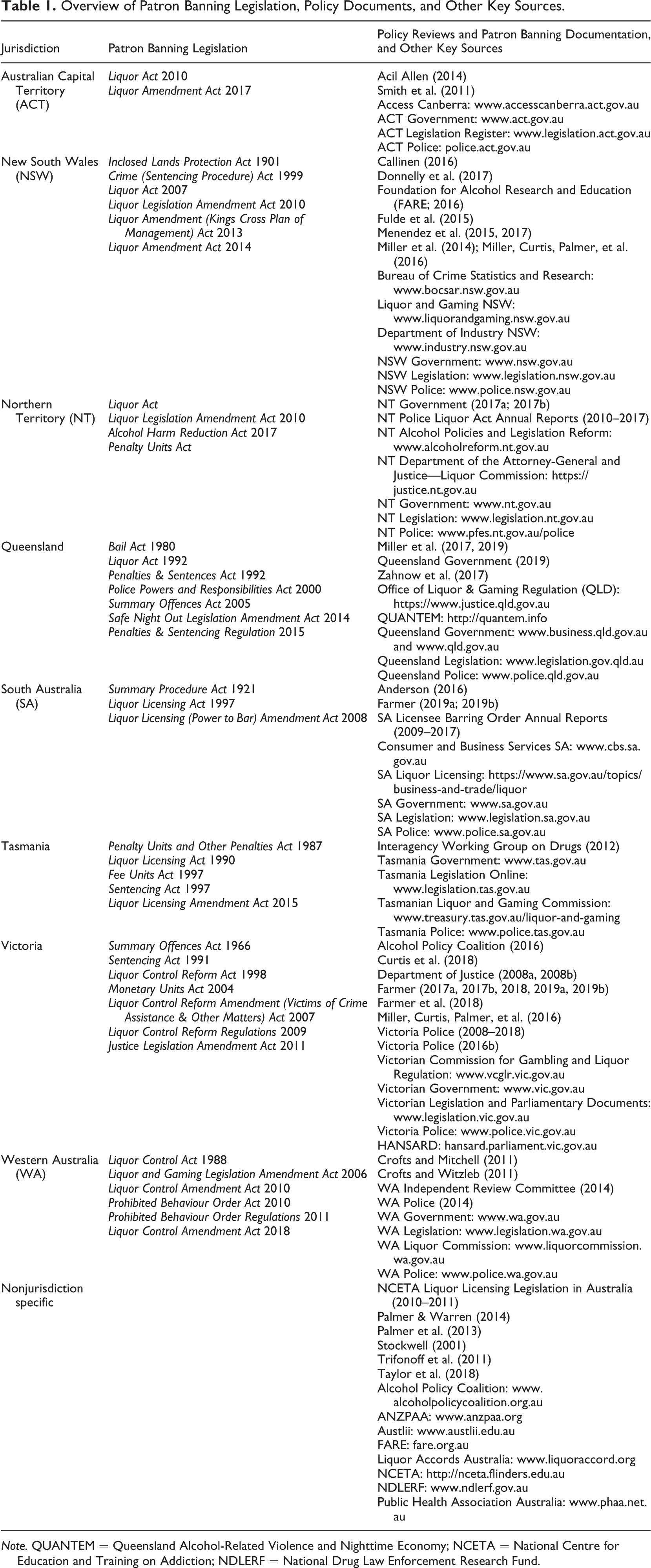
Note. QUANTEM = Queensland Alcohol-Related Violence and Nighttime Economy; NCETA = National Centre for Education and Training on Addiction; NDLERF = National Drug Law Enforcement Research Fund.
Approach to Audit and Analysis
Following the search and audit of patron banning policy and associated documentation, key conceptual and operational issues were identified. The analysis followed a thematic approach, framed by an examination of specific and wider patron banning policy considerations. This informed consideration of key presumptions upon which patron banning is predicated and ongoing issues from the perspective of policy and practice. The findings have been synthesized and summarized and include a number of recommendations for ongoing research.
Results
The substantive findings are set out in two parts. The first part summarizes the outputs from the patron banning mapping review for each of the eight Australian jurisdictions. The use of the four types of banning is documented along with the nature and extent of formal/published monitoring or scrutiny of their use. The second part sets out key findings from the analysis of patron banning as a policy response to alcohol-related behavioral issues in Australia’s NTE.
Part I: Patron Banning—Jurisdictional Mapping Review
For ease of reference and to aid comparison, the findings of the patron banning mapping review are documented by ban type, followed by consideration of data collection, reporting, and monitoring for each jurisdiction. To enhance comparability and to minimize description and repetition, the key features for each ban type and jurisdiction are documented in a series of tables. The written analysis highlights notable features and operational differences. The use of the four banning provisions across each jurisdiction is documented in Table 2.
The Use of Each Type of Patron Banning Across Australian Jurisdictions.

a Venue bans but not barring orders. bSafe night precincts, established as incorporated associations, function in addition to liquor accords. cAlcohol protection orders, imposed by police, included provision for a ban from licensed premises. dProhibition orders also include provision for a ban from licensed premises. ePlace restriction orders or area restriction orders are available to the courts; they are not specific to alcohol-related issues but could be used in relation to serious alcohol-related offending. fProhibited behavior orders, while not specific to alcohol-related issues, include the option to exclude recipients from licensed premises and entertainment districts.
Venue and liquor accord bans
In most of the jurisdictions, the liquor accord provisions mirror those in place for individual venues/licensees and extend the remit to multiple venues—the key features for both are set out in Table 3.
Key Features of Venue/Liquor Accord Banning/Barring Provisions in Each Australian Jurisdiction.
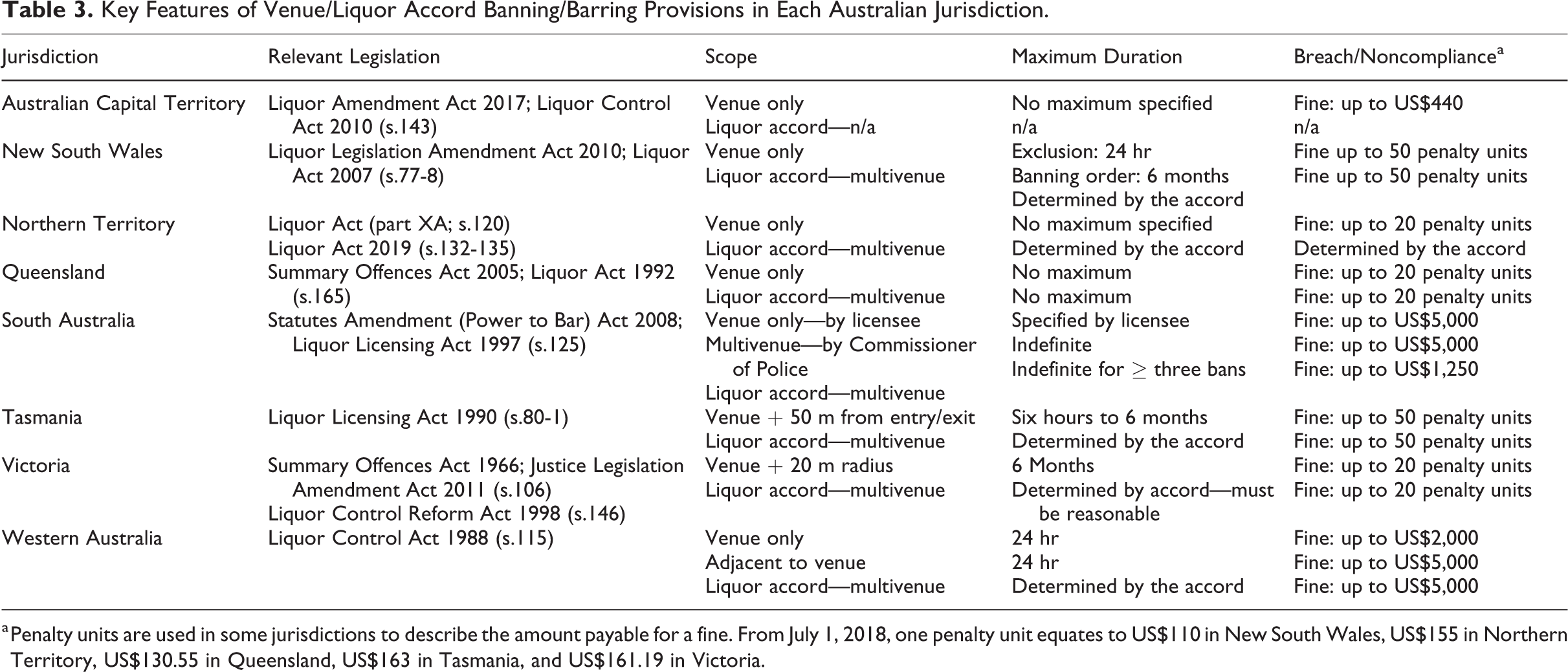
a Penalty units are used in some jurisdictions to describe the amount payable for a fine. From July 1, 2018, one penalty unit equates to US$110 in New South Wales, US$155 in Northern Territory, US$130.55 in Queensland, US$163 in Tasmania, and US$161.19 in Victoria.
Across all jurisdictions, the common law right of individual licensees to remove or exclude a patron from their venue has been codified through a series of amendments to primary liquor legislation. The operation of venue/license barring (referred to hereafter as venue barring) is broadly comparable across jurisdictions, although the permissible durations vary. Other than Victoria, each of the jurisdictions includes provision for an indefinite period of exclusion. The spatial extent of a venue ban is typically limited to the venue itself, except in Victoria, Tasmania, and Western Australia (WA) where the ban includes defined public areas around the venue.
South Australia (SA) operates two levels of venue barring: licensee barring orders and Commissioner of Police barring orders. A licensee may issue an order for a specified period if the recipient commits an offense, acts in a disorderly or offensive way in or near to the venue, or for any other reasonable cause (Liquor Licensing Act 1997, s.125). A Commissioner of Police barring order can exclude recipients from any licensed venue, class of licensed venues, or all licensed venues within a specified area, indefinitely for any “reasonable ground” (Liquor Licensing Act 1997, s.125A). In Tasmania, licensees can choose between requiring an individual to leave and/or not attempt to reenter the premises or its vicinity for at least 6 hr or until the venue has closed, or the imposition of a formal barring order for up to 6 months (Liquor Licensing Act 1990, s.81).
The reasons for which a venue barring order may be imposed are consistent across the jurisdictions. They include intoxication, more broadly framed behaviors that are perceived by the licensee to be violent, disorderly or quarrelsome, or for any other reasonable ground. For example, Victorian licensees may refuse entry to any patron and require them to leave their premises, or issue a formal barring order to anyone if “the person is drunk, violent or quarrelsome,” or creating a “substantial or immediate risk” (Justice Legislation Amendment Act 2011, s.106D). In all jurisdictions, the provisions are police-enforceable and noncompliance may lead to a financial penalty and concomitant enforcement actions.
Liquor accord provisions operate in all jurisdictions apart from the Australian Capital Territory (ACT). Their format ranges from informal and voluntary to formal written agreements between venues, police, government, and other interested stakeholders. An unspecified number of voluntary accords function across New South Wales (NSW) and SA. Within each accord, members typically determine the operation of multivenue bans, including their length, communication of banned patron details, and enforcement (Department of Industry [NSW], 2012, pp. 4–5; Liquor Accords Australia, 2018). Queensland also operates a system of voluntary liquor accords within entertainment precincts. A venue specific ban can be extended across all venues within an accord and a record of each ban is retained by the local police to support enforcement (Queensland Government, 2017c). Queensland has established formal safe night precincts (SNPs) to manage community safety issues; 15 SNPs have been designated in entertainment districts across the state (Queensland Government, 2017b). Multivenue bans are used within SNPs, and enforcement is aided by the use of ID scanners (to check the identification of patrons) at licensed premises (Queensland Government, 2018).
In the Northern Territory (NT), formal liquor accords function as written agreements between licensed venues, local councils, police, government, interested businesses, and the community (Liquor Act [NT], part XA). Six accords are currently in place (NT Government, 2019b), 2 and a licensee may “restrict the public’s access to the licensed premises in the way and to the extent provided by the accord” (Liquor Act, s.120C). In Tasmania and Victoria, liquor accord members share patron information to support imposition of multivenue bans within an accord (Interagency Working Group on Drugs, 2012, p. 2; Victorian Commission for Gambling and Liquor Regulation [VCGLR], 2012, p. 14; 2018). Six liquor accords are currently in operation in Tasmania (Liquor Accords Australia, 2018), and more than 80 are in place across Victoria (VCGLR, 2019b). 3 In WA, a liquor accord may be established with the agreement of at least two licensees in a given area, along with representatives from the licensing authority, state and local government, WA police, and other interested parties (Government of WA, 2017). There are no records of formal multivenue ban policies under WA liquor accords, but the provisions of the Liquor Control Act 1988 allow individuals to be banned from a range or class of licensed venues. Local liquor accords support the enforcement of such exclusions.
Police-imposed public area bans
Police-imposed public area banning provisions operate, in varying forms, in all jurisdictions apart from the ACT. The key features are set out in Table 4.
Key Features of Police-Imposed Banning Notice Provisions in Each Australian Jurisdiction.

In 2007, Victoria was the first Australian jurisdiction to introduce discretionary police powers to ban individuals from designated public areas; initially for 24 hr, increasing to 72 hr in 2010 (Justice Legislation Amendment [Victims of Crime Assistance and Other Matters] Act 2010). A police officer can impose a banning notice if they reasonably believe an individual has committed a specified offense or may engage in behavior that gives rise to alcohol-related violence or disorder (Liquor Control Reform Amendment Act 2007, s.148B[3]). In 2008, SA implemented similar measures for offensive or disorderly behavior in or near a licensed venue, or of any other reasonable ground (Liquor Licensing Act 1997, s.125B). Police-imposed banning has since been introduced across the remaining jurisdictions (except the ACT).
Police-imposed bans typically cover specified designated areas, which are determined by the state/territory government and/or jurisdictional licensing commission. In Victoria, designated areas are declared by the VCGLR. There are currently 20 across the state, covering major entertainment districts and town centers (VCGLR, 2019a). 4 NSW has designated two prescribed precincts in which a police-imposed public area ban can be imposed. The Kings Cross area of Sydney was first declared in 2013, followed by the Sydney Central Business District the following year. Across the NT, five towns/cities operate as designated areas: Darwin, Palmerston, Alice Springs, Tennant Creek, and Katherine (NT Government, 2019a). 5 A police officer may issue either an on-the-spot banning notice from a designated area or a barring order from all licensed premises within the designated area (Liquor Act, s.120J). Police bans can be imposed in any of Queensland’s 15 SNPs (Queensland Government, 2017b). An on-the-spot banning notice can exclude the recipient from a licensed venue, a class of venues, a public area designated within an SNP, a specified distance from an SNP, or a stated event held in a public place (Police Powers and Responsibilities Act 2000, s.602). In Tasmania, the area of the ban can be determined by individual police officers—potentially enabling the recipient to be barred from expansive public areas (Tasmanian Government, 2017).
The permissible length of a police-imposed ban varies from a maximum of 72 hr in Victoria to indefinite periods of exclusion in SA for recipients of three or more bans. In Queensland, an initial banning notice can be imposed for up to 10 days. This may be extended to up to 3 months, where a continued threat of disorderly, offensive, threatening, or violent behavior is perceived. Initial police-imposed public area bans in NSW are imposed for up to 48 hr. Longer term banning orders, of up to 12 months, may be applied for by the police through the NSW Liquor and Gaming Authority (Liquor Act 2007, s.116G), if the recipient has been charged with or found guilty of a serious indictable offense involving alcohol-related violence, or they have been given three temporary banning orders within a period of 12 consecutive months (Liquor Act 2007, s.116G).
WA is the only jurisdiction with police-imposed banning powers where a ban is not imposed on the spot. Following a 2010 Amendment to the Liquor Control Act 1988, the Commissioner of Police, or a police officer above the rank of Inspector, is empowered to approve the exclusion, for up to 12 months, of an individual from a specified licensed venue or a class of licensed venues if there is reasonable belief that the recipient has been violent or disorderly (Liquor Control Act 1988, s.115AA). A determination is made by the centralized liquor enforcement unit after an alleged incident, following consideration of evidence such as closed-circuit television and witness statements. The notice is then served on the recipient by officers from a police station close to their place of residence. A 2018 amendment expanded the permissible imposition of banning notices to include problematic behaviors occurring in the vicinity of licensed premises (Liquor Control Amendment Act 2018, s.57).
Court-imposed exclusion orders
A range of court-imposed exclusion provisions have been introduced across all jurisdictions, apart from the ACT. The key provisions and associated features are set out in Table 5.
Key Features of Court-Imposed Exclusion Provisions in Each Australian Jurisdiction.

Court-imposed exclusion provisions are not necessarily limited to issues arising from alcohol-related behaviors in/around licensed premises. In Victoria, the NT, and WA, primary licensing legislation and associated provisions provide for formal exclusion. Across the remaining jurisdictions, the judicial power to exclude sits within broader legislative provisions. Unlike venue and police banning provisions, there is notable variation between jurisdictions with respect to court-based exclusionary powers.
In Victoria, an exclusion order can be imposed by a Magistrate following court conviction for a “specified offence that was committed wholly or partly in the designated area” (Liquor Control Reform Amendment Act 2007, s148I[1]), or as a condition of bail. A related provision is the alcohol exclusion order, which can be imposed for up to 2 years (Sentencing Act 1991, s.89DE), and which prohibits an offender from entering licensed venues, and the proximity of major events.
Multiple court-based provisions are available in the NT to address alcohol-related behavioral issues. A court-imposed exclusion order may be given to an offender found guilty of a specified offense if the offense was committed in a designated area, the overall sentence is less than 12 months in custody, or if a recipient has three or more banning notices within any 24-month period (s.120S[3]). An alcohol protection order (APO) permitted exclusion from licensed premises in the NT, if the recipient was over 18, charged with a qualifying offense (typically one punishable by at least 6 months custody), or if it was alleged that the offense was committed under the influence of alcohol (NT Government, 2017b). APOs were superseded by banned drinkers orders (BDO) and an associated register. A range of circumstances can lead to individuals being prohibited from purchasing or consuming any alcohol for up to 12 months (Alcohol Harm Reduction Act, 2017). As the provisions are intended to be educative rather than punitive, a breach may lead to a further or longer BDO, rather than a fine or other criminal sanction.
In WA, the Commissioner of Police may seek approval from the Director of Liquor Licensing to issue a prohibition order to prevent an individual “…entering specified licensed premises, licensed premises of a specified class or any licensed premises” (Liquor Control Act 1988, s.152B). Prohibition orders can be also issued for antisocial behavior in or around licensed premises, or following conviction for relevant offenses (Government of WA, 2015). Courts may also exclude individuals from “entering or remaining on, or being near, specified premises or a specified locality or place” (Prohibited Behaviour Order Act 2010, s.10), including one or more licensed premises and/or entertainment precincts.
Specific alcohol-related court-imposed exclusion orders are not used in SA, Tasmania, NSW, or Queensland. In SA, a place restriction order may be imposed, either as a condition of bail or as part of a sentencing determination, if the defendant has been convicted of an indictable offense within the previous 2 years (Summary Procedure Act 1921, ss.77–78). The order can prohibit access to a specified place at any time or in any circumstance, for up to 2 years. Excluded areas may include licensed venues and entertainment precincts. In Tasmania, any person found guilty of an offense may be subject to a court-imposed area restriction order (Sentencing Act 1997, s.70). This can exclude the recipient from specified locations (including around licensed premises) for a period determined by the court. In NSW, while not limited specifically to issues of alcohol-related disorder, the Crime (Sentencing Procedure) Act 1999 (s.17A) enables the court imposition of a place restriction order, to prohibit the offender from entering a specified place or public area. Similarly, in Queensland, court-imposed banning orders, covering specified licensed premises or defined public areas, may be given as a condition of bail (under the Bail Act 1980) for offenses of violence committed in the vicinity of licensed premises. Queensland also permits banning orders as part of a sentencing disposal for offenses of violence or drug trafficking and supply committed in, or near, licensed premises (Penalties and Sentences Act 1992; Queensland Government, 2017a).
Data collection, monitoring, and reporting
The way and extent to which the use and effects of patron banning provisions are monitored is not consistent across the jurisdictions. The most accessible and visible oversight is apparent in Victoria and NT, although limitations are still evident. The other jurisdictions range from some data collection and reporting, to none.
Victoria police are required to publish Annual Reports which document key data relating to police and court-imposed banning notices (Victoria Police, 2008–2018). However, no data are published for licensee or liquor accord bans (Farmer, 2019a). A study by Miller, Curtis, Palmer, et al. (2016) gathered perceptions and experiences of banning from interviews with key informants in Victoria and NSW but reported no quantifiable findings. Victoria’s banning notice data have been analyzed in depth (Farmer, 2017a, 2017b, 2018), and key concerns noted regarding the use and potential effect of banning. Licensee barring was examined by Farmer (2019a) who drew attention to significant operational limitations. Curtis et al. (2018) highlighted the general lack of public awareness of patron banning. Despite some academic research, there is no evidence of any formal monitoring of the use of patron banning, by Victoria Police, the VCGLR or the State Government. A 2016 submission by the Alcohol Policy Coalition to a statutory review of the Liquor Control Reform Act 1998 refers to patron banning but offers no analysis of effect. Another submission by Victoria Police (2016b) to the statutory review also refers to police banning powers, notes a decline in numbers of banning notices imposed, and offers limited analysis of breach data. No consideration is given to the use of banning powers within the submission, other than the assertion “Victoria Police maintains a strong view that banning notices remain an effective option” (Victoria Police, 2016b, pp. 14–15). 6 Their need and effect continue to be presumed, but their use is not monitored or scrutinized.
In the NT, police-imposed banning notice data are published via Annual Reports (Liquor Act, s.120Z). 7 The data include the number of bans imposed each year, the number of individual recipients, the number of multiple banning notices, suspected specified offenses and designated areas for and in which bans were imposed, the age and indigenous status of recipients, and contravention and breach data (NT Police, 2011 –2017). Overall, compliance with the data publication requirements in NT has been strong, but there is no evidence that NT Police, the Licensing Commission, or the Territory Government are monitoring the specific use or effect of any patron banning mechanisms. An expert independent advisory panel, appointed by the NT Government in 2017, undertook a review of alcohol policies and legislation. The final report acknowledges banning but offered no analysis other than to state: “The system should continue but must be assessed for its effectiveness” (NT Government, 2017a, p. 88). No formal recommendation was included to facilitate any examination of the banning provisions. No other banning specific monitoring or research has been identified.
SA Police are required to record licensee/venue barring order reasons, scope, length, and recipient name (Liquor Licensing Act 1997, s.125B[4]), but SA does not publish any police-imposed banning data. Limited data regarding the imposition of licensee barring orders (Liquor Licensing Act 1997, s.125) are published in Annual Reports, which document the number and location of barring orders imposed for longer than 6 months (Consumer and Business Services [SA], 2010–2017; Farmer, 2019a). A 2016 review of the state’s liquor laws (Anderson, 2016) confirmed that the SA Government are, to some extent, monitoring the use of licensee-imposed banning mechanisms. However, other patron banning provisions received no attention in the Anderson review, and the research for this article found no evidence of any existing or ongoing analysis of their use or effect.
Police-imposed banning order data are recorded by the WA Police but it is not published. The details of individual prohibition orders and prohibited behavior orders are posted on publicly available websites. There has been academic analysis of such provisions (Crofts & Mitchell, 2011; Crofts & Witzleb, 2011), but no formal monitoring of their use. Similarly, to date, there is no documented evidence of the analysis of patron banning more broadly by WA Police, the Liquor License Commissioner, or the WA State Government. A review of the Liquor Control Act 1988 (WA Independent Review Committee, 2014) included within its scope the use of banning. A submission by WA Police (2014, p. 24) noted that banning has “been used extensively by police to reduce violence and improve safety within and around licensed premises,” but no evidence was presented to qualify their effect. The commentary within the final review report was limited to a statement of the number of bans issued between the implementation of the legislation and the data gathering for the review. The report asserts that banning has been effective due to “the speed in which they can be issued and the immediate impact on the barred person” (WA Independent Review Committee, 2014, p. 165). However, no evidence is presented to explain or support this claim.
Police-imposed banning order data are recorded by Queensland Police, but no banning related data are published. There is no evidence that Queensland Police or the State Government actively monitor the use or effect of banning mechanisms. A 2015 submission to the Queensland Parliament by the Labor Party included plans to continue with patron banning measures but offered no evidence of their effect, beyond assertion. A report by Zahnow et al. (2017) acknowledged the potential deterrent effect of patron banning in Queensland NTE but, again, noted the absence of empirical evidence with which to quantify the value of such provisions. The Queensland Alcohol-related violence and Nighttime Economy (QUANTEM) project is evaluating a range of provisions that were introduced in July 2016, under the “Tackling Alcohol-Fuelled Violence” policy (Miller et al., 2017). Patron banning is within the scope of the QUANTEM project and includes a brief analysis of data which has been made available to the project. No other banning specific research was located.
There is currently no data published with which to examine the use or effect of patron banning powers in NSW and, despite formal provisions being operational since 2013, there has been no banning specific analysis. Menendez et al. (2015) examined the impact of the 2014 liquor license reforms on assaults, but their report states explicitly that the use and effect of individual measures (such as banning) has not been isolated and cannot be discerned (p. 2). Studies by Liquor and Gaming NSW (2016), Menendez et al. (2016), Miller et al. (2012), and Miller, Curtis, Chikritzhs, et al. (2016b) also examine the effect of a range of provisions but none focus on patron banning specifically. Miller, Curtis, Palmer, et al. (2016) gathered perceptions and experiences of banning from interviews with key informants in NSW and Victoria but reported no quantifiable findings. A detailed review of amendments to the Liquor Act 2007 was later undertaken by Callinan (2016) and banning mechanisms were included within its scope. However, minimal attention was paid to banning and the only consideration of their use reflected the presumed “capacity to effect changes to social behaviour” (Callinan, 2016, p. 37). No evidence was presented to support this assertion and banning is not referenced within the report’s conclusions.
Tasmania Police do retain a record of police-imposed bans, 8 but there is currently no provision for the publication of patron banning related data. There is no documented evidence that Tasmania Police, the Liquor and Gaming Commission, or State Government are monitoring the use or effect of patron banning powers, and no other research was located.
It is not known why the ACT has shown no interest in liquor accords, police, or court banning. An independent review of the ACT liquor laws (Acil Allen, 2014) made no mention of patron banning or exclusion. There is also no monitoring of the use of exclusion from licensed premises, and no data are published.
Despite the proliferation of patron banning mechanisms across Australian jurisdictions, this mapping review reveals minimal proactive monitoring of their use, effect, or effectiveness. The second part of the results builds upon this key finding and draws attention to a number of conceptual and operational concerns that are embodied within and across Australian patron banning policy and practice.
Part II: Spatial Exclusion—Conceptual and Operational Policy Concerns
Part I documents the operationalization of a range of patron banning mechanisms, across Australian States and Territories. Most jurisdictions do not actively monitor their use of such provisions, and there is currently no oversight or analysis of their effects. The absence of effective scrutiny of patron banning is compounded by a number of underlying conceptual and operational concerns, which have emerged from this mapping review and associated analysis. Part II of the results considers the following issues: deterrence and community protection; displacement, diffusion, and isolation; enforcement; due process and legitimacy; and the civilianization of summary powers to punish. These issues are not siloed, and overlaps are evident within the discussion.
Deterrence and community protection
Patron banning is largely predicated upon an underlying presumption of deterrence and community protection. In an examination of the proliferation of police banning provisions across Australia, Farmer et al. (2018) highlighted the repeated and deeply embedded assumptions about their effects. Specifically, that removing and excluding individuals from licensed venues or public areas will address immediate issues arising from alcohol-related disorder, enhance the safety of the person being removed and of others in the locality, and act as an effective deterrent to manage the future risk of problematic behaviors. This perspective was typified in 2010 by Victoria’s Attorney General, Rob Hulls, who used the presumption of deterrence to justify the extension of the permissible length of Victoria’s police-imposed banning provisions, from 24 to 72 hr: The extension of the maximum duration for which a banning notice may be made, to 72 hours…is intended to increase the deterrent effect of banning notices, reduce the incidence of alcohol- related violence and disorder and, consequently, enhance public safety. (Legislative Assembly, 2010, p. 1132)
Deterrence can apply to individuals receiving a particular penalty, more generally to the community through the perceived risk of a sanction being imposed and enforced, or it can reflect more intricate intersections of specific and general effects. Of particular relevance to patron, banning is the notion of perceptual deterrence, which draws on presumptions of rational decision making. Individuals are presumed to calculate the possible benefits of a given act or behavior against the probable risks—notably the likelihood, celerity, and severity of punishment or sanction (Becker, 1968; Mann et al. 2016). The intricacies of deterrence theories are acknowledged, and there is a lack of consensus regarding the effects of punishment upon future behavior. For example, research in the United States, United Kingdom, and Australia has established no conclusive deterrent effects of moves toward more punitive criminal disposals (Chalfin & McCrary, 2017; Kleck et al., 2005; Paternoster, 2010). The risk of a sanction can also generate effects that are individualized, whereby some people are more deterred than others (Matthews & Agnew, 2008). Such differential effects can influence both individual and collective deterrability (Jacobs, 2010; McGrath, 2009).
Complex constructions of behavioral theory and sentencing practice have been examined in relation to a range of criminological, sociological, geo-spatial, and psychological contexts (see, e.g., Ehrlich, 1972; Nagin & Pogarsky, 2001; Tonry, 2008; Von Hirsch et al., 1999). Within the NTE, the potential effects of alcohol or drug consumption upon rational thinking further complicate expectations of perceptual deterrence and deterrability. Multiple links have been established between alcohol consumption, antisocial, and other disorderly behaviors (Fleming, 2008; Graham & Homel, 2008; Hadfield et al., 2009; Hughes et al., 2008; Mawby, 2017; McNamara & Quilter, 2015; Miller et al., 2015). The effects of alcohol on decision making, violence, and disorder are evident, if complex. Nevertheless, the discourse underpinning patron banning powers presumes a dual deterrent effect. The fact of being excluded is expected to deter the recipient from further behaviors which may lead to another ban—particularly in jurisdictions where subsequent bans may be more onerous. The existence of banning provisions and the risk of exclusion is also presumed to act as a general deterrent to prevent unacceptable behaviors by all patrons.
Licensee, liquor accord, and police-imposed bans can remove a problematic individual from a given location with immediate effect. This may reduce the immediate risk of harm within the given location. However, any broader or longer term effects of a patron ban are much less clear and have received no formal scrutiny in any Australian jurisdiction. It is not known, for example, how recipients of bans react, the extent to which they comply, or whether a ban has any tangible effect upon the behaviors of the recipient or their peers (including whether they simply relocate and continue the same behaviors elsewhere or at home). Other than a limited study by Curtis et al. (2018), the level of awareness of patron banning across the wider Australian population is not known, neither is the extent to which the existence and operation of banning provisions may affect the behaviors of the general population. Despite this absence of informed understanding of its effects, banning remains a popular policy and practice across Australian jurisdictions, supported by a justifying narrative that is largely unsubstantiated and unquantified. Without specific research and empirical evidence, any assessment is, at best, speculative.
Displacement, diffusion, and isolation of effects
Patron bans can provide an immediate response to a behavioral issue within a given location, by removing individuals from a specific place. One possible consequence is the temporal or spatial displacement of problematic behaviors, which could manifest in other public locations or within private domains. Ban recipients may simply relocate to other venues or, if they are deterred from reentering entertainment precincts, they may remain at home. This could have consequences for offending patterns elsewhere, most notably with respect to family violence. The issue of displacement has been examined in relation to Sydney’s lockout laws (Donnelly et al., 2017), and other provisions tackling issues in the NTE in Australia and elsewhere (Bellis & Hughes, 2011; De Andrade et al., 2018; Mendendez et al., 2015; Wadds, 2019; Welsh et al., 2010). However, no research was found which has analyzed the displacement effect of Australia’s alcohol-related patron banning measures, from a temporal or geo-spatial perspective.
That no jurisdictions are actively monitoring their wider effects also limits the understanding of the potential diffusion of benefits arising from patron banning (Prenzler, 2017; Ratcliffe & Makkai, 2004; Waring & Weisburd, 2002). There is an embedded expectation that the threat or imposition of a ban will act as an agent of change and initiate a deeper transformative effect upon decision making, which could have a beneficial effect upon offending and antisocial behaviors in other contexts. However, there is currently minimal research examining the specific individualized effects of such lower level, localized, summary penalties. It is also feasible that any behavior change may not result in diffusion of benefits. For example, resentment at the fact of being banned could lead to or exacerbate problematic or criminal acts. Without effective scrutiny, any assessment of the effects again remains speculative.
The absence of analysis is further complicated by the context in which patron banning provisions are typically implemented. Most jurisdictions have applied a multifaceted approach to tackling issues of alcohol-related disorder. This reflects general research evidence that effective control requires a combination of strategies to address individual behaviors, licensing, and environmental factors (Babor et al., 2010). For example, Victoria’s Alcohol Action Plan: 2008–2013 (Department of Justice, 2008b) incorporated a suite of initiatives, including a lockout trial, 9 tougher licensing rules, a significant increase in the level of nightlife policing (Miller et al., 2012), and the introduction of police-imposed banning notices. Similarly, NSW passed a swathe of restrictions (under the Liquor Amendment Act 2014) which included a 1.30 a.m. lockout for licensed venues in two Sydney entertainment precincts, a 3.00 a.m. cessation for the service of alcohol, and a freeze on new liquor licenses. 10 One consequence of implementing a range of responses to tackle behavioral issues in the NTE is the difficulty of discerning the particular effect of any individual measure (Menendez et al. 2015; Miller et al., 2014, 2016). This can lead to the perceived success of the overall strategy being used to justify extensions to the scope or remit of an individual mechanism, without an empirical basis of evidence for its particular beneficial effect.
Enforcement
Closely linked to deterrence and displacement is patron banning enforcement. Any short-term deterrent effect is likely to correlate with the probability of effective enforcement, through mechanisms such as real-time information sharing between venues and police, the use of ID scanners, and proactive policing of public spaces. In small or remote locations, ban recipients may be more readily identifiable if, for example, they are known to police, licensees, and venue security. This may enable more meaningful enforcement than in larger, metropolitan entertainment precincts, where patrons are more likely to move around without detection. Where bans are shorter, such as in Victoria, suboptimal information sharing practices may limit enforcement activities. For example, if the details of a ban are not recorded by police or shared between venues quickly, the ban may lapse before any enforcement is possible. Venues which either post photographs of banned patrons and/or use ID scanners are more likely to be able to enforce licensee and liquor accord bans, if not public area exclusions, although this has not been tested definitively. A number of studies have examined ID scanner use and noted potential benefits (Liquor and Gaming [NSW], 2016; Palmer & Warren, 2014; Palmer et al., 2013; Queensland Government, 2018; Taylor et al., 2018). Enforcement is a more notable challenge for public area bans and venues not using scanning technology. As early as 2010, the Geelong
11
Advertiser reported concerns among police officers charged with using and enforcing banning notice powers: A Geelong Police Sergeant [stated]…“We’ve found them [the police-imposed banning notices] to be cumbersome and ineffective because we would ban them (party-goers) but the pubs and clubs would not know about it.” (Geelong Advertiser, January 25, 2010)
Dilution of due process and perceived legitimacy
The discretionary and immediate nature of most banning powers circumvents established due process protections (such as the presumption of innocence, the right to legal representation, and the right to a fair hearing) and may undermine the individual rights of banning recipients. 12 Palmer and Warren (2014) drew attention to this issue, and it has been the subject of further analysis using data published in Victoria and SA (Farmer, 2017a, 2017b, 2018, 2019a, 2019b). Most venue and police-imposed bans are issued following a subjective assessment, by the licensee or police officer, of behaviors that do not necessarily have to pass a threshold of criminality. Banning legislation typically uses terms such as “offensive,” “disorderly behavior,” “quarrelsome,” and “reasonable cause,” which do not map to established offenses and are open to a range of interpretations (McNamara & Quilter, 2014, 2015). Prior to the imposition of a licensee or police-imposed ban, there is no requirement to present evidence or gather witness statements (except in WA) and, in most jurisdictions, appeal options beyond the auspices of the police are limited (Farmer, 2019a, 2019b). The potential exists for bans to be issued for reasons which may be discriminatory, disproportionate, or capricious (Farmer, 2019a). In such cases, even if a ban is subsequently revoked, there is no consequence for the issuer. Patron banning policy has been implemented and extended despite an absence of demonstrable evidence quantifying whether the ends of presumed deterrence and community protection justify the means which may limit the individual due process rights of banning notice recipients.
Patron bans can also be imposed preemptively to prevent a perceived future problematic behavior, which may further compromise due process. For example, in Victoria, a police officer can impose a banning notice if they reasonably believe an individual may engage in behavior that gives rise to alcohol-related violence or disorder (Liquor Control Reform Amendment Act 2007, s.148B[3]). The ban is issued in anticipation of a perceived future disorderly act. In their comprehensive analysis, Ashworth and Zedner (2014) examine such preventive justice approaches in the context of procedural fairness and the rule of law. While they acknowledge operational and legislative expectations of public protection and safety, this does not afford preventive justice a “trump card” status (Ashworth and Zedner, 2014, p. 266). Any provisions which limit due process or procedural justice must be subject to rigorous conceptual and operational scrutiny. Furthermore, a summary power to impose a punishment must include a timely and effective review mechanism. Court-imposed disposals typically embody full due process protections, including rights of appeal. However, the right to review a ban imposed by a police officer or licensee is much less clear. Farmer (2019a, 2019b) has set out a detailed analysis of issues relating to the review of summary banning powers.
The impact of patron banning may be borne by individual recipients, but there is a potentially wider and deeper effect for the perceived legitimacy of the provisions and those empowered with their imposition. This aligns with an extensive body of research examining policing legitimacy (Tyler, 2006; Tyler & Jackson, 2014; Tyler & Wakslak, 2004). Even for routine interactions, such as traffic stops, perceptions of procedural justice and operational fairness are essential prerequisites for individual and community compliance, co-operation, and trust (Bradford & Jackson, 2016; Huq et al., 2017; Mazerolle et al., 2013; Tankebe & Liebling, 2014). Once again, specific evaluative research is required to understand any effects and to ensure the optimal use of patron banning.
The civilianization of punishment
The way in which venue and liquor accord bans are imposed reflects a civilianization of punishment, which sits alongside and forms a distinct component of the steady privatization of policing and security (Ashworth, 2013; Button, 2016, 2019; Sarre & Prenzler, 2018). In England and Wales, dispersal orders can be enforced by local authority representatives, with police approval, and PSPOs can be enforced by local authority appointed authorized officers. In both cases, the original order follows either a police decision or a determination by a local authority following consideration of available evidence. For summary patron bans, the civilianization is, arguably, more profound and with potentially serious consequences for recipients. Venue staff have long been able to police who may enter and remain, but they have not been able to impose a criminally enforceable penalty. Licensee barring orders empower civilians to do just that—on the spot, with no requirement to provide any evidence. Orders are enforceable by police, and a breach may carry criminal consequences. Liquor accord bans can also be framed as a discretionary summary penalty which may be imposed by ordinary members of the public—licensees or venue managers—rather than sworn law enforcement or judicial officers.
The trajectory of such a civilianization of punishment extends concern about the dilution of due process and the risk to the perceived legitimacy of patron banning. Farmer (2019a) undertook the only examination, to date, of the risk that is embedded within the operationalization of licensee barring powers. Farmer noted how, in Victoria, licensee barring has been used since 2011 with no central records, limited review options, no training, and no provision to address licensee misuse or abuse of their powers. The absence of any meaningful oversight provides licensees with an unfettered power to punish, which is police enforceable and subject to criminal breach proceedings. Despite the potential consequences for recipients, there is no accountability of the way in which licensees choose to use this power. This issue is heightened by the subjective nature of behaviors that may lead to a ban. Terms such as quarrelsome and disorderly are used across patron banning legislation, but their definition and interpretation are inherently ambiguous. McNamara and Quilter (2014) raised comparable concerns regarding the interpretation of offensiveness. Such concerns are further compounded by the absence of meaningful review mechanisms afforded recipients of licensee and police-imposed bans (Farmer, 2019a, 2019b).
Other discretionary summary powers, such as move-on orders and a range of infringement provisions, have the potential to target identifiable and/or vulnerable demographic groups (Farmer, 2018). Licensee barring orders and liquor accord bans carry a more personal or individualized risk. The rationale is sound—as licensees have a responsibility to ensure their venues are safe for all patrons. However, the operation of licensee barring and liquor accord bans rely upon the good conscience and practice of those empowered to impose them. Law enforcement or judicial officers, who are typically afforded powers to punish others, must make a formal commitment to exercise these powers fairly and without favor or affection. No such requirement is in place for licensees or other responsible persons from a licensed venue. Yet they are empowered to impose a police-enforceable punishment, on-the-spot, without enabling the recipient to receive any legal support or a fair hearing of any kind. This move toward more civilianized punishment has been introduced with little commentary and no specific analysis of the risk of misuse or abuse of these discretionary powers.
Conclusion
The use of exclusion and the policing of space have been examined across a variety of criminal justice contexts, but the presumed beneficial effects are largely unproven. For example, Beckett and Herbert’s (2010) investigation of police powers to issue expansive exclusion orders in Seattle, WA, found that such measures progressively increased the likelihood of infringement and punishment but demonstrated little community benefit. In his study of responses to police zonal banning powers in Denmark, Sogaard (2018) found that bans are routinely disregarded, had limited value as a specific deterrence, and that fear of being banned exacerbated rather than reduced antisocial behaviors. In the context of patron banning, uncertainty regarding the value of exclusion per se is compounded by a dearth of data detailing the specific individual or collective effects of banning patrons from the NTE. However, despite a lack of evidence to support their effectiveness, there has been a steady expansion across Australian jurisdictions of discretionary powers enabling the imposition patron bans, some of which may apply to large public areas for extended periods of time.
The expansion of patron banning across Australian jurisdictions has been fragmented and uncoordinated but is based upon a common presumption of need and effect. This article draws together the range of mechanisms, to present a comprehensive picture of the banning provisions currently in operation. This article identifies a number of assumptions which underpin the proliferation of patron banning in Australia, in particular the expectation that spatial prohibition and exclusion increase public safety and are an effective deterrent for ban recipients and the wider community. Despite an extensive range of research examining responses to alcohol-related issues in the NTE (Taylor et al., 2018), there is a dearth of understanding of both the operation and particular effect of patron banning across Australia jurisdictions.
Banning may have the capacity to be an effective mechanism to address alcohol-related behavioral issues in the NTE, but little is known about the way in which patron banning provisions are used, or the extent to which they address or affect behavior. Nevertheless, as a policy response to alcohol-related issues, patron banning continues to proliferate. The absence of empirical research means that the introduction and extension of banning policy is based upon largely unchallenged and untested assumptions. It is acknowledged that patron banning may indeed have a beneficial effect upon recipients and the wider community, but any quantification is speculative at best and policy should be predicated upon a sound evidence base. While it may not be realistic to test the effect of provisions before their initial implementation, any policy which permits a discretionary punishment, particularly one that is imposed on-the-spot, preemptively or for subjectively assessed behaviors, and which carries minimal review options, should be monitored actively. Subsequent measures should draw on available data and research.
Australia’s patron banning provisions continue to operate without ongoing monitoring and have been implemented with a seemingly unquestioning faith in their necessity and their community safety effect. Despite the apparent popularity of patron banning among police, politicians and the media, no jurisdiction has assessed their effect. The discretionary way in which many patron banning measures operate, combined with the lack of scrutiny, creates a clear risk that banning could be used in a disproportionate, inappropriate, or discriminatory manner. The dilution of due process, circumvention of individual rights, and the civilianization of licensee and liquor accord bans are notable areas of concern.
It is clear that despite the introduction and expansion of patron banning, a significant knowledge gap exists. There is currently no evidence base from which to understand the use and effects of the different banning provisions, or to inform their further development. Focused research is required to measure the effects, upon individual and collective behaviors, of spatial exclusion and prohibition in Australia’s NTE. In particular, empirical research is needed to map offending and offenders both spatially and temporally to enable any displacement or diffusion effects of banning to be identified and quantified. Informed understanding of the use and effect of patron banning will ensure that the operationalization of provisions can be refined for optimum benefit. For example, the use of exclusion by licensees should be analyzed closely to understand the reasons for which bans are imposed, to ensure that their use is appropriate, and to identify whether legislative amendments are required to prevent the vexatious use of banning powers.
Policies which permit the imposition of discretionary summary punishments, particularly by civilians, require robust scrutiny and meaningful measurement of both need and effects. By clarifying and measuring the way in which bans are imposed, jurisdictions will be better able to support the proportionate and appropriate use of such provisions, maximize their beneficial effects, and to ensure effective accountability of those who are granted the discretionary power to punish.
Footnotes
Authors’ Note

Declaration of Conflicting Interests
The authors declared no potential conflicts of interest with respect to the research, authorship, and/or publication of this article.
Funding
The authors received no financial support for the research, authorship, and/or publication of this article.