



Abstract
Today’s professionals require a network of mentors to help them navigate complex organizational and individual challenges. Consistent with current trends, a growing number of these mentor relationships will be initiated and carried out electronically, via e-mentoring. We build on existing social network research to investigate the role of e-mentoring in protégé outcomes. On a sample of graduate and undergraduate students, we examine the impact of dyad characteristics (e.g., interaction frequency, pre-existing relationship, perceived similarity, relevant mentor knowledge) on e-mentoring received as well as the impact of e-mentoring on protégés’ learning and satisfaction. Several dyad characteristics and e-mentoring functions received were positively associated with protégés’ learning and satisfaction. Limitations and implications for future research are offered.
Keywords
E-mentoring, the process of using computer-mediated communication (CMC) technology as the primary means of communication between mentors and protégés, has become widely used. CMC—that is, the internet, e-mail, instant messaging, and related technologies—has changed the way we communicate. World-wide Internet users currently exceed two billion (665% growth since 2000), and among the 348.3 million North Americans, more than 78% communicate online and over 49% are Facebook users (Internet World Stats, 2012). Given the growing number of CMC users and a business climate characterized by layoffs, worker mobility, boundaryless careers, and increased work demands, use of electronic means to expand one’s network of developmental relationships is not only tenable but also critical for career success (de Janasz, Sullivan, & Whiting, 2003; Dobrow, Chandler, Murphy, & Kram, 2012; Higgins & Kram, 2001; Sproull & Kiesler, 1999).
Social network theory suggests that developmental relationships are necessary as the context of mentoring becomes more turbulent and career actors are more apt to draw on a variety of sources for support in their career (Dobrow et al., 2012; Higgins, Chandler, & Kram, 2007). Ensher and Murphy (2007) suggest that e-mentoring can boost the likelihood of initiating developmental relationships by increasing accessibility of mentors, equalizing salient differences of partners, and decreasing emphasis on demographics (e.g., race, age) identified through face-to-face meetings. Based on this framework, the purpose of this study is to gauge the effects of e-mentoring on protégés’ learning outcomes using a sample of graduate and undergraduate students who seek e-mentors and experience e-mentoring episodes (Fletcher & Ragins, 2007) or developmental interactions during a semester.
E-mentoring is an ongoing, mutually beneficial relationship whereby a more experienced partner transmits mentoring functions via electronic means to a less experienced partner (Ensher & Murphy, 2007; Godshalk, 2007). Contrasted with traditional mentoring, e-mentoring involves far less real face-time between mentor and protégé (Hamilton & Scandura, 2003). Despite this difference, there is growing anecdotal and empirical evidence suggesting that the benefits of e-mentoring compare favorably with those derived from traditional mentoring (e.g., de Janasz, Ensher, & Heun, 2008; MentorNet, 2002, 2003; Simmonds & Lupi, 2010). The functions received in e-mentoring relationships parallel those found in traditional relationships and include career development (coaching, sponsoring, increasing exposure and visibility, and offering protection), psychosocial support (offering acceptance and confirmation, providing counseling and friendship), and role modeling (Kram, 1985; Ragins & Kram, 2007; Scandura, 1992). E-mentors have been found to offer career development and psychosocial support as effectively as face-to-face mentors, although they are not as effective in providing role modeling (Hamilton & Scandura, 2003).
An important outcome of traditional mentoring is the protégé learning potential. Protégés report that the expectation of learning is a key factor in their involvement in formal mentoring programs (Allen & O’Brien, 2006; Eby & Lockwood, 2005). However, informal mentoring relationships are found to be more apt in providing for protégé learning and goal attainment than formal relationships (Godshalk & Sosik, 2003; Ragins, Cotton, & Miller, 2000; Wanberg, Welsh, & Hezlett, 2003). Learning occurs when a mentor guides the protégé in setting and achieving developmental goals (Lankau & Scandura, 2002). Mentors serve as role models, encourage protégés to become involved in learning (Allen, Russell, & Maetzke, 1997), and offer feedback to help protégés attain their goals (Godshalk & Sosik, 2003; Megginson, 1988; Scandura, 1992). Mentors report that they are attracted to protégés who have a learning orientation and to relationships that are focused on providing learning opportunities (Allen, Poteet, & Burroughs, 1997). Not surprisingly, protégés who had a high learning goal orientation reported greater amounts of mentoring functions received (Godshalk & Sosik, 2003). In addition, protégés’ learning benefits have been found to include tactical career advice as well as enhanced academic performance, professional network, and job opportunities (de Janasz et al., 2008; MentorNet, 2002; Miller, 1999).
Protégé job and career satisfaction has also been linked with mentoring (Allen, Eby, Poteet, Lentz, & Lima, 2004; Baugh & Scandura, 1999; Singh, Ragins, & Tharenou, 2009). Protégé satisfaction is in part determined by the amount of constructive feedback received and frequency of interactions with the mentor (Lyons & Oppler, 2004). In sum, past research suggests a positive relationship between mentoring received and protégé learning and satisfaction. This study builds on the above noted literature by empirically investigating the relationship between dyad characteristics, e-mentoring functions received, and protégés’ learning and satisfaction.
Dyad Characteristics and E-Mentoring
Koberg, Boss, and Goodman (1998) offered a mentoring model suggesting that dyad characteristics may affect mentoring functions received and learning outcomes. Wanberg et al. (2003) expanded on Koberg et al.’s model, adding mentor and protégé characteristics, such as knowledge and skills, demographics, frequency of interaction, and experience in mentoring relationships. Drawing on these models, this research posits that dyad factors will affect e-mentoring functions received and associated learning outcomes. The choice of these variables is rooted in myriad literatures, most particularly social network theory (Dobrow et al., 2012; Higgins et al., 2007) and CMC theory (J. R. Carlson & Zmud, 1999; Walther, 1996). Kram (1985) noted that individuals seek mentors who have similar values about work and learning as well as those who are competent. Walther (1996) noted that in CMC environments, when individuals exchange information, build impressions, compare values, and provide timely feedback for each other, highly interpersonal relationships may develop. Finally, frequency of interaction and the existence of a previous relationship are dyad factors that have been examined previously (Allen, Poteet, et al., 1997; Lyons & Oppler, 2004; van Emmerik, 2004a).
This study’s definition of e-mentoring builds on definitions offered by Godshalk (2007) and Ensher and Murphy (2007). An e-mentor provides a career development function, whereby he or she promotes professional growth by providing challenging assignments, exposure, visibility, and protection via CMC interactions. The e-mentor also fulfills a psychosocial function, such that she or he promotes personal growth by providing emotional support, counseling, acceptance, and guidance. Finally, the e-mentor offers role modeling functions through which the protégé identifies with and emulates the e-mentor, who is trusted and respected, possesses expert and referent power, and holds high standards (de Janasz et al., 2008; Gibson & Cordova, 1999; Thibodeaux & Lowe, 1996). Even though they are not witnessed first-hand, behaviors and experiences shared by a trusted e-mentor and related via electronic exchanges provide models for protégé consideration (MentorNet, 2002). These relationships are modeled in Figure 1. The following sections will develop the study’s hypotheses. First, the relationships between the antecedent dyad factors and e-mentoring functions received are examined and relevant hypotheses developed. Then, hypotheses are proffered related to the relationships between e-mentoring and protégé learning and satisfaction outcomes. This study is unique and makes a strong contribution to the literature since the CMC theories are integrated with the social network and mentoring literature, helping us understand the impact of e-mentoring on protégés. Finally, the study’s limitations and implications will be discussed.

Dyad relationship antecedents on e-mentoring received and protégé learning and satisfaction.
Interaction Frequency
Koberg et al. (1998) characterize mentoring as an exchange between mentor and protégé, wherein characteristics of the interaction affect its processes and outcomes. The frequency of interaction between mentor and protégé has been previously analyzed (Allen, Poteet, et al., 1997; Burke, McKeen, & McKenna, 1993; de Janasz et al., 2008; Grant-Vallone & Ensher, 2000; van Emmerik, 2004a; Waters, McCabe, Kiellerup, & Kiellerup, 2002). Allen, Poteet, et al. (1997) found a positive relationship between amount of interaction and satisfaction with the mentoring experience. Several studies (de Janasz et al., 2008; Eby et al., 2013; Grant-Vallone & Ensher, 2000) found frequent interaction to be positively associated with instrumental and psychosocial support received by protégés. Frequent interaction has been found to be related to both mentor and protégé perceptions of success and protégé intrinsic job satisfaction (van Emmerik, 2004a; Waters et al., 2002). Finally, interaction frequency has been found to mediate e-mentoring program antecedents and self-efficacy outcomes (DiRenzo, Linnehan, Shao, & Rosenberg, 2010).
The CMC literature also posits that frequency of interaction between electronic partners will build and enhance the relationship (Walther, 1996). Online community studies have found that CMC environments enable participants to obtain social support through frequent interaction with each other and finding common interests (Rheingold, 1993; Wellman & Gulia, 1999). Moreover, since online communities are based more on shared interests than on visual cues that can lead to bias and stereotypes, these participants disclose more quickly and readily, thereby building the trust critical for effective mentoring or learning relationships (Mooradian, Renzl, & Matzler, 2006; Sproull & Kiesler, 1999; Turkle, 1995; Wellman & Gulia, 1999). As Berscheid, Snyder, and Omoto (1989, p. 794) reasoned, “the more time people spend together, the more opportunity they have to influence each other’s thoughts and behaviors.” Based on these findings, it is expected,
Pre-Existing Relationship
Wanberg et al. (2003) examined characteristics that mentors and protégés bring to the relationship and that impact the intimacy achieved within the dyad. Intimacy is facilitated through acknowledgment of complementary skills each partner brings and a pre-existing relationship often improves and advances the relationship (Kelley et al., 1983). Given experience, history, and time associated with building a relationship, a pre-existing relationship allows for continued sharing, building trust and intimacy (Hinde, 1995). This pre-existing relationship results in partners disclosing more personal information, including divulging mistakes, and engaging in more meaningful dialogue (Wanberg et al., 2003). Therefore, dyad members who have previously known each other are apt to build stronger relationships than those who begin the e-mentoring process with individuals they know less well.
Perceived Similarity
Koberg et al. (1998) suggest individual differences affect traditional mentoring relationships. As mentoring relationships mature, demographic similarity becomes less important and deep-level similarity regarding attitudes, values, and goals becomes more important (Eby et al., 2013; Ensher, Grant-Vallone, & Marelich, 2002; Lankau & Scandura, 2002; Turban, Dougherty, & Lee, 2002). When investigating e-mentoring relationships, de Janasz et al. (2008) found perceived similarity to be positively related to e-mentoring functions and relationship satisfaction, while actual demographic similarity was unrelated. These researchers suggest that “the use of electronic means to establish mentoring relationships reduces the salience of observable differences in favor of value similarity even in new, early stage relationships” (de Janasz et al., 2008, p. 406). Walther (1996) also notes that CMC relationships often originate and persist due to the closeness of values and ideas, rather than demographic similarity. For these reasons, it is expected,
Relevant Mentor Knowledge
Mentor characteristics affect mentoring functions provided (Ensher & Murphy, 1997; Koberg et al., 1998). Not surprisingly, protégés seek mentors with enhanced abilities, knowledge, interpersonal skills, power, organizational rank, and respect (Gaskill, 1991; Olian, Carroll, Giannantonio, & Feren, 1988). When complementary skill sets exist between mentor and protégé, mentoring relationships thrive (Wanberg et al., 2003).
Therefore, we developed a construct, relevant mentor knowledge, to assess the protégé’s perception of how the mentor’s skill set complements the protégé’s learning needs. Protégés often enter into mentoring relationships because they expect to learn from them (Godshalk & Sosik, 2003). It is expected that when protégés perceive their mentors as having knowledge that will guide their career toward success, protégés will be receptive to and benefit from the psychosocial, career development, and role modeling support offered through these relationships. Therefore,
Protégé Comfort With Establishing a CMC Relationship
This study follows Walther’s (1992) relationship development theory and J. R. Carlson and Zmud’s (1999) channel expansion theory, which emphasize the user’s knowledge and experience base—rather than the technology itself—as allowing the individual to participate in increasingly rich CMC interactions. When dyad members are comfortable with CMC technology, they reach out and develop relationships characterized by a richness and depth of content that compares with face-to-face relationships, despite the absence of nonverbal cues. CMC users may invoke knowledge-building experiences—that is, previous experience with technology, discussion topic, organizational context, or dyad co-participant—to establish their relationship (J. R. Carlson & Zmud, 1999). Walther (1996) suggests that when users have time to exchange information, build impressions, compare values, and provide timely feedback, CMC allows for highly interpersonal relationships to develop. Other researchers have found that extensive use of e-mail reduces anxieties associated with the technology and allows for relationships to be built (R. E. Carlson & Wright, 1993; Fuller, Vician, & Brown, 2006; McDowell, 1998). Therefore, it is expected that:
Relationship Between E-Mentoring and Protégé Outcomes
Among mentoring relationship outcomes studied, protégé learning and satisfaction are key (Wanberg et al., 2003). Several studies have investigated the learning outcomes protégés accrue in traditional relationships (Allen & O’Brien, 2006; Eby & Lockwood, 2005; Godshalk & Sosik, 2003; Ragins et al., 2000; Scandura, 1992). Other studies, focusing on online relationship, suggest that learning and satisfaction result from the active involvement of students via technology-mediated interactions with highly skilled business executives (Alavi, Wheeler, & Valacich, 1995; Alavi, Yoo, & Vogel, 1997; Arbaugh, 2005; Arbaugh & Benbunan-Fich, 2006; Fuller et al., 2006).
In light of Alavi and Leidner’s (2001) suggestion that researchers should consider the psychological processes that impact learning, this study focuses on three specific learning variables—skill efficacy, increased course application, and learning via e-mentoring—as well as relationship satisfaction, as relevant variables for analyzing the cognitive and affective outcomes associated with e-mentoring. These variables, grounded in the literature, were specially developed for this purpose.
Skill Self-Efficacy
Self-efficacy refers to an individual’s belief that he or she can successfully perform a specific task or activity (Bandura, 1986). Individuals with high self-efficacy have been found to outperform lower self-efficacious individuals on several learning and performance outcomes (Bandura & Cervone, 1986; Ford, Smith, Weissbein, Gully, & Salas, 1998; Schunk, 1991). In the mentoring literature, Day and Allen (2002) found career development support to be positively associated with self-efficacy. Deakins, Graham, Sullivan, and Whittam (1998) found that e-mentors enhanced protégés’ ability to achieve. Lewis (2002) found protégés reported improved self-confidence and were more motivated to learn after interactions with their e-mentor. Taken together, these findings suggest that e-mentoring enhances protégés’ skill self-efficacy.
Increased Course Concept Application
Learning occurs not only vicariously but also through mastery (Bandura, 1986). Researchers found that students learn best by mastering experiential learning exercises that integrate course concepts, critical thinking, and problem solving and that using e-mail had a positive effect on learning (Fuller et al., 2006). Studies demonstrate that interacting with a mentor or classmate can increase protégés’ ability to assimilate course-related knowledge and that use of e-mail to facilitate course content discussions resulted in a higher level of mastery than that obtained by students participating in traditional classroom discussions (Gremler, Hoffman, Keaveney, & Wright, 2000; Taechamaneestit, 2000). Hezlett (2005) found that protégés learn primarily through explanations from and interactions with their mentors. Lankau and Scandura (2002) found personal learning to be associated with mentoring functions received. Through cumulative interactions with mentors, protégés have the opportunity to transform knowledge into higher level learning such as comprehension and application (Bloom, 1984). Reading how management theories play out in the workplace and engaging in follow-on e-mail-based conversations with their e-mentor facilitates protégés’ learning either vicariously or through their own mastery (Whiting & de Janasz, 2004). This learning can be measured by students reporting increased course concept application after interactions with the e-mentor. It is expected that e-mentoring will be positively associated with increased course concept application.
Learning via E-Mentoring
Individuals who are motivated to learn are more apt to participate in development programs like e-mentoring (Allen & O’Brien, 2006; Birdi, Allan, & Warr, 1997). When participating in such programs, individuals receive mentoring functions and are encouraged to learn new skills, develop competencies, and master skills. Protégés paired with e-mentors have been found to gain job-related and discipline-specific information (Single & Muller, 2001; Single & Single, 2005). Given that asynchronous learning environments have been found to be as effective as face-to-face collaborations (Ocker & Yaverbaum, 1999), it is expected that protégés will report increased learning as a result of interactions with e-mentors. We therefore include learning via e-mentoring as an outcome to assess work-related learning accrued from interactions with the e-mentor. The following relationship is therefore expected:
Satisfaction With E-Mentoring Relationship
Studies of traditional mentoring relationships demonstrate that both career development and psychosocial support are positively related to quality of and satisfaction with the relationship (Ensher et al., 2002; Godshalk & Sosik, 2000; Ragins et al., 2000; van Emmerik, 2004a). Wanberg et al.’s (2003) review of mentoring research describes a positive link between satisfaction with mentor and protégé job satisfaction, career satisfaction, life satisfaction, and career commitment. Other researchers have found that satisfaction is an outcome of distance learning relationships (Alavi & Gallupe, 2003; Arbaugh, 2000, 2005). Based on these findings, we expect that e-mentoring relationships will result in protégé satisfaction:
Method
The sample consists of 228 undergraduate/graduate respondents (58.8% and 41.2%, respectively) from three mid-sized universities on the East and West coasts who participated in an online mentoring assignment as part of the requirements of one of their business school courses. For the assignment, each student had to identify a practicing manager (ideally with 10 or more years of experience, 10 or more direct reports, and budgetary responsibilities), request and obtain his or her commitment (via e-mail) to participate in an electronic mentoring relationship, and correspond electronically (via e-mail) on course-related concepts of greatest interest to the student over the entire semester. One key goal of this assignment was to augment class materials and discussions by facilitating electronic discussions between the student and a practicing manager (see Whiting & de Janasz, 2004, for a complete description). By developing and asking their mentors questions (e.g., We learned that empowering subordinates has both risks and rewards. What is your view? Please share an example or two that demonstrates this view.), students were able to acquire personally relevant and valuable information about how course concepts (e.g., human resources, leadership, international management) played out in the workplace; how such concepts were impacted by contextual factors (e.g., company size, industry, background of the mentor); and how course-related skills and abilities affected managers’ personal and professional success. Most mentors provided specific, detailed answers to students’ questions, including many personal examples, and remained open to follow-up questions and continued contact beyond the assignment’s required interactions. 1 Finally, the students submitted their completed assignment, consisting of their questions, the mentor’s answers, and an analysis and critique of the mentor’s answers. All received satisfactory grades. Near the end of the course (which was 7 [graduate] or 15 [undergraduate] weeks in length), students were asked to complete a questionnaire based on their e-mentoring experience and were offered course or extra credit for doing so. Of the total 292 students enrolled, 228 completed the questionnaire, yielding a response rate of 78.1%. The students/protégés who responded were not significantly different from the total population and were primarily male (57.5%), single (77%), and 24.1 years old (SD = 6.8). The 228 students/protégés were 71.8% Caucasian, 12.3% Asian, 5.7% Hispanic, 5.3% African American, and 4.9% all other categories; 60.3% were employed at least part-time while engaged in their studies.
Measures
To more closely examine e-mentoring and its outcomes, we utilized both existing and newly created variables. Intercorrelations among the variables used in the study are included in Table 1.
Correlations Among Study Variables.
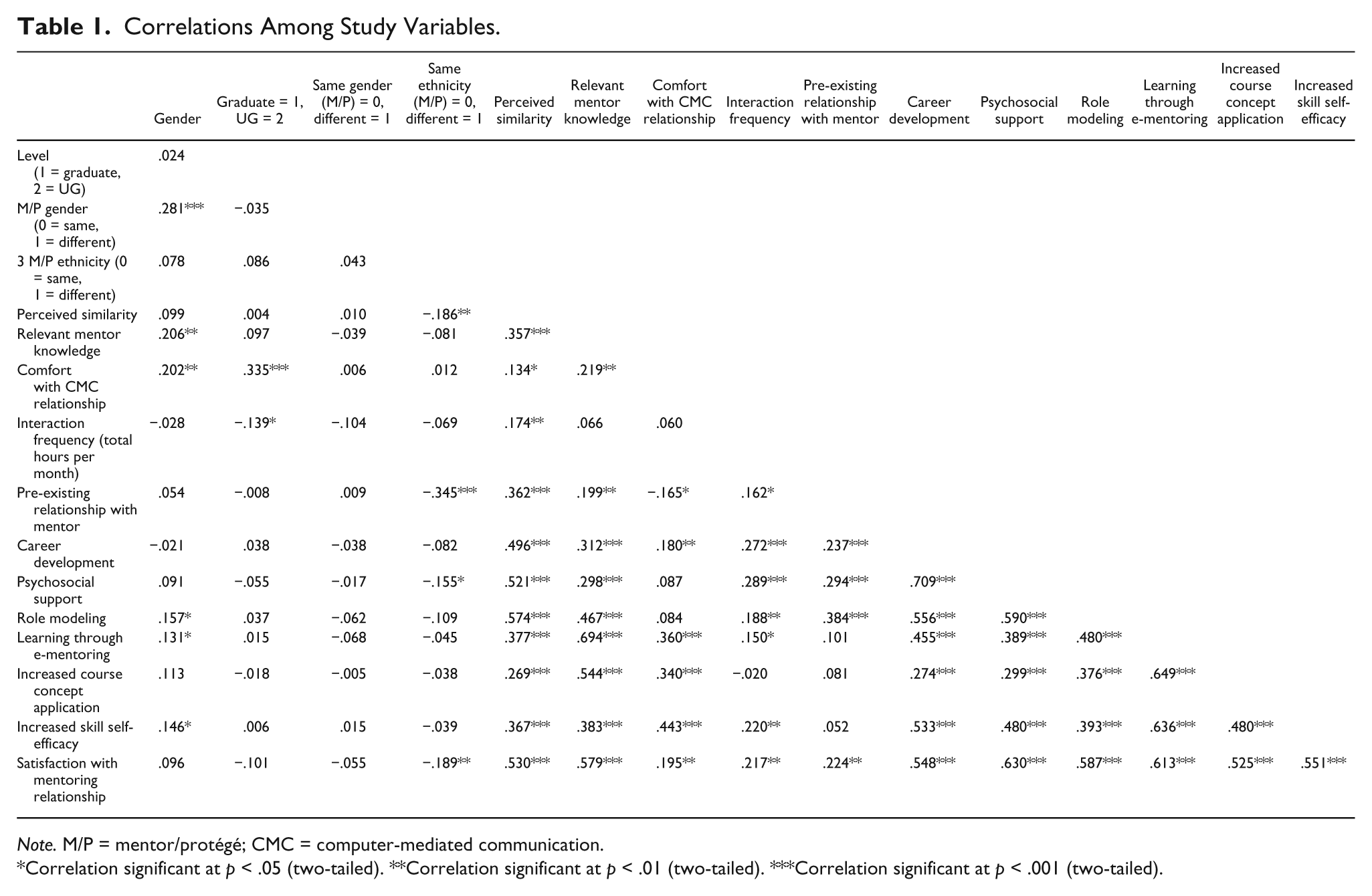
Note. M/P = mentor/protégé; CMC = computer-mediated communication.
Correlation significant at p < .05 (two-tailed). **Correlation significant at p < .01 (two-tailed). ***Correlation significant at p < .001 (two-tailed).
E-mentoring received
We used Scandura’s (1992) mentoring functions (a total of 13 items comprising three functions), modifying the language to reflect electronic as opposed to traditional relationship functions and the academic context. For most items, we changed the word mentor to e-mentor. In addition, because of the academic context and outcomes under study, we added or modified a few items to increase the relevance for respondents who had not yet entered or were not currently in the workforce. For example, we added the item “I often communicate with my e-mentor on topics that are unrelated to school” to psychosocial support. For the career development item, “My e-mentor provides coaching on performing effectively in work-related situations,” we inserted “academic or” before “work-related situations.” Finally, we took our cue from de Janasz et al. (2008) in allowing for the possibility that role modeling may occur in a virtual relationship. We believe that mentors’ storytelling in response to protégés’ questions such as “please tell me about a time when” or “please tell me about your path to your current position, including key challenges faced and how you overcame them,” can provide powerful examples of behavior that could be emulated. Whether these stories are relayed over a face-to-face lunch meeting or by e-mail, our belief, supported by protégés’ critiques, is that such interactions form the basis for role modeling.
The five-item career development function (e.g., My e-mentor provides advice on career progress) had a mean value of 3.53 (SD = 0.86) and an internal consistency reliability of .85. Psychosocial support was measured with five items (e.g., My e-mentor provides support and encouragement). We obtained a mean value of 3.61 (SD = 0.93) and an internal consistency reliability of .89 for this variable. Three items assessed role modeling (e.g., I try to model my behavior after my e-mentor); the mean, standard deviation, and reliability were 3.92, 0.68, and .68, respectively.
Protégé satisfaction and learning
Protégés’ overall satisfaction with the e-mentoring relationship was assessed using five slightly modified items from Young and Perrewé (2000; for example, Overall, I am satisfied with my e-mentoring relationship). The overall mean of this measure was 4.10 (SD = 0.75) and the reliability was .90. Three protégé learning variables were constructed and confirmed via factor analysis for this study. All items (see the appendix) were measured using five-point Likert scales. Learning through e-mentoring was assessed with 6 items; the mean was 3.97 (SD = 0.65) and reliability was .87. Increased course concept application comprised three items; the mean was 3.99 (SD = 0.67) and reliability was .80. Finally, enhanced skill efficacy was measured with three items; the mean was 3.68 (SD = 0.77) and reliability was .81.
Dyad characteristics
The dyad characteristics utilized in the study included interaction frequency, pre-existing relationship with mentor, perceived mentor/protégé similarity, perceived relevance of mentor knowledge, and comfort with CMC relationship. Protégés indicated how much time they typically interacted with their mentor using electronic means. This figure ranged from under 1 hr to over 40 hr per month with a mean of 6.0 hr. A majority of protégés already knew their mentor prior to initiating the e-mentoring relationship (62.3% did vs. 37.7% who did not). Students were barred from using family members as their mentor.
Perceived similarity was measured using a modified six-item scale previously used by Ensher and her colleagues (2002). The mean, standard deviation, and reliability of this measure were 3.67, 0.85, and .83, respectively. Two additional individual variables created for this study were assessed using five-point Likert scales. Perceived relevance of e-mentor knowledge was assessed using three items (e.g., My e-mentor demonstrated that he or she is current in the topics we discussed.); the mean was 4.28 (SD = 0.58) and reliability was .79. Comfort with a CMC relationship consisted of five items (e.g., Using e-mail to communicate with my e-mentor has enabled me to overcome any concerns I might have in approaching a stranger to ask for help or guidance); the mean was 3.28 (SD = 0.85) and reliability was .82.
Finally, we included several control variables. In addition to gender, we also included course level of the protégé (undergraduate and graduate). This control was important for two reasons. First, we expected that the graduate students (many of whom were full-time employees) would likely have a different sense of the importance of mentoring than the traditionally aged undergraduate students. Second, the graduate courses were shorter (7 vs. 15 weeks); with greater time comes the possibility for increased interaction and mentoring received.
Given the issues associated with cross-gender and cross-ethnic pairs (e.g., Ragins & McFarlin, 1990), we included two variables that represent demographic similarity of the mentor/protégé pair. Mentor/protégé gender was created as a dichotomous variable; 66.5% of the respondents were in same-gender pairs. The same type of variable was created for mentor/protégé ethnicity. Most of the protégés reported that they knew the ethnicity of their mentor (11% reported that they did not). Among those who did, 69.5% of the respondents were in same-ethnicity pairs.
Results
Table 1 displays the correlations among the study variables. Our slightly modified versions of Scandura’s three mentoring function measures shared strong positive intercorrelations, ranging from .56 to .71. A similar trend was apparent in the intercorrelations among the three learning outcomes created expressly for this study; these correlations ranged from .48 to .65.
Table 2 displays the regression results from the three models used to test the first five hypotheses. Each of the e-mentoring functions was regressed on the control variables, then the dyad characteristics. Hypothesis 1 was partially supported. Interaction frequency was positively related to career development and psychosocial support (βs were .176 and .190 [p < .01], respectively), but not role modeling. Hypothesis 2 also received partial support. A previous relationship between protégé and e-mentor was positively associated with the role modeling function (β = .177, p < .01).
Hierarchical Regression: E-Mentoring Functions as Dependent Variables (Standardized Beta Coefficients Shown).

Note. M/P = mentor/protégé; CMC = computer mediated communication.
p < .05. **p < .01. ***p < .001.
Table 2 also shows that perceived similarity is positively related to e-mentoring functions received, supporting Hypothesis 3, and is significantly related to all three mentoring functions with p < .001. The beta coefficients for career development, psychosocial support, and role modeling were .390, .411, and .407, respectively. Hypothesis 4 received partial support. Protégés’ perception of the relevance of their e-mentor’s knowledge was positively associated with the career development and role modeling functions; the beta coefficient for career development was .143 (p < .05) and for role modeling it was .266 (p < .001). Hypothesis 5 was not supported. Protégé comfort with establishing and carrying out a relationship via CMC was not related to any of the three e-mentoring functions.
Table 3 displays the output from four hierarchical regressions. Each of the three learning outcomes and satisfaction with the mentor relationship were regressed on the control variables, dyad characteristic variables, and e-mentoring received. Hypothesis 6 received partial support. Career development was positively associated with enhanced learning (β = .169, p < .05) and increased skill efficacy (β = .270, p < .001). Psychosocial support was positively related to increased skill efficacy (β = .166, p < .05). Role modeling was positively related to increased course concept application (β = .158, p < .05). Hypothesis 7 also received partial support. E-mentor relationship satisfaction was positively related to the psychosocial support and role modeling functions. The beta coefficients were .313 (p < .001) and .144 (p < .05), respectively.
Hierarchical Regression: E-Protégé Learning and Satisfaction as Dependent Variables.
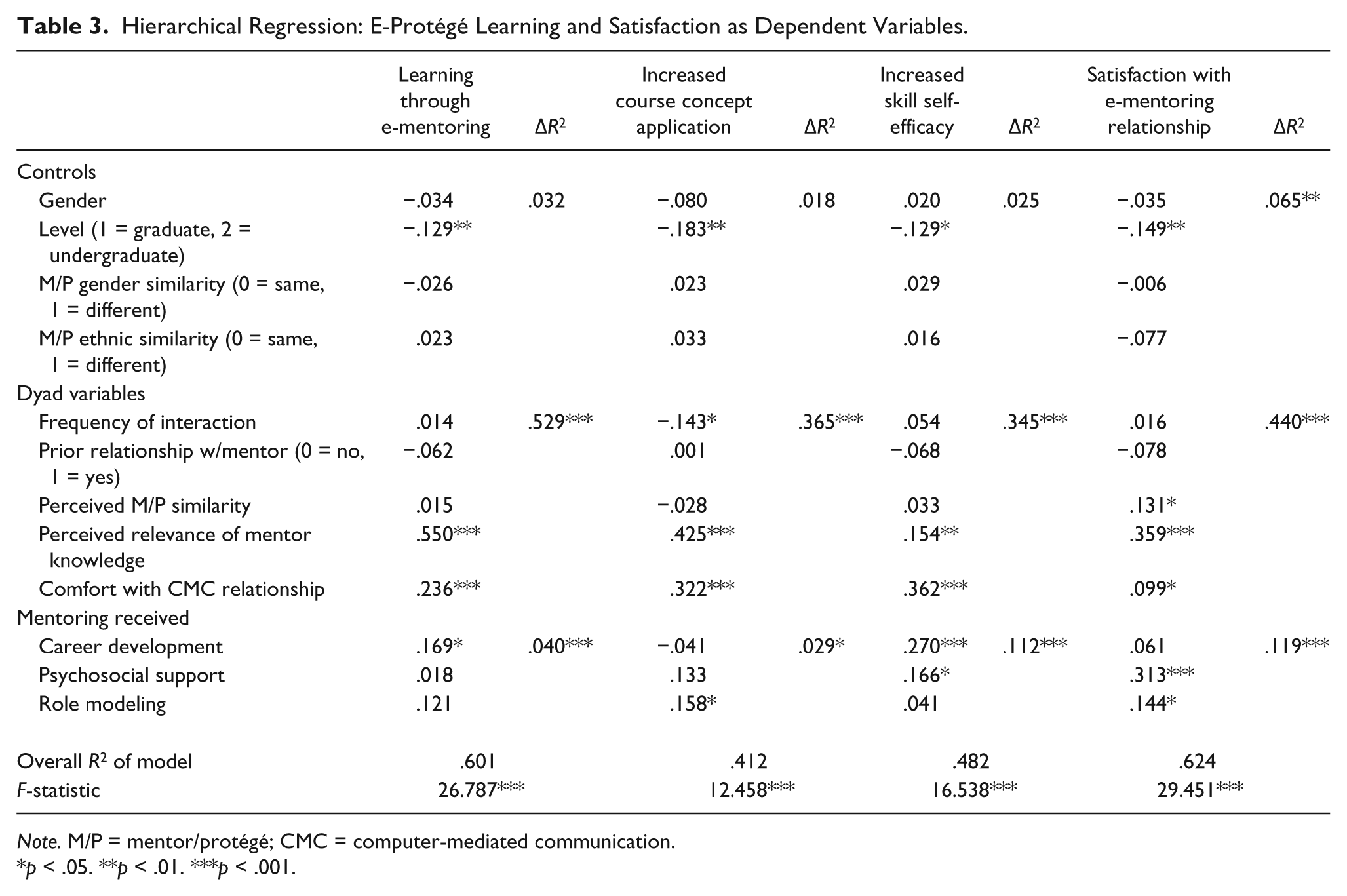
Note. M/P = mentor/protégé; CMC = computer-mediated communication.
p < .05. **p < .01. ***p < .001.
Discussion
The goal of the study was to build on and extend traditional mentoring research to investigate relationships among dyad characteristics and various outcomes when the medium of exchange is virtual or electronic. We presumed that, as in traditional mentoring relationships, protégés would learn and benefit even without meeting or communicating with their mentor face-to-face. Some of the variables tested suggested that the medium of communication was not a factor. As with traditional mentoring, the more frequently protégés interacted with their e-mentor, the greater the amount of mentoring functions received. Specifically, the greater the interaction frequency, the greater the career development (career-relevant advice and information) and psychosocial support (emotional support and acceptance) received by the protégé. However, and given that our respondents’ mentor relationships occurred almost exclusively via e-mail, interaction frequency was not associated with role modeling. Perhaps it is difficult to model one’s behavior after an e-mentor, particularly since many respondents (almost 38%) had not previously met with the e-mentor. A future study might examine the degree to which protégés recognize and utilize the role modeling of mentors who (a) started face-to-face and transitioned to virtual due to job changes, (b) started and remained virtual, and (c) started virtual and transitioned to face-to-face. Increasing career mobility makes job and geographic changes likely, so understanding when, how, and in what combination communication modes impact mentoring outcomes is important. It would also be interesting to examine whether individual differences in abstract versus concrete thinking or learning style (e.g., auditory, visual) would moderate this relationship. Protégés who are more abstract thinkers or who learn best by reading might be more able to consider their e-mentor as a role model than those who are more concrete thinkers or visual learners.
Although role modeling was not associated with interaction frequency, it was positively associated with the pre-existing relationship between mentor and protégé, as predicted. Protégés who knew their e-mentor prior to the start of their online relationship presumably chose the individual as a mentor because they had seen him or her in past interactions and considered him or her worth emulating. Prior role modeling may have continued virtually through the mentor’s storytelling in response to the protégé’s questions. The non-significant relationship between a pre-existing relationship with the e-mentor and career development or psychosocial support may suggest that such benefits are not contingent on prior, face-to-face interactions and perhaps that the pre-existing relationships were not of a mentoring nature. Taken together, these findings support those obtained from large-scale e-mentoring programs such as MentorNet and may help explain how a protégé separated by geographic and time constraints from his or her mentor may still receive the intended benefits of mentoring (e.g., de Janasz et al., 2003).
Perhaps one of the more thought-provoking findings is that perceived similarity was positively associated with the receipt of all three e-mentoring functions, while demographic similarity was not. First, mirroring research by Ensher and her colleagues (de Janasz et al., 2008; Ensher et al., 2002), our findings suggest that protégés who perceive that their mentor has similar attitudes, values, and goals are more likely to trust their mentor and the information he or she conveys. For example, a protégé struggling to maintain a balance between work and family life will be likely to heed the personal and professional advice or behavioral example of a mentor who values both domains and successfully manages work–life conflicts.
Second, following the work of Walther (1996), the findings suggest that CMC relationships work because of the similarity of values more than actual demographic similarities. E-mentoring operates much like informal mentoring relationships, wherein value similarity facilitates the trust that is slower to form in formal face-to-face mentor relationships. E-mentoring reduces negative effects associated with traditional mentoring’s face-to-face medium, which is hindered by visual cues and stereotyping (Sproull & Kiessler, 1999; Turkle, 1995). In this study, because protégés selected their mentor and 62.3% had pre-existing relationships, value similarity might be higher than it would likely be in a formal mentoring program where matches are determined by a third party, such as a human resources representative. Paralleling research on virtual teams (Martins, Gilson, & Maynard, 2004), it may be that once trust is established, communication effectiveness and information sharing in e-mentoring will equal that of traditional relationships (Alge, Wiethoff, & Klein, 2003). These results regarding perceived similarity and e-mentoring received support previous findings.
Protégés’ perception of the relevance of their e-mentor’s knowledge was positively related to the career development and role modeling functions, and this finding may unveil an important new piece in the mentoring puzzle. While past research suggests the importance of complementary skill sets between mentor and protégé (e.g., Wanberg et al., 2003), our newly developed construct explained a significant amount of variance in the receipt of career development and role modeling. One explanation arises out of formal mentoring programs, in which mentor and protégé are matched without significant regard to personal or professional preferences. A protégé paired with someone viewed as out of touch will likely give little credence to the mentor’s advice or behavioral modeling. By contrast, when a mentor’s knowledge and experience are perceived as relevant to and complementary with a protégé’s particular learning needs, the protégé is more likely to accept and value such mentoring (Allen, Poteet, et al., 1997). Taken together, these findings suggest that formal mentoring programs need to focus on the salience of matching processes that are not based only on personalities but also on discipline knowledge, skill sets, and needs so that mentors offer relevant knowledge. In fact, recent developments in the practice of e-mentoring suggest that this type of matching is effectively occurring. In 2003, Intel launched an automated mentoring website for its 100,000 worldwide employees. According to the program developer and manager, Kevin Gazzara, employees can log on to an internal website and enter up to three career interests or skills they want to develop. They then receive a list of possible mentors throughout the company; no mentor photos are supplied, despite the potential ease of doing so. Protégés select two or three mentors whose profiles match their needs and e-mails are generated inviting the mentors to participate (Owens, 2006). A similar practice is used at global accounting firm KPMG. Manny Fernandez, an audit partner-in-charge and e-mentoring program participant, notes that the matching process has been positive. “It has resulted in higher employee satisfaction, lower turnover and professionals who are better aligned with the organization and feel part of the team” (Owens, 2006, p. 106).
The prediction that comfort with the CMC relationship would be positively related to e-mentoring received was unsupported. We expected that CMC comfort would increase the ability of protégés—particularly traditionally aged undergraduates—to learn from their e-mentor because of the ease with which they initiated and communicated throughout the e-mentoring relationships. However, given the ubiquity of electronic communication in the contemporary environment, this construct may no longer be relevant for employees who have grown up in the age of the internet.
As a key purpose of mentoring is to facilitate protégé learning and development, we were not surprised that our analysis showed e-mentoring functions received predicted three different types of learning. These results were particularly satisfying given that these learning variables were tested on students who participated in an e-mentoring relationship over one semester, a short duration for a mentoring relationship. Specifically, we found that respondents reported increases in their skills/capabilities and confidence that resulted from the career development and psychosocial support received from their e-mentor (enhanced skill self-efficacy). By engaging in conversations with their e-mentor about business concepts and their importance in the workplace, protégés were able not only to enhance their skill set but also their confidence in using these skills. Our findings also demonstrate that role modeling was positively related to protégés’ ability to apply course-related topics to the business environment. Quite often, students/protégés’ questions were framed to elicit actual experiences (e.g., “Tell me about a time you faced an ethical dilemma . . . what happened and how did you handle it . . .?”). Mentors’ responses provide a concrete model—extending well beyond textbook definition—for protégés to emulate and apply in future situations. Our finding supports the use of e-mentoring to enhance student learning (Whiting & de Janasz, 2004) and reinforces the importance of e-mentoring to facilitate knowledge acquisition and application. Finally, respondents reported enhanced academic learning as a result of career development support and advice received from interactions with their e-mentor. This empirical support provides evidence that the use of e-mentoring in business environments can help protégés recognize and bridge knowledge gaps, as anecdotal reports suggest (e.g., Owens, 2006).
Finally, we found that the psychosocial support and role modeling that their e-mentor provided directly and positively affected protégés’ overall satisfaction with the e-mentoring relationship. If the mentor was judged as a credible role model and was able to provide the protégé with experiences from which the protégé could learn, then she or he would be satisfied that the relationship met this expectation (Godshalk & Sosik, 2000). The positive link between psychosocial support and relationship satisfaction was as expected and reinforced similar findings (Ensher et al., 2002). Protégés who felt that their mentor was a confidant and provided support without judgment viewed the relationship as positive and satisfying. The fact that the career development function was unrelated to satisfaction may be due to students’ expectations at the start of their e-mentoring relationship, which was a course assignment as opposed to a formal program within a protégé’s organization. Students’ first priority was to complete a project, not necessarily to experience career growth. Also, students might not have taken the opportunity to discuss future career directions with their e-mentor or it could be that experience in the workplace provides a more solid foundation for appreciating the role of mentoring in learning and career development. The findings that protégé learning and satisfaction were predicted—though not consistently—by the receipt of mentoring functions holds much promise for the practice and study of e-mentoring.
Implications
This study builds on traditional mentoring research and provides an empirical examination of how mentoring can be successful in a virtual setting. Although limited in scope, this study represents a step forward in understanding the positive impact of e-mentoring on protégé learning and satisfaction. Using a model that specified dyad characteristics of the relationship, the e-mentoring functions received, and learning and satisfaction, we were able to explain between 41% and 62% of the variation in learning and satisfaction. Even when protégé and mentor do not meet face-to-face, benefits similar to those of traditional mentoring accrue.
Taken together, our findings suggest that e-mentoring is a viable alternative or complement to other developmental relationships. The finding that perceived similarity (i.e., values and attitudes) affects the receipt of e-mentoring, whereas demographic similarity does not, provides hope for any group that has been shown to be disadvantaged in face-to-face mentoring situations. Past research shows that women and minorities tend to face great barriers in—and have a great need for—developing effective mentoring relationships in the workplace (Linehan & Walsh, 1999; Ragins et al., 2000). Furthermore, given the increasing career mobility of employees and the ubiquity of the internet and other electronic means for communicating, our study suggests that e-mentoring represents a viable means to expand a protégé’s developmental network. More mentors are preferable to fewer (Higgins, 2000; van Emmerik, 2004b), and a more diverse constellation, using both virtual and traditional communication means, is also desirable (de Janasz et al., 2003). One implication of this finding is that e-mentoring may provide a bridge to learning and development in cases when personality attributes or geographical distance may preclude the initiation of developmental relationships. In their study of networking behaviors, Forret and Dougherty (2001) found that self-esteem and extraversion were significantly correlated with proactive networking behaviors—of which mentoring is a typical one. Employees whose shyness or low self-esteem predisposes them not to initiate a developmental relationship face-to-face might find doing so online more comfortable. Over time, and as comfort with the interactions increases, the protégé might choose to meet with the mentor face-to-face, which might also enhance the potential for role modeling. In addition, should one partner in a face-to-face developmental dyad have to move to a new geographic location, the relationship need not end. On the contrary, our findings suggest that knowing one’s mentor before engaging in a virtual developmental relationship may enhance the role modeling received. Future research should explore more fully how virtual and face-to-face interactions affect protégé learning and development to better understand the individual and cumulative effects of the type, frequency, and order of interaction mode on e-mentoring effectiveness.
The use of electronic means to establish and carry out effective learning and mentoring relationships is advantageous for several reasons. Protégés in this study selected their mentor and asked her or him very specific questions to learn and build on course-related concepts and knowledge. Motivation to learn is a necessary condition for adult learning (Knowles, 1973) and since protégés asked questions as their learning needs arose, protégés were more likely to assimilate and retain this new knowledge received from the mentor. Similar results have been reported in several companies using e-mentoring programs (e.g., Francis, 2007). By deciding what development areas to work on and finding mentors with relevant knowledge, employees at a financial service company were able to tap into the skills and experiences of the company’s 13,000 employees scattered across the U.S. (Francis, 2007). In programs like these, the mentoring match choices were made by the employee, not HR. When adults are able to control the e-mentoring process, from selection of mentor to interaction content and frequency, they are able to meet their need to be independent and self-directed in the learning process (Simmonds & Lupi, 2010). In a survey by Triple Creek that examined mentoring participants in five organizations, 82% of respondents agreed that web-based mentoring gave them control over how they engaged in their relationships (Francis, 2007). This control influenced their motivation and their comfort in pursuing additional mentoring relationships. As noted by a senior HR executive: “Once people understand this new vision of mentoring, they can discover how to leverage development opportunities that exist all around them” (Francis, 2007, p. 56). Whether arranged through their company or their own efforts, employees have many simple and painless ways to connect with potential e-mentors who possess compatible values and complementary skill sets to facilitate their learning and career development.
Limitations and Suggestions for Future Research
One limitation centers on the reliance on self-reporting for the study. Although this approach is not uncommon in studies of mentoring, it does allow for the possibility of Common Method Variance (CMV). However, there are at least three reasons why we believe CMV is not an issue in this study. First, we have two predictor variables that are objectively verifiable—frequency of interaction and prior relationship with mentor—which, despite being self-reported, are relatively objective variables. Second, we ran a Confirmatory Factor Analysis (CFA) on all the items included in the study (Harman’s single-factor test) and found that as one variable, they only accounted for 31.6% of the variance, suggesting CMV is not a factor (Podsakoff, MacKenzie, Lee, & Podsakoff, 2003). Finally, we re-ran one of the regression analyses (with increased course concept application as the dependent variable) with a marker variable (hierarchical level of the mentor); the model had a slightly lower F-value (11.579) than the model that did not include it.
Because our sample consisted of graduate/undergraduate students, generalizing the findings to full-time professionals in all professions is another limitation. While over 60% of our respondents were employed at the time they participated in an e-mentoring relationship, not all were full-time nor in career-oriented positions, limiting our ability to demonstrate that the increased skill development and learning reported would translate into applicable workplace benefits. Future field studies in a variety of employment settings should replicate and expand on these findings. For example, e-mentoring may be more readily received and effective in technology-rich (or global) organizations than in low-technology environments. Future research might also examine the influence of relevant personality variables such as extraversion and learning style, as they might further explain comfort with and learning through CMC relationships.
Finally, we recognize that relationship duration may be a limitation. That these students worked on the e-mentoring project in courses that ranged from 7 to 15 weeks in duration is different from more traditional relationships that range from a few months to many years (Kram, 1985). However, these findings provide support that learning occurs in e-mentoring relationships even within short timeframes, reinforcing recent mentoring literature that suggests that individuals can receive development from a range of mentoring relationships that vary in intensity, duration, and purpose (Higgins & Kram, 2001). What may first appear as a trivial relationship may play as important a role in protégés’ development as a longer-term, face-to-face relationship. Future research should look at the impact of duration on the efficacy of e-mentoring relationships.
In sum, e-mentoring has a promising future and may provide a critical resource to the globalized workforce. By engaging virtually in a mentoring relationship, protégés are likely to accrue similar benefits as those afforded through traditional modes of engagement (i.e., face-to-face). While CMC may present some limitations, our findings suggest that by connecting electronically with mentors of their choosing, protégés enhance their learning, self-efficacy, and skills on their terms and without the need of a formal program. Although gender or ethnic differences could present problems in organizations, both in finding appropriate matches in the dyad and in carrying out the relationship without prejudice (Ragins et al., 2000), our findings suggest that perceived similarity is what matters in virtual relationships; actual demographic similarity is unrelated to mentoring received. These findings provide an important step in clarifying how dyad characteristics affect the mentoring received and learning and other outcomes. Future research on e-mentoring practiced by employees with reports from multiple sources may provide a stronger mandate for and understanding of the importance of virtual mentoring as a viable and effective complement to traditional forms of mentoring.
Footnotes
Appendix
Declaration of Conflicting Interests
The author(s) declared no potential conflicts of interest with respect to the research, authorship, and/or publication of this article.
Funding
The author(s) received no financial support for the research, authorship, and/or publication of this article.