




Abstract
Professional service firms (PSFs) are dependent on the competence of their employees to develop and retain new business. We investigate how PSFs utilize professional competence for strategic goals such as business internationalization and simultaneously facilitate professionals’ career mobility. We examine over a 5-year period the careers of 29 lawyers working in a large corporate law firm and identify four different competence regimes: technicians, project managers, competitive analysts, and global strategists. We argue that these competence regimes enable PSFs to pursue organizational business strategies while advancing or constraining or even undermining professional employees’ career goals and aspirations. Specifically, we show how the four competence regimes facilitate the PSF’s strategy to internationalize its business and support high performing employees’ social mobility goals to develop their professional competence and advance their career. We then give suggestions for future research studies on competence regimes in professional organizations.
The recent growth of global professional services firms (PSFs) that are “employing thousands of professionals in dozens of jurisdictions and generating multimillion pound profits” (Faulconbridge & Muzio, 2012, p. 143) has created substantial changes in the professions, especially in the large, elite firms. Changing modes of collaboration, competition, and work practices have been common whenever PSFs enter foreign professional jurisdictions (Boussebaa, Morgan, & Sturdy, 2012; Drolshammer & Pfeifer, 2001; Flood, 1996, 2011).
Perhaps one of the most important challenges in the globalization of businesses is that it necessitates development of new professional competences in organizations (Bartlett & Ghoshal, 1989; Caligiuri & Tarique, 2009; Prahalad & Hamel, 1990). When PSFs enter foreign markets, the new work demands can influence employers’ business strategies and employees’ professional practices, competences, and careers (Boussebaa, 2009; Morgan & Quack, 2005). A question of particular importance, then, is how professional competences in PSFs align with employers’ internationalization strategies and influence employees’ careers.
Previous studies of strategic alignment conducted in different areas of management have examined how organizational goals and employees’ careers are reconciled through distinct approaches to mutual investments in work, whereby each party might commit financially and psychologically at high, medium, or low levels to the employment contract (Boxall, 2013). Dabos and Rousseau (2004) have argued that greater mutuality, or shared satisfaction, contributes to functional employment relationships in the academic research professions. More empirical research is needed, though, on employers’ and employees’ investments in competence and the strategic alignment of competence during internationalization of professional services (Brock & Powell, 2005). It is proposed in a long stream of research on the professions that professional employees understand their work differently. Many of the individual differences are based on varying levels of work commitment and organizational identification (R. H. Hall, 1968; He & Brown, 2013; Sandberg, 2000; Schön, 1984). For example, some professionals remain primarily committed during their career to technical legal issues, whereas others develop a stronger orientation to the business of the firm and its clients (Brown & Lewis, 2011; Lansbury, 1976). Most internationalization of business involves expansion into separate legal jurisdictions and distinctive business systems (Abbott, 1988). Technical issues and business systems are both likely to be more diverse across multiple countries, potentially exacerbating challenges in achieving strategic alignment (Gerpott, Domsch, & Keller, 1988; Pinnington & Gray, 2007). Consequently, it is important for researchers and practitioners to learn more about how employers and employees understand professional competence in international business contexts. In particular, dissimilar approaches to professional competence may influence how employees relate to their organizations’ strategies for internationalization, which is likely to be important, not least since research on large globalizing PSFs frequently concludes by emphasizing the significance of organizational commitment to long-term business strategies (Segal-Horn & Dean, 2007, 2009, 2011). The purpose of this study, therefore, is to investigate how PSFs utilize employees’ competence in the internationalization of their businesses and how that utilization influences employees’ careers.
The article is structured as follows. In the next section, we review the literature on professional competence in PSFs and professionals’ involvement in PSF strategies and their own career. Our analysis of how organizations seek to organize and manage professionals draws attention to work constraints and the limited career paths available. We highlight how the PSF seeks to appropriate economic value from employees’ work and competence, and assess how employees pursue career advancement and mobility within this context. Then, we present our case study methodology and explain the background of the case (global legal firm). We subsequently report the results from the case study interviews and provide detail on four different competence regimes (within the legal firm investigated). Finally, we conclude with a discussion of the nature and extent of competence regimes and give suggestions for future research.
Professional Competence and Careers in PSFs During Internationalization
PSFs are commonly distinguished according to the service characteristics of their business and are primarily reliant on their human resources and organizational capital (Hitt, Bierman, Shimizu, & Kochhar, 2001; Hitt, Bierman, Uhlenbruck, & Shimizu, 2006; Sherer & Lee, 2002) to internationalize their business. Consistent with other researchers (Boxall & Steeneveld, 1999; Kärreman, 2010; Løwendahl, Revang, & Fosstenløkken, 2001), we make the assumption that PSFs depend on the competence of their human resources to survive and remain viable business organizations. The capacity of professional organizations to retain their best employees, in fact, has been an area of research interest for many decades in the sociology of the professions and, specifically, in research on PSFs (Larson, 1977; Løwendahl, 2005; Smigel, 1964).
Professional Competence
We define competences as complex forms of involvement that are central to how professionals conceptualize and feel about work (Sandberg, 2000; Sandberg & Pinnington, 2009). Professional competence we see as distinctive insofar as professions differ from one another in their approaches to societal institutions, knowledge, disciplines of professional practice, and professional community. Scientists and lawyers, for example, conduct, justify, and optimize their professional work based on different disciplinary ways of reasoning and forms of explanation (Malhotra, 2003; Robertson, Scarbrough, & Swan, 2003).
There is a significant amount of literature available on partners’ accounts of management and organization in PSFs and a growing number of studies on the diversity of professionals’ experiences and attitudes (Haynes, 2012; Pinnington, 2011). However, there has been little debate precisely on how professional competence enables PSFs to pursue innovative strategies such as internationalization of their business. Moreover, there is a limited amount of knowledge available on how professional competence simultaneously advances or undermines professional employees’ career goals and aspirations (Barnett & Miner, 1992; Biemann, Fasang, & Grunow, 2011). In this study, we address this omission precisely by investigating how professional competences contribute to the PSF’s strategy to internationalize its business and support high performing employees’ social mobility goals to develop their professional competence and advance their career.
Professional Competence and Careers in PSFs
While there are substantial theoretical and practical grounds for assuming there are plentiful opportunities for mutuality in employment relationships, review of the literature on PSFs provides clear evidence that meritocratic values such as those associated with career promotion tournaments for cohort groups of professional employees are often compromised or avoided in practice (Kamoche, Pang, & Wong, 2011; Parker & Rostain, 2012). The problems with maintaining fair and consistent systems of promotion are chiefly due to governance and organization forms of client and professional organizations. They perpetuate power asymmetries in business and society (Lee, 1992; Maclean, Harvey, & Chia, 2010) and between employers and employees (Nelson, 1988; Pinnington & Morris, 2002; Tolbert & Stern, 1991). Professionals employed in PSFs work in organizational fields embedded in elite ownership and controls, professional stratification, occupational segmentation, and seniority-based reward systems (Ackroyd & Muzio, 2007; Morris & Pinnington, 1998; Muzio & Kirkpatrick, 2011).
In general, PSF organizational cultures in classic (e.g., medicine, law) and relatively newer (e.g., management consulting, IT, public relations) organizations mostly tend to be elitist in values, emphasize control by small groups of powerful partners, and permit long tenure for professionals regarded as competent and reliable contributors (Alvesson & Kärreman, 2007; Pinnington & Morris, 2003). These aspects influence how competence is developed and structure professional careers in PSFs. In these complex professional work contexts, then, our main research questions are as follows:
We are interested in both how PSFs utilize professional competence and how competent performance by employees influences ways they relate to organizations’ strategies for internationalization and career opportunities. We argue that development and exercise of professional competence has the contradictory potential to reconcile and exacerbate differences between employers and employees in serving organizational goals and maintaining professional careers (Duberley, Cohen, & Mallon, 2006; Raisch, Birkinshaw, Probst, & Tushman, 2009). Our research, therefore, requires reflection on how organizations balance organizational and individual needs (Baruch, 2006; Gunz, 1989) as well as how individuals understand competence and careers (Eby, Allen, & Brinley, 2005; D. T. Hall, 2004; Litrico, Lee, & Kossek, 2011).
An enduring characteristic of the majority of the top tier of PSFs across both the liberal and entrepreneurial professions (Reed, 1996) is that they function as training grounds for cohorts of early-to-mid career professionals; in contrast, the middle and lower tier PSFs provide comparatively few formal training positions for new entrants to the profession as well as offer fewer professional development opportunities for qualified employees. Regarding career mobility, in the large elite firms, the majority of professionals are leavers rather than stayers during their professional careers and make interorganizational moves (Bidwell & Briscoe, 2010) to other PSFs or onto other private and public sector organizations.
Professionals’ Attitudes to PSFs’ Internationalization Strategies
A few recent studies of early- to mid-career professionals have identified a diverse range of individual and group perspectives in PSFs (Kuhn, 2009; Walsh, 2012). The individuals and subgroups who are at odds with prevalent work norms and practices often stand out from the others who conform more strongly to majority views. Some of these subgroups exhibit long-term resistance and follow ways of working based on traditional professional norms (Ackroyd, 1996; Levay, 2010). A few clique groups may be sufficiently productive or authoritative (Kelly, 2007) to remain in the PSF for years, or they may leave to form new practice groups or firms elsewhere (Maister, 1993). Occasionally, they sustain themselves against internal pressures for change and, based on their continuing commercial viability, preserve a dominant but elite niche within their profession (Starbuck, 1992). Empirical studies on professional and organizational commitments (Gouldner, 1957, 1958) continue to find that identification with organizational goals is stronger when professionals perceive organizational opportunities for career advancement (Wallace, 1995) and, broadly, whenever organizational identification is high and identification with the profession is low (Hekman, Bigley, Steensma, & Hereford, 2009).
Professionals’ Attitudes to Career Opportunities in PSFs
Some of the recent research on early- to mid-career professionals reports findings for individuals and subgroups who feel it is not possible to conform to some of the predominant norms of their employing organization (e.g., Kärreman & Alvesson, 2009; Mueller, Carter, & Ross-Smith, 2011). One of the more consistent themes has been differences in employee attitudes to promotion and reward systems arising from individual differences, notably, gender, race, age, education, and employment backgrounds. Unwillingness to comply with the career norms of PSFs and feelings of discrimination in relation to promotion are common problems raised in studies of gender (Kumra & Vinnicombe, 2008; Pinnington & Sandberg, 2013; Wallace, 2013), race (Wilkins, 2007), age, education, and employment backgrounds (Tomlinson, Muzio, Sommerlad, Webley, & Duff, 2013).
Among the diversity of organizational and career perspectives in PSFs is the enduring theme that only a few professionals in any cohort group are promoted to equity partner. The scarcity of opportunities for promotion in PSFs is problematic for both employers (as recruiters) and employees (as internal or external applicants). Limited opportunities for career advancement can create difficulties with organizational commitment. The problem is compounded by the unreliable role of prior work experience, which has both positive and negative effects on employee performance (Dokko, Wilk, & Rothbard, 2009). These uncertainties are then further increased by any individual’s performance being dependent upon the competence and collaboration of one’s professional colleagues (Groysberg & Lee, 2008). Therefore, how PSFs utilize professional competence for strategic goals, such as business internationalization, and facilitate professionals’ career mobility, is worthwhile investigating.
Method
Case Context
This empirical case study is situated within the context of elite corporate and niche services groups of Australian law firms that have expanded their international business less extensively than many competitors in the United States and Europe (Faulconbridge, Beaverstock, Muzio, & Taylor, 2008), but still are progressively increasing their organizations’ size and global reach. An elite group of law firms is thought by researchers to be pursuing long-term global strategies (Galanter & Henderson, 2008; Segal-Horn & Dean, 2007, 2009, 2011) and more so than before (Spar, 1997). The internationalization of service businesses has been an important contributor to Australia’s gross domestic product (GDP) growth, and the business services sector has grown strongly for an extended period so that in 2013, it accounts for 25% of Australia’s output and 20% of total employment (Manalo & Orsmond, 2013).
In our case study, we consider one corporate law firm that first attempted during the 1970s to internationalize its business, opening and later closing an office in the United Kingdom. At the time of writing, this PSF is in a more concerted phase of international expansion and has multiple offices operating in different countries across four continents. This firm is one of the Big Six Australian law firms, although it has fewer resources for transnational management than, for example, were available to some of the top 20 U.K. firms in Beaverstock’s (2004) interview study.
The firm had a comparatively large number of offices for Australian law firms. These offices were based in countries such as New Zealand, Hong Kong, China, Indonesia, Thailand, the United Kingdom, and the United States. The large size and scale of the firm meant that in foreign practitioner publications, it was within the top 20 firms worldwide when ranked by number of lawyers (“The Lawyer Global 100,” 2005; “The 2003 Global 100,” 2003). The specific choice of a single case study firm is apposite in that the firm needed to grow its client base and client services domestically and globally. Such international growth required recruiting and retaining large numbers of capable lawyers, most of whom would never become an equity partner in the firm and eventually would leave to continue their career elsewhere (Malhotra, Morris, & Smets, 2010). The case firm is similar to the other Australian firms in the Big Six, so that traditional attitudes about partners’ incomes and the leverage ratio of partners to associate lawyers meant there were only a few positions available each year for promoting professionals to partner.
Sample
With the assistance of the managing partners of the firm and the offices, partners in charge of selected areas of corporate legal practice, the HR director, and the HR team, we identified and invited a cross-section of lawyers with firsthand experience of international legal practice and, for the more senior or highly specialized lawyers, specific committee or client responsibilities for international legal work. In this investigation of professionals’ understanding of strategy in the practice of law, our research focuses on identifying variation in understanding of the business context of working as a lawyer within Big Six. To identify potential variation in understanding of strategy, the following criteria were used for achieving maximum variation in the selection of participants: formal position in the firm (junior lawyer, senior lawyer, senior associate, and partner), professional practice areas of expertise within corporate law, international work experience, gender (22 men and 8 women), and office location in major cities in Australia (16 respondents were from Sydney, 7 were from Melbourne, and 7 were from Brisbane).
Initially, 24 corporate lawyers were selected. Thereafter, 6 more were selected based on a question given to the 24 lawyers requesting them to identify 3 people in the firm whom they regarded as being outstanding corporate lawyers. One of the initial 24 lawyers was later excluded after he left the firm before the second round of interviews took place. We selected a group of lawyers who had established, led, or worked in foreign offices. For the graduate, junior, and some senior associate lawyers, due to the limited pool of lawyers with international experience, we had to reduce our sample selection criteria to professional staff who had worked in another country before joining this firm and had expressed an interest in international work assignments.
Interview Schedule
The main focus in the interviews was on understanding the wider context of lawyers’ professional work and its impact on them as individuals engaged in professional practice and employed in a large and growing law firm. The first two interview questions seek to capture the overall strategic context of the legal profession (“How would you describe the legal industry and its development: In Australia and globally?” and “How would you describe the business environment and its development: In Australia and globally?”). Four further principal questions were then asked to highlight further aspects of the competitive environment of being a lawyer and the business strategy of Big Six (“In Australia and globally, what else is important from your perspective?” “How does the Australian legal profession influence your legal and business practice [past and present please]?” “What to your knowledge is Big Six’s business strategy in the Australian market and the global market?” and “To implement this firm’s business strategy: What have you done? What management changes have been made in Big Six?”).
Thereafter, four additional principal questions guided by specific focus on the interviewee and his or her employment were asked to explore in more detail their understanding of their own career and its relationship (or lack thereof) to the firm’s strategy: “How would you compare your educational achievements to your friends and work colleagues?” “How has work influenced your networks of informal and formal social contacts?” “Some questions on your career: How did you come to choose law? How do you see it evolving? How do people get promoted in Big Six? What are your promotion goals?” and “Two questions on rewards: How are you rewarded by Big Six? Would you change the profit-sharing system? If so, how?” These principal questions were then elaborated and substantiated with follow-up questions such as “What do you mean by that?” Requesting examples was frequently used as a way of encouraging the interviewees to provide concrete illustration of their knowledge, understanding, and practice of strategy. The interviews were audiotaped and transcribed verbatim by the first author and an assistant.
Data Analysis
The first drafts of the transcripts were checked and in many places rewritten by the first author listening to the tapes and seeking to achieve precision and fidelity over wording and expression. The research process involved considerable discussion between the two authors, who were both present at the interviews and, therefore, were familiar with these conversations with lawyers. It also involved various distancing strategies and reconsideration of our theoretical preferences and interpretations of the data. Alvesson and Sandberg (2013) refer to these evaluative and critical approaches as problematization. In our study, problematization included identifying and challenging each other’s assumptions about the lawyers and their interview accounts. It also involved evaluating alternative concepts and assumptions in the academic literature on the management and internationalization of PSFs, some of which is reported in the literature review.
The data on professional competence were coded for each individual interviewee according to a specific understanding of work, self-understanding, other people, and tools. The assumption underlying this method is that it is the existential meaning of a specific human way of being that distinguishes and integrates aspects of practice, such as essential work activities, a particular self-understanding, people, and tools into a professional competence in work performance. This existential ontological perspective aims to produce an integrative conceptualization of how specific aspects of practice are brought together into distinct forms of competence in work performance (see Sandberg, 2000, and Sandberg & Pinnington, 2009, for further explanation of the method and procedures).
The purpose of our analysis was to identify specific ways of practicing law by focusing on the three interrelated dimensions in the existential ontological perspective mentioned above, namely, human way of being, others in human way of being, and things in human way of being. The coding, analysis, and interpretation of the interview transcript data were conducted by the two researchers. We followed the assumption that competence development often takes place through a transformation from a less to a more comprehensive way of practicing law. The second set of transcripts on organization strategy and careers were compared with the initial analyses, and major differences between the two sets of interviews were identified mainly in self-understanding. The research approach draws from phenomenography (Marton, 1981; Marton & Booth, 1997). The researcher identifies groups that express a distinct and particular way of practicing law. Then, for each group, one identifies how the lawyers enacting that way of working understand themselves and their work, paying particular attention to how it enables a specific competence. This concept of self-understanding and competence assumes that some groups understand their most central work activities differently (Sandberg, 2000).
Talking at length about one’s professional competence, organizational strategy, and one’s career did not yield substantial differences in accounts given by these lawyers on their understanding of work, other people, and tools. The procedure for identifying distinct competences in international work and career was assisted by the previous analysis phase of the research examining their professional competence. It was noticeable how much more constrained their accounts of PSF strategies and careers were in contrast to their lengthy descriptions of professional work and competence. An obstacle facing our study was the limited data available for generating numerous open codes that applied to several individuals, and at the same time incorporated our interpretation of their professional competence. Resolving to remain aware of alternative interpretations, we sought to achieve consistency in our analysis of the related issues of professional competence, PSF strategy, and professional career, and the results are reported in the next section.
Results
Our interpretation of the results of the analysis of the interview transcripts identifies four professional competence regimes that we propose facilitate PSFs’ internationalization strategies and offer professionals opportunities for career mobility. These we have named as follows: technicians, project managers, competitive analysts, and global strategists. These competences are analyzed in the second half of this section.
In our sample, there were 4 lawyers in construction law, 16 lawyers in corporate law, 4 lawyers in employment law, and 5 lawyers in energy and resources. These were all disciplinary areas that the firm’s partners had decided their organization had the strategic capability and reputation to internationalize. Promotion for the group of stayers occurred in corporate law (2), employment law (1), and energy and resources (1).
Table 1 lists the sample of lawyers’ hierarchical position in 2003 and 2008. Nine out of the 13 stayers were already partners in 2003, and during the study period, 4 people were internally promoted out of the 20 associates. From the 16 leavers, half of them were promoted in the external labor market, and none of them had to join a lower tier of law firm, with 8 of them working in foreign offices and around 13 engaging in international work either in large Australian law firms or in corporations.
Interviewees (N = 29): Stayers and Leavers (2003-2008).
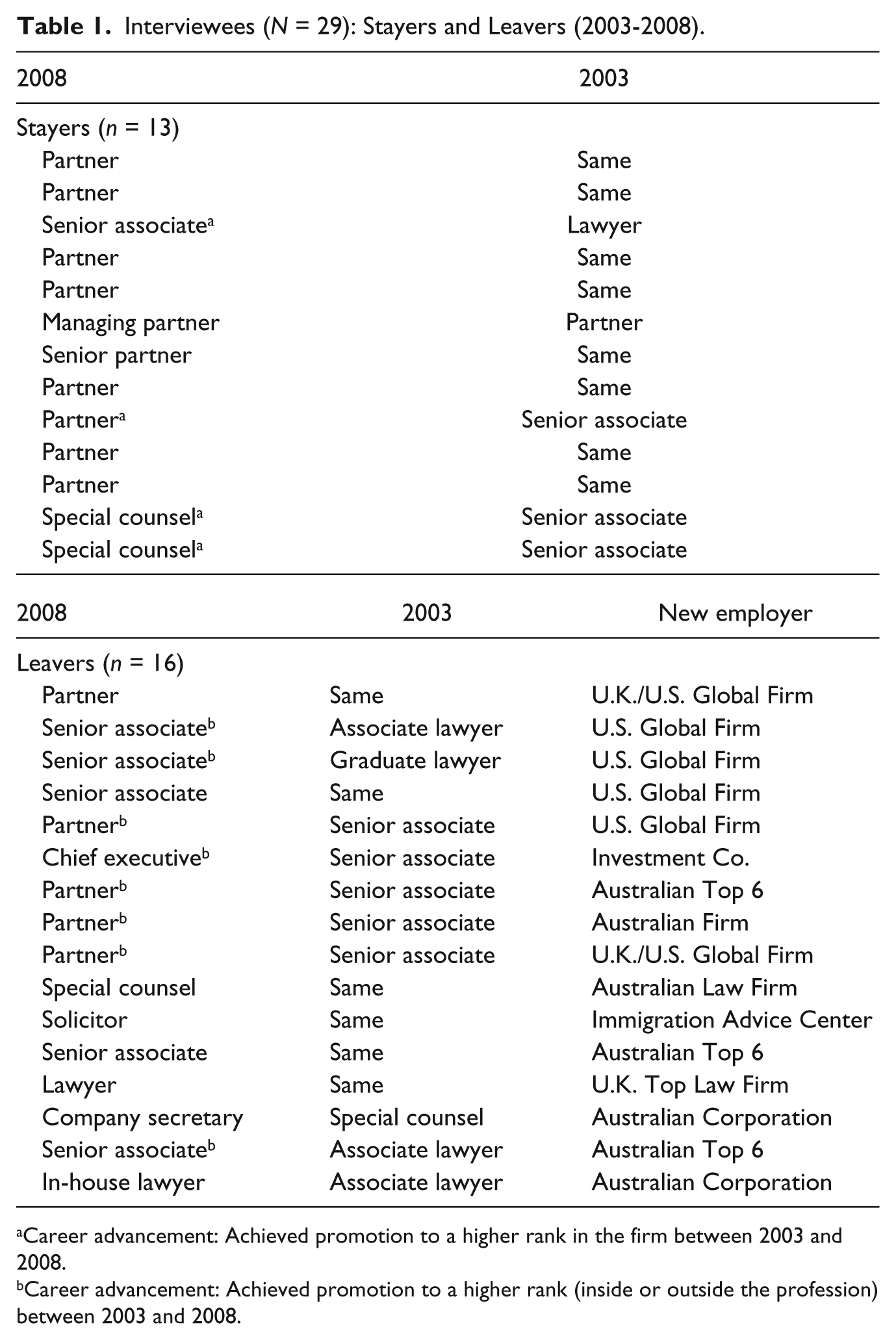
Career advancement: Achieved promotion to a higher rank in the firm between 2003 and 2008.
Career advancement: Achieved promotion to a higher rank (inside or outside the profession) between 2003 and 2008.
The firm retained all but one of the lawyers we identified as global strategists and also retained several (3) of the competitive analysts (see Table 2). Considering competence as a regime appropriated to varying degrees of success by organizations, then the evidence is that the case firm was successful in retaining its professionals with the most comprehensive strategic competence. Understanding competence as a regime with capacity to give some employees who are not promoted mobility in the external labor market, then the employees who left all achieved either lateral moves on the external labor market or were promoted. Interestingly, the majority of this group of lawyers moved on to positions with increased work responsibility in international legal business. It is fair to assume that the firm may have retained more of them if there had been sufficient growth in international business to provide more internal opportunities for promotion to partner. For example, the lawyers working in construction, except for the incumbent partner, all left the firm. It is also worth noting that none of the four lawyers who were promoted and stayed were global strategists (Technician, 1; Project Manager, 1; Competitive Analyst, 2); we assume that this competence profile is chiefly because the most comprehensive competence is hard to develop prior to obtaining the hierarchical level and authority of a salaried or equity partner.
Allocation of Lawyers (N = 29) Into the Four Competence Regimes.

The lawyers’ knowledge and evaluation of the firm’s international strategy were influenced by their experience of legal practice outside of Australia more so than international legal tasks derived from inbound work to Australia. Those individuals with experience of working in foreign offices of the firm or in other law firms based in other countries compared and contrasted them, supplying examples and analogies with the firm’s Australian environment, organization, and work practices.
I think Australia has borrowed bits and pieces of the . . . sector . . . of law that I do, the core corporate sector from the UK. I think what it has tended to do . . . reasonably well is . . . pick up some of the better practices from different places. Takeovers in public companies, they changed the law to far more closely the UK system . . . The system of corporate governance and disclosures is probably a little behind Britain’s but ahead of America’s . . . Possibly what Australia does is it . . . takes . . . the best aspects of all systems, puts it together and actually has quite a good system. (Senior Associate)
Their knowledge and understanding of strategy was diverse and embodied in the particular circumstances of their own educational background, legal practice experience, competence, access to clients, career progression, and sense of achievement. For example, only equity partners have routine access to formal strategic planning for the law firm.
I don’t think the globalization of the legal industry really became an issue until at earliest, six or seven years ago, maybe. I mean I became a partner about seven or eight years ago so I suppose I wasn’t really privy to it before that. (Partner)
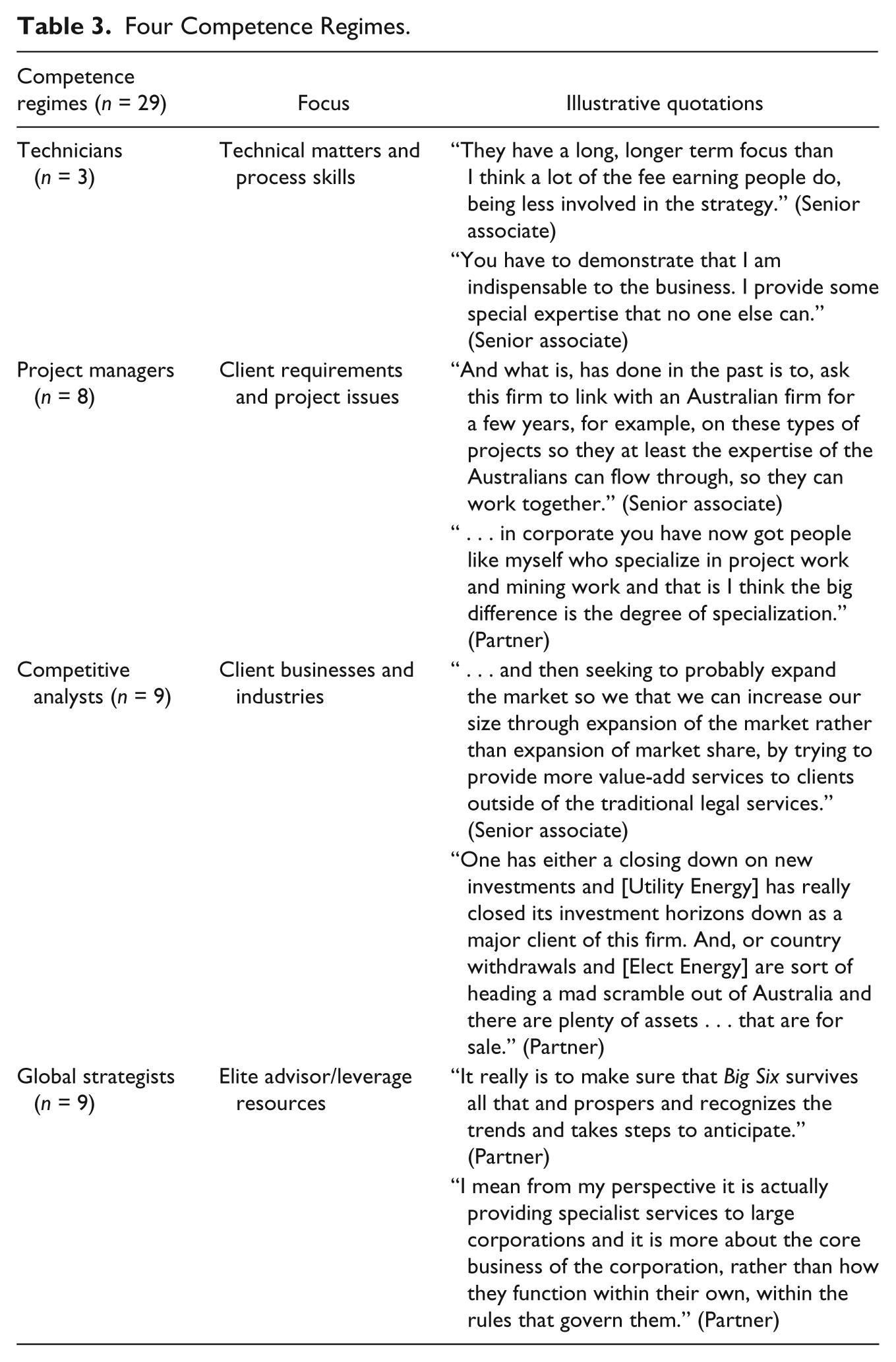
Nevertheless, we interpreted that their different approaches to work divide into four distinct competence regimes represented in Table 3.
Four Competence Regimes.
Technician Competence
This competence regime we propose is typical of lawyers who adopt a technical approach to legal competence. They focus on professional knowledge and demonstrate only a rudimentary knowledge of the firm’s internationalization strategy and its business strategies for new and retained clients. Their accounts of the business, its general business environment, its strategy and business operations, the strategic actions of competitor firms, and the clients’ businesses and industry environments we propose are sketchy and make few connections between technical matters and business issues. Often, they will perceive communication with clients as predominantly a matter of technical communication in straightforward ways that clients are likely to understand.
Mean that you . . . I think it is important to temper your advice to your client and I don’t necessarily give some clients one type of advice and another client a different type of advice. You just offer that advice in a different way and a different manner. Some clients would prefer you to be far more academic in your approach. Other clients would prefer you to be far more commercial and direct. (Senior Associate)
Lawyers with this understanding and approach to competence often seem to value technical perfection as an end in itself. Their main work interest is in the enactment of the skills of their profession. They concentrate on accomplishing legal matters by identifying and minimizing legal risks throughout each step of the transaction, such as in taking instructions, conducting legal analysis, and documenting and negotiating the deal. Their strong legal focus means that they are not particularly active in assisting clients with improving their commercial position. It can be expected that trainees and junior lawyers will more often exhibit a technical analysis confined to their level of authority and expertise, often being engaged primarily in developing their legal skills.
. . . If you stay with them, what are your promotion goals would you say?
Probably nothing for a couple of years until I think I, it takes a lot to prove yourself and to get your skills up and then after that I mean within, in a law firm it is to try and be a senior associate I guess and one day a partner.
However, some professionals will maintain the technician approach to competence throughout their whole career. To maintain work in competence regimes in international business, they will have to be flexible enough to incorporate technical areas of international legal work. These fields will to some extent be dissimilar to the professional jurisdiction of their education and training.
Project Management Competence
This competence regime we propose is typical of lawyers who adopt a project management approach to legal competence. Many lawyers work in small groups and deployment of temporary project teams is normal in many one-off transactions, such as in corporate law.
These lawyers reveal a more thorough knowledge and understanding of some aspects of the clients’ business although largely circumscribed to the scope of the projects they work on. This group can be distinguished from the group of lawyers imbued with a technician approach to competence by their greater capacity to integrate some of the technical aspects of their professional practice with general or specific business issues in the client organizations whose projects they have worked on. Their interest in strategy is constrained to what they perceive to be the environmental necessities and practical tools for obtaining, managing, and completing their projects. This relationship-based project management competence regime is biased toward project provision of legal services and in general motivates concern for the business strategy of the PSF (and its clients, competitive environment, and competitors’ strategies) only insofar as it assists progress and completion of the project.
I mean, my role is really looking at all of the arrangements required for development, project delivery, construction, and the operational contracts that flow out of it. I mean, generally projects would take anywhere between 6 to 18 months. At varying levels, you might have 2 or 3 up to 10 lawyers working on them. Handling all the different aspects of the transaction. (Special Counsel)
Project manager competence in international business, therefore, requires a willingness and capability to learn new ways of managing international projects that satisfy clients and partners.
Competitive Analyst Competence
This competence regime we propose is typical of lawyers who adopt a competitive and analytical approach to legal competence. This group is distinguished from the previous two by their capacity to demonstrate a thorough knowledge and understanding of the client’s business(es) and strategic environment. They use this knowledge to evaluate the client’s goals, attitudes, and motivations.
This group of lawyers can expound at length about the industry environment and strategies of their client and some of their competitors. They often interleave this information with analysis of the strategy of their firm and some of their major law firm competitors. Overall, they are able to relate their firm’s own legal practice to a developed knowledge and understanding of the client’s business and its strategic environment.
. . . are sort of heading a mad scramble out of Australia and there are plenty of assets that don’t have, that are for sale but don’t have for sale signs up on them yet, in the electricity industry. People . . . paid a premium to get into the Australian market, found it was a tough market like any other and pulled out and it is exactly the same scenario [that] happened in the banking industry in the eighties when there were forty foreign banks, country banking licenses granted or thereabouts and I would be surprised if there are five left . . . And likewise, . . . with the U.S. utilities they are pulling out. And the . . . new ownership tends to be Asian or occasionally European and look the freeing up of the Australian equity markets has tended to mean that there are occasional listed vehicles. (Partner)
They show interest in the international strategy of the PSF, assisting clients and peer professionals to achieve their objectives by leveraging the firm’s reach and scope in the global marketplace. Competitive analysts can talk in detail about some of the international activities of Big Six and relate them to the home country’s strategic controls and operations. To be effective in international business, they need to develop their exposure to these environments and learn about how clients’ organizations and business operate in these contexts.
Global Strategist Competence
This competence regime we propose is typical of lawyers who adopt a strategic and global approach to legal competence. These lawyers demonstrate a comprehensive knowledge and understanding of business, the general business environment, the strategy and business operations of the firm, strategic actions of competitor firms, and the clients’ businesses and industry environment(s). Frequently, in their accounts, they explore and evaluate a wide range of general and specific technical and business issues. These lawyers enjoy an excellent reputation with significant networks of clients and peer professionals.
These professionals are unusual for their capacity to articulate and balance the claims of a wide range of stakeholders in the domestic and international environment, both in client organizations and in law firms. They will talk in detail about the importance of managing the PSF, for example, sustaining a competitive advantage through having top quality skills and resources, and maintaining the firm’s reputation with clients for professional services. These lawyers behave much like owner-managers and are global in their approach to strategy.
They can expound in depth on a range of challenges facing the firm, considering the practicalities of internal management and strategic implementation in the light of the resources and capabilities of the firm. Their talk demonstrates an interest in the global business environment and differences between client organizations, industries, and practice environments. Their knowledge and understanding of the business environment is enhanced by their access to multiple sources for information on competitor’s activities as well as from their legal practice and social networks of senior figures in business and government.
Younger lawyers in this group will articulate the same drive toward a meritocratic and responsible sharing of the business. The understanding of strategy in this group is closely related to leadership of the firm and maintenance of the collective organization. They demonstrate a shared vision of what constitutes a worthwhile equity partner. A viable partner in this firm is promoted as someone who is competent in networking with clients, ensures quality technical outputs and motivates team working and, in addition, is an excellent performer in at least one of these areas.
Because the way of developing is to develop client base and then get a young lawyer working with part of it, give it to that, sort of encourage those clients to work with that partner and then go off and develop more or, and allow that to foster. (Partner)
In summary, this competence regime focuses on the business of major corporate clients and on participating as a significant member of their business and social communities. Global business ambition is set within the domain of existing and possible future relationships with clients and client organizations. Their analysis of the external environment is reconciled with what they consider to be realistic for leveraging the firm’s resources.
Discussion
During the period studied (2003-2008), internationalization of the law firm did not impact substantially on the retention of the sample of incumbent partners, and 20% of the sample of associates was promoted to equity partner or special counsel. All of the interviewees who left the firm continued in their chosen occupation as lawyers, and 50% of them obtained positions in global Australian, U.S., and European law firms. Given that the majority of associates left the firm, pursuit of international legal business subsequently was deployed for the competitive strategies of other firms (Bidwell & Briscoe, 2010; Hekman, Steensma, Bigley, & Hereford, 2009; Hitt et al., 2006). While we do not have access to data on the extent that international business grew for the firm during this period, it retained all but one of the nine lawyers we identified as global strategists. The case firm continues to have foreign offices in Europe and Asia in 2013 and remains committed strategically to internationalization of its business.
Professional Competence as an Appropriation Regime and Means of Career Mobility
These competences we have identified can function as formal and informal appropriation regimes which preserve the critical firm-specific client contacts and knowledge by hoarding key professional and business connections among global strategists and, to a lesser extent, competitive analysts, many of whom are partners. In several ways, these four competence regimes facilitate sets of work attitudes and behaviors within which employers and employees can establish and achieve mutual goals (Kamoche & Mueller, 1998; Kamoche et al., 2011; Whitley, 2003). Our research based on a single case study is exploratory and has enabled us to develop some new ideas about the capacities of competence regimes in (law firm) PSFs. The global strategists have professional authority in law and high strategic agency in the firm’s business. Moreover, they will often have special network relationships with the firm’s lawyers and clients (Anderson-Gough, Grey, & Robson, 2006). In the context of increasing internationalization of the legal profession, growing demand from global clients for customized services, and the tendency for many global strategists in PSFs to secure lengthy periods of tenure as equity partners of the firm, an implication for practice is for employers to implement organizational systems that sustain global strategists’ competence in global business and their individual reputations in elite organizational networks (Greenwood, Morris, Fairclough, & Boussebaa, 2010).
In comparison with global strategists, the technicians, project managers, and competitive analysts, we suggest, have stronger task commitments to execute the day-to-day professional work. Competitive analysts will often have credibility and reputation in specific areas of professional practice, combining it with strategic knowledge and understanding of certain industries. Competitive analysts occupy a competence regime based on several years of in-depth work experience in particular areas of industry and commerce (or government). Individuals with this approach to professional competence are likely to be or become recognized leaders and mentors of small groups of senior associates (Lazega, 2001).
Technicians, as an approach to competence, have high commitments to the pursuit of technical expertise and this competence regime is most commonly, although not exclusively, populated by trainees and junior lawyers. Those professionals who exhibit commitment to the technician approach throughout their career depend on the PSF retaining their services based on their technical expertise. They might remain with the firm because their expertise has been identified strategically as an area of talent shortage or is considered to be high potential for the future (Malhotra et al., 2010). Alternatively, their retention may have other explanations, such as high social capital value or in-group favoritism.
The project managers hold a bridge position between technicians and competitive analysts. They are managers of small teams of lawyers and can be relied on by clients and their superiors to plan, organize, and manage the operational execution of professional work tasks. Professionals working in project manager competence regimes have temporary access to firm-specific capital largely defined by the strategic value of the projects they are assigned. Their internal mobility is defined by their individual career interest and the support they maintain within the PSF to develop their competence as competitive analysts and global strategists. Their external labor market mobility is similarly circumscribed by the perceived value (Lawrence, 1990) of their project manager approach and competence regime. For example, their project experience and achievements may be evaluated by others outside the firm as relevant for work as an in-house lawyer or on similar projects in a competitor PSF.
Employee mobility means it is likely that the PSF will fail to appropriate long-term gain from many of its professionals (Mueller & Dyerson, 1999), whereas the professional labor market and client industries are likely to derive benefits from the physical movement of human resources to other organizations. It is common for PSFs to pursue international business in foreign countries through projects rather than immediately establishing an office (Krull, Smith, & Ge, 2012; Malhotra & Hinings, 2010; Malhotra, Morris, & Hinings, 2006), and a practical implication of this study is that the competence of the project manager is an area that can be more systematically addressed by PSFs through giving greater attention to project management methods of strategic alignment, employee resourcing, and career development. A further general implication for practice is PSF employers could address more systematically how employees can learn from projects (Swan, Scarbrough, & Newell, 2010). Most specifically, they should identify how lawyers exhibiting project manager competence can be developed to increase employees’ contribution to implementing PSF strategy.
In our sample, one or two lawyers each, from three of the competence regimes (technicians, project managers, and competitive analysts), achieved internal promotion, and their learning about and involvement with international legal business was sufficient for 50% of leavers to gain employment in top global law firms. Viewed from the perspective of the global law profession, the concept of professional career functioned effectively for this group of high potential lawyers insofar as it provided either internal promotion or career mobility on the external labor market (Baruch, 2006; Malhotra et al., 2010). Half of the leavers moved to higher ranked global law firms, and 50% of them are now partners, so this gain in formal position and organizational status will have been a positive form of psychological mobility across boundaries for a good proportion of them (Inkson, Gunz, Ganesh, & Roper, 2012; Sullivan & Arthur, 2006). Leavers voiced mixed impressions regarding their physical mobility. Several lawyers gave positive accounts about working in another country, while others said they preferred to remain in Australia and would have stayed with the firm if they had been promoted.
Although the promotion system in the firm operated to the benefit of a comparatively small group of partners, it did not significantly interfere with the general capacity of the sample group to obtain equivalent work in the occupation in other firms (Dobrev, 2012). This outcome is evidence that the competence regime simultaneously functions to maintain the organizational hierarchy of the firm while also contributing, over time, competent legal practitioners to the professional jurisdictions of global law firms and domestic and global corporations (Løwendahl, 2005). Given the high amount of variation across professional organizations in characteristics such as knowledge, values, clients, and work locations (Fincham, 2012; Morris & Empson, 1998), further research should be conducted to evaluate how competence regimes can accommodate diversity to offer mutual governance, task, and career goals for employers and employees.
Worthwhile areas for future research on competence regimes include comparative case studies of competence regimes in contexts of corporate professionalization and collegial professionalization (Cooper, Hinings, Greenwood, & Brown, 1996; Faulconbridge & Muzio, 2008; Lazega, 2001). Our competence regimes are analogous to Maister’s (1993) oft-cited distinction between “finders, minders, and grinders.” The technicians and project managers are primarily grinders, competitive analysts are often suitable for management roles (i.e., grinders and minders) and global strategists are competent owner-managers and entrepreneurs (i.e., minders and finders). Moreover, they show how professional competence can contribute to PSF and neo-PSF goals. Attention might also be given to areas of professional practice where knowledge asymmetry is not so great, such as in some industry-academe collaborations (Lam, 2007). These competence regimes assist professionals to work with people from different occupational roles, such as external and in-house lawyers as well as with people from different professions and occupations, such as lawyers collaborating on a major merger and acquisition with diverse client organizations and consultancy teams (Malhotra & Morris, 2009; Pinnington, Kamoche, & Suseno, 2009). Whereas our study’s findings support the idea that these four competence regimes comply with comparatively traditional “classic” PSF systems of professional governance and management (Greenwood, Hinings, & Brown, 1990; Von Nordenflycht, 2010), further research can contribute to our knowledge about how competence regimes change, decay, and evolve at individual, organizational, and institutional field levels (Lounsbury, 2008; Smets, Morris, & Greenwood, 2012). Concepts of professional and bureaucratic work commitments, global and local career orientations, have more than 50 years of research literature (Scullion, Collings, & Morley, 2007; Edström & Galbraith, 1977; Hall, 1968; Pinnington & Morris, 1996). New studies could be designed to assess how far the project, industry, and global business orientations of the project manager, competitive analyst, and global strategist that are identified in this research are a response to recent changes in business and management (Galanter & Henderson, 2008; Jennings, Jennings, & Greenwood, 2009).
We acknowledge that other PSFs with more of a “star” culture (Starbuck, 1992) or a “global professional network” strategy (Brock, 2006) may yield other theoretical codes and categories than the four competence regimes that we identified in this firm. Our argument is not that these are the sole competence regimes exhibited by individuals, groups, and organizations. We accept that by concentrating on a group of talented employees we have ignored perspectives of those who felt that they had less to gain from their work or organization (Mueller et al., 2011). Another limitation of this research is that by focusing exclusively on professionals in law, our study on competence does not acknowledge the important contribution made by management professionals (Empson, Cleaver, & Allen, 2013). However, our research has highlighted major organizational differences between incumbents and the leavers—successful lawyers who often leave for partner positions elsewhere (Hassard, Morris, & McCann, 2012). Future research studies should examine more precisely how far PSFs are dependent on increasing their international business based on sustaining competence regimes that retain high performing professionals with technician, project manager and competitive analyst approaches.
Studies of incremental and radical innovation in professional fields would be especially helpful to identify how far innovation activities are compliant with the norms and values of the competence regime and to what extent they arise and are diffused in contexts of highly socialized individual, group, and organizational agency (Anand, Gardner, & Morris, 2007; Jennings et al., 2009; Kärreman, 2010). Future research should investigate the rigidities and flexibilities of these regimes of professional competence as ways of understanding self, work, and others (Brivot, 2011; Gibson, 2003). Moreover, their functional and dysfunctional contributions to professions, business, and society will be of interest (Duberley et al., 2006). Macro-level studies of employment systems and resource flows of professionals utilizing data from different sources, such as government-supported research, professional institutes, university–employer associations, employers, recruitment consultants, and academic researchers, could be especially useful. More knowledge is needed on employee resource flows and career systems in PSFs and their influence on competence in professional occupations (Biemann et al., 2011). Future research in such areas should then contribute to existing academic and practitioner knowledge of competence and its management.
Conclusion
The aim of this study was to investigate how PSFs appropriate professional competence for strategic goals such as business internationalization while simultaneously accommodating professionals’ career mobility. We developed the concept of competence as an appropriation regime, which, we have argued, enable PSFs to pursue organizational business strategies while simultaneously advancing and, to varying degrees, constraining or even undermining professional employees’ career goals and aspirations. Specifically, we have shown how the four competence regimes—technicians, project managers, competitive analysts, and global strategists—contribute to the PSF’s strategy to internationalize its business and support high performing employees’ social mobility goals to develop their professional competence and advance their career inside and outside of the employing organization. We conclude these competence regimes are complex, and as yet under-acknowledged, resources that possess potential for systematic implementation of employers’ PSF internationalization strategies and for individuals’ enactment of career aspirations.
Footnotes
Acknowledgements
Our thanks to The University of Queensland Business School for additional internal funding support for the interview data collection and to the lawyers and managers in Minter Ellison who participated in the research.
Declaration of Conflicting Interests
The author(s) declared no potential conflicts of interest with respect to the research, authorship, and/or publication of this article.
Funding
The author(s) disclosed receipt of the following financial support for the research, authorship, and/or publication of this article: The authors gratefully acknowledge funding from the Australian Research Council (ARC), Strategic Partnerships with Industry - Research and Training (SPIRT) Grant C00107500, October 2000. The ARC grant was held (2001-2005) at The University of Queensland and University of Western Sydney.