




Abstract
We examine the role of self-monitoring personality in shaping network change in two important types of social relationships. In a two-wave social network study, we find that individuals with higher levels of self-monitoring derive persistent personality-linked in-degree centrality benefits in the general socializing network but have fading benefits over time in the close friendship network. Simultaneous examination of the formation and dissolution of relationships over time (network churn) reveals that this pattern of network change is shaped by differential reactions of relationship partners to individuals based upon level of self-monitoring in the two network types. Overall, by incorporating the dynamic reactions of relationship partners, the findings contribute to the understanding of the complex relationship between personality and social network development.
Keywords
Informal social relationships among employees are an important component of the structure of an organization. These informal relationships that range from deep personal friendships to mere casual acquaintances (Sandstrom & Dunn, 2014; van de Bunt, van Duijn, & Snijders, 1999) often enable quick, friendly, and efficient action by cutting across formal organizational structure. Informal social networks are considered crucial for efficient task completion, organizational performance, and organizational innovation (Cross, Nohria, & Parker, 2002; Cross, Parker, & Borgatti, 2002; Krackhardt & Hanson, 1993; Lowell, Matson, & Weiss, 2007). These informal social relationships also serve individual interests, for instance, by providing an important basis for job satisfaction and a continued desire to work in an organization (Cross, Nohria, & Parker, 2002; Mossholder, Settoon, & Henagan, 2005; Roberts & O’Reilly, 1979). Individuals occupying central and strategic positions in informal social networks exhibit higher performance, faster promotions, and greater creativity (Baldwin, Bedell, & Johnson, 1997; Burt, 1992; Jokisaari, 2013; Mehra, Kilduff, & Brass, 2001; Perry-Smith, 2006; Sparrowe, Liden, Wayne, & Kraimer, 2001), reflecting potentially valuable individual contributions to organizational outcomes.
The structure of social networks emerges from the efforts people make to shape their social relationships. Individual agency in shaping relationships is tied, in part, to personality. The effects of personality in shaping social relationships can be examined for similarity (e.g., the extent to which similar/dissimilar personalities attract or repel; cf. Lee, Qureshi, Konrad, & Bhardwaj, 2014) or level (e.g., the extent to which level of personality type is associated with the number of friendship ties). In the latter stream of research, prior research has identified the role of self-monitoring personality (Mehra et al., 2001; Sasovova, Mehra, Borgatti, & Schippers, 2010) in shaping friendships and acquaintances (Oh & Kilduff, 2008) as self-monitoring theory offers a strong theoretical basis (Kilduff & Brass, 2010) toward understanding the development and maintenance of relationships (Sasovova et al., 2010).
To understand the development and persistence of social relationships, however, it is important not only to consider just the personality (level) of one individual in the relationship (e.g., higher self-monitoring) but also to systematically examine the reactions over time of the relationship partners to the personality of the focal individual (e.g., higher/lower self-monitoring). Reactions of the relationship partner such as exits from relationships or the continuation of relationships are important because as Kilduff and Brass (2010) note in their review of social network research, if an individual tries to shape relationships solely to their advantage then other individuals may resist such maneuvering. Research incorporating reactions of relationship partners, however, is highly limited (Kilduff & Brass, 2010) yet crucial to understanding the development and maintenance of social relationships. This is particularly true in the context of self-monitoring personality. As Sasovova and colleagues (2010) note, “self-monitoring is primarily a theory of the impressions individuals create in the eyes of others” (p. 650), so bringing in the others or the alters/relationships partner for their reaction to self-monitoring personality is important. More broadly, this focus is also aligned with a call for greater attention on alters or relationship partners (e.g., Kilduff & Brass, 2010). In the current article, we seek to advance theory by systematically understanding the reactions of relationship partners over time to individual self-monitoring personality.
In examining social relationships, it may be important to distinguish between types of relationships as relationships serve a distinct organizational purpose. As van de Bunt et al. (1999) note, people typically make distinctions between close friends and friendly acquaintances. The strongest informal relationships are close friendships, which are characterized by high degrees of intimacy based upon mutual self-disclosure and support (Brissette, Scheier, & Carver, 2002), particularly, emotional support (Fehr, 2004). Past two-wave research examining the influence of self-monitoring on relationships (Sasovova et al., 2010) has limited itself to examining friendships, which have the potential to be confused with friendly relations that are not intimate and based on mutual self-disclosure and support sharing. Building on prior research, we seek to clearly delineate the specific effects of self-monitoring personality on close friendships as distinct from other friendly ties.
In addition to close friendships, people also engage in less intimate relationships as reflected in their set of acquaintances (Oh & Kilduff, 2008). For instance, interactions emanating in an organization at a company-sponsored general socializing event (e.g., happy hour, dinner, etc.) may lead to new acquaintances. In contrast to close friendships, individuals engage in less self-disclosure and more impression management with casual acquaintances to project a socially desirable self-image (Rosenfeld, Giacalone, & Riordan, 1995; Vohs, Baumeister, & Ciarocco, 2005). Individuals typically restrict conversation with casual acquaintances to topics of general interest. In our article, we separately measure and then explore the behavior of relationship partners in these two types of relationships.
Crucially, distinguishing two types of relationships (general socializing and close friendship) enables us to simultaneously compare and contrast the differences in the reactions of relationship partners with self-monitoring behavior across two different types of network ties. Furthermore, in conducting a two-wave social network study, we capture the differential change in reactions of relationship partners to self-monitoring behavior across the two relationship types. Consequently, by incorporating the differential reactions of relationship partners to self-monitoring personality in the two relationship types, we are able to develop a more comprehensive theory of the influence of self-monitoring personality on personal network development.
The two types of social relationships that we examine in our study play crucial but different roles in organizational life. Specifically, close friendship networks involve trust, intimacy, and emotional proximity (Coleman, 1990; Krackhardt, 1992; Obstfeld, 2005; Radmacher & Azmitia, 2006). Such ties are associated with openness to more sharing of sensitive information and valuable resources, engagement in both positive and negative gossip, and cooperating to implement changes that appear contrary to self-interest (Coleman, 1990; Ellwardt, Wittek, & Wielers, 2012; Grosser, Lopez-Kidwell, & Labianca, 2010; Obstfeld, 2005). Research identifies mutual validation, positive regard, and generalized exchange as dimensions of close friendships (Radmacher & Azmitia, 2006). Close friendships are particularly important for deeper collaboration as well as for political mobilization and for achieving harmony and consensus in organizations (Krackhardt, 1992; Nelson, 1989). In contrast, general socializing relationships are more superficial and practical where mutual validation, positive regard, and generalized exchange are not necessary. Such relationships are valuable in organizations for facilitating crucial flows of information and knowledge in dynamic business environments and for knowledge work. Thus, both types of relationships play different but important roles in informal organizational life.
In sum, using two types of relationships, which serve distinct but important purposes in organizational life, we examine the reactions of relationship partners to self-monitoring personality in shaping the two types of relationships. Prior research has not examined both types of relationships simultaneously in a two-wave research design. In doing so, our study is among the first to develop theory about how self-monitoring personality has distinct effects on the structuring of different types of social networks due to the differential reactions of relationship partners over time.
Self-Monitoring Personality and Social Relationships
According to a simplistic rendition of the self-monitoring theory (Snyder, 1974, 1979), individuals higher on self-monitoring are able to control and adapt their self-presentation to social situations, develop information about others, and adapt their images in suitable ways. In contrast, individuals lower on self-monitoring do little to adapt their self-presentations to social situations and express their true thoughts and feelings in social interaction. Theory and empirical evidence suggest that higher self-monitors, because of their adaptive “chameleon-like” (Mehra et al., 2001, p. 121) behavior, present themselves as attractive relationship partners to others. Such adaptive behaviors enable higher self-monitors to occupy central positions in the network of informal social relationships in organizations (Fang et al., 2015; Sasovova et al., 2010).
Higher self-monitors attract more relationship partners than individuals lower on self-monitoring; however, they may also be prone to experiencing greater dissolutions of social relationships (Sasovova et al., 2010). This dynamic is interesting, and greater dissolution may over time affect the extent to which higher self-monitors are more central in social networks. For instance, if exits from social relationships gain momentum, then, over time, higher self-monitors in some cases may lose the advantage of being located in central positions in the network of informal relationships. Given the potentially crucial role of loss of relationships in influencing the shape of social networks, we seek to understand the mechanisms that drive the greater dissolution of relationships from higher (vs. lower) self-monitors.
A key mechanism for greater relationship dissolution, we suggest, has its genesis in the situationally adaptive behavior of higher self-monitors. Specifically, repeated encounters and multiple exposures to higher self-monitors enable other individuals in the social network to gather information that leads to perceptions of inconsistent behavior by higher self-monitors. We are not suggesting that higher self-monitors deliberately act in more inconsistent ways, but that such perceptions may arise among relationship partners because of the situational adaptability associated with higher self-monitoring. In other words, higher self-monitors may merely be adapting behavior to situations in the effort to fit a variety of contexts, but doing so might generate perceptions of inconsistent behavior. Such perceptions of inconsistent behavior arise from the very nature of the situationally adaptive behaviors exhibited by higher self-monitors. For example, consider a focal higher self-monitor A, who facilitated by situational adaptations, is able to engage in a relationship with another person B (the relationship partner of the focal person). Over time, the relationship partner B has more opportunities to observe person A and may notice that the higher self-monitoring individual A does not always advocate/express consistent positions/opinions but seems malleable to the situational context and sometimes even appears to contradict what he or she may have told B. 1
Such perceptions of inconsistent behavior by relationship partners, we suggest, motivate greater dissolution of certain types of informal relationships with higher self-monitors. More specifically, degradation or loss of relationships due to the perceptions of inconsistent behavior/values are particularly likely for close friendship ties, which require a basis of strong mutual trust, deep emotional bonds, and high value congruency (Coleman, 1990; Krackhardt, 1992; Obstfeld, 2005; Radmacher & Azmitia, 2006). In contrast, the perceived inconsistencies matter less and are more normatively acceptable for general socializing—ties that do not involve such strong mutual trust, value overlap, and strong emotional connection. Thus, we expect that close friends will respond differently to self-monitoring behavior than socializing acquaintances will. In particular, we expect that reactions of relationship partners to the situationally adaptive behavior of “chameleon-like high self-monitors” (Mehra et al., 2001, p. 121) over time weaken the linkages between self-monitoring and network centrality in the close friendship network but not in the general socializing network.
In the following sections, we elaborate on the relationship between self-monitoring and network centrality in early and later stage networks. Our hypothesis development is focused on others’ responses to behaviors associated with higher and lower self-monitoring in the close friendship and the general socializing network. Consequently, we focus on in-degree centrality as it captures the reactions of relationship partners. More specifically, in-degree centrality represents the ties where the relationship partner indicates a relationship with the focal individual, and thus the in-degree centrality measure is consistent with our conceptual reasoning in the article.
Self-Monitoring Personality and In-Degree Centrality in Early Stage Networks
We propose that in the early stage network, the impact of self-monitoring creates similarity among the socializing and close friendship networks. When people enter a new social setting, several processes attract people to form both close friendship ties and general socializing ties with individuals higher in self-monitoring. Across repeated interactions over time, however, we propose that the behavioral processes associated with higher self-monitoring interfere with the longer term maintenance of close friendships but not general socializing relationships. In this section, we discuss how people respond to self-monitoring behaviors in the contexts of general socializing and close friendships to influence the development, maintenance, and change of these two types of social networks over time.
Self-monitoring is positively associated with the ability to quickly gain centrality in social networks through the garnering of social intelligence about potential relationship partners in the organization. Past research on self-monitoring orientation reveals that self-monitoring is positively related to greater accuracy in person perception, emotional perception, and in assessing nonverbal behavior (Geizer, Rarick, & Soldow, 1977; Mill, 1984; Riggio & Friedman, 1982; Zaccaro, Foti, & Kenny, 1991). Greater knowledge of potential partners’ characteristics and preferences facilitates the positioning of higher self-monitors as more appealing network partners (Ibarra, Kilduff, & Tsai, 2005). Due to these skills, individuals higher in self-monitoring are more effective at successfully forming social ties that are not based on similarities in identity and values (Snyder, Gangestad, & Simpson, 1983) or functional groups (Sasovova et al., 2010). The ability to interact effectively with a diverse set of individuals increases attractiveness to a wider array of relationship partners (Mehra et al., 2001). Thus, higher self-monitors are more likely to appeal to members of multiple groups and consequently attract a larger pool of relationship partners in the early stages of network development. As a result, higher self-monitors are likely to be more central in newly formed social networks.
Early in the development of general socializing networks, the appeal of higher self-monitors is further enhanced because higher levels of self-monitoring are positively associated with effectiveness at self-presentation (Turnley & Bolino, 2001). Higher self-monitors are more likely to talk about the other person (Ickes, Reidhead, & Patterson, 1986), use humor (Turner, 1980), and express the appropriate emotions (Riggio & Friedman, 1982) to smoothly carry out social conversations. These processes mean that individuals enjoy interacting with higher self-monitors and are likely to want to reconnect with them for further socializing. As a result, we anticipate that higher self-monitors quickly achieve higher in-degree centrality in socializing networks than their lower self-monitoring counterparts.
In the early formation of close friendship networks, higher self-monitoring behaviors attract more partners as well, because self-monitoring behavior is associated with appearing to be friendly and helpful (Sasovova et al., 2010; Toegel, Anand, & Kilduff, 2007). During initial acquaintance, higher self-monitors are better at reciprocating self-disclosures (Shaffer, Smith, & Tomarelli, 1982), which generates the sense of intimacy needed to build a close friendship. Individuals higher in self-monitoring are likely to be quicker and more adept at reciprocating invitations and favors, which strengthens the sense of mutual support characteristic of close friendships. Consequently, individuals are likely to feel validated and supported in their interactions with higher self-monitors, thereby positioning higher self-monitors as appealing partners for close friendships. As a result of rich, intimate, and validating interactions, relatively large numbers of individuals are likely to nominate higher self-monitors as close friends, making them considerably more central in the early close friendship network than their lower self-monitoring peers.
When people first enter a new social setting, they respond to each other based upon the information gained in their early set of social interactions. In particular, higher self-monitors, with their greater friendliness, openness to reciprocating self-disclosures, and quicker validation of other individuals, are more likely than their lower self-monitoring peers to be nominated for close friendship ties as well as enjoyable socializing in the future. With all such things considered, we propose the following hypotheses:
Self-Monitoring Personality and In-Degree Centrality in Later Stage Networks
Although the aforesaid advantages lead to greater early stage in-degree centrality for higher self-monitors in both close friendship and general socializing networks, we expect the pattern of advantages to later diverge. Specifically, we envisage that over time, the relative advantages of self-monitoring for reaching central positions weaken in close friendship networks but strengthen in general socializing networks. In particular, we propose that the behavioral processes associated with self-monitoring generate a substantial amount of churn in the close friendship ties linked to higher self-monitors. By comparison, we propose that the close friendship ties to lower self-monitors are more stable over time.
Close Friendship Networks
Several processes advantage higher self-monitors for achieving in-degree centrality in early close friendship networks. In the later stage network, however, the relative advantages of self-monitoring weaken, and its disadvantages gain strength. Consequently, we expect that in later stage close friendship networks, self-monitoring will be less strongly related to network in-degree centrality. Two factors drive the weakening of the early relative benefits of self-monitoring: repeated interaction over time and the expectations of close friendship relationship.
First, relationship partners with close friendship ties to individuals higher in self-monitoring over time become exposed to the “chameleon-like” (Mehra et al., 2001, p. 121) behavior of higher self-monitors. Such exposure leads to the development of perceptions of inconsistent behavior, and this process is aided by repeated interactions and multiple exposures. Specifically, time facilitates multiple exposures and interactions with a variety of individuals across different contexts. Perceptions of inconsistency develop when individuals observe the continuous enactment of behaviors linked to higher self-monitoring, particularly, adjusting self-disclosures to validate a diverse set of interaction partners. Hence, time is crucial for developing perceptions that higher self-monitors behave inconsistently as multiple observations over time enhance the likelihood of spotting discrepancies in personal style, professed opinions, or personal values (Olk & Gibbons, 2010).
Perceiving inconsistencies creates doubts about close friendship ties. Close friendships involve intense personal engagement, high levels of trust, emotional support, and exchange of knowledge and resource (Coleman, 1990; Granovetter, 1983; Krackhardt, 1992; Lin, 2007; Mu, Peng, & Love, 2008; Obstfeld, 2005; Radmacher & Azmitia, 2006). When relationship partners perceive higher self-monitors to lack consistency in professed values and beliefs, they are likely to question the trustworthiness of higher self-monitors as close friends and to doubt the genuineness of their validating statements or expressions of emotional support. Such doubts lead to greater rates of close friendship tie dissolution as level of self-monitoring increases, with the result of higher levels of network churn among the close friendship ties to higher self-monitors.
Furthermore, we expect that close friends in particular are highly likely to observe the consistency of lower self-monitors as well as the inconsistencies in self-presentation associated with higher levels of self-monitoring. Lower self-monitoring is linked to value consistency, firm commitments, principled stances (e.g., Mehra & Schenkel, 2008), and lower manipulation of information (Fandt & Ferris, 1990). Close friends are likely to perceive these qualities in frequent intimate conversations and exchanges of support (Brissette et al., 2002; Fehr, 2004), leading them to value close friendships with lower self-monitors over time.
By comparison, it is likely that closer friends more than other relationship partners will observe higher self-monitors present themselves to others in ways that are inconsistent with what has been expressed in intimate conversations. Closer friends are likely to have had a larger number of intimate conversations, to have disclosed more information about themselves, and to have provided material and social support on the basis of professed shared values and interests. In the context of such perceived intimacy, observations of inconsistency may result in a sense of manipulation or betrayal.
We suggest that lower self-monitors slowly increase their in-degree centrality between the early and the later stage, weakening the strength of the association between self-monitoring personality and in-degree centrality in the later stage network. Lower self-monitors build stable close friendship ties that provide a base to which they can add over time. In contrast, higher self-monitors experience more network churn, such that they must replace a larger number of close friendships to retain their original level of centrality. It is possible that higher self-monitors are able to replace ties as quickly as they are dissolved, but even if they accomplish that feat, lower self-monitors are adding to their smaller number of early ties by creating and adding more stable relationships over time. Thus, over time, the consistency associated with lower self-monitoring may increase relative attractiveness as a close friend.
As such, we expect the initial advantages of higher self-monitoring in early close friendship networks to weaken with repeated exposure, with the result that individuals lower in self-monitoring gain in the relative number of close friendship ties or in the relative in-degree close friendship centrality over time. Furthermore, we also expect greater rates of close friendship tie dissolution among the close friendship ties to higher self-monitors. Bringing the aforesaid together, we suggest the following hypotheses:
General Socializing Networks
Earlier, we suggested that individuals higher in self-monitoring gain greater in-degree centrality in general socializing networks due to their higher social attractiveness, their adeptness and speed at reciprocating invitations and favors, and their openness to a larger pool of potential associates. In general socializing networks, we expect these factors to provide persistent and increasing advantages to individuals higher in self-monitoring, leading to their gaining greater network in-degree centrality over time.
People attempt to build ongoing socializing relationships with acquaintances they consider to be desirable associates in the longer term by engaging in self-disclosure or providing offers of support (Fehr, 2004). Unlike close friendships, however, general socializing ties do not necessarily involve close emotional bonds. Instead, people may choose to present themselves in socially desirable ways to maintain casual acquaintances over time (Rosenfeld et al., 1995; Vohs et al., 2005).
Because casual acquaintances are relatively unlikely to engage in intimate interaction, value inconsistency and “chameleon-like” (Mehra et al., 2001, p. 121) behavior is less of a liability in general socializing networks. Furthermore, the association between self-monitoring and socially attractive conduct, along with greater efforts to be supportive and helpful, discourages individuals from dissolving general socializing ties to higher self-monitors (Sasovova et al., 2010). By comparison, the advantages of consistency for maintaining close friendships associated with lower levels of self-monitoring are not particularly relevant to socializing among acquaintances. Rather, in a general socializing context, relationship partners might find the variety of opinions and viewpoints expressed by higher self-monitors to be interesting and engaging.
Given the overall advantages linked to higher self-monitoring for attracting new ties and given no expected advantage to lower self-monitoring in tie dissolution rates, we hypothesize that in general socializing networks, self-monitoring will be a positive predictor of in-degree centrality. Furthermore, the relative advantages of higher self-monitoring will continue to grow in the general socializing network over time due to the benefits of skills in engaging others, presenting oneself in a socially desirable manner, and in validating a wider variety of individuals in a diverse pool. Consequently we hypothesize the following:
Method
Participants
We collected social network data from an incoming cohort of honors business students at a business school in Canada at two points of time. The program admits high performing students to prepare them for professional business careers. Most of the incoming students to this program were in their third year of university. We collected information on social networks about 4 weeks after the beginning of the program (Time 1) and then subsequently 3 months later (Time 2). In doing this, we were able to capture early stages of their network formation and observe the changes in network structure over time.
An important challenge to delineating the effects of individual dispositions in shaping the structure of networks may arise from staggered entry of individuals at different points in time. In a typical organization with continuous entry and exit of actors, the attribute of self-monitoring is introduced at different points in time, and as such, is confounded with the structure of the social network at the time of entry. Consequently, the influence of self-monitoring on social network development can be most cleanly examined in the context of newcomers entering at the same point of time so that prior network positions of the members are controlled. By examining the social networks of an incoming cohort of professional students who simultaneously enter the program from the onset, we are able to control for such potential contamination. Hence, this sample of incoming professional students offers greater internal validity for delineating the effects of self-monitoring in the structuring of social networks. Internal validity is further strengthened because the participants were similar in age and intellectual ability, the effects of self-monitoring on structuring of social networks are unlikely to be confounded by individual differences such as work experience, ability, or occupational choice.
Data
Network data
We collected network data using the roster method (Lyons & Scott, 2012; Scott, 1992; Wasserman & Faust, 1997). The roster method is widely used in social network research (e.g., Gibbons & Olk, 2003), and it is strongly preferred over alternative methods such as asking for names of friends based on pure recall because such recollection may often be biased. Participants were provided with an alphabetical listing of the names of all of their classmates and asked to respond to two different survey questions about each individual indicating (a) their close friends and (b) how often they interacted with each individual for social and leisure activities. We asked participants to provide direct information about the close friendship network by indicating whether each person on the roster was a close friend (coded 1), friend (coded 0), or a third response choice—don’t know this person well (coded 0). For the separate measurement of the general socializing network, we asked participants to report the frequency of interaction with each person on the roster with whom they socialize and do leisure activities with on a scale 1 to 7 (1 = never, 2 = once in a month, 3 = couple of times a month, 4 = once in a week, 5 = couple of times in a week, 6 = once in a day, 7 = several times in a day).
Given the cohort size of 300, students are placed in four sections of about 75 students each at the onset of the program. Students in each section complete all their course work together, closely interacting with their section mates and building friendship ties in the process. Asking students to indicate their ties with each and every individual in the cohort of 300 can be quite tiring. Consequently, in collecting our data, instead of providing students with a list of 300 students, we deployed an alternative protocol to minimize participant fatigue. We used the roster method to assess ties with every person in the same section of 75. Then, we provided additional space to indicate ties (maximum of 30) in all the other three sections along with an alphabetical listing of all students to facilitate recall of all ties in the cohort. In this way, we ensured that each and every student in the pool of 300 had a chance to be selected by the respondent without requiring responses to several questions about all 300 people. At Time 1 (T1), the average number of students nominated from other sections was 8.87 (range = 0-16), whereas at Time 2 (T2), the average was 9.32 (range = 0-15). Hence, the additional 30 spaces were sufficient for listing ties from other sections. Thus, we believe our approach adequately captures the structure of this network.
For both rounds of survey administration, students were provided with a web link to a questionnaire at the end of one of their classes. To incentivize participation, we provided a pizza lunch and Can$10 gift coupon to the participants. During the first round of data collection (T1), 197 of 300 students provided usable data for analysis. For the second round of data collection (T2), a slightly higher number of participants (212 of 300) provided usable data for analysis. Network analysis requires a high response rate, and the information on 64.91% of the relationships in the two rounds of the network survey provided an adequate response rate to make reliable network-related inferences. We used the complete data provided by all the respondents for the purpose of determining degree centrality (Freeman, 1978/1979) in these two networks to capture the most comprehensive picture of the network structure in each time frame. The overlapping sample between the early and the later social networks consisted of 159 participants who responded to the survey at both points in time. We used this subsample to outline the changes in the relationship between self-monitoring and degree centrality in the close friendship and the general socializing network.
Measures
Self-monitoring personality orientation
We assessed self-monitoring personality orientation using Snyder and Gangestad’s (1986) 18-item scale, which is a shortened version of the 25-item scale developed by Snyder (1974). The shortened 18-item scale has internal validity comparable with the 25-item scale (Gangestad & Snyder, 2000; Snyder & Gangestad, 1986), and has been widely used in social network research (e.g., Mehra et al., 2001). We measured self-monitoring personality orientation at T1 as it demonstrates high stability over time (Jenkins, 1993; Snyder, 1987). The scores on 18 items (after correcting for reverse coding) were added to obtain a continuous variable that “indicates the probability that an individual is a high or low self-monitor” (Gangestad & Snyder, 1985; Mehra et al., 2001, p. 133). The reliability of this measure in our data was acceptable (α = .81).
In-degree centrality
The goal of our research was to understand the impact of personality on direct relational ties as personality and reactions to personality can best be examined among individuals interacting directly with one another. Consequently, degree centrality that captures the number of ties directly involving an individual (Brass, 1995; Marsden, 2002) appeared to be the appropriate measure for our study.
Degree centrality is calculated on the basis of outgoing or incoming ties to a focal individual (ego). We calculated degree centrality in the close friendship network and the general socializing network using the in-degree network measure (Burkhardt & Brass, 1990; Fang et al., 2015; Freeman, 1978/1979; Mossholder et al., 2005; Sparrowe et al., 2001) as we focus on the reactions of the relationship partner as a key mechanism for network change. In-degree centrality captures the ties where the relationship partner indicated a relationship with the ego. For the close friendship network, we calculated the number of in-degree ties using a dichotomized friendship network such that 1 indicated close friendship ties and 0 indicated all other ties. This particular dichotomization helped us to capture the strongest friendship ties between the participants. We used this network to calculate each participant’s in-degree centrality scores for close friendship at T1 and T2. Specifically, in-degree centrality in the close friendship network was calculated by counting the number of participants who nominated the focal individual as a close friend. For the general socializing network that captured general socializing and leisure activities, we dichotomized the frequency-based measure. Specifically, we used 5 as cutoff point such that 5 (couple of times in a week), 6 (once in a day), and 7 (several times in a day) were recoded as 1 (frequent socializing ties) and 1 to 4 were coded as 0 (nonfrequent or no socializing ties). We used these network ties to calculate each participant’s in-degree centrality for the general socializing networks at T1 and T2. Specifically, in-degree centrality was calculated by counting the number of participants who nominated the focal individual for frequent socializing. In-degree centrality measures for both networks were calculated utilizing the full data set at both T1 (n = 197) and T2 (n = 212).
Control variables
We controlled for gender and ethnicity/race using dummy variables in the regression analysis. Furthermore, we also controlled for proactive personality score (Seibert, Crant, & Kraimer, 1999) because of its association in past research with networking behaviors (Thompson, 2005). Proactive personality was measured using a shortened 10-item measure, which has well-established reliability and validity (e.g., Seibert et al., 1999). The reliability of this measure in our data was acceptable (α = .87).
Results
Table 1 provides the mean, standard deviation, and correlation coefficients for the overlapping sample of 159 participants. At T1, in-degree centrality in the close friendship network ranged from 0 to 10 ties (M = 2.47, SD = 2.00). At T2, centrality among close friendship ties ranged from 0 to 13 network ties and the average number of close friendship ties increased (M = 3.94, SD = 2.60). For the general socializing network, at T1, in-degree centrality ranged from 0 to 11 network ties (M = 4.70, SD = 2.53). At T2, centrality in the general socializing network ranged from 0 to 14, and the sample mean increased (M = 6.74, SD = 3.48). Self-monitoring personality orientation score on the 18-item scale ranged from 2 to 18 (M = 9.89, SD = 3.91). Proactive personality ranged from 1.90 to 6.00 (M = 4.54, SD = 0.78). In the following section, we report separately the results for the analysis of the close friendship and the general socializing networks.
Descriptive Statistics for the T1/T2 Overlap Sample (N = 159).
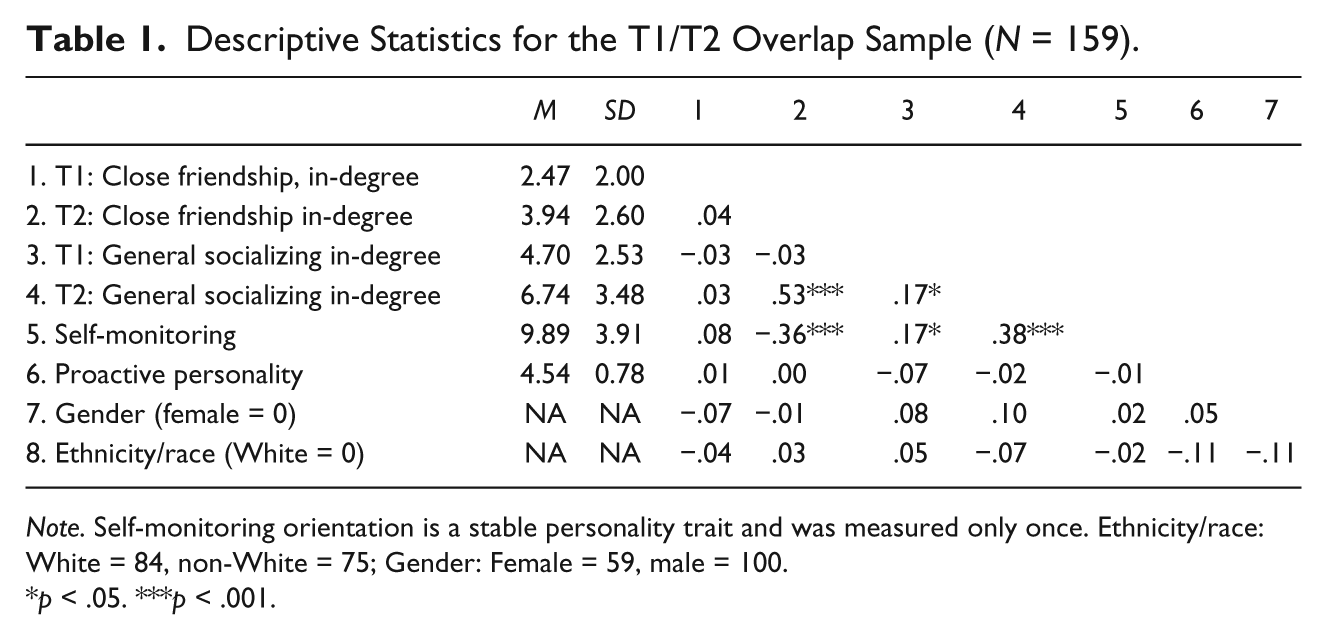
Note. Self-monitoring orientation is a stable personality trait and was measured only once. Ethnicity/race: White = 84, non-White = 75; Gender: Female = 59, male = 100.
p < .05. ***p < .001.
In-Degree Centrality in Close Friendship Networks
The regression analysis of the T1 data in Table 2 provides evidence in support of H1a. At T1, self-monitoring personality orientation was a significant positive predictor of centrality in close friendship networks (β = .19, p = .01), as expected. The regression analysis of the T2 data in Table 2 provides clear evidence in support of H2a. Self-monitoring personality orientation was not a positive predictor of in-degree centrality at T2 in the close friendship network. The beta coefficient for self-monitoring personality orientation was negative and significant at T2 (β = −.15, p = .03). 2 The pattern of results did not change even when we controlled for T1 in-degree centrality (β = −.36, p < .001). 3
Summary of Regression Analyses Predicting Close Friendship In-Degree Centrality at T1 and T2 (at T2, With and Without Controlling for T1 Centrality).
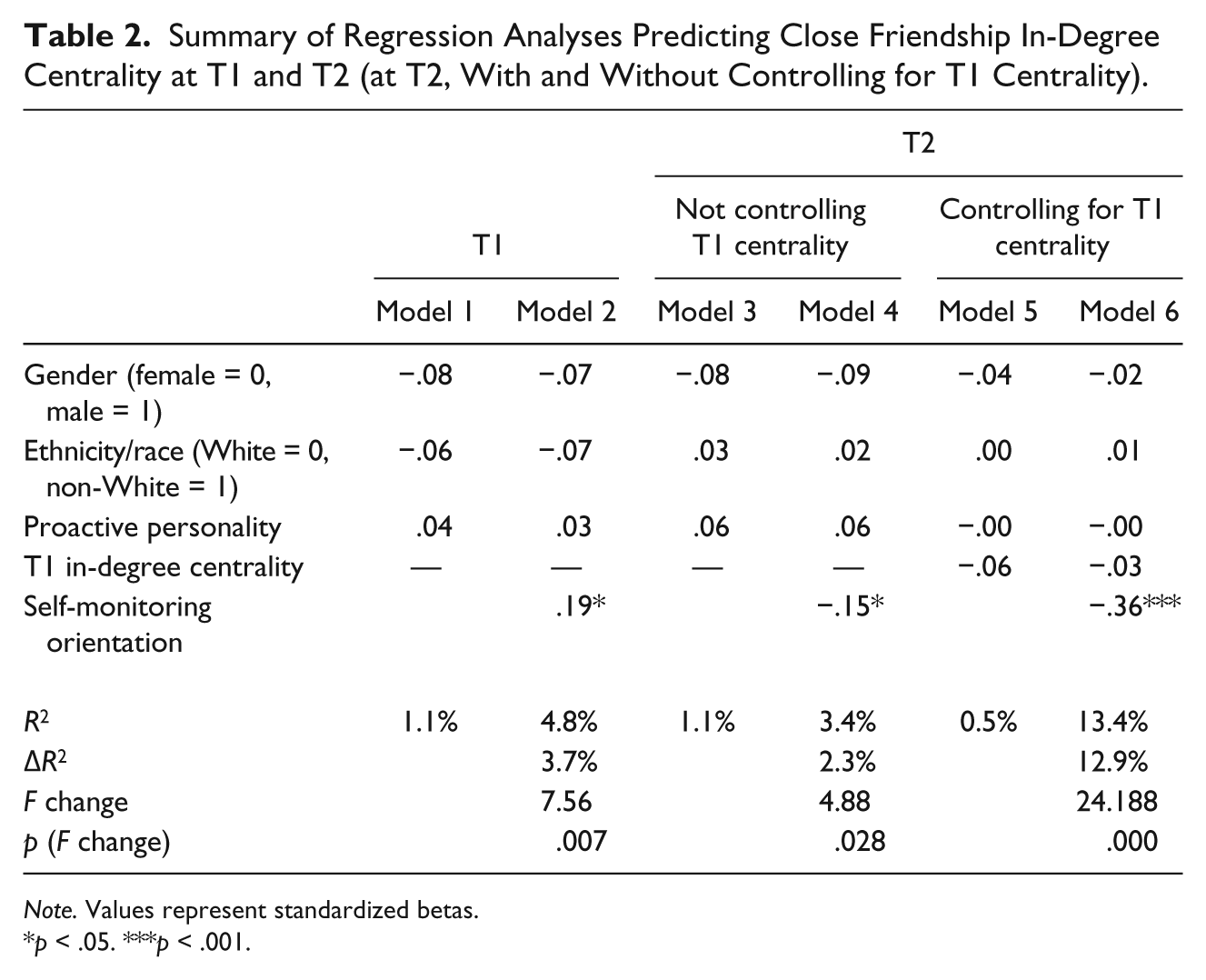
Note. Values represent standardized betas.
p < .05. ***p < .001.
To capture deeper insight into the changes in the close friendship network between the two points in time, we unpacked the network churn by examining the formation and dissolution of in-degree close friendship ties to each individual. Consistent with Sasovova et al.’s (2010) assertion that higher self-monitors are more open to ties with dissimilar relationship partners, we further disaggregated the data on ties to examine the formation and dissolution of ties between high and low self-monitors. For our overlapping sample of 159 participants, 74 (47%) participants were classified as low self-monitors (scoring 9 or lower on the 18-item self-monitoring scale, M = 6.66, SD = 2.17) whereas 85 (53%) participants were classified as high self-monitors (scoring 10 or higher on self-monitoring, M = 12.71, SD = 2.63). This dichotomization was used only for purposes of illustration in the descriptive tables (see Tables 3, 4, and 6) whereas the continuous self-monitoring score was used in all regression analyses. In the following discussion, because of the extensive use of the term high and low self-monitors, we further abbreviate it to HSM and LSM for high and low self-monitors to improve flow.
Results From the t Tests for Difference in Means in Ties, Tie Additions, Tie Dissolutions, and Tie Stability in Close Friendship Networks for HSMs and LSMs.
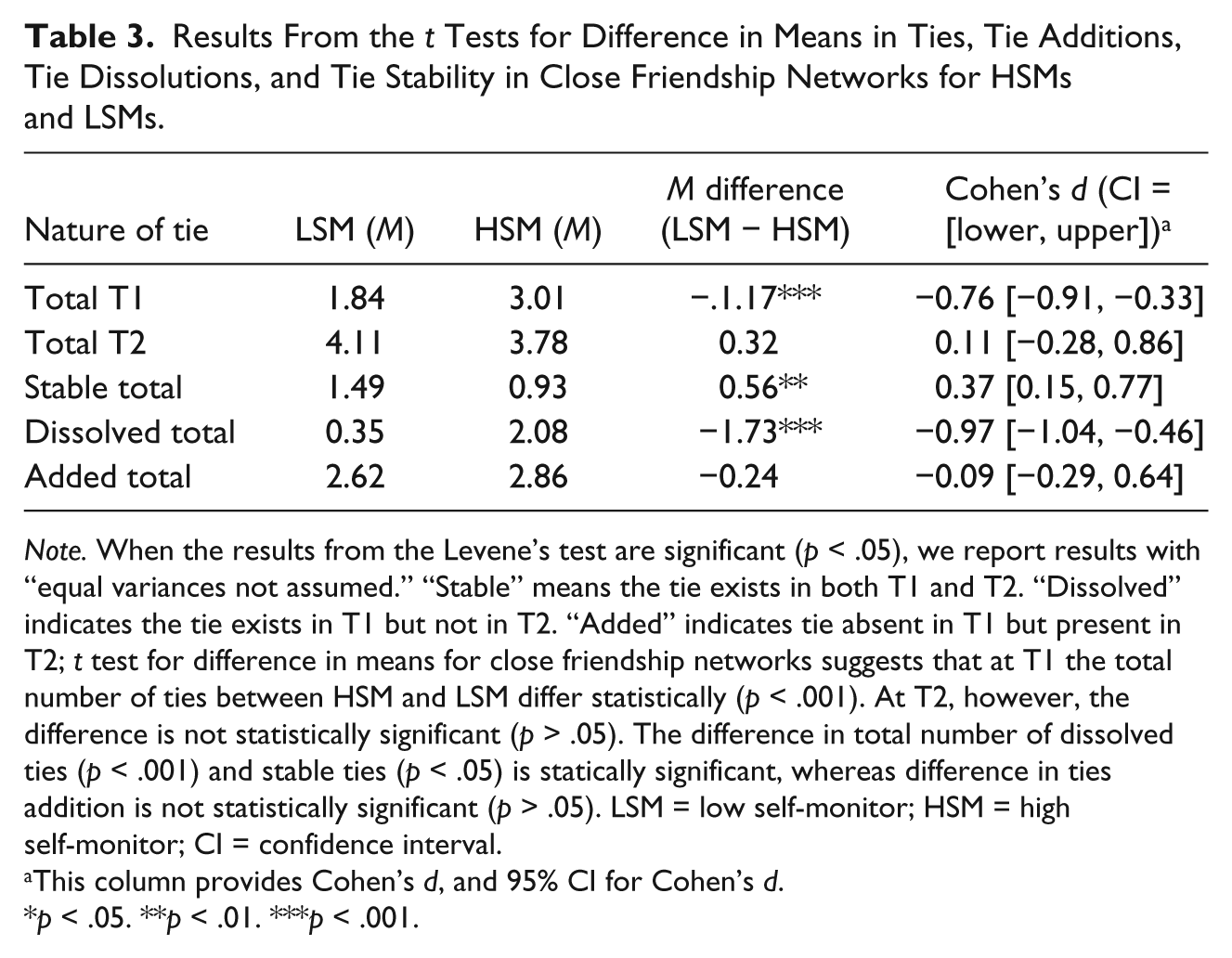
Note. When the results from the Levene’s test are significant (p < .05), we report results with “equal variances not assumed.” “Stable” means the tie exists in both T1 and T2. “Dissolved” indicates the tie exists in T1 but not in T2. “Added” indicates tie absent in T1 but present in T2; t test for difference in means for close friendship networks suggests that at T1 the total number of ties between HSM and LSM differ statistically (p < .001). At T2, however, the difference is not statistically significant (p > .05). The difference in total number of dissolved ties (p < .001) and stable ties (p < .05) is statically significant, whereas difference in ties addition is not statistically significant (p > .05). LSM = low self-monitor; HSM = high self-monitor; CI = confidence interval.
This column provides Cohen’s d, and 95% CI for Cohen’s d.
p < .05. **p < .01. ***p < .001.
Close Friendship Tie Formation Among and Between the High and Low Self-Monitoring Individuals.
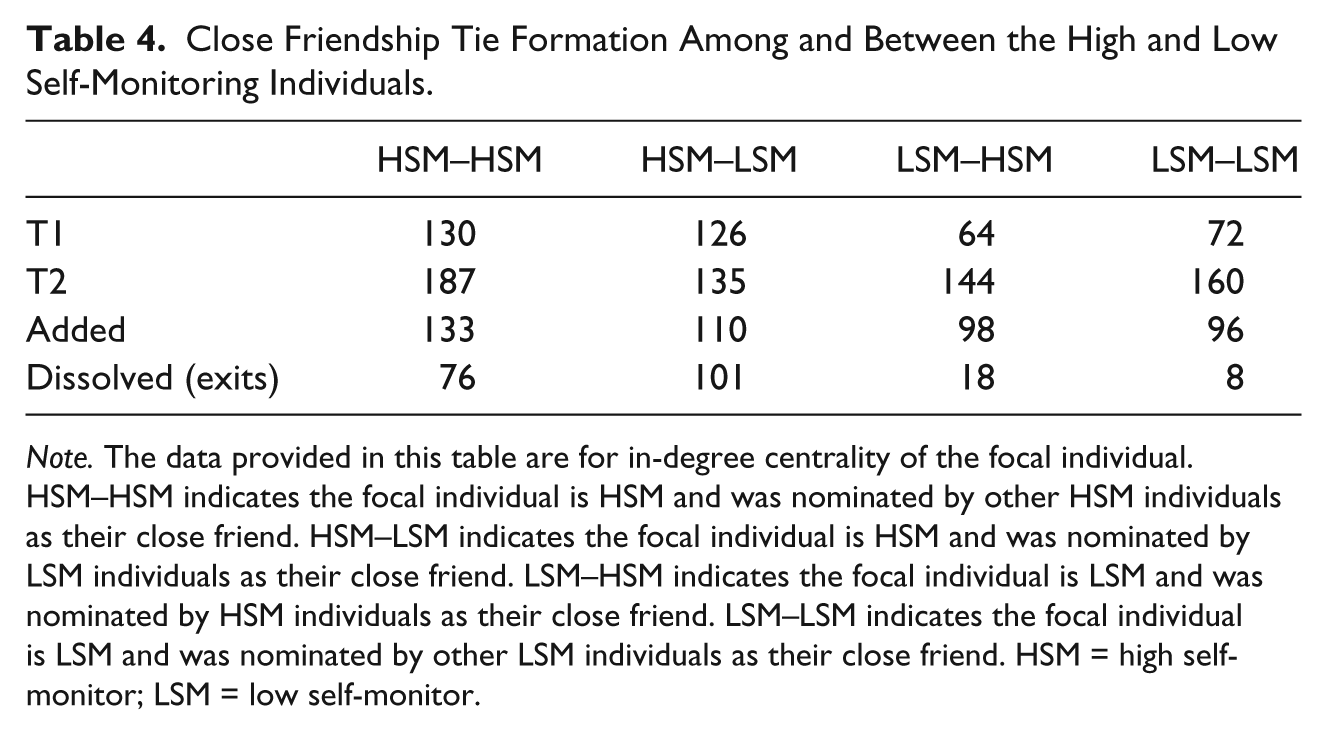
Note. The data provided in this table are for in-degree centrality of the focal individual. HSM–HSM indicates the focal individual is HSM and was nominated by other HSM individuals as their close friend. HSM–LSM indicates the focal individual is HSM and was nominated by LSM individuals as their close friend. LSM–HSM indicates the focal individual is LSM and was nominated by HSM individuals as their close friend. LSM–LSM indicates the focal individual is LSM and was nominated by other LSM individuals as their close friend. HSM = high self-monitor; LSM = low self-monitor.
Examining the differences between these two groups, the t tests in Table 3 indicate that HSMs received more nominations as close friends from all relationship partners at T1 (Δµ = −1.17, p < .001, Cohen’s d = −0.76). 4 At T2, however, there were no significant differences between HSMs and LSMs in number of nominations as close friends from all relationship partners (Δµ = 0.32, ns, Cohen’s d = 0.11). Examining the network churn data in Table 3 provides support for H2b that between T1 and T2, HSMs experienced significantly more dissolutions of close friendship ties than LSMs. Specifically, LSMs showed greater stability of close friendship nominations from all relationship partners (Δµ = 0.56, p < .01, Cohen’s d = 0.37), whereas HSMs showed more dissolutions of close friendship nominations from all relationship partners (Δµ = −1.73, p < .001, Cohen’s d = −0.97). The number of added close friendship nominations between the two points in time was not significantly different for HSMs and LSMs (Δµ = −0.24, ns, Cohen’s d = −0.09).
Table 4 provides the data on the formation and dissolution of ties between HSMs and LSMs for the overlapping sample. The findings reveal that at T1, both LSMs and HSMs tend to nominate HSMs as their close friends. Specifically, HSMs nominated 130 other HSMs as their close friends whereas LSMs nominated 126 HSMs as their close friends. In contrast, LSMs received considerably fewer nominations as close friends from both HSMs and LSMs at T1. In particular, HSMs claimed close friendship ties with 64 LSMs whereas LSMs claimed close friendship ties with 72 LSMs. This pattern clearly suggests that consistent with our arguments, at T1, HSMs were more likely to be nominated for tie formation as a close friend. Indeed, both HSMs and LSMs were attracted to the situationally adaptive HSMs for close friendship ties. Furthermore, we did not find any evidence of self-monitoring personality homophily.
The pattern of nomination for close friendship ties changed considerably at T2. By T2, LSMs received considerably more nominations as close friends than they did at T1 so that the number of close friendship in-degree ties was similar for HSMs and LSMs at T2. Furthermore, the findings for added ties reveal that LSMs gained almost equal number of nominations as close friends from HSMs and LSMs. Specifically, at T2, HSMs nominated 144 LSMs as their close friends (compared with 64 at T1, reflecting a 125% increase) whereas LSMs nominated 160 LSMs as their close friends (compared with 72 at T1, reflecting a 122% increase). Thus, the number of nominations to LSMs for close friendship ties more than doubled by T2. In contrast, by T2, HSMs showed considerably smaller increases in nominations for close friendship ties from both HSMs and LSMs. In particular, LSMs nominated 135 HSMs (compared with 126 at T1, reflecting a 7% increase) as their close friends whereas HSMs nominated 187 HSMs (compared with 130 at T1, reflecting a 44% increase) as their close friends. This pattern clearly suggests that, consistent with our arguments, LSMs gained a considerable number of close friendship tie nominations between the two points in time and the relative advantage of HSMs declined during the same period.
The rows labeled “Added” and “Dissolved” in Table 4 provide additional insight into the patterns of dissolution and new tie formation in the close friendship network. The row labeled as Added refers to the new ties that were added between T1 and T2. This row shows a muted version of the pattern exhibited in row T1, that is, HSM–HSM added 133 new ties, followed by HSM–LSM (110), LSM–HSM (98), and LSM–LSM (96). Thus, HSMs added more in-degree ties to their already high in-degree centrality at T1. However, despite these additions, HSMs did not substantially exceed LSMs in their in-degree centrality at T2. To delve deeper into this finding, we examined the patterns of tie dissolutions in close friendship ties. The row labeled Dissolved in Table 4 provides data on tie dissolutions in the close friendship network. The data suggest that 76 out of 130 (58.5%) HSM–HSM ties dissolved between T1 and T2. Similarly 101 out of 126 (80.2%) HSM–LSM ties dissolved between T1 and T2. In contrast, only 28.1% (18 out of 64) of LSM–HSM and only 11.1% (8 out of 72) of LSM–LSM ties dissolved between T1 and T2.
In-Degree Centrality in General Socializing Networks
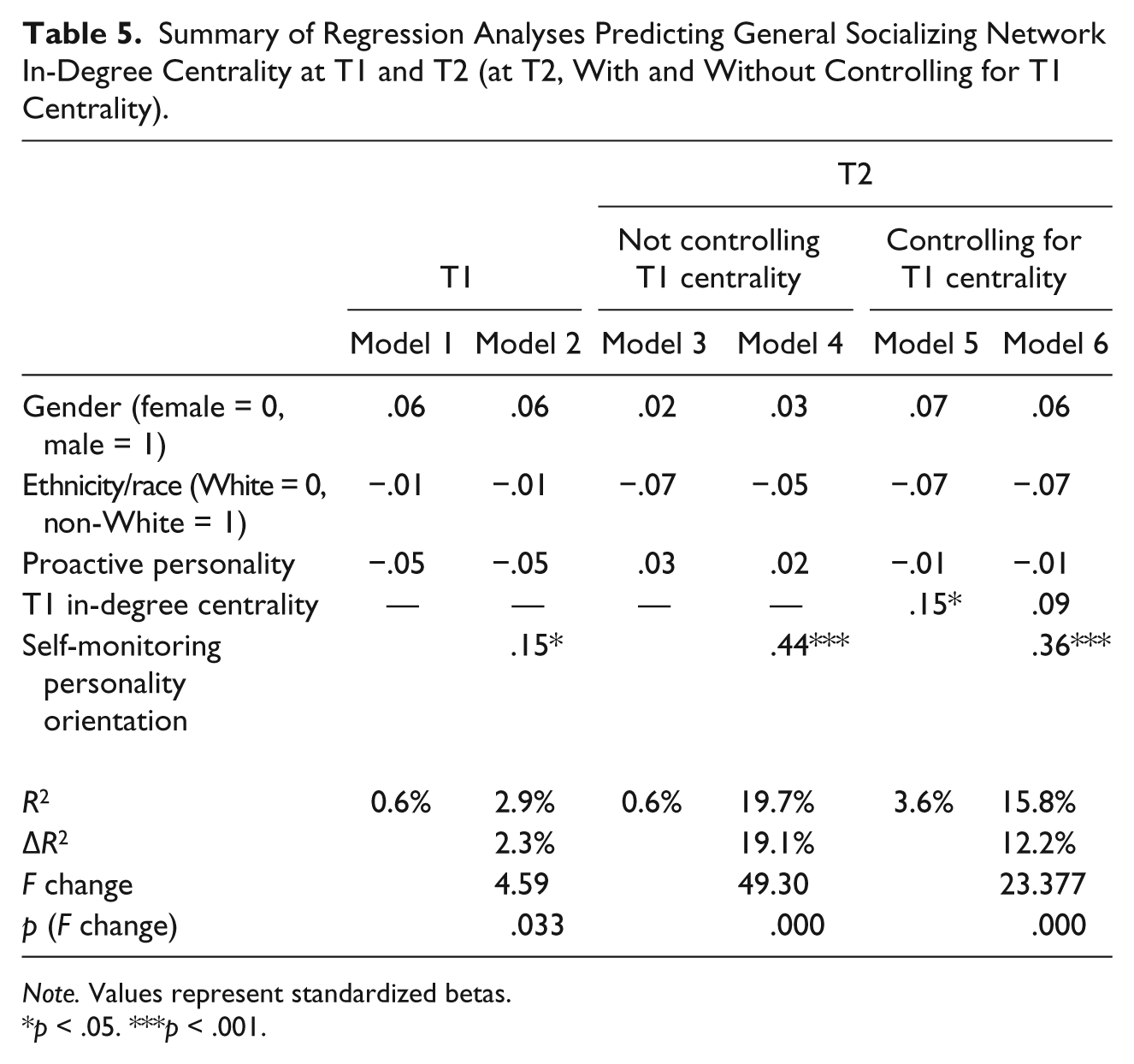
The regression analysis of the T1 data in Table 5 provides evidence in support of H1b and H3. In support of H1b, self-monitoring was a significant positive predictor of centrality (β = .15, p = .04) in the general socializing network at T1. In support of H3, self-monitoring was a significant positive predictor of in-degree centrality in the general socializing networks at T2 (β = .44, p < .001). 5 The pattern of results did not change even when we controlled for T1 in-degree centrality (β = .36, p < .001). 6
Summary of Regression Analyses Predicting General Socializing Network In-Degree Centrality at T1 and T2 (at T2, With and Without Controlling for T1 Centrality).
Note. Values represent standardized betas.
p < .05. ***p < .001.
The pattern of network churn, including both tie formation and tie dissolution, as predicted, unfolded differently in the general socializing network (Table 6). HSMs attract others (HSM and LSM) into nominating them as ties in the general socializing network at both T1 and T2. HSMs were nominated more frequently in the general socializing network at both T1 and T2. During the period between T1 and T2, HSMs added a much greater number of ties (n = 506) that clearly outnumbered tie dissolutions during the time (n = 287). In contrast, LSMs added a lower number of ties in the general socializing networks (n = 261) while having almost as many tie dissolutions (n = 220). Hence, the advantages of HSMs as a result of considerably higher new tie formation led to the strengthening of the relationship between self-monitoring and in-degree centrality in the general socializing network at T2. Consistent with our arguments, Table 5 shows the R2 change associated with adding self-monitoring at T2 (ΔR2 = 19.1%) was considerably larger than the R2 change at T1 (ΔR2 = 2.3%). This pattern did not change even after controlling for T1 centrality in the T2 analysis (ΔR2 = 12.2%).
General Socializing Network Tie Formation Among and Between High and Low Self-Monitoring Individuals.
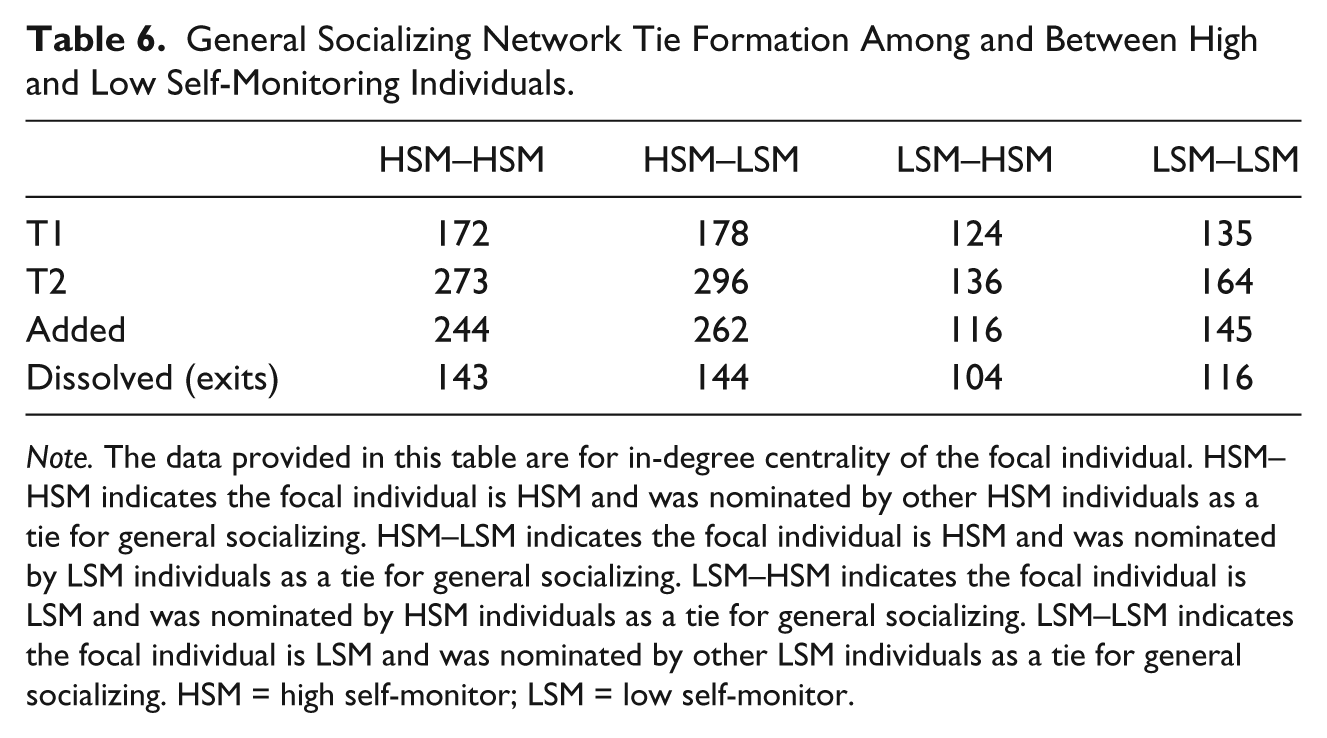
Note. The data provided in this table are for in-degree centrality of the focal individual. HSM–HSM indicates the focal individual is HSM and was nominated by other HSM individuals as a tie for general socializing. HSM–LSM indicates the focal individual is HSM and was nominated by LSM individuals as a tie for general socializing. LSM–HSM indicates the focal individual is LSM and was nominated by HSM individuals as a tie for general socializing. LSM–LSM indicates the focal individual is LSM and was nominated by other LSM individuals as a tie for general socializing. HSM = high self-monitor; LSM = low self-monitor.
In sum, the study provides evidence that higher self-monitors achieve more central positions in social networks in early but not in later close friendship networks, whereas in the general socializing networks, higher self-monitors occupy central positions both in the early and later stages. Furthermore, the analysis of relationship formation and dissolution suggests that differential reactions of relationship partners to the personality of the focal individual in the two network types shape this pattern of network change.
Discussion
Our findings identify network type as a boundary condition to the relationship between self-monitoring personality and network centrality. Past research examining the link between self-monitoring and betweenness centrality has shown consistent evidence of advantages for individuals higher in self-monitoring. Our findings based on the important and direct measures of in-degree centrality (Burkhardt & Brass, 1990; Mossholder et al., 2005) reveal that advantages vary as a function of relationship type. Specifically, in close friendship networks, self-monitoring is unrelated to in-degree centrality at later points in time, and close friendship ties are more stable and less likely to be dissolved as level of self-monitoring declines. Our findings provide a more balanced view of the impact of personality on social networks over time by identifying the general socializing network as the boundary condition within which self-monitoring is linked with personality-related centrality benefits. These findings are consistent with emerging views on the need to examine boundary conditions as well as liabilities associated with self-monitoring behavior (Mehra & Schenkel, 2008) and point to the complexities faced by individuals in managing network evolution.
This boundary condition, driven by the differential reactions of the relationship partners, occurs due to the qualitative differences between close friendships and casual acquaintanceships. Socializing between casual acquaintances is influenced by the motive to present oneself in a socially desirable way (Rosenfeld et al., 1995). Self-monitoring is associated with effectiveness at self-presentation during casual interaction that is well received by the relationship partners, leading to increasing centrality for individuals higher in self-monitoring in the general socializing network. Close friendships are intimate relationships based upon mutual self-disclosure and sharing of support (Fehr, 2004). Intimacy is not achieved unless and until trust begins to form as one person’s self-disclosure and/or offer of support is reciprocated by another (Sunnafrank & Ramirez, 2004). The inconsistency associated with self-monitoring reduces the ability to demonstrate shared values over time (e.g., Mehra & Schenkel, 2008). The relationship partners in observing a close friend espouse ideas to another that apparently contradict the views that the close friend expressed in intimate conversation with them degrades trust in the process of mutual self-disclosure. This process explains the higher rate of close friendship tie dissolutions over time with individuals with higher levels of self-monitoring.
Social network theory traditionally argued that the advantages of social networks are embedded in social positions (Burt, 1986; Wellman & Berkowitz, 1988) with no role for individual agency in the structuring of social networks. Subsequently, scholars argued for incorporating the role of human agency (see Emirbayer & Goodwin, 1994) in shaping networks to develop a more comprehensive understanding of how social networks form, change, and function. Self-monitoring theory has been particularly useful in bringing together the individual level and the structural social network perspective. Specifically, self-monitoring personality is associated with structurally advantageous positions in social networks and offered a theoretical basis for understanding the patterning of social relationships. As Sasovova et al. (2010) note, self-monitoring is “particularly relevant because of its theoretical emphasis on how identity and impression management skills influence the structuring of interpersonal relationships” (p. 640).
Thus, self-monitoring theory offered a mechanism to bring together individual agency and structural perspectives by pointing to the association between self-monitoring and the occupation of structurally advantageous network positions (Kilduff & Brass, 2010; Kilduff & Krackhardt, 1994; Mehra et al., 2001; Sasovova et al., 2010). Although early research linking personality and social structure was cross-sectional, more recently in examining two-wave data, Sasovova et al. (2010) note that bringing together social network theory and self-monitoring theory offers an “overarching theoretical contention that dispositional forces help shape the dynamics of social networks in predictable ways” (p. 641, emphasis added). Thus, self-monitoring theory remains highly relevant for explaining network dynamics as well.
Our research moves this theoretical integration of structural perspective and self-monitoring theory by suggesting that social network patterns are different in affect-based, high-trust close friendship ties in contrast to general socializing ties. Specifically, the role of agency in structuring ties is bounded by the reactions of relationship partners (alters) to the self-monitoring behavior of the focal individual. Our comparison of two types of networks (close friendships vs. general socializing) clearly suggests that the impact of self-monitoring in structuring networks plays out differently in the two network types. Thus, our research adds more complexity and nuance to understanding the association of self-monitoring personality and the dynamic structuring of social networks by showing different associations of personality and structure in the two types of networks. Not incorporating the reactions of relationship partners, for example, may lead individuals higher in self-monitoring to underestimate network churn in close friendship ties. Self-monitoring personality brings advantages in the initial structuring of close friendship networks but simultaneously has seeds that weaken this association over time. Overall, our research also highlights the need to measure multiple networks to reach a fuller understanding of the impact of personality variables in structuring social networks.
An important contribution of our research is to incorporate the role of relationship partners in shaping the pattern of relationships between actor personality and centrality in informal social networks. Past research on the role of personality has focused on actor-centered mechanisms (Mehra et al., 2001; Sasovova et al., 2010). Our findings suggest that reactions of relationship partners to actor personality are crucial in shaping social network evolution. Specifically, through multiple observations and interactions, relationship partners make important evaluations about their relationships and are more likely to exit from ties with higher self-monitors in close friendship networks. By focusing on the crucial role of relationship partners and their reactions to actor personality, we enrich social network theory and research and point to an important additional factor in shaping individual social network change.
Another key contribution of the present study is the fine-grained analysis of tie formation and dissolution in the close friendship and general socializing networks as conceptualized in the idea of network churn. Understanding these patterns of tie additions and dissolutions between T1 and T2, as Sasovova et al. (2010) note, enables us to see the “considerable change and adjustment in the ties that make up the structures” that may be masked by the outward and “apparent stability of social network structures” (p. 639).
We incorporate the simultaneous examination of tie additions and tie dissolutions to uncover differences between two time points. Such an analysis enhances understanding of the differential pathways of individuals over time to reach similar levels of network centrality. For instance, individuals lower in self-monitoring begin with few relationships in the early stages but add more relationships over time while experiencing limited relationship dissolutions to reach a particular level of centrality. In contrast, individuals higher in self-monitoring begin with many more relationships in the early stages of the network, and add more relationships over time, but experience a higher level of relationship dissolutions to reach a similar level of network centrality. Although both personality types have similar network centrality in the later time period, their pathways to such a state of equifinality (e.g., Katz & Kahn, 1978) are quite different. Although our data in the social network study are limited to two time points, examination of such pathways with data at multiple time points holds the potential to offer deeper insights into the personality-linked differential evolution of relationships. Such longitudinal research may facilitate the integration of the idea of equifinality with networking outcomes and examine the use of different pathways to reach similar centrality levels in certain relationship types.
Our findings have implications for understanding the influence of tie level changes on the network level density over time. At the network level, the network density increases for both the close friendship and the general socializing networks over time. But, the factors driving the increase in network density for the two networks are different. Specifically in case the close friendship network, the increase in network density is driven largely by the greater increase at later time in mean close friendship ties of individuals with lower levels of self-monitoring. In contrast, the increase in network density in the general socializing network over time is driven largely by the greater increase at later time in mean close friendship ties of individuals with higher levels of self-monitoring.
Our research clearly points to the importance of taking into consideration both time and relationship type when examining the linkages between personality and the structure of social relationships. Time creates opportunities for repeated observations and interactions that differentially shape the choices of the relationship partners in the two network types. Thus, it is important to consider simultaneously the role of time and relationship type in the structuring of networks. In addition, our findings point to the role of time in shaping differential pathways for lower and higher self-monitors in reaching centrality in social networks, thereby, pointing to the limitations of cross-sectional research design in capturing network change.
Limitations
The study has several limitations. We examined social relationships in a bounded network. Because we collected complete social network data, we had to select a natural boundary and while the cohort appeared to be a natural boundary for our social network study, other network boundaries could also have been possibly used (e.g., the university). The specification of a boundary is considered to be a general limitation of collecting complete social network data as social relationships outside the selected boundary are excluded from consideration. Complete social network data within a boundary provides researchers with information on all the relationships within a chosen boundary (e.g., department or the complete organization), and such a rich data set (Marsden, 2002) enables researchers to calculate network centrality measures. We, however, carried out section wise analyses using class sections as an alternative boundary to supplement our analyses of using the entire cohort as the boundary. We obtained a similar pattern of results across the two network boundaries and we have no reason to believe that our results will not hold across other network boundaries.
Another limitation of the study was that although we had close to 70% response in the two rounds of social network survey, the response rate for the overlapping sample did not exceed 64% for any of the sections. We acknowledge these low response rates to be a limitation of the current study. Furthermore, we conducted a two-wave study by collecting network data at two points in time. Future research may endeavor to carry out social network data collection at multiple points in time for a rich longitudinal network analysis.
We collected social network data from business students preparing for professional careers. Collecting network data from the incoming cohort of students allowed us to control for potential contamination of the effect of self-monitoring on network centrality by examining the development of relationships among newcomers to an organizational context. Because all newcomers enter the organization at the same time, prior network positions are controlled for all the members. To establish generalizability, we encourage future researchers to test our findings in an organizational setting, such as a newly formed organization.
Researchers seeking to test these findings in an organizational setting may need to consider a different time interval between two waves of social network data collection. Specifically, we choose a 3-month time interval between the two waves of data collection. The students in our sample spend an average of 20 hr per week in face-to-face groups of 75 people, which is considerably larger than face-to-face task groups in a typical workplace. Also, these students socialize with each other considerably more than typical coworkers do. For instance, each section organizes a weekly social event. As such, participants in our study had opportunities to experience multiple observations of a relatively large group of people in a relatively short period of time. The compression of the time frame within which multiple observations occur would enhance memory, increasing the likelihood that discrepancies in behavior could be identified in a relatively short time. As identifying discrepancies within higher self-monitors is a key mechanism in shaping close friendship networks—this factor would enhance the likelihood of observing these effects within the 3 months interval. In a setting characterized by fewer interactions, the effect may appear in a longer time interval. However, increasing the number of people under observation in the face-to-face group would reduce memory through information overload, and this factor in our setting potentially delayed the effects. However, greater socializing mitigated this problem. Thus, in a setting that is characterized by a larger group and fewer social interactions, a longer time interval between T1 and T2 may be chosen. In contrast, a smaller group with more frequent interactions may require a shorter time interval between T1 and T2 for these effects to appear in the close friendship network. However, the student setting in our study may not be sensitive for broader socializing networks as identifying discrepancies within higher self-monitors across multiple interaction events, a key mechanism in the context of close friendships, may not influence the development of broader socializing networks.
We examined the reactions of the relationship partners to self-monitoring behavior on the structure of direct relationships. However, research on the structure of network ties in teams has identified other personality variables such as extraversion and neuroticism as influential on the centrality of actors in team networks (Klein, Lim, Saltz, & Mayer, 2004). Given that we examined a large network of 300 students, adding additional questions to the network survey may have significantly enhanced the chances of participant fatigue and so we chose not to include these personality variables in our survey. Interestingly, we also did not find any evidence of homophily for self-monitoring personality. While a large body of research provides evidence of homophily or ties across similarity (see McPherson, Smith-Lovin, & Cook, 2001, for a review), recent research on personality has suggested that similarity in personality may not be an attraction for tie formation (Labianca, 2014; Lee et al., 2014). An interesting area for future research can consider similarity on other dimensions of personality for their influence on tie formation.
Practical Implications
The results from this study have practical implications for problem solving, knowledge sharing, and creativity in organizations. Variety among individuals on the dimension of self-monitoring may support the development of the complex sets of network ties that support organizational innovation and effectiveness. For instance, informal networks consisting of a combination of strong ties with a large range across a variety of functions and teams are most strongly predictive of organizational innovation (Tortoriello, Reagans, & McEvily, 2012). Connections that bridge otherwise separated networks serve as more effective conduits of knowledge transfer if they are strong (Levin, Walter, Appleyard, & Cross, 2015). Teams combining midrange levels of relationship and trust internally with strong ties to organizational members external to the team are the most productive, particularly for innovative, nonroutine work (Chung & Jackson, 2013). Individual variety in self-monitoring may help to generate the mix of network ties linked to innovation due to the differences between lower and higher self-monitors in number and duration of close network connections.
Specifically, our findings show that higher self-monitors generate a larger number of close ties with a higher amount of churn (Sasovova et al., 2010). As such, these individuals add dynamism to informal organizational networks, linking new people at different points in time. Prior research has shown that teams whose members have greater variety and range among their network ties are more creative (Tortoriello et al., 2012). Given the enhanced impression management skills of higher self-monitors (Turnley & Bolino, 2001), these individuals are likely to be effective at building ties relatively quickly across functional and social boundaries in organizations (Sasovova et al., 2010; Snyder et al., 1983). Such ties bridge otherwise segregated networks (Ibarra, 1992, 1995), increasing the probability that higher self-monitors serve as valuable information and knowledge-sharing brokers in organizations (Burt, 2004, 2005). Given their networking skills, higher self-monitors may be particularly effective in roles that cross boundaries or require maintenance of large networks, where they are required to work across multiple departments. 7
While higher self-monitors support organizational action and innovation by creating a variety of ties across diversity relatively quickly, the networking pattern of lower self-monitors provides complementary benefits that enable the flow of complex and sensitive information across organizational boundaries. Prior research indicates that scarce and tacit resources vital to knowledge development only flow across trusted network ties (Levin & Cross, 2004). Because the close ties of lower self-monitors are more stable and less likely to be dissolved, individuals on the lower end of the self-monitoring continuum are likely to be valuable for creating reliable and sustained conduits of information, knowledge, and resource flows over time (Chung & Jackson, 2013; Smith, Collins, & Clark, 2005).
Sets of close, long-lasting ties, however, have the unintended downside of creating in-groups and out-groups in organizations (Tomaskovic-Devey, 1993). When teams become too close-knit, ties can create constraints limiting creativity as individuals act in ways consistent with in-group norms (Chung & Jackson, 2013). A practical suggestion for avoiding these problems is to create organizational networking and relationship-building activities. Such activities serve to move lower self-monitors out of their in-groups and create new ties generating new sources of information and exchange. Leadership development research indicates that the most beneficial activities are longer term job rotations through multiple functions because these experiences generate long-term trusting relationships among current and future organizational leaders (Galli & Muller-Stewens, 2012). Leaders who are lower in self-monitoring may be more effective at maintaining these relationships, and hence serving as reliable conduits of information and resource flow for critical problem-solving and innovative activities (Chung & Jackson, 2013; Smith et al., 2005; Tortoriello et al., 2012). Given their networking skills, lower self-monitors may be effective in high reliability departmental roles that require a stable trust environment.
Conclusion
We conducted a two-wave network study to examine the relationship between self-monitoring personality and in-degree centrality in close friendship and general socializing networks. Our findings suggest that the link between self-monitoring personality and personal network development is affected by the differential reactions of relationship partners to actor personality in the two network types. Specifically in close friendship networks, higher self-monitors attract more new in-degree ties but are less adept at maintaining close friendships as lower self-monitors show significantly lower rates of relationship dissolution over time. In general socializing networks, however, higher self-monitors accrue persistent benefits. The findings advance research in the area of personality and social networks by identifying a more complex relationship between self-monitoring personality and the structuring of social networks than has been theorized in the past.
Footnotes
Acknowledgements
The third author is grateful for the support of the Corus Entertainment Chair in Women in Management at the Ivey Business School.
Declaration of Conflicting Interests
The author(s) declared no potential conflicts of interest with respect to the research, authorship, and/or publication of this article.
Funding
The author(s) disclosed receipt of the following financial support for the research, authorship, and/or publication of this article: This research was supported by a grant from Western University’s Academic Development Fund. In addition, the second author acknowledges support of the Hong Kong Polytechnic University Internal Grant G- UB95.
Associate Editor: Lisa Finkelstein