



Abstract
In this article, we analyze how shared team and task mental models, developed prior to an acquisition, affect exploration and exploitation activities in the postacquisition phase, and how these effects are dependent on relative size. With a sample of 101 transactions of acquirers from the German-speaking part of Europe, we provide empirical evidence that both shared team and task mental models positively influence exploitation activities following an acquisition, whereby only shared team mental models (TMMs) are beneficial for exploration. We provide empirical evidence that shared mental models in terms of task and team are an important informal source for enhancing exploration and exploitation innovation activities. However, this source of informal coordination is contextual. Although the relationships on exploitation are stable, the beneficial effect of TMMs on exploration is sensitive and devitalized by an increasing relative size. Implications for further research and management practice are given.
Keywords
Introduction
Mergers and acquisitions (M&A) constitute an important strategic opportunity for corporate development and value creation (Bower, 2001). Sustainable corporate development and enduring success require constant change (Stadler, 2007) and adaptation to changing circumstances (Andriopoulos & Lewis, 2009) to tackle complexity and ambiguity (Lewis & Smith, 2014). In this respect, research in the fields of innovation, competitive advantage, and organizational learning highlights the importance of balancing the exploration of avenues for new developments and the exploitation of established activities to increase survival rates (Gupta, Smith, & Shalley, 2006). Acquisitions can be seen as a judicious measure enabling such a strategic redirection and renewal (Jemison & Sitkin, 1986). In fact, a considerable number of acquisitions are reorientation acquisitions, which “show that exploitation and exploration [ . . . ] can co-exist during acquisition integration” (Angwin & Meadows, 2015, p. 249).
In any case, the success of an acquisition depends significantly on a firm’s capability of managing the acquisition process (Zollo & Singh, 2004), especially acquisition implementation (Haspeslagh & Jemison, 1991). Linking two firms with different systems and contexts is a complex process tied to uncertainty and ambiguity (Cording, Christman, & King, 2008), as it requires removing, changing, transferring, and adapting well-established ways of proceeding and thinking (Stahl & Voigt, 2008). Integration decisions are confronted with a trade-off. On one hand, more interaction and coordination enable the highest probabilities of synergy realization, and on the other hand, they also bear the potential for employee resistance, cultural clashes, or in-group and out-group biases (Larsson & Finkelstein, 1999).
Capability transfer and successful integration can only prosper if systematic attention is paid to the interaction of both formerly separate organizations (Dao, Bauer, Strobl, Matzler, & Eulerich, 2016), as interaction is the key means of value creation (Haspeslagh & Jemison, 1991). Puranam, Singh, and Chaudhuri (2009) investigated common ground (knowledge which is known to be shared between two groups) as an alternative to structural measures for achieving coordination. Informal alignment—when employees of both organizations develop shared understandings, constructive perceptions, and attitudes of each other (Schweiger & Goulet, 2005)—creates closer interunit relationships and trust, and considerable advantages can thereby be extracted. First, it enhances the capability transfer between both firms (Björkman, Stahl, & Vaara, 2007); second, it reduces the costs of structural integration and coordination (Puranam et al., 2009); and third, it reduces disruptions for employees (Paruchuri, Nerkar, & Hambrick, 2006).
In this connection, we examine how shared mental models (SMMs) influence exploration and exploitation innovation activities following an acquisition. SMMs have proven to increase team performance and communication in many situations (e.g., DeChurch & Mesmer-Magnus, 2010; Smith-Jentsch, Campbell, Milanovich, & Reynolds, 2001). We conceptualize SMMs as common psychological representations of the environment between the acquirer and the target. Thus, SMMs act as a tacit antecedent of coordination and integration in M&A transactions. Neglected so far in M&A research, we consider different content-related premerger dimensions of SMMs (Cannon-Bowers, Salas, & Converse, 1993) as influential antecedents for implicit coordination. Consequently, we analyze task and team SMMs between acquirer and target organizations, and how they affect postmerger innovation performance, specifically exploration and exploitation. However, the effects of SMMs depend on the relative size of the target compared with the acquirer. Although larger targets offer greater synergy potentials (Kitching, 1967), they require greater coordination efforts and are more complex to integrate (Cording et al., 2008). Consequently, we develop arguments that increased relative size triggers in-group/out-group biases, which result in resistance and cultural clashes deteriorating the positive relations between SMMs and exploration/exploitation outcomes.
The purpose of this article is to contribute to M&A research in several ways: First, we incorporate SMMs as a salient antecedent for coordination to M&A research. Second, we differentiate between knowledge antecedents in terms of task- and team-related aspects and their contribution to innovation performance. Therefore, we examine whether an acquisition leads to the enhancement of exploration and exploitation activities necessary for strategic redirection and renewal (Jemison & Sitkin, 1986). Third, we consider relative size as an important deal-specific contingency. Relative size is related to disruptive forces, such as, for instance, the occurrence of in-group and out-group biases when power struggles or coordination efforts are increased by differences in company size.
Exploration and Exploitation in Post-M&A Integration
Examining ambidexterity (a combination of exploration and exploitation) in general and in M&A in particular has been pointed out as a promising future research avenue (Junni, Sarala, Taras, & Tarba, 2013; Junni, Sarala, Tarba, Liu, & Cooper, 2015; Meglio, King, & Risberg, 2015). In this sense, acquisition integration acts as a boundary condition for achieving explorative and exploitative innovation outcomes in a more flexible manner (Graebner, 2004). Exploration is defined as a learning type, which evolves through “concerted variation, planned experimentation, and play” (Baum, Li, & Usher, 2000, p. 768). In a discovering approach, new knowledge should be built to achieve above-average returns (Koza & Lewin, 1998). Thus, exploration is a more open and flexible approach of learning, which leads to radical innovations (Atuahene-Gima, 2005). Exploration is more uncertain and time-consuming and requires future orientation as well as new knowledge and experience infusion (March, 1991), but nevertheless can highly increase productivity and efficiency (Nielsen, 2010). Explorative innovation capabilities entail a lot of tacit knowledge, and aligning operations and functions following acquisitions can disrupt such capabilities, impeding synergy realization (Paruchuri et al., 2006; Puranam et al., 2009). Exploitative innovation strategies aim to improve and/or to build upon existing capabilities by refining routines built on existing knowledge (March, 1991). Therefore, improvements of processes and structures (Burgers, Jansen, Van den Bosch, & Volberda, 2009; March, 1991) are achieved by averting redundancies and efficiently and effectively redesigning activities to accomplish more, for instance, a faster production (He & Wong, 2004). In acquisitions, these efficiency gains are usually achieved with tighter coordination and integration.
Following both learning forms may trigger tensions. Whereas exploration is more uncertain, time-consuming, and change enforcing, exploitation is rather certain and reinforces existing structures (Kostopoulos & Bozionelos, 2011). However, many researchers propose that knowledge infusion from outside the firm can more easily foster the organization’s ability to pursue both exploration and exploitation (e.g., Baum et al., 2000; Koza & Lewin, 1998). In this research, we concentrate on antecedents of ambidexterity, namely, exploration and exploitation, and how they can be triggered through team and task SMMs. As intended changes in exploration and exploitation activities can only occur after deal closing and during integration, we analyze exploration and exploitation outcomes following an acquisition (Bauer, Strobl, Dao, Matzler, & Rudolf, 2016). Postmerger integration is the most critical phase in M&A. Acquisition integration “is an interactive and gradual process in which individuals from two organizations learn to work together and cooperate in the transfer of strategic capabilities” (Haspeslagh & Jemison, 1991, p. 106). To realize synergies, processes of mutual resource sharing (Capron & Pistre, 2002) and knowledge leverage (Puranam & Srikanth, 2007) must be established. Thereby, aligning structures, tasks, and systems not only contributes to increased M&A performance by eliminating redundancies and streamlining procedures but also enhances the reciprocal predictability of actions (Puranam et al., 2009). Effects of combination are not limited solely to the consolidation or coordination of functions and operations. Benefits also entail mutual learning, which results in the convergence between organizational and individual beliefs (March, 1991).
Due to an adverse understanding of the interrelation between coordination, knowledge transfer, and integration issues (Puranam & Srikanth, 2007), researchers constantly report that integrating tasks results in disruptions preventing synergy realization. On a general level, change can cause resistance (Weber & Tarba, 2011) and hamper the initial goals of integration measures (Benner & Tushman, 2003). M&A integration includes converging processes and, therefore, causes disruptions when different organizational worlds collide and substantive incompatibilities evolve (Graebner, Heimeriks, Huy, & Vaara, 2017; Schweizer, 2005). These disruptions may lead to major challenges in terms of talent retention in the aftermath of M&A (Zhang et al., 2015), as “value creation and synergy potential realization largely result from employees’ knowledge base, skills and experience” (Xing & Liu, 2015, pp. 11-12). Such reactions have been primarily reported in technology acquisitions, when the newly formed organization was not able to retain inventors and/or maintain their innovative capabilities (Puranam et al., 2009). This happens when knowledge depends on socially complex relationships and when implemented changes or their corresponding measures destroy these knowledge resources (Ranft & Lord, 2002).
Considering these challenges of M&A integration, it would seem to be even more complex to achieve both exploration and exploitation outcomes in the aftermath of a merger. So far, M&A integration literature suggests different approaches for realizing the value potential of an acquisition. Schweizer (2005), for instance, claimed that multistaged approaches toward typologies of integration with differing degrees of autonomy across different value chain activities are most promising to simultaneously accomplish short- and long-term goals. Others recommend keeping the target organization autonomous to minimize disruptions to ensure know-how development and capability transfer (Paruchuri et al., 2006; Puranam et al., 2009). In ambidexterity literature, similar arguments can be found regarding reaping the benefits of exploration and exploitation activities. Whereas one stream calls for a separation to ensure that both contradictory learning approaches do not distract each other (Benner & Tushman, 2003; J. J. P. Jansen, Tempelaar, van den Bosch, & Volberda, 2009), another stream argues that the integration of both activities is vital (Kauppila, 2010; Raisch, Birkinshaw, Probst, & Tushman, 2009).
In our study, we extend both literature streams and examine how SMMs, as a tacit antecedent, can unleash a “self-coordinating” effect among the integrated employees of both firms to enable the organization to pursue exploration and exploitation outcomes. Thus, we follow calls from several researchers in M&A for more integrative approaches linking critical success factors of pre- and postacquisition phases (Gomes, Angwin, Weber, & Tarba, 2013). We believe that SMMs, as a common understanding of the task and team environment among members of acquirer and target, serve as a knowledge platform fostering capability transfers. Based on a shared representation of the environmental context, the integrated organizational members can more easily join forces to increase exploration and exploitation outcomes.
SMMs
According to Darr and Kurtzberg (2000), a context of understanding is necessary to transfer knowledge successfully. A similar set of attitudes, experiences, and encountered problems facilitates knowledge transfer. Tanriverdi and Venkatraman (2005) found that knowledge relatedness between acquirer and target in terms of products, technology, and R&D significantly improves performance. Reasoning is based on the theory of social comparison, which states that with increased similarity of judgments, people are more willing to cooperate, and resistance decreases (Festinger, 1954). Mental models “enable individuals to make inferences and predictions, to understand phenomena, to decide what action to take and to control its execution, and above all to experience events by proxy” (Johnson-Laird, 1983, p. 397). So, mental models entail descriptions, explanations, and observations of systems, which allow people to organize, structure, process, and store their knowledge rapidly and flexibly based on working schemas (e.g., Cannon-Bowers et al., 1993; Maynard & Gilson, 2014). As psychological representations of the environment, mental models enable individuals to make sense and generate actions from a situation (Johnson-Laird, 1983; Kellermanns, Floyd, Pearson, & Spencer, 2008).
The relevance of mental models in team settings has been emphasized by Cannon-Bowers et al. (1993). According to the authors, organizing and storing knowledge in structured, meaningful patterns allow people to effectively interact with their environment. Thus, SMMs serve as an internal knowledge base of expectations concerning how team members “decide which behaviors are required, and when and how to execute them” (Cannon-Bowers et al., 1993, p. 228). Based on compatible expectations regarding the internal and external performance environment, team members intuitively adapt to the demands of the task and of their team members (e.g., Maynard & Gilson, 2014).
In the context of mental models, sharedness has been interpreted in various ways leading to terminological differences. Some researchers refer to the term team mental model (TMM; Lim & Klein, 2006; Mohammed, Ferzandi, & Hamilton, 2010) and reason that “shared” is an ambiguous term. They focus on team functioning (e.g., Klimoski & Mohammed, 1994; Mohammed et al., 2010). Others state that sharedness is considered as a convergence, agreement, or overlap among team members’ mental models, which evolve from a shared situation or a shared problem (Cannon-Bowers et al., 1993). This research commonly refers to SMMs (e.g., Mathieu, Heffner, Goodwin, Salas, & Cannon-Bowers, 2000; Maynard & Gilson, 2014). Even though TMMs and SMMs have been used somewhat interchangeably, we follow the conceptualization of Cannon-Bowers et al. (1993), who refer to a fluid, implicit common understanding of task and team coordination. However, “each ‘piece’ of social knowledge is commonly, but not necessarily uniformly, shared” (Carley, 1997, p. 535). Thus, we see the notions of SMMs and TMMs as distinct from each other. Whereas TMM entails both similarity and accuracy of mental models on a collective level among team members, SMM refers to shared cognitions among dyads of individuals in the sense of “having in common” or “being on the same page” (Langan-Fox, Wirth, Code, Langfield-Smith, & Wirth, 2001; Mohammed et al., 2010). This is particularly important in complex, dynamic, and ambiguous situations (Mohammed & Dumville, 2001) such as M&A, where team members need to swiftly predict what information or assistance their team members will need to solve a problem without explicit communication (Stout, Cannon-Bowers, Salas, & Milanovich, 1999).
Several studies have shown that SMMs positively influence team performance, as team members not only better anticipate their colleagues’ behavior but also communicate more effectively (e.g., DeChurch & Mesmer-Magnus, 2010). Based on the approach of Mathieu, Heffner, Goodwin, Cannon-Bowers, and Salas (2005), researchers (e.g., Lim & Klein, 2006; Maynard & Gilson, 2014) categorize SMMs into two major content domains, task and team SMMs. Both dimensions not only theoretically improve team performance, empirically there is also evidence for beneficial influences on team performance. So far, task and team SMMs have been analyzed in different settings, ranging from change processes in the communication industry (Langan-Fox et al., 2001), to minor crisis situations of university departments (Kellermanns et al., 2008), to experimental settings in navy submarine communities (Smith-Jentsch et al., 2001) or among undergraduate students (Mathieu et al., 2000), to team development in combat teams of armed forces (Lim & Klein, 2006) and air traffic controllers (Mathieu, Rapp, Maynard, & Mangos, 2009). The effects of task and team SMMs have only been tested on team processes (specific behavior that converts input to output, for example, coordination or planning) and team performance (degree of goal achievement, for example, in terms of operational effectiveness and decision-making quality; DeChurch & Mesmer-Magnus, 2010; Kellermanns et al., 2008; Lim & Klein, 2006; Mathieu et al., 2009). Team process and performance are very generic variables that are dependent upon the task content and context. Still, they have proven to be beneficial.
Task SMMs
Task-related SMMs comprise two main areas—first, a schema of a team’s duties, resources, and jobs; second, an understanding of how a task’s environment affects the demands and procedures of a specific task (Maynard & Gilson, 2014). Consequently, task SMMs embrace team members’ understanding of strategies, environmental conditions, problems, technologies, and other resources to cope with a complex situation (Kellermanns et al., 2008; Mathieu et al., 2000). Therefore, task SMMs should enhance team performance in fulfilling the task to be resolved (Mathieu et al., 2009; Maynard & Gilson, 2014). Transferred to an M&A context, we argue that task SMMs among the merged parties facilitates coordinating the integration of both organizations, and consequently, increases exploitation and exploration. An exploitative innovation strategy aims to improve and/or to build upon existing capabilities by refining routines grounded on previous and existing knowledge (Baum et al., 2000; March, 1991; Teece, Pisano, & Shuen, 1997). Exploration is defined as a learning type, which evolves through “concerted variation, planned experimentation, and play” (Baum et al., 2000, p. 768). Whereas exploitation results in incremental innovations, exploration, as a more open and flexible approach of learning, leads to radical innovations (Atuahene-Gima, 2005).
Task SMMs constitute a common understanding of resource allocation patterns, decision making or strategizing, and sequences for completing a task (e.g., Kellermanns et al., 2008). This is a process that enables both organizations to adapt to each other by eliminating redundancies and by streamlining processes and structures. In M&A integration, this can be of particular benefit, because the precision and interconnectedness is improved by the characteristics of adaptive procedures that enhance exploitation cumulatively and more rapidly (March, 1991). So, instead of absorbing capabilities from each other by integrating tasks (Björkman et al., 2007), whereby learning outcomes are fostered by the creative process itself (Zollo & Singh, 2004), synergies can be extracted when a task SMM between acquirer and target is already in place. Resource sharing and transferring as well as the exchange of learning capabilities are facilitated, the more interdependent both organizations are. When organizational members have a common understanding of their task environment, the alignment of operational and structural requirements is more easily coordinated, which might free resources for exploration. Thus, we consider task SMMs between acquirer and target as an auxiliary basis for achieving synergies in terms of both exploration and exploitation success after an acquisition. Consequently, we propose the following:
Team SMMs
By contrast, team-related SMMs encompass the content and structure of how team members understand their interaction process and interdependence among each other (Cooke, Salas, Cannon-Bowers, & Stout, 2000). Team SMMs are based on knowledge about team members’ roles, skills, responsibilities, abilities, beliefs, and so forth (Cooke et al., 2000). They are useful because individuals can more easily organize their team behavior in a reflective and participative manner (Smith-Jentsch et al., 2001). This also entails how well all team members work together in terms of compensating each other’s weaknesses, communication patterns, and performance monitoring (Cannon-Bowers et al., 1993). Team SMMs increase the effectiveness of team performance, as team members can more effectively interact with each other when they hold similar belief structures to intuitively agree upon priorities and strategies (Lim & Klein, 2006). Moreover, Lim and Klein (2006) proved that in situations with high stress and intense pressure, team SMMs are particularly advantageous. Bringing together two companies with diverse organizational cultures results in lower top-management commitment and lower cooperation between both organizations (Weber, Shenkar, & Raveh, 1996). Consequently, difficulties in achieving operational synergies can emerge, resulting in poor performance (Datta, 1991). However, in terms of collaboration, rational decision making is more easily ensured when managers and employees of both firms involved are less concerned with ascertaining social acceptance and, therefore, can better pool relevant information and exchange ideas in a more constructive manner (Gruenfeld, Mannix, Williams, & Neale, 1996). We contend that if employees of both organizations have developed a common set of beliefs, in other words a team SMM, relations are smoothed and fertile collaboration is ensured. We, therefore, argue that when members of two integrated organizations share TMMs, the integration process will result in superior performance in terms of both exploration and exploitation success after an acquisition.
The Moderating Effect of Relative Size
In M&A research, the relative size of the target is cited to have both beneficial and detrimental effects. The main argument for acquiring larger targets can be found in an increased synergy potential (Kitching, 1967). In terms of detrimental effects, arguments can be found both with regard to acquiring a target that is smaller and larger in size. On one side, researchers state that acquiring smaller targets is disadvantageous for two reasons: First, acquirers tend to regard the new organizational entity with a lack of empathy or misunderstandings owing to knowledge deficiencies in managing small companies (Calipha, Tarba, & Brock, 2010). The neglect of human needs increases the larger the acquirer is in relation to the target organization. Second, according to the theory of relative standing (Festinger, 1954), target employees might feel inferior or unappreciated when being acquired by a larger organization, which results in decreased performance (Very, Lubatkin, Calori, & Veiga, 1997). On the other side, there is evidence that relative size correlates, for instance, with high rigidity and inertia (Hannan & Freeman, 1984). Researchers argue that the larger a target organization relative to the acquirer, the more complex integration measures will be (e.g., Ahuja & Katila, 2001; Cording et al., 2008), despite the fact that larger acquisitions receive more managerial attention (Slangen, 2006). Thus, return on assets and market return are affected negatively (Kusewitt, 1985). Other researchers found no effect of relative size on M&A performance (Bruton, Oviatt, & White, 1994) and argue that management can set structural countermeasures to mitigate size mismatch effects (Kitching, 1967) or that the relationship between relative size and M&A performance is too complex and could be contingent on other variables (see, for instance, Kusewitt, 1985). Building on these heterogeneous results, we argue that relative size affects acquisition implementation and, thus, moderates our proposed direct relationships instead of affecting performance directly.
According to Cording et al. (2008), integration becomes a bigger challenge with increasing size of the target, notwithstanding the increased attention from management that larger acquisitions receive (Slangen, 2006). The bigger challenge derives from the fact that greater targets are less adaptive as they have routinized behaviors and inertial pressures. Despite the fact that Puranam et al. (2009) found a significant positive correlation between the number of target employees and common ground (which might be attributed to the measurement of common ground in terms of overlapping patents), we argue that relative size negatively moderates the relationships of SMMs on both exploration and exploitation for several internal and external reasons.
Social identity theory argues that the individual’s self-concept is embedded in a group membership driving a consistency of an individual’s thinking, acting, and feeling with a group (van Dick, Ullrich, & Tissington, 2006). Humans belong to social groups whose importance is determined by situational characteristics. Here, conflicts strengthen the allegiance to a group, and a common identity fosters resistance to merge with other groups (Haunschild, Moreland, & Murrell, 1994). We, therefore, contend that an increasing relative target size fosters in-group/out-group biases. So far, organizational members favoring their former group over the new group have been mainly reported when both organizations are highly dissimilar (van Knippenberg, van Knippenberg, Monden, & de Lima, 2002). Anyway, in the case of acquisitions, it is usually the target that has to adapt and implement the acquirer’s processes to create operational synergies (Andrade, Mitchell, & Stafford, 2001). These changes lead to discontinuity for employees, hampering the transfer of their former identity to the new organization (Ullrich & van Dick, 2007; van Dick et al., 2006). This effect is triggered by relative size. When acquired employees have many peers from their former group, chances of accepting or building a new identity are rather low, as commitment to the old group is maintained (Homburg & Bucerius, 2006). Furthermore, managers of larger firms are more confident in their power and former leaders of the target organization can increase the commitment of their employees (Avolio, Zhu, Koh, & Bhatia, 2004). Thus, it is assumable that target employees stick to their former leaders and resist adapting to the new organization. These causes hamper adjustment and neutralize the beneficial effects of SMMs.
Next to inner-organizational issues, increased firm size comes along with institutional pressures such as stricter labor regulations. Capron and Guillén (2009) found empirical evidence that stricter labor rights negatively affect the redeployment of target resources. In central European countries, reporting requirements, regulations with regard to work councils, or mandatory employee positions in the supervisory board increase with firm size. These institutional pressures caused by firm size additionally limit the possibilities for informal coordination through SMMs as formal and transparent measures are mandatory and have to be imprinted to the target organization.
With regard to exploration, smaller firms are more capable of generating explorative activities (March, 1991). This ability decreases when organizations grow, because larger organizations are more prone toward bureaucracy, complex communication, and coordination of research and development (R&D) activities (Stock, Greis, & Fischer, 2002). Smaller firms have an exploration advantage as they can more easily adapt to changes (Levinthal & March, 1993; March, 1991) and the performance effect of an individual is more visible than in larger firms, which leads not only to greater responsibility but also to higher motivation of employees (Kamien & Schwartz, 1975). Considering that the required agility and flexibility vanishes with increasing size, we contend that the larger a target is relative to the acquiring company, the more difficult it will become to utilize the benefits of SMMs on exploration outcomes.
With regard to exploitation, there is evidence that organizational size affects inertial pressures leading to the exploitation of existing capabilities. This is in line with the observation that relative size correlates with integration. Larsson and Finkelstein (1999), for instance, found that relative size positively correlates with organizational integration, indicating that acquirers implement tighter control mechanisms to achieve cost advantages and other synergies with greater targets. This would make SMMs obsolete. Furthermore, Paruchuri et al. (2006) found a negative significant correlation between relative size and loss of relative standing of inventors, indicating that increasing relative size reduces the effects of informal coordination.
Therefore, we put the following hypotheses forward:
Method
Sample and Procedure
Survey methodology for primary data collection was applied. After a face-to-face pretest with five managers from various backgrounds (banking, industry, science, economics, and law) in February 2013, we made minor adjustments to the questionnaire to clarify wording and add examples. Subsequently, five academics as well as M&A managers conducted an additional pretest of the final questionnaire (Dillman, Smyth, & Christian, 2009). The finalized questionnaires were sent out including a personalized letter together with a management summary of a previous study (the intention was to trigger responses with an upfront incentive; Rogelberg & Stanton, 2007) and return envelopes. Furthermore, we offered participants to receive a management summary of the current survey. Regarding this issue, the respondents could fill out a separate section with their contact details. The separation of this section guaranteed the respondents’ anonymity. Overall, managers from 655 acquirers were contacted at the beginning of March 2013.
The sample was drawn from databases from Bureau van Dijk. For the acquisition details, we used the Zephyr database, which is a comprehensive M&A database. Contact details were identified from the Orbis database. We limited our sample to organizations with fewer than 2,000 employees, a maximum deal value of 100 million Euros, and operating in long-living industries (e.g., machinery industry) in the German-speaking part of Europe. We also limited the sample to acquisitions that took place between January 2007 and December 2010. The sample selection followed three principles: First, in particular small and medium-sized enterprise (SME) acquisitions are of interest in M&A research, as the European industry structure is primarily made up of small and medium-sized firms and research on SME transactions is lacking (S. A. Jansen, 2008). Research results and conclusions from large enterprises (e.g., Siemens or GE conducting about 100 acquisitions per year) or so-called mega-mergers (i.e., M&A exceeding a deal value of one billion Euros) cannot be automatically generalized to acquisitions by SMEs, as they differ in terms of strategic and financial control systems, R&D expenses, and type of innovativeness (King, Covin, & Hegarty, 2003). Furthermore, our intention was to observe a specific acquisition and its effect on the combined entity. Second, focusing on industries with long life cycles allows us to disregard those acquisitions that are not strategy driven. Third, the chosen period of time not only increases the likelihood that managers in charge are still employed at the acquiring company but also reduces a retrospective bias (Reus & Lamont, 2009). It also ensures that postmerger integration has already been completed (Krishnan, Miller, & Judge, 1997).
Key informants of this survey included CEOs, chief financial officers (CFOs), or managers of corporate development departments of the acquirer. Top managers are best informed about strategic and organizational issues (Bauer & Matzler, 2014; Ellis, Reus, Lamont, & Ranft, 2011; Homburg & Bucerius, 2006). Furthermore, in our sample, acquisitions are a top-management task. We opted for a single key informant design, because in most cases it was impossible to survey several executives. After receiving 32 questionnaires 2 weeks after our initial mailing, reminder emails were sent out and follow-up calls were conducted, which led to a total of 101 useable questionnaires, resulting in a response rate of 15.42%. In consideration of the length of the questionnaire and the high-level executives who were targeted, this response rate is satisfactory and in line with other survey data research on M&A (Homburg & Bucerius, 2006). Following Armstrong and Overton (1977), we test for differences between early and late respondents and find no significant differences. Thus, non- and late-response bias is not a serious problem in our study.
Measures
To ensure the validity and reliability of the survey measurement, we adapt established measurements from existing studies. Rating scales were chosen with either a 5-point or 7-point Likert-type scale. Even though the 5-point scale was originally used (Pedhazur & Pedhazur Schmelkin, 1991), using a 7-point scale gives the opportunity of deriving a more differentiated evaluation (Schwarz, 2010). Questions relating to more distant points in time were scaled on 5-point measures, whereas more recent events were scaled on a 7-point measure. This is beneficial because respondents’ capacity for remembering decreases over time (Golden, 1992; Sudman & Bradburn, 1973). Table 3 presents the survey measurement described in the following.
Exploration and exploitation
We relied on the measurements of both innovation strategy domains introduced by He and Wong (2004), which have already been proven to be reliable and valid by other researchers (e.g., Cao, Gedajlovic, & Zhang, 2009; Lubatkin, Simsek, Ling, & Veiga, 2006). On a 7-point Likert-type scale, respondents had to indicate whether the items for each dimension improved after the acquisition (1 = I do not agree at all to 7 = I totally agree).
Task and team SMMs
The discourse about how to appropriately measure SMMs has resulted in different standpoints. Due to their context-dependent nature, to date no consistent operationalization has been developed (Mohammed et al., 2010). Some researchers imply that SMMs are complex to elicit owing to the ambiguous operationalization and the required lead time to evolve, and therefore, pose an empirical challenge (Mathieu et al., 2009; Mohammed et al., 2010). As outlined in the theory section on SMMs of our article, we follow the conceptualization of Cannon-Bowers et al. (1993) and apply SMMs as a common understanding of task and team coordination. We, therefore, analyze the presence of SMMs between acquirer and target on an organizational level. We adhere to a traditional questionnaire with rating scales, which have been proven to reveal consistent results in terms of task and team SMMs (DeChurch & Mesmer-Magnus, 2010). Therefore, we adapted task and team SMMs items introduced by Lim and Klein (2006). Respondents were asked to assess the degree of fit in terms of task (five items) and team SMMs (six items) prior to the acquisition on a 5-point Likert-type scale (1 = companies did not match at all, 5 = companies matched perfectly).
Relative size
Relative size is usually assessed as a ratio of acquirer and target sales (e.g., Bauer & Matzler, 2014), market capitalization (King, Slotegraaf, & Kesner, 2008), assets, employees, or a combination (Cording et al., 2008). Even though research on, for instance, export behavior found different effects of size measures (Calof, 1994), in acquisition research, there is evidence that the different measures highly correlate (Hambrick & Cannella, 1993). One reason for this high correlation can be found in the horizontal nature of most acquisitions, indicating rather homogeneous sales and assets per capita. Some researchers even use the measures alternatively (Larsson & Finkelstein, 1999). Furthermore, the participants of our pretest suggested that annual sales might be a more robust indicator managers would remember. Furthermore, annual sales reflect organizations’ potential to mobilize resources and can, therefore, be considered as a proxy for relative strength. This is in line with some qualitative research indicating that managers compare firm size according to annual sales (Ranft & Lord, 2002). Consequently, annual sales have been included as a single-item measure, whereby respondents were asked to indicate the relative size in terms of annual sales in the year of transaction (1 = <25%; 5 = >100%).
Control variables
Structural integration is included as a control variable, as it might not only have an influence on a more coordinated exploitation of common resources (Puranam, Singh, & Zollo, 2006) but also disrupt innovation capabilities (Paruchuri et al., 2006; Puranam et al., 2009). We applied the items of the measurement model introduced by Cording et al. (2008) for marketing, production, and systems integration. The respondents had to rate the degree of change they experienced on a 7-point Likert-type scale (1 = no change at all, 7 = entire change) in terms of marketing (three indicators), production (two indicators), and systems (three indicators) integration. Structural integration is measured as a second-order reflective construct covering the three dimensions. The resource availability of an acquirer might influence its capacity to pursue exploitation as well as exploration activities. Therefore, we included annual sales as a proxy for the resource availability of a company. Furthermore, annual sales are associated with well-developed acquisition routines (Barkema & Schijven, 2008) and bureaucratic structures or formalization (Marsh & Mannari, 1981). Industry growth is incorporated to capture the firm-specific environment. We also controlled for transaction type (horizontal, vertical, or conglomerate) and whether the transaction was an acquisition or a merger. Finally, we controlled for the number of prior M&A, as literature provides evidence for potential influences of experience (Haleblian & Finkelstein, 1999).
Results
Method of Analysis
The study model was tested with partial least square (PLS) structural equation modeling (SEM). SEM was the preferred choice over a standard regression analysis for two reasons: First, we investigate two independent variables. Whereas ordinary regression analysis cannot detect interfering effects between the two independent variables, SEM enables researchers to do so (Byrne, 2013; Hair, Hult, Ringle, & Sarstedt, 2014). Second, SEM is the preferred choice when research involves latent constructs (Bollen & Lennox, 1991).
PLS SEM was chosen for several reasons. Foremost, PLS SEM is favored for prediction-oriented research such as the research at hand because it aims at maximizing the explained variance of dependent variables (Hair, Ringle, & Sarstedt, 2012; Hair, Sarstedt, Ringle, & Mena, 2012). Covariance-based SEM (CB SEM) focuses on overall model fit and is, therefore, only suitable when a very strong theoretical background is available (Barroso, Cepeda, & Roldán, 2010). This is not the case in the research at hand, which focuses on predicting innovation outcomes from M&A transactions and enabling theory building in M&A research by introducing SMMs. Therefore, we seek to explain exploration and exploitation innovation following a transaction and adding to future theory development on organizational learning through M&A. Although we provide theoretical arguments for the proposed relationships, there is no strong theory available, making the use of a prediction-oriented method preferable. According to Hair, Sarstedt, Pieper, & Ringle (2012), “the benefits of PLS-SEM lie in its ability to identify relationships among latent variables in the model when they in fact exist in the population (i.e., its statistical power)” (p. 333). Therefore, the prediction-oriented nature of PLS SEM provides opportunities for supplementary analyses, shedding further light on poorly investigated phenomena by facilitating the identification of so far undetected relationships.
In addition, PLS SEM performs superior when the research model is rather complex (Haenlein & Kaplan, 2004; Hair, Sarstedt, Ringle, & Mena, 2012). The number of variables employed in this research exceeds the average number of variables reported in reviews of SEM (Hair, Sarstedt, Ringle, & Mena, 2012; Shah & Goldstein, 2006). As for most survey-based research investigating the phenomenon of M&A (e.g., Bauer & Matzler, 2014; Homburg & Bucerius, 2006), the sample size underlying this research is limited (n = 101). Like for other statistical procedures, the statistical power of PLS SEM depends on the sample size (Marcoulides & Chin, 2013). However, research has shown that CB SEM requires relatively large sample sizes (n > 200), whereas PLS SEM can achieve high levels of power with small sample sizes (Hair, Sarstedt, Ringle, & Mena, 2012; Henseler et al., 2014). Research has, therefore, referred to PLS SEM as “generally more favorable with smaller sample sizes and more complex models” (Hair, Sarstedt, Ringle, & Mena, 2012, p. 420). A definitive judgment regarding the superiority of one of these methods remains to be delivered though (McIntosh, Edwards, & Antonakis, 2014). Furthermore, PLS SEM is a well-established technique in the field of strategic management and M&A (e.g., Junni, Sarala, Tarba, & Weber, 2015). Thus, we argue for the use of PLS SEM in this research.
PLS SEM bases its significance testing on the bootstrapping technique. As proposed in literature (Hair, Sarstedt, Ringle, & Mena, 2012), we base all our investigations on 5,000 bootstrap runs, and fix the number of cases according to the sample size (n = 101). In addition, the sign change option is set to individual-level sign changes following the recommendation of Henseler, Ringle, and Sinkovics (2009). All calculations are conducted with the software package SmartPLS 3.2.4 (Ringle, Wende, & Becker, 2015; SmartPLS GmbH, 2016).
Descriptive Statistics
Table 1 displays the descriptive data of our sample. In detail, we display relative size, annual sales, and the average growth rates of the acquirer’s industry.
Sample Descriptives.

We have reason to believe that our sample reflects the real situation of the investigated industries. We compared our sample with a randomly chosen sample of 101 firms of the basic population in terms of relative size and annual sales. The results of a Kruskal–Wallis test indicate no statistically significant differences. Furthermore, we find evidence that for medium-sized acquirers, acquisitions are a top-management task. Table 2 gives information on our respondents.
Information on the Respondents.

Note. CFO = chief financial officer; M&A = mergers and acquisitions.
Most of the respondents are CEOs or CFOs (see Table 2). Only very few responses stem from heads of M&A departments (which are rather unusual for the acquirers’ firm size) or other firm functions. Different hierarchical levels and organizational roles of respondents might lead to systematically different views on organizational events, as well as in the judgment of their impact and influence (Kumar, Stern, & Anderson, 1993). Consequently, we conducted a Kruskal–Wallis test to compare our independent, dependent, and control variables among the different hierarchical groups. Our results suggest no significant differences. Job tenure as well as industry experience of the respondents display the typical character of medium-sized firms in German-speaking countries.
Analysis of the Structural Equation Model
Before the structural model is investigated, we check the reliability and validity of the measurement model and its constituting latent variables. One of the criticisms of PLS refers to not being suitable for investigating the measurement model and specifying measurement misspecifications (Rönkkö & Eyermann, 2013). Thus, before we investigate the composite measurement model in PLS, we perform a confirmatory factor analysis (CFA) using AMOS 24.0.0, including all latent variables. The CFA yielded the necessity of conducting some changes to the measurement model. First of all, two items of team SMM and one item each of the task SMM and systems integration had to be excluded. In addition, the best model fit was achieved when treating the control variable structural integration as three separate first-order dimensions (production, marketing, and systems integration). The final CFA shows that all the survey items load highly on the proposed constructs (standardized loadings varied between .71 and .93). The average variance extracted (AVE; .56-.72) and construct reliability (CR; .76-.91) are well above the proposed thresholds recommended in literature (.50 for AVE and .60 for CR) (Bagozzi & Yi, 1988). Furthermore, model fit is acceptable, χ2 = 264.02 (p = .004), χ2/df = 1.28, Tucker–Lewis index (TLI) = .95, comparative fit index (CFI) = .96, root mean square error of approximation (RMSEA) = .05. Although the chi-square value is significant, we do not deem this problematic as this is almost always the case and the other fit indices indicate a good model fit (Iacobucci, 2010).
PLS models latent variables as composite factors. Thus, after specifying a suitable measurement model with the CFA, we check the reliability and validity of the composite measurement model in PLS. Again, the standardized loadings of the items on the respective constructs are high (.66-.99). AVE (.66-.80) and CR (.83-.94) are well above the proposed thresholds. Building on these findings, we can conclude that our measurement model is reliable. Table 3 presents the calculations of the composite measurement model in PLS.
Psychometric Properties of the Scales.

Note. SMM = shared mental model; AVE = average variance extracted; CR = construct reliability.
We also investigate the discriminant validity of our model. In this respect, we calculate the Fornell–Larcker criteria (Fornell & Larcker, 1981). We compare the correlations between the latent variables and the squared root of the AVEs of the respective latent variables. Table 4 clearly shows that the latent variable correlations are lower than the square roots of the AVEs. As further indication of discriminant validity, we checked the cross-loadings of all survey items and found that all items loaded highest on the proposed constructs (Chin, 1998). Thus, violations against discriminant validity are not an issue in this research.
Latent Variable Correlations.

Note. Square root of AVE in italics on the diagonal. AVE = average variance extracted; SMM = shared mental model; STDV = standard deviation.
Previous research has highlighted the possibility of facing common method bias when conducting survey research (Podsakoff, MacKenzie, Lee, & Podsakoff, 2003). Even though some scholars refer to common method bias as being an “urban legend” (Spector, 2006), we address this serious concern (Podsakoff, MacKenzie, & Podsakoff, 2012) by taking several countermeasures. Our “a priori” measures were first, guaranteeing respondents anonymity and confidentiality (Podsakoff et al., 2012); second, our measures were borrowed from existing research and we improved clarity of the items with a pretest; and third, for our main constructs, we applied multiple item measurements (Harrison, McLaughlin, & Coalter, 1996). We further investigated the possibility of common method bias, by introducing a common method factor in the model (Podsakoff et al., 2003; Williams, Edwards, & Vandenberg, 2003). We follow the recommendations put forward by Liang, Saraf, Hu, and Xue (2007) for performing this analysis in PLS. The possibility of common method bias is investigated by comparing the loadings on the common method factor and the loadings on the respective latent variables. The average item loading on the common method factor is .01 compared with .81 on the respective latent variables. The respective ratio is 103.42:1. Thus, we do not consider common method bias an issue.
As the measurement model seems to be valid and reliable, we test the structural model as a next step (Hulland, 1999). The calculations provide evidence for several significant influences. Figure 1 summarizes the results of structural model testing.

Results.
H1 and H2 predicted significant direct effects of task SMMs and team SMMs on postmerger exploitation and exploration. Task SMMs positively influence postmerger exploitation (β = .20, p < .10) in a significant way, whereas the influence on postmerger exploration is nonsignificant. Team SMMs significantly influence postmerger exploitation (β = .24, p < .10) and exploration (β = .30, p < .05) positively. Our results support the predictions made for H1a, H2a and H2b, but not for H1b.
For investigating the moderation hypotheses, H3, the variables are standardized before calculating the interaction terms as recommended in literature (Aiken & West, 1991). To get a more detailed picture of the moderating effects of relative size, we also conducted a simple slope analysis (see Table 5) following Aiken and West (1991). The results show that relative size negatively moderates the relationship between task SMMs and exploitation (β = −.23, p < .05) and, thus, support our prediction made in H3a. Figure 2 clearly shows that the relationship between task SMMs and postmerger exploitation is far stronger when the target displays a small relative size. In addition, the simple slope analysis reveals that the relationship between task SMMs and exploration is significant only for rather low levels of relative size. The slope turns significant at the 10% level when relative size reaches standardized values lower than −.16.
Simple Slope Analysis.

Note. SMM = shared mental model.
p < .1. **p < .05. ***p < .01.

The moderating effect of relative size on the relationship between task SMM and exploitation.
Furthermore, the moderation effects on the relationships between team SMMs and exploitation (β = .22, p < .05) and exploration (β = −.31, p < .05) are significant. Contrary to the predicted effect, Figure 3 shows how a high relative size of the target strengthens the relationship between team SMMs and exploitation. The simple slope analysis demonstrates that moderation is significant for rather high levels of relative size. The slope becomes significant at the 10% level when relative size is slightly below the mean (at standardized values higher than −.07). Thus, we find no support for our prediction made in H3b. Figure 4 shows how the positive influence of team SMMs on exploration increases the smaller the target is in relation to the acquirer. The simple slope analysis shows that the slope becomes significant at the 10% at standardized values below .21 for relative size. Thus, H3d is supported.
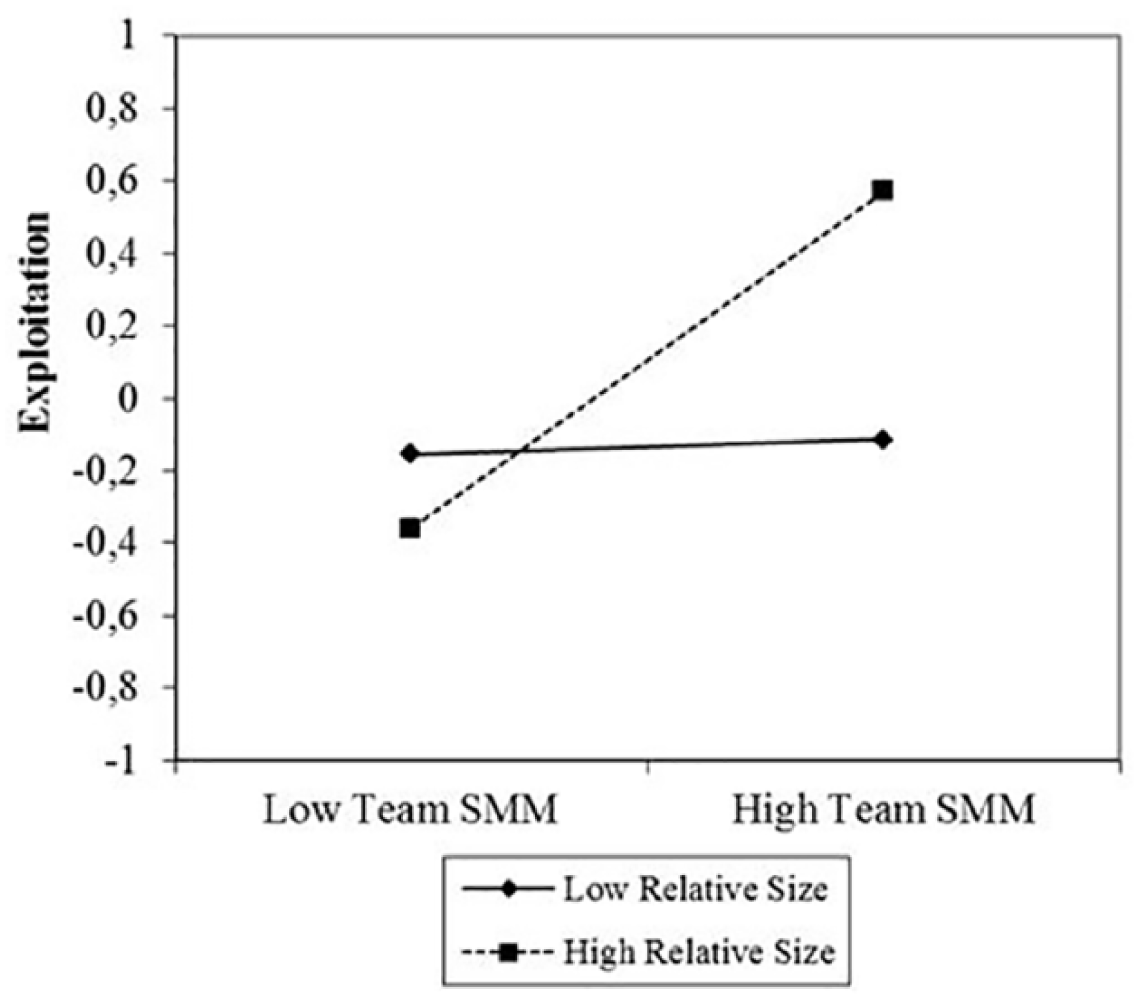
The moderating effect of relative size on the relationship between team SMM and exploitation.
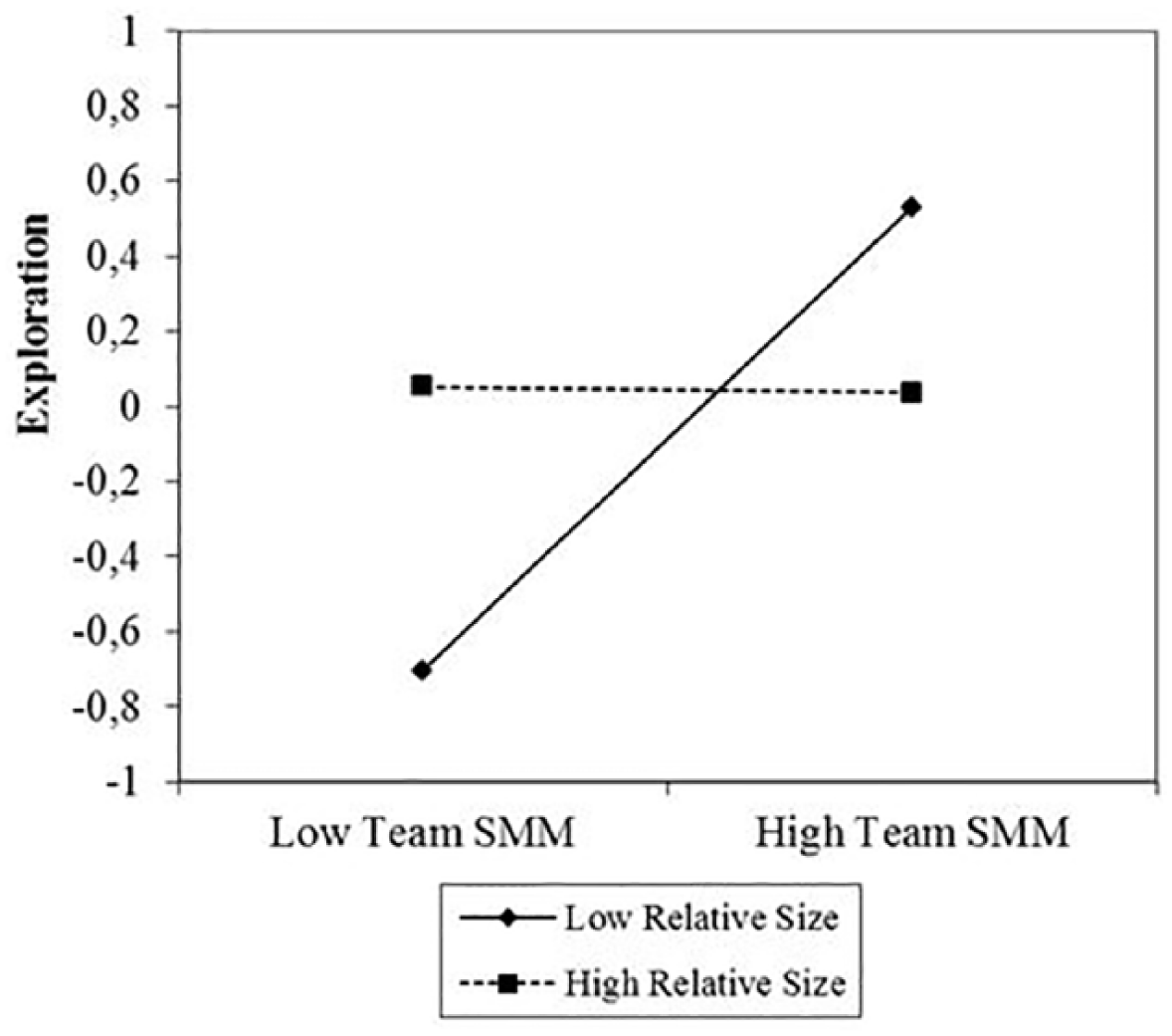
The moderating effect of relative size on the relationship between team SMM and exploration.
Three control variables show significant effects. Marketing integration (β = .33, p < .05) and annual sales (β = −.17, p < .10) influence exploration outcomes. Marketing integration (β = .21, p < .10) also influences exploitation outcomes. The proposed relationships yield an R2 of .22 for exploration and of .30 for exploitation (see Figure 1). The R2 for exploration is rather weak (Chin, 1998; Henseler et al., 2009). One reason might be that only one exogenous variable significantly affects this dependent variable and exploration might also be attributed to other variables not subject in this investigation. Table 6 presents the path coefficients together with the respective t statistics and variance inflation factors (VIFs). VIFs are calculated for investigating potential multicollinearity issues. All VIFs are well below the threshold of 10 (O’Brien, 2007).
Estimates and t Statistics.

Note. VIF = variance inflation factor; SMM = shared mental model.
p < .1. **p < .05. ***p < .01.
To evaluate the inner model, the predictive relevance (q2 effect sizes) of the proposed model was investigated by applying blindfolding. As proposed in literature, the cross-validated redundancy approach was used (Hair, Sarstedt, Ringle, & Mena, 2012). For conducting this analysis, the literature proposes to choose an omission distance between five and 10 which is not a multiple of the sample size (Chin, 1998; Henseler et al., 2009). Eight meet these criteria for the study at hand (n = 101). In addition, f2 effect sizes display the explanatory power of the exogenous latent variables (Cohen, 1988). Table 7 presents these calculations for the endogenous latent construct exploration. All effect sizes are positive, indicating the predictive relevancy of the proposed relationships (Chin, 1998; Henseler et al., 2009). The effect size of task SMMs of .00 is no surprise, as we did not find a significant effect on exploration. The f2 effect sizes turn out to be weak to medium (Hair, Sarstedt, Ringle, & Mena, 2012), emphasizing the explanatory relevance of the proposed relationships.
q2 and f2 Effect Sizes for Exploration.

Note. SMM = shared mental model; OD = omission distance.
Table 8 presents these calculations for the endogenous latent construct exploitation. All q2 effect sizes are at least weakly positive, again indicating the predictive relevancy of the proposed relationships. Furthermore, also all f2 effect sizes are weak to moderate, indicating that the proposed relationships show explanatory power for postmerger exploitation.
q2 and f2 Effect Sizes for Exploitation.

Note. SMM = shared mental model; OD = omission distance.
Supplementary Analysis
As our results indicate that team and task SMMs differ with regard to their effects on innovation outcomes, we conducted supplementary analyses. For investigating a potential difference, we calculated 95% bias corrected confidence intervals for the paths between task and team SMMs and exploitation and exploration success. This approach builds on the nonparametric confidence set approach (Sarstedt, Henseler, & Ringle, 2011), which was developed for comparing path coefficients across groups. Table 9 displays the 95% bias corrected confidence intervals. The path between task SMMs and exploitation does not fall into the confidence interval of the path between task SMMs and exploration. As consequence, the effect of task SMMs is significantly stronger on exploitation than on exploration. One reason might be that a common understanding of the task environment fosters process and structural efficiency and, thus, increases exploitation success (J. J. P. Jansen et al., 2009; March, 1991). For team SMMs, we find no statistically significant differences (see Table 9).
95% Bias Corrected Confidence Intervals.

Note. CI = confidence interval; SMM = shared mental model.
p < .1. **p < .05. ***p < .01.
Discussion
Theoretical Implications
This study analyzed whether task and team SMMs can reinforce innovation outcomes, by enabling a perspective that goes beyond simple performance measures and includes context-related organizational conditions and mechanisms of value creation. From a social capital theory lens, SMMs might be considered as a crucial condition for learning and knowledge sharing in M&A (Aklamanu, Degbey, & Tarba, 2015). Knowledge transfer has been emphasized by Degbey (2015) for ensuring customer retention as an important indicator of overall M&A performance. In terms of task SMMs, we provide empirical evidence for a positive relationship with postmerger exploitation success only. This emphasizes that SMMs on task-related features of a situation (e.g., technology, equipment, competitors, strategy; Lim & Klein, 2006; Mathieu et al., 2005) are beneficial, because exploitation activities build upon existing capabilities (Baum et al., 2000; March, 1991). Exploitation as one manifestation of innovation strategies is primarily concerned with improving the current state of procedures (Andriopoulos & Lewis, 2009; Nielsen, 2010). As this approach is based upon altering what is already in place by routine-based experiential learning (Lavie, Stettner, & Tushman, 2010), both organizations can seize their common understanding of tasks to refine routines, improve processes, reduce redundancies, and so forth. Crossan, Lane, and White (1999) provided a helpful framework for explaining how learning might transcend from the individual, to the group, and eventually to the organization. In this respect, task SMMs help acquirer and target members to establish a common interpretation of tasks. These mutually developed interpretations are the foundation for developing a shared understanding at the group level (the whole integration management team consisting of acquirer and target employees) regarding which adaptations and refinements of tasks need to be accomplished. In a final step, these shared interactive systems are institutionalized through the development of routines, rules, and procedures.
The relationship between task SMMs and exploration is nonsignificant. As task SMMs are characterized by a shared understanding in terms of resource allocation and sequences in complementing tasks (e.g., Kellermanns et al., 2008), these SMMs might not be useful for exploration, which is geared toward experimentation and variation. A possible explanation is that task SMMs are heavily focused on alteration of what is already in place, so that such mental models do not have any influence on the discovery of entirely new approaches for radical innovation. The positive direct effect between team SMMs and both exploration and exploitation shows that a common understanding of team interaction fuels employees’ absorptive capacity, as they can rely on trust and social acceptance. Those more subjective and less formally communicated codes of conduct are established through cultural learning effects (Schweiger & Goulet, 2005).
In terms of relative size, we show that increasing relative size has indeed a negative influence on the task SMMs exploitation relationship as well as on the team SMMs exploration relationship. Even though exploitation focuses on improving structures and processes (J. J. P. Jansen et al., 2009; March, 1991) and, thus, does not require as much freedom and autonomy, the beneficial influence of SMMs can be hampered when the target company is large relative to the acquirer. In that case, we assume that postmerger integration management, which is primarily coordinated by the acquirer, is increasingly challenged by the target organization with a higher perception of unfair management. The principle of equality—everyone receives equal treatment—is spoiled, which results in social disintegration (Meyer & Altenborg, 2007). Despite this, fair processes are necessary to create a fruitful environment for the intellectual value and emotional well-being of employees to encourage them to take on new challenges and cooperate with each other, which consequently leads to firm-level value creation (Ellis, Reus, & Lamont, 2009). If employees are being disrupted or even dominated during the creation and maintenance of relationships, social integration negatively affects M&A success (Meyer & Altenborg, 2007). This is the case because established intergroup dynamics and the perceived legitimacy of power relations are unsettled (Lupina-Wegener, Schneider, & van Dick, 2011). As such, perceptions of discontinuity result in lowered identification with the combined organization (Vuuren, Beelen, & de Jong, 2010). Well-grooved belief structures are decisive in creating a social identity and, thus, crucial for M&A success (Hogg & Terry, 2000). However, the positive effect of team SMMs among both organizations is levered out with increasing relative size. The study shows that the relationship between team SMMs and exploration is a sensitive one that can be easily disrupted.
An interesting result derives from our control variable structural integration, as it has neither a supportive nor a disruptive effect on exploration and exploitation. We assume that the reinforcing effect between task and team SMMs on exploration and exploitation are so strong that it makes no difference whether integration mechanisms are applied. This ties in to the findings of Puranam et al. (2009), who already questioned whether structural integration is necessary considering a common understanding between the merged organizations. Furthermore, we find no evidence for a significant effect of acquisition experience in terms of prior acquisitions undertaken by the acquirer. In general, experienced acquirers benefit from routinized acquisition behavior as well as elaborated integration skills (Nikandrou & Papalexandris, 2007). Thus, it is not the number of prior acquisitions but rather how firms apply deliberate learning mechanisms that affect acquisition performance (Zollo, 2009; Zollo & Singh, 2004). As a consequence, future research should investigate how codified and tacit experiences affect the relationships of SMMs on exploration and exploitation.
Practical Implications
M&A managers should make sure that targets and acquirers follow similar task and team SMMs, especially when the transaction aims at increasing exploitation. If exploration is the goal, only team SMMs are of importance. Managers secure task and team SMMs following two paths. First, target screening can emphasize the importance of similar company cultures with regard to task and team understanding. M&A integration can be facilitated to the extent that emotional factors such as status and achievement (Graebner & Eisenhardt, 2004) can be mitigated, when employees of both firms are aligned and have a common understanding on norms of collaboration (Monin, Noorderhaven, Vaara, & Kroon, 2013), for instance, prioritizing targets that have been partners in the past so that SMMs might already exist. Second, triggering the development of SMMs as early as possible during integration might be a viable avenue. Joint trainings and activities could pave the way. Zueva-Owens, Fotaki, and Ghauri (2012) found that evaluating cultural fit between target and acquirer would be too complex for forecasting potential conflicts and challenges. Thus, we suggest to look for, and establish, team and task SMMs. Furthermore, M&A managers need to consider that the use of SMMs depends on contingency factors. In this research, we show that relative size affects the beneficial influence of SMMs. Relatively large targets might bring along resistance against change measures imposed on them. In particular, task SMMs lose importance when targets are large. The usefulness of team SMMs is mixed when relative size is high. In this respect, team SMMs are especially helpful when postmerger exploitation should be fostered.
Limitations and Future Research
Although several countermeasures have been undertaken to reduce potential biases (see “Method” section), limitations cannot be ruled out completely. Surveys can involve problems regarding key informants’ decreasing capacity of recollection and measurement reliability (Sudman & Bradburn, 1973). In M&A research, this is important because it takes 3 to 5 years until transaction success is measurable (Homburg & Bucerius, 2006). Thus, key informants might not be able to remember every detail of the transaction process. However, as the integration process normally spans several years, it is necessary to implement a time lag to investigate M&A integration outcomes (Ellis et al., 2009). Furthermore, the phenomena of interest (especially task and team SMMs) are barely measurable with other data sources. In addition, the research design brings along a possible key informant bias (Kumar et al., 1993). A longitudinal research design would also have been preferable. We decided against a longitudinal design because managerial turnover complicates the identification of suitable respondents, and the willingness of managers to participate in primary data research is generally low. Finally, our sample is limited to the German-speaking part of Europe. Consequently, the results might not be generalizable to other parts of the world. These limitations provide fertile research opportunities for future research initiatives. A replication of the proposed relationships accessing other data sources could prove the robustness of the results. Recent trends in the field of emerging market multinational corporations venturing into advanced economies, in particular, could be captured in this context (see, for example, Liu & Deng, 2014; Xing, Liu, Tarba, & Cooper, 2016). Furthermore, an investigation of cultural and institutional aspects could shed light on important contingencies of M&A performance. Also, reinforcing effects by additional human resource management practices during M&A integration (Aklamanu et al., 2015) could be analyzed.
In summary, our study offers new insights into the sensitivity of SMMs with regard to the organizational context in M&A and their joint effects on innovation outcomes following the deal.
Footnotes
Declaration of Conflicting Interests
The author(s) declared no potential conflicts of interest with respect to the research, authorship, and/or publication of this article.
Funding
The author(s) received no financial support for the research, authorship, and/or publication of this article.
Associate Editor: Yipeng Liu