



Abstract
Although much attention has been paid to the knowledge, skills, abilities, and experiences that an individual brings when he or she transitions into an organizational role, little attention has been given to the history of the enactment of the role into which he or she is transitioning. This article examines how the behaviors of a predecessor influence the expectations for the successor, the successor’s role behaviors, and the evaluations made of the successor. A new construct, role residual, is introduced as a conceptual link between the behaviors of the predecessor and the behaviors and evaluations of the successor. A role residual is the set of expectations held by a role sender, associated with a position in an organization, which is left behind by a predecessor. A model of the antecedents and outcomes of role residual is presented and implications for theory, research, and practice are discussed.
In today’s professional world, the average person changes jobs 10 to 15 times during his or her career, and average employee tenure is 4.2 years (Bureau of Labor Statistics, 2016). As such, individuals spend a considerable amount of time and effort on role transitions and role making. Roles involve the set of activities and expected behaviors associated with a position in an organization (Kahn, Wolfe, Quinn, Snoek, & Rosenthal, 1964; Katz & Kahn, 1978). Yet, roles are not clearly defined, rather, they develop through the “changing effects of actual work activities, differences in expectations between the role occupant and his role senders [the individuals adjacent in the workflow structure or organizational hierarchy who depend on the focal role-holder’s performance in some manner (Katz & Kahn, 1978)], discrepancies between the expectations of the role occupant and the reality he encounters, and the role occupant’s perceptions of his employment situation”. (Toffler, 1981, p. 414) As such, understanding factors that influence the role-making process and effectiveness of a role occupant in performing in a new role is an important area of academic and practical investigation.
Interestingly, while a well-established body of literature investigates the history of the individual entering into a role (e.g., Ployhart, 2006; Schmitt, Cortina, Ingerick, & Wiechmann, 2003), little attention has been paid to the history of the role into which the individual is transitioning. This is surprising because the entry of a new person into a role constitutes “a new intersection of two existing systems, with the area of intersection characterized by cycles of behavior that in some respects continue the previous history of each system and in some respects are unique products of their coming together” (Katz & Kahn, 1978, p. 217). This means that the success of role occupants in their new roles (successors) is at least in part dependent on the history of the role and its previous occupants (predecessors), including their successes and failures, as well as the relationships they held with individuals that interact with that role (role senders). The fascinating implication is that the successor may be advantaged (“Boy are we glad you came!”) or disadvantaged (“You’ve got big shoes to fill!”), at least initially, when he or she assumes a new role, not by anything that he or she has done or by anything he or she brings to the role, but rather by something completely out of his or her control, namely, those residual expectations left by the predecessor.
We focus our inquiry on such role residuals. A role residual is the set of expectations held by a role sender associated with a position in an organization, which is left behind by a predecessor in that role. A role residual is developed over time through cycles of interaction with a predecessor and occurs based on role occupant—role sender relationships. The role residual includes both expectations regarding task behavior in the formal job requirements and also expectations that reach far beyond these formal requirements to include things, such as personal styles, the kind of person the role occupant should or should not be, how that person should relate to others, how he or she should dress, and the attitudes and beliefs that person should hold. The role residual can consist of high or low expectations for the successor and represents the “big (or small) shoes” that a successor is expected to fill when entering a role.
We develop a framework for understanding the antecedents and consequences of role residuals. In so doing, we contribute to theory and practice in several ways. First, we advance role theory by introducing a construct that addresses the history of the enactment of a role. Specifically, we demonstrate how the history of the predecessor engaging in a role influences the experiences of the successor. Research on role theory is pivotal in explaining how individuals adopt roles and behaviors based on expectations sent by others, both from within their organizations (e.g., Katz & Kahn, 1978), and from outside of it, such as with strategic alliance partners (Luvison & Cummings, 2017). However, existing literature does not attend to how the behaviors of the predecessor influence (a) the expectations held by role senders and the origin of those expectations, (b) the behaviors enacted by the successor, and (c) the initial evaluations of the successor made by the role senders. We address these origins and effects of roles and expectations. In so doing, we build on ideas of Cohen (2016) that jobs and incumbents cocreate one another, and argue that not only role successors, but also role predecessors and role senders, have an important influence on roles in the form of role residuals.
Second, the framework presented is expected to apply to all roles and at all levels in an organization; it is not limited to top management or leadership (e.g., J. D. Sherman, 2002). This is an advancement over extant work because the literature on role predecessors and successors tends to focus on leaders, including affective reactions to leader departure (Ballinger & Schoorman, 2007), position imprints (Burton & Beckman, 2007), predecessor’s “shadow” (Gilmore & Ronchi, 1995), the “Rebecca Myth” (Gouldner, 1954), leader transference (Ritter & Lord, 2007); and founder effects (Schein, 1991). Our model of the antecedents and consequences of role residuals offers a unifying framework to this body of work as well as an extension to incorporate all types of roles.
Finally, the construct of role residual is an important factor when studying role transitions. Similar to U. P. Sherman and Morley’s (2015) work on how communication of expectations from multiple organizational agents shapes newcomers’ psychological contracts, we argue that multiple role senders influence the received role of successors and subsequent successor behavior. We integrate this approach with development of the antecedents of those role sender expectations. We also build on the work of Slaughter and Zickar (2006) and Perrot et al. (2014) when we suggest that organizational insiders in the form of role senders participate in socialization of role successors, but suggest this socialization is also based on role residuals left by predecessors in the role. As such, we argue that the concept of role residual has implications for research on socialization and psychological contract formation, and provides a framework to integrate the antecedents as well as consequences of such residuals, which have implications for the behavior of and the evaluative attitudes toward role successors (newcomers to a role).
We begin by establishing the theoretical foundations of roles and role making before turning to development of a conceptual model of the antecedents and consequences of role residuals in organizations. The implications of the model and future research directions are then discussed.
Theoretical Foundations
Role theory provides a strong foundation in structure and terminology upon which to build the study of role residuals. It is the dynamic nature of role episodes (Kahn et al., 1964; Katz & Kahn, 1978) and role making (e.g., Graen, 1976) that allow for expectations of organizational members to change and role residuals to form. Table 1 provides a summary of several role constructs, their definition, and unit of analysis.
Role-Related Terms, Constructs, Definitions, and Units of Analysis.
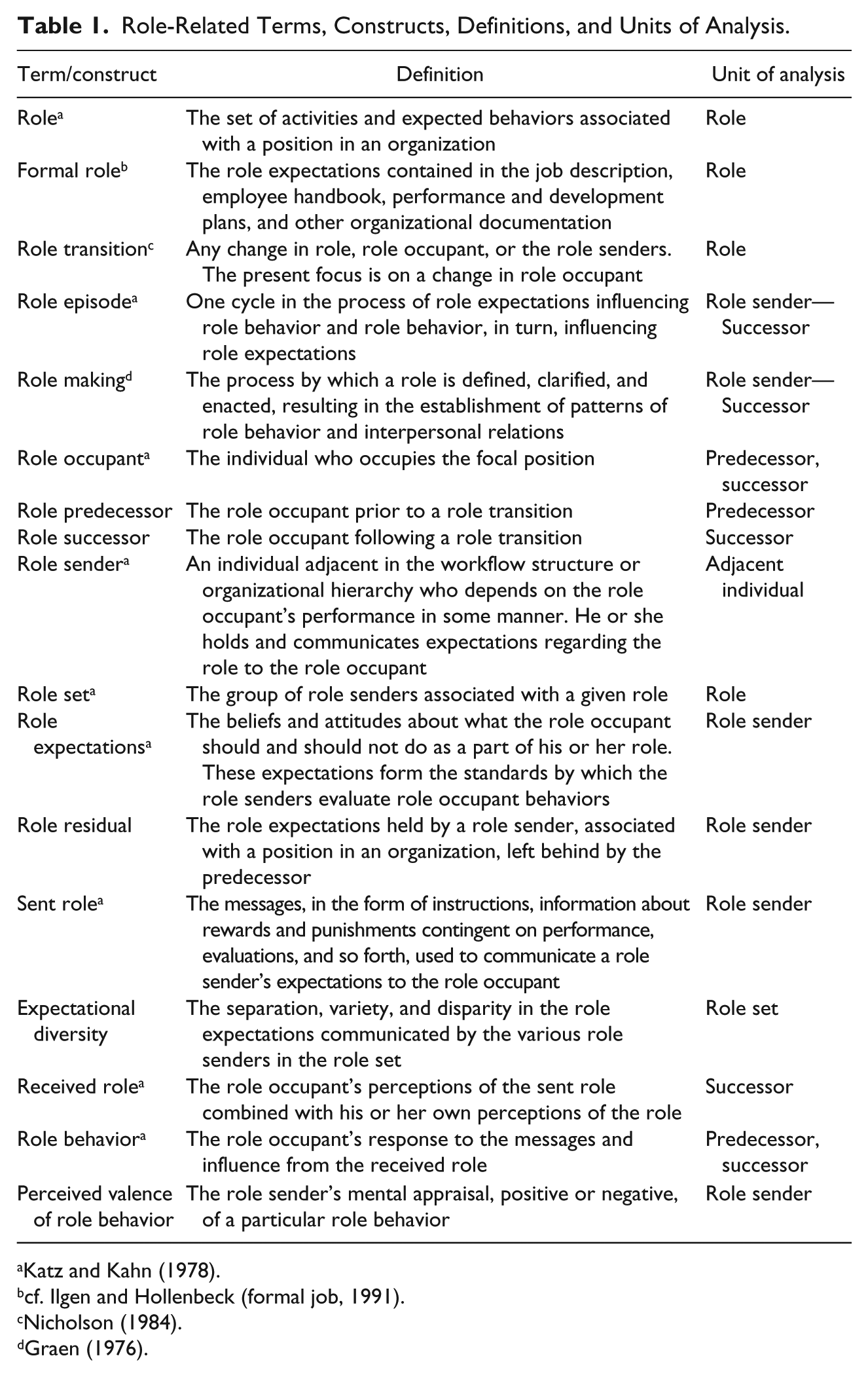
cf. Ilgen and Hollenbeck (formal job, 1991).
Roles and Role Episodes
The model of the taking of organizational roles presented by Katz and Kahn (1978) provides the basis for the following discussion of role episodes and the role-related terminology used in this article. A role is the set of activities and expected behaviors associated with a position in an organization. A role is broader than the job that it encompasses. Ilgen and Hollenbeck (1991) defined a job as “a set of task elements grouped together under one job title and designed to be performed by a single individual” (p. 173). They suggest that the elements of the job are typically specified by the prime beneficiaries of the job, codified into formal organizational documents, exist independent of job incumbents, and are relatively constant over time. In contrast, roles also include a number of “emergent” elements (Ilgen & Hollenbeck, 1991), which are specified by a number of social sources (including the incumbent), exist outside of formal documentation, are associated with the incumbent, and are dynamic. Roles contain both official job requirements, as well as the expectations and behaviors outside those of the “official system” or position (e.g., Biddle, 1979; Homans, 1950).
Although roles are held by role occupants, they are also influenced by role senders. These individuals, who depend on the role occupants’ performance in some manner (Katz & Kahn, 1978), form expectations regarding what the focal role occupant should and should not do as a part of the role. These role expectations form the standards by which the role senders evaluate the role occupant’s behaviors. Each role sender communicates expectations in different ways to the role occupant, such as in the form of instructions, information about rewards and punishments contingent on performance, and evaluations.
The role occupant is also agentic, whereby he or she processes expectations sent by role senders and forms the received role, which reflects the role occupant’s perceptions of the sent role combined with his or her own perceptions of the role. Role behavior is the role occupant’s response to the information and influence contained in the received role, and reflects how he or she fulfills (or doesn’t) the role expectations. The degree to which the role occupant’s behavior conforms to the expectations of role senders then influences the expectations of the role senders during the next cycle. This entire process is referred to as the role episode, a cyclical process of the expectations of role senders influencing role occupant behavior and role occupant behavior, in turn, influencing later expectations.
Role Making
Given the cyclical nature of role episodes, it should be clear that roles have a fluid and changing nature. “Roles are both stable and changing, as they provide strong expectations for behavior that enables continuity across projects while also allowing individuals room to enact changes in particular instantiations of their roles” (Bechky, 2006, p. 16). Role occupants shape the roles they occupy. The role-making process, where an organizational role is defined, clarified, and enacted, is a process of negotiation of the role over time between the focal role occupant and the role senders, resulting in the establishment of patterns of role behavior and interpersonal relations (Graen, 1976). “[R]ole making and the whole creative process associated with it are constantly in operation, even in the most rigidly defined situation” (Turner, 1985, p. 32). Research focused on role making and related concepts, such as role innovation (Ashforth & Saks, 1996; Van Maanen & Schein, 1979), role development (Nicholson, 1984), job crafting (Berg, Wrzesniewski, & Dutton, 2010; Wrzesniewski & Dutton, 2001), and role expansion (Grant & Hoffman, 2011), examines how a static incumbent engages in a dynamic process of shaping a role. We instead focus on how predecessors, role senders, and incumbents together shape roles dynamically.
Role making and the creation of “emergent” elements of a role are typically thought to be a function of the discretion or latitude the role incumbent possesses to alter or negotiate the role. This includes dimensions of the capacity to choose goals, means for achieving goals, timing of means–ends relationships, and patterns of interpersonal communications, influence, and evaluation. Interestingly, it is this notion of role discretion in the role-making process that allows for the creation of the unique role residual by the predecessor that affects the successor posttransition.
A Conceptual Model of Role Residual
Figure 1 presents our conceptual model. This model suggests that when a role transition occurs, and a new process of role making commences, the role residual constitutes a major initial aspect of a role sender’s role expectations for the successor. These expectations are then transmitted by the role sender and perceived and processed by the successor into the received role expectations. The resulting role behavior enacted by the successor is then evaluated on the basis of the role sender’s expectations and attitudes toward the successor are formed. These evaluative attitudes subsequently provide feedback into the role expectations of the role sender and the cycle continues in a dynamic manner. We explain each aspect of this model in more depth below.
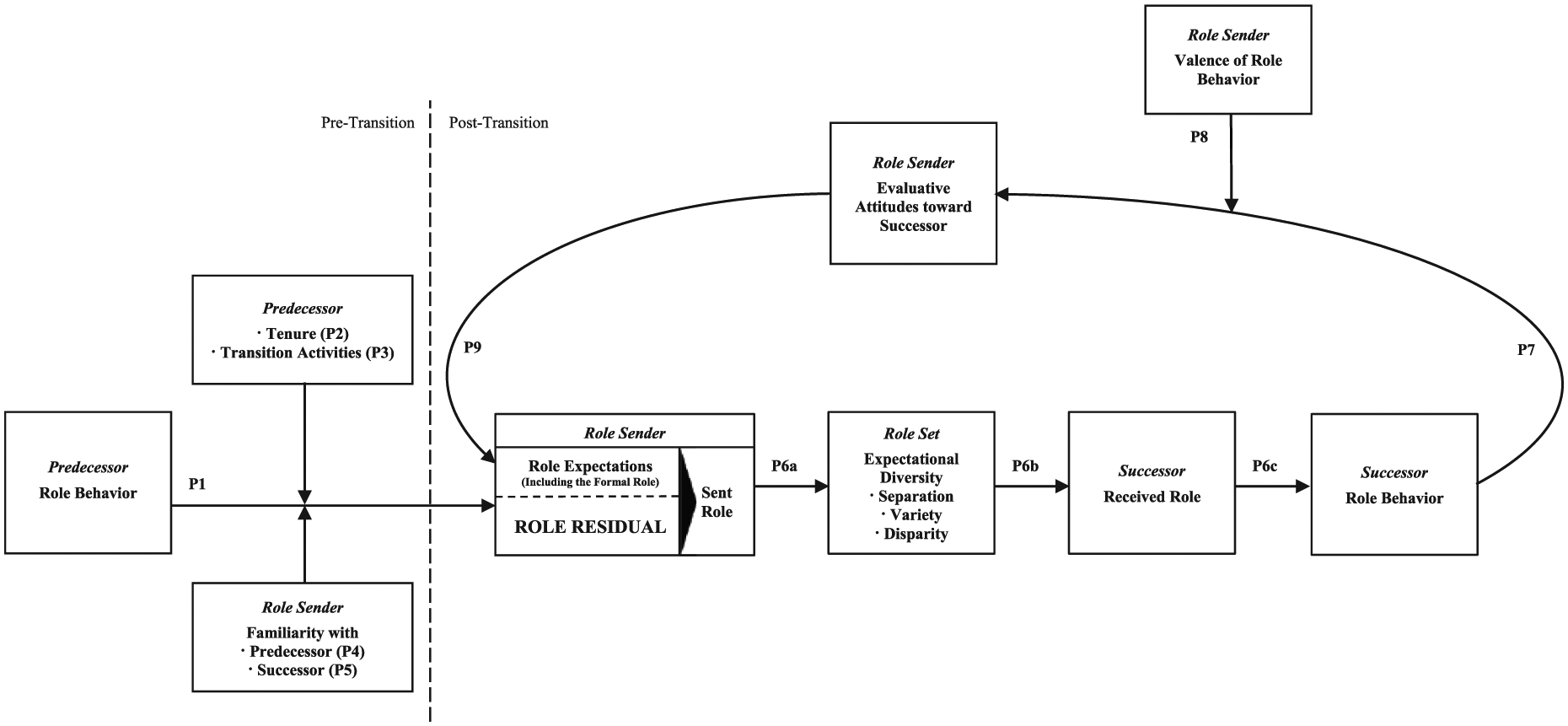
Conceptual model of the role-making process with the antecedents and consequences of role residuals.
Role Residual Antecedents
Role expectations consist of preferences for specific acts or behaviors and personal characteristics of role occupants (Katz & Kahn, 1978). The factors most directly influencing the formation of role residuals are a role sender’s perceptions of a focal role occupant’s role behaviors as they relate to performance of a role. These perceived role behaviors serve as the basis for the content of the expectations that shape the role residual. They are the stimulus to which the role senders respond and they represent a major part of the focal individual’s influence in the process of defining, clarifying, and enacting role expectations and hence the role residual.
Predecessor role behavior
Predecessor role behavior includes the role senders’ perceptions of the role occupant’s performance of job-related tasks, duties, and responsibilities. These role behaviors include fulfilling one’s job responsibilities but may also include perceptions of contextual or organizational citizenship behaviors, and other behaviors in which he or she is engaged while enacting the role. Predecessor role behavior also captures role sender perceptions of the display of a broad array of dispositions, styles, and other behaviors that an individual may exhibit in the workplace. These behaviors can include the role senders’ perceptions of the focal role occupant’s personality; for example, does the individual’s behavior suggest that he or she is conscientious and does he or she tend to be more outgoing or reserved? They can include the display of other dispositions such as positive and negative affect or one’s preference for multitasking. They may include perceptions of interaction styles, and likely also include surface characteristics, such as appearance, gender, age, ethnicity, and so forth. As such, role behaviors include both what role occupants do and how they do it. The display of these role behaviors by the predecessor encapsulates all of the processes and variables associated with the cycles of role episodes and role making that have occurred between the predecessor and the role senders during the predecessor’s entire time in the role.
The perceived level of a particular role behavior exhibited by a predecessor serves to shape the expectations for the future display of those role behaviors. Helson’s (1964) adaptation-level theory suggests that every stimulus shifts the expected level of that stimulus in its own direction. For example, if the predecessor did an excellent job of fulfilling role expectations of the role senders, the role senders would be likely to have high expectations for other individuals who take on that role once the predecessor leaves it. Considering the level of a particular behavior exhibited by an individual as the stimulus, it follows that the individuals (i.e., the role senders) observing or experiencing those role behaviors would adjust their expectations for the future display of those role behaviors toward the levels previously demonstrated.
Biddle (1979) noted that when people interact, it is reasonable to believe that expectations will form that reflect (and also generate) behavior. The predecessor to a greater or lesser extent will modify the role and the expectations of the role senders through the manner in which he or she enacts the role (Katz & Kahn, 1978). Each role sender’s perceptions of the role behaviors of the role occupant thus influence the expectations that the role sender holds for the role. Hence, the behaviors of the predecessor, about which a role sender has formed expectations, should be reflected in the expectations held for the successor. Support for this view also comes from Cohen (2016) who argues that individuals leave “imprints or ghosts that persist and influence the job long after an incumbent has left” (p. 46). Accordingly, we argue as follows:
Moderating Factors
Predecessor tenure
The tenure of the predecessor in working with the various role senders is related to the formation of a role residual. The formation of a role residual occurs through repeated cycles of interaction between the predecessor and the role senders. Hence, the formation of residual expectations is a process that occurs over time. As suggested by Helson (1964), the extent to which a stimulus influences the expected future level of that stimulus depends upon, among other things, the frequency and duration of the stimulus. The longer the tenure of the predecessor, the more the opportunity exists for the role senders to engage in cycles of interaction and thereby develop residual expectations similar in level to the role behaviors exhibited by the predecessor.
Predecessor transition activities
The extent to which the predecessor engages in transition activities should influence the role residual. Transition activities include the predecessor’s attempts to set the stage for success for the successor or attempts to undermine the successor’s success before he or she enters the role. For example, Sonnenfeld (1988) demonstrated that some leaders will thoroughly develop their successors and serve as valued mentors and confidants, whereas others serve as destructive mentors and work to block the careers of potential successors. These transition activities of the predecessor influence the successor’s preparedness, the expectations he or she will face in the role, and ultimately his or her success (Sonnenfeld, 1988). Attempts to enhance or undermine the successor’s success could take many forms, such as creating a “blueprint for success” in the role on the positive side or sabotage on the negative side, or subtler attempts to influence expectations of role senders for the successor. In any of these cases, predecessors engaging in deliberate transition activities, whether helpful or harmful, would shift the emphasis of the role residual toward those transition activities and away from prior role behaviors performed over the predecessor’s time in the role. This would weaken the direct relationship between the predecessor’s role behavior and the role residual. 1
Role sender familiarity with predecessor
Role sender familiarity with predecessor refers to the amount of knowledge or information each role sender has about the behaviors of the predecessor. It is the amount of prior interpersonal knowledge developed through their history of interaction. In order for a role residual to develop, the role sender must be able to engage in cycles of interaction and/or observe a range of behaviors of the focal role occupant. If the role sender has limited information regarding the role behaviors of the predecessor, then it is unlikely that the role sender will incorporate residual expectations into his or her representation of the predecessor and hence, a role residual would be unlikely to develop.
Although one might expect that the tenure of the predecessor will be highly correlated with the role sender’s familiarity with that predecessor, this may not always be the case. Due to the structure of the relationship between a given role sender and the predecessor, the opportunities for frequent and/or enduring interaction, and hence the development of familiarity with the predecessor, may or may not exist. Changes in the organization, such as growth or restructuring, can also influence the nature and frequency of interaction between the predecessor and any given role sender. These and other variations contribute to a socially complex situation. Therefore, the level of familiarity with a predecessor, and the development of residual expectations similar in level to the role behaviors exhibited by the predecessor, will likely vary among role senders regardless of the tenure of the predecessor.
Consistent with this line of reasoning, research in the team’s literature has examined the influence of team member familiarity on team performance. In some instances, familiarity can be detrimental to team performance (e.g., Baron & Byrne, 1987; Janis, 1972), whereas in others, familiarity can improve it (e.g., Espinosa, Slaughter, Kraut, & Herbsleb, 2007; Gruenfeld, Mannix, Williams, & Neale, 1996; Harrison, Mohammed, McGrath, Florey, & Vanderstoep, 2003; Moreland, 1999). It is the mechanisms by which familiarity influences performance that are important for the formation of role residuals. For example, familiarity provides a basis for coordination (Gruenfeld et al., 1996; Harrison et al., 2003); can help individuals anticipate each other’s behaviors and can result in the formation of transactive memory systems (Moreland, 1999); enables individuals to better interact, coordinate, and share information (Espinosa et al., 2007); can lead to the establishment of similar interpretive schemes, behavioral expectations, and trust (Jones & George, 1998); and can emerge as a semistructure or framework encompassing a rich set of shared expectations and behaviors (Okhuysen & Waller, 2002). The common thread is that familiarity is a key factor in the formation of expectations. Thus, we predict that role sender familiarity with the predecessor will moderate the relationship between the level of a given role behavior exhibited by the predecessor and the level of that role behavior found in the role residual.
Role sender familiarity with successor
Familiarity with the successor may also influence the role residual. Familiarity with the successor refers to the amount of knowledge or information role senders have about the behaviors of the successor. If successor familiarity exists prior to the role transition, it may serve to influence the information used by the role senders in constructing their overall expectations for the successor, thereby reducing the influence of the predecessor on the residual components. For example, if a role sender has worked with the role successor previously, or spent time with the successor during the interview process, greater familiarity may have developed that would influence the expectations that role sender has for the successor’s enactment of the role. In such instances, expectations for the successor would likely be less influenced by predecessor behavior to the extent that the role sender has been influenced by knowledge or familiarity with the successor.
It is possible that this familiarity can develop passively; however, it is also possible that the successor will take an active role in developing that familiarity via impression management. Impression management refers to the attempts by an individual to control the images he or she projects in social interactions (Schlenker, 1980) and thereby to control the impressions other people form of him or her. Such attempts can influence the expectations role senders have for the successor. If these attempts occur prior to role transition, they may affect the formation of the role residual as this prior knowledge can contribute to the overall role expectations of the role senders. In support of this, Wayne and Liden (1995) noted that supervisors may develop expectations regarding a subordinate’s behaviors during the interview process, before working with the individual. They suggest that attempts at impression management by the successor during the interview process may influence expectations and subsequent performance evaluations more so than attempts at impression management while on the job. Whether role sender familiarity with the successor develops passively or actively through impression management, this familiarity will likely influence the role residual. Hence,
Consequences
The role residual constitutes a major initial aspect of a role sender’s expectations for the successor. The balance of the role sender’s initial role expectations come from the formal role (i.e., those expectations contained in the job description, employee handbook, performance and development plans, etc.). We note that the role residual can have a direct effect on the formal role as residual expectations may be codified into the formal role prior to the role transition (Graen & Scandura, 1987). However, as elements of the new formal role, residuals are still a component of the role expectations of the role senders.
Successor role behavior
The role residual will include expectations regarding both the formal and emergent aspects of the role. Consistent with the model of the taking of organizational roles (Katz & Kahn, 1978), residual expectations have implications for the role behavior of the new role occupant. The idea that expectations influence outcomes has been noted for decades. For example, the idea of self-fulfilling prophecy (Merton, 1948) suggests that the expectation that an event will happen increases the likelihood of its occurrence; McGregor (1960) indicated that a manager’s expectations influence how he or she treats subordinates, which affects subordinate behavior; and, expectancies have been said to influence motivation and effort (Vroom, 1964). Certainly, the notion that higher expectations lead to higher performance (Rosenthal & Jacobson, 1968) is relevant as well.
Returning to the model of the taking of organizational roles, the residual expectations of each role sender are communicated to the successor through the various messages that comprise the role sender’s sent role. The successor perceives the sent roles from the various role senders and incorporates the expectations contained therein with his or her own expectations into the received role. The successor then responds to the received role in the form of role behavior. Katz and Kahn (1978) noted that the received role expectations cannot be assumed to be identical to the role expectations sent by any of the role senders. Instead, role behavior is a product of the expectations, including the role residual, communicated by the role senders as perceived and interpreted by the successor. Indeed, Pfeffer and Salancik (1975) found that a significant amount of the variance in supervisor behavior was accounted for by the supervisor’s perceptions of the expectations of role senders. These perceived expectations, the received role expectations, therefore mediate the relationship between the expectations of each role sender and the behavior of the successor.
Expectational diversity
It is important to note that there is typically more than one role sender for a given role. This group of role senders associated with the role is referred to as the role set (Katz & Kahn, 1978). The presence of multiple role senders in the role set creates the opportunity for differences in expectations to arise. In these situations, the potential exists for the role occupant to experience conflict related to the diversity of role sender expectations on three fronts. Using the terminology offered by Harrison and Klein (2007), the role occupant may be faced with separation in the expectations of the role senders on a given dimension, variety in the dimensions about which the role senders form expectations, and disparity in the power of the various role senders to influence the role occupant.
Separation refers to dissimilarity in position (Harrison & Klein, 2007) of role senders with respect to a particular expectation. Maximum separation occurs when the role senders are equally divided and hold expectations that are at opposite ends of the continuum for a particular role behavior. For example, assume there are two role senders in the role set and each has expectations regarding the successor’s need or ability to multitask. Maximum separation would occur when one role sender expects the successor to be willing and able to juggle multiple tasks while the other role sender expects the successor to focus exclusively on one task at a time. Such high separation would be challenging for the successor to resolve.
Differences in the kind of expectations held by the role senders are referred to as variety (Harrison & Klein, 2007). Variety is greatest when each role sender has expectations about a unique role behavior. For example, one role sender may have expectations related to specific tasks while another has expectations regarding citizenship behaviors. Indeed, Pfeffer and Salancik (1975) found that the perceived expectations of different role senders influenced different classes of behaviors. The perceived expectations of supervisors were found to influence the role occupant’s task-related behaviors while the perceived expectations of subordinates were found to influence the role occupant’s social behaviors. Variety becomes problematic for the role occupant when he or she does not have the resources (e.g., time, ability, motivation) to adequately address the full array of expectations arising from different role senders.
If it is expected that the role residual may vary between role senders, an important question arises; specifically, when the expectations of the role senders are perceived to be in conflict, to whom does the role occupant pay heed? When the residual expectations are aligned, they should reinforce each other. However, when they are in conflict, a decision must be made. The influence that a given role sender’s expectations have on the role occupant is likely a function of the “importance” or “power” that the given role sender has relative to other role senders in the role set. This difference in the concentration of power of the role senders is referred to as disparity (Harrison & Klein, 2007). Maximum disparity occurs when one role sender holds all of the power to influence the role occupant. It is under conditions of minimum disparity, when all role senders exercise equal influence, that variety and separation of expectations become most difficult for the role occupant to resolve.
Level of the role residual
Above, we explained how the predecessor’s behaviors influence the formation of an individual role sender’s residual expectations for the successor. However, given that residual expectations are potentially held and communicated by many role senders to one role successor, the received role is formed through an aggregation of the sent roles received from various role senders, including the role successor himself or herself. How this aggregate is formed within the individual is a function of the separation and variety of the expectations coupled with the disparity in the ability of the role senders to exercise influence. Therefore, it is important to recognize that when multiple role senders are present, the relationships between any single sent role/role residual and the received role and role behaviors may not be as strong as when the relationships involve only a single role sender for a role successor.
Different role senders may have different residual expectations for the successor, and these expectations can differ in terms of variety, separation, and disparity. However, scholars should not examine the role residual as a group-level construct. Attempting to demonstrate agreement, for example, rWG and ICC(1), ICC(2), among role senders does not make sense because agreement is not necessarily expected. In cases where there is no agreement, the mean of the role set’s expectations would be ambiguous, and that mean may not capture the expectations of any one of the role senders. Instead, if the role occupant receives multiple sent roles (as expected when there are multiple role senders each with her or his own expectations) then the role occupant has to make sense of all of the messages, including those that are consistent and those that are conflicting. The role successor has to pay attention to all three forms of diversity of expectations—different levels of a particular behavior expected (separation), different types of or specific behaviors expected (variety), and different power of each role sender (disparity). The attention to these, and the sensemaking process to distill these different role sender expectations into one received role, occurs within the mind of the role occupant, not external to that individual, and not at the group (role set) level. Once these expectations are processed into a received role, role successors have discretion to choose how to behave in a role, whether consistent with or contrary to the received role expectations. The above discussion leads us to propose the following:
Evaluative attitudes toward successor
As the successor engages in role behavior, each role sender will evaluate those behaviors against her or his unique role expectations and form attitudes about the successor. Expectations of the role senders represent the standards by which the role senders evaluate the performance of the role occupant (Chen & Klimoski, 2003; Katz & Kahn, 1978). Expectations help to form the cognitive processes through which role senders attend to, encode, and retrieve performance-related information (DeNisi & Williams, 1988). Furthermore, Katz and Kahn (1978) suggested that changes in the role occupant’s behavior (e.g., sudden and persistent failure to comply with the role sender’s expectations) would alter the role sender’s evaluations of the occupant’s role behavior and change her or his attitudes toward the role occupant. Inasmuch as the initial expectations of the role senders consist in large part of the role residual, the role residual will be integral to the initial appraisal of a successor’s behavior and the evaluative attitudes formed about the successor.
As role senders engage in repeated interactions with the predecessor they adapt their expectations for the role behaviors to the level exhibited by the predecessor. When a role transition occurs, those adapted expectations remain in the form of the role residual. Prolonged exposure to a specific level of a stimulus causes the evaluators to adapt to that level of the stimulus and then to interpret changes in the stimulus in terms of that adaptation level (Helson, 1964). The successor role behaviors represent a potential change in the stimulus and are interpreted by the role senders in terms of the role residual. If the successor behaves in ways contrary to the set of expectations from the role residual, a contrast effect occurs. Comparisons across exemplars have been shown to result in such contrast effects. For example, Hakel, Ohnesorge, and Dunnette (1970) found that the qualifications on a previous applicant’s resume affected the evaluation of the next applicant’s resume. In addition, a prior applicant’s performance in an employment interview influenced the evaluations of the next applicant’s interview (Kopelman, 1975; Wexley, Yukl, Kovacs, & Sanders, 1972). These findings support the idea that the evaluation of the successor’s behaviors are likely to be influenced by the expectations created by a predecessor. Stapel and Schwarz (1998) also noted that prior exemplars serve as standards of comparison. Thus, for the exact same role behaviors, the successor would be judged less favorably when evaluated against a more favorable role residual and more favorably when evaluated against a less favorable role residual. The intriguing consequence is that those residual expectations created by the predecessor will either aid or harm the successor upon entering the new role, regardless of what he or she brings to the role. Thus, it is the history of the role, and not simply the history of the individual entering into it, that influences evaluative outcomes.
Perceived valence as a moderator
The valence of a given behavior as perceived by a role sender plays an important moderating role in the relationship between the level of the successor’s behavior and the role sender’s evaluative attitudes toward the successor. Although the displayed level of the role behavior will shift the expected level for the future display of that role behavior toward the displayed level (cf. Helson, 1964), it is the perceived valence of that particular behavior, positive or negative, that determines whether successor behavior that is higher or lower than the expected level is evaluated more or less favorably. For example, if a predecessor typically behaved in a highly neurotic manner, then the residual expectation would be for highly neurotic behavior from the successor. As this type of behavior is generally regarded as negative, if the successor engaged in behavior that was even more neurotic, the evaluative attitudes toward the successor would be negative (a higher level of negative behavior is considered bad). However, if the successor was less neurotic, the evaluative attitudes toward the successor and that behavior would be positive (a lower level of negative behavior is considered good). Contrast that with a predecessor who was a high performer. The residual expectation for the successor would be for high performance. If the successor was an even higher performer, the evaluative attitudes toward the successor would be positive (a higher level of positive behavior is considered good). However, if the successor was a lower performer, even if performing to some objective standard, the evaluative attitudes toward the successor would be negative (a lower level of positive behavior is considered bad). So, in each case, the residual expectation for the level of the behavior represents the standard, and the perceived valence determines the evaluative attitude toward the behavior exhibited by the successor. Hence,
Role expectations
Role making is a cyclical and ongoing process (Graen, 1976). Upon evaluating the behaviors of the successor, the role sender alters or reinforces his or her role expectations and subsequent role sending (Katz & Kahn, 1978). A series of longitudinal studies has demonstrated the ability of a new role occupant to change or influence the expectations of the role sender (e.g., Dansereau, Graen, & Haga, 1975; Graen, 1976; Haga, Graen, & Dansereau, 1974). We underscore the cyclical nature of the role-making process, noting that as successor behaviors influence a role sender’s evaluations, these evaluations further influence the role sender’s expectations concerning the role, which restarts the cycle of expectations influencing behaviors.
Discussion
In this article, we developed a conceptual model of role residuals, the set of role sender expectations associated with a position in an organization that are left behind by the predecessor in that role. We explored the antecedents and consequences of role residuals and the entire process of role making of role successors. This model has important implications for research and practice, as well as opportunities for future extensions.
Implications for Research
Role theory
The models and frameworks in the extant role theory literature fail to offer a comprehensive means for addressing the history of the role system into which a successor enters. The elaboration of the role residual concept advances role theory by specifically addressing this aspect of role transitions. It is not only what the successor brings to the role, in terms of knowledge, skills, abilities, and experiences, which influences successor performance in the role, but also the residual expectations left behind by the predecessor. Furthermore, these residual expectations influence how the successor is evaluated by various role senders. There may be many situations in which, by any objective standard, a successor is performing quite well and yet, due to relative comparisons with the expectations created by the predecessor, the successor is evaluated as underperforming. Our model explains such situations and why they come about based on role residuals. In addition, extant role theory takes role expectations for granted without addressing the origin or the development of those expectations. The discussion of role residuals illustrates the formation of expectations faced by the successor to a role and explains how while successors are agentic in determining their role behaviors, they cannot control expectations based on predecessors and role residuals. As such, our focus on the history of the role rather than the typical focus on the history of the role occupant or successor is an important extension of role theory.
Role transitions
The notion of a role residual also builds upon and extends the work examining role transitions by looking at these transitions from a unique perspective. Much of the work on role transitions has examined the impact of the transition from the perspective of the individual experiencing the transition (e.g., Allen & van de Vliert, 1984; Minkler & Biller, 1979; Nicholson, 1984). In the preceding discussion of role residual, the transition was examined from the perspective of the role senders and how the expectations of the role senders transfer from one individual occupying a role in an organization to the next. Role transitions affect the entire network of people linked to the transitioning individual. Thus, it is imperative that theory investigating role transitions be constructed to examine the influence these transitions have on all parties involved.
Work role transitions involve a process of adjustment to a new role during which two independent types of development can occur. The first is personal development, through which the individual adjusts to meet the requirements of the new situation, and the second is role development, through which the individual alters the situation to suit her or his needs, abilities, and/or identities (Nicholson, 1984). During the transition and adjustment process, a successor may make attempts to fit in while he or she may introduce ideas, preferences, and expectations about what the role should be. A strong role residual may constrain the transitioning individual’s ability to change the environment, leading to more personal development. On the contrary, a weak role residual may be less constraining, allowing for more role development. Thus, the strength of the role residual should prove an important variable in understanding how much of each type of adjustment the individual engages in upon transitioning into a new role.
Role history and role predecessors
In contrast to work that examined the influence of current role occupant attributes on role enactment, the study of the history of the enactment of the role focused on the influence of prior role occupant attributes is limited. Concepts studied in this area include founder effects (Schein, 1991), position imprints (Burton & Beckman, 2007), the “Rebecca Myth” (Gouldner, 1954), the predecessor’s shadow (Gilmore & Ronchi, 1995), individual reactions to leadership succession (Ballinger & Schoorman, 2007), and leadership transference (Ritter & Lord, 2007). Each of these founder and previous leader perspectives sheds a ray of light on how the history of a role can influence the context experienced by future role occupants. Yet with the exception of founder effects, these concepts have received little research attention. The conceptual model of role residual presented above provides the structure and support to unify and explain the basis for these understudied concepts. Recognizing that these disparate pieces of research represent a broader phenomenon allows for the exploration of these interrelated issues and the examination of the antecedents and consequences of the role residual.
Future Research Directions
Several interesting areas for future research emerge from the above discussion of role residuals.
Testing the model
Developing and testing specific hypotheses for the relationships in the conceptual model will require a series of carefully designed studies that incorporate observation of role transitions. To see the formation of the residuals and their outcomes, predecessors must leave their roles and the successors must enter the vacated roles. This will require the identification of samples that will yield a sufficient number of transitions; ideally with little uncertainty regarding the transitions and the timing of the transitions. Clearly, longitudinal data need to be collected to measure the role residual, as well as other aspects of the model such as predecessor and successor familiarity and behaviors, over time. Such a study would require balance between robustness of the data and ease of data collection. We suggest that both direct and indirect alternatives for operationalizing the residual should be considered, and perhaps a qualitative case study approach would be most appropriate.
In addition, given that there are potentially multiple role senders with different expectations for the successor, empirical study of expectational diversity and how this is managed by role successors could prove insightful. Successors have a challenging job of aggregating diverse sent roles and could do so in a myriad of different ways, such as stacking them together, focusing on the areas of the most overlap in expectations, prioritizing expectations of role senders with more power such as supervisors or crafting the received role primarily based on their own expectations for the role. This individual rationalization and sensemaking process of role successors has not been examined conceptually or empirically and such inquiry is sorely needed.
Duration of the role residual
The residual expectations are an important initial element of the interactions between a role sender and the successor. Although the successor likely enters the position focused on the formal role, as that is typically the focus of discussion during the hiring process, role senders are likely focused on the role residual, as the formal role may or may not be salient to them. This could lead to confusion for the successor upon entering the role as role residuals may be surprising or contradictory to the information successors receive during the hiring process. 2 Future research could investigate the resolution of this potential conflict and the period of time over which the role residual has an influence. The literature on role making suggests that the definition and expectations of the role are continually being negotiated (e.g., Graen, 1976; Turner, 1985). Hence, the expectations contained in the residual could be incorporated into the role for the duration, completely negotiated away, or some expectations retained and others let go. Examination of the scope of retained role residuals and the duration of their influence is needed.
Organizational environment and culture
Although not included in our model, it is important to note that changes in the environment in which the organization is embedded or changes in the context in which the focal position is embedded may lead to changes in what is required from a given position and hence changes in the expectations associated with the position. When role senders fail to recognize the need for change, however, their residual expectations could hinder the ability of the role successor, and ultimately the organization, to adapt to the changing environment. Thus, the influence of environmental forces and the influence of the changing environment must be taken into consideration when examining specific instances of the formation and influence of role residuals.
Organizational culture could similarly affect role residuals and the role-making process. An important part of organizational culture involves the amount of discretion or latitude the predecessor possessed to alter or negotiate the role (i.e., engage in role making). When employees perceive that discretion exists, they are more likely to engage in job crafting (Wrzesniewski & Dutton, 2001) and the creation of “emergent” elements of the role that would be reflected in the role residual. Greater discretion may also allow role successors to deviate from role residuals without negative evaluation of their role behaviors and, as such, this aspect of organizational culture (and perhaps others) should be explored as potential moderators of the relationships discussed in our model.
Size and scope of group of role senders
Finally, explicit examination of the size and scope of the group of role senders may yield interesting insights. Size simply refers to the number of role senders. Scope incorporates the locus of each role sender; for example, the group of role senders may consist of individuals not only within but also external to the work organization, including family, friends, professional organizations, and so forth. The size and scope of the group of role senders might influence the type and the magnitude of diversity in expectations faced by the role occupant, such as the separation, variety, and disparity of such expectations, which would have implications for the received role and the resulting role behavior. Furthermore, the discussion of our model has assumed that the predecessor leaves behind the role senders when they transition out of the role, but it is possible for predecessors to remain in the organization in a different role. Extensions of our model could examine what happens when the predecessor stays in the department and becomes a role sender for their past role, providing a living comparison for the role successor and not just a memory or role residual. 3
Practical Implications
In addition to the theoretical and empirical research implications discussed above, several practical implications deserve mention. One implication is that managers should be made aware of the potentially biasing effects of their residual expectations and the residual expectations of the other members of the work group. The entire work group should take time to reflect on the expectations they have developed based on the predecessor. If these expectations are deemed important for successful performance in the role, then they should be made explicit and incorporated into the formal position documentation and highlighted during the onboarding process. If these expectations are not relevant, then work group members should attempt to realign their expectations with the requirements of the position.
Furthermore, when an organization is planning for succession and/or recruiting to fill an open position, a residual audit could be conducted to identify the explicit and tacit residual expectations held by the role senders. Any revisions to the formal job description and selection criteria stemming from the residual expectations should be made prior to beginning the search for a replacement.
Another recommendation is that organizations provide sufficient time, even structured time, during the socialization process for the successor to meet with the various role senders to discuss their expectations for the role. During this time, the successor and the role senders should be encouraged to talk about the predecessor and how his or her behaviors may influence the expectations for the successor. Such discussions would serve to ease the successor’s transition into the new role by providing some degree of understanding and anticipation of the new set of expectations he or she will face.
Finally, role residuals have implications for the restructuring of work groups and the perpetuation of organizational routines. For example, if a particularly high functioning work group with effective routines experiences a transition of one of its members, the organization and work group can take heart in the fact that the enduring expectations of the remaining members of the work group can help to perpetuate its high functioning with the successor. However, if there is a particularly low functioning work group in an organization, with ineffective routines, it may be necessary for the organization to restructure the entire work group, or at least the most influential members, to dismantle the enduring expectations that might perpetuate the poor functioning of the group.
Conclusion
Roles are a fundamental building block of organizations. Role transitions are an ongoing concern for organizations and for the individuals entering into and exiting organizational roles. These transitions are influenced by both what the successor brings into the role and what the predecessor left behind. A new theoretical construct—role residual—was offered to explain the expectations left behind by the predecessor and how those expectations influence the successor and the role senders. By focusing on what the predecessor left behind, in the form of the role residual, we examined the role transition and the cycles of expectations influencing behavior and behavior influencing expectations from a new perspective. Future research can build on the foundation laid by this discussion to inform theory and to provide useful practical advice for recognizing, understanding, and managing role residuals.
Footnotes
Acknowledgements
This article is based on Joseph Cooper’s dissertation, completed under the supervision of Howard Klein and dissertation committee members, Roy Lewicki and Ray Noe. We would like to thank them for their insightful comments and support. We also thank Charles Stevens, Stephanie Oneto, Roland Kidwell, and Philip Varca for their feedback on earlier drafts of this article.
Declaration of Conflicting Interests
The author(s) declared no potential conflicts of interest with respect to the research, authorship, and/or publication of this article.
Funding
The author(s) received no financial support for the research, authorship, and/or publication of this article.
Associate Editor: Rebecca Reichard