



Abstract
The authors developed and tested a two-by-two framework that identifies the strength of relationships between facets of negative affect (trait and state) and facets of organizational citizenship behavior (OCBI and OCBO). The framework is based on a stream of research concerned with dispositional- and situational-based predictors of OCB and is complemented with the phenomenon of social exchange spillover. Hypotheses were developed and tested using meta-analytic data to provide an authoritative perspective on the relationships of interest. The results largely support the proposed framework and suggest the strongest relationships are those between trait negative affect and OCBO, whereas the weakest relationships are those between state negative affect and OCBI. The authors discuss implications for research and practice concerning relationships between negative affect and OCB.
There has been a surge in empirical examinations of affect–behavior relationships in the organizational literature. Over the past couple of decades, researchers have examined the influence of affective constructs (i.e., a person’s emotions, moods, or feelings) on work-related outcomes such as performance (e.g., Rothbard & Wilk, 2011), creativity (e.g., Amabile, Barsade, Mueller, & Staw, 2005), and citizenship behavior (e.g., Dalal, Lam, Weiss, Welch, & Hulin, 2009), to name a few. Upon what has been called an affective revolution (Barsade, Brief, & Spataro, 2003) has been a growing interest in the relationship between affect and organizational citizenship behavior (OCB; for example, Dalal, Baysinger, Brummel, & LeBreton, 2012; Lee & Allen, 2002; Rodell & Judge, 2009; Spence, Brown, Keeping, & Lian, 2014; Spence, Ferris, Brown, & Heller, 2011). While literature has enlightened our understanding of some relationships between affect and OCB (e.g., positive affect [PA] and OCB), 1 relationships concerning negative affect and OCB are still not well understood.
In fact, several recent empirical reviews show mixed results when examining relationships between negative affect and OCB (e.g., Kaplan, Bradley, Luchman, & Haynes, 2009; Organ & Ryan, 1995; Shockley, Ispas, Rossi, & Levine, 2012). For example, the results of an early meta-analysis including affect and OCB (Organ & Ryan, 1995) suggested that trait negative affect has a significant negative relationship with OCB directed at the organization (i.e., compliance), but a non-significant relationship with OCB directed at individuals (i.e., altruism). More recently, Kaplan et al. (2009) showed meta-analytic support for a significant negative relationship between trait negative affect and OCB as a composite construct. Extending these findings, Shockley and colleagues’ (2012) research suggested a distinction between trait and state affect may determine the relationship between negative affect and OCB. Their results displayed a significant negative relationship between trait negative affect and OCB as a composite construct, and a non-significant relationship between state negative affect and OCB as a composite construct.
The mixed findings across studies concerning negative affect and individual behavior are not new. Echoing a statement by George and Brief (1992) concerning such relationships, “The influence of negative moods on behaviors like these is much less clear-cut. Generally, these relationships have either been nonexistent, inconsistent across studies, or uninterpretable” (p. 317). Since the most recent meta-analyses including negative affect and OCB (e.g., Shockley et al., 2012), examinations of negative affect with individual behaviors continue to show mixed results. For example, some studies have found negative relationships between negative affect and OCB (e.g., Dalal et al., 2012; Greenidge & Coyne, 2014), whereas others have found non-significant (e.g., Koopman, Lanaj, & Scott, 2016) or inverse relationships (e.g., Tenhiälä & Lount, 2013) between negative affect and OCB. As such, the thoughts of George and Brief (1992) are still relevant.
In our research, we continue the conversation concerning the relationship between negative affect and OCB by presenting one possible framework that may help provide a clearer picture on this relationship. To help explain how relationships might differ with respect to different types of negative affect and OCB, we follow logic rooted in dispositional versus situational predictors of OCB (McNeely & Meglino, 1994). Furthermore, we follow research on spillover effects of social exchange (Lavelle, Rupp, & Brockner, 2007), which suggests predictors of employee behavior may show different relationships depending on the target of the behavior. Moreover, we examine the predicted relationships using meta-analytic methodology.
In general, our goal in this research is to provide theoretical and empirical support for different relationships between negative affect and OCB. Specifically, we hypothesize and examine relationships between two facets of negative affect (trait and state) and two facets of OCB (OCBI and OCBO). By providing predictions grounded in theory and testing these predictions using meta-analytic data, this research may provide new insight and an authoritative perspective (Bosco, Uggerslev, & Steel, 2017; Cooper & Hedges, 2009) on the relationship between negative affect and OCB. In the forthcoming sections, we review key literature and provide a theoretical rationale to predict relationships between negative affect and OCB. We then provide a meta-analytic examination to test hypotheses and conclude with a discussion of the findings and implications.
Constructs
Negative Affect
Negative affect is a term for negative feelings that include negative emotions, moods, and affectivity (George & Brief, 1996; Lee & Allen, 2002; Weiss & Cropanzano, 1996). The consensus when defining negative affect is that it is comprised of unpleasant feelings (Kaplan et al., 2009; Russell & Carroll, 1999; Watson & Tellegen, 1985). Research suggests that conceptualizing affect in terms of valence (i.e., unpleasantness) may yield important insights into the nature and strength of affect’s relationship with behavior (Côté, 1999; Cropanzano & Wright, 2001; Kaplan et al., 2009; Watson & Clark, 1984). In this study, we focus on individuals’ feelings that are identified as negative (unpleasant) as described by prominent frameworks of affect (Russell & Carroll, 1999; Watson & Tellegen, 1985). Furthermore, we differentiate between trait and state negative affect. Individuals with high trait negative affect have a general tendency to experience negative feelings across time and situations. This form of negative affect is a partially inheritable and relatively stable individual trait (Kaplan et al., 2009; Watson & Walker, 1996). In contrast to trait negative affect, which manifests itself regardless of time and situation, state negative affect refers to feelings that are time and/or situation dependent (Watson & Clark, 1984).
OCB
OCB has traditionally been defined as “individual behavior that is discretionary, not directly or explicitly recognized by the formal reward system, and that in the aggregate promotes the effective functioning of the organization” (Organ, 1988, p. 4). Employee discretionary behaviors such as helping (or altruism), sportsmanship, organizational loyalty, organizational compliance, individual initiatives, civic virtue, and self-development have largely been considered subconstructs of OCB (see P. M. Podsakoff, MacKenzie, Paine, & Bachrach, 2000, for a thorough review). Given many kinds of OCB, researchers have often conceptualized OCB based on the object to which the discretionary behavior is exercised, such as individuals (e.g., coworkers) and the organization. Following this conceptualization, L. J. Williams and Anderson (1991) distinguished two distinct types of OCB: OCBO and OCBI. OCBO includes “behaviors that benefit the organization in general (e.g., gives advance notice when unable to come to work, adheres to informal rules devised to maintain order),” whereas OCBI includes “behaviors that immediately benefit specific individuals . . . (e.g., helps others who have been absent, takes a personal interest in other employees” (p. 601-602).
Among other work behaviors, OCB should be a special concern for organizations. This is because employees can exert their discretion at a greater level for OCB compared with other types of work behaviors. For example, counterproductive work behaviors (CWB) include abusive and nasty treatment of others such as damaging property, theft, and unauthorized withdrawal (Spector et al., 2006). In general, reducing OCB may not be caught as easily, but engaging in CWB involves a greater risk to be caught by other members of the organization. Furthermore, the adverse consequence against employees who engage in CWB is greater than for those who reduce OCB. Likewise, when employees reduce in-role performance, they may receive lower scores during the performance appraisal process. Thus, in general, reduction of OCB is a relatively easier option for employees than engaging in CWB or reducing in-role performance. However, the consequence of lowered OCB can still be detrimental to organizations (N. Podsakoff, Whiting, Podsakoff, & Blume, 2009). Thus, focusing on the relationship between negative affect and OCB is meaningful both theoretically and practically.
Theory and Hypotheses
State Negative Affect and OCB
Research has been interested in situational predictors of OCB (George, 1991; Lee & Allen, 2002; McNeely & Meglino, 1994). These situational predictors have mostly been conceptualized as job cognitions, such as job satisfaction and fairness perceptions, among others. In our research, however, we suggest that affective states may serve as situational predictors of OCB. Supporting this idea, Forgas and George (2001) suggested that affective states (or moods) are essential components of social interaction and behavior in organizations and are important for employee behavior because they influence both what employees think and how employees think.
Important for the present study, Forgas and George (2001) suggested that negative affect states prompt vigilant information processing (Bless, 2000; Fiedler, 2000; Forgas & George, 2001). In other words, state negative affect’s influence on employee behavior may be less explained by the direct influence of negative affect itself, and more by the situation from which it results. For example, Brown, Westbrook, and Challagalla (2005) claimed that negative emotion “prompts intensive analysis of details of the situation to explore their implications for one’s goals, well-being, and behavior responses” (p. 793). As such, different situations may result in different behavioral outcomes. For example, some situations may spur negative emotions that lead employees to dwell on a negative event and their negative feelings about it, and, in turn, they may respond by reducing OCB (Brown et al., 2005). Alternatively, employees may have reasons for maintaining the status quo of social interaction, or may perform OCB for self-serving reasons such as impression management. As such, employees may choose to maintain, or even raise, levels of OCB as the results of a negative affect state (Bolino, 1999; Wayne & Green, 1993). In general, because state negative affect prompts vigilant analysis of a situation (Bless, 2000; Brown et al., 2005; Fiedler, 2000; Forgas & George, 2001), employees might reflect on their motives for performing OCB before deciding to change their OCB performance.
Trait Negative Affect and OCB
Unlike state negative affect, trait negative affect is more likely to have a stronger direct influence on employee behavior. This is because, compared to state negative affect, behavioral outcomes of trait negative affect rely less on appraisals of a situation and occur as a direct response to one’s disposition. As discussed above, trait negative affect is a partially inheritable and relatively stable disposition. Compared with state negative affect, trait negative affect is more likely to manifest itself as behavioral inhibition (Gray, 1987). Explained by Carver and White (1994), individuals with a high disposition to experience negative affect are inherently over-aroused and attempt to avoid stimulation. These employees have a tendency to perceive the work environment in a threatening way (Diefendorff & Mehta, 2007). As such, employees high on negative affect as a disposition will likely see extra-role behaviors in a threatening way and will avoid them if possible.
In general, key insights can be made concerning the relationships of dispositional (trait) negative affect and situational (state) negative affect with OCB. That is, individuals high on dispositional negative affect are likely to carry the burden of negative feelings across all times and situations. Employees high on this trait will bring their negative dispositions with them to the workplace and may naturally avoid OCB from the start of their employment. As such, regardless of workplace situations, employees high on trait negative affect (compared with those high on state negative affect) will have lower levels of OCB. On the contrary, employees experiencing high state negative affect are more likely to consider situations prior to deciding whether to reduce OCB. In all, we suggest that state negative affect will have less of a negative influence on OCB than trait negative affect. Based on this logic, we provide the following hypotheses:
Negative Affect and OCBO Versus OCBI
In addition to the influence of trait versus state negative affect on employee behavior, research on target-specific OCB suggests that employees may direct their OCB differently toward individuals and organizations (Lavelle et al., 2007). In a review of research on social exchange and citizenship behavior, Lavelle and colleagues (2007) presented the “target similarity” model. In their review of the literature on target-specific social exchange, Lavelle et al. (2007) pointed to the empirical findings of a study by Rupp and Cropanzano (2002). What they found, and what Lavelle and colleagues argued, was that cross-level targets or “spillover” of OCB may move up the organizational hierarchy. For example, Rupp and Cropanzano (2002) found that supervisor social exchange had a significant influence on OCB directed at the organization. In contrast, organization social exchange did not influence OCB directed at supervisors. However, more surprisingly, supervisor social exchange predicted OCB directed at the organization beyond organization social exchange.
What the cross-foci model (Lavelle et al., 2007) and empirical results (Rupp & Cropanzano, 2002) might suggest is that outcomes of social exchange will have spillover effects toward the authority that oversees the source of the social exchange. In line with our research, employees may interpret the organization as the unit that oversees within-organization social exchange. As such, any negative feelings associated with individuals will result in behaviors directed at individuals and the organization. In contrast, negative feelings associated with the organization will only result in behaviors directed at the organization. Given the logic that negative feelings will have overall stronger relationships with behaviors directed at the organization than at individuals, we provide the following hypothesis:
Strength of Relationships Between Negative Affect and OCB
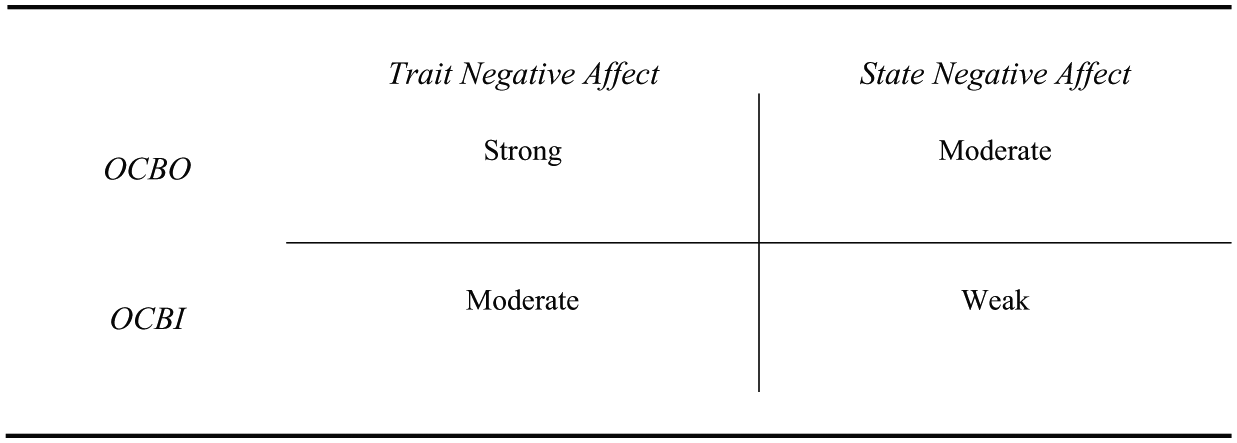
Hypothesis 2 suggests that trait negative affect will have a stronger negative relationship with OCB than state negative affect. Hypothesis 3 suggests that negative affect will have a stronger relationship with OCBO than OCBI. As depicted in Figure 1, we consider the combined relative strength of trait negative affect and OCBO, and the combined relative weakness of state negative affect and OCBI. Considering these combined effects, we provide the following hypotheses:
Relative strength of relationships between negative affect and OCB.
Method
Data Collection and Coding
For this research, we collected published and unpublished studies concerning the relationship between affect and OCB. To identify relevant studies, we searched electronic databases (e.g., PsychINFO; Business Source Complete; ProQuest Dissertations & Theses; Google Scholar) and carried out manual searches in prominent management journals (e.g., Academy of Management Journal, Journal of Applied Psychology, Journal of Management, Journal of Organizational Behavior, Organizational Behavior and Human Decision Processes, Personnel Psychology). Keywords associated with affect (emotion, affect, mood, affectivity) were combined with keywords associated with OCB (OCB, OCB-individual, OCB-organization, organizational citizenship behavior, contextual performance, altruism, compliance, civic virtue, courtesy, helping, loyalty, organizational support, individual support). Searches were conducted from 1983 to the present year, 1983 being the year that the original conception of OCB was introduced (e.g., Bateman & Organ, 1983; Smith, Organ, & Near, 1983). In addition, we searched metaBUS (see Bosco et al., 2017, for a thorough review) and reference sections of quantitative reviews (Dalal, 2005; Kaplan et al., 2009; Organ & Ryan, 1995; Shockley et al., 2012). In addition, we sent a request for unpublished papers and data via the Academy of Management OB ListServ.
Empirical studies were included in this investigation if they fit several criteria. First, only empirical studies that investigated the relationship between negative affect (negative emotion, mood, or affectivity) and OCB were included in the analysis. Second, only studies that used participants in an employment setting were included. Finally, if studies had an overlap in authorship, we reviewed their methods and sample demographics to determine if the same sample was used more than once (Wood, 2008). If multiple studies were identified as using the same sample, results from only one of the studies were included in the analyses. The online appendix reports the studies that were considered but excluded.
Two authors coded negative affect and OCB by following relatively objective protocols. Our protocol when coding negative affect was to first review the measure used. We coded negative affect that was assessed with no reference to a time or situation as trait. If negative affect was measured with respect to a specific time or situation, it was coded as state. When information was not provided in the methods with respect to these criteria, we defaulted to the conceptualization used by the authors. The negative affect protocol resulted in an interrater agreement kappa (κ) of 0.82 (p < .001). The protocol for coding OCB was to follow the work of L. J. Williams and Anderson (1991). We reviewed their research concerning descriptions of OCBs that immediately benefit individuals (e.g., helping coworkers) versus those that benefit the organization in general (e.g., adhering to informal rules). Studies assessing OCB that immediately benefit individuals were coded as OCBI, and those assessing OCB that benefit the organization in general were coded as OCBO. Studies that provided only composites of OCB (i.e., did not differentiate between OCBI and OCBO) were coded as OCB-composite. The OCB coding protocol resulted in an interrater agreement kappa (κ) of 0.91 (p < .001).
In addition, two authors collected study sample size, construct reliabilities, and effect size estimates. Any discrepancies were discussed and resolved. Most effect sizes were reported as correlations; effect sizes not reported as correlations were transformed into correlations (Knight & Eisenkraft, 2015; Peterson & Brown, 2005). Composite correlations were created for studies reporting multiple effect sizes for the same construct (Hunter & Schmidt, 1990). 2 Table 1 displays the studies used and the coding of the studies. In all, 214 effect sizes across 58 articles and 70 independent samples (k = 70) that included 15,843 individuals (n = 15,843) were used for the meta-analysis.
Summary of Studies and Samples Included in the Meta-Analysis.

Note. The values in brackets indicate reliability. OCB = organizational citizenship behavior; Trait = trait affect; State = state affect; OCBcomp = OCB composite; OCBI = OCB directed at individuals; OCBO = OCB directed at the organization; Self = self-report OCB; Other = other report OCB; NA = reliability not available; mean reliability of all negative affect assessments used for negative affect NA; mean reliability of all OCB assessments used for OCB NA
Analysis
Following meta-analytic procedures (Hunter & Schmidt, 1990), we estimated sample size weighted mean effect sizes (r) and sample size weighted mean effect sizes corrected for measurement error (rc). To test direct relationships, we calculated 95% confidence intervals (CI) around the error-corrected effect sizes. Effect sizes with CIs that do not include zero are significant. To test hypotheses concerning the comparison of effect sizes, we utilized bivariate subgroup analysis (Geyskens, Krishnan, Steenkamp, & Cunha, 2009) and calculated Z-scores to test for significant differences in effect sizes. For this meta-analysis, we utilized the R package metafor (Viechtbauer, 2010). The metafor package is a validated tool that allows for the computation of meta-analysis effect sizes in R and is particularly useful for moderator analyses (Viechtbauer, 2010).
Self-report bias tests
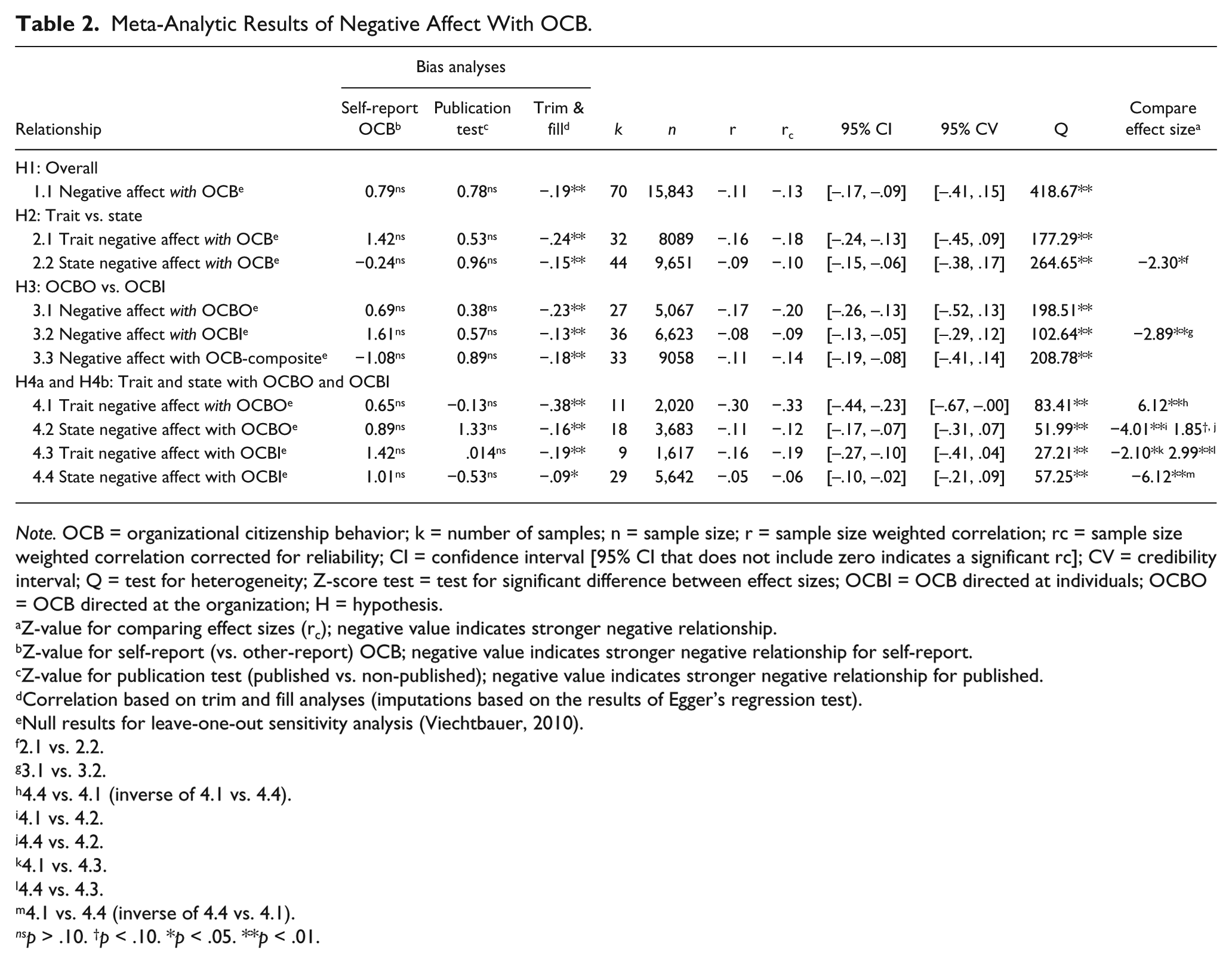
We tested the effects of OCB that was self-report and OCB that was other-report. The purpose for these tests was to examine the extent to which the results may be influenced by self-report bias (P. M. Podsakoff, MacKenzie, Lee, & Podsakoff, 2003). The idea is that self-report constructs inflate the magnitude of relationships due to spurious covariance (Organ & Ryan, 1995), and with affect being largely self-report, common method bias (i.e., self-report OCB) should be of concern to the literature investigating the relationship between affect and OCB. To examine this, we used subgroup analysis to test for a significant difference in relationships based on whether OCB was self-report or other-report. As displayed in Table 2, the results of these tests were not significant. Therefore, there is little evidence that self-report bias influenced the results of this study.
Meta-Analytic Results of Negative Affect With OCB.
Note. OCB = organizational citizenship behavior; k = number of samples; n = sample size; r = sample size weighted correlation; rc = sample size weighted correlation corrected for reliability; CI = confidence interval [95% CI that does not include zero indicates a significant rc]; CV = credibility interval; Q = test for heterogeneity; Z-score test = test for significant difference between effect sizes; OCBI = OCB directed at individuals; OCBO = OCB directed at the organization; H = hypothesis.
Z-value for comparing effect sizes (rc); negative value indicates stronger negative relationship.
Z-value for self-report (vs. other-report) OCB; negative value indicates stronger negative relationship for self-report.
Z-value for publication test (published vs. non-published); negative value indicates stronger negative relationship for published.
Correlation based on trim and fill analyses (imputations based on the results of Egger’s regression test).
Null results for leave-one-out sensitivity analysis (Viechtbauer, 2010).
2.1 vs. 2.2.
3.1 vs. 3.2.
4.4 vs. 4.1 (inverse of 4.1 vs. 4.4).
4.1 vs. 4.2.
4.4 vs. 4.2.
4.1 vs. 4.3.
4.4 vs. 4.3.
4.1 vs. 4.4 (inverse of 4.4 vs. 4.1).
p > .10. †p < .10. *p < .05. **p < .01.
Publication bias tests
We tested for the influence of publication bias. Also known as the “file-drawer problem” (Rosenthal, 1979), publication bias refers to the idea that null or unsupportive results are less likely to be published (Kepes, Banks, McDaniel, & Whetzel, 2012). As a result, research using meta-analytic methods should include tests examining the extent to which publication bias may be present. To assess the potential influence of publication bias on the results of this study, we utilized two approaches suggested by Kepes et al. (2012).
First, we conducted subgroup analysis to test for a significant difference in relationships based on whether the effect sizes were published or unpublished. This is a traditional method (Kepes et al., 2012) to test for publication bias that is commonly used across meta-analyses. As displayed in Table 2, none of these tests were significant. Second, we implemented trim and fill analysis (Duval & Tweedie, 2000a, 2000b) using Egger’s Linear Regression method (Egger, Smith, Schneider, & Minder, 1997). This is an advanced method (Kepes et al., 2012) to examine publication bias which uses an iterative process to impute missing effect sizes. As displayed in Table 2, the pattern of results of the trim and fill analyses were similar to that of both uncorrected (r) and corrected (rc) effect sizes.
Primary Results
Table 2 reports the meta-analytic results of all hypothesis tests. Hypothesis 1 states that negative affect is negatively related to OCB. As displayed, the relationship between negative affect and OCB is negative (rc = −.13) and the 95% CI does not include zero (95% CI = [−.17, −.09]). Thus, Hypothesis 1 is supported. Hypothesis 2 states that the negative relationship between trait negative affect and OCB is stronger than the negative relationship between state negative affect and OCB. As displayed in Table 2, the relationship between trait negative affect and OCB is negative (rc = −.18) and the 95% CI does not include zero (95% CI = [−.24, −.13]). Also, the relationship between state negative affect and OCB is negative (rc = −.10) and the 95% CI does not include zero (95% CI = [−.15, −.06]). Furthermore, the relationship between trait negative affect and OCB is stronger than the relationship between state negative affect and OCB (Z-score = −2.30, p < .05). Thus, Hypothesis 2 is supported.
Hypothesis 3 states that the negative relationship between negative affect and OCBO is stronger than the negative relationship between negative affect and OCBI. As displayed in Table 2, the relationship between negative affect and OCBO is negative (rc = −.20) and the 95% CI does not include zero (95% CI = [−.26, −.13]). Also, the relationship between negative affect and OCBI is negative (rc = −.09) and the 95% CI does not include zero (95% CI = [−.13, −.05]). Furthermore, the relationship between negative affect and OCBO is stronger than the relationship between negative affect and OCBI (Z-score = −2.89, p < .01). Thus, Hypothesis 3 is supported.
Hypothesis 4a states that the negative relationship between trait negative affect and OCBO is stronger than other relationships between negative affect and OCB. Hypothesis 4b states that the negative relationship between state negative affect and OCBI is weaker than other relationships between negative affect and OCB. As displayed in Table 2, the results show that the relationships between trait negative affect and OCBO (rc = −.33; 95% CI = [−.44, −.23]), state negative affect and OCBO (rc = −.12; 95% CI = [−.17, −.07]), trait negative affect and OCBI (rc = −.19; 95% CI = [−.27, −.10]), and state negative affect and OCBI (rc = −.06; 95% CI = [−.10, −.02]) are negative and significant.
To directly test Hypothesis 4a, direct comparisons were made between the strength of the effect size for the relationship between trait negative affect and OCBO with all other relationships between negative affect and OCB. As displayed in Table 2, the results show that the relationship between trait negative affect and OCBO is significantly stronger than the relationship between state negative affect and OCBO (Z-score = −4.01, p < .01), trait negative affect and OCBI (Z-score = −2.10, p < .05), and state negative affect and OCBI (Z-score = −6.12, p < .01). Thus, Hypothesis 4a is supported.
To directly test Hypothesis 4b, direct comparisons were made between the strength of the effect size for the relationship between state negative affect and OCBI with all other relationships between negative affect and OCB. As displayed in Table 2, the results show that the relationship between state negative affect and OCBI is significantly weaker than the relationship between trait negative affect and OCBI (Z-score = 2.99, p < .01) and trait negative affect and OCBO (Z-score = 6.12, p < .01). However, it is only marginally weaker than the relationship between state negative affect and OCBO (Z-score = 1.85, p < .10). Considering these results, we can conclude partial support for Hypothesis 4b.
Discussion
We found evidence supporting our hypotheses that suggest trait negative affect has a stronger relationship with OCB than state negative affect, and that negative affect has a stronger relationship with OCBO than OCBI. Collectively, as displayed in Figure 1, the results suggest that the strongest relationship is between trait negative affect and OCBO, whereas the weakest relationship is between state negative affect and OCBI. This is consistent with our dispositional versus situational argument that employees high on trait negative affect may inherently engage in less OCB, whereas employees high on state negative affect will likely consider situational factors before deciding to change their levels of OCB. Moreover, the results support research that suggests employee behavior may be stronger when directed at the organization than at individuals (Lavelle et al., 2007; Rupp & Cropanzano, 2002). In all, the results of our investigation may provide one explanation for why relationships between negative affect and OCB are different across studies.
Implications for Research and Theory
There may be several contributions of this study for research and theory. For example, our results support previous research showing that trait negative affect is negatively related to OCB (Kaplan et al., 2009; Shockley et al., 2012), and we extend these findings by showing that this relationship is consistent for both OCBO and OCBI. Moreover, whereas previous research suggests that state negative affect may not have a relationship with OCB (Shockley et al., 2012), we found significant negative relationships between state negative affect and each of the OCBs examined (i.e., OCBO, OCBI, and OCB-composite).
To the best of our knowledge, this study is the first meta-analysis that differentiates relationships between negative affect and OCB based on whether OCB is directed at the organization or individuals. We believe this is because until recently, the number of empirical studies examining affect and distinct types of OCB (i.e., OCBO and OCBI) may not have been sufficient for a meta-analysis. This is apparent given that approximately two thirds of the studies used to examine OCBO and OCBI in the present research are from the past decade. Moreover, much of the research concerning the relationship between affect and OCB (exceptions include those used in this study) conceptualize OCB as a composite construct. Although not formally hypothesized, the results included in this study (see Relationships 3.1, 3.2, and 3.3 in Table 2) suggest that negative affect’s relationship with OCBO and OCBI may be different than with OCB-composite.
Because of the limited theoretical distinction between OCBO and OCBI in past research, literature may be missing an important aspect of how affective constructs are related to OCB. For example, research suggests that individuals may direct work behaviors differently toward individuals and organizations (Lavelle et al., 2007). One possible explanation is that when employees experience affect related to social contexts, there is likely to be considerable affective spillover toward the organization. That is, in social settings, interpersonal perceptions may be strongly associated with the authority that oversees interpersonal exchanges. From this perspective, affect influencing OCB directed at coworkers (i.e., individuals) will also influence OCB directed at the organization (i.e., authority overseeing the individuals). In contrast, affect influencing OCB directed at the organization will not spillover toward coworkers, because coworkers do not have authority over the organization.
An additional contribution may be the use of a situational perspective to explain the relationship between state negative affect and OCB. Historically, the influence of state negative affect on employee behaviors has been ambiguous (George & Brief, 1992). For example, George and Brief (1992) pointed out that the influence of negative states on behaviors is largely inconsistent across studies. We acknowledged similar patterns across meta-analyses (Kaplan et al., 2009; Organ & Ryan, 1995; Shockley et al., 2012) and recent primary studies (e.g., Dalal et al., 2012; Greenidge & Coyne, 2014; Koopman et al., 2016; Tenhiälä & Lount, 2013). In general, by providing meta-analytic results on the relationship between negative affect and OCB, our research provides a promising step forward for theory and research concerning this relationship.
Practical Implications
Beyond the implications for research and theory, the results of this study suggest that organizations may want to reduce negative affect in the workplace. One option for organizations may be to test individuals’ susceptibility to negative affect before hiring decisions. With the idea that individuals high on trait negative affect inherently have lower levels of OCB at the outset of their employment, employers may want to implement selection processes to place these employees in appropriate positions. For example, research on emotional contagion suggests, “people are ‘walking mood inductors,’ continuously influencing the moods and then the judgments and behaviors of others” (Barsade, 2002, p. 667). As such, in theory, individuals’ negative affect will also influence the OCB of their coworkers through emotional contagion processes. Thus, to maintain overall levels of group and organizational level OCB, employees’ who are primed to experience and display negative affect may be better suited for positions that require a greater amount of individual and/or isolated work (e.g., work from home).
Another option for organizations could be the implementation of training programs or interventions to help employees cope with negative affect. For example, drawing from emotional labor and work recovery literatures, Trougakos, Beal, Green, and Weiss (2008) found that during work breaks, employees who engaged in more respite activities (e.g., relaxing), rather than chore activities (e.g., running errands), experienced less negative emotions. Furthermore, interventions aimed at leadership may be implemented in ways to reduce the negative affect of subordinates (S. K. Johnson, 2008). Work conditions can also reduce employees’ negative affect. For example, noise reduction, temperature control, and better illumination could all be related to less negative affect among employees (Wright, Cropanzano, & Meyer, 2004).
While we suggest that organizations can implement procedures based on selection and training to deal with employee negative affect, it may not always be this straightforward. For example, it may not be convenient, or the right thing to do, to filter employees out of certain positions, or out of the organization altogether. For many organizations, finding talented employees can be a challenge (Schramm, 2016), and ruling out otherwise qualified applicants based on negative affect could be a cost many organizations cannot afford. Furthermore, selecting employees based on traits, which may or may not be related to potential in-role performance, could be seen as unfair. For example, once a potential employee is labeled with negative affect, employers may form stereotypes about their behaviors and ability to perform their job. Even if hired, preconceived attributes of a negative affect individual by employers may result in those individuals being placed in less desirable positions. Thus, while measures can be taken with respect to hiring and training processes, they must be approached with caution concerning costs incurred by the organization and their effect on individuals.
In light of our suggestions and precautions, organizations should be aware of what research on OCB suggests for organizations. For example, research has shown that OCB can have implications for organizational effectiveness (Hoffman, Blair, Meriac, & Woehr, 2007; N. Podsakoff et al., 2009). Empirical results show that more employee OCB results in less absenteeism, turnover intentions, and actual turnover (N. Podsakoff et al., 2009). At an organizational level, empirical results show that more OCB results in greater productivity, efficiency, profitability, and customer satisfaction (N. Podsakoff et al., 2009). In general, the results of this study suggest that negative affect is important for employee OCB. Through selection processes, work designs, and training, organizations can mitigate the impact that negative affect has on OCB and, as a result, experience greater organizational effectiveness.
Limitations and Future Directions
Despite the contributions of this study, limitations and future directions should be discussed. First, the studies included in this meta-analysis constitute a mix of independent samples that may differ in substantive ways. For example, different work contexts may display various levels of negative affect and OCB, which may influence the strength of the relationships. An interesting future direction for research might be to compare work contexts that require frequent interaction with customers, such as customer service, with those consisting of limited interaction with customers, such as manufacturing. Because front-line service employees might regulate their emotions and behaviors differently than employees that work behind closed doors, there may be meaningful differences concerning negative affect and OCB across these contexts.
Second, future research may want to delve deeper into the measures of affect and OCB. For example, the Positive and Negative Affect Schedule (PANAS) scale (Watson, Clark, & Tellegen, 1988) is the prevalent assessment tool for affective constructs when examining the relationship between affect and OCB. However, there are other popular scales (e.g., Job-Related Affective Well-Being Scale [JAWS]; Van Katwyk, Fox, Spector, & Kelloway, 2000) and newly developed scales (Levine et al., 2011) being used to examine these relationships.
Moreover, while we recognized that much of the OCB measures cited can be traced back to early research on OCB (e.g., Smith et al., 1983; L. J. Williams & Anderson, 1991), the actual work that is cited when reporting OCB measures varies. In general, it may be insightful for future research to theorize and empirically examine the influence that different measures have with respect to negative affect and OCB.
Further limitations of this research reside in the conventional nature of meta-analyses. That is, the effect sizes for this study were mostly correlational relationships, thus limiting causal inferences. Future research may want to examine the proposed framework using a study design that can examine these relationships longitudinally and provide a clearer picture of causality. In a similar vein, the samples used in this meta-analysis consisted of self- and other-report OCB. This may have resulted in method bias effects among some samples given that affect was all self-report. However, we did consider this possibility and tested for the presence of bias based on self- and other-report OCB. As the results suggest, there was little evidence of method bias due to self-report OCB.
We should also note that we did not include PA in our research. While previous research shows mostly strong positive relationships between PA and OCB across studies (Kaplan et al., 2009; Shockley et al., 2012), there may still be interesting theory development and research to pursue on these relationships. Finally, as with any meta-analysis, there may be research with useful effect sizes that are not included in this study. However, we conducted a thorough search using traditional methods complemented with a search in metaBUS (Bosco, Uggerslev, & Steel, 2017). Furthermore, we conducted traditional and advanced publication bias tests (Kepes et al., 2012), which showed no marked influence of publication bias.
Conclusion
Our meta-analysis shows that relationships between different facets of negative affect (i.e., trait and state) and different facets of OCB (i.e., OCBO and OCBI) are significantly different. We encourage future research to distinguish different facets of negative affect and OCB when they measure these constructs. Furthermore, we suggest that future research utilize theory that explains the unique mechanisms through which negative affect relates to employee behavior (George & Brief, 1996). From a practitioner’s perspective, a better understanding of these relationships may help managers attenuate the effects of negative affect on OCB, ultimately improving organizational effectiveness (Hoffman et al., 2007; N. Podsakoff et al., 2009). In general, this paper contributes to research interested in the relationship between negative affect and OCB.
Supplemental Material
GOM-3003_Revision2_Appendix – Supplemental material for The Power of Negative Disposition: An Examination of Trait and State Negative Affect With OCBI and OCBO
Supplemental material, GOM-3003_Revision2_Appendix for The Power of Negative Disposition: An Examination of Trait and State Negative Affect With OCBI and OCBO by Mark Geiger, Jeong-Yeon Lee and Mingang K. Geiger in Group & Organization Management
Footnotes
Declaration of Conflicting Interests
The author(s) declared no potential conflicts of interest with respect to the research, authorship, and/or publication of this article.
Funding
The author(s) disclosed receipt of the following financial support for the research, authorship, and/or publication of this article: This study was supported by the Institute of Management Research at Seoul National University.
Supplemental Material
Supplemental material for this article is available online.
Associate Editor: Rebecca Reichard
Notes
Author Biographies
References
Supplementary Material
Please find the following supplemental material available below.
For Open Access articles published under a Creative Commons License, all supplemental material carries the same license as the article it is associated with.
For non-Open Access articles published, all supplemental material carries a non-exclusive license, and permission requests for re-use of supplemental material or any part of supplemental material shall be sent directly to the copyright owner as specified in the copyright notice associated with the article.
