




Abstract
In recent years, unethical conduct (e.g., Enron, Lehman Brothers, Oxfam, Volkswagen) has become an important issue in management; relatedly, there is growing interest regarding the nature and implications of ethical leadership. Drawing from social learning theory, we posited that ethical leadership would positively relate to team ethical voice and organizational citizenship behavior (OCB) through team moral efficacy. Furthermore, building on social information processing theory and the social intuitionist model, we expected these effects to be accentuated in teams with a strong ethical climate. Using survey data from subordinates and leaders pertaining to 150 teams from the Republic of Korea Army, ethical leadership was found to indirectly relate to increased team ethical voice and OCB directed at individuals and the organization through team moral efficacy. These relationships tended to be amplified among teams with a strong ethical climate. In addition, these findings persisted while controlling for transformational leadership, thereby highlighting the incremental value of ethical leadership for team outcomes. Theoretical and practical implications are discussed.
Keywords
Recently, several top executives of large organizations (e.g., Lehman Brothers, Volkswagen) have been accused of immoral behaviors and financial misconduct, resulting in a government clampdown that endeavors to enforce fundamental economic principles (Hotten, 2015; Kottasova, 2015; Wolff, 2011). These unethical behaviors convey negative images of organizations. Given these scandals and tighter ethical standards in the workplace, the importance of ethical behavior has become increasingly evident (Fehr et al., 2015; Lemoine et al., 2019; Moore et al., 2019). Considering the influence of leaders over employees, leaders’ ethical and moral responsibilities are crucial to establishing an ethical climate (Mayer et al., 2010; Shin, 2012) and culture (Schaubroeck et al., 2012). Because ethical concerns have surged in the workplace, many researchers have become interested in understanding ethical leadership and its implications (Bavik et al., 2018; Cheng et al., 2019; Thiel et al., 2018). Ethical leadership is defined as “the demonstration of normatively appropriate conduct through personal actions and interpersonal relationships, and the promotion of such conduct to followers through two-way communication, reinforcement, and decision-making” (Brown et al., 2005, p. 120).
Previous studies have reported ethical leadership to be positively related to individual-level performance as well as team-level performance (Avey et al., 2012; Babalola et al., 2019; Mayer et al., 2009; Mo et al., 2019; Walumbwa et al., 2011, 2012; Walumbwa & Schaubroeck, 2009). Although ethical leadership has received a great deal of attention, some issues have yet to be explored. This study addresses two gaps in this literature. First, while there is evidence suggesting that ethical leadership results in normatively desirable behaviors (see reviews by Bedi et al., 2016; Brown & Mitchell, 2010; Hoch et al., 2018; Lemoine et al., 2019; T. W. Ng & Feldman, 2015), we have a limited understanding of the processes relating ethical leadership to team performance outcomes. Prior research has focused on “normative processes” such as climate and culture as mediators of the relationship between ethical leadership and team extra-role performance (e.g., L. Huang & Paterson, 2017; Mayer et al., 2009; Shin, 2012; Walumbwa et al., 2012). However, the motivational mechanism by which ethical leadership relates to team performance remains unclear. For example, although ethical leaders who show high trustworthiness and fairness promote team extra-role performance (L. Huang & Paterson, 2017; Mayer et al., 2009), such leaders also concentrate on compliance with normative standards, norms, and laws, which may limit the team’s discretionary behavior (Hannah et al., 2014; Lemoine et al., 2019; Mayer et al., 2013). That is, when ethical leaders enforce compliance with ethical standards, it may not be possible for team members to perform collective behaviors to their own discretion.
We posit that team moral efficacy is a central motivational mechanism that explains why ethical leadership fosters team extra-role performance (Bandura, 2000; G. Chen & Gogus, 2008; G. Chen & Kanfer, 2006; Hu & Judge, 2017; Hu & Liden, 2011; Zaccaro et al., 2008). Team moral efficacy is defined as a state of shared confidence in the team’s collective ability to behave ethically (Hannah & Avolio, 2010). This notion has the unique property of reflecting both a motivational mechanism drawn from social learning and an ethical orientation, which makes it a suitable process induced by ethical leadership. Moreover, we concentrate on team ethical voice, which reflects a search for changing practices “that are not normatively appropriate” (L. Huang & Paterson, 2017, p. 1160), and team organizational citizenship behavior (OCB) as team extra-role performance outcomes because they both reflect nonprescribed behaviors that have a constructive and prosocial orientation, hence are in line with the expectable influence of ethical leaders. Our aim is also to explore the value of ethical leadership in the military, a context where effective leadership is central to the success of operations. Drawing from social learning theory (Bandura, 2000), we suggest ethical leadership acts as a driver of team members’ motivation (Brown & Treviño, 2006) by allowing them to be confident in their team’s ability to act ethically through role modeling, enactive mastery, and verbal persuasion by ethical leaders (Brown & Treviño, 2006, 2014). Previous research has suggested that moral efficacy may represent a team-level motivational factor that transmits ethical leadership to team ethical outcomes (Hannah & Avolio, 2010; Hannah et al., 2011; L. Huang & Paterson, 2017). Thus, we suggest that team moral efficacy acts as a team-level mediator that explains how ethical leadership promotes team extra-role performance.
Second, while some scholars have examined ethical climate as an outcome of ethical leadership (e.g., Hansen et al., 2016; Lu & Lin, 2014; Mayer et al., 2010), this research considers ethical climate as a contextual factor that moderates the relationship between ethical leadership and team moral efficacy. Ethical climate refers to the shared perception among team members regarding team ethical policies, procedures, and practices (Arnaud & Schminke, 2012; Victor & Cullen, 1988). Although a leader may influence the formation of a team’s ethical climate, such climate also emerges through the influence of a variety of contextual factors such as formal (e.g., ethics training programs, rules) and informal (e.g., ethical norms, myths) systems of behavioral control (Arnaud & Schminke, 2012; Treviño et al., 1998; Victor & Cullen, 1988; Vidaver-Cohen, 1998; Zohar & Luria, 2005). In contrast to other organizations, team ethical climate cannot easily emerge from the team leader’s actions in the military, because military organizations do not allow team leaders to create an informal team ethical climate (J. Kim, 2016; K. Lee, 2018). In this respect, scholars have argued that there is some ambiguity regarding what behaviors ethical leaders would consider appropriate versus inappropriate (Brown & Mitchell, 2010; Eisenbeiss, 2012; Lemoine et al., 2019; Palanski et al., 2019). This ambiguity should be carefully addressed, particularly in the military context. For instance, in the military, more so than in other organizations, the behaviors of team leaders have a great impact on team members (K. Lee, 2018; Schaubroeck et al., 2012). As the ethical standards recognized by ethical leaders may be ambiguous, it is likely that the effects of ethical leadership vary as a function of the formal moral laws and codes embedded in the ethical climate (Brown & Treviño, 2006; Treviño et al., 2003). We thus argue that ethical climate is an independent construct driven by the military organization’s rules. Therefore, it is worth investigating how ethical leadership interacts with ethical climate in predicting the team’s moral efficacy, hence considering ethical climate as a context that alters the social learning process instilled by ethical leadership (e.g., Mo et al., 2019; Shin, 2012).
Drawing upon social information processing theory (Salancik & Pfeffer, 1978) and the social intuitionist model (Haidt, 2001), we propose that the social learning process associated with ethical leadership will vary across levels of the team’s ethical climate (Y. S. S. Huang et al., 2019; Martin & Cullen, 2006; Schminke et al., 2005). A strong ethical climate signals that ethical standards are intensely endorsed by the team as a whole (Brown & Treviño, 2006; Y. S. S. Huang et al., 2019; Martin & Cullen, 2006; Mayer et al., 2010). We further suggest that a stronger ethical climate enhances team members’ responsiveness to leaders who emphasize the value of moral behaviors, resulting in an amplified relationship between ethical leadership and team extra-role performance through team moral efficacy (Haidt, 2001). Indeed, teams with a strong ethical climate are more likely to perceive the conduct of ethical leaders as being legitimate in establishing the collective moral confidence to behave ethically, which in turn should strengthen team ethical voice and OCB (Y. S. S. Huang et al., 2019). In contrast, in a weak ethical climate, team members pay less attention to ethical standards and are less likely to develop team moral efficacy because such teams may not recognize the ethical standards exhibited by their leaders. In turn, such teams are less likely to transfer team moral efficacy into team extra-role performance. We thus posit that ethical climate boosts the link between ethical leadership and team moral efficacy, leading to team ethical voice and OCB.
This study aims to contribute to the literature in several ways. First, we use social learning, as operationalized by team moral efficacy, as a motivational mechanism that explains how ethical leadership results in enhanced team ethical voice and OCB. Few studies have examined how motivational mechanisms can emerge at the team level from the action of ethical leaders. In line with social learning theory (Bandura, 1986, 2000), we contend that the team’s confidence in its collective capability to engage in moral behavior is a central process through which ethical leadership results in team ethical voice and OCB. As such, this study identifies a motivational mechanism that has an ethical background (team moral efficacy) to explain ethical leaders’ actions. Second, this study heeds the call for examining the incremental validity of ethical leadership over more established models of leadership (Bedi et al., 2016; Hoch et al., 2018; T. W. Ng & Feldman, 2015) such as transformational leadership (TFL).
Third, our study breaks new ground by examining a boundary condition (i.e., team ethical climate) regarding the effects of ethical leadership. Because the notion of climate refers to shared perceptions regarding practices in use within a work unit (e.g., Schulte et al., 2009), a climate for ethics (i.e., ethical climate) would qualify how teammates collectively perceive the norms of behavior within the ethical domain. Drawing from the literature on climates (e.g., Jones & James, 1979; Schneider et al., 2013), one may expect ethical climate to facilitate the action of ethical leaders. Thus, this investigation might extend our knowledge with respect to the contextual boundaries of ethical leadership. Finally, this study highlights the importance of the military context in South Korea. Extant ethical leadership studies have mostly focused on business or educational contexts (e.g., Bedi et al., 2016; Sosik et al., 2019; G. Wang & Hackett, 2016). Yet, military contexts are an appropriate field for studying ethical leadership, because these contexts encourage compliance to a code of ethics as a way not only to maintain a strong ethical climate within extreme operational conditions but also to constrain the team’s discretionary behavior (Hannah et al., 2014; Lemoine et al., 2019; Mayer et al., 2013; Sosik et al., 2019). The South Korean military context uniquely promotes ethical behaviors and professionalism not only to prepare for existing military threats from North Korea but also to protect national interests (J. Kim, 2016; K. Lee, 2018). To summarize, this study contributes to knowledge by looking at the ethics-based motivation factor that drives ethical leadership’s effects on team prosocial outcomes and examines how these effects are altered by the level of ethical climate instilled in a military organization. Figure 1 presents our research model.

Hypothesized research model.
Literature Review and Hypothesis Development
Ethical Leadership and Team Moral Efficacy
In line with prior research (L. Huang & Paterson, 2017; Mayer et al., 2009, 2012; Schaubroeck et al., 2012; Walumbwa et al., 2012, 2017), we conceptualize ethical leadership at the team level, suggesting that team members who work in the same team perceive similar ethical leadership effects (Kozlowski & Bell, 2003; Kozlowski et al., 1996, 2016). Indeed, based on the tenets of social learning theory (Bandura, 1986, 2000), we argue that team members similarly observe an ethical leader’s behavior as indicating the features of both a moral person and a moral manager. Because ethical leaders conduct their personal lives ethically, they consider team members’ best interests and collective goals; thus, they exhibit high trustworthiness toward team members in general and are perceived as moral persons (Brown & Treviño, 2006, 2014). Furthermore, as moral managers, ethical leaders promote morally appropriate behaviors by establishing those behaviors as role models, rewarding desirable behaviors, punishing inappropriate behaviors among team members, and making fair management decisions. Ethical leaders also demonstrate the importance of moral standards (e.g., fairness and altruism) as an essential foundation for effective cooperation among team members (Axelrod & Hamilton, 1981; Brown & Treviño, 2006; Nowak & Sigmund, 2005).
Drawing from the principles of social learning theory (Bandura, 1997, 2000) that function at the group level, this study proposes that team members share their perceptions of team leaders’ ethical conduct, thereby bolstering their collective beliefs of moral efficacy (Chan, 1998; Morgeson et al., 2010; Morgeson & Hofmann, 1999). Team moral efficacy refers to a shared perception regarding the team’s ability to perform ethical behaviors within situations that have moral implications (Hannah & Avolio, 2010). Thus, it represents both team members’ belief in their team’s moral capabilities and confidence in the team’s ability to perform ethical behaviors (Hannah & Avolio, 2010; Luthans & Youssef, 2005). In applying social learning theory, we posit that team moral efficacy can be developed through vicarious experience (i.e., role modeling), enactive mastery, and leaders’ verbal persuasion. That is, team members may become confident in their team’s ability to act ethically, because they learn and develop this ability through vicarious experience and enactive mastery, as well as by exposure to verbal persuasion by ethical leaders (Brown & Treviño, 2006, 2014).
Vicarious experience, which involves observation and mimicking ethical leaders’ behaviors, is one of the primary factors that enhance team moral efficacy beliefs. For example, when team leaders show ethical behaviors by demonstrating high integrity and conducting their personal life in an ethical way, team members are likely to consider their leaders as credible and legitimate role models (Mayer et al., 2009, 2012). In turn, by vicariously observing and imitating how their ethical role models behave, team members can promote the development of shared team moral efficacy beliefs. Team moral efficacy can also be strengthened through members’ collective enactive mastery experiences from their ethical leaders. Enactive mastery implies gaining meaningful experience from reacting to ethical issues in the workplace (Bandura, 1997, 2000). For instance, team members may learn and increase their shared moral efficacy beliefs by seeing leaders reinforcing high ethical standards, rewarding appropriate behaviors, and punishing immoral actions in their teams. Thus, team members learn from ethical leaders’ actions once these leaders punish followers who violate ethical rules (e.g., falsifying expense reports, stealing office supplies), which in turn enhances the shared group beliefs of their team moral efficacy.
Finally, leaders’ verbal persuasion, which is defined as persuading team members that they can effectively perform team ethical outcomes (Bandura, 2000), is also thought to generate team moral efficacy beliefs. Specifically, ethical leaders often solicit input from team members to figure out their team needs and strengths (Brown et al., 2005; Mayer et al., 2009, 2012). Moreover, ethical leaders verbally provide information for their team members to learn and internalize appropriate moral values to foster team moral efficacy. That is, information obtained through two-way communication with team members helps ethical leaders provide appropriate suggestions to establish group ethical norms, thereby strengthening team moral efficacy. Taken together, we suggest that ethical leadership should enhance team moral efficacy beliefs owing to vicarious experience, enacted mastery, and verbal persuasion (Hannah & Avolio, 2010; D. Lee et al., 2017; Schaubroeck et al., 2012; Z. Wang et al., 2018).
Ethical Leadership and Team Outcomes: The Mediating Role of Team Moral Efficacy
This study also proposes that an indirect relationship exists between ethical leadership and team outcomes (i.e., team ethical voice and OCB) through team moral efficacy. On one hand, team ethical voice is defined as “a form of team expression that challenges, and seeks to change, the current behaviors, procedures, and policies that are not normatively appropriate” (L. Huang & Paterson, 2017, p. 1160). Specifically, team ethical voice consists of shared suggestions by team members to improve ethical behavior, such as voicing concerns about unethical behaviors that have been detected or suggestions regarding the need to thwart immoral behaviors. On the other hand, team OCB refers to the normative level of OCB displayed within the team (Ehrhart & Naumann, 2004). OCB denotes prosocial behavior that supports the goals of the organization (i.e., team organizational citizenship behavior directed at other organization [OCB-O]) or helps other individuals (i.e., team organizational citizenship behavior directed at the individuals [OCB-I]; Organ, 1988; Williams & Anderson, 1991). OCB can also be considered as a demonstration of ethical behavior in the organization (Turnipseed, 2002). Based on prior research (e.g., Bandura, 1997, 2000; Hannah & Avolio, 2010; Hannah et al., 2011), team moral efficacy beliefs, as promoted by ethical leadership, should foster team ethical voice and OCB. This may occur because, following the tenets of the theory of planned behavior (Ajzen, 1991), team moral efficacy is tied to the intention to exhibit desirable team behaviors.
Specifically, team ethical voice and citizenship behaviors are influenced by perceived team behavioral control, which refers to the shared perception of “the ease or difficulty of performing the behavior of interest” (Ajzen, 1991, p. 183). Such perceived team behavioral control is associated with the concept of team efficacy beliefs (Hannah et al., 2011; L. Huang & Paterson, 2017). That is, team moral efficacy beliefs involving the moral intention to display desirable team behaviors are likely to result in team extra-role outcomes (Ajzen, 1991, 2002; Hannah & Avolio, 2010; Hannah et al., 2011; L. Huang & Paterson, 2017). Accordingly, previous studies have found team whose moral efficacy is positively related to team extra-role performance (e.g., Hannah & Avolio, 2010; Hannah et al., 2011; Hu & Judge, 2017; Hu & Liden, 2011; D. Lee et al., 2017; Owens et al., 2019; Schaubroeck et al., 2012). A recent study (D. Lee et al., 2017) has found that ethical leadership is positively related to employee moral voice through moral efficacy at the individual level. However, they focused on the aspects of moral courage, which is defined as a psychological state featuring “the courage to convert moral intentions into actions despite the face of adversity and persevere through challenges” (Hannah & Avolio, 2010, pp. 291–292), regarding employee moral voice behavior. Our study extends Lee et al.’s research by examining the indirect relationships between ethical leadership and team ethical voice (i.e., a component of voice behavior that is distinct from moral courage and outlines the promotion of ethical conduct) and OCBs through team moral efficacy at the team level. Our study also looks at ethical leadership as a team-level construct instead of an individual-level one because “team-level leadership may facilitate social integration, efficient processes, and smooth communication within the team, thereby enhancing team motivation” (Hu & Liden, 2011, p. 851).
This study also controls for TFL to examine the unique effect of ethical leadership. Prior studies have claimed that ethical leadership differs from TFL, because ethical leadership not only focuses on demonstrating moral behaviors but also on enforcing compliance with ethical laws and standards and encouraging ethical conduct by using rewards and punishments (e.g., Brown et al., 2005; Brown & Treviño, 2006; Lemoine et al., 2019; Treviño & Brown, 2007). In contrast to ethical leadership, TFL, namely, focuses on expressing visions that are attractive to followers and stimulating employees’ innovative ideas (Bass & Avolio, 1993, 2000; Podsakoff et al., 1990). Yet, scholars argue that there is still a partial overlap between ethical leadership and TFL (Bedi et al., 2016; Brown et al., 2005; Hoch et al., 2018; T. W. Ng & Feldman, 2015). For example, role modeling is a key element of ethical leadership, but it is also a component of TFL (Avolio et al., 1999; Bass & Avolio, 2000; Bedi et al., 2016; Hoch et al., 2018; Treviño & Brown, 2007). Thus, we include TFL as a control to identify the incremental contribution of ethical leadership. The above reasoning suggests that based on the social learning processes instilled by ethical leaders (i.e., role modeling, enacted mastery, and verbal persuasion), ethical leadership will uniquely relate to team moral efficacy, which should positively relate to team ethical voice and OCB.
The Moderating Role of Ethical Climate
An organizational climate refers to shared perceptions among employees regarding the procedures, policies, and behaviors that are rewarded, supported, and expected in the organization. Such climate emerges from social interactions at the team level (Kuenzi & Schminke, 2009; Schneider et al., 2013). Collectively, the team climate creates expectations regarding appropriate behavior for team members by promoting specific norms and practices (Schneider et al., 2013). Among different types of work climates, ethical climate reflects the shared perception of moral standards and laws regarding ethical behaviors (Arnaud & Schminke, 2012; Victor & Cullen, 1988). It is defined as “the prevailing perceptions of typical organizational practices and procedures that have ethical content” and “those aspects of work climate that determine what constitutes ethical behavior at work” (Victor & Cullen, 1988, p. 101). Victor and Cullen (1988) proposed that an ethical climate comprises five factors: caring, law and code, rules, instrumental norms, and independence. This study focuses on the law and code dimension, for the following reasons. First, previous research has shown that, compared with the other aspects of ethical climate, the law and code dimension is more strongly associated with behavioral outcomes (e.g., Leung, 2008; Martin & Cullen, 2006; Shin, 2012; Treviño et al., 1998). For example, Leung (2008) found that the law and code dimension is more strongly related to OCB than the other dimensions of ethical climate. Second, the law and code factor is plausibly the core of an ethical climate, because it reflects team members’ perceptions of the ethical policies and code of ethics in the organization (e.g., Schwepker, 2001; Shin, 2012). In line with this view, scholars have often conceptualized ethical climate as a unidimensional construct denoting the salience and reinforcement of ethical and professional standards, hence implicitly referring to the law and code dimension.
Finally, and most importantly, the law and code dimension best reflects ethical climate in a military context. First, military organizations have more stringent laws and codes than other organizations. This is because keeping the core values of a military organization, which are key in protecting the national security and defending national interests, involves complying with strict codes of conduct. Military organizations also have a strong hierarchical structure that emphasizes order and a strong ethical climate formed by the organization, both of which enforce the law and code factor of ethical climate fostering compliance to the organization’s ethical values, procedures, and behaviors (Arnaud & Schminke, 2012; Brown & Treviño, 2006; K. Lee, 2018; Schaubroeck et al., 2012; Victor & Cullen, 1988; Vidaver-Cohen, 1998). Second, although ethical leaders can be one of the elements needed to form the team’s ethical climate (e.g., Mayer et al., 2010; Schaubroeck et al., 2012), team ethical climate is not only created by team leaders, especially in a military organization (J. Kim, 2016; K. Lee, 2018). According to the business ethics literature (Brown & Treviño, 2006; Treviño et al., 1998), ethical climate (Victor & Cullen, 1988) and ethical culture (Trevino, l990), both of which refer to “a multidimensional interplay among various formal and informal systems of behavioral control that are capable of promoting either ethical or unethical behavior” (Treviño et al., 1998, p. 451), are represented as an ethical context.
Although ethical climate and ethical culture are somewhat similar (Brown & Treviño, 2006; Treviño et al., 1998), the reason why we focused on ethical climate is because an ethical climate provides an important direction to team members by fortifying the normative procedures that influence ethical judgments and behaviors, which is most appropriate for a military organization (Arnaud & Schminke, 2012; Victor & Cullen, 1988; Vidaver-Cohen, 1998). Unlike in other organizations, an ethical climate cannot easily emerge from informal behavioral control systems (e.g., the team leader) in the military (J. Kim, 2016; K. Lee, 2018). Indeed, military organizations generally do not allow team leaders to establish an informal team ethical climate, because team leaders may interpret the same organization’s ethical standards differently depending what they believe is appropriate versus inappropriate (Brown & Mitchell, 2010; Eisenbeiss, 2012; Lemoine et al., 2019; Palanski et al., 2019). Thus, the law and code of the ethical climate formed by the military organization legitimately represents the team’s ethical climate (J. Kim, 2016; K. Lee, 2018; Zohar & Luria, 2005).
The team’s ethical climate may strengthen the ethical leadership’s relationship with team moral efficacy and indirect relationship with team ethical voice and OCB. Following the tenets of social information processing theory (Salancik & Pfeffer, 1978), an ethical climate emerges from the information shared through interactions among teammates and offers a background to promote the value of ethical behavior. This process facilitates the formation of moral judgments by team members. Furthermore, as suggested by the social intuitionist model (Haidt, 2001), automatic moral judgments are likely to emerge through moral intuitions driven by the social environment. Haidt (2001) defines moral intuition as the “sudden appearance in [the] consciousness of a moral judgment (. . .) without any conscious awareness of having gone through [the] cognitive steps of searching, weighing evidence, or inferring a conclusion” (p. 818). This simplified process of moral judgment plausibly occurs under a strong ethical climate. Indeed, an ethical climate helps foster moral standards through formal processes such as ethical practices (Y. S. S. Huang et al., 2019; Martin & Cullen, 2006; Mayer et al., 2010; Treviño et al., 1998; Victor & Cullen, 1988). Thus, a team ethical climate provides cues that simplify team members’ moral judgments, make moral decisions more intuitive (Mayer et al., 2010; Salancik & Pfeffer, 1978), and help members use parallel ethical standards, hence fostering shared moral decisions (Greenberg, 2002; Haidt, 2001).
Team members who work in the context of a strong ethical climate are more willing to perceive the value of ethical leaders’ actions. Indeed, they plausibly consider the actions of an ethical leader as being legitimate when the leader exhibits trustworthiness and promotes ethical behaviors among team members (Brown & Treviño, 2006). This may strengthen team members’ perceptions of and confidence in the collective ability of their team to act ethically in a work context, thereby building team moral efficacy, and ultimately leading to increased team ethical voice and OCB. By contrast, in the context of a low ethical climate, team members are less sensitive to their leader’s ethical conduct. They are less likely to recognize the value of the ethical standards promoted by ethical leaders, because they lack the moral mind-set to make sense of their leaders’ actions (Y. S. S. Huang et al., 2019; Mayer et al., 2010). Team members are thus less likely to feel confident in the ability of their team to engage in ethical behaviors, which in turn should be related to reduced team ethical voice and OCB. Accordingly, a stronger team ethical climate will facilitate the actions of ethical leaders in promoting team ethical voice and OCB through team moral efficacy. In line with this view, several studies have provided evidence for the moderating role of various work climates in the relationship between leader behaviors and work outcomes (e.g., A. S. Y. Chen & Hou, 2016; Hui et al., 2007; Porter & McLaughlin, 2006; Tse et al., 2008; P. Wang & Rode, 2010). Given the above arguments, we propose the following hypothesis:
Method
Sample and Procedure
Participants were team members and their leaders (e.g., officers) in the Republic of Korea Army, South Korea. Compared with business contexts, military contexts are more intense and safety oriented, which emphasize ethical conduct and professionalism (Department of the Army, 2006; Fehr et al., 2015; Hannah et al., 2013; Schaubroeck et al., 2012; Sosik et al., 2019). This is particularly the case of the South Korean military where a strong ethical climate with clear ethical standards and compliance to procedures is promoted (Byun et al., 2018; J. Kim, 2016; J. Kim & Park, 2016; K. Lee, 2018). Hence, the Korean military context appears suitable for testing our research model. To minimize same-source bias effects (Podsakoff et al., 2012), two separate questionnaires were developed, one for team members and one for their leaders. The first author contacted personnel officers personally to present the study and its purposes. The team member questionnaire contained measures of perceived team leaders’ ethical leadership, TFL, ethical climate, and team moral efficacy. Team leaders received a separate questionnaire to assess team ethical voice and OCB. According to previous studies (e.g., Colquitt et al., 2002; Richardson & Vandenberg, 2005; Schneider et al., 1998; Tracey & Tews, 2005), three responses per team is a sufficient number for data aggregation at the team level. Therefore, we selected military teams that had at least three members for participation in the study. Team member and leader questionnaires were coded so that they could be matched for analysis. All participants were assured that their responses would remain confidential.
To reach a large number of participants, the first author contacted all the divisions’ personnel staff officers in the Republic of Korea Army to present the study and its purposes. The officers were also informed that participation was voluntary, and that the questionnaires were to be completed during free time in a private place. The personnel officers from 10 divisions expressed interest to participate in the study. Then, the questionnaires were randomly distributed to 900 team members and 180 team leaders pertaining to 20 regiments within these divisions. Three battalions were randomly selected from each of those regiments as were three companies from each battalion. In total, 730 team member surveys (response rate = 81.1%) and 170 leader responses (response rate = 94.4%) were returned (i.e., average number of member responses per team = 4.29; range: 1–5). Excluding questionnaires where respondents only completed their demographic information (i.e., 272 team member and 16 leader responses), 458 team members and 154 leaders provided usable responses. In addition, after removing teams from which we received fewer than three responses from the team members, the final sample comprised 450 team members (i.e., a final response rate of 50.0% [450/900]) nested within 150 teams and their leaders (i.e., a final response rate of 83.3% [150/180]). Thus, at the team level, 150 matched team member–leader responses were available for analysis. Among the team member respondents, 92.4% held at least a high school degree, average age was 20.52 years (SD = 1.97), and all were male. Team members’ organizational tenure was distributed as follows: 1 to 6 months: 11.8%; 7 to 12 months: 47.6%; 13 to 18 months: 33.1%; 19 to 24 months: 7.3%; and 41 to 48 months: 0.2%. Moreover, the current rank of the team members was distributed as follows: private: 4.0%; private first class: 46.2%; corporal: 39.8%; and sergeant: 10.0%. Participants were affiliated with various military branches such as the infantry and armed forces/cavalry. The average team size was 12.67 (SD = 5.07). Among team leaders, all were male, 64.6% held at least a college degree, and average age was 24.29 years (SD = 2.45).
We used logistic regression to examine potential self-selection biases in the final samples of the team members (N = 450) and team leaders (N = 150). First, we tested whether the probability of remaining in the final team member sample (N = 450) among the initial participants (N = 730) could be predicted by demographics (i.e., age, educational level, rank, and organizational tenure) and substantive (i.e., TFL, ethical leadership, ethical climate, and team moral efficacy at the individual level) variables. The logistic regression model was non-significant, χ2(8) = 9.34, ns, and none of the predictors was significant. Second, we examined whether the probability of remaining in the final team leader sample (N = 150) among the initial respondents (N = 170) could be predicted by demographics (i.e., age and educational level) and leader-rated (i.e., team ethical voice and team OCB-I and OCB-O) variables. The logistic regression model was non-significant χ2(5) = 5.90, ns, and none of the variables was significant. Thus, self-selection does not appear to be an issue in the final samples of respondents.
Measures
All measures were translated from English to Korean using a translation-back-translation procedure (Brislin, 1980). Items were rated on a 7-point Likert-type scale ranging from 1 (strongly disagree) to 7 (strongly agree).
Ethical leadership
Ethical leadership was measured with the 10-item scale developed by Brown et al. (2005). A sample item was “My team leader defines success not just by results but also the way that they are obtained.” The reliability for this scale was .94.
Ethical climate
We measured ethical climate as a referent-shift consensus construct (Chan, 1998) using the three-item law and code scale from Victor and Cullen (1988). As discussed earlier, among the five factors of ethical climate, we selected the law and code scale, because the latter best reflects the core essence of the ethical climate in the military (e.g., J. Kim, 2016; K. Lee, 2018; Schaubroeck et al., 2012) and has stronger predictive power regarding work outcomes (e.g., altruism) than the other dimensions of ethical climate (e.g., Leung, 2008 [law and code: r = .37, p < .01; caring: r = .16, ns; rules: r = .27, p < .01; instrumentality: r = −.12, ns; and independence: r = −.22, p < .05]). A sample item was “In this team, team members are expected to comply with the law and professional standards over and above any considerations” (α = .87).
Team moral efficacy
Team moral efficacy was measured as a reference-shift composition construct via the 9-item scale from May et al. (2014). Team members were asked to rate the team’s confidence in its ability to fulfill team tasks in terms of dealing with ethical issues (e.g., “My team is analyzing an ethical problem to find a solution”; α = .96).
Team ethical voice
The team leaders were asked to rate the team’s ethical voice. Following the referent-shift approach (Chan, 1998), team ethical voice was assessed with a 6-item scale developed by Van Dyne and LePine (1998), with the items being worded such that the team was the referent: Team leaders rated the extent to which their team engaged in voice behavior, with a focus on ethical issues in the workplace. A sample item was “This team develops and makes recommendations concerning ethical issues that affect their work” (α = .92).
Team OCBs
Following Chan’s (1998) referent-shift model, team leaders rated team OCB-I (seven items) and OCB-O (seven items) using Williams and Anderson’s (1991) scales. Sample items were “The team I supervise helps others who have heavy workloads” (OCB-I; α = .93) and “The team I supervise conserves and protects organizational property” (OCB-O; α = .78).
Control variables
Following previous studies examining the relationship between team-level ethical leadership and team extra-role performance (e.g., L. Huang & Paterson, 2017; LePine & Van Dyne, 1998; Mayer et al., 2009; Walumbwa et al., 2012), we controlled for team size, given that a leader’s ability to influence team outcomes may be reduced, and voice behavior may be less frequent in large teams due to team members feeling less responsible for team activities. As previously mentioned, we also controlled for TFL. Prior meta-analytic reviews have found significant associations between ethical leadership and TFL (e.g., Bedi et al., 2016 [TFL:rc = .94]; Hoch et al., 2018 [TFL: rc = .70]; T. W. Ng & Feldman, 2015 [TFL: rc = .76]). This is because ethical leadership partly overlaps with TFL: Brown et al. (2005) reported a strong correlation between their ethical leadership scale and TFL’s idealized influence component because both measures focus on assessing behavioral modeling by team leaders (Hoch et al., 2018). To examine the incremental effect of ethical leadership beyond TFL’s idealized influence, we used Podsakoff et al.’s (1990) scale of “providing an appropriate model” (three items, for example, “My team leader provides a good model for me to follow”; α = .94) as a proxy for TFL. Finally, we controlled for seniority as a culture variable specific to the Korean military that captures power distance in relations between team leaders and team members. Power distance refers to “the degree of inequality in power between a less powerful individual and a more powerful other” (Hofstede, 2001, p. 83). The Republic of Korea Army has high power distance and a hierarchical structure (J. Kim, 2016; K. Lee, 2018). Leadership practices in high power distant settings are likely stronger because leaders are accorded more authority to allocate resources (House et al., 2004; Kirkman et al., 2009). In addition, seniority and Confucian ethics in South Korea may influence leader effectiveness (Bae, 2012; Horak, 2014, 2016; Lew, 2013; Rowley & Paik, 2009). We evaluated seniority using the age differential between team leader and team members. Generally, team members (mean age: 20.52 years) are beginning mandatory military service as soldiers after graduating from secondary school or in the middle of postsecondary education, whereas team leaders (mean age: 24.29 years) are starting military service as officers right after graduating from college or university.
Team Level of Analysis and Data Aggregation
As our model was specified at the team level, we evaluated the appropriateness of data aggregation for all constructs assessed by team members. We first used the within-group interrater agreement index rwg(j) (James et al., 1984) as the basis to justify aggregating follower-rated variables to the team level. Although extant studies rely on the uniform (or rectangular) null distribution to estimate rwg(j) values (e.g., Chiniara & Bentein, 2018; L. Huang & Paterson, 2017; Walumbwa et al., 2017), scholars argue that the uniform null distribution may obfuscate the true distribution of team members’ responses because it “assumes that all answering options have the same probability of being selected by the rater” (Biemann et al., 2012, p. 68). Moreover, such responses could be influenced by several response biases such as social desirability, leniency, severity, and central tendency biases (Cohen et al., 2009; James et al., 1984; LeBreton & Senter, 2008).
Following recent recommendations (e.g., Biemann et al., 2012; James et al., 1984; LeBreton & Senter, 2008; Rego et al., 2013; Smith-Crowe et al., 2014), we calculated rwg(j) values using both the uniform distribution and a slightly skewed distribution, which are based on theoretically justifiable null distributions. Indeed, we considered team leaders’ ethical leadership, TFL, ethical climate, and team moral efficacy to be liable to a slightly skewed distribution, because responses to these scales may be affected by a positive leniency bias (Biemann et al., 2012; K.-Y. Ng et al., 2011; Smith-Crowe et al., 2014). The estimated mean rwg(j) values indicated strong within-team agreement: .95 (uniform) and .90 (slight skew) for ethical leadership, .85 (uniform) and .76 (slight skew) for TFL, .85 (uniform) and .76 (slight skew) for team ethical climate, and .86 (uniform) and .77 (slight skew) for team moral efficacy. We also evaluated the intraclass correlation coefficient (ICC) values (James, 1982) to examine between-group differences (ICC1) and reliabilities of the group means (ICC2; Bliese, 2000). ICC1 and ICC2 values were .29 and .55 for ethical leadership, .24 and .49 for TFL, .25 and .50 for team ethical climate, and .28 and .54 for team moral efficacy, respectively, suggesting acceptable levels of between-group differences and reliabilities of the group means (Bliese, 2000). Together, these statistics provide support for aggregating team member scores on all constructs to the team level.
Results
Preliminary Analyses
Even though we collected our data from two different sources to reduce common method bias, ethical leadership, TFL, ethical climate, and team moral efficacy were rated by a single source (i.e., team members). Following recommendations (Podsakoff et al., 2003, 2012), we used confirmatory factor analysis (CFA; with Mplus 8.4; Muthén & Muthén, 2017) and maximum likelihood estimation to examine the issue of common method variance in these data (N = 450). Specifically, we run a CFA model where items had a loading on their intended construct and a separate loading on an uncorrelated latent method factor. This model yielded a good fit, χ2(244) = 630.22, p < .001 (χ2/df = 2.58, comparative fit index [CFI] = .93, Tucker–Lewis index [TLI] = .92, root mean square error of approximation [RMSEA] = .07, standardized root mean square residual [SRMR] = .04) and improved over a model with no method factor, ∆χ2(25) = 273.23, p < .001. However, the variance explained by the uncorrelated method factor was 8.17%, which is much less than the average 25% of method variance observed in behavioral research (Babalola et al., 2019; Bavik et al., 2018; Fuller et al., 2016; Greenbaum et al., 2015; Latorre et al., 2016; Mitchell & Ambrose, 2007; Williams et al., 1989). These results indicate that common method bias was not a major issue in team members’ ratings.
Confirmatory Factor Analyses
We again used CFA in Mplus 8.4 with maximum likelihood estimation to examine the dimensionality and discriminant validity of our multi-item measures at the team level. To maintain a favorable indicator-to-sample size ratio (Bagozzi & Edwards, 1998), we simplified the measurement model by parceling out the five constructs of the model (i.e., ethical leadership, team moral efficacy, and performance outcomes). Some scholars argue that the estimation of a measurement model can be biased when a parceling approach is applied to multidimensional constructs (e.g., Bandalos, 2002; Hagtvet & Nasser, 2004; Hall et al., 1999; S. Kim & Hagtvet, 2003; Schallow, 2000). Thus, following recommendations (Bandalos & Finney, 2001; Little et al., 2002; Meade & Kroustalis, 2006; Sass & Smith, 2006), we used parceling (with random assignment of items to parcels) only for those constructs assessed through unidimensional scales. Specifically, we created five indicators for ethical leadership and three indicators for team moral efficacy. We also created three indicators for each of the leader-rated variables (i.e., team ethical voice, OCB-I, and OCB-O). This resulted in a 23-item/indicator covariance matrix to be analyzed.
The results of the CFAs are presented in Table 1. The theorized seven-factor model yielded a good fit to the data (χ2(209) = 454.60, p < .001, χ2/df = 2.18, CFI = .92, TLI = .90, RMSEA = .09, SRMR = .09). This model outperformed more parsimonious models, such as a six-factor model combining ethical leadership and TFL, ∆χ2(6) = 144.69, p < .001; a five-factor model in which ethical leadership and TFL formed one factor and team OCB-I and OCB-O were combined in another factor, ∆χ2(11) = 269.01, p < .001; a four-factor model treating ethical leadership and TFL as one factor and all leader-rated variables as another factor, ∆χ2(15) = 436.51, p < .001; a three-factor model treating ethical leadership and TFL as one factor and team moral efficacy and all leader-rated variables as another factor, ∆χ2(18) = 965.03, p < .001; a two-factor model in which ethical leadership and TFL formed one factor and ethical climate, team moral efficacy, and all leader-rated variables formed another factor, ∆χ2(20) = 1,104.27, p < .001; and a one-factor model, ∆χ2(21) = 1,364.67, p < .001. These results suggest that the theorized seven-factor model was the best-fitting model.
Confirmatory Factor Analysis Results for Alternative Models.
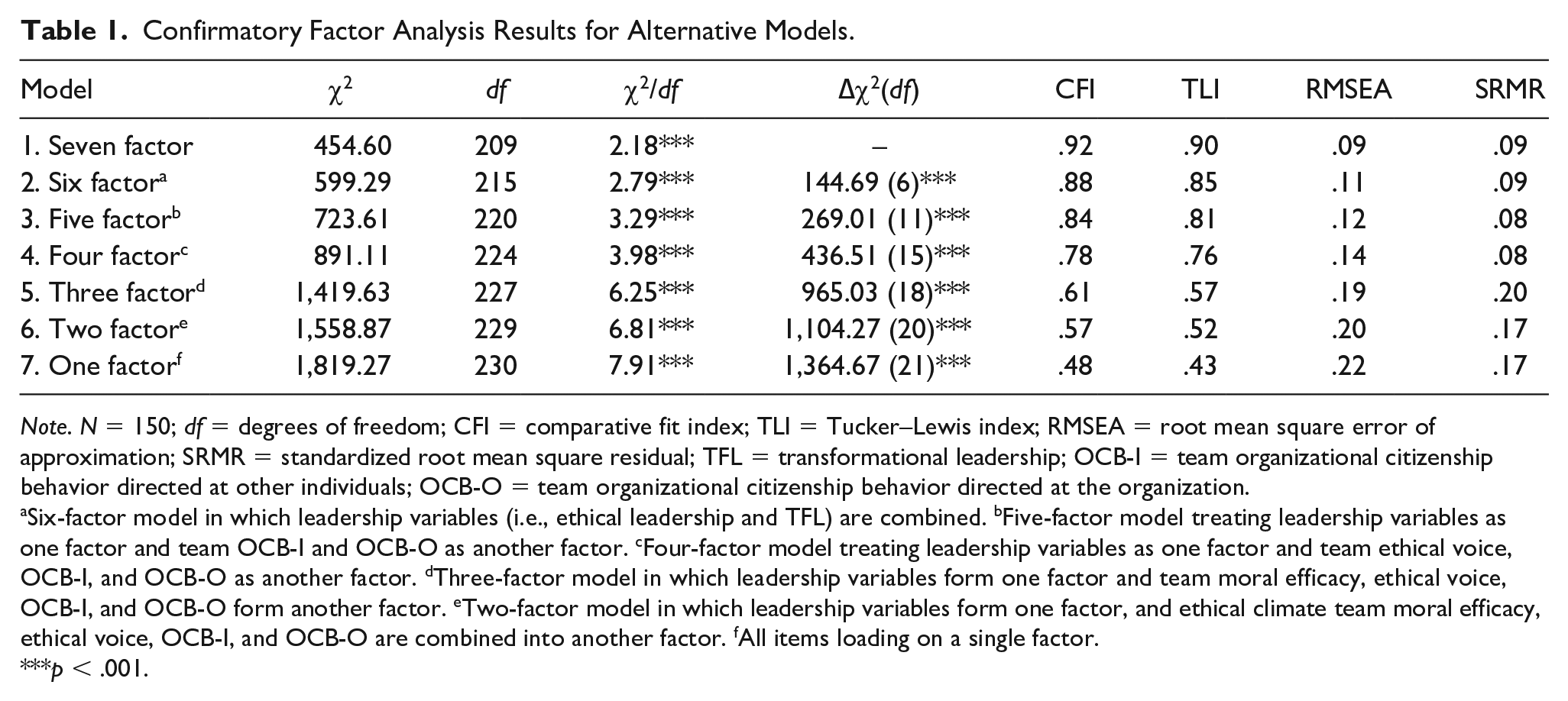
Note. N = 150; df = degrees of freedom; CFI = comparative fit index; TLI = Tucker–Lewis index; RMSEA = root mean square error of approximation; SRMR = standardized root mean square residual; TFL = transformational leadership; OCB-I = team organizational citizenship behavior directed at other individuals; OCB-O = team organizational citizenship behavior directed at the organization.
Six-factor model in which leadership variables (i.e., ethical leadership and TFL) are combined. bFive-factor model treating leadership variables as one factor and team OCB-I and OCB-O as another factor. cFour-factor model treating leadership variables as one factor and team ethical voice, OCB-I, and OCB-O as another factor. dThree-factor model in which leadership variables form one factor and team moral efficacy, ethical voice, OCB-I, and OCB-O form another factor. eTwo-factor model in which leadership variables form one factor, and ethical climate team moral efficacy, ethical voice, OCB-I, and OCB-O are combined into another factor. fAll items loading on a single factor.
p < .001.
Correlations and Descriptive Statistics
Correlations and descriptive statistics are reported in Table 2. The reliabilities were reasonably high for all variables (≥ .78). Ethical leadership was positively correlated with team moral efficacy (r = .64, p < .001) and team OCB-I (r = .25, p < .01), but unrelated to team ethical voice (r = .13, ns) and team OCB-O (r = .15, ns). In addition, team moral efficacy was positively correlated with team ethical voice (r = .19, p < .05) and team OCB-I (r = .28, p < .001), but unrelated to team OCB-O (r = .12, ns).
Means, Standard Deviations, and Correlations for the Study Variables.

Note: N = 150 (team-level correlations); M = mean; SD = standard deviation; TFL = transformational leadership; OCB-I = team organizational citizenship behavior directed at other individuals; OCB-O = team organizational citizenship behavior directed at the organization. Reliabilities are reported on the diagonal in parentheses.
Rated by team members. bRated by team leaders.
p < .05. **p < .01. ***p < .001.
Structural Model Analyses
We tested the structural model associated with our hypotheses (Figure 1) using Mplus 8.4 (Muthén & Muthén, 2017) and maximum likelihood estimation with robust standard errors (MLR). Because the leader-rated variables were moderately correlated with one another, we allowed their residuals to be freely correlated. As shown in Table 3, the hypothesized structural model displayed an acceptable fit to the data, χ2(276) = 521.40, CFI = .91, TLI = .90, RMSEA = .08, SRMR = .09. We compared this model to several plausible alternative models. Prior meta-analyses have indicated that ethical leadership is positively related to voice behavior and OCB (e.g., Bedi et al., 2016 [voice: rc = .36; OCB: rc = .37; OCB-I: rc = .29]; Chamberlin et al., 2017 [voice: rc = .21]; Hoch et al., 2018 [OCB-I: rc = .28; OCB-O: rc = .36]; and T. W. Ng & Feldman, 2015 [voice: rc = .32; OCB-I: rc = .22; OCB-O: rc = .27]). To account for these previous findings, we tested the following alternative models. Alternative Model 1 added a direct path from ethical leadership to team ethical voice. This model did not improve over the theoretical model, Δχ2(1) = 1.04, ns, and the added path was non-significant. Alternative Models 2 and 3 added a direct path from ethical leadership to team OCB-I and team OCB-O, respectively. These models were not superior to the theoretical model, Δχ2(1) = .78, ns, and Δχ2(1) = .96, ns, respectively, and the corresponding paths were non-significant. Based on prior research suggesting that TFL may be positively related to voice behavior and OCB (e.g., Chamberlin et al., 2017 [voice: rc = .30]; Hoch et al., 2018 [OCB: rc = .28]; T. W. Ng & Feldman, 2015 [OCB: rc = .26 (individual level), rc = .42 (team level)]), we examined Alternative Models 4 to 6, which added a link between TFL and ethical voice (Alternative Model 4), OCB-I (Alternative Model 5), and OCB-O (Alternative Model 6), respectively. These models did not improve over the hypothesized model, Δχ2(1) = 1.04, ns, Δχ2(1) = 3.75, ns, and Δχ2(1) = 1.55, ns, respectively, and the added paths were non-significant. Thus, based on the parsimony rule, we retained the hypothesized model as the best-fitting model for hypothesis testing. 1
Summary of Fit Statistics for Hypothesized and Alternative Structural Models.

Note. N = 150 (teams); df = degrees of freedom; CFI = comparative fit index; TLI = Tucker-Lewis index; RMSEA = root mean square error of approximation; SRMR = standardized root mean square residual; OCB-I = team organizational citizenship behavior directed at other individuals; OCB-O = team organizational citizenship behavior directed at the organization; TFL = transformational leadership.
p < .001.
Hypothesis Testing
The standardized path coefficients associated with the retained structural model are presented in Figure 2. Hypothesis 1 predicted a positive indirect relationship between ethical leadership and team ethical voice (Hypothesis 1a), team OCB-I (Hypothesis 1b), and team OCB-O (Hypothesis 1c) through team moral efficacy. Figure 2 shows that ethical leadership was positively associated with team moral efficacy (γ = .22, p < .05) and that, in turn, team moral efficacy was positively related to team ethical voice (γ = .25, p < .01), team OCB-I (γ = .32, p < .001), and team OCB-O (γ = .19, p < .01). We used bootstrapping (MacKinnon et al., 2007) in Mplus 8.4 using 1,000 resamples of the data and 95% bias-corrected confidence intervals (CIs) to estimate the indirect effects predicted in Hypotheses 1a and 1c. The indirect effect of ethical leadership on team ethical voice through team moral efficacy was significantly positive (b = .08, SE = .05, 95% CI = [.01, .17]). Hypothesis 1a is thus supported. Likewise, the indirect effects of ethical leadership on team OCB-I (b = .10, SE = .06, 95% CI = [.01, .21]) and team OCB-O (b = .02, SE = .02, 95% CI = [.00, .06]) through team moral efficacy were significant and positive, thus supporting Hypotheses 1b and 1c.
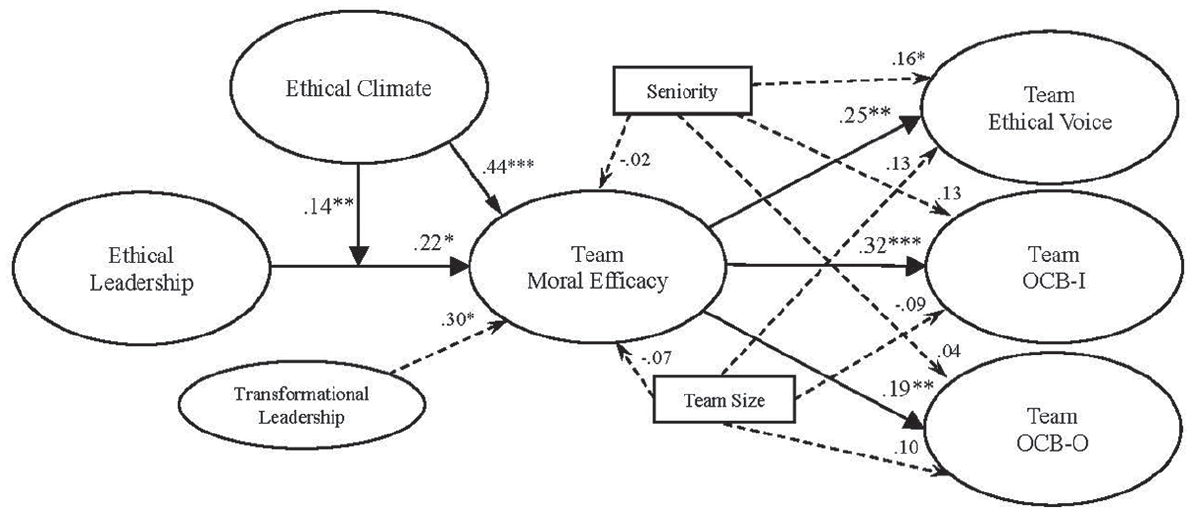
Final moderated mediation model (N = 150, teams).
Hypothesis 2 proposed that the relationships between ethical leadership and team ethical voice (Hypothesis 2a), OCB-I (Hypothesis 2b), and OCB-O (Hypothesis 2c) through team moral efficacy would be stronger at higher levels of ethical climate. Thus, Hypothesis 2 corresponded to a moderated mediation model where the moderator (i.e., team ethical climate) affects the first stage of the indirect relationship between ethical leadership and team ethical voice. As shown in Figure 2, ethical leadership and ethical climate interacted to affect team moral efficacy (γ = .14, p < .01). Figure 3 displays the relationship between ethical leadership and team moral efficacy at high (1 SD above the mean) and low (1 SD below the mean) levels of ethical climate. To formally test Hypothesis 2, we again used Mplus 8.4 (Muthén & Muthén, 2017) to obtain an estimate of the conditional indirect effects of ethical leadership on team ethical voice, OCB-I, and OCB-O at 1 SD above and below the mean level of ethical climate using 1,000 bootstrapped resamples of the data. The indirect effect of ethical leadership on team ethical voice was significantly positive, both at high levels (b = .09, SE = .06, 95% CI = [.01, .19]) and low levels (b = .07, SE = .05, 95% CI = [.00, .16]) of ethical climate. The difference in the strength of the indirect effects was significant (b = .02, SE = .01, 95% CI = [.00, .04]). Therefore, Hypothesis 2a is supported. Similarly, the indirect relationship between ethical leadership and team OCB-I was significantly positive, both when ethical climate was high (b = .11, SE = .06, 95% CI = [.02, .23]) and low (b = .09, SE = .06, 95% CI = [.01, .20]), and the difference between the two was significant (b = .02, SE = .01, 95% CI = [.01, .04]). Hypothesis 2b is thus supported. Finally, the indirect relationship between ethical leadership and team OCB-O was significantly positive, when ethical climate was high (b = .02, SE = .02, 95% CI = [.00, .06]) and low (b = .02, SE = .02, 95% CI = [.00, .05]), but the difference between the two effects was non-significant (b = .00, SE = .00, 95% CI = [−.00, .01]). Hence, Hypothesis 2c is not supported. Of incidental interest, as shown in Figure 2, TFL was positively related to team moral efficacy (γ = .30, p < .05).
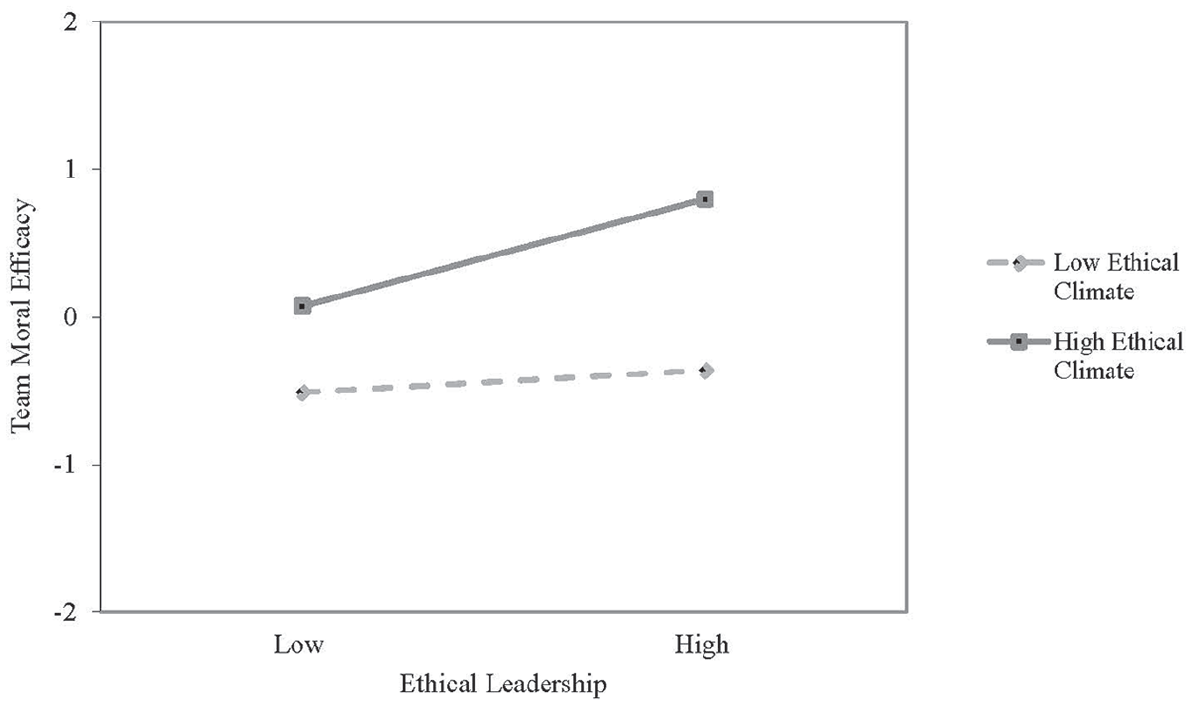
Interaction between ethical leadership and ethical climate predicting team moral efficacy.
Supplementary Analyses
Although we controlled for TFL to identify the unique contributions of ethical leadership, the high correlation between ethical leadership and TFL (r = .77, p < .01) raises an issue of potential redundancy with ethical leadership and suppression effect (Bedi et al., 2016; Hoch et al., 2018; Palanski et al., 2019). Hence, we reanalyzed our model without TFL as a control. In this model (Figure 4), ethical leadership remained positively related to team moral efficacy (γ = .41, p < .001) while team moral efficacy was also positively related to team ethical voice (γ = .25, p < .01), team OCB-I (γ = .32, p < .001), and team OCB-O (γ = .19, p < .01). Using bootstrapping in Mplus 8.4 with 1,000 resamples of the data and 95% bias-corrected CIs, the indirect relationship between ethical leadership and team ethical voice (b = .16, SE = .08, 95% CI = [.05, .29]), team OCB-I (b = .19, SE = .07, 95% CI = [.08, .33]), and team OCB-O (b = .03, SE = .03, 95% CI = [.00, .10]) through team moral efficacy remained significantly positive. Ethical leadership and ethical climate also interacted to affect team moral efficacy (γ = .15, p < .05). Based on 1,000 bootstrapped resamples of the data, the indirect relationship between ethical leadership and team ethical voice through team moral efficacy was positive and significant when ethical climate was high (b = .17, SE = .08, 95% CI = [.05, .31]) and low (b = .15, SE = .07, 95% CI = [.05, .28]), and the difference between the two was significant (b = .02, SE = .01, 95% CI = [.00, .04]). In addition, the indirect effect of ethical leadership on team OCB-I was significantly positive both at high (b = .20, SE = .08, 95% CI = [.09, .34]) and low (b = .18, SE = .07, 95% CI = [.08, .31]) levels of ethical climate. The difference between the two effects was significant (b = .02, SE = .01, 95% CI = [.01, .04]). Finally, the indirect effect of ethical leadership on team OCB-O through team moral efficacy was significant when ethical climate was high (b = .04, SE = .03, 95% CI = [.00, .11]) and low (b = .03, SE = .03, 95% CI = [.00, .09]), but the difference between the two was non-significant (b = .00, SE = .00, 95% CI = [−.00, .01]). Thus, these findings replicate those obtained with TFL as a control. 2
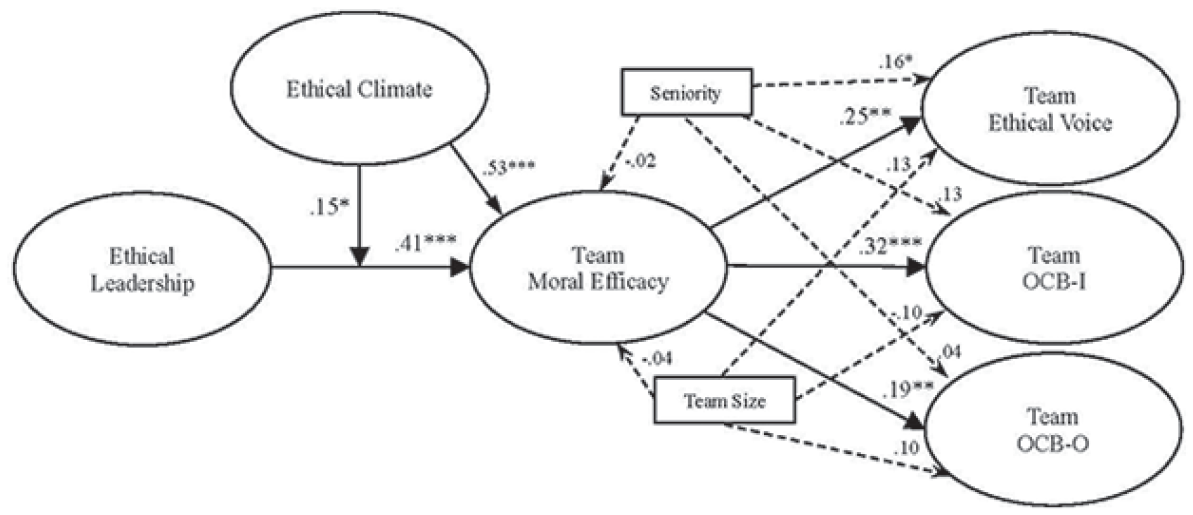
Moderated mediation model with transformational leadership excluded (N = 150, teams).
Discussion
Drawing upon social learning theory (Bandura, 1986, 2000), this study showed that ethical leaders help team members develop a collective confidence in their capability to perform ethical behaviors (i.e., team moral efficacy), which can be explained by role modeling, enactive mastery, and verbal persuasion. This results in enhanced team ethical voice, OCB-I, and OCB-O. Based on social information processing theory (Salancik & Pfeffer, 1978) and the social intuitionist model (Haidt, 2001), results further indicate that ethical leadership’s relationship to team ethical voice and OCB-I was enhanced when ethical climate was stronger. However, ethical climate did not moderate the indirect relationship between ethical leadership and team OCB-O. Our findings were held while accounting for the effect of TFL’s core dimension of “providing an appropriate model.” The theoretical and practical contributions of these results are outlined below.
Theoretical Contributions
This study makes contributions to the literature on ethical leadership and climate. First, findings indicate that ethical leadership relates to team ethical voice and OCB through a social learning process that aggregates at the team level. Although previous studies have examined social learning as a process linking ethical leadership to team outcomes (e.g., Bedi et al., 2016; Hoch et al., 2018; Mayer et al., 2012; T. W. Ng & Feldman, 2015; Walumbwa et al., 2012), this study highlights team moral efficacy as a specific mechanism. Team moral efficacy reflects the collective emergence of moral efficacy beliefs through the observation of leaders’ moral conduct, a sense of meaning obtained through reactions to ethical issues, and verbal persuasion by leaders to engage in moral behaviors (Bandura, 1997, 2000; Brown et al., 2005; Brown & Treviño, 2006). Even though ethical leaders who enforce compliance with normative standards may discourage team extra-role performance (Hannah et al., 2014; Lemoine et al., 2019; Mayer et al., 2013), this specific social learning mechanism explains how ethical leadership may foster team ethical voice and OCB. Moreover, results indicate that moral efficacy beliefs from team members aggregate to form a team-level phenomenon. Future research is needed to explore other psychological mediators at the team level (e.g., team moral ownership) that can explain how ethical leadership relates to team outcomes. Moreover, this line of work could be extended to address other relevant outcomes, such as team creative performance.
Second, drawing upon social information processing theory (Salancik & Pfeffer, 1978) and the social intuitionist model (Haidt, 2001), this study underlined the importance of ethical climate as a moderator of ethical leadership and added to the list of work climate types that have been examined as moderators of leadership (e.g., Porter & McLaughlin, 2006; P. Wang & Rode, 2010). In addition, our study indicates that the vagueness of team leaders’ judgment about ethical standards (Brown & Mitchell, 2010; Eisenbeiss, 2012; Lemoine et al., 2019; Palanski et al., 2019) can be reduced through the shaping influence of the formal laws and standards of ethical climate (Brown & Treviño, 2006; Treviño et al., 2003). Specifically, we found that within a strong ethical climate, team members are more likely to be responsive to ethical leaders’ moral behaviors plausibly because the actions of their leaders are consistent with the team’s ethical norms. In such conditions, the team’s confidence in its ability to engage in ethical behaviors is ultimately transferred to team ethical voice and OCB-I. By contrast, in a weak ethical climate, team members are less likely to endorse the moral values promoted by ethical leaders, resulting in a weaker indirect relation between ethical leadership and team ethical voice and OCB-I. Thus, the shared norms regarding the team’s ethical behaviors play a pivotal role in this process. An extension of this study could be to examine the impact of other positive team climate constructs (e.g., procedural justice climate and psychological safety climate) and climate strength as team-level moderators of ethical leadership (Koopman et al., 2016, 2019; Shin, 2012; Shin et al., 2015).
Third, ethical climate did not moderate the indirect relationship between ethical leadership and team OCB-O. In line with prior research (e.g., Kamdar et al., 2006; McAllister et al., 2007; Van Dyne et al., 2008), one plausible explanation for this is that team members may react differently to the interaction between ethical leadership and ethical climate depending on whether extra-role performance is experienced as in-role versus extra-role. Voice behavior and OCB have been originally conceptualized as discretionary, hence not explicitly rewarded by the organization. However, team OCB-O, which produces positive consequences for the organization, may be seen as in-role rather than extra-role (McAllister et al., 2007; Van Dyne et al., 2008). Indeed, in the military, team members may perceive team citizenship behavior directed toward the organization as part of the required team’s responsibility and prescribed by the organization’s code of conduct. In reality, team members may experience team OCB-I (e.g., assisting other team members who need some help in the team) as extra-role but team OCB-O (e.g., volunteering to provide services in an organizational event) as prescribed or nondiscretionary behavior. Unlike the business context, the military organization is a more extreme organization where team members are risking their own lives not only to save their colleagues but also to protect national security for citizens (J. Kim, 2016; K. Lee, 2018; Sosik et al., 2019). Future research is needed to further examine this issue in various organizational settings.
Finally, this study provides further evidence for the incremental validity of ethical leadership over and above TFL. Other studies have documented the unique contributions of ethical leadership over constructs such as TFL and transactional leadership (e.g., Bedi et al., 2016; Brown et al., 2005; Hoch et al., 2018; T. W. Ng & Feldman, 2015; Walumbwa et al., 2012). Bedi et al. (2016) argued that the boundaries between ethical leadership and TFL need to be clarified. We contend that the conceptual domain of ethical leadership is broader than that of TFL, although they share commonalities, such as an emphasis on fair treatment and role modeling. Extending recent arguments in the ethical literature (Lemoine et al., 2019; Palanski et al., 2019), this study indicates that one unique contribution of ethical leadership relates to compliance with moral values. Ethical leadership also involves the activation of the psychological mechanism of team-level moral efficacy, which acts as a driver of team ethical voice and OCB. This mechanism may be specific to ethical leadership. However, the incremental validity of ethical leadership should be further examined, for example, by exploring how it can affect team outcomes, controlling for other relevant leadership constructs, such as authentic leadership, servant leadership, or interactional fairness.
Practical Implications
This study offers practical implications for managers and organizations. First, our findings suggest that fostering ethical leadership may have beneficial effects on team members’ willingness to engage in ethical behaviors, voicing ethical concerns, and prosocial behavior toward colleagues. Consistent with the existing literature (e.g., L. Huang & Paterson, 2017; Mayer et al., 2012; Shin, 2012; Walumbwa et al., 2012), when leaders are perceived as more ethical, team members not only engage in more team ethical voice but also exhibit team citizenship behaviors. These outcomes may contribute to building better workplaces. Thus, value exists for organizations to recruit and develop leaders who possess high ethical standards. Indeed, organizations have emphasized the importance of integrity and ethical values in appointing top executives. However, similar attention has not been devoted to how organizations choose leaders at lower levels of the hierarchical ladder, because immediate supervisors and managers are often selected based on the quality of their performance record. This lack of attention may be an unfortunate oversight, because supervisors and managers often have greater influence than top executives on employees’ attitudes and behaviors due to their physical proximity with subordinates (Davis & Rothstein, 2006). Organizations would be well advised to select and promote into these positions those followers who exhibit the traits of ethical leaders. Similarly, organizations may build training programs (e.g., leadership development programs) that develop ethical leadership abilities among the lower ranks of the organizational hierarchy.
Second, organizations should be cautious about team climate in implementing social learning interventions. They should be aware of the role of team ethical climate to maximize the effectiveness of ethical leadership, because such activities may be more effective among team members who are affiliated with teams that display a strong ethical climate. Therefore, organizations should invest resources that help improve the ethical climate within teams to facilitate team members’ learning of the guidelines, bolstered by ethical leaders and their implementation to promote ethical and prosocial behaviors in the workplace (Shin, 2012).
Limitations and Future Directions
This study has limitations. First, all the data were collected at the same point in time, preventing us from drawing causal inferences. Nevertheless, the strength of our study is that it used data from different sources, and that consensus was evident among employee responses to allow the data to be aggregated at the team level. However, replications of the current findings using a longitudinal design would be helpful in reaching safer conclusions regarding the temporal relationships among our variables. Second, though we used seniority as a culture-specific control, our context was peculiar due to all respondents being male soldiers, which limits the generalizability of the findings. Similar to other military organizations (e.g., the U.S. military), the South Korean military is a male-dominated organization with formal rank systems and hierarchical structure, and routinized task behavior (Griffin & Mathieu, 1997; Hannah et al., 2009; Schaubroeck et al., 2012). Although the South Korean military is currently in a state of armistice with North Korea, its core objective remains to defend against existing North Korean military threats (J. Kim, 2016; K. Lee, 2018). In addition, South Korea is characterized by high power distance and collectivism. In a high power distance culture, the authority of leaders is considered legitimate, and the ability of leaders to influence subordinates might be stronger than in low power distance cultures (e.g., Dickson et al., 2003; House et al., 2004; Kirkman et al., 2009; Lian et al., 2012). Given this, our finding of a moderating effect of ethical climate is noteworthy, because it reveals that the effect of ethical leadership varies across teams, even if the dominant culture provides leaders with a great deal of power. Undoubtedly, it would be worth examining if ethical leadership and ethical climate similarly interact in low power distance cultures. More generally, future research using data from other countries as well as different types of organizations with a broad diversity of demographic samples is warranted.
Third, we examined the incremental validity of ethical leadership over and above TFL, which was a step toward addressing potential redundancies across leadership constructs (Dust et al., 2018; Mayer et al., 2009; Walumbwa et al., 2012). However, other leadership constructs that share similarities with ethical leadership (e.g., authentic leadership, transactional leadership, and servant leadership) were not introduced as controls in our analyses. Thus, although prior studies have suggested that ethical leadership is different from other related leadership constructs (e.g., Bedi et al., 2016; Brown et al., 2005; Brown & Treviño, 2006; Hoch et al., 2018; Lemoine et al., 2019; T. W. Ng & Feldman, 2015), the question remains as to whether employee reactions to ethical leadership, as observed in this study, would actually be due to the overlap between ethical leadership and related leadership constructs (Hunter, 2012). It would be useful for future research to examine the extent to which the social learning process associated with ethical leadership is shared with other leadership constructs. Finally, we selectively measured ethical climate through its law and code dimension and TFL through its dimension of “providing an appropriate model.” Although these scales displayed strong reliability (αs = .87 and .94, respectively), future research is needed to replicate the current findings using the complete set of ethical climate and TFL dimensions.
Conclusion
This study examined a team-level model of ethical leadership in the Republic of Korea Army. Based on social learning theory (Bandura, 1986, 2000), the study indicated that social learning, as operationalized by team moral efficacy, mediated a positive relationship between ethical leadership and team ethical voice, OCB-I, and OCB-O. Drawing upon social information processing theory (Salancik & Pfeffer, 1978) and the social intuitionist model (Haidt, 2001), we further demonstrated that team ethical climate acts as a boundary condition such that the indirect relationship between ethical leadership and team ethical voice and OCB-I was enhanced in teams characterized by a strong ethical climate. These results suggest that the interplay among ethical leadership, ethical climate, and team moral efficacy is critical in comprehending how teams’ ethical voice and OCB are generated. We hope that these findings will encourage further research endeavors at exploring the mechanisms by which ethical leadership affects team outcomes.
Footnotes
Declaration of Conflicting Interests
The author(s) declared no potential conflicts of interest with respect to the research, authorship, and/or publication of this article.
Funding
The author(s) received no financial support for the research, authorship, and/or publication of this article.

Associate Editor: Hannes Leroy